© 2017, IRJET | Impact Factor value: 6.171 | ISO 9001:2008 Certified Journal | Page 1334
User Preference Based Network Selection in Wireless Networks
Vrushali U. Uttarwar
1, Dipali M. Patil
21,2
Department of Computer Engineering, D.Y. Patil College of Engineering, Akurdi, Pune, India
---***---Abstract -
An Wireless networking is becoming anincreasingly important and popular way of providing global information access to users on the move. One of the main challenges for seamless mobility is the availability of simple and robust vertical handoff algorithms, which allow a mobile node to roam among heterogeneous wireless networks. The objective is to determine the conditions under which handoff should be performed. Nowadays mobile handsets are capable of having different network interfaces. There are multiple criteria for handoff in NGWN. Handoff decision algorithm decides the optimal target network by considering a set of decision parameters including available bandwidth, velocity, throughput, monetary cost, security and user preference. One of the technical challenges with this integration and interfacing of heterogeneous wireless networks is handoff decision that is used to choose the optimal network depending upon the type and service requirements demanded by the user’s application. Heterogeneous wireless network will be dominant in next generation wireless networks (NGWN). Increasing user demands and the growing interest of service providers to offer diverse applications have motivated the integration of heterogeneous wireless networks which enable the users to move seamlessly across different types of networks and to enjoy anytime, anywhere services.
Key Words: Mobility management, Next generation
wireless networks, Media independent handoff, Vertical handoff management.
1. INTRODUCTION
There has been tremendous changes taking place in concern to network landscape, recently most of the homogeneous networks are changed to heterogeneous networks. The reason behind this is, due to the innovation of multimodal terminal devices that has the ability to support more than one type of network with multiple interface capability. Handoff is the method by which a mobile node can move logically within the network environment without any service interruptions and keeps its session active while on the move Handoff execution is initiated by the selection of access network only when the strength of signal from the base station goes down or the base station is unable to provide service as per the users requirements.
Crowded scenes have been more frequent in the real world because of increase of population and variety of human activities. Due to increase in popularity a crowded scenes analysis is an area of interest to scientists in the recent times. It brings out massive challenges to public management, security or safety. In the last decade,
automated scene analysis has already pulled much research attention in the computer vision community. In case of crowded scenes, the problems cannot be handled well due to the large number of individual participation. These individual not only cause the detection and tracking fail, but also greatly increases computational complexity. Under such circumstance, crowded scene analysis as a unique topic, is specifically addressed.
Different types of Next generation wireless networks such as GPRS, LTE, WiMAX and WLAN are brought together to form a single wireless network environment the reason behind this is that a single type of network or an homogenous network hardly could satisfy different need of services required by users and diverse applications. Each network has its own ability to support different kinds of application and services with different quality of service requirements [1].
In order to overcome such drawbacks and gain benefit from the diversity of different technologies these next generation wireless networks are brought to form a single network and support such diverse application and maximally satisfy users needs.
Selection of the optimal network among available networks is one of the challenging tasks because several criteria’s and parameters involved in it such as service type, network condition, system performance and user preferences for making the decision.
© 2017, IRJET | Impact Factor value: 6.171 | ISO 9001:2008 Certified Journal | Page 1335 Fig. 1. Classification of handoff
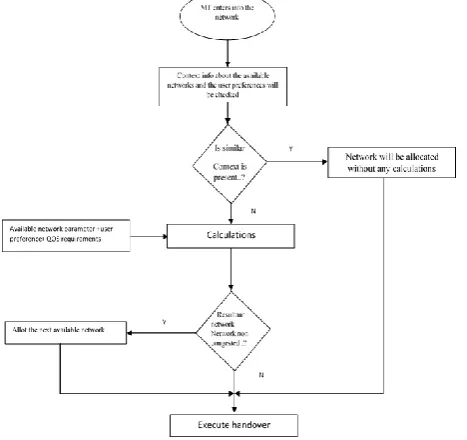
Decision Module will use these parameters for computing the utility factor for each network and selects the best among them for executing the handoff. The proposed system cut downs the computational complexity by selecting the available context information of optimal networks from the database. The proposed system best meets the need of user and ensures the selection of optimal network to perform handoff in heterogeneous wireless network environment.
2. RELATED WORK
Sharing of connection by different types of wireless networks is called vertical handoff. It has different phases such as: handoff initiation, discovering networks, decision making and execution of handoff. The MN acquires the neighbor networks information like: bandwidth available cost of service, network security, delay and packet loss in discovering the network. During the decision making, by using this information obtained, the node will decide the connection network. Later in execution of handoff the node will carry out its connection with the targeted network. Various network selection algorithms can be classified [8] as (1) Traditional (Received signal strength), (2) Bandwidth based, (3) Functional-based, (4) Multi-criteria, (5) Computational intelligence and (6) Context aware. RSS based traditional VHD algorithms in compares the RSS of the current point of attachment against the others to make handoff decisions. The author has classified the RSS based algorithm into different sub-categories on vertical as well as horizontal handoff. The complexity of RSS based algorithms is simple, which is followed by bandwidth based algorithms. Bandwidth based algorithm as in it is also shown that, SINR based handoffs has the ability to provide with higher overall throughput than RSS based handoffs to users since the throughput that is available, will depend on the SINR, and the resultant algorithm is capable of balancing the loads between the WLAN and the WCDMA networks. But such an algorithm may also tends to unnecessary handoffs with variation to signal to interference and noise ratio (SINR) that causes the mobile node to handoff forth and back between two networks, this situation is referred as the Ping-Pong effect, this algorithm reduces the wrong decision probability and traffic load balancing where, Received signal strength isn’t considered. A handoff to a selected network with more bandwidth and weak strength of signal received is not required as those results into breakdown of the connection.
In Context-aware handoff decision making the terminal governs its surroundings and saves context information that is relevant for making handoff. Context aware decision making governs and uses information of device, network, and user and try to improve the connectivity, QoS and by maintaining users satisfaction. In a context-aware vertical handoff decision strategy is used that combines the fuzzy logic technique and the AHP technique for selecting the best network. Imprecise data during handoffs are also handled and addressed. IEEE 802.21 Media Independent Handoff (MIH) approach [15] allowed a common primitive for heterogeneous network environment for central abstraction of control and information querying that acts as a common interface for exchange messages by providing functionalities such as event service, command service and information service of MIH. The author in [7] proposed handoff architecture for heterogeneous networks. This architecture was an extension to the IEEE 802.21MIH. The proposed architecture considered the users needs and resources that are available of IEEE class for making the decision for best network selection. To enable the MIH functionality and enabling accepting of multiple hop mode to operate in heterogeneous wireless network environments by effectively using the services provided by MIH framework an extended MIH model for Multi hop mode operation was proposed in. The proposed techniques proved to be vital in multi-hop seamless handoff when it comes to consider in the personal environments. This model presents and evaluates the message exchange functionality to enhance the MIH services. The results show that user experiences seamless mobility in both single model and multimodal hop networks scenarios. Some simulation results shown by author also proved that the proposed system gains the benefit of MIH Event triggers in predicting a connection loss that may happen in future; this can result in a reduced delay in handoff and early preparation for making handoff.
[image:2.595.322.561.578.746.2]2.1 Proposed MIH based Optimal Network Selection In the proposed system mobile terminal requires information about the available access networks for the decision making and computation.
© 2017, IRJET | Impact Factor value: 6.171 | ISO 9001:2008 Certified Journal | Page 1336 Independent handoff standard makes it easy for
exchanging and signaling the message between different modules and access networks. This standard helps in obtaining required information about network as well as user.
3. IEEE 802.21 MIH STANDARD OVERVIEW
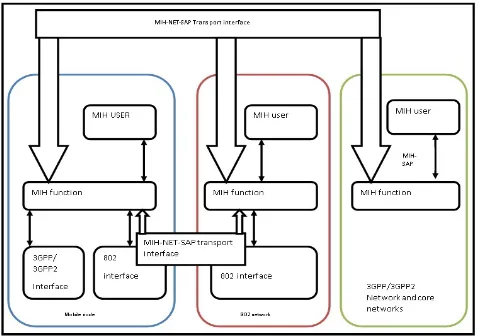
A protocol has been proposed for vertical handoff based on IEEE 802.21 MIH [6] it makes link layer and other information associated to it available for upper layers to achieve mobility between heterogeneous networks while keeping session continued. The proposed system will be configured by MIH framework for providing a common interface for managing events and controlling messages that switches between the modules and different access networks. An overview of the general architecture of the MIH framework as defined by IEEE 802.21 standard, fig.2 shows a MN that has two interfaces, a 3GPP interface and an 802 interface that is connected to the network. It shows also the intern architecture of the 802 network (which can be an access point) and the 3GPP network (the base station). All the nodes displayed in the figure have a central entity MIHF. The MIHF provides services to the upper layers through interfaces that are technology independent. It obtains information from the lower layers through many interfaces or technology-dependent system access points (SAPs). This information is used by the MIH users to make better handoff decisions. The communication between MIHF and the MIH users and between MIHF and lower layers is done through the use of SAPs. The current version of IEEE 802.21 defines three types of SAPs.
1) MIH-SAP: used for communication between MIH users and the MIHF.
2) MIH-LINK-SAP: used for communication between the MIHF and lower layers.
3) MIH-NET-SAP: used for the exchange of information between remote MIHF.
4) MIH point of service (MIH PoS): a network entity that exchanges necessary MIH messages with MNs. A PoS can
communicate with many MNs at a time, a MN an communicate with many PoSs.
5) MIH point of attachment (PoA): can be an access point (AP) or a base station (BS).
In the context of MIHs, there are two types of entities. Non-MIH entities are managed by a third party. Non-MIH entities implement the standard. All these entities and their interactions are represented in Fig. 2, which is a reference model for 802.21
3.1 System design and architecture
The proposed system architecture is shown in fig. 3 The mobile terminal(MT) with multiple interfaces have the capability to operate in 3GPP LTE, WiMAX and Wi-Fi interfaces, and use the services supplied by the MIHF to
[image:3.595.307.556.159.326.2]provide an integrated architecture. We suppose also that all entities networks are equipped with MIH functionalities. The core network (MIIS server) is assumed to be able to connect a variety of different access systems, and access selection derived from a mixture of user preferences, access network conditions.
Fig. 3. Proposed architecture
3.2 Profile Database (PD)
It maintains all the required information that is required to assist the selection decision algorithm when it makes the best network selection decisions. The following data are stored in the PD: Data related to applications QoS requirements. It contains mainly the QoS level required by each application. For example, the useful parameters from the application QoS requirements could be: Minimum necessary bit rate (kb/s),supported bit error rate, required security level and maximum tolerated delay. Data related to the available networks performance such as the mean bit rate, the maximum packet size, the packet error rate, the bit error rate, and the average latency to send a packet.
3.3 Profile Manager (PM):
The PM includes two entities: I. Handoff Control Manager (HCM) : HCM has the abilities to support MT controlled handoff. Context Aware Manager (CAM): CAM identifies information of MT and generates trigger events to HCM. HCM supervises all the available entities that are responsible for the optimal network selection decision (network, user, application, and terminal) and stores the necessary information in the PD. The HCM also determines when it is necessary to trigger the Selection Decision Module (SDM) and assists in making the choice of the best access. Indeed, the HCM triggers the SDM in the following cases:
1) A modification of network interface status. 2) An application been created or deleted.
© 2017, IRJET | Impact Factor value: 6.171 | ISO 9001:2008 Certified Journal | Page 1337 HCM has the ability to make the automatic selection of an
access network. It does the selection by keeping all the required information for selecting proper interface configuration.
3.3.1 Selection Decision Module (SDM):
Selection decision module is called when trigger event is generated from the profile Manager to selection of optimal network among available network only when the HCM fails to select the network.
4 PROPOSED SELECTION DECISION MODULE
In heterogeneous environments, criteria to select the best network is one of the main challenges for achieving seamless mobility, as there is no single factor than can provide a clear idea of which to select. Some of the most important decision factors are:
1) User satisfaction degree. 2) Offered bandwidth. 3) Velocity.
4) Signal strength.
5) Interference (load balancing). 6) Power requirements.
Each network selection algorithm proposed in related work has its own advantages and disadvantages. All of them where designed to meet different needs of mobile users with respect to bandwidth, reliability, cost or power conservation. The proposed system uses multi criteria decision making strategy for finding the optimal network. It uses the parameters of available networks, QoS requirements and user preference for computing the optimal network among available access networks.
5 MATHEMATICAL MODULE
This section presents the set theory analysis. 1) Let S be the set of proposed system S= Ev, Cm, In, F, Fs, Fl Where,
Ev= Event services. Cm= Command services. In= Information services. F= Set of functions. Fs= Final state. Fl= Failure state. 2) Identify the inputs. Let I be the set of inputs.
I= Ia, Nid, Lp, Rp, Cst, Sc, Qos Where,
Ia = Information about List available networks. Nid= Information about network ID.
Lp = Information about access point. Rp = Information about Roaming partners. Cst= Information of cost of service. Sc = Information of security.
Qos= Information about quality of service requirements. 3) Identify the set outputs.
Let O be the set of outputs. O=E, T, Cmd Where, E = Events service. T = Triggers.
Cmd= Command service. 4) Identify the set of Functions Let F be the set of Functions F= F1, F2, F3, F4 Where,
F1 = Handoff initiate. F2 = Handoff preparation. F3 = Handoff complete. F4 = Handoff commit. 5) Final state.
Fs= Always best connected.
6) Failure case. Fl= No network found
6 PROPOSED ALGORITHM
[image:4.595.308.542.524.744.2]This section presents the steps in proposed algorithm 1. Event occurs: The mobile terminal enters into the radio access technology and makes a call for list of available networks.
© 2017, IRJET | Impact Factor value: 6.171 | ISO 9001:2008 Certified Journal | Page 1338
4. CONCLUSIONS AND FUTURE SCOPE
The proposed system presents a new and efficient method with objective to determine the optimal network available under which handoff should be performed. To support MIH services, appropriate primitives are added to configure the wireless network this is why it is still not fully exploited and not yet largely implemented by the industry. Work should be done so that no additional primitives need to be added.
REFERENCES
[1] Abhijit Sarma,Sandip Chakraborty, Context Aware
Handover Management: Sustaining QoS and QoE in a Public IEEE 802.11e Hotspot,IEEE transactions on network and service management DEC 2014.
[2] [2] S.R. Mugunthan a, C. Palanisamy b, Localized handoff
architectures for seamless access in wireless networks,ScienceDirect, Computers and Electrical Engineering .pp 494503, 2014.
[3] [3] Shanzhi Chen, Yan Shi, Bo Hu, and Ming Ai,
Mobility-Driven Networks (MDN): From Evolution to Visions of Mobility Management, IEEE Network , July/August 2014.
[4] [4] Igor Bisio,Carlo Braccini,Stefano Delucchi, Fabio
Lavagetto and Mario Marchese, Dynamic Multi-Attribute Network Selection Algorithm for Vertical Handoff Procedures over Mobile Ad Hoc Networks, IEEE Adhoc and Sensor Networking Symposium, 2014.
[5] [5] Kiran Ahujaa, Brahmjit Singhb, Rajesh Khanna,
Network selection algorithm based on link quality parameters for heterogeneous wireless networks, Science Direct- optik.pp 3657-3662, 2014.
[6] [6] N. Omheni, F. Zarai, M. S. Obaidat, and L. Kamoun,
Optimized MIHAssisted P-NEMO design for Vertical Handoff over Heterogeneous Network Mobility, IEEE - Mobile and Wireless Networking Symposium,2014.
[7] [7] Jos Jailton, Tssio Carvalho, Warley Valente, Carlos
Natalino,and Renato Francs, A Quality of Experience Handoff Architecture for Heterogeneous Mobile Wireless Multimedia Networks, IEEE Communications Magazine, 2013.
[8] [8] Dhanaraj Cheelu , M. RajasekharaBabu , P. Venkata
Krishna, A Study of Vertical Handoff DecisionStrategies in Heterogeneous WirelessNetworks, International Journal of Engineering and Technology IJET, JunJul 2013
[9] [9] Sandra Brigit Johnson ,SaranyaNath P and
T.Velmurugan, An Optimized Algorithm for Vertical Handoff in Heterogeneous Wireless Networks, ,IEEE Conference on Information and Communication Technologies ICT 2013.
[10] [10] Shin-Jer Yang , Wen-Chieh Tseng, Design novel
weighted rating of multiple attributes scheme to enhance handoff efficiency in heterogeneous wireless networks, Science Direct, Computer Communications .pp-1498-1514, 2013.
[11] [11] Zohar Naor, Fast and reliable handoff for vehicular
networks, Science Direct, Ad Hoc Networks. pp.2136-2145,
[12] 2013.
[13] [12] Muhammad Younas and Irfan Awan, Mobility
Management Scheme for Context-Aware Transactions in Pervasive and Mobile Cyberspace,IEEE TRANSACTIONS ON INDUSTRIAL ELECTRONICS, VOL. 60, NO. 3, MARCH 2013.
[14] [13] Dong-Hoon Shin, Danny Moses and Muthaiah
Venkatachalam, Saurabh Bagchi, Distributed Mobility Management for Efficient Video Delivery over All-IP Mobile Networks: Competing Approaches,IEEE Network, March/April 2013.
[15] [14] D. Corujo, M. Lebre, D. Gomes, R. L. Aguiar,
Furthering Media Independence Mechanisms for Future Internet Enablement, Workshop on Telecommunications, IEEE pp-978-4577, 2012.
[16] [15] Tiago Cardoso, Pedro Neves, Manuel Ricardo,