Conrad C. Weihl
J Clin Invest.
2011;
121(12)
:4627-4630.
https://doi.org/10.1172/JCI61126
.
Inclusion body myopathy with Paget disease of the bone and frontotemporal dementia
(IBMPFD) is a multisystem degenerative disorder caused by mutations in the
valosin-containing protein (
VCP
) gene. How missense mutations in this abundant, ubiquitously
expressed, multifunctional protein lead to the degeneration of disparate tissues is unclear.
VCP participates in diverse cellular functions by associating with an expanding collection of
substrates and cofactors that dictate its functionality. In this issue of the
JCI
, Wang and
colleagues have further expanded the VCP interactome by identifying neurofibromin-1
(NF1) as a novel VCP interactor in the CNS. IBMPFD-associated mutations disrupt binding
of VCP to NF1, resulting in reduced synaptogenesis. Thus, aberrant interactions between
VCP and NF1 may explain the dementia phenotype and cognitive delay observed in
patients with IBMPFD and neurofibromatosis type 1.
Commentary
Find the latest version:
in many cell types. Nor is the issue of cell autonomy settled: does the expression of
SPTLC1 mutations by neurons alone lead to neuropathy? The C133W transgenic mice used by Garofalo et al. (16) are not helpful in this regard, because expression of the C133W mutation is controlled by the β -actin promoter, which is ubiquitous-ly expressed. Furthermore, even with this transgene, the amount of measured axonal loss is slight compared with the devastating loss that has been documented in affected patients (11). Let’s get back to the lab.
Acknowledgments
The author’s work is supported by the NIH, the National Multiple Sclerosis Society, the Muscular Dystrophy Association, and the Charcot-Marie-Tooth Association.
Address correspondence to: Steven S. Scherer, Department of Neurology, The Perelman School of Medicine at the Univer-sity of Pennsylvania, Room 450 Stemmler Hall, 36th Street and Hamilton Walk, Phil-adelphia, Pennsylvania 19104-6077, USA.
Phone: 215.573.3198; Fax: 215.573.4454; E-mail: [email protected].
1. Kandel ER, Schwartz JP, Jessell TM. Principles of Neural Science. New York, New York, USA: Elsevier; 2000. 2. Salzer JL. Polarized domains of myelinated axons.
Neuron. 2003;40(2):297–318.
3. Shy ME, Lupski JR, Chance PF, Klein CJ, Dyck PJ. Hereditary motor and sensory neuropathies: an overview of clinical, genetic, electrophysiologic, and pathologic features. In: Dyck PJ, Thomas PK, eds. Peripheral Neuropathy . Philadelphia, Pennsylva-nia, USA: Saunders; 2005:1623–1658.
4. Timmerman V. Inherited Peripheral Neuropa- thies Mutation Database. Human Genome Varia-tion Society web site. http://www.molgen.ua.ac. be/CMTMutations/. Updated February 17, 2011. Accessed September 23, 2011.
5. Latour P, et al. SIMPLE mutation analysis in dominant demyelinating Charcot-Marie-Tooth disease: three novel mutations. J Peripher Nerv Syst. 2006;11(2):148–155.
6. Saporta ASD, Sottile SL, Miller LJ, Feely SME, Sis-kind CE, Shy ME. Charcot-Marie-Tooth disease subtypes and genetic testing strategies. Ann Neurol. 2011;69(1):22–33.
7. Scherer SS, Wrabetz L. Molecular mechanisms of inherited demyelinating neuropathies. Glia. 2008;56(14):1578–1589.
8. Bejaoui K, et al. SPTLC1 is mutated in heredi-tary sensory neuropathy, type 1. Nat Genet. 2001; 27(3):261–262.
9. Dawkins JL, Hulme DJ, Brahmbhatt SB,
Auer-Grumbach M, Nicholson GA. Mutations in
SPTLC1, encoding serine palmitoyltransferase, long chain base subunit-1, cause hereditary sensory neu-ropathy type I. Nat Genet. 2001;27(3):309–312. 10. Rotthier A, et al. Mutations in the SPTLC2 subunit
of serine palmitoyltransferase cause hereditary sen-sory and autonomic neuropathy type I. Amer J Hum Genet. 2010;87(4):513–522.
11. Houlden H, et al. Clinical, pathological and genetic characterization of hereditary sensory and auto-nomic neuropathy type 1 (HSAN I). Brain. 2006; 129(pt 2):411–425.
12. Nicholson GA, Dawkins JL, Blair IP, AuerGrum-bach M, Brahmbhatt SB, Hulme DJ. Hereditary sensory neuropathy type I: Haplotype analysis shows founders in southern England and Europe.
Amer J Hum Genet. 2001;69(3):655–659.
13. Gable K, Gupta SD, Han G, Niranjanakumari S, Harmon JM, Dunn TM. A disease-causing muta- tion in the active site of serine palmitoyltrans-ferase causes catalytic promiscuity. J Biol Chem. 2010;285(30):22846–22852.
14. Penno A, et al. Hereditary sensory neuropathy type 1 is caused by the accumulation of two neurotoxic sphin-golipids. J Biol Chem. 2010;285(15):11178–11187. 15. Eichler FS, et al. Overexpression of the wild-type
SPT1 subunit lowers desoxysphingolipid levels and rescues the phenotype of HSAN1. J Neurosci. 2009;29(46):14646–14651.
16. Garofalo K, et al. Oral l-serine supplementation reduces production of neurotoxic deoxysphingo- lipids in mice and humans with hereditary sen-sory autonomic neuropathy type 1. J Clin Invest. 2011;121(12):4735–4745.
Another VCP interactor: NF is enough
Conrad C. Weihl
Department of Neurology and Hope Center on Neurological Disorder, Washington University School of Medicine, Saint Louis, Missouri, USA.
Inclusion body myopathy with Paget disease of the bone and
frontotem-poral dementia (IBMPFD) is a multisystem degenerative disorder caused
by mutations in the valosin-containing protein (
VCP
) gene. How missense
mutations in this abundant, ubiquitously expressed, multifunctional
pro-tein lead to the degeneration of disparate tissues is unclear. VCP participates
in diverse cellular functions by associating with an expanding collection of
substrates and cofactors that dictate its functionality. In this issue of the
JCI
, Wang and colleagues have further expanded the VCP interactome by
identifying neurofibromin-1 (NF1) as a novel VCP interactor in the CNS.
IBMPFD-associated mutations disrupt binding of VCP to NF1, resulting
in reduced synaptogenesis. Thus, aberrant interactions between VCP and
NF1 may explain the dementia phenotype and cognitive delay observed in
patients with IBMPFD and neurofibromatosis type 1.
Inclusion body myopathy with Paget disease of the bone and frontotemporal dementia (IBMPFD) is a rare, late age– onset inherited degenerative disorder that can affect the muscles, bones, and brain. It
is caused by autosomal dominant muta-tions in the valosin-containing protein (VCP; also known as p97) gene. Although IBMPFD is a fully penetrant disorder, it has variably penetrant phenotypes (1). Approx-imately 50% of IBMPFD patients initially present with muscle weakness in mid-life, and more than 90% will eventually develop disabling weakness. Characteristic of the heterogeneity of this disorder, patients can initially present with a proximal or distal
pattern of weakness that is often asymmet-ric. As the disease progresses, patients lose their ability to ambulate and develop respi-ratory failure that ultimately leads to death within 10–15 years of initial presentation. Among IBMPFD patients, 50% develop Paget disease of the bone (PDB), manifest-ing as painful osteolytic lesions, and 35% develop frontotemporal dementia (FTD), with mean onset 7–10 years later than mus- cle weakness or PDB. The potential for pro-gressing to FTD is particularly troubling to patients, who may experience changes in personality, language abilities, as well as cognitive function. The phenotypic diver- sity of IBMPFD is not attributable to dif-ferent mutations, since two patients with the same VCP point mutation, even within the same family, can present with drasti- cally different clinical features (e.g., demen-tia in one and isolated muscle weakness in another) (2). This intrafamilial variability makes the diagnosis of IBMPFD difficult. Whether there are environmental or genet-ic modifiers that explain this phenotypic variability is not known.
Conflict of interest: The author has declared that no conflict of interest exists.
Recently, it has been established that
VCP mutations are associated with neu-rodegenerative disorders other than IBMPFD, including amyotrophic lateral sclerosis (ALS) and Parkinson disease (PD) (3, 4), broadening the phenotypes caused by VCP mutations. However, even with this renewed interest in VCP and neurodegenerative disease, we do not have a clear understanding of the function of VCP in specialized cells such as neurons and how IBMPFD-associated VCP muta-tions alter these functions. In this issue of the JCI , Wang and colleagues now pro-vide new insight into the function of VCP in neurons and how this is disrupted by IBMPFD-associated mutations (5). This insight could potentially explain the dementia phenotype observed in patients with IBMPFD and cognitive delay in those with neurofibromatosis type 1.
VCP, a multifunctional ATPase Consistent with its multiple cellular roles, VCP is an AAA+ ATPase (ATPase
associated with diverse cellular activities). Among the diverse cellular processes for
which VCP is necessary are DNA replica- tion, mitosis, protein degradation, endo-cytosis, membrane fusion, and organelle biogenesis (6). The ability of VCP to par-ticipate in these functions relates to its promiscuity in substrate and cofactor binding. For example, depending upon which cofactors are available, VCP can pull aurora B kinase from chromatin to allow nuclear envelope reformation (7) or triage a misfolded protein that was extracted from the ER lumen to the pro-teasome for degradation (8). In order to understand the biologic processes attrib-uted to VCP, one must therefore define its interactome. To date, more than 50 proteins have been shown to associate with VCP either directly or indirectly via ubiquitin adaptors; however, the function of many of these interactions remains unclear (9). In addition, under-standing of cell type–specific interactors and cofactors that have impaired interac-tions with VCP mutants associated with disease is limited. Recent evidence sug-gests that it is alterations in cofactor and substrate association and not a global loss of VCP function that explains the pathogenesis of IBMPFD (10, 11).
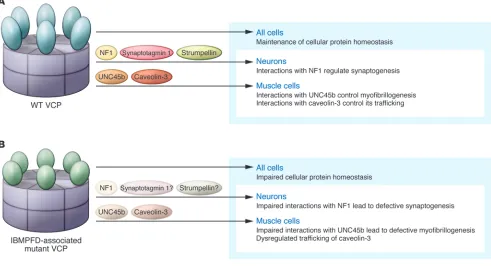
[image:3.585.48.539.88.356.2]IBMPFD-associated mutations in VCP alter global protein homeostasis In terminally differentiated cells such as the skeletal muscle cells and neurons affected in individuals with IBMPFD, VCP is important for maintaining cellular homeostasis (Figure 1A). VCP participates in the proteasomal degradation of misfolded proteins and the consolidation of protein aggregates into inclusion bodies (8, 12). More recently, VCP has been implicated in autophagic and lyso-somal degradative pathways (10, 13). VCP is also necessary for the autophagic degrada- tion of ubiquitinated proteins and mitochon-dria (14). In addition, VCP is required for the endolysosomal degradation of select plasma membrane proteins (10). Mutant forms of VCP associated with IBMPFD have been found to disrupt many of these homeostatic pathways (refs. 10, 12, 13, 15, and Figure 1B). IBMPFD mutations in VCP may therefore sensitize skeletal muscle and neurons to other environmental and genetic modifiers that enhance tissue-specific degeneration. Alternatively, IBMPFD-associated mutations in VCP may disrupt yet-to-be-defined tissue-specific processes accounting for the selective vulnerability of brain and skeletal muscle. Figure 1
IBMPFD-associated mutations in VCP disrupt select skeletal muscle– specific processes In the case of myopathy, perhaps dysfunc-tion in the skeletal muscle–specific myosin chaperone UNC45b and myosin stability (16, 17), as well as reduction in caveolin-3– mediated signaling (10), further contribute to the muscle weakness observed in individ-uals with IBMPFD (Figure 1B). In skeletal muscle, IBMPFD-associated mutations in VCP affect the degradation of UNC45b (16). Too much or too little UNC45b can affect the folding of myosin, altering its stability and resulting in defective myofibrillogen-esis (17). VCP and its cofactor Ufd2 bind to UNC45b and facilitate its degradation via the proteasome. Loss of Ufd2 or expres-sion of IBMPFD-associated mutant VCP stabilizes UNC45b, subsequently altering myosin stability. The stability and function of other muscle-specific proteins may also be disrupted in the muscle of patients with IBMPFD. Using tandem affinity purifica-tion of wild-type and IBMPFD-associated mutant VCP, Ritz and colleagues identi-fied caveolin as a novel VCP interactor that failed to associate with IBMPFD-associ- ated mutant VCP (10). VCP forms a com-plex with ubiquitinated caveolin and the VCP cofactor UBXD1. Disruption of this complex by chemical inhibition of VCP, knockdown of UBXD1, or expression of IBMPFD-associated mutant VCP impairs endolysosmal trafficking of caveolin (10). In muscle from patients with IBMPFD, the muscle-specific isoform of caveolin, caveo-lin-3, is delocalized from the sarcolemma and accumulates within the sarcoplasm (10). Whether VCP interacts with neuron-specific substrates and if this is affected by IBMPFD-associated VCP mutations, lead-ing to neurodegeneration, is not known.
VCP interacts with NF1 in the brain and mediates synaptogenesis In this issue of the JCI, Wang and colleagues identify a novel VCP interactor that may help to explain the CNS phenotype in individu- als with IBMPFD (Figure 1B). By immuno-precipitating neurofibromin-1 (NF1) from adult rat brain homogenates, they identified VCP, along with its cofactor p47, as high-probability interactors (5). Further analysis confirmed that VCP and NF1 interacted and mapped the region of interaction to a 400-amino-acid leucine-rich domain (LRD) of NF1. In cultured rat hippocampal neurons, knockdown of VCP decreased dendritic spine density, as did NF1 depletion in mice, suggesting that they participate in the same functional pathway. Moreover, expression of the LRD region of NF1 decreased spino-genesis, presumably by interfering with the endogenous interaction between VCP and NF1, since an LRD fragment that did not associate with VCP had no effect. IBMPFD-associated mutations in VCP abrogated the interaction with NF1, and expression of IBMPFD-associated mutant VCP also dimin-ished dendritic spine formation in cultured rat hippocampal neurons.
The mechanism by which VCP and NF1 mediate synaptogenesis is unclear. VCP associates with ubiquitinated substrates via common ubiquitin adaptor proteins that contain ubiquitin-binding domains (i.e., p47, Ufd1/Npl4, UBXD1, and UBXD7) (10). Although p47 was found by Wang and colleagues to co-immunoprecipitate with VCP and NF1 in rat brain homogenates (5), it is likely not necessary for the VCP-NF1 interaction, since a truncated VCP lacking the p47-binding region also bound avidly to NF1. Moreover, Wang and colleagues found that neither IBMPFD-associated mutant VCP nor dominant negative VCP affected NF1 stability or ubiquitination state. This is surprising, because others have found that NF1 protein levels can be stabilized by genetic knockdown of anoth-er known VCP cofactor and NF1 interactor, UBXD8 (18). Whether UBXD8 is the miss- ing link between VCP and NF1 in mediat-ing synaptogenesis remains to be studied. A role for VCP in synaptogenesis is intrigu-ing (5). Sudhof and Sugita have previously immunoprecipitated the synaptic vesicle pro-tein synaptotagmin 1 (Syt1) from rat brain and identified VCP as an interactor (19). VCP associates with Syt1 in a Ca2+
-depen- dent manner; however, unlike most special-ized synaptic proteins, VCP is expressed at high levels in all tissues examined and did not increase during postnatal brain develop-ment, when synaptogenesis occurs (18). VCP has also been found to associate with anoth-er presynaptic protein, strumpellin, which is mutated in a dominant form of familial spas-tic paraplegia (SPG8) (20, 21). In Drosophila neurons, potent VCP inhibition results in cel-lular stress and neuronal death, while mild VCP inhibition, as might be expected with IBMPFD-associated mutant VCP expression, affects dendritic pruning, suggesting that the level of expression of VCP is important for synaptic development and maintenance (22). The study by Wang and colleagues (5) further supports the notion that VCP is necessary for synaptic development.
VCP and NF1 are potential disease modifiers
and colleagues (5) establishes a framework for how to tease out genetic and biochemi-cal modifiers of complex phenotypes in monogenic disorders such as IBMPFD and neurofibromatosis type 1.
Acknowledgments
Conrad C. Weihl is supported by the NIH (R01 AG031867) and the Muscular Dystro-phy Association.
Address correspondence to: Conrad C. Weihl, Department of Neurology, Washington University School of Medicine, 660 S. Euclid Avenue, Saint Louis, Missouri 63110, USA. Phone: 314.362.6981; Fax: 314.362.4391; E-mail: [email protected].
1. Watts GD, et al. Inclusion body myopathy associat-ed with Paget disease of bone and frontotemporal dementia is caused by mutant valosin-containing protein. Nat Genet. 2004;36(4):377–381.
2. Weihl CC. Valosin containing protein associated fronto-temporal lobar degeneration: clinical pre-sentation, pathologic features and pathogenesis.
Curr Alzheimer Res. 2011;8(3):252–260.
3. Majounie E, et al. Mutational analysis of the VCP gene in Parkinson’s disease [published online ahead of print September 13, 2011]. Neurobiol Aging. doi:10.1016/j.neurobiolaging.2011.07.011.
4. Johnson JO, et al. Exome sequencing reveals VCP mutations as a cause of familial ALS. Neuron. 2010;68(5):857–864.
5. Wang H-F, Shih Y-T, Chen C-Y, Chao H-W, Lee M-J, Hsueh Y-P. Valosin-containing protein and neuro- fibromin interact to regulate dendritic spine den-sity. J Clin Invest. 2011;121(12):4820–4837. 6. Halawani D, Latterich M. p97: The cell’s molecular
purgatory? Mol Cell. 2006;22(6):713–717. 7. Ramadan K, et al. Cdc48/p97 promotes reformation
of the nucleus by extracting the kinase Aurora B from chromatin. Nature. 2007;450(7173):1258–1262.
8. Rabinovich E, Kerem A, Frohlich KU, Diamant N, Bar- Nun S. AAA-ATPase p97/Cdc48p, a cytosolic chaper-one required for endoplasmic reticulum-associated protein degradation. Mol Cell Biol. 2002;22(2):626–634. 9. Dreveny I, et al. p97 and close encounters of every kind: a brief review. Biochem Soc Trans. 2004; 32(pt 5):715–720.
10. Ritz D, et al. Endolysosomal sorting of ubiquity-lated caveolin-1 is regulated by VCP and UBXD1 and impaired by VCP disease mutations. Nat Cell Biol. 2011;13(9):1116–1123.
11. Fernandez-Saiz V, Buchberger A. Imbalances in p97 co-factor interactions in human proteinopathy.
EMBO Rep. 2010;11(6):479–485.
12. Ju JS, Miller SE, Hanson PI, Weihl CC. Impaired protein aggregate handling and clearance underlie the pathogenesis of p97/VCP-associated disease.
J Biol Chem. 2008;283(44):30289–30299. 13. Ju JS, et al. Valosin-containing protein (VCP) is
required for autophagy and is disrupted in VCP disease. J Cell Biol. 2009;187(6):875–888. 14. Tanaka A, et al. Proteasome and p97 mediate
mitophagy and degradation of mitofusins induced
by Parkin. J Cell Biol. 2010;191(7):1367–1380.
15. Weihl CC, Dalal S, Pestronk A, Hanson PI. Inclu-sion body myopathy-associated mutations in p97/ VCP impair endoplasmic reticulum-associated deg-radation. Hum Mol Genet. 2006;15(2):189–199.
16. Janiesch PC, et al. The ubiquitin-selective chaper-one CDC-48/p97 links myosin assembly to human myopathy. Nat Cell Biol. 2007;9(4):379–390. 17. Landsverk ML, et al. The UNC-45 chaperone
mediates sarcomere assembly through myosin degradation in Caenorhabditis elegans. J Cell Biol. 2007;177(2):205–210.
18. Phan VT, Ding VW, Li F, Chalkley RJ, Burlin-game A, McCormick F. The RasGAP proteins Ira2 and neurofibromin are negatively regulated by Gpb1 in yeast and ETEA in humans. Mol Cell Biol. 2010;30(9):2264–2279.
19. Sugita S, Sudhof TC. Specificity of Ca2+-depen-dent protein interactions mediated by the C2A domains of synaptotagmins. Biochemistry. 2000;39(11):2940–2949.
20. Clemen CS, et al. Strumpellin is a novel valosin- containing protein binding partner linking heredi- tary spastic paraplegia to protein aggregation dis-eases. Brain. 2010;133(10):2920–2941.
21. Valdmanis PN, et al. Mutations in the KIAA0196 gene at the SPG8 locus cause hereditary spastic paraplegia. Am J Hum Genet. 2007;80(1):152–161.
22. Rumpf S, Lee SB, Jan LY, Jan YN. Neuronal remod- eling and apoptosis require VCP-dependent degra-dation of the apoptosis inhibitor DIAP1. Develop-ment. 2011;138(6):1153–1160.
23. Shilyansky C, Lee YS, Silva AJ. Molecular and cel-lular mechanisms of learning disabilities: a focus on NF1. Annu Rev Neurosci. 2010;33:221–243.
On the origin of the liver
Joshua R. Friedman1 and Klaus H. Kaestner2
1Department of Pediatrics, 2Department of Genetics, and Institute for Diabetes, Obesity, and Metabolism,
Perelman School of Medicine, University of Pennsylvania, Philadelphia, Pennsylvania, USA.
While it has been well established that the fetal liver originates from foregut
endoderm, the identity of the mechanisms that maintain liver mass under
both basal and injury conditions remains controversial. Dramatically
differ-ent models have been proposed based on the experimdiffer-ental design employed.
In this issue of the
JCI
, Malato and colleagues report their elegant new model
for genetic lineage tracing of mature mouse hepatocytes using an
adenoas-sociated virus–driven Cre recombinase. They show convincingly that
main-tenance of liver mass during normal turnover or in response to mild injury
is achieved by mature hepatocytes, rather than cholangiocytes or specialized
progenitor cells, as has been suggested by others.
For parents, the question, where do babies come from? may cause dread or discom-fort. The same is true for scientists who are asked, where do hepatocytes come from? The reason for this is that there is not a single answer. Hepatocytes can arise from
different cell types depending on age (pre-natal vs. adult), the presence or absence of hepatic injury, and even the type and degree of injury. An understanding of hepatocyte origins is a prerequisite for advancing the treatment of liver disease by promoting regeneration of endogenous hepatocytes or by deriving hepatocytes ex vivo for cel- lular therapy. The work of Malato and col-leagues, reported in this issue of the JCI (1), adds
new and important information regarding the origins of adult hepatocytes, although controversy still remains.
Fetal hepatocytes are derived from hepatoblasts
One area of clarity regarding hepato-cyte origin is that embryonic and fetal hepatocytes arise from hepatoblasts, endo-derm-derived cells with the potential to differentiate into either hepatocytes, which populate the bulk of the liver parenchyma, or cholangiocytes, which line the intrahe-patic bile ducts. Cholangiocytes
differenti-ate from hepatoblasts near a transient fetal structure called the ductal plate, while the remaining hepatoblasts differentiate into hepatocytes (2). Hepatoblasts are charac-terized by coexpression of biliary markers (e.g., cytokeratin 19) and hepatocyte mark- ers (e.g., albumin) as well as hepatoblast-specific genes (e.g., α-fetoprotein). Shortly after birth, this cell type is virtually unde- tectable in situ. This implies that the sup-ply of hepatocytes necessary for the rapid hepatic growth that occurs in juveniles must arise from another cell type.
Conflict of interest: Klaus H. Kaestner consults for Johnson & Johnson.