http://dx.doi.org/10.4236/jsea.2015.83011
How to cite this paper: Benchara, F.Z., Youssfi, M., Bouattane, O., Ouajji, H. and Bensalah, M.O. (2015) Distributed C-
Distributed C-Means Algorithm for Big Data
Image Segmentation on a Massively Parallel
and Distributed Virtual Machine Based on
Cooperative Mobile Agents
Fatéma Zahra Benchara1, Mohamed Youssfi1, Omar Bouattane1, Hassan Ouajji1,
Mohammed Ouadi Bensalah2
1Laboratory SSDIA, ENSET Mohammedia, University Hassan II of Casablanca, Casablanca, Morocco 2FSR, University Mohammed V, Rabat, Morocco
Email: [email protected], [email protected], [email protected]
Received 11 February 2015; accepted 28 February 2015; published 3 March 2015
Copyright © 2015 by authors and Scientific Research Publishing Inc.
This work is licensed under the Creative Commons Attribution International License (CC BY).
http://creativecommons.org/licenses/by/4.0/
Abstract
The aim of this paper is to present a distributed algorithm for big data classification, and its ap-plication for Magnetic Resonance Images (MRI) segmentation. We choose the well-known classifi-cation method which is the c-means method. The proposed method is introduced in order to per-form a cognitive program which is assigned to be implemented on a parallel and distributed ma-chine based on mobile agents. The main idea of the proposed algorithm is to execute the c-means classification procedure by the Mobile Classification Agents (Team Workers) on different nodes on their data at the same time and provide the results to their Mobile Host Agent (Team Leader) which computes the global results and orchestrates the classification until the convergence condi-tion is achieved and the output segmented images will be provided from the Mobile Classificacondi-tion Agents. The data in our case are the big data MRI image of size (m × n) which is splitted into (m × n) elementary images one per mobile classification agent to perform the classification procedure. The experimental results show that the use of the distributed architecture improves significantly the big data segmentation efficiency.
Keywords
1. Introduction
Multi-agent system is the aim of several researchers and developers in order to design and implement some me-thods and solutions which improve existing meme-thods and create new ones in order to achieve high performance results, save time and make the work easy in many domains. As examples, in the renewable energy domain [1]
the authors proposed a method that parallelizes the procedure for detection of illegal consumers of electricity which can be improved by the use of a distributed architecture based on the multi-agent systems; and in web semantic domain [2] the authors proposed a novel model for automatic construction of business processes based on multi-agent systems. In the high performance computing domain, the authors in [3] proposed the use of this technology in order to improve the management, the flexibility and the reusability of grid like parallel compu-ting architectures.
For each new technology or method, we can distinguish its straightness and weakness. That is the case of the researchers who start by analyzing these two items related to their field in order to propose and argue their ideas. As in [4], we start by analyzing the state of the art about the parallel computing strategies. We can say that the growth of number of data to be processed and the convergence of the applications from the standard to the dis-tributed one make it necessary to use many cores of processors as a supercomputer. Due to the high cost of the supercomputers and the real parallel machines, it is feasible to use the parallel virtual machine as in [5] for spe-cific work and [6] for global needs. It is based on a parallel and distributed grid computing that cooperates with the power of processors from heterogeneous computers by forming a distributed system for parallel computing. So it is possible to split tasks and data between them in order to reach the hoped level of high performance computing. But we do not need to forward the main component which is responsible of creating and managing the grid computing and also which supports the computing performance keys (load balancing, fault tolerance and communication cost) in the distributed system. As in [7] we propose a middleware for parallel and distri-buted computing which manipulates virtual processors (VPU objects) in different nodes of the grid. It is an in-novated idea that was developed using the power of the multi-agent system.
In this paper, we propose a new method for big data classification which is a distributed c-means algorithm. It is based on different previous works and applied to MRI cerebral segmentation images in order to be imple-mented on a mobile agents’ parallel and distributed virtual machine. In this case we use the power of multi-agent system especially the mobile agents to answer to the parallel computing challenges where some of them are presented in [8] with a critical way. So we need to use applications that can run the scalable parallel algorithms and ensure a high performance computing for different cases. As in [9] the authors showed the improvement of the time efficiency of a medical reasoning system using multi-agent architecture. In [10] the authors proposed a parallel and distributed model based on mobile agent for high performance computing where we implemented the distributed c-means algorithm for MRI cerebral images segmentation.
Big data image segmentation is an analyzing image strategy which is emerged especially in the medicine do-main using different algorithm specifications where the execution of the programs is based especially on the pa-rallel computing strategy in order to achieve effective results. In this case we choose to test by the c-means clas-sification algorithm to implement it on different parallel architectures. In [11], the authors proposed a method that subdivided the c-means program into several elementary operations which were organized in pipeline structure. In [12], the authors have proposed an optimal clustering solution based on a reconfigurable array of processors, while in [13] the authors proposed a SIMD parallel segmentation c-means algorithm.
The proposed method in this paper is a distributed c-means algorithm for big data classification; it is assigned to be implemented on a parallel and distributed virtual machine based on mobile agents. The corresponding dis-tributed program is validated on a multi-agent system platform using the JADE middleware and an extensible and flexible smart grid computing of the same size as the input image. This paper is organized as follows: the second section makes an overview of the distributed computational model. Section 3 presents the distributed c-means algorithm while Section 4 is focused on the results concluded by implementing this distributed c-means algorithm. The last section presents some interesting obtained results and the effectiveness, and some perspec-tives of this work.
2. Distributed Computational Model
2.1. Model Overviewagents which represent the Processing Elements (PEs) are involved in the execution of the parallel programs on different structures (SIMD, SPMD, MIMD…) and topologies (2D Mesh, 3D Mesh, hierarchical…) according to the parallel problem to resolve.
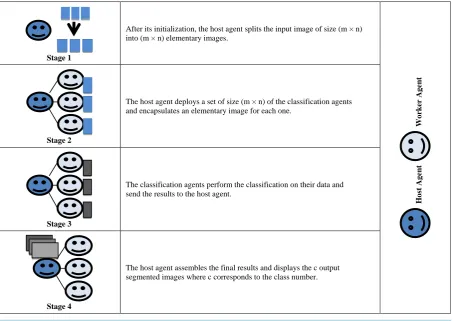
In this work we implement the well known algorithm for big data image segmentation which is the c-means algorithm as a distributed program on this model by using SPMD structure. The main components which are engaged to perform the execution of this program are the host agent and the team worker agents that are de-signed to play the roles introduced in Figure 1.
2.2. Intelligent Mobile Agents Grid Computing
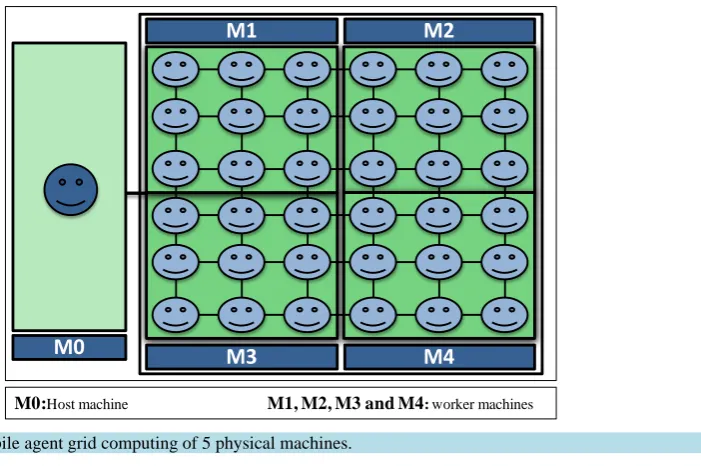
This model is based on an intelligent grid computing organized as a bidimensional 2D mesh topology (Figure 2) of size m × n, in which each mobile agent MPE (Mobile Processing Element) is localized in row i and column j and has an AID (Agent Identifier). Figure 2 shows an example of (2 × 2) workers machines hosted by M0. All the agents (i, j) in the mesh execute their tasks autonomously and maintain asynchronous communication by exchanging ACL (Agent Communication Language) Messages between each other over the grid computing. In order to achieve a high performance computing of the big data image segmentation, it is important to deploy the large amount of skills of these agents, as:
1) Autonomy: each mobile agent can perform, image classification autonomously. It can extend its activities to make the diagnostic on images and generates reports and data for eventual decisions.
2) Adaptability: it can execute its tasks in different environments with the same performance as in the envi-ronment where it was created.
3) Mobility: it can move from one machine to another and resume its tasks if some parallel computing chal-lenges happen.
4) Asynchronous communication ability: it can exchange data, tasks and knowledge using ACL message in remote or local communication.
Stage 1
After its initialization, the host agent splits the input image of size (m × n) into (m × n) elementary images.
H
o
st
Ag
ent
W
o
rker
Ag
ent
Stage 2
The host agent deploys a set of size (m × n) of the classification agents and encapsulates an elementary image for each one.
Stage 3
The classification agents perform the classification on their data and send the results to the host agent.
Stage 4
[image:3.595.88.542.389.710.2]The host agent assembles the final results and displays the c output segmented images where c corresponds to the class number.
3. Distributed Segmentation Algorithm
3.1. Standard C-Means AlgorithmThe c-means algorithm as defined in [13], is an image segmentation algorithm which consists on a partitioned groups of set S of n attribute vectors into c classes (clusters Ci i = 1, ···, c). In this algorithm [13] authors used the pixel gray level as the main classification attribute. The finale goal is to find the class centers (centroïd) that minimize the cost function J defined by the following equation: J=
∑
ic=1Ji =∑
ic=1∑
k Ci∈ d x c(
k, i)
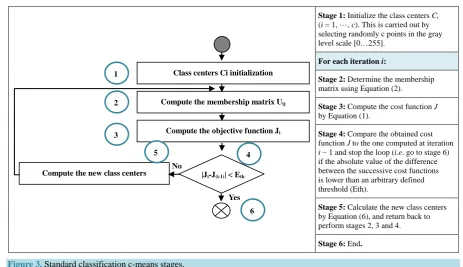
. To do so, we have to execute the different equations, given in Table 1.The c-means classification is achieved using the following algorithm stages which are summarized in Figure 3.
3.2. Distributed C-Means Algorithm
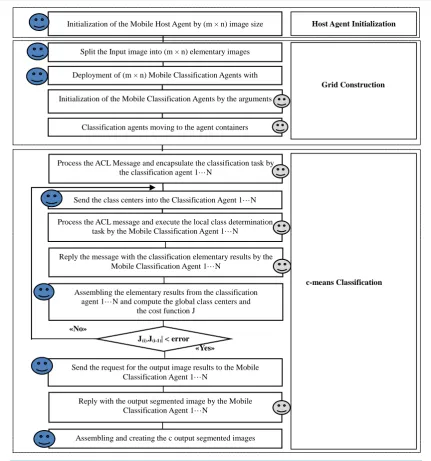
In this section, we present our distributed implementation of the c-means algorithm on a cooperative multi-agent platform using the 2D mesh architecture of the same size as the input image (MRI cerebral image of 256 gray levels). MRI images are stored on a cooperative multi-agent platform one pixel per agent. In order to perform the distributed c-means classification of the image in this model we need to perform the following three global stages as shown in Figure 4.
[image:4.595.173.524.328.561.2]1) Host agent initialization: when our segmentation platform goes on. The host agent is the first one created, and initialized by the size of the data image which is in our case (m × n).
Figure 2. 2D mesh mobile agent grid computing of 5 physical machines.
Table 1. The different equations needed for the classification c-means.
Equation number Equation Description
1
(
2)
1 1
c c
i k i
i i k Ci
J=
∑
=J =∑
=∑
∈ x −c The objective function defined by the Euclidean distance(distance between ith center c
i and the kth data of S).
2
2 2
1 , ,
0
k i k k
ij
if x c x c k i
u
Otherwise
− ≤ − ∀ ≠
=
The membership matrix element where i = 1 to c, j = 1 to n, for a total number n of points in S. It has two properties:
1, 1 1, ,
c
ij
i=u=∀ =j n
∑
1 1
c n
ij i= j=u =n
∑ ∑
3
( )
, 1
k i
i k
k x C i
c x
C ∈
=
∑
The class center where i = 1 to c by the average of all its attribute vectors and Ci is the cardinal of Ci.M1
M2
M3
M4
M0
[image:4.595.88.522.582.725.2]Class centers Ci initialization
Compute the membership matrix Uij
Compute the objective function Ji
Compute the new class centers |Ji-J(i-1)| < Eth
1
2
3
4
6 5
No
Yes
Stage 1: Initialize the class centers Ci
(i = 1, ···, c). This is carried out by selecting randomly c points in the gray level scale [0…255].
For each iteration i:
Stage 2: Determine the membership matrix using Equation (2).
Stage 3: Compute the cost function J
by Equation (1).
Stage 4: Compare the obtained cost function J to the one computed at iteration
i − 1 and stop the loop (i.e. go to stage 6) if the absolute value of the difference between the successive cost functions is lower than an arbitrary defined threshold (Eth).
Stage 5: Calculate the new class centers by Equation (6), and return back to perform stages 2, 3 and 4.
[image:5.595.79.543.79.346.2]Stage 6: End.
Figure 3. Standard classification c-means stages.
2) Grid construction: just after the initialization, the host agent splits the input image into (m × n) elementary images and then deploys a list of the classification agents which each of them encapsulates an elementary image and moves to a specific destination where it supposes to execute it tasks.
3) C-means classification: to start the data segmentation, the classification agents process, the classification tasks and the initial class centers which are sent by their host agent, and execute the local class determination task in order to compute the membership matrix. Then they replay the message with the results to their host agent which assembles the elementary results from all the classification agents and performs the global class de-termination and computes the cost function J and test the condition. If it is not achieved, it sends a new class centers to the classification agents to repeat the classification until it is achieved. Finally the host agent sends a request to the classification agents in order to send the output elementary images which will be assembled in or-der to display the c output segmented images for the classification.
4. Distributed C-Means Algorithm Implementation and Results
4.1. Multi-Agent System MiddlewareThis cooperative and intelligent platform is a distributed and parallel virtual machine on which we implemented the image segmentation algorithm according to the model of Figure 5. It is based especially on the JADE mid-dleware [14] and on the mobile agent skills.
Thanks to the JADE middleware, we prepare the platform where we run the parallel and distributed c-means program. The main components of this model are:
• The main container: it is the first container which starts in the platform and which is different from the others by its two special agents (the AMS agent and the DF agent). It connects all the performed containers in the platform.
• The host container: is the second container that is started in the platform where the host agent is created in order to manage the required infrastructure and computational inside in the physical grid computing.
• The agent containers: the free containers are started in the platform to receive groups of the classification agents so that each group can execute its classification tasks.
Initialization of the Mobile Host Agent by (m × n) image size Host Agent Initialization
Split the Input image into (m × n) elementary images
Deployment of (m × n) Mobile Classification Agents with
Classification agents moving to the agent containers Initialization of the Mobile Classification Agents by the arguments
Grid Construction
Send the class centers into the Classification Agent 1···N
Process the ACL message and execute the local class determination task by the Mobile Classification Agent 1···N
Reply the message with the classification elementary results by the Mobile Classification Agent 1···N
Assembling the elementary results from the classification agent 1···N and compute the global class centers and
the cost function J
Reply with the output segmented image by the Mobile Classification Agent 1···N
Assembling and creating the c output segmented images Process the ACL Message and encapsulate the classification task by
the classification agent 1···N
Send the request for the output image results to the Mobile Classification Agent 1···N
c-means Classification
«No»
[image:6.595.95.527.78.540.2]«Yes» J(i)-J(i-1)| < error
Figure 4. Distributed c-means program execution organization chart.
The mobile agents are considered as Processing Elements (PEs) which encapsulate tasks and data in order to achieve the parallel programs execution. So they are independent inside their containers, where they are dep-loyed, in order to stay or move to the most suitable environment to achieve perfectly their tasks. They have the ability to communicate between each other asynchronously by exchanging ACL messages. Thanks to the high performance of the mobile agent we can take strong control about all the parallel computing challenges: load balancing, fault tolerance and communication cost. This allows us to constitute a cooperative and intelligent grid for high performance computing.
4.2. Implementation and Results
Figure 5.Distributed computational model architecture for c-means classification.
m
n
(a) Input Big Data image (b) Elementary images
(c) Grey matter (d) Cerebrospinal fluid (e) White matter
Figure 6. Segmentation results by the elaborated distributed program.
output images where each of them corresponds to a specific class: the gray matter, the cerebrospinal fluid and the white matter.
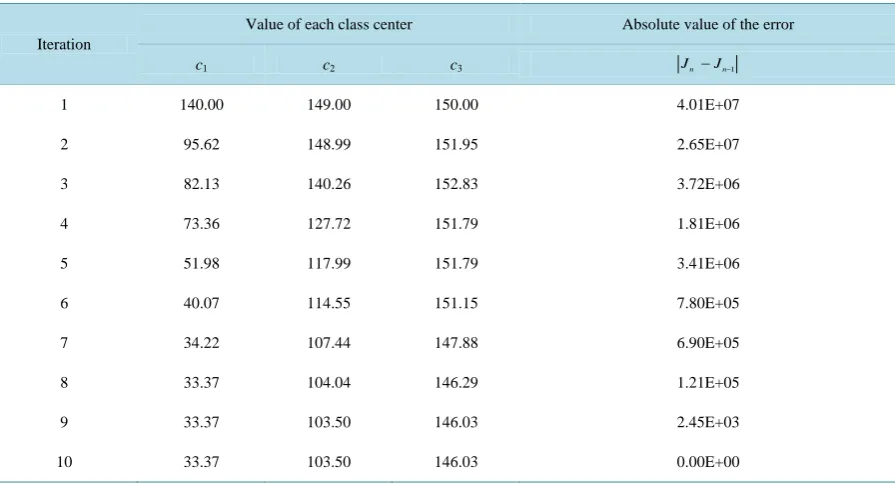
The effectiveness features of this distributed method for data image classification is shown under these three cases of studies for dynamic convergence analysis and time classification analysis under the fourth case.
1) (c1, c2, c3) = (1, 2, 3) where we see clearly in Table 2 the convergence of the algorithm after 15 iterations to
the final class centers (c1, c2, c3) = (28.60, 101.60, 146.03) and which are illustrated in Figure 7. Intelligent Mobile Agent Grid Coumputing
Cooperative Multi Agent Platform
Network Main Container
DF Agent
Host Container
Mobile host Agent
M1: Agent Container
Mobile classification Agent (Group 1)
M2: Agent Container
Mobile classification Agent (Group 2)
MN: Agent Container
Mobile classification Agent (Group N)
Table 2. Different states of the classification algorithm starting from class centers (c1, c2, c3) = (1, 2, 3).
Iteration
Value of each class center Absolute value of the error
c1 c2 c3 Jn 1−Jn−
1 1.00 2.00 3.00 4.96E+06
2 1.00 2.00 120.14 4.42E+06
3 1.00 33.86 129.57 3.26E+06
4 4.38 51.91 132.04 1.33E+06
5 6.15 58.40 133.23 1.50E+05
6 7.14 60.05 133.43 5.36E+04
7 7.14 65.14 134.44 2.34E+05
8 16.70 72.44 134.64 9.02E+05
9 21.49 90.47 141.16 2.76E+06
10 24.68 93.37 142.41 1.24E+05
11 28.60 95.44 142.42 7.92E+04
12 28.60 96.71 142.98 1.02E+05
13 28.60 100.94 145.51 2.41E+05
14 28.60 101.60 146.03 5.64E+03
15 28.60 101.60 146.03 0.00E+00
0 20 40 60 80 100 120 140 160
1 2 3 4 5 6 7 8 9 10 11 12 13 14 15
Class centers
Iteration
c1 c2 c3
c1 c2 c3
0,00E+00 1,00E+06 2,00E+06 3,00E+06 4,00E+06 5,00E+06 6,00E+06
1 2 3 4 5 6 7 8 9 10 11 12 13 14 15
Error value
[image:8.595.85.540.104.572.2]Iteration
|Jn-Jn-1|
6.00E+061
n n
J −J−
5.00E+06
4.00E+06
3.00E+06
2.00E+06
1.00E+06
0.00E+00
(a) (b)
Figure 7. Dynamic changes of the class centers starting from (c1, c2, c3) = (1, 2, 3). (a) Class centers; (b) Error of the
objec-tive function.
2) (c1, c2, c3) = (1, 30, 255) where the algorithm converges to the same final class centers of the case 1 (c1, c2,
c3) = (28.60, 101.60, 146.03) after 5 iterations as shown inTable 3 and which are illustrated inFigure 8.
3) (c1, c2, c3) = (140, 149, 255) where the algorithm converges to the final class centers (c1, c2, c3) = (33.37,
103.50, 146.03) after 10 iterations as shown inTable 4 which are illustrated inFigure 9.
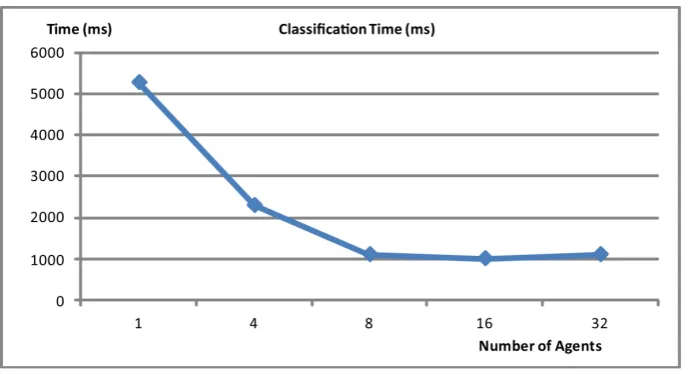
In Figure 10, we present the variation of the classification time according to the number of agents involved in the computing using the initial class centers (1, 2, 3).
Table 3. Different states of the classification algorithm starting from class centers (c1, c2, c3) = (1, 30, 255).
Iteration
Value of each class center Absolute value of the Error
c1 c2 c3 Jn 1−Jn−
1 1.00 30.00 255.00 1.47E+08
2 4.32 102.35 151.79 1.43E+08
3 24.68 100.37 146.29 1.42E+06
4 28.60 101.60 146.03 4.53E+04
5 28.60 101.60 146.03 0.00E+00
0 50 100 150 200 250 300
1 2 3 4 5
Class centers
Iteration
c1 c2 c3
c1 c2 c3
0,00E+00 2,00E+07 4,00E+07 6,00E+07 8,00E+07 1,00E+08 1,20E+08 1,40E+08 1,60E+08
1 2 3 4 5
Error value
[image:9.595.90.538.474.717.2]Iteration
|Jn-Jn-1|
1.60E+08
1
n n
J −J−
1.20E+08
8.00E+07 6.00E+07 4.00E+07 2.00E+07 0.00E+00 1.00E+08 1.40E+08
(a) (b)
Figure 8. Dynamic changes of the class centers starting from (c1, c2, c3) = (1, 30, 255). (a) Class centers; (b) Error of the
ob-jective function.
Table 4. Different states of the classification algorithm starting from class centers (c1, c2, c3) = (140, 149, 150).
Iteration
Value of each class center Absolute value of the error
c1 c2 c3 Jn 1−Jn−
1 140.00 149.00 150.00 4.01E+07
2 95.62 148.99 151.95 2.65E+07
3 82.13 140.26 152.83 3.72E+06
4 73.36 127.72 151.79 1.81E+06
5 51.98 117.99 151.79 3.41E+06
6 40.07 114.55 151.15 7.80E+05
7 34.22 107.44 147.88 6.90E+05
8 33.37 104.04 146.29 1.21E+05
9 33.37 103.50 146.03 2.45E+03
0 20 40 60 80 100 120 140 160 180
1 2 3 4 5 6 7 8 9 10
Error value
Iteration
c1c1 c2c2 c3c3
0,00E+00 5,00E+06 1,00E+07 1,50E+07 2,00E+07 2,50E+07 3,00E+07 3,50E+07 4,00E+07 4,50E+07
1 2 3 4 5 6 7 8 9 10
Error value
[image:10.595.85.538.79.247.2] [image:10.595.143.489.283.470.2]Iteration
|Jn-Jn-1|
Jn−Jn−14.00E+07
3.00E+07
2.00E+07
5.00E+06 0.00E+00 1.00E+07 1.50E+07 2.50E+07 3.50E+07 4.50E+07
(a) (b)
Figure 9. Dynamic changes of the class centers starting from (c1, c2, c3) = (140, 149, 150). (a) Class centers; (b) Error of the
objective function.
Figure 10. Time of classification (Tc) depending on the number of agents and with initial class centers (c1, c2, c3) = (1, 2, 3).
5. Conclusion
In this paper, we have presented the distributed c-means classification algorithm and its implementation on a cooperative platform based on mobile agents. We considered a new method that allows us to distribute the c-means algorithm and encapsulate its program in mobile agents. In order to execute the parallel programs in our grid computing, the data are splitted and the program instructions are shared between the mobile agents. We considered a segmentation application algorithm on MRI cerebral image which is performed on this new coop-erative multi-agent platform. The obtained results show that we can reduce the complexity of the parallel pro-grams thanks to the benefits of mobile agents. Moreover, it contributes to overcoming the big data challenges and offers a high-performance computing tool using multi-agent system. This cooperative agent platform is flexible and extensible for parallel algorithms trends.
References
[1] Depuru, S.S.S.R., Wang, L.F., Devabhaktuni, V. and Green, R.C. (2013) High Performance Computing for Detection of Electricity Theft. International Journal of Electrical Power & Energy Systems, 47, 21-30.
http://dx.doi.org/10.1016/j.ijepes.2012.10.031
[2] Coria, J.A.G., Castellanos-Garzón, J.A. and Corchado, J.M. (2014) Intelligent Business Processes Composition Based on Multi-Agent Systems. Expert Systems with Applications, 41, 1189-1205.
[3] Sánchez, D., Isern, D., Rodríguez-Rozas, Á. and Moreno, A. (2011) Agent-Based Platform to Support the Execution of Parallel Tasks. Expert Systems with Applications, 38, 6644-6656. http://dx.doi.org/10.1016/j.eswa.2010.11.073
[4] El-Rewini, H. and Abd-El-Barr, M. (2005) Advanced Computer Architecture and Parallel Processing. Wiley, Hoboken.
[5] Migliardi, M., Baglietto, P. and Maresca, M. (1998) Virtual Parallelism Allows Relaxing the Synchronization Con-straints of SIMD Computing Paradigm. High-Performance Computing and Networking Lecture Notes in Computer Science, 1401, 784-793. http://dx.doi.org/10.1007/BFb0037206
[6] Youssfi, M., Bouattane, O. and Bensalah, M.O. (2010) On the Object Modelling of the Massively Parallel Architecture Computers. IASTED International Conference on Software Engineering, Innsbruck, 71-78.
[7] Youssfi, M., Bouattane, O., Benchara, F.Z. and Bensalah, M.O. (2014) A Fast Middleware for Massively Parallel and Distributed Computing. International Journal of Research in Computer and Communication Technology, 3, 429-435.
[8] Hwu, W.-M. (2014) What Is Ahead for Parallel Computing. Journal of Parallel and Distributed Computing, 74, 2574- 2581. http://dx.doi.org/10.1007/BFb0037206
[9] Rodríguez-González, A., Torres-Niño, J., Hernández-Chan, G., Jiménez-Domingo, E. and Alvarez-Rodríguez, J.M. (2012) Using Agents to Parallelize a Medical Reasoning System Based on Ontologies and Description Logics as an Application Case. Expert Systems with Applications, 39, 13085-13092. http://dx.doi.org/10.1016/j.eswa.2012.05.093
[10] Benchara, F.Z., Youssfi, M., Bouattane, O., Ouajji, H. and Bakkoury, J. (2014) A Fast Middleware of Parallel and Dis-tributed Virtual Machine Based on Mobile Agents for High Performance Computing. Proceedings of CMT14, Morocco, 260-263.
[11] Ni, L.M. and Jain, A.K. (1985) A VLSI Systolic Architecture for Pattern Clustering. IEEE Transaction on Pattern Analysis and Machine Intelligence, PAMI-7, 80-89. http://dx.doi.org/10.1109/TPAMI.1985.4767620
[12] Tsai, H.R. and Horng, S.J.(1999) Optimal Parallel Clustering Algorithms on a Reconfigurable Array of Processors with Wider Bus Networks. Image and Vision Computing, 17, 925-936.
http://dx.doi.org/10.1016/S0262-8856(98)00167-X
[13] Bouattane, O., Cherradi, B., Youssfi, M. and Bensalah, M.O. (2011) Parallel Cmeans Algorithm for Image Segmenta-tion on a Reconfigurable Mesh Computer. Parallel Computing, 37, 230-243.
http://dx.doi.org/10.1016/j.parco.2011.03.001
[14] Padgham, L. and Winikoff, M. (2004) Developing Intelligent Agent Systems. Wiley, Hoboken.