© 2018, IRJET | Impact Factor value: 6.171 | ISO 9001:2008 Certified Journal | Page 755
Optimal Power Flow Solution of Transmission Line Network of Electric
power System using Genetic Algorithm Technique
ArvinderSingh
1, Harkamal Deep Singh
2, vikram singh
31
M.Tech. Research Scholar, Department of EEE, IKGPTU University, Punjab
2
Assistant professor, Department of EEE, IKGPTU University, Punjab.
---***---ABSTRACT -
In this paper presents arrangement ofoptimal power flow issue of substantial conveyance frameworks by means of a straightforward genetic algorithm. The goal is to limit the fuel cost and keep the power yields of generators, shunt capacitors/reactors, volt. and transformers tap-setting in their safe points of confinement. Calculation per unit times can be lessened by breaking down the enhancement
limitations to dynamic imperatives controlled
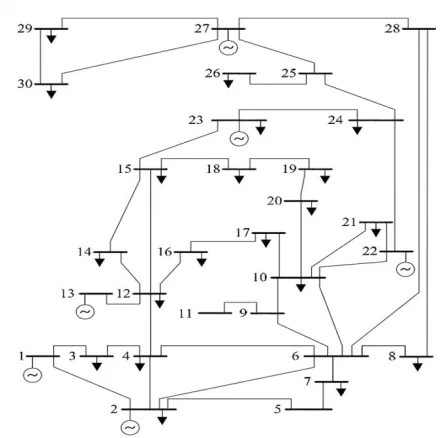
straightforwardly by the genetic algorithm and uninvolved requirements kept up in their delicate points of confinement utilizing a customary requirement load flow. The IEEE 30- bus system framework has been concentrated to demonstrate the adequacy of the calculation.
Key words
: Load flow of power system network, OPF, andGA.
I. INTRODUCTION
The optimal power flow has been as often as possible understood utilizing traditional classical techniques. The OPF has been typically considered as the minimization of desire function representing to the generation cost as well as the transmission losses. The requirements included are the physical laws representing the power system generation, transmission and the working restrictions of the equipment’s. Successful optimal power flow is restricted by (i) the high dimensionality of energy frameworks and (ii) the deficient space subordinate information of energy framework engineers. The principal restriction is tended to by numerical streamlining strategies in view of progressive linearization utilizing the first and the second subordinates of target capacities and their requirements as the inquiry headings or by straight programming answers for uncertain models [1-2]. The benefits of such techniques are in their numerical underpinnings, however inconveniences exist likewise in the affectability to issue plan, calculation choice and more often than not unite to a neighborhood least [6]. The second impediment, inadequate space learning, blocks likewise the dependable utilization of master frameworks where control fulfillment isn't conceivable.
Genetic algorithm offer another and intense way to deal with these enhancement issues made conceivable by the
expanding accessibility of superior PCs at moderately low expenses. These calculations have as of late discovered broad applications in taking care of worldwide improvement looking issues when the shut frame enhancement system can't be connected. Genetic algorithm is parallel and worldwide pursuit methods that imitate characteristic genetic operators. The GA will probably join toward the worldwide arrangement since it, at the same time, assesses numerous focuses in the parameter space. It doesn't have to accept that the pursuit space is differentiable or persistent.
The genetic algorithm optimal power flow problem is understood in light of the utilization of a genetic algorithm load flow, and to quicken the ideas it propose the utilization of inclination data by the utilization of the steepest conventional strategy. The strategy isn't delicate to the beginning stages and skilled to deciding the global optimum solution to OPF for scope of limitations and target functions. However, GAOPF requires two load streams to be performed per individual, per emphasis since every controllable variable are incorporated into the wellness. In this paper we build up a straightforward genetic algorithm connected to the issue of optimal power flow in vast power distribution system. To quicken the procedures of genetic algorithm of optimal power flow, the controllable factors are disintegrated to dynamic limitations that impact straightforwardly the cost work are incorporated into the genetic algorithm process and detached imperatives which are refreshing utilizing a regular load flow program, just, one time after the meeting on the genetic algorithm of optimal power flow. In which the pursuit of the optimal parameters set is performed utilizing into the record that the power misfortunes are 2.1% of the power load demand. The slack bus parameter would be recalculated in the load flow procedure to produce the results of the detached limitations.
II. PROBLEM FORMULATION
© 2018, IRJET | Impact Factor value: 6.171 | ISO 9001:2008 Certified Journal | Page 756 Minimize F(x) {objective function} subject to :
hi(x) = 0, i = 1, 2, ..., n {equality constraints} gj(x) = 0, j = 1, 2, ...,m
{inequality constraints}
where x is the vector of the control factors, that is those which can be differed by a control focus administrator (produced bus voltage magnitude, transformers, active and reactive power etc.)
The real meaning of the optimal power flow issue lives in lessening the target work and all the while fulfilling the load flow equations (equality constraints) without damaging the inequality constraints.
A. Objective Function
The most normally utilized goal in the OPF issue detailing is the minimization of the aggregate cost of real power generation. The individual expenses of each producing unit are thought to be work, just, of active power generation and are written to by quadratic curves of second order. The objective function for the whole power framework would then be able to be composed as the total of the quadratic cost show at every generator.
(1)
where NG is the number of generation including the slack bus. Pgi is the generated active power at bus i. ai, bi and ci are the unit costs curve for ith generator.
B. equality constraints
Even as minimizing the cost function, it’s essential to make sure that the generation still supplies the load demands and losses in transmission lines. Usually the power flow Equations are used as equality constraints.
(2)
Where active and reactive power injection at the buses i are defined in the following equation:
(3)
(4) C. inequality constraints
The inequality constraints of the optimal power flow reflect the points of confinement on physical device in the power framework and in addition the limits made to guarantee power system security. The most normal kinds of inequality constraints are upper bus voltage limits at generations and load flow buses, bring down bus voltage limits at load buses, reactive power (var). Limits at generation’s buses, most extreme dynamic power limits relating to bring down points of confinement at a few generators, greatest line stacking breaking points and phase shifter. The inequality constraints on the issue factors thought about include:
1) Upper and lower bounds on the reactive power generations at generator buses and reactive power injection at buses with VAR compensation Qgimin ≤ Qgi ≤ Qgimax, i = 1, npv
2) Upper and lower bounds on the voltage magnitude at the all buses Vimin ≤ Vi ≤ Vimax , i = 1, nbus.
3) Upper and lower bounds on the active generations at generator buses Pgimin ≤Pgi ≤ Pgimax , i = 1, ng.
4) Upper and lower bounds on the bus voltage phase angles:
, i = 1, nbus.
It can be seen that the summed up objective function F is a non-linear, the quantity of the uniformity and imbalance limitations increment with the extent of the power distribution systems. Utilizations of a traditional optimization method, for example, gradient-based algorithms to an expansive power appropriation framework with an extremely non-direct target capacities and incredible number of requirements are sufficiently bad to take care of this issue. Since it rely upon the presence of the first and the second subsidiaries of the target work and on the well figuring of this subsidiary in huge pursuit space.
III. GENETIC ALGORITHM USED IN OPTIMAL
POWER FLOW
a) Genetic Algorithms
© 2018, IRJET | Impact Factor value: 6.171 | ISO 9001:2008 Certified Journal | Page 757 enlivened in the Nature. Genetic algorithms are intense
stochastic search algorithms in view of the system of natural selection and natural genetics. Genetic algorithms works with a populace of binary string, looking numerous crests in parallel. By utilizing genetic operators, they trade data between the peaks, consequently decreasing the likelihood of closure at a neighborhood optimum. Genetic algorithms are more adaptable than most pursuit strategies since they require just data concerning the nature of the arrangement delivered by every parameter set and not lake numerous improvement techniques which require derivative information, or more regrettable yet, total knowledge of the issue structure and parameters.
There are some distinction amongst genetic algorithms and other classical techniques which are compressed as takes after:
o Genetic algorithms work with a populace of string, seeking numerous crests in parallel, rather than a single point.
o Genetic algorithms work specifically with strings of characters on behalf of parameters set not simply the parameters.
o Genetic algorithms utilize probabilistic change governs rather than deterministic principles.
o Genetic algorithms utilize target work data rather than subordinates or others helper information.
o Genetic algorithms can possibly discover arrangements in a wide range of zones of the hunt space all the while.
b) Genetic Algorithms to optimal power flow
A straightforward genetic algorithm is an iterative strategy, which keeps up a consistent size populace P of applicant arrangements. During every iteration step (generation) three hereditary operators (reproduction, crossover, and mutation) are performing to produce new populations and the chromosomes of the new populations are assessed by means of the estimation of the fitness which is identified with cost function. In light of these genetic operators and the assessments, the better new population of hopeful arrangement is shaped.
With the above depiction, a straightforward genetic algorithm is given as take after:
1. Generate randomly a population of binary string.
2. Evaluate the fitness for every string in the population.
3. Create offspring strings through reproduction, crossover and mutation operation.
4. Evaluate the new strings and evaluate the fitness for each string.
5. If the search objective is achieved, or an acceptable generation is attaining, return the best chromosome as the solution; otherwise go to step 3.
c) Chromosome coding and translating
Genetic algorithms works with a populace of binary string, not simply the parameters. For straightforwardness and accommodation, binary coding is utilized as a part of this research paper. With the binary coding strategy, the dynamic generation control set of 30 buses test system (Pg1 to Pg6) would be coded as binary string of 0's and 1'. Every parameter Pgi have upper bound Ui and lower bound Li.
d) Crossover
Crossover is the essential genetic operator, which advances the investigation of new areas in the search space. For a couple of guardians selection from the populace the recombination task separates two string of bits into sections by setting a Crossover point indiscriminately, i.e. Single Point Crossover The portions of bits from the guardians behind the Crossover point are exchanged with each other to produce their string. The blend is performed by picking a state of the strings arbitrarily, and changing their fragments to one side of this point. The new strings have a place with the up and coming generation of conceivable arrangements. The strings to be crossed are chosen by their scores utilizing the roulette wheel. In this manner, the strings with bigger scores have more opportunities to be blended with different strings since every one of the duplicates in the roulette have a similar likelihood to be chosen.
e) Mutation
Mutation is an auxiliary operator and keeps the untimely ceasing of the calculation in a nearby arrangement. The mutation operator is characterized by an irregular piece esteem Mutation in a picked string with a low likelihood of such change.. The transformation adds an random search character to the genetic algorithm, and it is important to keep away from that, after a few generations every single conceivable arrangement were fundamentally the same as ones.
f) Reproduction
© 2018, IRJET | Impact Factor value: 6.171 | ISO 9001:2008 Certified Journal | Page 758 duplicates of arrangements as indicated by their fitlness
value. In the event that the score builds, at that point the quantity of duplicates increments as well. Score value is of related to a given arrangement as indicated by its separation of the optimal solution (nearer to optimal solution mean higher scores).
g) Fitness of candidate solutions and cost function
The cost function is defined as:
(5)
Our goal is to seek (Pg1 to Pg6) in their acceptable cutoff limits to accomplish the optimization problem of optimal power flow. The cost function F(x) takes a chromosome (a conceivable (Pg1 to Pg6) and returns an value. The estimation of the cost is then mapped into a fitness value (Pg1 to Pg6) to fit in the genetic algorithm.
To limit F(x) is proportionate to getting most extreme fitness value in the seeking procedure. A chromosome that has lower cost function should be transfer a larger fitness value.
The goal of OPF must be changed to the expansion of wellness to be utilized as a part of the reproduced roulette wheel as takes after:
(6)
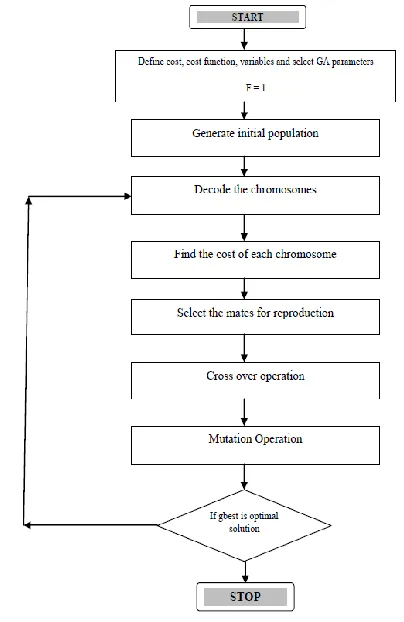
[image:4.612.338.540.82.393.2]Then the genetic algorithm tries to produce enhanced offspring to improve the fitness. Using the above components, a standard genetic algorithm procedure for solving the optimal power flow problem is summarized in the diagram of the Figure 1.
Fig:1 A Simple flow chart of the Genetic Algorithm for OPF
The utilization penalty functions in many optimal power flow solutions method to handle generation bus reactive power (var.) limits can lead to convergence problem due to the distortion of the solution surface. In this strategy no penalty functions are required because just the active power (kw) are utilized as a part of the fitness and the reactive power levels are scheduled in the load flow process because active constraint are evaluated by genetic algorithm process.
h) Load Flow Estimate
© 2018, IRJET | Impact Factor value: 6.171 | ISO 9001:2008 Certified Journal | Page 759 Table-I: Generator characteristics of 6-Unit test System
[image:5.612.47.286.106.204.2]The loss coefficient matrix for 6-unit system
Fig:2 IEEE 30 BUS SYSTEM DATA FOR 6 UNITS
Table: II Multi-objective OPF optimized values of generation cost and losses using PSO, ACO Hybrid and
Genetic Algorithm
DATA PSO ACO HYBRID GA
Pg1 (MW) 177.132 176.901 176.7 176.45 Pg2 (MW) 48.12 49.932 48.89 49.12 Pg3 (MW) 21.356 21.125 21.4719 20.98 Pg4 (MW) 22.878 21.468 21.6423 22.14
Pg5 (MW) 10.121 10.116 12.0878 12.65 Pg6 (MW) 12 12 12.00 11.41 Vg1 1.05 1.045 1.045 1.060 Vg2 1.0442 1.043 1.043 1.043 Vg3 1.446 0.998 0.998 1.025 Vg4 1.0408 1.009 1.009 1.017 Vg5 0.9601 1.014 1.014 1.010 Vg6 1.05 1.047 1.047 1.014 T6-9, (p.u) 1.01 1.012 1.012 1.053 T6-10,(p.u)0.99 0.971 0.971 1.046 T4-12, (p.u)1.01 1.023 1.023 1.041 T27-28, (p.u) 1.02 1.014 1.014 1.028 Cost ($/hr) 802.15 804.86 801.54 801.85 Loss (MW) 5.974 9.42 5.208 9.369
Figure: Fitness Function and Current Best Position
V. CONCLUSION
Relevance of Genetic algorithm (GA) to Optimal Power Flow has been investigated and tested. A simulation results show that a simple genetic algorithm can give a best result using only simple genetic operations such as proportionate reproduction, simple mutation.
For large system CPU time take more so to save CPU time, the constraints are to be rotten in (mw) active constraints and (mvar) reactive ones. The active constraints are the parameters whose enter directly in the cost function and the reactive constraints are infecting the cost function indirectly. With this approach, only the active constraints are taken to calculate the optimal solution set. And the reactive constraints are taking in an efficient load flow by recalculate active power of the slack bus. The developed system was then tested and validated on the IEEE 30-bus system. Solutions obtained with the developed Genetic Algorithm Optimal Power Flow program has shown to be almost as fast as the solutions given by a conventional language.
0.000022 0.000020 0.000019 0.000025 0.000032 0.000085 0.000026 0.000015 0.000024 0.000030 0.000069 0.000032 0.000019 0.000016 0.000017 0.000071 0.000030 0.000025 0.000015 0.000013 0.000065 0.000017 0.000024 0.000019 0.0000
B
17 0.000060 0.000013 0.000016 0.000015 0.000020 0.00014 0.000017 0.000015 0.000019 0.000026 0.000022
[image:5.612.56.276.356.575.2]© 2018, IRJET | Impact Factor value: 6.171 | ISO 9001:2008 Certified Journal | Page 760
REFERENCES
[1] Sheila Mahapatra1, Nitin Malik2, ‘‘A Hybrid Approach for Secured Optimal Power Flow and Voltage Stability with TCSC Placement’’2 The NORTHCAP University, Gurgaon-07, Haryana, India. pp 1-8
[2] Boumediène Allaoua and Abdellah Laoufi “Optimal Power Flow Solution Using Ant Manners for Electrical Network”, Advances in Electrical and Computer Engineering Volume 9, Number 1, 2009, pp. 34-40.
[3] H. Manafi1, N. Ghadimi2, M. Ojaroudi2, P. Farhadi3, “Optimal Placement of Distributed Generations in Radial Distribution Systems Using Various PSO and DE Algorithms”, Elektronika Ir Elektrotechnika, ISSN 1392-1215, VOL. 19, NO. 10, 2013, pp. 53-57.
[4] Waqquas A. Bukhsh, Andreas Grothey, Ken McKinnon, and Paul Trodden, ‘‘ Local Solutions of Optimal Power Flow’’ School of Mathematics,University of Edinburgh, James Clerk Maxwell Building, Edinburgh EH9 3JZ, Scotland, pp. 1-8.
[5] Baosen Zhang, Member, IEEE, Albert Y.S. Lam, Member, IEEE,, ‘‘An Optimal and Distributed Method for Voltage Regulation in Power Distribution Systems’’ IEEE member , pp. 1-13.
[6] Philipp Fortenbacher,Turhan Demiray, ‘‘Linear/Quadratic Programming-Based Optimal Power Flow using Linear Power Flow and Absolute Loss Approximations ’’ Research Center for Energy Networks (FEN), ETH Zurich urich, Switzerland, pp.1-8