© 2018, IRJET | Impact Factor value: 6.171 | ISO 9001:2008 Certified Journal | Page 3036
AUTOMATED DOOR ACCESS CONTROL SYSTEM USING FACE
RECOGNITION
Tejas Saraf
1, Ketan Shukla
2, Harish Balkhande
3,
Ajinkya Deshmukh41,2,3,4Department of Electronics & Telecommunication Engineering, Prof. Ram Meghe College of Engineering & Management, Bandera Road, Amravati (444602), Maharashtra, India
---***---Abstract -
Authentication is one of the significant issues in the era of the information system. Among other things, human face recognition (HFR) is one of the known techniques which can be used for user authentication. As an important branch of biometric verification, HFR has been widely used in many applications, such as video monitoring/surveillance system, human-computer interaction. This project proposes a method for automatic door access system using face recognition technique by using python programming and from OpenCV library Haar cascade method. Object Detection using Haar feature-based cascade classifiers is an effective object detection method proposed by Paul Viola and Michael Jones. This is the standalone security device has been developed by using Raspberry Pi electronic development board and operated on Battery power supply, wireless internet connectivity by using USB modem. Automatic e-mail notification has been achieved by sending security alert mail to the user e-mail id. This proposed is more effective, reliable, and this system consumes very less data and power compared to the other existing systems.Key Words: OpenCV, Database, Recognition, Detection, Raspberry Pi, LBPH.
1. INTRODUCTION
In today’s world of connectivity and smart devices there is an urgent need to modify our existing day to day objects and make them smart, also it is not the era when we can blindly trust the old and conventional security measures, specifically speaking is our door locks. To change and modernize any object we need to eliminate its existing drawbacks and add extra functionality. Face detection is more challenging because of some unstable characteristics, for example, glasses and beard will impact the detecting effectiveness. Moreover, different kinds and angles of lighting will make detecting face generate uneven brightness on the face, which will have an influence on the detection process. An intensive study of OpenCV platform and its inbuilt libraries has been conducted to generate a code, which does correct and reliable facial recognition with new and efficient use of hardware. This proposed system also acts as a home security system for both Person detection and provide security for door access control by using facial recognition for the home environment. The human body is identified as an intruder within a home environment achieved by capturing live video from web camera and processing will be done on captured
video frames. The web camera to capture the series of images as soon as the person press switch. The advantage of this system is for accessing the door is that face detection and recognition are performed by using face detection technique and the entire face recognition is completed by pressing single and tiny push button switch. Face recognition includes feature extraction from the facial image, recognition or classification and feature reduction. As the world is progressing people are scared about the safety of their possessions, information and themselves. With the model of Smart Door, a profound impact is expected in the security industry and it is somewhat anticipated as the time has come to make all daily life objects interconnected and interactive. This model will be a major contribution to the field of Home Security.
2. SYSTEM ARCHITECTURE
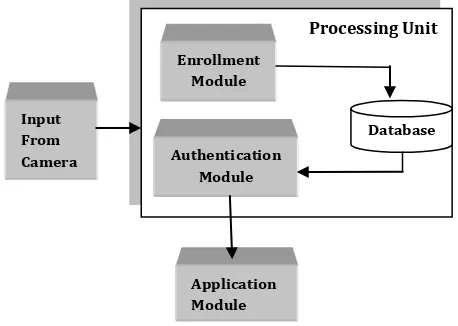
The Architecture of the proposed system is the design diagram which depicts the scope of the project with the whole system design. In architecture diagram, it highlights the modules with its various functions as a process. It aims to convey the internal design of the proposed system the following Fig-2.1 shows the entire architecture of the proposed system.
[image:1.595.330.559.500.663.2]
Fig-2.1: System Architecture 2.1 Input Unit
In input unit, the Facial images for Face Recognition and Video frames for person detection are captured from camera input devices respectively i.e. from Raspberry Pi Camera or Web camera.
Processing Unit Enrollment
Module
Authentication Module Input
From Camera
Application Module
© 2018, IRJET | Impact Factor value: 6.171 | ISO 9001:2008 Certified Journal | Page 3037 2.2 Processing Unit
The data which is collected from Input unit that is captured Image and Video frames input is fed into the processing unit in which the processing or calculations are performed on the proposed person detection and door lock system module, Here the processing unit is nothing but a Raspberry Pi board, along with code scripts of the implemented modules.
2.2.1 Enrollment Module
In this enrollment module, the data which collected from input camera means person face image is stored in the database. Before storing the image it will use feature extraction means it is converted in Haar Feature-based Cascade Classifiers.
Fig-2.2.1(a): Enrollment Module 2.2.2 Authentication Module
In this module, we recognize and detect the input images. This module is connected to the outer side of the door, where the captured image converted into Haar Feature-based Cascade Classifiers. And matching this feature extraction image with the database.
Fig-2.2.1(b): Authentication Module
2.3 Application Module
The Application specific unit which consists of Door lock circuitry, it is associated with Door lock system module of authentication module and it starts functioning according to results of the module to perform door lock open/close operation based on Face Recognition.
Fig-2.3: Application Module
3. SYSTEM IMPLEMENTATION
There are two parts in this section. The first is the implementation of Door lock access by using Face Recognition and the second is the implementation of person detection along with auto alert sending.
3.1 Implementation of Door Lock Access by using Face Recognition
[image:2.595.91.250.452.528.2]This project work proposes an idea of for face reorganization concept for accessing the door lock system and it implemented with the help of OpenCV, which is a popular computer vision library. Face recognition is an important application of image processing owing to its use in many fields. An effective face recognition system based on OpenCV is developed in the project. Face recognition has been the best choice for the problem of biometrics and it has a various type of applications in our present life. An efficient face recognition system can be of great help in forensic sciences, identification for law enforcement, authentication for banking and security system, and giving preferential access to authorized users i.e. access control for secured areas etc. A real-time door lock access system by face recognition system. The algorithm used here is Local Binary Patterns Histograms (LBPH), based on Haar Feature-based Cascade Classifiers is presented in the project. The technique used here we will work with face detection. Initially, the algorithm needs a lot of positive images (images of faces) and negative images (images without faces) to train the classifier. Then we need to extract features from it. For this, Haar features shown in the below Fig-3.1 are used. They are just like our convolution kernel. Each feature is a single value obtained by subtracting the sum of pixels under the white rectangle from the sum of pixels under the black rectangle.
Fig-3.1: Haar Features
3.2 Implementation of Person Detection along with Auto Alert Sending.
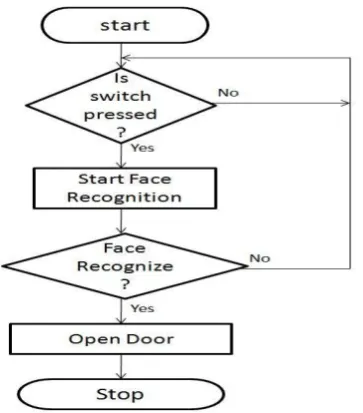
The proposed home security system is a machine learning based approach where a cascade function is trained from a lot of positive and negative images. It is then used to detect objects in other images. A procedural view of how this person detection works is shown in below flowchart. Enrollment
Image Feature Extraction
Image Feature Extraction
Result Matching
Relay Circui
t
[image:2.595.320.542.506.638.2]© 2018, IRJET | Impact Factor value: 6.171 | ISO 9001:2008 Certified Journal | Page 3038 In the above Figure, we see the procedural view person
detection process. In this system first in authentication module is having small switch button, when the person presses the switch button then the implemented code is the call. Then by using the camera the system capture the image sequence and compare this images with the database. If the image is a match then in application module get the signal to unlock the door. After unlocking the door the SMTP is to send alert to an authorized personnel.
4. SYSTEM DESCRIPTION
4.1 Internal Module:
[image:3.595.78.260.84.291.2]The following block diagram shows the internal module of door unlocking system. Which is have the Raspberry Pi board, motor driving circuit, motor & camera.
Fig-4.1: Internal Module
Raspberry Pi 3 Model B are used in it. The commands are sent to a driver circuit for processing the required action and the motor is being driven in either clockwise or anticlockwise as per requirement for locking or unlocking the door.
I]Software and Techniques for Face Recognition:
This System is used Python 3.5+ software and python programming. With OpenCV (Open Source Computer Vision)
is a library of programming functions mainly aimed at real-time computer vision.
•Haar Cascade Classifier
Object Detection using Haar feature-based cascade classifiers is an effective object detection method proposed by Paul Viola and Michael Jones in their paper, "Rapid Object Detection using a Boosted Cascade of Simple Features" in 2001. It is a machine learning based approach where a cascade function is trained from a lot of positive and negative images. It is then used to detect objects in other images.
• Local Binary Patterns Histograms Technique
The Local Binary Patterns methodology has its roots in 2D texture analysis. Thebasic idea of Local Binary Patterns is to summarize the local structure in an imageby comparing each pixel with its neighborhood. Take a pixel as center and threshold its neighbors against. If the intensity of the center pixel is greater-equalits neighbor, then denote it with 1 and 0 if not. You’ll end up with a binarynumber for each pixel, just like 11001111. So with 8 surrounding pixels, you’llend up with 2^8 possible combinations, called Local Binary Patterns orsometimes referred to as LBP codes. The first LBP operator described in literature actually used a fixed 3 x 3 neighborhood just like this.
4.2 External Door module:
The following block diagram shows the external module of door unlocking system. Which is have the switch, Led by indication & camera. In this module when the person presses the switch, then the code will run from the virtual environment of the raspberry pi board. Then the camera is started, and from camera capture, the images and it will process in raspberry pi. After matching and verifying the images the Led will glow it means the door is open.
[image:3.595.36.288.523.618.2]© 2018, IRJET | Impact Factor value: 6.171 | ISO 9001:2008 Certified Journal | Page 3039 5. SYSTEM ANALYSIS
Testing procedure:
Install OpenCV and Python
1. Write the code for detecting and recognition of image through the camera.
2. Then start the training code, and the camera will open up, Accuracy depends on the number of data sets as well as the quality and lighting conditions.
3. Take pictures of the person for face recognition after running create_database.py script. It automatically creates Train folder in Database folder containing the face to be recognized. You can change the name from Train to the person’s name. The result in the creation of the real-time database is recorded. The real-timedatabase is created by using python. While executing it 100 images of eachsubject. Likewise, databases should be created a dictionary and it creates each image size of variable pixels of height and width. While creating the database, the face images must have different expressions, which is why a 0.38-second delay is given in the code for creating the dataset. In this example, we take about 45 pictures/images and extract the face, convert it into greyscale and save it to the database folder with its name.
4. After program execution, the database is created and then run face recognition program. And the database is accessed by the program and it will match the live stream video image with it.
The proposed system works are as follows:
• Interface the camera to capture live face images.
• Create a database of an authorized person by using Graphical user interface shown in below image.
• Write name in the blank block in GUI model to store the person image on their name in the database. And then click on start.
• After click on start one video frame window will open. It captures the images and creates the database.
• After competing capturing the images click on Train.
(Above two process images are following shown respectively.)
© 2018, IRJET | Impact Factor value: 6.171 | ISO 9001:2008 Certified Journal | Page 3040 • When the face is recognized then by using Simple Mail
Transfer Protocol(SMTP) to send alert to an authorized person while unlocking the locked door in the form of an email.
6. CONCLUSION
In this proposed system door access system by using face recognition and along with the e-Mail alert system has been presented. This system has been used with home door lock access control based on face recognition method by verifying enrolled facial images. Concern persons will be informed successfully about the person detection via e-mail alert generations along with details attached. Face recognition is one of the several techniques for recognizing people. There are several methods that can be used for that purpose. Some of the most common are using PCA or eigenfaces. Though there are other new techniques more simple to understand the use and implement but also with very good performance. The Haar Cascades algorithm is one of those algorithms. As we show Haar Cascades has very good performance and is very accurate.
REFERENCES
[1] Hteik Htar Lwin, Aung Soe Khaing, Hla Myo Tun, “Automatic Door Access System Using Face Recognition”, International Journal of Scientific & Technology Research Volume 4, Issue 06, June 2015.
[2] Samuel Lukas, Aditya Rama Mitra, Ririn Ikana Desanti, Dion Krisnadi "Student Attendance System in Classroom Using Face Recognition Technique" IEEE 2016.
[3]Ratnawati Ibrahim, "Study of Automated Face Recognition System for Office Door Access Control Application", IEEE 2011
[4] Lerato Masupha, Tranos Zuva, Seleman Ngwira, Omobayo Esan, "Face Recognition Techniques, their Advantages, Disadvantages and Performance Evaluation", IEEE 2015
[5] Paul Viola, Michael J. Jones, "Robust Real-Time Face Detection", International Journal of Computer Vision 57(2), 2004.
[6] Ayushi Gupta, Ekta Sharma, NehaSachan, and Neha Tiwari, "Door Lock System through Face Recognition Using MATLAB", International Journal of Scientific Research in Computer Science and Engineering, Vol-1, Issue-3, 30 June 2013.
BIOGRAPHIES
Mr. Tejas Nitin Saraf, is a student of Prof. Ram Meghe College of Engineering & Management, Badnera and pursuing Bachelor's Degree in Engineering in Stream Electronics & Telecommunication from Sant Gadge Baba Amravati University.
Mr. Ketan Ajay Shukla, is a student of Prof. Ram Meghe College of Engineering & Management, Badnera and pursuing Bachelor's Degree in Engineering in Stream Electronics & Telecommunication from Sant Gadge Baba Amravati University.
Mr. Harish A. Balkhande, is a student of Prof. Ram Meghe College of Engineering & Management, Badnera and pursuing Bachelor's Degree in Engineering in Stream Electronics & Telecommunication from Sant Gadge Baba Amravati University.