http://dx.doi.org/10.4236/jsea.2015.83015
How to cite this paper: Suleiman, D., Itriq, M., Al-Anani, A., Al-Khalid, R. and Hudaib, A. (2015) Enhancing ERS-A Algorithm for Pattern Matching (EERS-A). Journal of Software Engineering and Applications, 8, 143-153.
http://dx.doi.org/10.4236/jsea.2015.83015
Enhancing ERS-A Algorithm for Pattern
Matching (EERS-A)
Dima Suleiman1, Mariam Itriq1, Aseel Al-Anani2, Rola Al-Khalid2, Amjad Hudaib2 1Department of Business Information Technology, King Abdullah II School for Information Technology, The
University of Jordan, Amman, Jordan
2Department of Computer Information Systems, King Abdullah II School for Information Technology, The University of Jordan, Amman, Jordan
Email: [email protected], [email protected], [email protected], [email protected], [email protected]
Received 25 February 2015; accepted 18 March 2015; published 20 March 2015
Copyright © 2015 by authors and Scientific Research Publishing Inc.
This work is licensed under the Creative Commons Attribution International License (CC BY). http://creativecommons.org/licenses/by/4.0/
Abstract
Pattern matching is a very important topic in computer science. It has been used in various appli-cations such as information retrieval, virus scanning, DNA sequence analysis, data mining, ma-chine learning, network security and pattern recognition. This paper has presented a new pattern matching algorithm—Enhanced ERS-A, which is an improvement over ERS-S algorithm. In ERS-A, two sliding windows are used to scan the text from the left and the right simultaneously. The pro-posed algorithm also scans the text from the left and the right simultaneously as well as making comparisons with the pattern from both sides simultaneously. The comparisons done between the text and the pattern are done from both sides in parallel. The shift technique used in the Enhanced ERS-A is the four consecutive characters in the text immediately following the pattern window. The experimental results show that the Enhanced ERS-A has enhanced the process of pattern matching by reducing the number of comparisons performed.
Keywords
Pattern Matching, Enhanced Two Sliding Windows Algorithm, RS-A Fast Pattern Matching Algorithm, Enhanced RS-A
1. Introduction
Many applications use pattern matching algorithms such as search engines, anti-virus and biological applications such as DNA [1]-[5].
algo-rithms made enhancements on preprocessing phase [6]-[9] and searching phase [10]-[12], and others modified the shifting technique [5] [9] [13]-[15] used in a case of a mismatch between the pattern and the text.
Searching process differs from one algorithm to another: some algorithms scan the text from one side only, either from left [15] or from right [5]; other algorithms use two sliding windows to scan the text from the left and the right sides simultaneously [10]-[13].
Some algorithms made modification on the shifting values. The shift value is the amount of shift that the sliding window will move in a case of a mismatch between the text and the window; shift values depend on the number of consecutive characters immediately after the sliding window. Some algorithms use one consecutive character [16] [17]; others use two [10] [12] [15] and few use three [13].
In this paper, we propose a new pattern matching algorithm—Enhanced ERS-A. The algorithm uses two slid-ing windows such as TSW [12], ETSW [10], ERS-A [11] and EBR [13] algorithms. It also uses four consecutive characters to compute the shift values such as RS-A [5] and ERS-A [11] algorithms. In addition to that, it uses the same comparison technique between the pattern and the text that was used in ETSW [10].
This paper compares between the new algorithms of EERS-A, ETSW [10] and ERS-A [11]. The results showed that the new algorithm is better than others as explained in Section 5. The reminder of this paper is or-ganized as follows: Section 2 consists of related works; Section 3 explains EERS-A algorithm; Section 4 covers the analysis. Finally, the conclusion and the future work are presented in Section 6.
2. Related Works
Pattern matching algorithms were needed in many applications [2] [14] [18]-[20]. Some algorithms made en-hancement in a memory used in preprocessing phase, while others try to make the searching process faster and more efficient [8] [9] [21].
The Berry-Ravindran algorithm (BR) [15] made enhancement in Boyer Moore algorithm [16]. In a case of a mismatch between the text and the pattern window Boyer uses one consecutive character in the text immediately to the right of the pattern window to determine amount of shift the window must move, on the other hand Berry- Ravindran uses two consecutive characters.
Many enhancements made in Berry-Ravindran algorithm (BR) [15], some algorithms changed the searching process but on the other hand they used the same bad character shift values, bad character shift depends on using two consecutive characters immediately that follow the text such as TSW [12] and ETSW [10]. Others made enhancement on the shift values such as RS-A [5] and ERS-A [11] these two algorithms changed the shift values by using four consecutive character instead of two, also EBR [13] algorithm made modifications on Berry-Ra- vindran bad character shift by depending on using three consecutive characters.
Two Sliding Windows algorithm TSW [12] used the same preprocessing technique used in BR [15] but made enhancements on the searching phase. In a case of a mismatch between the pattern and text, it uses two consecu-tive characters to determine the amount of shift the pattern window must slide which is the same technique used in BR [15], but instead of using one pattern window to scan the text as in BR [15] it uses two sliding windows that scan it in parallel.
Searching process become faster in Enhanced Two Sliding Window algorithm (ETSW) [10]. ETSW [10]
made enhancements on TSW [12] by minimizing the number of comparisons needed but it doesn’t make any changes on the number of attempts. The reason for this is that two algorithms used the same preprocessing tech-niques and also used the two sliding window, the only difference between them is related to the idea that TSW
[12] compares the text with the pattern from one side of the pattern while ETSW [10] compare the text with the pattern from the both sides of the pattern at the same time, the best time complexity is O m
(
2)
and the worst case time complexity is O(
(
(
n 2−m 2 1+)
)(
m 2)
)
. The preprocess time complexity is O(
2(
m−1)
)
.RS-A [5] algorithm used only one window to search for a pattern p in a text t from the right side of the text. In order to make the searching process faster ERS-A [11] algorithms made enhancements on RS-A by using two windows instead of one. The left window aligned with the text from the left and in a case of a mismatch the window will be shifted to the right, and the right window aligned with text from the right and in a case of a mismatch the window will be shifted to the left. The two windows slide in parallel. The search will stop either when the pattern is found or in a case the pattern not found at all.
pattern, in this case it uses the same method used in ETSW [10], which make comparisons between the text and the pattern from both sides of the pattern at the same time. It is obvious from the results that there are no changes in average number of attempts in both ERS-A [11] and EERS-A, on the other hand there are a clear differences in average number of comparisons. The EERS-A is more efficient and faster.
3. The Enhanced ERS-A Algorithm
EERS-A algorithm improved the searching process by scanning the pattern as well as the text from both sides simultaneously. EERS-A used two sliding windows to scan the text from both sides at the same time; also com-parisons between the pattern and the text happened from both sides of the pattern.
EERS-A algorithm used the same searching technique used in ERS-A, they uses two sliding windows to search for a pattern p in a text t. Two sliding windows scan the text from the left and right side at the same time and in a case of a mismatch both algorithms will use RS-A bad character shift function [5]. The searching process will stop either when a pattern is found or in a case a pattern is not found in the text at all.
The main difference between EERS-A and ERS-A [11] algorithms is that in ERS-A [11] comparisons be-tween the pattern and the text happened only from the left side of the pattern while in EERS-A comparisons done from left and right sides of the pattern at the same time.
4. Pre-Processing Phase
Two arrays are generated in this phase nextl and nextr, each array is one-dimensional array. The values of the nextr array are calculated according to RS-A algorithm [5]. Initially the indexes of the four consecutive charac-ters of the text after aligning it with the right window are (n − m − 4), (n − m − 3), (n − m − 2) and (n − m − 1) for a, b, c and d respectively, which are used to calculate the shift values in a case of a mismatch from the right side of the text as in Equation (1).
[
]
[
]
[
]
[
]
[ ]
[ ][ ]
[ ][ ][ ]
(
)
(
)
[ ][ ][
][
]
3 if 1 a
2 if 1 b
1 if 1 c
1 if 0 d
Right shift value a,b,c,d min
2 if 0 1 cd
3 if 0 1 2 bcd
4 if 1 2 3 abcd
4 otherwise
m p m
m p m
m p m
p
p
p
m m i p i i i i
m + − = + − = + − = = = = = − − − + + + = + (1)
On the other hand, the values of the nextl array are calculated according ERS-A algorithm [11]. The shift val-ues are calculated by using four consecutive text characters a, b, c and dwhich are aligned immediately to the right of the left sliding window. Initially, the indexes of the four consecutive characters in the text string needed to search the text from the left side are (m + 1), (m + 2), (m + 3) and (m + 4) for a, b, c and d respectively as in Equation (2).
[
]
[
]
[
][
]
[
] [
][
]
[ ]
[ ]
[ ]
[ ][ ][
][
]
1 if 1 a
2 if 2 1 ab
3 if 3 2 1 abc
1 if 0 b
Left shift value a,b,c,d min
2 if 0 c
3 if 0 d
if 1 2 3 abcd
4 otherwise p m
p m m
p m m m
m p
m p
m p
m i p i i i i
The pre-processing phase is the same in both ERS-A and EERS-A algorithms but the searching phase is en-hanced in EERS-A.
5. Searching Phase
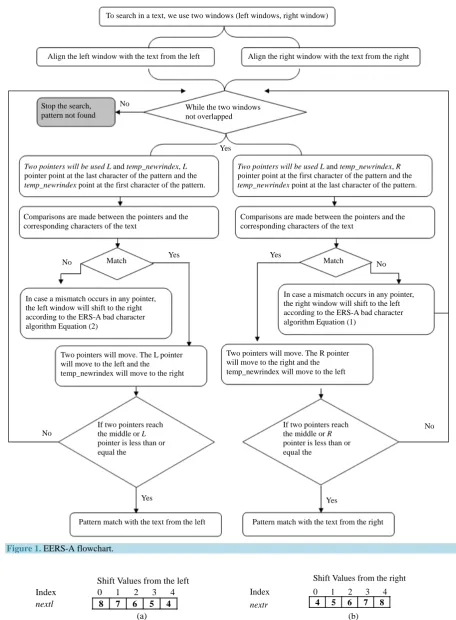
In EERS-A algorithm the searching process started by aligning two windows with the text, the left window aligned with the beginning of the text and the right window aligned with the end of the text. In case of a mis-match the proposed window will be shifted according to next array values calculated in a preprocessing phase; the left window will be shifted to the right and the right window will be shifted to left.
Four pointers will be used in a comparison process between the text and the pattern, two for each window. The left window uses the L and temp_newlindex pointers while the right window uses the R and temp_newrindex pointers.
Comparisons between the text and the pattern from both sides is the same, in each window the first character of the pattern is compared with the corresponding text character and at the same time the last character of the pattern is compared with the corresponding character in the text. Each window uses different pointers as ex-plained below:
6. Left_Window Search Process
After aligning the left window with the text from the left, comparisons between the pattern and the text will be done using two pointers, L and temp_newlindex, L pointer points at the last character of the pattern and the temp_newlindex points at the first character of the pattern, comparisons are made between the pointers and the corresponding characters of the text.
If a mismatch occurs in any pointer a shift will occurs according to the ERS-A bad character algorithm. In case of a match the two pointers will move.
The L pointer will move to the left and the temp_newlindex will move to the right. A movement of pointers in a case of a match will stop either when two pointers reach the middle of the pattern or when the L pointer is less than or equal the temp_newlindex, in either case the pattern is found.
7. Right_Window Search Process
After aligning the right window with the text from the right, comparisons between the pattern and the text will be done using two pointers, R and temp_newrindex, R pointer points at the first character of the pattern and the temp_newrindex points at the last character of the pattern, comparisons are made between the pointers and the corresponding characters of the text.
If a mismatch occurs in any pointer a shift will occurs according to the ERS-A bad character algorithm. In case of a match the two pointers will move. The R pointer will move to the right and the temp_newrindex will move to the left. A movement of pointers in a case of a match will stop either when two pointers reach the mid-dle of the pattern or when the R pointer is less than or equal the temp_newrindex, in either case the pattern is found.
The proposed EERS-A algorithm is explained in Figure 1.
8. Working Example
In this section, we will give an example to explain the new algorithm. Given:
Pattern (P) = “ACCBCBAC”, m = 8,
Text (T) = “ABCDABADBACEDABACCBCBACABADBCEDABADDDBACCBABCBCBAB”, n = 50.
9. Pre-Processing Phase
Initially, shiftl = shiftr = m + 4 = 12.
The shift values are stored in two arrays nextl and nextr as shown inFigure 2(a)and Figure 2(b) respective-ly.
147
No
Yes
Yes Yes
Yes Yes
No No
No Match Match No
To search in a text, we use two windows (left windows, right window)
Align the left window with the text from the left Align the right window with the text from the right
While the two windows not overlapped
Pattern match with the text from the left Pattern match with the text from the right If two pointers reach
the middle or L
pointer is less than or equal the
If two pointers reach the middle or R
pointer is less than or equal the
Two pointers will move. The R pointer will move to the right and the temp_newrindex will move to the left Two pointers will move. The L pointer
will move to the left and the
temp_newrindex will move to the right
In case a mismatch occurs in any pointer, the right window will shift to the left according to the ERS-A bad character algorithm Equation (1)
In case a mismatch occurs in any pointer, the left window will shift to the right according to the ERS-A bad character algorithm Equation (2)
Comparisons are made between the pointers and the corresponding characters of the text
Comparisons are made between the pointers and the corresponding characters of the text
Two pointers will be used L and temp_newrindex, L
pointer point at the last character of the pattern and the
temp_newrindex point at the first character of the pattern.
Two pointers will be used L and temp_newrindex, R
pointer point at the first character of the pattern and the
temp_newrindex point at the last character of the pattern. Stop the search,
[image:5.595.80.537.79.700.2]pattern not found
Figure 1.EERS-A flowchart.
Index 0 1 2 3 4 8 7 6 5 4
nextl
(a)
Shift Values from the left
Shift Values from the right
Index 0 1 2 3 4 4 5 6 7 8
nextr
(b)
give it an index starting from 0. For example for the pattern structure ACCBCBAC, the consecutive characters ACCB, CCBC, CBCB, BCBA and CBAC are given the indexes 0, 1, 2, 3 and 4 respectively.
The shift values for the nextr array are calculated according to Equation (1) while the shift values for the nextl array are calculated according to Equation (2).
10. Searching Phase
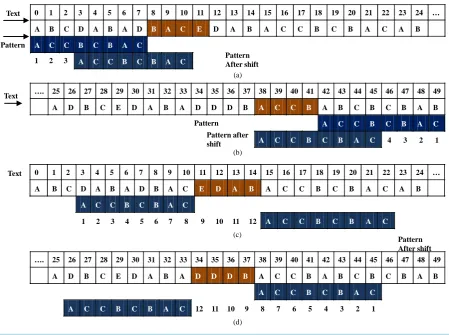
The searching process for the pattern P is explained through the working example as shown inFigure 3.
10.1. First Attempt
In the first attempt (see Figure 3(a)), we align the left sliding window with the text from the left. In this case, a comparison is made between the text character located at index 0 (character A) with the leftmost character in the pattern (character A) although a match occurs, the total result is a mismatch since at the same time a comparison must be made between the text character at index 7 (character D) with the rightmost character in the pattern (character C); therefore we take the four consecutive characters of the text at index 8, 9, 10 and 11 which are (B, A, C and E) respectively. To determine the amount of shift (shiftl) we have to do the following:
Since if p m
[
−3][
m−2][
m− =1]
abc; BAC = BAC then according to a preprocessing algorithm the shift value will be 3.10.2. Second Attempt
In the second attempt (see Figure 3(b)), we align the right sliding window with the text from the right. In this case, a match occurs between text character at index 42 (A) and left most character of the pattern character A but a mismatch occurs between the last text character B with the last pattern character C so as a total result,
Text Text
0 1 2 3 4 5 6 7 8 9 10 11 12 13 14 15 16 17 18 19 20 21 22 23 24 …
A B C D A B A D B A C E D A B A C C B C B A C A B
A C C B C B A C
1 2 3 4 5 6 7 8 9 10 11 12 A C C B C B A C
(c)
…. 25 26 27 28 29 30 31 32 33 34 35 36 37 38 39 40 41 42 43 44 45 46 47 48 49
A D B C E D A B A D D D B A C C B A B C B C B A B
A C C B C B A C A C C B C B A C 12 11 10 9 8 7 6 5 4 3 2 1
(d)
…. 25 26 27 28 29 30 31 32 33 34 35 36 37 38 39 40 41 42 43 44 45 46 47 48 49
A D B C E D A B A D D D B A C C B A B C B C B A B
A C C B C B A C
A C C B C B A C 4 3 2 1
(b)
0 1 2 3 4 5 6 7 8 9 10 11 12 13 14 15 16 17 18 19 20 21 22 23 24 …
A B C D A B A D B A C E D A B A C C B C B A C A B
A C C B C B A C
1 2 3 A C C B C B A C C
(a)
Pattern Text
Pattern Pattern After shift
Patternafter shift
[image:6.595.90.540.374.709.2]Pattern After shift
there is a mismatch; therefore we take the four consecutive characters from the text at index 38, 39, 40 and 41 which are A, C, C and B respectively. To determine the amount of shift (shiftr), we have to do the following:
a) We find the index of ACCB in the pattern which is 0.
b) Since we search the text from the right side we use nextr array, and shiftr = nextr[0] = 4; therefore the window will be shifted to the left 4 steps.
10.3. Third Attempt
In the third attempt (see Figure 3(c)), a mismatch occurs from the left between the text character at index 3 (character D) and the leftmost character in the pattern (character A) while there is a match between the text cha-racter at index 10 (chacha-racter C) and the rightmost chacha-racter in the pattern (chacha-racter C); therefore we take the four consecutive characters from the text at indexes 11, 12, 13 and 14 which are E, D, A and B respectively, since EDAB is not found in the pattern, so the window will be shifted to the right 12 steps.
10.4. Fourth Attempt
In the fourth attempt (see Figure 3(d)), a comparison is made between the text character located at index 38 (character A) with the leftmost character in the pattern (character A) at the same time a comparison must be made between the text character at index 45 (character B) with the rightmost character in the pattern (character C) since there is a mismatch we take the four consecutive characters of the text at index 34, 35, 36 and 37 which are D, D, D and A respectively; since DDDB is not found in the pattern, so the window will be shifted to the left 12 steps.
10.5. Fifth Attempt
We align the left most character of the pattern P[0] with T[15]. A comparison between the pattern and the text characters leads to a complete match at index 15. In this case, the occurrence of the pattern is found using the left window.
11. Analysis
Preposition 1: The space complexity is O
(
2(
m−3)
)
where m is the pattern length.Preposition 2: The pre-process time complexity is O
(
2(
m−3 .)
)
Lemma 1: The worst case time complexity is O
(
(
(
n 2−m 2 1+)
)
(
m 2)
)
.Proof: The worst occurs when a match between the text and patterns occurs in all characters except a charac-ter at index m/2 in the pattern, and if at the same time the shift values in case of a mismatch equal to 1.
Lemma 2: The best case time complexity is O m
(
2)
.Proof: The best case occurs when the pattern is found in the leftmost or the rightmost sides of the text.
Lemma 3: The average case time complexity is O n
(
(
2 *(
m 2+4)
)
)
.Proof: The average case occurs when the four consecutive characters of the text directly following the sliding window is not found in the pattern. In this case, the shift value will be (m + 4) and hence the time complexity is
(
)
(
)
(
2 * 2 4)
O n m + .
12. Experimental Results and Discussion
Several experiments have been done using Book 1 from the Calgary corpus [22] to be the text in most of searching algorithms. Book 1 consists of 141,274 words (752,149 characters). Book 1 consists of 141,274 words (752,149 characters). Patterns of different lengths are also taken from Book 1.
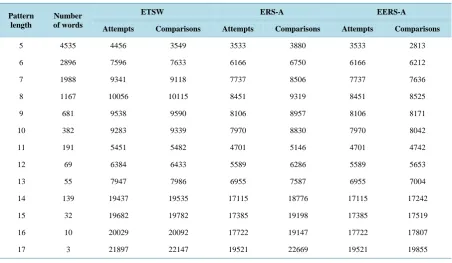
Table 1 shows the results of comparing the algorithms ETSW, ERS-A and EERS-A.
ETSW algorithm and EERS-A algorithm use the same comparison technique, they use two sliding windows to scan the text, and in addition to that they use the same technique when comparing the text with the pattern where comparisons happened from both sides of the pattern simultaneously. It is clear that the number of com-parisons and attempts in EERS-A algorithm are better than ERS-A algorithm and this refers to using different shifting technique. While ETSW uses Berry-Ravindran (BR) [15] bad character shift values which uses two consecutive characters, EERS-A uses ERS-A [11] bad character shift values that uses four consecutive charac-ters.
Table 2 shows the average number of attempts and comparisons for 100 words taken from the right side of Book1. It is clear that EERS-A is the best among all others according to the number of comparisons and the same results can be seen in Table 3 andTable 4.
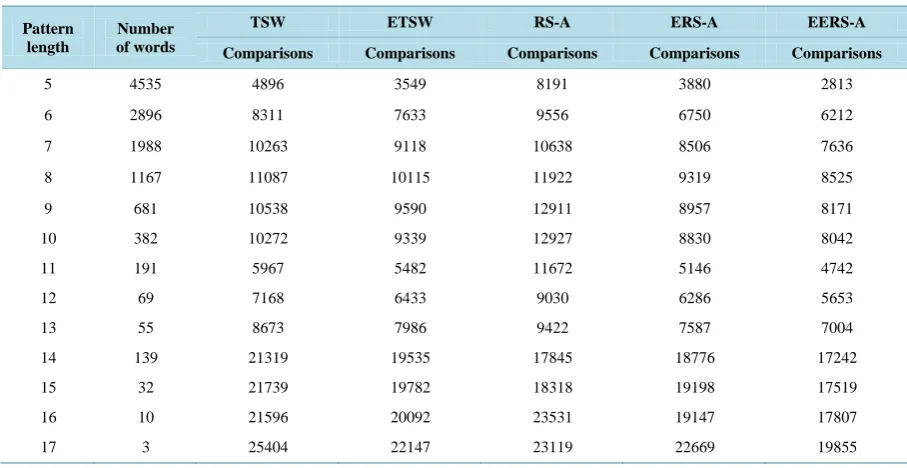
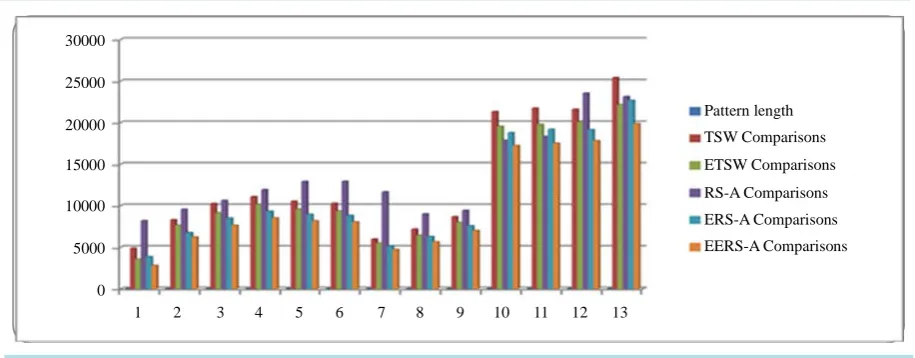
Table 5andFigure 4 show the average number of comparisons needed to search for patterns with different lengths. The results show that EERS-A finds the patterns with minimum number of comparisons compared with
Table 1. The average number of attempts and comparisons of ETSW, ERS-A and EERS-A algorithms.
Pattern length
Number of words
ETSW ERS-A EERS-A
Attempts Comparisons Attempts Comparisons Attempts Comparisons
5 4535 4456 3549 3533 3880 3533 2813
6 2896 7596 7633 6166 6750 6166 6212
7 1988 9341 9118 7737 8506 7737 7636
8 1167 10056 10115 8451 9319 8451 8525
9 681 9538 9590 8106 8957 8106 8171
10 382 9283 9339 7970 8830 7970 8042
11 191 5451 5482 4701 5146 4701 4742
12 69 6384 6433 5589 6286 5589 5653
13 55 7947 7986 6955 7587 6955 7004
14 139 19437 19535 17115 18776 17115 17242
15 32 19682 19782 17385 19198 17385 17519
16 10 20029 20092 17722 19147 17722 17807
17 3 21897 22147 19521 22669 19521 19855
Table 2. The average number of attempts and comparisons performed to search for (100) patterns selected from the right side of the text.
Pattern length
Number of words
ETSW ERS-A EERS-A
Attempts Comparisons Attempts Comparisons Attempts Comparisons
5 100 185 187 146 163 146 148
6 100 227 230 182 205 182 186
7 100 347 351 286 324 286 291
8 100 504 510 424 476 424 431
9 100 670 677 571 640 571 579
10 100 1160 1170 999 1117 999 1011
11 100 622 628 529 597 529 536
[image:8.595.87.540.548.722.2]Table 3.The average number of attempts and comparisons performed to search for (100) patterns selected from the middle of the text.
Pattern length
Number of words
ETSW ERS-A EERS-A
Attempts Comparisons Attempts Comparisons Attempts Comparisons
5 100 13965 11618 11038 11970 11038 10875
6 100 16682 16771 13536 14870 13536 13648
7 100 27267 26242 22607 24971 22607 22179
8 100 27830 28015 23385 25976 23385 23617
9 100 33929 34069 28764 31541 28764 28943
10 100 29676 29845 25471 28193 25471 25689
11 100 23195 23242 19886 21119 19886 19946
[image:9.595.86.539.306.463.2]12 100 26806 27009 23484 26507 23484 23761
Table 4. The average number of attempts and comparisons performed to search for (100) patterns selected from the left side of the text.
Pattern length
Number of words
ETSW ERS-A EERS-A
Attempts Comparisons Attempts Comparisons Attempts Comparisons
5 100 271 270 216 238 216 218
6 100 364 368 295 326 295 299
7 100 402 405 333 372 333 337
8 100 536 541 451 499 451 457
9 100 776 783 660 730 660 668
10 100 1579 1593 1361 1517 1361 1378
11 100 619 624 531 573 531 537
12 100 1667 1685 1459 1641 1459 1480
Table 5. The average number of attempts and comparisons for patterns with different lengths.
Pattern length
Number of words
TSW ETSW RS-A ERS-A EERS-A
Comparisons Comparisons Comparisons Comparisons Comparisons
5 4535 4896 3549 8191 3880 2813
6 2896 8311 7633 9556 6750 6212
7 1988 10263 9118 10638 8506 7636
8 1167 11087 10115 11922 9319 8525
9 681 10538 9590 12911 8957 8171
10 382 10272 9339 12927 8830 8042
11 191 5967 5482 11672 5146 4742
12 69 7168 6433 9030 6286 5653
13 55 8673 7986 9422 7587 7004
14 139 21319 19535 17845 18776 17242
15 32 21739 19782 18318 19198 17519
16 10 21596 20092 23531 19147 17807
[image:9.595.85.539.489.723.2]1 2 3 4 5 6 7 8 9 10 11 12 13 0
5000 10000 15000 25000
20000 30000
[image:10.595.83.541.78.257.2]Pattern length TSW Comparisons ETSW Comparisons RS-A Comparisons ERS-A Comparisons EERS-A Comparisons
Figure 4.The average number of comparisons of TSW, ETSW, RS-A and ERS-A, EERS-A algorithms.
other algorithms such as TSW, ETSW, RSA and ERS-A. For example, it took EERS-A 8042 comparisons to locate the pattern of length 10 while it took TSW, ETSW, RS-A and ERS-A 10272, 9339, 12927 and 8830 comparisons respectively for the same pattern length. These results show that EERS-A is the best algorithm compared to others.
13. Conclusions and Future Work
In this paper, we presented a new pattern matching algorithm—Enhanced ERS-A algorithm. The Enhanced ERS-A algorithm enhances the ERS-A’s process by utilizing the idea of the two sliding windows and by making comparisons with the pattern from both sides simultaneously. The comparisons done between the text and the pattern are done from both sides in parallel. This process gives the proposed algorithm a preference over the ERS-A algorithm.
The Enhanced ERS-A algorithm utilizes the idea of RS shifting algorithm to maximize the shift values. To assess the performance of the proposed algorithm, we considered ETSW and ERS-A algorithms for comparison with the proposed algorithm. The experimental results show that the Enhanced ERS-A shows better results in the number of comparisons performed.
References
[1] El Emary, I.M.M. and Jaber, M.S.M. (2008) A New Approach for Solving String Matching Problem through Splitting the Unchangeable Text. World Applied Sciences Journal, 4, 626-633.
[2] Chao, Y. (2012) An Improved BM Pattern Matching Algorithm in Intrusion Detection System. Applied Mechanics and Materials, 148-149, 1145-1148.
[3] Diwate, R. and Alaspurkar, S. (2013) Study of Different Algorithms for Pattern Matching. International Journal of Advanced Research in Computer Science and Software Engineering, 3, 615-620.
[4] Bhukya, R. and Somayajulu, D. (2010) An Index Based Forward Backward Multiple Pattern Matching Algorithm.
World Academy of Science, Engineering and Technology, 4, 1513-1521.
[5] Senapati, K.K., Mal, S. and Sahoo, G. (2012) RS-A Fast Pattern Matching Algorithm for Bio-Logical Sequences. In-ternational Journal of Engineering and Innovative Technology (IJEIT), 1, 116-118.
[6] Bhukya, R. and Somayajulu, D. (2011) Multiple Pattern Matching Algorithm Using Pair-Count. IJCSI International Journal of Computer Science Issues, 8, 1694-0814.
[7] Faro, S. (2009) Efficient Variants of the Backward-Oracle-Matching Algorithm. International Journal of Foundations of Computer Science, 20, 967-984.http://dx.doi.org/10.1142/S0129054109006991
[8] Faro, S. and Külekci, M.O. (2012) Fast Packed String Matching for Short Patterns. arXiv:1209.6449v1 [cs.IR] [9] Salmela, L., Tarhio, J. and Kalsi, P. (2010) Approximate Boyer-Moore String Matching for Small Alphabets.
Algo-rithmica, 58, 591- 609.
[11] Suleiman, D., Hudaib, A., Al-Anani, A., Al-Khalid, R. and Itriq, M. (2013) ERS-A Algorithm for Pattern Matching.
Middle East Journal of Scientific Research, 15, 1067-1075.
[12] Hudaib, A., Al-Khalid, R., Suleiman, D., Itriq, M. and Al-Anani, A. (2008) A Fast Pattern Matching Algorithm with Two Sliding Windows (TSW). Journal of Computer Science, 4, 393-401. http://dx.doi.org/10.3844/jcssp.2008.393.401
[13] Suleiman, D. (2014) Enhanced Berry Ravindran Pattern Matching Algorithm (EBR). Life Science Journal, 11, 395- 402.
[14] Al-Mazroi, A. and Rashid, N. (2011) A Fast Hybrid Algorithm for the Exact String Matching Problem. American Journal of Engineering and Applied Sciences, 4, 102-107.
[15] Berry, T. and Ravindran, S. (2001) A Fast String Matching Algorithm and Experimental Results. In: Holub, J. and Si-manek, M., Eds., Proceedings of the Prague Stringology Club Workshop’99, Collaborative Report DC-99-05, Czech Technical University, Prague, 16-26.
[16] Boyer, R.S. and Moore, J.S. (1977) A Fast String Searching Algorithm. Communications of the Association for Com-puting Machinery, 20, 762-772. http://dx.doi.org/10.1145/359842.359859
[17] Pendlimarri, D. and Petlu, P.B.B. (2010) Novel Pattern Matching Algorithm for Single Pattern Matching. International Journal on Computer Science and Engineering, 2, 2698-2704.
[18] Hussain, I., Kausar, S., Hussain, L. and Khan, M. (2013) Improved Approach for Exact Pattern Matching (Bidirection-al Exact Pattern Matching). International Journal of Computer Science Issues, 10, 59-65.
[19] Bhandaru, J. and Kumar, A. (2014) A Survey of Fast Hybrid String Matching Algorithms. International Journal of Emerging Sciences, 4, 24-37.
[20] Hussain, I., Kazmi, S., Khan, I. and Mehmood, R. (2013) Improved-Bidirectional Exact Pattern Matching. Internation-al JournInternation-al of Scientific & Engineering Research, 4, 659-663.
[21] Hlayel Abdallah, A. and Hnaif Adnan, A. (2014) A New Exact Pattern Matching Algorithm (WEMA). Journal of Ap-plied Sciences, 14, 193-196.