© 2017, IRJET | Impact Factor value: 6.171 | ISO 9001:2008 Certified Journal
| Page 1800
Vibrational Analysis of FGM Plates-A Critical Review of Various Solution
Methods and Modelling Techniques
Pankaj Bohra
1, Dr. Manish Bhandari
2, Shailendra Bohra
3,Piyush Sharma
41
Lecturer Mechanical Engineering, Government Polytechnic College Bagidora, Distt. Banswara Rajasthan, India
2Assistant Professor, Jai Narayan Vyas University, M.B.M Engineering College Jodhpur, Rajasthan, India
3
Assistant Professor, Vyas Institute of Engineering & Technology, Jodhpur, Rajasthan, India
4Ph.D. Scholar, Jai Narayan Vyas University, M.B.M Engineering College Jodhpur, Rajasthan, India
---***---Abstract - Functionally Graded Materials are the advanced
composite materials which are characterized by the gradual variation in material properties (composition) and structure over volume which results in corresponding variations in the properties of the material. FGM can withstand high temperatures and efficient in reduction of thermal stresses. Significant studies are reported for predicting the vibration characteristic of Functionally Graded Material plate subjected to both mechanical and thermal loadings. This article presents a complete review of application of FGM, various processing methods of FGM, developments, different mathematical idealizations of functionally graded materials, modelling techniques, temperature profiles and various solution methods and techniques which are adopted for the vibration analysis of FGM plates. Efforts have been made to focus the discussion on the various research studies conducted until recently for the vibration analysis of FGM plates. Finally, some important conclusions and suggestions for future research are presented in this area.
Key Words: FGM plates, Vibration analysis, Mathematical modelling, Analytical methods, Shear-deformation theories, Finite Element methods.
1.
INTRODUCTION
Materials have played an important role in the development of our society. The scientific use of base materials available in various inorganic and organic compounds has paved the way for the development of advanced polymers, engineering alloys, structural ceramics, etc. The structure of development of modern materials is illustrated in Figure 1. Therefore, composites are a class of advanced materials made by combining one or more materials in the solid state with different chemical and physical properties. These composite materials offer superior properties compared to their original materials and are also light in weight. Functionally graded materials (FGMs) are the advanced materials in the family of engineering composites consisting of two constituent phases with continuous and smoothly variable composition. FGMs are an advanced class of composite materials with variable material properties over the change in dimension.
© 2017, IRJET | Impact Factor value: 6.171 | ISO 9001:2008 Certified Journal
| Page 1801
material gradient index. The most common FGMs are metal /ceramic composites wherein the ceramic part has good heat resistance and the metal part has excellent fracture toughness.
Fig -1: Representation of modern material hierarchy [60]
1.1 Structure of Functionally Graded Material
By varying percentages of volume fractions of two or more materials, spatially FGMs can be formed which have a desired property gradation in spatial directions [60]. The structural unit of FGM is referred to as element or material ingredient. It is a basic unit for the construction of a FGM which includes various aspects of its chemical composition, physical state and geometric configuration. FGMs were developed by combining the advanced technical material in the form of particulates, fibers, whiskers or platelets. In the continuous drive to improve structural performance, FGM are developed to scale microscopically material architecture to optimize certain functional properties of structures [60]. In FGMs, material components can resemble biological entities such as cells and tissues, for example, bamboo, shell,
tooth, and bone, all of which have graded structures consisting of biological material components. Table 1.1 shows the composition of FGM material constituents and Table 1.2 illustrates metal-ceramic FGM.
Table 1.1: FGMs can be composed of various Material Constituents [82]
Chemical inorganic, organic, ceramic, metal, polymer
Physical electronic state, ionic-state
crystalline state, dipole moment, magnetic moment
band gap, potential well, barrier Geometrical granule, rod, fibre, platelet, sheet
Pore, texture, orientation
[image:2.595.54.269.172.529.2]Biological complex, macromolecule, organelle, cell, tissue
Table 1.2: Illustration of a Metal-Ceramic FGM [82]
High
temperature side
Ceramic
rich Heat resistant Good anti-oxidant properties Low thermal conductivity Low
temperature side
Metal rich Mechanical toughness, Strength ,
High thermal conductivity
High fracture toughness In between Ceramic +
Metal Effective thermal stress relaxation throughout
© 2017, IRJET | Impact Factor value: 6.171 | ISO 9001:2008 Certified Journal
| Page 1802
Fig-2: The compositional variation from one surface toanother; (a) on the microstructure and (b) as a continuous medium [4]
1.2 Mathematical Modeling of Functionally Graded
Materials & its various areas of analysis
[image:3.595.309.562.110.448.2]Mathematical modeling involves the study of the constitutive relationship of the material and the analysis of structural elements, i.e. plates, solids, and shells, etc. made from FGM under various loading conditions. Table 1.3 summarizes the developments in the modeling of constitutive behaviour and Table 1.4 summarizes the previous analytical studies.
Table 1.3: Constitutive Relations
1. Assumed Variation of Material Properties Polynomial Profiles (e.g.,
E
a
0
a
1z
a
2z
2) Exponential Profiles (e.g., EE0eβx) Piecewise homogenous layers
(Ei,νi,ρi,κi,ilay er number
)
2. Micromechanics Approach Variational methodso Upper and lower bounds of effective elastic moduli
Eshelby-type inclusion theories
o Mean-field schemes, Self-consistent schemes
o Generalized self-consistent schemes Percolation, Multiple Scattering theories
Table 1.4: Analytical Studies
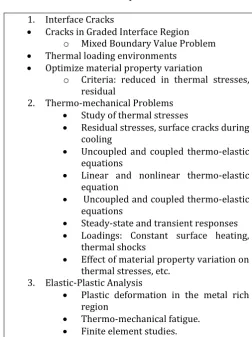
1. Interface Cracks
Cracks in Graded Interface Region
o Mixed Boundary Value Problem Thermal loading environments
Optimize material property variation
o Criteria: reduced in thermal stresses, residual
2. Thermo-mechanical Problems Study of thermal stresses
Residual stresses, surface cracks during cooling
Uncoupled and coupled thermo-elastic equations
Linear and nonlinear thermo-elastic equation
Uncoupled and coupled thermo-elastic equations
Steady-state and transient responses Loadings: Constant surface heating,
thermal shocks
Effect of material property variation on thermal stresses, etc.
3. Elastic-Plastic Analysis
Plastic deformation in the metal rich region
Thermo-mechanical fatigue. Finite element studies.
2.1
Functionally Graded Material Processing
Techniques
A. Mortensen and S. Suresh [1] presented in two sections an overview of the processing techniques, the performance and the thermo-mechanical analysis of functionally graded materials. The first section concentrates on constructive & transport-based production processes. Constructive methods represent FGM gradients by selectively stacking of two or more base materials and allowing programmed composition gradient control since they mainly employ powder consolidation processes such as solid state powder metallurgy or reactive sintering and coating methods such as plasma spraying and vapour deposition. Whereas in transport-based processes, natural transport phenomena such as the transport of heat, mass or fluid are used to develop compositional and micro-structural gradients during the production of FGM. A time scale analysis is carried out for the corresponding transport phenomenon and validation studies are carried out to test the role and importance in both methods of FGM production.
[image:3.595.30.293.514.712.2]© 2017, IRJET | Impact Factor value: 6.171 | ISO 9001:2008 Certified Journal
| Page 1803
theories of thermo-elastic & thermo-plastic deformation inmetal-ceramic composites. The rules of the mixture approach and the mean field theories, the crystal-plasticity and the discrete displacement models as well as the continuum finite element formulations of the constitutive phases of composite materials are explained and their limits and their significance discussed. The mathematical modelling of the thermal, elastic and plastic deformation of graded multi-layer structures is discussed in the context of classical beam and plate theories. It is concluded that the construction of step-wise or continuously stepped metal-ceramic composites improves the interfacial bonding between dissimilar solids, minimizes and optimizes thermal stresses, expands plastic, and mitigates the destructive effects of singular fields at free edges of multilayer where interfaces occur and minimize cracks. Kieback et al. [9] have described an overview of established powder metallurgical processes and techniques with molten metals and discussed the advances in the field of graded polymer processing. A large number of processing techniques are available today for virtually any combination of materials. It is concluded that a suitable processing method depends not only on the materials involved, but also on the type and extent of the gradation index and the geometry of the desired component. New challenges in FGM processing as new fields of application are developed by FGM are discussed. Victor Birman et al. [27] provides a detailed overview of recent developments in the modelling, characterization and analysis of the FGM mainly focusing on published research since 2000. These area include homogenization schemes of functionally graded material, stress, stability and dynamic analysis, testing and heat transfer problems, manufacturing and design, fracture analysis, and more recent FGM application areas. Mahamood et al. [65] reviewed a number of published literature and concluded that FGMs are advanced materials which are defined by varying the material properties in the direction of thickness so that the overall properties are unique and different from their starting materials. Due to the wide range of potential and emerging applications of FGM in aerospace, medical, energy and defense industries, there is a need to reduce the manufacturing costs of FGM. Thus in this area the most promising FGM manufacturing process, i.e. solid free-form SFF). The improvisation of SFF processes and extensive studies on the material characterization of the produced components lead to a reduction in the production costs of FGM and to an increase in productivity
2.2
Thermomechanical Behaviour of Functionally
Graded Material
G. N. Praveen and J. N. Reddy et al. [3] examined the static and dynamic thermo-elastic response of functionally graded ceramic metal plates using a plate finite element, which takes into account the effect of transverse shear stresses, rotational inertia and large rotations in von-Kármán type.
© 2017, IRJET | Impact Factor value: 6.171 | ISO 9001:2008 Certified Journal
| Page 1804
boundary conditions. The analysis is performed with higherorder shear deformation theory with reasonable improvement in transverse displacement using FEM. The temperature-dependent mechanical properties are assumed and graded according to simple power law distribution of volume constituents in the thickness direction. Fundamental equations for FGM plate are derived using a variational approach taking into account the traction-free boundary condition at the top of plate and a C0 continuous iso-parametric Lagrange element with thirteen degree of freedom per node is developed and used to calculate the results. Convergence tests and validation studies were performed to verify the accuracy of the present formulation. It is concluded that in all kinds of boundary conditions when thermal effect is considered, the bending behaviour of the functionally graded plate is not necessarily between that of the metal and the ceramic plate.
2.3
Plate Deformation Theories
Ferreira et al. [14] uses mesh-less collocation method, multi-quad radial basis functions & third order shear deformation theory to analysis static deformations of FGM square plates with varying aspect ratios. The mixture rule and the Mori-Tanaka scheme have been used to calculate material properties. The calculated results are in good agreement with those calculated from the mesh-less local Petrov–Galerkin (MLPG) from Qian, Batra and Chen. Results of collocation and MLPG methods are in asymmetric "stiffness" matrices. Computational time which the collocation method has been significantly less than the MLPG method because there is no numerical integration is necessary in collocation scheme. For nearly equal Poisson’s ratios of the two materials, homogenization techniques i.e., rule of mixtures and Mori-Tanaka have nearly the same results, but for widely varying Poisson’s ratios the above homogenization techniques give quite different results. A.M. Zenkour [15] introduced the sinusoidal shear formation plate theory to investigate the buckling and free vibration behaviour of the simply supported FGM sandwich plate. The sinusoidal theory comprises the same dependent unknowns as the shear deformation theories of the first and third order type, but transverse shear strain follows cosine-law distribution through thickness direction of FGM plate. By increasing ceramic component i.e. volume fraction exponent decreases in sandwich FGM plate vibration frequencies and critical buckling loads increases. Shyang-Ho Chi et al. [20] studied mechanical behaviour of simply supported FGM rectangular elastic plate of average thickness subjected to lateral loads. The volume fraction of the components defined by P-FGM, S-FGM or E-FGM functions is used to vary the modulus of elasticity by the thickness of the plate, but the Poisson ratio of FGM plates is assumed to be constant. Classical plate theory & Fourier series expansion are used to derive series solution of Power law FGM (P-FGM), Sigmoid FGM (S-FGM) & Exponential FGM (EFGM). It is concluded
that the formulations of FGM and homogeneous plate solutions are the same but the flexural (bending) stiffness differs. Shyang-Ho Chi and Yen-Ling Chung [21] evaluated numerical solutions directly from theoretical formulations or finite element solutions using the MARC program. The mechanical behaviour of the FGM plate is investigated considering the effects of the loading conditions, changing Poisson ratio, aspect ratio of plate and also the variable mechanical properties of FGM defined by the Power-law, Sigmoid Law and exponential law. It is concluded that the changing Poisson’s ratio does not affect the mechanical behaviour of FGM plate, so it is assumed to be constant. Variation of FGM properties in the thickness direction or the ratio of Young's modulus for a certain material distribution determines the position of the neutral surface. Nguyen, Sab, Bonnet et al. [32] introduced a first-order shear deformation plate theory model for simply supported square FGM plates with improved shear correction coefficient and shear stiffness. Energy equivalence method is used to study transverse shear factors through this model. Equilibrium equations and expressions of membrane stresses are used to calculate transverse shear stresses. Transverse shear stress factor is used to calculate numerical results of simply supported square plate and a cylindrical bending clamped sandwich plate. Numerical simulations showed that the shear correction factor is not the same as that calculated from homogeneous FSDT models, and is a function of the relationship between the elastic modulus of the material constituents and their distribution across thickness of FGM plate.
2.4
Analytical solution of free vibration analysis of
FGM plates without thermal loadings
© 2017, IRJET | Impact Factor value: 6.171 | ISO 9001:2008 Certified Journal
| Page 1805
vibration characteristics of FGM plates. The equations of themotions for the FGM plate are derived by the von Karman theory for large transverse deflections and the solution is derived in terms of mixed Fourier series. Effect of the properties of the material, the boundary conditions and the thermal load on the dynamic behaviour of the plates is studied. It is found that the fundamental frequency of FGM plates is mainly influenced by non-linear coupling effects. Serge Abrate [22] studied the free vibrations, buckling and static deflections of the FGM plates in which the properties of the material vary through the thickness. After studying available literature he concluded that the natural frequencies, the critical temperature, in-plane buckling load and deflections of the FGM plates were proportional to those of equivalent homogeneous plates. Extensive studies were performed for thin and thick plates with different aspect ratios, as well as skew and circular plates and many combinations of boundary conditions. These problems were analyzed with classical plate theory, the first and third order shear deformation theories. Roque et al. [25] investigated free vibration response of FGM plates by multi-quadratic radial basis function method with higher order shear deformation theory. The mesh-less, multi-quadratic method allows a fast and easy domain and boundary discretization. Mori-Tanaka scheme is used to homogenize material properties. Hiroyuki Matsunaga [31] studied buckling stress and natural frequency of FGM plates by considering effects of transverse shear, normal deformation and rotary inertia. To vary material properties Simple Power-law distribution in terms of the volume fractions of the constituents is used. Power Series expansion method of displacement components, and set of elementary dynamic equations of two-dimensional (2D) type and higher order shear deformation theory of FGM plates is derived by Hamilton’s principle. Several sets of approximate truncated theories are applied to solve the Eigen-value problems of FGM plates with simply supported edges.Farzad Ebrahimi et al. [35] analytically investigated the free vibrational behavior of thin, circular FGM plates integrated with two evenly distributed piezoelectric (PZT4) material actuator layers using classical plate theory. The properties of the FG substrate plate materials are graded in the thickness direction according to the simple power law distribution in terms of the volume fractions of the constituents while the distribution of the electric potential field in the direction of the thickness of the piezoelectric layers is simulated by a quadratic function in short circuit form. Zhang et al. [43] presented an analysis on the non-linear dynamics and the chaos of the simply supported orthotropic FGM rectangular plate in the thermal environment and was applied to parametric and external excitation. Both temperature-dependent ion and heat conduct material properties are taken into account. Equations of motion of rectangular orthotropic FGM plate are based on Reddy’s third-order share deformation theory and Hamilton’s principle is used to derive this. Galerkin method is applied to the regulating
© 2017, IRJET | Impact Factor value: 6.171 | ISO 9001:2008 Certified Journal
| Page 1806
calculated by n-order theory with different materialgradation index values.Benachour et al. [51] uses four variable refined plate theory for the free vibration analysis of FGM plates with random material gradation. This theory considers transverse shear effects and the parabolic distribution of transverse shear strains through thickness of the plate, so shear correction factors are not required. In this refined plate theory number of unknown functions are four while in shear deformation theory there are 5 unknown functions. Equations of motion are derived according to Hamilton's principle. Navier method is used to obtain closed form solutions, and fundamental frequencies are then calculated by solving the results of Eigen-value problems. Kumar and Reddy [53] provided an analytical solution to investigate free vibration of functionally graded plates without imposing zero transverse (cross shear) stress conditions on upper and lower surfaces of plate with the higher order displacement model. Virtual work principle is used to derive motion equations for the higher-order displacement model. Energy principle is used to derive equations of motion of FGM plate and Navier’s solutions. It is found that the natural frequencies of the FGM plate with different material gradient index lie between those of the natural frequencies of metal and ceramics. Y.X. Hao et al. [55] investigated nonlinear transverse vibration response of cantilever type FGM rectangular plates which were subjected to combined transverse and thermal loadings. The non-linear motion equations for the FGM plate are derived from Reddy's third order shear deformation plate theory and the Hamiltonian principle. The Galerkin method converts the governing partial differential equations into a nonlinear system with two degrees of freedom containing square (quadratic) and cubic nonlinear terms under combined external excitations. Resonance case with 1: 1 internal resonance and sub-harmonic resonance of order ½ are considered for present problem and asymptotic perturbation method develops four nonlinear average equations, which are then solved by the Runge-Kutta method to find out non-linear dynamic response of FGM plate. The chaotic, periodic and quasi-periodic movements of the plate are present under certain conditions, and the forced excitations can alter the shape of the movements of the functionally graded rectangular plate. D.K. Jha et al. [66] presented a higher order shear and normal deformation theory (HOSNT) to investigate free vibration behaviour of functionallygraded elastic, rectangular plates with simply supported edges. Governing equations of motion are derived by Hamilton’s principle using HOSNT. Navier’s solution method using double Fourier series is used to compute the result with required accuracy. The results concluded that as the material gradient index increases, the natural frequency decreases significantly. Huu-Tai Thai et al. [88] presented a new simple first order shear deformation theory to investigate bending and free vibration response of FGM plates. The present FSDT model contains only four unknown variables and resembles the classical theory of plates in many aspects
regarding equation of motions, boundary conditions and stress-resultant expressions. Comparative and validation studies show that the present theory can achieve the same accuracy of the conventional FSDT that has more unknown variables.
2.5
Thermal vibration analysis
© 2017, IRJET | Impact Factor value: 6.171 | ISO 9001:2008 Certified Journal
| Page 1807
consideration. In first boundary condition a particular valueof temperature is applied on upper surface of plate & some different (or same) value of temperature is applied on lower surface of plate. Second boundary condition is that the heat flows from the upper surface to lower surface which is held at prescribed temperature. Mathematical model is formulated using third-order shear deformation theory which considers rotary inertia & transverse shear strain. Frequency equation is obtained by Rayleigh-Ritz method.
Sundararajan et al. [18] developed nonlinear formulation based on first-order shear deformation theory which contains von Karman’s type geometric nonlinearity. Temperature field is uniformly distributed over the plate surface and varied in thickness direction. Effective material properties are estimated according to law of volume fraction of constituents and Mori–Tanaka homogenization method. Nonlinear governing equations are obtained with Lagrange’s equations of motion and finite element method coupled with the direct iteration technique are used to solve this. Temperature field and material gradient index have significant effect on nonlinear vibration of FGM plate. E.Efraim and M.Eisenberger [26] presented exact natural vibration frequencies and modes of the variable thick isotropic annular FGM plate. Coupled set of differential equations with variable coefficients are the governing equations of motion and their exact solution is obtained by exact element method & dynamic stiffness method
.
Q. Li et al. [28] used three- dimensional linear theory of elasticity to investigate free vibration behaviour of rectangular sandwich FGM plate with simply supported edges. In this study two types of sandwich FGM plates are considered firstly, sandwich plate having FGM face-sheet and homogenous core whereas second plate is sandwich with homogenous sheet and FGM core. Three components of plate displacement expand by triplicate summations of series of Chebyshev polynomials that are multiplied by suitable functions to accomplish the fundamental boundary condition and these are best approximation of variation of displacements in the thickness direction. Ritz method is used to calculate natural frequencies. Bahar Uymaz and Metin Aydogdu [29] presented three-dimensional vibration analysis for rectangular FGM plate with different boundary conditions, based on small strain linear elasticity theory. The Rayleigh Ritz method with Chebyshev polynomial displacement functions is used to solve the vibration problem of the FGM plate. Effects of plate aspect and thickness ratios &gradient index on the free vibration frequencies are investigated.Fazelzadeh [30] investigated the vibration analysis of the rotating thin walled blade of functionally graded material exposed to high-temperature supersonic flow, using the differential quadrature method (DQ). Governing equation of motion are based on first-ordershear deformation theory of beams which accounts the effect of rotary inertia and blade presetting angle & high temperature supersonic gas flow loading. Quasi-steady aerodynamic pressure loading and steady wall temperature are assumed. Convergence of above
© 2017, IRJET | Impact Factor value: 6.171 | ISO 9001:2008 Certified Journal
| Page 1808
Xian-Kun Xia et al. [42] investigated non-linear vibrationsand dynamic responses of shear deformable FGM plates with surface-bonded piezoelectric fiber-reinforced composite actuators (PFRC) in a thermal environment. Temperature field is assumed to be uniformly distributed over plate surface and varied in thickness direction of the plate. The electric field is assumed to be a transversal component of only. Temperature dependent material properties of both functionally graded material and surface-bonded piezoelectric fibre reinforced composite actuators (PFRC) are considered. Problem formulation is based on higher order shear deformation plate theory and thermo-piezoelectric effects are considered by von Kármán-type equation. It is concluded that the effect of control voltage on natural frequency of the functionally graded material plate with PFRC actuators is greater than that of the plate with monolithic piezoelectric actuators. It is confirmed that the temperature field and the volume fracture distribution have a significant effect on the dynamic response of hybrid FGM plates. Mahi et al. [46] presented analytical solution to study free vibration of symmetric FGM beam subjected to initial thermal stress by a temperature rise through the thickness. Theoretical formulations are based on classical beam theory, first & higher order shear deformation theories. Temperature dependent material properties are assumed to vary continuously through the thickness according to P-FGM, S-FGM or E-FGM distribution laws. Equations of motion were derived by Hamilton’s principle and frequency equations were derived by solving analytically the governing differential equations for different boundary conditions. Ebrahimi et al. [47] investigated behaviour of piezoelectric bounded circular FG plate subjected to temperature change and control voltage excitations using classical plate theory. Thermal gradient, piezothermo-elasticity and von Kármán type geometric nonlinearity effects are considered in this study. Nonlinear coupled open-loop equations in radial & transverse oscillations were simplified to axisymmetric oscillation problem. An exact series type solution is used to derive piezothermoelastic solutions for nonlinear static deformations & natural frequencies of the functionally graded circular plate. It is concluded that a high temperature causes a higher deflection of the plate, & the deflection at each temperature is induced by increasing the control voltage, but this effect is predominant at higher voltages. By increasing material gradient index in FGM, the normalized center deflection in a nonlinear profiler will increase for different temperature fields
.
Fakhari et al. [54] developed finite element formulation based on higher order shear deformation theory including Kármán type geometric non-linearity to study nonlinear free vibration frequency, time & frequency responses of FGM plate with surface-bound piezoelectric layers subjected to thermal, electrical and mechanical loads. The temperature field is assumed to be uniform distribution over plate surface and varies in thickness direction and considered electric field only hasnon-zero valued component. Suresh Kumar et al. [56] presented nonlinear thermal analysis of FGM plates with considering effect of material gradation index, boundary condition, aspect ratios & side to thickness ratio using higher order shear deformation theory. Higher order equations of motions are derived using principal of virtual work. Nonlinear simultaneous equations are derived by Navier’s method considering various parameters, loads and boundary condition. Nonlinear algebraic equations are solved by Newton Raphson iterative method. Alijani et al. [57] investigated geometric nonlinear vibration analysis of FGM rectangular plates in thermal environment using multi-modal approach. First-order shear deformation theory and von Kármán theory are used to model simply supported FGM plates with moving edges. Effective material property & the temperature field are assumed to vary nonlinearly in thickness direction. By Lagrange equations of motion, energy equation has been reduced to a system of infinite nonlinear ordinary differential equations with quadratic & cubic nonlinearities. Pseudo-arc length continuation & collocation scheme is used and it is concluded that in order to predict the accurate natural frequency in thermal environments, analysis should be performed on nonlinear model because the plate loses its original straight configuration due to thermal loadings. The effect of temperature variations as well as the material gradient exponents is investigated in detail and it is concluded that thermally deformed FGM plates have a higher hardening behaviour, on the other hand the effect of the material gradient exponent is not significant. But in thermally deformed plates modal interactions may rise, which cannot be observed in their un-deformed isotopic counterparts. Maziar Janghorban et al. [58] investigated the free vibration analysis of functionally graded non-uniform straight side plates with circular and non-circular cutouts subjected to thermal boundary conditions. Parametric studies have been performed to investigate the various effects viz. size of cut-out,length-to-thickness ratio & nature of loading and boundary conditions of plate on natural frequencies. Shahrjerdi et al. [59] investigated temperature-dependent free vibration characteristics of solar-functionally graded plates which were subjected to uniform, linear, heat-flow, and sinusoidal temperature fields using the Navier's method for simply supported solar-functionally graded plates. Governing equations of motion are based on second order shear deformation theory which considers effect of transverse shear stress through the thickness of plate. In this study two different types of solar FGM plates made of ZrO2/Ti6Al4V
&
Si N /SUS3044 3
© 2017, IRJET | Impact Factor value: 6.171 | ISO 9001:2008 Certified Journal
| Page 1809
Hui-Shen Shen et al. [62] investigated large and smallamplitude vibration analysis of the FGM plate in the thermal environment resting on a two-ply (Winkler–Pasternak) elastic foundation. Voigt (V) and Mori-Tanaka (M-T) micromechanical models are considered in this analysis. Higher order shear deformation plate theory considering the effects of plate foundation interaction are used as governing equations of motions. Material properties dependent on temperature are considered. In-plane type two boundary conditions are considered: (i) initial stresses caused due to thermal loads and (ii) the in-plane edge loads are considered. Comparative studies concluded that the difference between Voigt (V) model and Mori-Tanaka (M-T) models is significantly lower than the difference caused by different solution methods and plate theories.Rahimabadi et al. [71] numerically examined the effect of centrally located cut-out of various geometries like circular, elliptical and crack resulting from the cut-out and their free and flexural vibration characteristics of the FGM plate in thermal environment. First-order shear deformation theory of plates is used for problem formulation and developed shear flexible 4-noded quadrilateral element for spatial discretization. The discontinuity of the surface is represented independently of the mesh by utilizing the detachment of the unity method framework. Influence of various parameters viz. plate aspect ratio a/b. cut-out geometry d/e, cut-out radius r/a, crack-length l/a, thickness of plate h and material gradient exponent n is investigated for FGM plates subjected to thermal boundary conditions. Fiorenzo A. Fazzolari et al. [74] developed a fully coupled thermo-elastic formulation to study the free vibration response of anisotropic composite plates and isotropic / sandwich FGM plates. This formulation was developed within Carrera's unified formulation by combining the hierarchical plate models with trigonometric Ritz method. Temperature profile over the plate thickness is modelled with a layer-wise kinematics description, however, both equivalent single layer and layered approaches for the displacement variables are used correctly and effectively. It is concluded that thermo-elastic mode shapes give the shape of the structure’s temperature distribution associated with corresponding natural frequencies, regarding the fact that compressed/expanded locations result hotter/colder with respect to the reference temperature. In practice, the temperature change during the vibration is almost negligible, in all anisotropic composite laminates. Gulshan Taj and Anupam Chakrabarti [77] investigated free vibration analysis of FGM skew plates subjected to thermal environment. Reddy’s higher order shear deformation theory is used to derive kinematic equations of skew FGM plate. For meshing of plate geometry nine noded iso- parametric Lagrangian element is used. Displacements Components of a rectangular plate are mapped into the skew plate geometry using a suitable transformation rule. One dimensional Fourier heat conduction equation is used to determine the temperature profile of the plate along thickness direction. Effect of various parameters viz.
material gradient index, plate aspect ratio, thickness ratio, boundary condition temperature field on variation of frequency parameter of FGM skew plates by solving various numerical problems and their related findings were discussed. M. Huang and T. Sakiyama[85] used an approximate method to investigate free vibration characteristic of rectangular plates with differently shaped & arbitrarily arranged holes using the green function of the equivalent rectangular plate of non-uniform thickness. Shapes of the holes on rectangular plate are semi-circular, elliptic, square, rectangular, triangular, & rhombic, etc. Rectangular plates with a hole are considered as a rectangular plate of non-uniform thickness. Hole in the plate is assumed to be a very thin part of the plate so that the free vibration of a plate with a central hole can be translated into the free vibration problem of the equivalent rectangular plate of uneven thickness.
2.6
Finite Element Modelling of Modal analysis of
FGM plates
© 2017, IRJET | Impact Factor value: 6.171 | ISO 9001:2008 Certified Journal
| Page 1810
displacement field is approximated by Kernel particleestimation. In this study skew FGM plates made of
,
O
Al/Al
2 3 AlZrO2, Ti6Al4V/Aluminium oxide, andSUS304/ Si3N4 are selected. Eigen-equation is derived by application of energy function of the system using Ritz method. Effects of various parameters i.e. volume fraction index, length-to-thickness ratio & boundary conditions on vibrational frequency are studied. It is concluded that a volume fraction exponent ranging from 0 to 5 has a significant influence on the frequency but the effects of the length-to-thickness ratio on the frequency of a plate are not affected by the volume fraction. Prakash et al. [61] investigated the flutter characteristics of a functionally graded plate under high supersonic airflow using a high precision shear flexible finite element method taking in to account both geometric and aerodynamic nonlinearities. First-order shear deformation theory is used to model functionally graded material plate taking into account the exact position of the neutral surface and the von Kármán theory of large displacement. Aerodynamic pressure is calculated by third-order piston theory. Nonlinear Eigen-value equation is derived using harmonic balanced method which calculates aerodynamic pressure. Time history analysis is done to validate nonlinear Eigen-value equation and to determine the periodic, harmonic, and quasi-periodic characteristic of the flexural vibration under aerodynamic loading load by using plots of transverse displacement, phase portrait, bifurcation diagram & Poincare map. It is apparent that by increasing Mach number & aerodynamic load, the bending (flexural) vibration becomes chaotic and is more resistant to chaotic phenomenon in graded FGM plate having ceramic constituent. Sanjay Anandrao et al. [63] presented the significance of transverse shear on fundamental frequencies and mode shapes of FGM beams subjected to various boundary conditions and length-to-thickness ratios. Two separate finite element formulations, one is Timoshenko beam formulation which considers effect of transverse shear and other is Euler-Bernoulli beam formulation which neglects effect of transverse shear. It is noticed that consideration of transverse shear in the formulation of FGM beam increases flexibility of short beams and reduces frequencies. Effect of transverse shear is more dominant for clamped beams as compared with other boundary conditions
.
Koteswara Rao D et al. [64]developed finite element model of functionally graded composite shell structure using 8 noded layered shell element (SHELL99). Response and characteristic of functionally graded spherical shells were studied and compared with response of homogenous shell structures under static uniform distributed load and thermo- mechanical loading. Structural response of functionally graded shells is found between the responses of the homogeneous shells made of ceramic and metal. Free vibration analysis of thick and thin functionally graded shell
structures for only first and second mode shapes.
K. Swaminathan et al. [68] presented finite element formulation based on first order shear deformation theory to determine natural frequency of simply supported FGM plates. Results of Exact 3-Dimensional elasticity solution are compared with computational analysis. Results are presented for FGM plates with varying side-to-thickness ratio, plate aspect ratio & material gradation index. Shuohui Yin et al. [69] developed non-uniform rational B-spline (NURBS) based iso-geometric analysis with classical plate theory to investigate free vibration analysis of thin non-homogenous functionally graded material plates and shells. For thin non-homogenous FGM plates, mid-plane displacements are neglected in classical plate theory that’s why classical plate theory is not accurate to analyze non-homogenous thin FGM plate with moderate material gradient indexes. Mid-plane displacements effects are not minimized without introducing new unknown variable the physical neutral surface is introduced into CPT which is known as CPT_neu. The NURBS basis function is used to implement geometric description and deflection field approximation.Z.X. Lei, K.M. Liew et al. [70] investigate free vibration analysis of functionally graded composite plates reinforced by single walled carbon nano-tubes (SWCNTs) using element-free kp-Ritz method. Effective material properties of CNTRCs are approximated by extended rule of mixture or Eshelby–Mori–Tanaka scheme. First-order shear deformation plate theory with considering transverse shear & rotary inertia effect and a kernel particle estimate is used to approximate the two- dimensional displacement field. Various examples are solved in computational simulation to study the effects of carbon nano-tube volume fraction, plate-aspect ratio and width-to-thickness ratio with temperature change on natural vibration frequencies and mode shapes of various FG-CNTRC plates.Alshorbagy et al. [72] studied finite element analysis of thermo-mechanical behaviour of functionally graded material plates using first-order shear deformation theory. A series of simulations are performed to investigate characteristic of FGM plates which are exposed to thermo-mechanical loads and to determine the effect of heat source intensity. The results of the numerical simulation concluded that there is adifference in the plate deflection when one considers the effect of shifting of the neutral plane position. But neutral plane of the FGM plate is shifted toward the surface with higher Young's modulus. But the position of the neutral plane depends mainly on the ratio of the modulus of elasticity of the two plate constituents. The main advantage of the FGM plate versus the conventional laminate plate is that the variation in stresses and strains without any kind of singularities is smooth in the functionally graded plate due to the continuity of the material properties distribution along the thickness of the plates. Natarajan and Ferreira [73] studied mechanical & thermal buckling and free vibration behaviour of FGM plates using cell-based
smoothed finite element method with discrete
first-© 2017, IRJET | Impact Factor value: 6.171 | ISO 9001:2008 Certified Journal
| Page 1811
order shear deformation theory and discrete gap method is used to prevent shear locking. The shear correction factor is evaluated by the use of energy equivalence principle. Mori-Tanaka homogenization method is used to approximate effective material properties of FGM plate. Effective material properties are calculated by Mori-Tanaka homogenization method. Parametric studies are carried out to investigate the effect of material gradient index, plate-side to thickness ratio, plate skewness and boundary conditions on the global response of FGM plates. It is concluded that this improved finite element method is insensitive to the shear locking and gives excellent computational results for static deflection, free vibration and buckling behaviour characteristics of FGM plates. Ramu I et al. [75] performed modal analysis of FGM plates to determine their natural frequency and mode shape by finite element method with different boundary conditions and different power-law material gradient index values. For the modal analysis of the FGM plate the FEM program was encoded in the MATLAB software. Effects of the material scaling index 'n' and the four different boundary conditions on the natural frequencies are investigated. Plates having CCCC edges have highest value of natural frequency than corresponding frequencies evaluated for SCSC, SSSS and SFSF boundary conditions. It is noticed that effect of power law index is more prominent within the range up to 4, after which the effect is not so important. Ali Yeilaghi Tamijani et al. [76] developed element free Galerkin method (EFG) based on first-order shear deformation theory to investigate free vibration analysis of FGM plate with curvilinear stiffeners. In plane deformation, plate rotations and transverse deflections of a plate are expressed by moving least square approximation (MLS) and the boundary conditions are imposed by the penalty method. The MLPG formulation can model stiffeners with any orientation, curvature, and eccentricity. The effect of the material composition, the stiffener’s number and its size on the natural frequency is investigated. It is noted that the effect of the volume fraction exponent on the frequency parameter for a non-stiffened plate is greater than the stiffened plate. It is noted that natural frequencies for FGM plates with curvilinear stiffeners are greater than those made from a pure metal plate with curvilinear stiffeners but lower than those from a pure ceramic plate with curvilinear stiffeners. It is shown for plates with 1, 2, 3 and 4 curvilinear stiffeners that the gradients in the material properties significantly influence the natural frequencies while the volume fraction exponent is between 0 and 2. Kulkarni, Trivedi & Ishi [78]
Studied behaviour of skew functionally graded material plates subjected to various boundary conditions by applying modified, improved discrete Kirchhoff quadrilateral (MIKD) elements. This element has seven degrees of freedom comprising three displacements, two revolutions, and two shear stresses per node. Isotropic plate is assumed and gradation of material properties occurs in thickness direction according to simple power law distribution. Results of central deflection and stresses are compared and
validated to three-dimensional finite element results of ABAQUS. Performance of MIDKQ element is satisfactory and its results are validated by 3D FE results of ABAQUS 20 node solid element. Pradhan et al. [86] studied vibration characteristic of stepped functionally graded cylindrical shell made of stainless steel and zirconium oxide. An influence of boundary conditions & volume fractions (Power Law Index) on the natural frequencies of the FG cylindrical shell is investigated. Rayleigh method and Love's shell theory is used to calculate natural frequency. The vibration characteristics of functionally graded cylindrical shells are similar to those made of isotropic materials. Material gradation index is responsible for variation of natural frequency. Extensional and flexural stiffness decreases as the power law exponent increases where - as the stiffness of the coupling first increases and then decreases by the increasing value of N. It is concluded that the natural frequency of the functionally graduated shell decreases rapidly by increasing length to radius ratio.Natarajan et al. [87] derived natural frequencies of cracked functionally graded plate with enhanced finite element method. Equation of motion was derived by first-order shear deformation theory and a 4-noded quadrilateral platebending element used for above analysis which is based on field & edge consistency requirement having 20 degrees of freedom per element. In thickness direction of plate temperature dependent material properties are assumed. Numerical computation have been conducted to investigate the effect of gradient index, effect of multiple cracks and their relative orientation, crack length, crack location, plate boundary condition, plate aspect ratio & plate thickness on the free vibration frequency of the FGM plate. It is concluded that an increase in crack length decreases the natural frequency, because the stiffness of the material is reduced and the frequency is found at a minimum value when the crack is located at the middle of the plate. Natural frequency of FGM plate decreases by increase in material gradient index n, which increases metallic content of FGM. Natural frequency of cracked FGM plate increases by lowering of plate thickness (a/h) ratio and rising plate aspect ratio (b/a).
2.7
Natural Frequency Assessment formula For
FGM Plates
© 2017, IRJET | Impact Factor value: 6.171 | ISO 9001:2008 Certified Journal
| Page 1812
thickness with isotropic material in elastic limit. Thefrequency equation of the clamped circular plate in cylindrical coordinate, kinetic and potential energy for the in-plane behaviour was obtained by stress- strain displacement terms & application of the Hamilton principle .Helmholtz decomposition principle was used to decouple coupled differential equations of the motions. The harmonic solution for uncoupled equations led to generation of wave equations and the general solution was obtained by separating the variables. For in-plane displacements in r & y directions solution is calculated. The derived frequency equation is in good justification with the finite element analysis and the comparison of the results published so far. Shahrjerdi [37] applied Second order shear deformation theory (SSDT) to study natural frequency of rectangular FGM plates. FGM phase is composed of aluminum as metal phase while Zirconia as ceramic phase. Hamilton principle is used to derive equation motion and these equations are solved by Navier's method. Natural frequency increases with increasing side-to- side ratio and gradation of material properties significantly vary the frequency of rectangular plate. Bashmal [40] studied in-plane vibration characteristic of annular circular disc which were subjected to various types of boundary conditions at the inner and outer edge. Two-dimensional linear theory of elasticity is used to study for in-plane free vibration response of elastic and isotropic disc. The analytical solution of the equilibrium of the annular disc is derived in the form of Bessel functions. Presented frequency equations provide the frequency parameters for the appropriate number of modes for a wide range of radius and Poisson ratios of annular discs subjected to clamped, free, or flexible boundary conditions. Elia Efraim [52] investigated natural frequencies of FGM annular plates for different modes of vibration. Studies on the natural frequency calculation of the FGM isotropic annular plates concluded that the coupling effect induced in the vibration modes due to the variation in the density and elasticity of the FGM plates in the shear plane, mainly due to the mixed mode of bending and stretching as in isotropic annular plates. Based on the investigation of the frequency variation due to the volumetric fraction, the present method derives an empirical formula which gives a correlation between the frequencies of the FGM plate and the isotropic plates made of different containing materials. Above empirical formula gives accurate results for various modes of vibration for different volume fraction index and Poisson's ratio of containing materials with minimum computational effort.
3.
Effective material properties
(homogenization) of Functionally Graded
Materials
The functionally graded material (FGM) can be composed by continuously changing the constituents of multi-phase materials in a predetermined manner. FGM are the
non-uniform microstructures having continuously graded macro-properties. Functionally graded materials are defined by the variation in the volume fractions. Effective material properties, viz. Elastic constant, shear modulus, density etc. of the graded composite are being calculated by the volume fraction distribution & the approximate shape of the dispersed phase. Various micromechanics models have been developed to assume the effective properties of macroscopically homogenous composite materials. Analytical approaches both micromechanical models & Finite element methods are used for modelling of FGM. There are various analytical approaches which are used for FGM modelling are viz. Self -consistent estimates, Mori-Tanaka scheme, Composite sphere assemblage model, Composite cylindrical assemblage model, The simplified strength of materials method, The method of cells & Micromechanical models [60].
4.
Mathematical Idealization of Functionally
Graded Materials
FGMs are extremely heterogeneous, so it is important to idealize them as continua with their mechanical properties changing gradually with respect to the spatial co-ordinates. In FGM material properties are likely to follow a gradation through the thickness in a continuous profile.
Most of the investigations related to functionally graded material, use the power-law function, sigmoid function or exponential function to define the volume fractions functions. So FGM plates with power-law, exponential, or sigmoid function will be considered in this study. Consider a rectangular plate as shown in Fig 3 x & y are the coordinates of the plane of the plate, whereas the z -axis originated at the middle surface of the plate is in the direction of thickness. The material on the top (upper) surface of the plate is ceramic rich whereas the bottom (lower) surface material is metal rich. Effective material properties, such as Young’s modulus & the Poisson’s ratio, on the top and bottom surfaces are different but are selected according to the performance criteria. However, the Young’s modulus & Poisson’s ratio of the plates vary continuously only in the thickness direction (z-axis) i.e.,
E
E(z)
, and
(z)
The "z" is varying from “ℎ/2” at top surface, “0” at the middle of the thickness, to “−ℎ/2” at bottom surface. That’s why it is© 2017, IRJET | Impact Factor value: 6.171 | ISO 9001:2008 Certified Journal
| Page 1813
Figure 3: The geometry of an FGM plate4.1
The material properties of Power Law FGM
(P-FGM) plates (Vigot-Model)
The volume fraction of the P-FGM is assumed to vary according to power-law function. The effective material properties at an arbitrary point within the structural domain, like Young’s modulus
E
, Poisson’s ratioν
,mass densityρ
,coefficient of thermal expansionα
,of the FGM plate are the effective material propertiesP
These properties are position dependent & can be expressed as.(z)
V
P
(z)
V
P
P(z)
t t
b b (1)1
(z)
V
(z)
V
t
b
(2)n
t
2
1
(z)
V
h
z
Where (
n
0
) (3)Where
P
denotes a generic material property like elastic modulus, whereP
t andP
bdenotes the property of the top and bottom faces of the plate respectively & h is the total thickness of the plate.V
t(z)
andV
b(z)
are the volume fractions of the constituent of the top and bottom faces of the plates. The volume fractions of the constituent of the top (upper) surface of the plate follows a simple power-law as,n
t
2
1
(z)
V
h
z
(4)
Where n is a non-negative volume fraction index which describes the material variation profile through the thickness of the plate and may be adjusted to attain the optimum distribution of the constituent material.
At the bottom surface
(z/h)
1
2
; soV
t(z)
0
andb
P
P(z)
(Metal)At the top surface:
(z/h)
1
2
; soV
t(z)
1
andt
P
P(z)
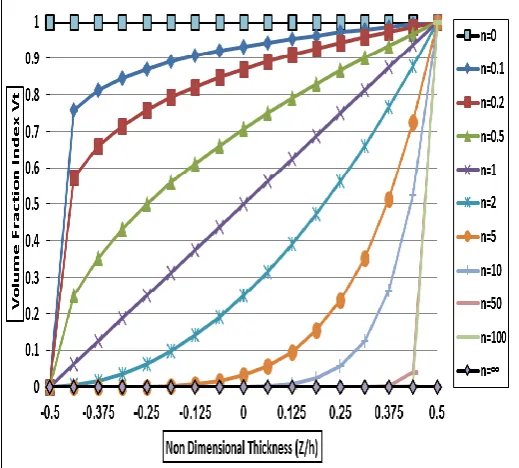
(Ceramic)At n =0 the plate is a fully ceramic plate while at n = ∞ the plate is completely metal. The variation of volume fraction in the thickness direction of the P-FGM plate is depicted in Figure 4, which shows that volume fraction changes rapidly near the lowest surface for n > 1 and increases quickly near the top surface for n < 1. If temperature affects material properties then effective properties are expressed as a function of temperature. [79]
)
(
1 1 1 1 2 2 3 30
P
T
P
T
P
T
P
T
P
P
(5)Where
P
0,P
1,P
1,P
2, andP
3 are the coefficients of temperatureT
(
K
)
and are limited to the constituentmaterials. It is ascertain that the effective Young’s modulus
E
and thermal expansion coefficient
dependent on temperature. But, the mass density
& the thermal conductivity
are not temperature dependent. Poisson’s ratio
is assumed to be constant as temperature change has less effect on this. From Eqs.(1) to (3) & Eqs.(5), the effective material properties with two constituents for graded plates can be expressed as: [image:14.595.308.568.461.695.2]© 2017, IRJET | Impact Factor value: 6.171 | ISO 9001:2008 Certified Journal
| Page 1814
b n b t b n b t b n b t b n b t h h z z h h z z T h h z T T T z T E h h z T E T E T z E
2 2 ) ( ) ( 2 2 ) ( ) ( ) ( 2 2 )] ( ) ( [ ) , ( ) ( 2 2 )] ( ) ( [ ) , ( (6)4.2
The material properties of Sigmoid FGM
(S-FGM) plates
In the case of adding an Functionally Graded Material of a single power-law function to the multi-layered composite, stress concentrations induce on one of the interfaces where the material is continuous but changes rapidly [20]. So, Chung & Chi (2001) defined the volume fraction using two power-law functions to make sure smooth distribution of stresses among all the interfaces. Then the two power-law functions are defined by:
2
h
z
0
for
n
2
2
2
1
1
)
(
1
h
z
h
z
g
(7)0
z
2
for
n
2
2
2
1
)
(
2
h
h
z
h
z
g
(8)By the use of rule of mixture, the Young’s modulus of elasticity of the S-FGM can be calculated by:
2
h
z
0
for
)]
(
1
[
)
(
)
(
z
g
1z
E
1
g
1z
E
2
E
(9)0
z
2
h
-for
)]
(
1
[
)
(
)
(
z
g
2z
E
1
g
2z
E
2
[image:15.595.307.558.60.304.2]E
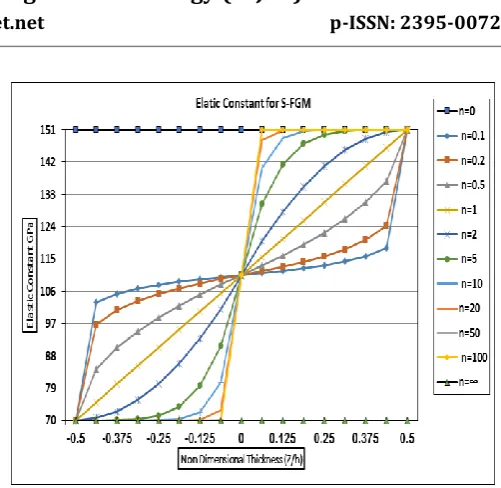
(10)Figure 5 shows that the variation of Young’s modulus in Eqs. (9) and (10)represents sigmoid distributions, so this FGM plate is thus called a sigmoid FGM plate (S-FGM plates).
Figure. 5: The variation of Young’s modulus for S-FGM.
4.3.
The material properties of Exponential FGM
(E-FGM) plates
Exponential function used to describe the material properties of FGMs as follows [20].
2 h z BAe
E(z)
(11)With
a
E
2 and
2 1E
E
ln
B
2 h z E E ln h 1 2 2 1e
E
E(z)
(12) [image:15.595.42.287.380.506.2]The material distribution in the thickness direction of the E-FGM plates is plotted in Figure 6.
[image:15.595.311.557.566.716.2]© 2017, IRJET | Impact Factor value: 6.171 | ISO 9001:2008 Certified Journal
| Page 1815
4.4
Mori- Tanaka Homogenization Scheme
This method works well for composites with regions of graded microstructure having clearly defined continuous matrix and a discontinuous particulate phase. This method assumes a small spherical particle embedded in a matrix. According to the Mori–Tanaka scheme, the effective local bulk modulus
K
& the shear modulusG
are expressed by1
)
(
)
1
(
1
4
3
)
(
3
)
1
(
1
f
G
G
G
V
V
G
G
G
G
G
K
K
K
V
V
K
K
K
K
m m c c c m c m m m m c c c m c m
(13))
2
(
6
)
8
9
(
1 m m m m mG
K
G
K
G
f
Where
(14)Here
V
i(
i
c
,
m
)
is the volume fraction of the phase material. The subscripts c and m refer to the ceramic and metal phases respectively. The volume fractions of the ceramic and metal phases are related byV
c
V
m
1
&V
cis defined as0
n
'
2
2
n ch
h
z
V
(15)where n in Eq. (15) is the volume fraction exponent, & called as the gradient index. The effective Young’s modulus
E
and Poisson’s ratio
can be calculated from the following expressions:)
3
(
2
2
3
3
9
G
K
G
K
G
K
KG
E
(16)The thermal expansion coefficient
and thermal conductivity
may be expressed by
m m c c c m c m m c m m c mV
V
3
]
1
[
1
1
1
1
1
(17)5.
Application of Functionally Graded Material
Functionally Graded Material have basically been developed for aerospace structures which operate under high temperature fluctuations. Recently, however, due to their flexibility in the manufacture of a particular composite material, FGMs have acquired potential applications in various fields according to the requirements. Major applications of FGMs in different sectors are discussed below.
![Table 1.2: Illustration of a Metal-Ceramic FGM [82]](https://thumb-us.123doks.com/thumbv2/123dok_us/8150128.802311/2.595.54.269.172.529/table-illustration-of-a-metal-ceramic-fgm.webp)