prediction of (epi)genomic data
Christoph Bock, Konstantin Halachev, Joachim Büch and
Thomas Lengauer
Address: Max-Planck-Institut für Informatik, Campus E1.4, 66123 Saarbrücken, Germany.
Correspondence: Christoph Bock. Email: [email protected]
© 2009 Bock et al.; licensee BioMed Central Ltd.
This is an open access article distributed under the terms of the Creative Commons Attribution License (http://creativecommons.org/licenses/by/2.0), which permits unrestricted use, distribution, and reproduction in any medium, provided the original work is properly cited.
EpiGRAPH
<p>EpiGRAPH is a genome-scale data-mining software tool that enables users to identify epigenetic and gene regulatory features in large datasets of genomic regions.</p>
Abstract
The EpiGRAPH web service http://epigraph.mpi-inf.mpg.de/ enables biologists to uncover hidden associations in vertebrate genome and epigenome datasets. Users can upload sets of genomic regions and EpiGRAPH will test multiple attributes (including DNA sequence, chromatin structure, epigenetic modifications and evolutionary conservation) for enrichment or depletion among these regions. Furthermore, EpiGRAPH learns to predictively identify similar genomic regions. This paper demonstrates EpiGRAPH's practical utility in a case study on monoallelic gene expression and describes its novel approach to reproducible bioinformatic analysis.
Rationale
EpiGRAPH addresses two tasks that are common in genome biology: discovering novel associations between a set of genomic regions with a specific biological role (for example, experimentally mapped enhancers, hotspots of epigenetic regulation or sites exhibiting disease-specific alterations) and the bulk of genome annotation data that are available from public databases; and assessing whether it is possible to pre-dictively identify additional genomic regions with a similar role without the need for further wet-lab experiments.
The increasing relevance of analyzing sets of genomic regions arises from technical innovations such as tiling microarrays and next-generation sequencing [1-5], which can be used to scan the genome for specific types of regions (for example, transcription factor binding sites or cancer-specific genomic alterations). The resulting datasets are difficult to analyze with existing toolkits for genomic data mining - such as GSEA [6] and DAVID [7] - because most existing tools are gene-cen-tric and cannot easily account for genomic regions that are
located outside of (protein-coding) genes. In the absence of a suitable tool for statistical analysis and prediction of genomic region data, researchers have performed the necessary steps by hand, downloading relevant datasets from existing reposi-tories and writing one-time-use scripts for data integration, statistical analysis and prediction (for example, [8-19]). Such manual analyses are time-consuming to perform, difficult to reproduce and require bioinformatic skills that are beyond the reach of most biologists. Hence, these studies support demand for a software toolkit that facilitates statistical analy-sis and prediction of region-based genome and epigenome data.
With the development of EpiGRAPH, we have pulled together our experiences and established workflows from several stud-ies [10,20-23] and incorporated them into a powerful and easy-to-use web service. In the remainder of this paper, we sketch the basic concepts of EpiGRAPH, demonstrate its practical use and utility in a case study on monoallelic gene expression, and outline how the UCSC Genome Browser [24], Published: 10 February 2009
Genome Biology 2009, 10:R14 (doi:10.1186/gb-2009-10-2-r14)
Received: 18 June 2008 Revised: 3 December 2008 Accepted: 10 February 2009 The electronic version of this article is the complete one and can be
Galaxy [25,26] and EpiGRAPH integrate into a comprehen-sive pipeline for (epi)genome analysis and prediction. Finally, the Methods section provides extensive bioinformatic back-ground on EpiGRAPH's software architecture and describes how the software can be extended and customized. This paper is supplemented by a step-by-step, tutorial-style description of two example analyses [27] and by three tutorial videos that demonstrate EpiGRAPH 'in action' [28].
Concept
EpiGRAPH is designed to facilitate complex bioinformatic analyses of genome and epigenome datasets. Such datasets frequently consist of sets of genomic regions that share cer-tain properties, for example, being bound by a specific tran-scription factor or exhibiting characteristic patterns of evolutionary conservation. Typically, these genomic regions fall into opposing classes, for example, transcription factor bound versus unbound promoter regions or significantly con-served versus nonconcon-served regulatory elements. Even when this convenient situation does not emerge by default, it is straightforward and common practice to establish it artifi-cially, by generating a randomized set of control regions to complement a given set of genomic regions. EpiGRAPH thus focuses on the analysis of sets of genomic regions that fall into two classes, which we denote as 'positives' (cases) and 'nega-tives' (controls).
EpiGRAPH provides four analytical modules (see Figures 1, 2, 3 for screenshots of illustrative results and Figure 4 for an
overview of EpiGRAPH's software architecture). The statisti-cal analysis module identifies attributes that differ signifi-cantly between the sets of positives and negatives, based on an attribute database comprising a broad range of genome and epigenome datasets. The diagram generation module draws boxplots that visualize the distribution of a selected attribute among the sets of positives versus negatives. The machine learning analysis module evaluates how well predic-tion algorithms - such as support vector machines - can dis-criminate between positives and negatives in the input dataset, based on different combinations of (epi)genomic attributes from the database. The prediction analysis module predicts whether a genomic region that is not contained in the input dataset belongs to the set of positives or negatives, thus exploiting any correlations detected by the machine learning analysis module for the prediction of new data.
Typical EpiGRAPH analyses follow a defined workflow. The starting point is a dataset of genomic regions, which the user may have obtained through wet-lab analysis (for example, ChIP-seq analysis of transcription factor binding) or bioinfor-matic calculations (for example, computational screening for regions that are under evolutionary constraint). This dataset is uploaded to the EpiGRAPH web service as a table of genomic regions with separate columns for chromosome name, start position, end position, and a binary class value specifying for each region whether it belongs to the positives or negatives. (When no class value is provided, EpiGRAPH regards all genomic regions of the input dataset as positives and assists the user with calculating a set of random control
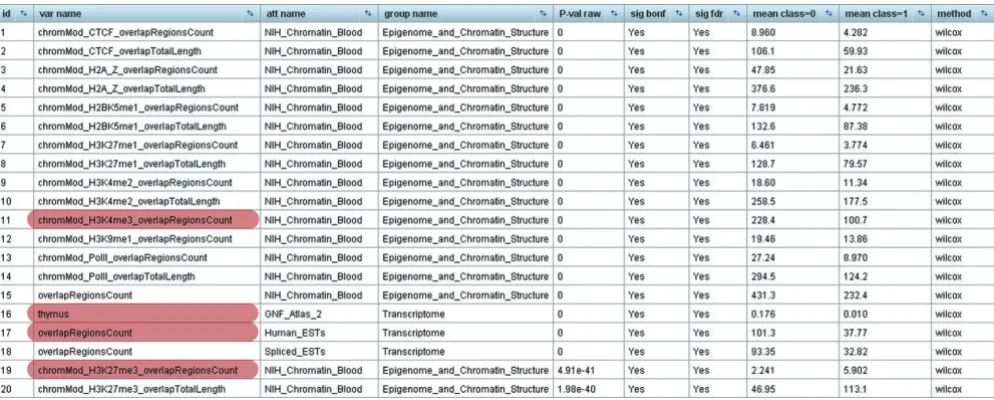
[image:2.612.57.554.449.649.2]Results screenshot of EpiGRAPH's statistical analysis identifying significant differences between the promoter regions of monoallelically versus biallelically expressed genes
Figure 1
regions to be used as negatives.) Next, EpiGRAPH calculates a large number of potentially relevant attributes for each genomic region in the input dataset. Most of these attributes represent overlap frequencies or score values, quantifying the co-localization of the genomic regions in the input dataset
[image:3.612.54.554.132.583.2]with publicly available annotation data for the respective genome. Upon completion of the attribute calculation (which can take several hours or even days when the input dataset is large), EpiGRAPH's statistical and machine learning modules test for significant differences between the positives and neg-EpiGRAPH-generated diagrams highlighting differential histone modification patterns for the promoters of monoallelically versus biallelically expressed genes
Figure 2
EpiGRAPH-generated diagrams highlighting differential histone modification patterns for the promoters of monoallelically versus biallelically expressed genes. This figure displays EpiGRAPH-generated boxplots comparing the promoter regions of genes exhibiting monoallelic (red boxplots) versus biallelic gene expression (yellow boxplots) with respect to their enrichment for two histone modifications, (a) H3 lysine 4 trimethylation and (b) H3 lysine 27 trimethylation. The y-axis plots the frequency of overlap with ChIP-seq tags [37], which is indicative of the strength of enrichment of the corresponding histone modification. Boxplots are in standard format (boxes show center quartiles, whiskers extend to the most extreme data point, which is no more than 1.5 times the interquartile range from the box) and outliers are shown as crosses.
Attribute name: Epigenome_and_Chromatin_Structure.NIH_Chromatin_Blood.chromMod_H3K4me3_overlapRegionsCount
Feat
ure val
u
e
Left window (−2): −50 kb to −10 kb Center window (0): 0 bp to 0 bp Right window (2): 10 kb to 50 kb
0
200
400
600
800
Monoallelic_vs_biallelic_gene_expression.monoallelically_expressed = 0 Monoallelic_vs_biallelic_gene_expression.monoallelically_expressed = 1
Attribute name: Epigenome_and_Chromatin_Structure.NIH_Chromatin_Blood.chromMod_H3K27me3_overlapRegionsCount
Feat
ure val
u
e
Left window (−2): −50 kb to −10 kb Center window (0): 0 bp to 0 bp Right window (2): 10 kb to 50 kb
0
2
00
400
600
800
Monoallelic_vs_biallelic_gene_expression.monoallelically_expressed = 0 Monoallelic_vs_biallelic_gene_expression.monoallelically_expressed = 1
(b)
Boxplot diagram for (repressive) histone H3 lysine 27 trimethylation
atives in the input dataset and perform an initial assessment of whether or not these differences are sufficient for bioinfor-matic prediction. Based on an inspection of these results, the user can request follow-up analyses utilizing the pre-calcu-lated data. In particular, the diagram generation module can be used to visualize interesting differences between positives and negatives as detected by the statistical analysis, and the prediction analysis module lets the user predict the class value of new genomic regions - for example, in order to extrapolate experimental data to regions that were not cov-ered by wet-lab experiments.
The key to EpiGRAPH's practical utility is its database, for which we collected a large number of attributes that are likely to play a role in genome function and epigenetic regulation. For the most thoroughly annotated human genome, Epi-GRAPH currently includes almost a thousand attributes (see Table 1 for an overview and the attribute documentation web-site [29] for details). These attributes fall into ten groups: DNA sequence; DNA structure; repetitive DNA; chromosome
organization; evolutionary history; population variation; genes; regulatory regions; transcriptome; and epigenome and chromatin structure. EpiGRAPH also incorporates the genomes of chimp, mouse and chicken (with slightly lower numbers of attributes) and can easily be extended to support genomes of other species. In addition to using EpiGRAPH's default attributes, researchers can upload their own datasets and incorporate them as custom attributes in subsequent analyses. This is particularly useful because problem-relevant experimental data - such as chromatin structure data for the cell type of interest - often boost EpiGRAPH's prediction accuracy.
Application
[image:4.612.55.560.98.395.2]The best starting point for getting acquainted with the practi-cal use of EpiGRAPH are the tutorial videos [28] and the step-by-step guide [27], which is available online. In the following case study, we take a slightly more high-level view, focusing on how to plan and interpret an EpiGRAPH analysis and Results screenshots of EpiGRAPH's machine learning module predicting monoallelic gene expression
Figure 3
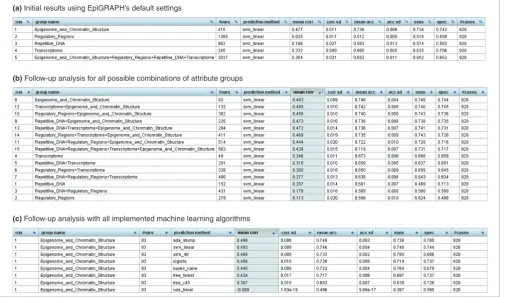
Results screenshots of EpiGRAPH's machine learning module predicting monoallelic gene expression. (a-c) These screenshots display the results of machine learning analyses comparing the promoter regions of monoallelically expressed genes (class = 1) with those of biallelically expressed genes (class = 0), each panel being based on different EpiGRAPH settings. The table values in the tables summarize the average performance of a linear support vector machine or alternative machine learning algorithms (c) that were trained and evaluated in ten repetitions of a tenfold cross-validation. Performance measures include mean correlation ('mean corr' column), prediction accuracy ('mean acc' column), sensitivity ('sens' column) and specificity ('spec' column). Additional columns display standard deviations observed among the repeated cross-validations with random partition assignment ('corr sd' and 'acc sd'), the number of variables in each attribute group ('#vars') and the total number of genomic regions included in the analysis ('#cases').
(a) Initial results using EpiGRAPH’s default settings
(b) Follow-up analysis for all possible combinations of attribute groups
highlighting potential sources of misinterpretation. All raw data, settings and results of this case study are available online [30], and readers are encouraged to download the analysis description file, upload it into their own EpiGRAPH accounts, reproduce the results and perform follow-up analy-ses.
Monoallelic gene expression - the focus of our case study - is a common phenomenon in vertebrate genomes. While the majority of human genes are expressed from both alleles, a sizable proportion is expressed exclusively from a single allele, with important biological consequences. Genomic imprinting - that is, parent-specific monoallelic gene expres-sion - plays a critical role in normal development and gives rise to non-Mendelian patterns of inheritance [31]. X-chro-mosome inactivation leads to mitotically heritable silencing of the surplus X chromosome in females [32]. And random monoallelic gene expression, which is common among odor-ant receptor genes and immune-system related genes, increases the phenotypic diversity among clonal cells [33].
In an attempt to identify potential determinants of monoal-lelic gene expression, several bioinformatic studies compared
DNA sequence properties of monoallelically versus bialleli-cally expressed genes. These studies reproducibly found enrichment of long interspersed nuclear element (LINE) repeats and depletion of short interspersed nuclear element (SINE) repeats to be associated with monoallelic gene expres-sion [8,34-36]. Encouraged by this finding, attempts have been made to predict based on the genomic DNA sequence -which genes are subject to imprinting and X-chromosome inactivation [16,17,19]. However, the conclusiveness of these prior studies is somewhat diminished by the fact that most of them relied on small gene lists curated from the literature and that none took epigenome data into account.
[image:5.612.56.554.87.397.2]Here, we revisit the relationship between DNA characteristics and monoallelic gene expression based on genome-scale datasets, including a recent assessment of monoallelic versus biallelic gene expression for about 4,000 genes in human lymphoblastic cells [33] and extensive epigenome maps of human T-cell lymphocytes [37]. To start with, we obtain a list of monoallelically and biallelically expressed genes from the supplementary material of the corresponding paper [33], and we map these to a non-redundant set of RefSeq gene promot-ers (this step is performed using Galaxy [38]). As the result, Outline of EpiGRAPH's software architecture
Figure 4
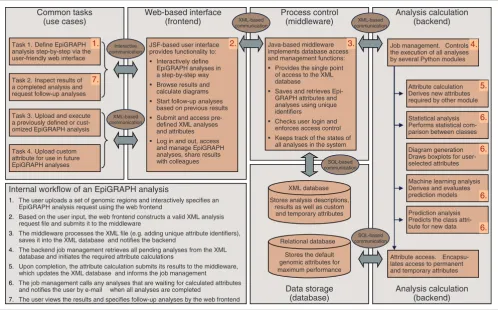
Outline of EpiGRAPH's software architecture. This figure displays a schematic overview of EpiGRAPH's software components, and it describes their interaction in a typical analysis workflow. The red numbers indicate the key component(s) for each step of the workflow description outlined in the bottom left of the figure. JSF, Java Server Faces (which is a Java-based web application framework).
Common tasks (use cases)
Task 1. Define EpiGRAPH analysis step-by-step via the user-friendly web interface
Task 2. Inspect results of a completed analysis and request follow-up analyses
Task 3. Upload and execute a previously defined or cust-omized EpiGRAPH analysis
Task 4. Upload custom attribute for use in future EpiGRAPH analyses
JSF-based user interface provides functionality to:
Interactively define EpiGRAPH analyses in a step-by-step way Browse results and calculate diagrams Start follow-up analyses based on previous results Submit and access pre-defined XML analyses and attributes Log in and out, access and manage EpiGRAPH analyses, share results with colleagues Web-based interface (frontend) Process control (middleware) Analysis calculation (backend) Java-based middleware implements database access and management functions:
Provides the single point of access to the XML database
Saves and retrieves Epi-GRAPH attributes and analyses using unique identifiers
Checks user login and enforces access control Keeps track of the states of all analyses in the system
Attribute calculation Derives new attributes required by other module
Machine learning analysis Derives and evaluates prediction models
Prediction analysis Predicts the class attri-bute for new data
Attribute access.
Encapsu-lates access to permanent and temporary attributes XML database
Stores analysis descriptions, results as well as custom
and temporary attributes
Relational database
Stores the default genomic attributes for maximum performance
Data storage (database)
Job management. Controls the execution of all analyses by several Python modules
Analysis calculation (backend) XML-based communication Interactive communication SQL-based communication XML-based communication XML-based communication SQL-based communication
Internal workflow of an EpiGRAPH analysis
1. The user uploads a set of genomic regions and interactively specifies an
EpiGRAPH analysis request using the web frontend
2. Based on the user input, the web frontend constructs a valid XML analysis
request file and submits it to the middleware
3. The middleware processes the XML file (e.g. adding unique attribute identifiers),
saves it into the XML database and notifies the backend
4. The backend job management retrieves all pending analyses from the XML
database and initiates the required attribute calculations
5. Upon completion, the attribute calculation submits its results to the middleware,
which updates the XML database and informs the job management
6. The job management calls any analyses that are waiting for calculated attributes
and notifies the user by e-mail when all analyses are completed
7. The user views the results and specifies follow-up analyses by the web frontend
1. 2. 3. 4.
5.
6.
6. 7.
Diagram generation Draws boxplots for user-selected attributes
6. Statistical analysis Performs statistical com-parison between classes
we obtain a total of 464 positives (monoallelically expressed genes) as well as a substantially longer list of negatives (bial-lelically expressed genes), from which we randomly select 464 genes to match the number of positives. Random down-sampling of the set of negatives is performed in order to limit bias toward predicting the majority class, which is a common issue in machine learning. In general, we recommend that the number of positives should never exceed twice the number of negatives, and vice versa. EpiGRAPH automatically enforces this upper limit for the class imbalance, unless the user dese-lects the corresponding option.
Before we can submit our dataset to EpiGRAPH, we have to decide exactly which regions we want to analyze, that is, whether we expect DNA signals relating to monoallelic gene expression distributed throughout the gene or preferentially located in specific regions, such as promoters, exons or introns. Since monoallelic gene expression appears to be con-trolled by the transcriptional machinery, we believe that pro-moter regions have the highest probability of containing relevant regulatory elements. For the purpose of this analysis, we define the putative promoter region as the sequence win-dow ranging from 1,250 bp upstream to 250 bp win-downstream of the annotated transcription start site. We calculate the cor-responding region of interest for each gene in our dataset, giv-ing rise to the input file that can be uploaded to EpiGRAPH. However, as we cannot exclude that important regulatory ele-ments might be located further upstream or downstream, we activate EpiGRAPH's option to cover four additional
sequence windows ranging from -50 kilobases to +50 kilo-bases around the region of interest.
Next, we have to decide which groups of attributes from Epi-GRAPH's database to include in our analysis. While it is always possible to perform hypothesis-free screening by selecting all default attributes, focusing the analysis only on promising attribute groups can significantly increase statisti-cal power and also decreases computation time. Based on prior knowledge, we choose four attribute groups that are likely to be related to monoallelic gene expression, namely 'repetitive DNA', 'regulatory regions', 'transcriptome', and 'epigenome and chromatin structure'.
Having made all relevant decisions, we can now start the analysis, log out of the web service and wait for EpiGRAPH to perform the necessary calculations. Assuming that email notification has been enabled, EpiGRAPH will inform us as soon as it has completed an initial analysis. At that point, we can log into the web service again, review the results and define follow-up analyses.
[image:6.612.53.558.129.348.2]Our inspection of the results starts with the statistical analysis table (Figure 1). This table summarizes pairwise statistical comparisons between positives and negatives, which were performed for each attribute using Wilcoxon's rank-sum test (for numerical attributes) and Fisher's exact test (for categor-ical attributes). Focusing on the 1.5 kilobase core promoter region (the main window of our analysis), a total of 72 out of Table 1
List of default attributes included in EpiGRAPH
Total number of attributes
Attribute groups hg18 hg17 mm9 panTro2 galGal3 Attributes (examples)
DNA sequence 178 178 178 178 178 Frequency of 'TATA' pattern, cytosine content, CpG frequency DNA structure 21 21 21 21 21 Predicted DNA helix twist, predicted solvent accessibility Repetitive DNA 95 95 91 94 94 Overlap with Alu elements, LINEs and tandem repeats Chromosome organization 18 29 15 - - Overlap with chromosomal bands and isochors Evolutionary history 94 101 - - 86 Overlap with evolutionarily conserved regions Population variation 75 75 - - - SNP density and overlap with specific SNP types
(for example, non-synonymous exonic or splice site) Genes 37 60 20 10 10 Overlap with annotated genes, pseudogenes and predicted
microRNA genes
Regulatory regions 249 259 5 5 5 Overlap with CpG islands and predicted transcription factor binding sites
Transcriptome 49 65 9 9 9 Overlap with ESTs and mRNA sequences
Epigenome and chromatin structure 80 17 114 - - Overlap with ChIP-seq tags indicating enrichment for specific histone modifications
Sum 896 900 453 317 403
563 attributes differ significantly between monoallelically and biallelically expressed genes, at a false discovery rate of 5%. Furthermore, similar but weaker differences are observed for four additional sequence windows upstream and downstream of the promoter region (data not shown), indi-cating that the contrasting genomic properties of monoalleli-cally versus biallelimonoalleli-cally expressed genes are strong for the core promoter, but also present in a wider genomic region surrounding the genes.
In their core promoter regions, biallelically expressed genes exhibit, on average, twice the amount of histone H3 lysine 4 trimethylation (which is indicative of open chromatin) as the promoters of monoallelically expressed genes. Conversely, the latter are almost threefold enriched in terms of repressive histone H3 lysine 27 trimethylation. Consistent with the interpretation that promoters of monoallelically expressed genes generally exhibit a more repressed chromatin state than their biallelic counterparts, we also observe significant under-representation of their associated transcripts in expressed sequence tag (EST) libraries and decreased expres-sion according to microarray data (Figure 1). Interestingly, out of the 28 tissues covered by EpiGRAPH, the difference in gene expression is most significant for thymus, consistent with the fact that monoallelic gene expression is prominent among genes related to the immune system.
To illustrate the distinct chromatin structure at the core pro-moters of monoallelically versus biallelically expressed genes, we select H3 lysine 4 trimethylation and H3 lysine 27 trimeth-ylation for visualization using EpiGRAPH's diagram genera-tion module (Figure 2). Boxplots confirm that the differences are not only significant, but also substantial in quantitative terms. This confirmation is an important first step toward establishing the biological relevance of our finding, given that even minor and biologically irrelevant differences can become highly significant when sample sizes are large. In general, to demonstrate both significance and strength of an observed difference, we recommend that EpiGRAPH users should report not only P-values, but also the corresponding boxplot diagrams or at least separate mean values for the sets of positives and negatives.
Further support for a strong association between (repressive) chromatin structure and monoallelic gene expression comes from EpiGRAPH's machine learning analysis. Based on the values of 83 chromatin-related attributes measured across the core promoter regions and four adjacent windows (415 variables in total), EpiGRAPH could predict with an accuracy of 73.8% (sensitivity, 73.4%; specificity, 74.2%; correlation, 0.47) whether a gene is monoallelically or biallelically expressed (Figure 3a). Substantially lower prediction per-formance was observed for the other attribute groups, namely repetitive DNA (accuracy, 58.3%; correlation, 0.17), regula-tory regions (accuracy, 51.2%; correlation, 0.03) and the tran-scriptome (accuracy, 66.5%; correlation, 0.33). We thus
conclude that attributes relating to epigenome and chromatin structure are among the most significant predictors of monoallelic gene expression. Importantly, all measures of prediction performance reported by EpiGRAPH are calcu-lated exclusively based on test set results in a cross-validation design, thereby minimizing the risk of overtraining and irre-producibly optimistic performance evaluations that is inher-ent in the use of machine learning methods [39].
Due to the complex structure of mammalian genomes, the attribute groups included in our analysis are not statistically independent. On the contrary, strong biological interdepend-encies exist between different attribute groups - for example, between chromatin structure and the transcriptome (open chromatin structure facilitates transcription), between regu-latory regions and repetitive DNA (reguregu-latory regions are preferentially located in non-repetitive regions), and between repetitive DNA and chromatin structure (repetitive regions most commonly exhibit repressive chromatin structure). Therefore, the predictiveness of some attribute groups included in our analysis could be indirect and mediated by their correlation with other, more predictive attributes. Epi-GRAPH helps us better understand such relationships by measuring whether any combination of two or more attribute groups gives rise to higher prediction performance than each attribute group on its own right (which indicates that all attribute groups contribute to the overall prediction perform-ance) or whether a single attribute group dominates the other attribute groups (in which case the other attribute groups are likely to 'borrow' predictiveness from the former, rather than being independently predictive). To perform such an analy-sis, we restart the machine learning analysis with custom set-tings, requesting EpiGRAPH to account for all possible combinations of attribute groups while focusing on the puta-tive promoter regions (that is, ignoring the four additional sequence windows upstream and downstream). The results table lists prediction performance separately for linear sup-port vectors trained on each of the 15 possible combinations of attribute groups (Figure 3b). These data clearly indicate that a single attribute group - epigenome and chromatin structure - is more predictive than all others. In fact, there is no evidence of complementarity for any combination of attribute groups (that is, no set of attribute groups outper-forms the single highest-scoring attribute group contained in the set). In the light of these results, it seems unlikely that repetitive elements are directly causal for monoallelic gene expression, at least on a genomic scale. Rather, the predic-tiveness of specific repetitive elements observed in prior stud-ies as well as in this analysis appears to be largely due to the fact that certain types of repeats (such as LINEs) are enriched in regions that exhibit repressive chromatin structure, while other types of repeats (such as SINEs) are depleted in such regions.
monoallelic or biallelic gene expression. To that end, we first verify that a linear support vector machine (EpiGRAPH's default prediction algorithm) indeed provides competitive prediction performance when compared to other machine learning algorithms. Such benchmarking is achieved by restarting the machine learning analysis with custom settings and selecting all available machine learning algorithms for inclusion (Figure 3c). EpiGRAPH's cross-validation results indicate that linear support vector machines perform on par with the best method, an ensemble learning algorithm (Ada-Boost on tree stumps). We thus conclude that a linear support vector machine trained on epigenome and chromatin struc-ture data provides a suitable setup for genome-wide predic-tion of monoallelic gene expression. Next, we obtain a list of RefSeq-annotated genes from the UCSC Genome Browser, calculate the 1.5 kilobase promoter regions for all genes and submit this dataset to EpiGRAPH's prediction analysis. Upon submission of the analysis, EpiGRAPH starts to calculate the relevant attributes and predicts the expression status of all 25,419 RefSeq-annotated genes in the human genome. The results - which are available online [30] - provide a first genome-wide prediction of monoallelic gene expression in the human genome. Although the accuracy of our predictions is far from perfect (Figure 3c) and further experimental anal-ysis is clearly warranted, these predictions could be useful for identifying new candidate genes that contribute to the many biological roles of monoallelic gene expression.
In summary, this case study illustrates how EpiGRAPH can be applied to analyzing a genomic feature of interest (in this case, monoallelic gene expression) in the context of publicly available genome annotations and epigenome data. Two main conclusions emerge from our analysis. First, monoallelically expressed genes exhibit a substantially more repressed chro-matin structure in their promoter regions than biallelically expressed genes. This observation is consistent with a model in which monoallelic gene expression is the direct conse-quence of opposing chromatin states at the two alleles of a gene within a diploid cell. Indeed, Wen et al. [40] recently
showed that an experimental search for genomic regions that exhibit activating as well as repressive chromatin marks can identify monoallelically expressed genes. Second, chromatin structure clearly emerges as the strongest predictor of monoallelic gene expression, outperforming attributes such as the overall level of gene expression or the enrichment/ depletion of specific types of repeats and regulatory regions. In fact, none of the other attribute groups included in our analysis could increase prediction performance after chroma-tin structure had been accounted for. This observation is not necessarily in contradiction with an (indirectly) causal model in which local enrichment of LINEs fosters repressive chro-matin structure, which in turn facilitates random silencing of a single allele. However, the weak predictiveness of attributes relating to repetitive DNA suggests that such a model omits important additional drivers of monoallelic gene expression.
Integration
EpiGRAPH integrates well with existing bioinformatics resources and infrastructure. It can be regarded as part of a three-step data analysis pipeline involving genome browsers, genome calculators and tools for genome data analysis (Fig-ure 5). First, researchers typically start the analysis of new genome-scale datasets by uploading pre-processed and qual-ity-controlled data into a genome browser, which facilitates data visualization and manual inspection. The UCSC Genome Browser [24] is popular for this task, due to the ease with which custom data tracks can be displayed alongside public genome annotations, and Ensembl is an alternative option [41]. Second, based on initial observations, it is usually necessary to pick a subset of genomic regions for further analysis -for example, all promoter regions that are bound by a specific transcription factor. The Galaxy web service [25,26] imple-ments a wide range of calculations and filtering methods that facilitate the selection of biologically interesting regions for further analysis. Finally, it is often desirable to perform statis-tical analysis and data mining on the potentially large set of interesting regions in order to discover, test and interpret
[image:8.612.53.555.562.659.2]cor-Workflow for web-based analysis of large genome and epigenome datasets Figure 5
Workflow for web-based analysis of large genome and epigenome datasets. This figure outlines a workflow for the analysis of genome and epigenome data using publicly available web services. Initially, the user uploads a newly generated dataset into a genome browser, which visualizes the data and facilitates hypothesis generation by manual inspection (left box). Next, data can be processed with a genome calculator such as Galaxy, in order to extract interesting regions for in-depth analysis (center box). Finally, genome analysis tools such as EpiGRAPH facilitate the search for significant associations with genome annotation data and enable bioinformatic prediction of genomic regions with similar characteristics as the input dataset (right box).
Genome Browsers
Data visualization
Hypothesis generation by manual inspection
Retrieval of genome annotations
Example: UCSC Genome Browser
Genome Analysis Tools
Data mining
Testing for statistically significant associations
Bioinformatic prediction
Example: EpiGRAPH Genome Calculators
Data processing
Filtering of genomic regions
Calculation of derived attributes
relations with other genomic data. For this step, a compre-hensive and easy-to-use toolkit has been lacking. We developed EpiGRAPH to fill this gap, thereby enabling biolo-gists to perform advanced bioinformatic analysis and predic-tion with little need for bioinformatic support. We demonstrate the interplay of UCSC Genome Browser, Galaxy and EpiGRAPH in a case study focusing on the (epi)genomic characteristics of highly polymorphic promoter regions in the human genome [27,28].
In the future, we anticipate that the three layers of genome browsing, calculation and analysis tools will increasingly merge into a single application, for which 'statistical genome browser' might be an appropriate term. To that end, it will be neither necessary nor beneficial to integrate all functionality and underlying databases into a single monolithic tool. Instead, a distributed network of interoperable web services for genome analysis is likely to emerge. Genome browsers could act as single points of entry, from which the user initi-ates a complex analysis. The analysis is then split into sepa-rate subtasks, encoded in an XML-based analysis description language (such as the XML genomic relationship analysis for-mat (X-GRAF) prototyped in EpiGRAPH) and distributed over the Internet to calculation servers at which all relevant datasets and software components for a specific type of anal-ysis are available. Finally, the decentrally calculated results are merged and displayed to the user at the central genome browser front-end. EpiGRAPH was developed with this sce-nario in mind and prototypes software paradigms required for distributed genome analysis by concerted action of spe-cialized tools.
Conclusion
The EpiGRAPH web service enables biologists to perform complex bioinformatic analyses online - without having to learn a programming language or to download and manually process large datasets. Compared to related tools such as Gal-axy [25,26] and Taverna [42,43], its main emphasis lies in exploratory statistical analysis, hypothesis generation and bioinformatic prediction, based on large datasets of genomic regions. EpiGRAPH facilitates reproducibility and data shar-ing by encodshar-ing all analyses in standardized analysis descrip-tion files that can be re-run by other users. We highlighted EpiGRAPH's utility by a case study on monoallelic gene expression, and we provide extensive additional material online (including tutorial videos and a step-by-step guide [27,28]).
Methods
EpiGRAPH's software architecture and analysis workflow
The key design decision underlying EpiGRAPH's software architecture is to store each EpiGRAPH analysis in a single XML file. This XML file contains not only a detailed
specifica-tion of the analysis and its supplementary attributes, but also its current processing status and, upon completion, its results. All XML files processed by EpiGRAPH conform to the standardized X-GRAF format (discussed in more detail below) and are stored in an XML database.
EpiGRAPH's XML-based, analysis-centric design offers a number of advantages over alternative architectures, includ-ing reproducibility, parallel processinclud-ing and interoperability and error checking. Reproducibility: all information relevant to an analysis, including its specifications and results, are bundled in a single file, which provides a complete documen-tation of the analysis. The same analysis can be rerun at any time simply by uploading its XML file back to the EpiGRAPH web service. Parallel processing: because the different analy-sis modules operate on different parts of the XML tree, they can work in parallel without generating write-write conflicts. Interoperability and error checking: the use of XML files facilitates data exchange with other software systems, and the X-GRAF format provides error checking when XML files are constructed manually or exchanged between different soft-ware systems.
cus-tom attributes), both types of data are ultimately stored in the same database management system.
Importantly, the choice of technologies for each component reflects the specific requirements of the tasks they perform. The front-end has to present a user-friendly interface in a variety of web browsers, which is facilitated by a web applica-tion framework such as JavaServer Faces. The middleware makes connections with the XML database and performs extensive XML processing; hence, Java, with its well-estab-lished libraries for Oracle XML DB access [50], StAX [51] and JAXB processing [52], is an appropriate choice. The back-end implements most of EpiGRAPH's application logic and is likely to be extended by other researchers, therefore Python [46] was selected due to its proven track record for fast and robust software engineering in scientific applications, its plat-form independence and its wide acceptance within the bioin-formatics community.
The internal workflow of an EpiGRAPH analysis is depicted in Figure 4, illustrating how the different components inter-act when fulfilling an EpiGRAPH analysis request.
Genomes, annotations and attributes included in EpiGRAPH
EpiGRAPH currently supports five genome assemblies from four species: hg18, the latest assembly of the human genome (NCBI36.1); hg17, the genome assembly used for the ENCODE project pilot phase (NCBI35); mm9, the latest assembly of the mouse genome (NCBI37); panTro2, the latest assembly of the chimp genome; and galGal3, the latest assembly of the chicken genome. For each of these genomes, we manually selected a large number of genomic attributes that are likely to be predictive of interesting genomic phe-nomena (see Table 1 for an overview and the attribute docu-mentation website [29] for details). When calculated for a specific genomic region, most of these attributes take the form of overlap frequencies (for example, how many exons overlap with the genomic region?), overlap lengths (for exam-ple, how many base-pairs of exonic DNA overlap with the genomic region?) or DNA sequence pattern frequencies (for example, how many times does the pattern 'TATA' appear in the genomic region?). All of these attributes are standardized to a default region size of one kilobase in order to be compa-rable between genomic regions of different size. In addition, EpiGRAPH uses score attributes, which are averaged across all overlapping regions of a specific type (for example, what is the average exon number of all genes overlapping with the genomic region?), and category attributes, which split up an attribute into subattributes (for example, how many synony-mous versus non-synonysynony-mous single nucleotide polymor-phisms overlap with the genomic region?).
The datasets underlying most of these attributes were col-lected from annotation tracks of the UCSC Genome Browser [24], using an automated data retrieval pipeline. In addition,
published genomic datasets that appear to be of particular interest are imported into the database on a regular basis. Currently, this includes data on histone modifications [37], DNA methylation [53,54], regulatory CpG islands [20], DNA helix structure [55], DNA solvent accessibility [56], tissue-specific gene expression [57], isochores [58] and transcrip-tion initiatranscrip-tion events [59]. Finally, users can upload custom datasets into the database, making them available for inclu-sion in further analyses by the same user.
Attribute calculation
The basic functionality of EpiGRAPH's attribute calculation module is to calculate a large number of genomic attributes (such as frequency and length of overlap with EpiGRAPH's default attributes) for any set of genomic regions submitted to the web service. This step is a prerequisite for all further anal-yses, and it is typically the most computationally intensive and time-consuming part of an EpiGRAPH analysis. The attribute calculation makes extensive use of multithreading in order to increase performance.
Beyond its core task of deriving hundreds or even thousands of different attribute values for each genomic region in the input dataset, the attribute calculation module provides three additional features that increase its utility as a general genome calculator. First, the user can define derived attributes, thus augmenting genomic attributes that are already contained in the database (for example, deriving a set of putative promoter regions from a gene attribute). Second, random control regions can be calculated such that they match a given set of genomic regions in terms of chromosome and length distribution, GC content, repeat content and/or exon overlap. Technically, this is achieved by repeatedly sam-pling random genomic regions of a given length from a spe-cific chromosome and retaining a region only if its GC content, repeat content and/or exon overlap are within a user-specified interval around the corresponding value of the source region. Third, attributes can be calculated not only for the genomic regions provided in the input dataset, but also for fixed sequence windows left and right of these regions, in order to capture significant differences in the upstream or downstream neighborhood of a given set of genomic regions. All results calculated by the attribute calculation module can be used as the basis for further EpiGRAPH analyses or down-loaded in tab-separated value format for analysis outside Epi-GRAPH.
Statistical analysis and diagram generation
dis-crete attributes. P-values are adjusted for multiple testing by the highly conservative Bonferroni method, which controls the family-wise error rate, and by a more recent and usually preferred method that controls the false discovery rate [60]. While EpiGRAPH applies an overall significance threshold of 5% by default, the user is free to select different values. If mul-tiple windows around the genomic regions of interest are taken into account and tested simultaneously, the user can specify weights to control how the P-value threshold is dis-tributed when testing for significant attributes in each of these windows. A typical choice is to use a relatively high P -value of, say, 3% for the central window (that is, the regions provided by the input dataset), while distributing the remain-ing 2% equally among the upstream and downstream win-dows. This way, the additional testing for strong effects in the upstream and downstream neighborhoods comes at the cost of only a limited decrease in statistical power for the genomic regions of interest.
While the statistical analysis module focuses on the question of whether or not a specific attribute differs significantly between the sets of positives and negatives, the diagram gen-eration module can help assess the effect size, that is, the quantitative difference between positives and negatives. For any selected attribute, this module derives boxplots contrast-ing the attribute's distribution among the positives with that among the negatives.
Machine learning analysis and prediction analysis
In contrast to the statistical analysis module, which focuses on individual attributes, the machine learning analysis mod-ule assesses how well attribute groups collectively differenti-ate between the sets of positives and negatives. We treat this question as a machine learning task, predicting for each genomic region whether it is likely to belong to the set of pos-itives or to the set of negatives and interpreting the prediction performance achieved for a specific attribute group as a meas-ure of how well this group discriminates between positives and negatives.
Technically, a machine learning algorithm (for example, a support vector machine) is repeatedly trained and tested on partitions of the training dataset following a four-step proce-dure (all parameters mentioned below are default values and can be changed by the user). First, if the set of positives con-tains more than twice as many genomic regions as the set of negatives (or vice versa), the larger set is randomly downsam-pled such that the class imbalance never exceeds 67% versus 33%, thus limiting potential prediction bias toward the majority class. Second, using tenfold cross-validation, the machine learning algorithm is repeatedly trained on 90% of the genomic regions and tested on the remaining 10%. Third, cross-validation is repeated ten times with random partition assignments. Fourth, the overall prediction performance is measured by the correlation coefficient between the predic-tions and the correct values on the cross-validation test sets,
as well as by the corresponding values for percent accuracy, sensitivity and specificity, averaged over all cross-validation runs.
During prediction analysis, a machine learning algorithm is trained as described above, but now on a bootstrapped sam-ple drawn from the entire training dataset (downsampling is used if necessary to enforce a maximum class imbalance of 67% versus 33%). The trained prediction model is then applied to predict the likelihood of belonging to the set of pos-itives for all genomic regions in a user-supplied set of target regions. The resulting quantitative prediction for each region can assume values between zero and one, with a value of zero corresponding to a high-confidence negative prediction, a value of 0.5 to a borderline case, and a value of one to a high-confidence positive prediction. This process is repeated ten times with different bootstrapped samples in order to obtain an additional criterion for the reliability of the predictions. Finally, the consensus prediction, the mean confidence value and the standard deviation of the confidence values are calcu-lated for each genomic region and each prediction setup.
For both machine learning analysis and prediction analysis, EpiGRAPH currently supports the use of seven different machine learning methods/configurations: support vector machine with linear kernel; support vector machine with RBF kernel; AdaBoost on tree stumps; logistic regression; random forest; C4.5 tree generator; and naïve Bayes. All of these are implemented using functions from the Weka package [48] with default parameters. For comparison and to give a base-line for the expected accuracy, we also include a trivial algo-rithm that always predicts the majority class.
X-GRAF format
state and error messages) and the results of the analysis (in the form of tables and diagrams that are directly embedded in the XML file).
Although X-GRAF was created for EpiGRAPH, it is designed with additional applications in mind. Being both formalized and sufficiently easy to understand, X-GRAF may provide a suitable basis for analysis specification, results documenta-tion and data exchange of future genome analysis tools and statistical genome browsers.
Adapting and extending EpiGRAPH
EpiGRAPH provides multiple options for customization, adaptation and extension, which are outlined below in increasing order of complexity and power.
First, it is possible to use EpiGRAPH for attribute calculation only, thus profiting from EpiGRAPH's large and carefully selected set of default attributes, while performing follow-up analyses offline (for example, with the R statistics package). To that end, the user performs a normal EpiGRAPH analysis and presses the 'Download Data Table' button on the results page to obtain a tab-separated data file that contains all attribute values for all genomic regions in the input dataset.
Second, the user can add custom genomic attributes to Epi-GRAPH, using the 'Upload Custom Attribute Dataset' button on the overview page. A new custom attribute can be defined in three ways: by uploading a set of genomic regions; by spec-ifying how the attribute can be calculated from other attributes that are already present in the database (for exam-ple, filtering rows that match a specific condition or defining additional columns); and by deriving a randomized control attribute that matches an existing attribute in terms of its GC content, repeat content and/or exon overlap. Custom attributes can be included in EpiGRAPH analyses in the same way as the default attributes, but they are exclusively accessi-ble to the user who created them.
Third, the user can specify advanced analysis requests and attribute calculations directly in EpiGRAPH's internal X-GRAF format. Any XML file that adheres to the X-X-GRAF for-mat can be uploaded through the 'Execute Analysis Based on Existing XML File' button, bypassing the interactive 'Define New Analysis' pages. This can be useful for several reasons: when running the same analysis on different datasets, it is often convenient to design the analysis once using the web front-end, then download its specifications in X-GRAF for-mat and use a text editor or a custom script to produce sepa-rate versions for each dataset; sharing X-GRAF files with other researchers (for example, by inclusion in the supple-mentary material of a paper) will enable them to reproduce the analysis by simply submitting the X-GRAF files back to the EpiGRAPH web service, thus contributing to reproducible research [63]; and some of the more advanced features (for example, calculated attributes with multiple new columns)
are supported by the calculation engine but cannot be speci-fied easily using the web front-end.
Fourth, the user can download a 'light' version of the Epi-GRAPH calculation engine for local installation, which runs on any computer with recent versions of Python [46], the R statistics package [47] and the Weka data mining package [48], after a few additional libraries have been installed. The 'light' version (source code available online [64]) is particu-larly useful for researchers developing new bioinformatic methods for genome analysis, such as new flavors of the sta-tistical analysis, diagram generation, machine learning anal-ysis and prediction analanal-ysis, but who do not want to spend their time writing code for attribute calculation. The main disadvantage of the 'light' version is that in the absence of a relational database all genomic attributes have to be stored in flat files. However, the 'light' version is code-compatible with the full version of EpiGRAPH. Hence it is possible to develop and test new modules using the 'light' version and to incorpo-rate the completed modules into the EpiGRAPH web service.
Fifth, the user can obtain and install the full version of Epi-GRAPH (release package and source code available on request), which includes the process control middleware and the web front-end components as well as a version of the cal-culation engine that provides full database support. While running a full-blown EpiGRAPH server locally is a non-trivial task and requires both a Java application server (for example, Apache Tomcat) and an Oracle 11 g database server [49], this setting gives the user full flexibility for customizing Epi-GRAPH and a powerful infrastructure for genome analysis.
Abbreviations
LINE: long interspersed nuclear element; SINE: short inter-spersed nuclear element; X-GRAF: XML genomic relation-ship analysis format.
Competing interests
The authors declare that they have no competing interests.
Authors' contributions
Acknowledgements
We would like to thank Jörn Walter, Martina Paulsen, Eivind Hovig and the Galaxy team for helpful discussions, Yassen Assenov, Barbara Hutter and Fang Liu for testing earlier versions of EpiGRAPH, and Holger Jung for con-tributing source code to the attribute calculation module. This work was partially funded by the European Union through the CANCERDIP project (HEALTH-F2-2007-200620).
References
1. Bock C, Lengauer T: Computational epigenetics. Bioinformatics 2008, 24:1-10.
2. Mardis ER: The impact of next-generation sequencing tech-nology on genetics. Trends Genet 2008, 24:133-141.
3. Bernstein BE, Meissner A, Lander ES: The mammalian epige-nome. Cell 2007, 128:669-681.
4. Schones DE, Zhao K: Genome-wide approaches to studying chromatin modifications. Nat Rev Genet 2008, 9:179-191. 5. van Steensel B: Mapping of genetic and epigenetic regulatory
networks using microarrays. Nat Genet 2005, 37(Suppl):S18-24. 6. Subramanian A, Kuehn H, Gould J, Tamayo P, Mesirov JP: GSEA-P: a desktop application for gene set enrichment analysis. Bioin-formatics 2007, 23:3251-3253.
7. Huang DW, Sherman BT, Tan Q, Collins JR, Alvord WG, Roayaei J, Stephens R, Baseler MW, Lane HC, Lempicki RA: The DAVID gene functional classification tool: a novel biological module-cen-tric algorithm to functionally analyze large gene lists. Genome Biol 2007, 8:R183.
8. Allen E, Horvath S, Tong F, Kraft P, Spiteri E, Riggs AD, Marahrens Y: High concentrations of long interspersed nuclear element sequence distinguish monoallelically expressed genes. Proc Natl Acad Sci USA 2003, 100:9940-9945.
9. Berry C, Hannenhalli S, Leipzig J, Bushman FD: Selection of target sites for mobile DNA integration in the human genome. PLoS Comput Biol 2006, 2:e157.
10. Bock C, Paulsen M, Tierling S, Mikeska T, Lengauer T, Walter J: CpG island methylation in human lymphocytes is highly corre-lated with DNA sequence, repeats, and predicted DNA structure. PLoS Genet 2006, 2:e26.
11. Cohen SM, Furey TS, Doggett NA, Kaufman DG: Genome-wide sequence and functional analysis of early replicating DNA in normal human fibroblasts. BMC Genomics 2006, 7:301. 12. Das R, Dimitrova N, Xuan Z, Rollins RA, Haghighi F, Edwards JR, Ju J,
Bestor TH, Zhang MQ: Computational prediction of methyla-tion status in human genomic sequences. Proc Natl Acad Sci USA 2006, 103:10713-10716.
13. Derti A, Roth FP, Church GM, Wu CT: Mammalian ultracon-served elements are strongly depleted among segmental duplications and copy number variants. Nat Genet 2006, 38:1216-1220.
14. Fang F, Fan S, Zhang X, Zhang MQ: Predicting methylation status of CpG islands in the human brain. Bioinformatics 2006, 22:2204-2209.
15. Guelen L, Pagie L, Brasset E, Meuleman W, Faza MB, Talhout W, Eus-sen BH, de Klein A, Wessels L, de Laat W, van Steensel B: Domain organization of human chromosomes revealed by mapping of nuclear lamina interactions. Nature 2008, 453:948-951. 16. Luedi PP, Dietrich FS, Weidman JR, Bosko JM, Jirtle RL, Hartemink AJ:
Computational and experimental identification of novel human imprinted genes. Genome Res 2007, 17:1723-1730. 17. Luedi PP, Hartemink AJ, Jirtle RL: Genome-wide prediction of
imprinted murine genes. Genome Res 2005, 15:875-884. 18. Montgomery SB, Griffith OL, Schuetz JM, Brooks-Wilson A, Jones SJ:
A survey of genomic properties for the detection of regula-tory polymorphisms. PLoS Comput Biol 2007, 3:e106.
19. Wang Z, Willard HF, Mukherjee S, Furey TS: Evidence of influence of genomic DNA sequence on human X chromosome inacti-vation. PLoS Comput Biol 2006, 2:e113.
20. Bock C, Walter J, Paulsen M, Lengauer T: CpG island mapping by epigenome prediction. PLoS Comput Biol 2007, 3:e110.
21. Bock C, Walter J, Paulsen M, Lengauer T: Inter-individual varia-tion of DNA methylavaria-tion and its implicavaria-tions for large-scale epigenome mapping. Nucleic Acids Res 2008, 36:e55.
22. Liu F, Tostesen E, Sundet JK, Jenssen TK, Bock C, Jerstad GI, Thilly WG, Hovig E: The human genomic melting map. PLoS Comput Biol 2007, 3:e93.
23. Moser D, Ekawardhani S, Kumsta R, Palmason H, Bock C, Athanassi-adou Z, Lesch KP, Meyer J: Functional analysis of a potassium-chloride co-transporter 3 (SLC12A6) promoter polymor-phism leading to an additional DNA methylation site. Neu-ropsychopharmacology 2008, 34:458-467.
24. Karolchik D, Kuhn RM, Baertsch R, Barber GP, Clawson H, Diekhans M, Giardine B, Harte RA, Hinrichs AS, Hsu F, Kober KM, Miller W, Pedersen JS, Pohl A, Raney BJ, Rhead B, Rosenbloom KR, Smith KE, Stanke M, Thakkapallayil A, Trumbower H, Wang T, Zweig AS, Haus-sler D, Kent WJ: The UCSC Genome Browser Database: 2008 update. Nucleic Acids Res 2008, 36:D773-779.
25. Blankenberg D, Taylor J, Schenck I, He J, Zhang Y, Ghent M, Veerar-aghavan N, Albert I, Miller W, Makova KD, Hardison RC, Nekrutenko A: A framework for collaborative analysis of ENCODE data: making large-scale analyses biologist-friendly. Genome Res 2007, 17:960-964.
26. Giardine B, Riemer C, Hardison RC, Burhans R, Elnitski L, Shah P, Zhang Y, Blankenberg D, Albert I, Taylor J, Miller W, Kent WJ, Nekrutenko A: Galaxy: a platform for interactive large-scale genome analysis. Genome Res 2005, 15:1451-1455.
27. EpiGRAPH Tutorial [http://epigraph.mpi-inf.mpg.de/documenta tion/EpiGRAPH_tutorial.pdf]
28. EpiGRAPH Videos [http://epigraph.mpi-inf.mpg.de/videos/] 29. EpiGRAPH Attribute Documentation
[http://epigraph.mpi-inf.mpg.de/attributes/]
30. EpiGRAPH Case Study on Monoallelic Gene Expression
[http://epigraph.mpi-inf.mpg.de/casestudy/]
31. Reik W: Stability and flexibility of epigenetic gene regulation in mammalian development. Nature 2007, 447:425-432. 32. Heard E: Recent advances in X-chromosome inactivation.
Curr Opin Cell Biol 2004, 16:247-255.
33. Gimelbrant A, Hutchinson JN, Thompson BR, Chess A: Widespread monoallelic expression on human autosomes. Science 2007, 318:1136-1140.
34. Bailey JA, Carrel L, Chakravarti A, Eichler EE: Molecular evidence for a relationship between LINE-1 elements and X chromo-some inactivation: the Lyon repeat hypothesis. Proc Natl Acad Sci USA 2000, 97:6634-6639.
35. Greally JM: Short interspersed transposable elements (SINEs) are excluded from imprinted regions in the human genome.
Proc Natl Acad Sci USA 2002, 99:327-332.
36. Ke X, Thomas NS, Robinson DO, Collins A: A novel approach for identifying candidate imprinted genes through sequence analysis of imprinted and control genes. Hum Genet 2002, 111:511-520.
37. Barski A, Cuddapah S, Cui K, Roh TY, Schones DE, Wang Z, Wei G, Chepelev I, Zhao K: High-resolution profiling of histone meth-ylations in the human genome. Cell 2007, 129:823-837. 38. Galaxy Genome Analysis Website [http://main.g2.bx.psu.edu/] 39. Tarca AL, Carey VJ, Chen XW, Romero R, Draghici S: Machine learning and its applications to biology. PLoS Comput Biol 2007, 3:e116.
40. Wen B, Wu H, Bjornsson H, Green RD, Irizarry R, Feinberg AP: Overlapping euchromatin/heterochromatin-associated marks are enriched in imprinted gene regions and predict allele-specific modification. Genome Res 2008, 18:1806-1813. 41. Flicek P, Aken BL, Beal K, Ballester B, Caccamo M, Chen Y, Clarke L,
Coates G, Cunningham F, Cutts T, Down T, Dyer SC, Eyre T, Fitzger-ald S, Fernandez-Banet J, Gräf S, Haider S, Hammond M, Holland R, Howe KL, Howe K, Johnson N, Jenkinson A, Kähäri A, Keefe D, Kokocinski F, Kulesha E, Lawson D, Longden I, Megy K, Meidl P, et al.: Ensembl 2008. Nucleic Acids Res 2008, 36:D707-714.
42. Hull D, Wolstencroft K, Stevens R, Goble C, Pocock MR, Li P, Oinn T: Taverna: a tool for building and running workflows of serv-ices. Nucleic Acids Res 2006, 34:W729-732.
43. Oinn T, Addis M, Ferris J, Marvin D, Senger M, Greenwood M, Carver T, Glover K, Pocock MR, Wipat A, Li P: Taverna: a tool for the composition and enactment of bioinformatics workflows.
Bioinformatics 2004, 20:3045-3054. 44. Java [http://www.java.com/]
45. XML-RPC [http://www.xmlrpc.com/]
46. Python Programming Language [http://www.python.org/] 47. R Project for Statistical Computing [http://www.r-project.org/] 48. Weka Data Mining [http://www.cs.waikato.ac.nz/~ml/weka/] 49. Oracle Database [http://www.oracle.com/database/]
50. Oracle XML DB [http://www.oracle.com/technology/tech/xml/ xmldb/index.html]
52. Java Architecture for XML Binding [https://jaxb.dev.java.net/] 53. Meissner A, Mikkelsen TS, Gu H, Wernig M, Hanna J, Sivachenko A,
Zhang X, Bernstein BE, Nusbaum C, Jaffe DB, Gnirke A, Jaenisch R, Lander ES: Genome-scale DNA methylation maps of pluripo-tent and differentiated cells. Nature 2008, 454:766-770. 54. Rollins RA, Haghighi F, Edwards JR, Das R, Zhang MQ, Ju J, Bestor TH:
Large-scale structure of genomic methylation patterns.
Genome Res 2006, 16:157-163.
55. Gardiner EJ, Hunter CA, Packer MJ, Palmer DS, Willett P: Sequence-dependent DNA structure: a database of octamer structural parameters. J Mol Biol 2003, 332:1025-1035.
56. Greenbaum JA, Pang B, Tullius TD: Construction of a genome-scale structural map at single-nucleotide resolution. Genome Res 2007, 17:947-953.
57. Su AI, Wiltshire T, Batalov S, Lapp H, Ching KA, Block D, Zhang J, Soden R, Hayakawa M, Kreiman G, Cooke MP, Walker JR, Hogenesch JB: A gene atlas of the mouse and human protein-encoding transcriptomes. Proc Natl Acad Sci USA 2004, 101:6062-6067. 58. Costantini M, Clay O, Auletta F, Bernardi G: An isochore map of
human chromosomes. Genome Res 2006, 16:536-541.
59. Carninci P, Sandelin A, Lenhard B, Katayama S, Shimokawa K, Ponjavic J, Semple CA, Taylor MS, Engström PG, Frith MC, Forrest AR, Alkema WB, Tan SL, Plessy C, Kodzius R, Ravasi T, Kasukawa T, Fukuda S, Kanamori-Katayama M, Kitazume Y, Kawaji H, Kai C, Nakamura M, Konno H, Nakano K, Mottagui-Tabar S, Arner P, Chesi A, Gustincich S, Persichetti F, et al.: Genome-wide analysis of mammalian promoter architecture and evolution. Nat Genet 2006, 38:626-635.
60. Benjamini Y, Hochberg Y: Controlling the false discovery rate: a practical and powerful approach to multiple testing. J R Statist Soc B 1995, 57:289-300.
61. X-GRAF XML Format Documentation [http://epigraph.mpi-inf.mpg.de/xml/]
62. Illustration of the X-GRAF File Format [http://epigraph.mpi-inf.mpg.de/documentation/X-GRAF_Format_Illustration.pdf] 63. Gentleman R: Reproducible research: a bioinformatics case
study. Stat Appl Genet Mol Biol 2005, 4:.