International Journal of Emerging Technology and Advanced Engineering
Website: www.ijetae.com (ISSN 2250-2459, ISO 9001:2008 Certified Journal, Volume 6, Issue 9, September 2016)
155
Performance of Pervious Concrete with Industrial Waste as
Coarse Aggregate – An Overview
M. Neamitha
1, A. Muthadhi
21PG student, 2Assistant Professor, Department of Civil Engineering, Pondicherry Engineering College, Puducherry Abstract - The use of pervious concrete is significantly
increasing due to its high ratio of continuous voids which makes the water permeable which reduces the runoff, risk of flooding and top soil wash away, increases the ground water and reduces the heat island effect. A large volume of natural resources and raw materials are being used for concrete production around the world, to eliminate or minimize the negative environmental sustainability of the industry, the use of industrial and agricultural waste as material for concrete making is considered as an alternative solution for preventing the excessive of raw materials. In this paper, use of waste materials such as air-cooling electric arc furnace slag, steel slag, municipal solid waste, waste tire rubber, seashell, etc., as replacement of coarse aggregate for producing pervious concrete is reviewed.
Keywords – pervious concrete, waste material, permeability, porosity, compressive strength, flexural strength, split tensile strength.
I. INTRODUCTION
Pervious concrete is a special type of concrete which has relatively high water permeability compared to conventional concrete due to pore structure. It has been gaining a lot of attention in recent years due to its various environmental benefits such as controlling storm water runoff, restoring groundwater supplies, reducing water and soil pollution specially used in primary pavements which are in: residential roads, alleys and driveways, low volume pavements, low water crossings, sidewalks and pathways, parking areas, tennis courts, etc [1].
Pervious concrete can be produced using conventional concrete-making materials, namely cement, supplementary cementitious materials, admixtures, coarse and fine aggregates, and water. They usually consist of single sized aggregate which is bonded together at its point of contact by a paste formed by the cement and water. The paste forms a thick coating around aggregate particles. Using enough pasteto coat the particles maintain a system of interconnected voids which allow water and air to pass through. The lack of sand in pervious concrete results in a very harsh mix with a rough textured, and a honeycombed surface. To achieve the permeability, pervious concrete is typically designed with high void content (15%-30%). Due to the high void content, pervious concrete has lower compressive strength and less unit weight of about 70% of conventional concrete [3].
However pervious concrete has a greater advantage in many regards. In general pervious concrete automatically acts as a drainage system, thereby putting water back where it belongs.
Large volume of natural resources and raw materials are being used for concrete production around the world. To eliminate or minimize the negative environmental impact of the concrete industry and promote environmental sustainability of the industry, industrial by products are used for concrete making [4]. This paper reviews the research work conducted on utilizing industrial byproduct as replacement for coarse aggregate in pervious concrete. This summary of existing knowledge about the successful use of wastes in the concrete industry helps to identify other existing waste products for use in making pervious concrete.
II. INDUSTRIAL BY PRODUCTS AS COARSE AGGREGATE
Electric arc furnace slag (EAFS) is a by-product of steel formed in an electric arc furnace. In the process, steel scrap and fluxes are added to a refractory lined cup-shaped vessel. This vessel has a lid through which carbon electrodes are passed. An arc is induced between the scrap and electrodes, and the resultant heat generated melts scrap and fluxes. Steel and slag are also separated similarly to the steel furnace slag process and allowed to cool slowly, it solidifies to a grey, crystalline, stone-like material known as air-cooled slag. This product is then crushed and screened to sizes suitable as coarse aggregate. EAFS contains different forms of iron oxides and most also include magnesium and manganese compounds. They has low amorphous silica content and high amount of ferric oxides, which make it unsuitable to be employed in blended cement.But utilization of steel slag as aggregate in concrete has advantages compared to natural aggregate. Thehardened concrete, with EAFS aggregate achieved higher values of compressive strength, tensile strength, flexural strength and modulus of elasticity, compared to natural aggregate concrete [5].
International Journal of Emerging Technology and Advanced Engineering
Website: www.ijetae.com (ISSN 2250-2459, ISO 9001:2008 Certified Journal, Volume 6, Issue 9, September 2016)
156
Before reuse, the toxicity characteristicleaching procedure (TCLP) is conducted and the dioxintoxicity equivalent concentration value is determined to ensure that the material meets the appropriatestandard for hazardous industrial waste [6]. If the majority of the incineratorbottom ash was to be buried, the available burial grounds would not be sufficient to accommodate it.Therefore, this incinerator bottom ash must be reusedeffectively to reach the goals of zero waste and full recovery. Presently the applications involve incorporation of incinerator bottom ash in road base layers, pavement, dikes, concrete blocks and controlled low-strength materials [7]. Studies have shown that the constituents of bottom ash are silica, calcium oxide, ferric oxide, alumina, sodium oxide, magnesium oxide and other trace metal oxides. These components account for more than 90% of the dry weight, which means that the bottom ash is compositionally similar to terrestrial crushed stone and soil. Land filling of waste incinerator bottom ash prevents sustainable development of the environment. Belgium, the Netherlands, Germany and France have all established criteria for the recycling of municipal solid waste incinerator bottom ash (MSWIBA)[8]. MSWIBA can be recovered as a nonstructural construction material and road base aggregate.Thousands of tons of seashell byproducts has been generated in France and are considered as waste that has to be discharged. some attempts has been made to recycle them as soil conditioner or animals food but none of these attempts gave satisfaction in terms of viable and added value recycling. Seashell By-Products (SBP) were prepared and used to partially replace natural aggregates [9].
Disposal of waste tires has been a major issue to the cities all around the world. Generally, the cheapest and easiest way to decompose the used tires is by burning them. However, the pollution due to enormous amount of smoke makes this method so unacceptable that it is prohibited by law in many countries. Therefore, recycling of the waste tires seems to be necessary by means of innovative techniques Innovative solutions to meet the challenge of the tire disposal problem involve the use of waste materials as additives to cement-based materials [10] and the production of rubber-powder incorporated asphalt or bituminous materials. One of the leading efforts of the concrete manufacturers to make more economic and environment friendly concrete is to use recycled products in the production. One important recycling material is the
recycled aggregate obtained from demolished concrete structures.
The Portland cement concrete association (PCA) reported that the concretes produced with recycled aggregate show very similar performance to conventional concrete containing natural aggregate further increases its environmental benefits by reducing the amount of materials extracted from quarries and riverbeds. Attempts were also made to use the recycled brick aggregate, crushed stone aggregate to make pervious concrete [11].
2.1. Air-cooling electric arc furnace slag
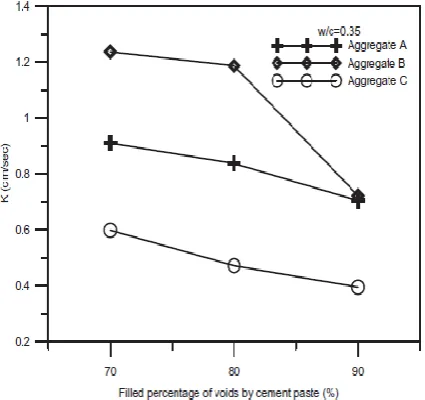
Yeih et al, (2015) investigated the properties of pervious concrete made with air-cooling electric arc furnace slag (EAFS) as aggregates. Two sizes of 4.8mm and 9.5mm EAFS were used and 4.8mm gravel was used with three different filled percentages of voids by cement paste as 70, 80, and 90%. The porous nature of EAFS allows a greater porosity in the unit volume, also forms a better interface bounding due to the interlocking effect. Among all concrete mixes, the pervious concrete made with EAFS (0.24 cm–0.48 cm) and w/c = 0.35 had the highest 28-day compressive strength of 28 MPa. The pervious concrete made with EAFS provides a greater anti-skid capability which may avoid accidents in the rainy day. The pervious concrete made with EAFS can have a water permeability coefficient greater than 0.01 cm/s and can be classified as the pervious concrete according to the Japan Road Association. Pervious concrete made with EAFS had flexure strength of about 12.19% and the split tensile strength 6.45% higher than that made with gravels. Fig. 1 shows the influences of aggregate type and filled percentage of voids by cement paste on the water permeability of pervious concrete [5].
2.2. Washed municipal solid waste incinerator bottom ash
International Journal of Emerging Technology and Advanced Engineering
Website: www.ijetae.com (ISSN 2250-2459, ISO 9001:2008 Certified Journal, Volume 6, Issue 9, September 2016)
157
No significant differences in connected porosities, compressive strengths or permeability coefficients were observed between pervious concrete made with washed MSWIBA and pervious concrete made with natural aggregate. Pervious concrete made with 9.5-mm washed MSWIBA had a lower connected porosity, bending strength and permeability coefficient than pervious concrete made with 12.5mm washed MSWIBA. For 12.5-mm washed-MSWIBA pervious concrete mixes with w/c ratios of 0.30–0.50 and pore-filling paste ratios of 40– 80%, the connected porosities, permeability coefficient, and compressive strength ranges were 10.3–32.7%, 0.6– 4.1 cm/s, and 4.8– 12.7MPa, respectively. These results are consistent with the results of previous research on pervious concrete made with natural aggregates and indicate that 12.5-mm washed- MSWIBA pervious concrete can satisfy practical engineering requirements for pervious concrete. Therefore, using washed MSWIAB as the aggregate in pervious concrete is considered practical. Fig. 2 (a)& (b) shows the compressive strength and permeability of pervious concrete made by washed MSWBA aggregates [12].2.3 Seashell by-products
Nguyen et al (2013), studied partial replacement of aggregates in pervious concrete pavers considered as an environmentally friendly building material. The coarse aggregate fraction were partially (20% or 40% by mass) replaced by SBP obtained from the Crepidula shell. The crushed Crepidula seashell of 2/ 4 mm and 4/6.3 mm were used to make new seashell by-products based pavers. Compressive strength of about 16 and 15 MPa was achieved for the control pervious concrete pavers and the seashell by-products pervious concrete pavers respectively. The permeability increases about 37% then the control mix when SBP is introduced and the permeability coefficients, ranged from 3 mm/s to 8.4 mm/s. These results can be interpreted by the porosity of the material which increases with the percentage of SBP introduced. The infiltration rate of concrete is also connected to the porous network and pore size.
Permeability is also related to the compressive strength. Indeed, the variation of the compressive strength of pervious concrete is inversely proportional to the permeability, as shown in Fig. 3.SBP size strongly influences the granular arrangement of concrete matrix and consequently the compressive and tensile strength.SBP of size 2/4 mm can insert into the pore in decreasing the porosity. Whereas, 4/6.3 mm size of SBP, disrupts the granular arrangement resulting in a decrease in mechanical strength and promoting the water infiltration. Fig. 4 shows the relationship between the porosity accessible to water and the water permeability obtained by the falling head test.
Porosity values obtained, is about two times higher than that of ordinary concrete, which makes the concrete lighter (density 1700–1800 kg m3) with low mechanical strength [14].
2.4. Waste tire rubbers
Gesoglu et al (2014), studied the properties of rubberized pervious concrete in terms of the mechanical properties and the permeability. Three types of rubber such as crumble rubber, tire chips and fine crumble rubber were used. Rubber incorporated pervious concretes had lower compressive strength, splitting tensile strength, and modulus of elasticity. Compressive strength of the control pervious concretes ranges from 3 to 30 MPa, whereas rubberized pervious concretes produced compressive strength of about 6.45 MPa.
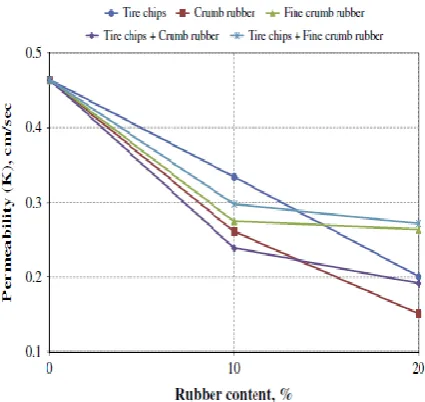
Permeability coefficients of the rubberized pervious concretes fell between 0.025 and 0.61 cm/s which falls in recommended limits of pervious concretes. Fracture energy of the pervious concretes increased with tire chips and/or coarse crumb rubber while using fine crumb rubber decreased the fracture energy. Based on the obtained results, it may be possible to utilize such kind of pervious concrete in constructing parking areas, walkways and road shoulders, etc. Fig. 5 (a), (b) shows the Compressive strength and permeability of pervious concretes versus rubber content. In addition the rubberized pervious concrete has significant positive effect on abrasion and freeze – thaw resistance of pervious concrete [15].
2.5 Recycled aggregate
Sriravindrarajah et al, (2012) experimentally proved that for a given porosity, recycled concrete aggregate had reduced the compressive strength of pervious concrete; the influence of aggregate type on strength is nonlinearly reduced with the increase in the porosity. Permeability of pervious concrete is influenced by the porosity and the use of recycled concrete aggregate had no significant effect on the permeability of pervious concrete. Fig. 6 gives the relationships among porosity, strength and permeability for pervious concrete [16].
International Journal of Emerging Technology and Advanced Engineering
Website: www.ijetae.com (ISSN 2250-2459, ISO 9001:2008 Certified Journal, Volume 6, Issue 9, September 2016)
158
Increasing the recycled aggregate content resulted in systematical decreasing of compressive strength since the recycled aggregate contains a weak cement matrix and interfacial transition zone between aggregate and this weak cement paste [17]. Splitting tensile strength values of pervious concrete ranging between 1.00 and 1.29 MPa was achieved. When the w/c ratio and recycled aggregate content were increased, the splitting tensile strength of pervious concrete decreased. The pervious concrete produced with lower aggregate cement ratio performed low permeability characteristic. It was noticed that the dry density, void content, compressive and splitting tensile strength of pervious concretes were more affected by recycled aggregate content than w/c ratio, while the permeability and abrasion of pervious concrete were more affected by w/c ratio than recycled aggregate content when contribution of independent factors was considered.Chindaprasirt et al, (2014) investigated of the use of recycled lightweight aggregate from waste autoclaved aerated concrete block to make lightweight pervious concrete (LWPC). The RLWA from broken autoclaved aerated concrete blocks could be used as coarse aggregate to make LWPC with low density of 775–900 kg/m3 and low thermal conductivity coefficient of 0.15–0.27W/mK. The additions of both fine sand (SA) and fly ash (FA) at 10–30% by weight of cement in LWPC were effective for increasing the compressive, splitting tensile, and flexural strengths by 116%, 72% and 56%, respectively, while their water permeability coefficients and total void ratios were reduced from 1.16 to 0.17 cm/s and 23.7 to 14.8%, respectively. Both density and thermal conductivity coefficient from 775 to 900 kg/m3 and 0.15 to 0.27W/mK, were also increased respectively by addition of sand and fly ash. The LWPC with low thermal conductivity and low density in this study could be used for thermal insulation concrete [18].
2.6 Locally available materials
Hasnat et al, (2012) made pervious concrete with locally available coarse aggregates such as first class brick aggregate (FB), crushed stone aggregate(CS), and recycled brick aggregate (RB). The pervious concrete made with CS shows higher unit weight with an average of 1885 kg/m3 compared to FB and RB pervious concrete, whereas pervious concrete made with FB, RB has an average value of 1520 kg/m3 and1510 kg/m3 respectively. Percentage void of pervious concrete made with CS and FB has about 20% and for RB it has an average of about 21%.pervious concrete made with RB shows higher interconnected pores; it is due to blunt edge of the RB. Similar to percentage void, permeability of pervious concrete made with RB is higher in most of the cases.
Permeability of pervious concrete made with CS has an average of about 0.31cm/s and for FB and RB it is 0.27 and 0.30 respectively. Compressive strength of pervious concrete made with CS has an average of about 7.8MPa, for FB it is 5.6MPa and RB has about 6.2MPa Pervious concrete made with CS shows higher compressive strength compared to FB and RB. RB shows higher average compressive strength compared to FB. It is due to the rough and porous texture of recycled aggregate which gives good bonding with cementitious matrix. Relationships between permeability and compressive strength of pervious concrete made with different aggregates are shown in Fig. 7.
2.7. Recycled Light weight aggregate
Zaetang et al, (2013)used three type of light weight aggregates such as Diatomite (DA) and pumice (PA) and recycled light weight aggregate from autoclaved aerated concrete (RA) to produce pervious concrete. Three cement paste contents of 15%, 20%, and 25% by volume were used. The results indicated that the use of DA, PA, and RA as coarse aggregates in pervious concrete could reduce the density and thermal conductivity about 3–4 times compared with pervious concrete containing natural aggregate. The densities were 558–775 kg/m3 which were lower than 800 kg/m3 and suited for use as insulating concrete. The compressive strength of light weight pervious concrete ranged from 2.47 to 5.99 MPa. The increase in cement paste content improved the mechanical properties. LWPC containing DA showed 28% higher mechanical properties. The thermal conductivity coefficients depended on the cement paste contents and types of aggregates. When the cement paste content of LWPCs increased from 15% to 25%, the thermal conductivity coefficient increased from 0.16 to 0.23 W/m K for DA concrete, from 0.16 to 0.24 W/m K for PA concrete, and from0.17 to 0.25 W/m K for RA concrete. Thus DA has lower thermal conductivity than those of RA and PA as shown in Fig.8. Permeability of pervious concrete mainly depends upon the cement paste volume and the aggregate type. When the cement paste content of LWPCs increased from 15% to 25%, the permeability coefficient decreased from 2.43 to 0.42 cm/s for DA concrete, from 4.77 to 0.99 for PA concrete, and from 2.93 to 0.30 for RA concrete. However PA exhibited higher water permeability [19].
III. SUMMARY
International Journal of Emerging Technology and Advanced Engineering
Website: www.ijetae.com (ISSN 2250-2459, ISO 9001:2008 Certified Journal, Volume 6, Issue 9, September 2016)
159
One approach can be through the use of by-products and industrial wastes in concrete. Studies show the possibility of use and acceptable performance of waste materials e.g. Air-cooling electric arc furnace slag, washed municipal solid waste incinerator bottom ash, seashell by-products, recycled aggregate, waste tire rubber, recycled brick aggregate, etc. as aggregate in making concrete. Since aggregate makes up about 60– 80% of the volume of the concrete, the substitution of solid waste as full or partial replacement for conventional aggregate contributes significantly in cost effectiveness, energy saving and mitigation of the environmental impact of the construction industry. Considering the current criteria for a sustainable infrastructure, green building rating systems and related environmental benefits, making concrete using wastes as aggregate can help in making the concrete industry environmentally-friendly. The data presented in this paper shows that there is a promising potential for the use of waste materials in concrete. The development of existing knowledge and identification of other useful wastes to be used in making concrete will also provide a valuable contribution in the environmental sustainability of the industry.Acknowledgment
This research was supported by Pondicherry Engineering College, Puducherry. We are immensely thankful to the Principal and Institution for providing economic facilities to enhance the research.
REFERENCES
[1] ACPT - The advanced concrete pavement technology, “perviousconcrete”techbriefdecember 2012 | GHWA-HIF-13-006. [2] CIP 38 – “pervious concrete”, concrete in practice –
what?Why?How?, NRMCA.
[3] NRMCA (2004) - National Ready Mix Concrete Association. “Pervious concrete pavements”.
[4] Intergovernmental Panel on Climate Change (IPCC).www.google.co.in/#q=intergovernmental+panel+on+cliate +change+ (ipcc).
[5] WeichungYeih, Tun Chi Fu, Jiang Jhy Chang, and Ran Huang, “Properties of pervious concrete made with air-cooling electric arc furnace slag as aggregates”,Construction and Building Materials, Article in press, 2015.
[6] Environmental Policy Monthly. Taiwan 2010; 13(12): p. 1. [7] Lin K.L.,Lin DF,“Hydration characteristics of municipal solid
waste incineratorbottom ash slag as a pozzolanic material for use in cement”,CemConcr Compo 2006, vol. 28(9), pp. 817–23. [8] Van Gerven T, Geysen D,Stoffels L, Jaspers M,Wauters G,
Vandecasteele C, “Management of incinerator residues in Flanders (Belgium) and in neighbouring countries - A comparison”. Waste Manage 2005, vol. 25(1), pp. 75–87.
[9] Ovive. http://www.ovive-sa.com/ [accessed 10.04.13].
[10] Son KS, Hajirasouliha I, Pilakoutas K. “Strength and deformability of waste tyre rubber-filled reinforced concrete columns”.Constr Build Mater 2011, vol. 25, pp. 218–26.
[image:5.595.75.524.493.650.2][11] Jiusu, L. “Theoretical compressive strength of pervious recycled aggregate concrete”. Energy Procedia, 2011, vol. 11, pp. 3547-3552.
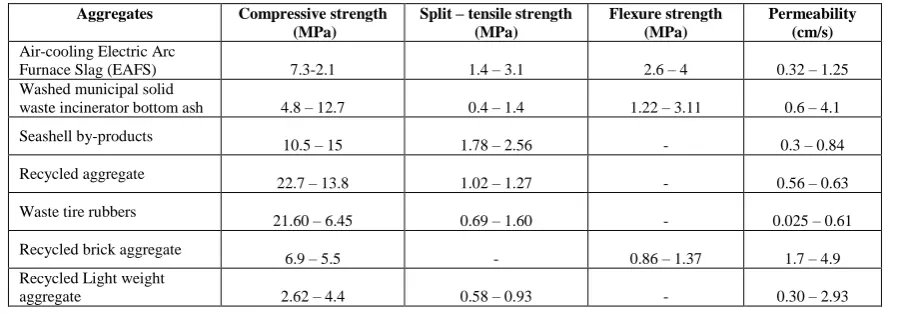
Table 1.
Mechanical Properties Of Pervious Concrete Containing Various Industrial By-Products As Aggregates
Aggregates Compressive strength
(MPa)
Split – tensile strength (MPa)
Flexure strength (MPa)
Permeability (cm/s)
Air-cooling Electric Arc
Furnace Slag (EAFS) 7.3-2.1 1.4 – 3.1 2.6 – 4 0.32 – 1.25
Washed municipal solid
waste incinerator bottom ash 4.8 – 12.7 0.4 – 1.4 1.22 – 3.11 0.6 – 4.1
Seashell by-products
10.5 – 15 1.78 – 2.56 - 0.3 – 0.84
Recycled aggregate
22.7 – 13.8 1.02 – 1.27 - 0.56 – 0.63
Waste tire rubbers
21.60 – 6.45 0.69 – 1.60 - 0.025 – 0.61
Recycled brick aggregate
6.9 – 5.5 - 0.86 – 1.37 1.7 – 4.9
Recycled Light weight
aggregate 2.62 – 4.4 0.58 – 0.93 - 0.30 – 2.93
International Journal of Emerging Technology and Advanced Engineering
Website: www.ijetae.com (ISSN 2250-2459, ISO 9001:2008 Certified Journal, Volume 6, Issue 9, September 2016)
[image:6.595.58.271.143.343.2]160
Fig. 1. The influences of aggregate type and filled percentage ofvoids by cement paste on the water permeability of pervious concrete.
Fig.2(a). Compressive strength of the washed MSWBA pervious concrete.
[image:6.595.327.534.143.322.2]Fig.2 (b).Permeability of the washed MSWBA pervious concrete.
Fig.3. Relationship between the compressive strength Rc and the water permeability K obtained by the falling head test
[image:6.595.326.527.354.525.2] [image:6.595.63.276.393.579.2] [image:6.595.319.544.559.724.2]International Journal of Emerging Technology and Advanced Engineering
Website: www.ijetae.com (ISSN 2250-2459, ISO 9001:2008 Certified Journal, Volume 6, Issue 9, September 2016)
161
Fig.5.(a). Compressive strength of pervious concretes versus rubbercontent.
[image:7.595.59.277.148.339.2]Fig. 5 (b) Permeability of pervious concretes versus rubber content.
[image:7.595.319.565.149.308.2]Fig. 6 Relationships among porosity, strength and permeability for pervious concrete.
Fig.7. Relationships between Compressive Strength and Permeability of Pervious Concrete Made with Different Aggregates
[image:7.595.319.543.347.474.2] [image:7.595.59.272.382.583.2] [image:7.595.317.544.514.684.2]