International Journal of Emerging Technology and Advanced Engineering
Website: www.ijetae.com (ISSN 2250-2459,ISO 9001:2008 Certified Journal, Volume 4, Issue 10, October 2014)
533
Evaluation of Cost Overrun Factors in the Construction Projects
in Developing Countries: Cameroon as Case Study
Guy Bertrand Elanga Elanga
1, Paul Louzolo-Kimbembe
2, Chripin Pettang
31,3
Department of Civil Engineering, Ecole Nationale Supérieure Polytechnique, P.O. Box 8390, Yaounde, CAMEROON
2Department of Exact Sciences, Ecole Normale Supérieure, P.O. Box 237, Brazzaville, CONGO
Abstract - In the field of the building industry, it is quite rare to see a project comply with the initial budget. This phenomenon seems even more accentuated in the Developing Countries (DCs). The causes of observed failures come from several factors. The aim of this study is to know the weight of factors that generate over-costs in the construction industry, particularly in Cameroon, in order to achieve better control of construction costs. A study based on a survey of 61 expert advisors of the building (architects, engineers, senior technicians and contractors) has highlighted the importance of each of these factors. The results obtained show that, regardless of the category of buildings, four factors: construction cost estimate, supply of building materials, construction technology and weather, strongly involved in the occurrence of additional costs. Factors such as the quality of the building materials and labor accidents are also quite significantly involved in the causes of the cost overruns.
Keywords - Developing Countries (DCs), survey, costs overrun, over-costs, construction project.
I. INTRODUCTION
Research on the causes of the cost overruns in construction projects have been conducted in some DCs. It appears that the problems are sometimes attributed to a poor practice of project management, economic factors, and natural environmental conditions [Mansfield et al., 1994]. It has been shown that during the planning stages and implementation, cost overruns occur entirely at the earliest stages of the project [Chalabi et al., 1984]. Exceedances can be very important. Indeed, a study in India found that of 184 major projects that were supervised centrally, 125 (approximately 68% of the total) have suffered from cost overruns, in some cases up to 750% [Chandra, 1990]. The causes of these problems have been attributed to three main categories: inadequate project formulation, lack of proper planning and poor management in the carrying out. In many DCs, the role of engineering in the construction process is insufficient, or non-existent. A consequence of this low involvement is that engineering may present a limited knowledge on the problems of construction cost [Thomas, 2002].
Therefore, we might think that the construction cost overruns are amplified by the number of causes that provoke them. Moreover these causes are numerous and more cost overruns will be important.
Conversely, less there are causes and minimal will be overruns. It therefore comes to know the weight of the factors that cause additional costs in order to better monitor, so that the resorption of the various causes can contribute to the reduction of the over-costs. It is within this framework that we have initiated a study on the over-costs incurred in the construction in Cameroon [Elanga, 2004]. We are interested in the influence of some factors of over-costs in different operations (tasks) of the building, mainly in the implementation phase where the maximum effort is made [Louzolo, 2007; 2014]. Failing to have data on the construction project costs, confidentiality has almost become the rule in the construction industry, we opted for a survey from a sample composed of operators, including architects, engineers and contractors.
II. METHODOLOGY OF THE SURVEY
The survey is based on a questionnaire. This allows firstly to collect the causes of over-costs and secondly, to show the weight of a given factor of any construction task. The different operations are as follows:
- Foundation; - Elevation; - Floor;
- Stairs/Elevator; - Sanitation/Plumbing; - Electricity;
- Septic tanks.
The buildings were classified into three categories according to their height. We have:
- The low buildings or category I: pavilions with simple ground floor (SGF) and SGF plus one story; - Medium-sized buildings or category II: SGF plus
two stories up to SGF plus six stories;
- High buildings or category III: SGF plus seven stories and more.
International Journal of Emerging Technology and Advanced Engineering
Website: www.ijetae.com (ISSN 2250-2459,ISO 9001:2008 Certified Journal, Volume 4, Issue 10, October 2014)
534 It should be noted that the questionnaire has been designed so that the interviewee is able to highlight the major factor which causes the over-cost, with a coefficient higher than other factors. The elements likely to cause cost overruns are:
-Architecture of structures; -Building technology;
-Quality of the building materials; -Construction cost estimate;
-Scheduling and organization of construction projects;
-Quality of the labor;
-Conflicts between the various stakeholders in the construction,
-Supply of building materials, -Weather;
-Industrial accidents.
We set out some hypotheses in order to quantify the responses extracted from the survey. So:
- Each factor is likely to generate an over-cost and represents an initial proportion of at least 1%; -The interviewee expresses the proportion of the cost
factor within a range from 1% to 90% depending on the magnitude of the contribution of the factor in the failure of the construction project;
- The sum of the percentages must equal 100% for each construction task.
The average weight of a factor for each task is calculated from the following expression:
〈 〉 ∑
With:
〈 〉 : The weighted average of the proportion of a factor; n: Size of the sample;
p: Factor of over-cost;
: Proportion allocated to a factor by respondents; : Frequency corresponding to .
III. PRESENTATION OF THE RESULTS
We present the results of the survey by category of buildings in the tables I-II-III of the Annex below.
Figure I shows the histogram emphasizing the importance of the various factors in the causes of the cost overruns for the three categories of buildings.
CAPTION
I: Architecture of structures; II: Building technology; III: Quality of the building materials;
IV: Construction cost estimate V: Scheduling and organization of construction projects;
VI: Quality of the labor; VII: Conflicts between the various stakeholders in the construction; VIII: Supply of building materials; IX: Weather;
X: Industrial accidents.
IV. ANALYSIS OF THE RESULTS AND INTERPRETATION
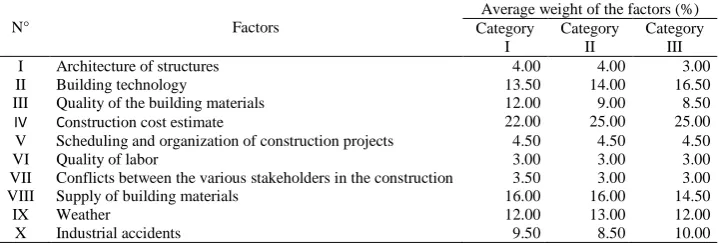
We determined the average weight of each factor for his involvement in the construction project cost overruns. It appears from the survey that we conducted the observation of a recurrence of the major influence of certain factors regardless of the category of the construction. We note as well that the cost estimate is the dominant factor in the causes of exceedence of the initial forecast budget. It contributes to nearly 22% for category I and 25% for categories II and III. Then comes the supply of building materials with 16% for categories I and II, and just fewer than 15% for category III. The building technology exceeds 16% for category III, while it is around 14% for the categories I and II. Weather is also a cause that can cause significant cost overruns in the construction; their weight is around 12% in the three categories of buildings. We will also mention the quality of buildings materials which affects 12% for category I and to almost 9% for categories II and III. Labor accidents represent a weight that can reach 10% for category III and a little less for the categories I and II.
0 5 10 15 20 25 30
I II III IV V VI VII VIII IX X
A
v
er
ag
e
w
ei
g
h
t
(%)
Factors of the overcosts
Category I Category II Category III
FIGURE I HISTOGRAM REPRESENTING THE AVERAGE WEIGHT (%) OF THE FACTORS IN THE CAUSES OF THE COST OVERRUNS FOR THE THREE
International Journal of Emerging Technology and Advanced Engineering
Website: www.ijetae.com (ISSN 2250-2459,ISO 9001:2008 Certified Journal, Volume 4, Issue 10, October 2014)
535 Other factors, namely: the architecture of structures, scheduling and the organization of construction sites, the quality of the labor and conflicts between different stakeholders in the construction do not appear to cause significant cost overruns because their respective weight is less than 5%.
All the above factors can be classified into two groups: factors related to the technical problems (first group) and those related to the management (second group).
First group: technical problems -Architecture of structures; -Building technology; -Quality of building materials; - Cost estimation.
Second group: management problems -Scheduling;
-Labor;
-Conflicts between different stakeholders in the construction;
-Supply of building materials; -Weather;
- Labor accidents.
Technical problems, in particular the architecture of the structures and building technology, could be quite easily resolved. Why we should entrust the job to qualified persons in order to avoid the presence of defects in the design and implementation of construction projects. The building materials such as concrete, aggregates, steel, etc., normally should be tested prior to use. However site laboratories, where could be conducting the tests are rarely found, hence the risk of dubious quality materials be used in the construction of a building. These shortcomings have harmful consequences for the solidity of the structure. When it looks dangerous, the resumption of the works becomes inevitable, which invariably results in significant over-costs. The construction cost estimation methods are not quite fine. It often leads to a relatively coarse initial estimated budget, illustrating by an almost lack of precision and with no margin for reliable tolerance. This could explain in large part the fact that the initial budgets often show very important deviations compared to the final construction project cost.
The problems of management appear to be more complex for their resolution. For example regarding the organization of tasks, the methods used by a large number of contractors and companies indicate that they merely content with empirical practices rather than scientific methods of scheduling and the critical path such as PERT (Program Evaluation and Review Technique) or the CPM (Critical Path Method). These bad practices usually lead to trial and error and to arbitrary decision-making by the site foreman, causing delays which, in turn, generate constructions cost overruns [Louzolo, 2005].
This phenomenon of non-compliance of the deadline, very common in sites, so not only increases the cost of labor, but also of rental equipment used. Searching for cheap labor often leads contractors to recruit low-skilled workers. Unfortunately, it happens in this case that structures are poorly executed, with major effect to the resumption of works. Task duration is then extended, resulting at the end by time overruns and therefore cost overruns. Conflicts between certain stakeholders in construction, i.e. the owner, the contractor, technical controller, the technician and utilities, are also caused delays in the start of projects, preparation and organization of construction sites, and the performance of the works. The supply of building materials is often carried out continuously and in small quantities throughout the implementation phase, because the space for the storage of materials is reduced. A consequence to this bad procedure is that stock-outs occur fairly regularly as long as an unexpected disruption arises. Moreover imported materials are experiencing price fluctuations, in addition to random and long delivery times. All this often causes the work stoppage, even extending the original deadline for project completion, with its corollary which is the construction cost overruns. Weather sometimes causes damage during implementation of certain structures if prior precautions are not observed. This is particularly the case for the distribution slab requiring protection against rain, because its implementation must be done without stopping, otherwise it could be forced to resume carrying out of the works. In any case, weather conditions, as shown by two remarkable studies led respectively by Moselhi and El-Rayes, may have an adverse impact on the duration and cost of the construction activities [Moselhi et al., 1997; El-Rayes et al., 2001]. Labor accidents result in injuries that are sometimes serious. These accidents are often the consequence of non-observance of the safety rules. When they occur, disruptions are occurring in the course of the works, and then causing delays that promote the construction cost overruns.
International Journal of Emerging Technology and Advanced Engineering
Website: www.ijetae.com (ISSN 2250-2459,ISO 9001:2008 Certified Journal, Volume 4, Issue 10, October 2014)
536 So, fight against time overruns is implicitly troubleshoot conflicts, the supply of materials, scheduling, meteorology, etc.
V. CONCLUSION
Our study was to conduct survey in order to distinguish and understand the various factors that cause additional costs in construction projects, especially in Cameroon. The survey shows that the expert advisors emphasize the cost estimation as the factor that explains most strongly the cost overruns and this regardless of the category of the building and whatever the type of operation. This result could call two possible interpretations: either cost estimation techniques used are not sufficiently reliable and have a tendency to underestimation, or there are difficulties in management that do not promote the conduct and development of a construction project within the limits of the budgetary framework. Building technology used and the supply of building materials are also considered important factors in the causes of cost overruns in all categories of buildings. Weather is another decisive factor capable of causing over-costs, particularly as regards the completion of the floor.
Despite the somewhat qualitative aspect of the results obtained through this study, we nevertheless have provided useful guidance to construction projects managers and other technicians. Knowing the weight of the factors that might adversely affect the construction cost could help the actors operating in the field of the construction industry to prevent possible budgetary skid and better control them, failing to curb them.
Acknowledgements
We would like to thank sincerely all the expert advisors of the cities of Yaounde and Douala (Cameroon) who were willing to participate in the survey despite his cumbersome and tedious character. We would also like to acknowledge the enthusiasm and seriousness which they demonstrated during the survey.
REFERENCES
[1] Aibinu A. A., Jagboro G. O. 2002. The effects of construction delays on project delivery in Nigeria construction industry, International Journal of Project Management, Vol. 20, N° 8, p. 593-599.
[2] Akpan Edem O. P., Igwe O. 2001. Methodology of Determining Price Variation in Project Execution, Journal of Construction Engineering and Management, ASCE, Vol. 127, N° 5, p. 367-373.
[3] Al-Momani A. H. 2000. Construction delay: A quantitative analysis, International Journal of Project Management, Vol. 18, p. 51-59.
[4] Chalabi F. A., Camp D. 1984. Causes of delays and overruns of construction projects in Developing Countries, CIB Proceedings, W-65, Vol. 2, p. 723-734.
[5] Chandra H. 1990. Management of construction in Developing Countries: India experiences, Building Econ. Management, Vol. 5, p. 211-224.
[6] Elanga Elanga G. B. 2004. Analyse des surcoûts dans la construction au Cameroun, Mémoire de fin d’études d’Ingénieur de conception de Génie Civil, Ecole Nationale Supérieure Polytechnique de Yaoundé (Cameroun), 81 pages.
[7] El-Rayes K., Moselhi O. 2001. Impact of rainfull on the productivity of highway construction, Journal of Construction Engineering and Management, ASCE, Vol. 127, N°2, p. 125-131. [8] Frimpong Y., Oluwoye J. 2003. Significant factors causing delay
and cost overruns in construction of groundwater projects in Ghana, Journal of Construction Research, Vol. 4, N° 2, p. 175-187.
[9] Frimpong Y., Oluwoye J., Crawford L. 2003. Causes of delay and cost overruns in construction of groundwater projects in a Developing Countries: Ghana as case study, International Journal of Project Management, Vol. 21, N° 5, p. 321-326.
[10] Hutcheson J. M. 1990. Developing Countries – A challenge to managers, Project Management Journal, Vol. 15, N° 1, p. 77-85. [11] Louzolo-Kimbembé P. 2005. Contribution aux méthodes de
maîtrise du coût de la construction dans les Pays en Développement : Estimation du coût et Optimisation dans un contexte hors délai, Thèse de Ph.D de Génie Civil et Sciences de l’Habitat, Ecole Nationale Supérieure Polytechnique de Yaoundé (Cameroun), 304 pages.
[12] Louzolo-Kimbembé P., Pettang C., Tamo Tatiétsé. 2007. Minimisation des surcoûts dans un contexte hors délai: cas des projets de construction dans les Pays en Développement, Canadian Journal of Civil Engineering, Vol. 34, N°9, pp. 1180-1191.
[13] Louzolo-Kimbembé P., Mampika-Bathy B. R. 2014. Improvement of the model of minimization of the costs in time-overrun context: case of construction projects, International Journal of Civil Engineering and Technology (IJCIET), Vol. 5, N°9, pp. 114-134.
[14] Mansfield N. R., Ugwu O. O., Doran T. 1994. Causes of delay and cost overruns in Nigeria construction projects, International Journal of Project Management, Vol. 12, N°1, p. 254-260. [15] Moselhi O., Gong D., El-Rayes K. 1997. Estimating weather
impact on the duration of construction activities, Canadian Journal of Civil Engineering, Vol. 24, p. 359-366.
[16] Ogunlana S. O., Promkuntong K. Vithool J. 1996. Construction delays in a fast-growing economy: Comparing Thailand with other economies, International Journal of Project Management, Vol. 14, N° 1, p. 37-45.
International Journal of Emerging Technology and Advanced Engineering
Website: www.ijetae.com (ISSN 2250-2459,ISO 9001:2008 Certified Journal, Volume 4, Issue 10, October 2014)
537 ANNEX
Table 1
Importance Of Factors Of Cost Overruns Following Various Operations Of Construction For Category I (Low Buildings)
N° Operations of construction
Contribution of factors of over-costs (%)
I II III IV V VI VII VIII IX X 1 Fondation 2.50 14.92 9.67 30.67 4.42 4.33 2.33 12.08 14.83 4.25 2 Elevation 4.00 11.00 26.40 4.00 3.40 3.40 12.60 14.00 5.60 15.60 3 Floor 2.75 15.00 10.50 25.37 3.50 2.88 1.38 11.25 10.87 16.50 4 Stairs/Elevator 2.25 18.75 11.25 25.25 5.25 3.75 2.25 16.25 9.00 6.00 5 Sanitation/Plumbing 5.00 15.00 14.00 30.00 1.00 2.00 1.00 2.00 20.00 10.00 6 Electricity/Telephone 10.00 5.00 5.00 20.00 5.00 1.00 1.00 50.00 2.00 1.00 7 Septic tanks 1.00 15.00 6.67 17.33 8.33 4.67 4.33 8.67 20.00 14.00
Average weight for the whole construction (%)
3.93 2.00
13.52 4.00
11.93 7.00
21.80 9.00
4.41 2.00
3.15 1.00
3.56 2.00
16.32
11.00
11.76 7.00
9.62 6.00
CAPTION:
I: Architecture of structures; II: Building technology;
III: Quality of the building materials; IV: Construction cost estimate V: Scheduling and organization of construction projects;
VI: Quality of the labor; VII: Conflicts between the various stakeholders in the construction; VIII: Supply of building materials; IX: Weather;
X: Industrial accidents.
Table II
Importance Of Factors Of Cost Overruns Following Various Operations Of Construction For Category Ii (Medium-Sized Buildings)
N° Operations of construction
Contribution of factors of over-costs (%)
I II III IV V VI VII VIII IX X 1 Fondation 1.67 16.25 8.08 32.25 4.17 4.50 2.67 10.83 14.50 5.08 2 Elevation 2.80 15.00 11.80 29.00 3.60 3.20 3.40 12.00 13.80 5.40 3 Floor 2.63 14.37 10.37 25.63 4.25 2.50 1.38 11.13 11.37 16.37 4 Stairs/Elevator 2.25 17.50 11.25 24.25 4.50 3.00 2.25 16.25 10.25 8.50 5 Sanitation/Plumbing 5.00 20.00 10.00 25.00 1.00 1.00 6.00 2.00 20.00 10.00 6 Electricity/Telephone 10.00 5.00 5.00 20.00 5.00 1.00 1.00 50.00 2.00 1.00 7 Septic tanks 2.67 12.67 6.67 18.33 8.33 5.00 4.33 9.00 19.00 14.00
Average weight for the whole construction (%)
3.86 2.00
14.40 5.00
9.02 3.00
24.92 5.00
4.41 2.00
2.89 1.00
3.00 2.00
15.89
10.00
12.99 6.00
[image:5.595.113.482.530.633.2]8.62 5.00
Table III
Importance Of Factors Of Cost Overruns Following Various Operations Of Construction For Category Iii (High Buildings)
N° Operations of construction
Contribution of factors of over-costs (%)
I II III IV V VI VII VIII IX X 1 Fondation 1.50 15.92 7.33 32.66 4.25 4.42 2.67 12.08 13.92 5.25 2 Elevation 2.60 14.40 11.80 28.60 3.80 2.80 3.40 12.80 13.80 6.00 3 Floor 2.25 15.12 9.75 26.00 3.50 2.50 1.37 11.13 11.75 16.63 4 Stairs/Elevator 2.25 15.00 10.00 28.00 4.50 3.00 2.25 15.00 10.25 9.75 5 Sanitation/Plumbing 5.00 25.00 10.00 25.00 1.00 1.00 6.00 2.00 15.00 10.00 6 Electricity/Telephone 5.00 15.00 5.00 20.00 5.00 1.00 1.00 40.00 2.00 6.00 7 Septic tanks 2.67 16.00 5.00 15.00 8.33 6.67 4.33 9.00 17.33 15.67
Average weight for the whole construction (%)
3.04 1.00
16.64 4.00
8.41 3.00
25.04 6.00
4.34 2.00
3.06 2.00
3.00 2.00
14.57
11.00
12.00 5.00
9.90 4.00
International Journal of Emerging Technology and Advanced Engineering
Website: www.ijetae.com (ISSN 2250-2459,ISO 9001:2008 Certified Journal, Volume 4, Issue 10, October 2014)
[image:6.595.120.480.169.293.2]538
Table IV
Summary Of The Results On The Factors Of Cost Overruns Following The Categories Of Constructions
N° Factors
Average weight of the factors (%) Category
I
Category II
Category III
I Architecture of structures 4.00 4.00 3.00
II Building technology 13.50 14.00 16.50
III Quality of the building materials 12.00 9.00 8.50
IV Construction cost estimate 22.00 25.00 25.00
V Scheduling and organization of construction projects 4.50 4.50 4.50
VI Quality of labor 3.00 3.00 3.00
VII Conflicts between the various stakeholders in the construction 3.50 3.00 3.00
VIII Supply of building materials 16.00 16.00 14.50
IX Weather 12.00 13.00 12.00