PAZAR: a framework for collection and dissemination of
cis-regulatory sequence annotation
Elodie Portales-Casamar
¤
*
, Stefan Kirov
¤
†‡
, Jonathan Lim
*
,
Stuart Lithwick
*
, Magdalena I Swanson
*
, Amy Ticoll
*
, Jay Snoddy
†§
and
Wyeth W Wasserman
*
Addresses: *Centre for Molecular Medicine and Therapeutics, CFRI, University of British Columbia, Vancouver, BC., V5Z 4H4, Canada. †Graduate School for Genome Science and Technology, Oak Ridge National Laboratory-University of Tennessee, Oak Ridge, TN, 37830, USA. ‡Applied Genomics Department, Pharmaceutical Research Institute, Bristol-Myers Squibb, NJ, 08534, USA. §Biomedical Informatics Department, Vanderbilt University School of Medicine, Nashville, TN, 37235, USA.
¤ These authors contributed equally to this work.
Correspondence: Wyeth W Wasserman. Email: [email protected]
© 2007 Portales-Casamar et al.; licensee BioMed Central Ltd.
This is an open access article distributed under the terms of the Creative Commons Attribution License (http://creativecommons.org/licenses/by/2.0), which permits unrestricted use, distribution, and reproduction in any medium, provided the original work is properly cited.
The PAZAR database
<p>PAZAR is an open-access and open-source database of transcription factor and regulatory sequence annotation with associated web interface and programming tools for data submission and extraction.</p>
Abstract
PAZAR is an open-access and open-source database of transcription factor and regulatory sequence annotation with associated web interface and programming tools for data submission and extraction. Curated boutique data collections can be maintained and disseminated through the unified schema of the mall-like PAZAR repository. The Pleiades Promoter Project collection of brain-linked regulatory sequences is introduced to demonstrate the depth of annotation possible within PAZAR. PAZAR, located at http://www.pazar.info, is open for business.
Rationale
The study of gene regulation has emerged as a focus of efforts to understand how genome sequences give rise to diverse and complex cells and tissues. From gene-centric dissection of promoter sequences [1] to regulon-based analysis of cis-regu-latory modules [2] through to genome-scale chromatin probes [3], researchers across the subdisciplines of modern biology strive to understand how cells regulate the flow of genetic information from DNA to RNA via the process of tran-scription. This developing knowledge, and more critically the data produced, has unleashed a wealth of computational-driven approaches to predict the locations of regulatory sequences, as well as to discover classes of binding sites for transcription factors and models of regulatory programs [4-8]. Annotated sets of regulatory sequences, with well
under-stood and independently confirmed function, are necessary to serve as gold standards to support the validation of new molecular techniques and computational algorithms. As con-fidence in regulatory annotation and prediction advances, researchers will increasingly draw on such knowledge to design sequences capable of directing targeted gene expres-sion in molecular applications such as gene therapy.
Existing regulatory sequence data collections are generated primarily in a need-driven manner. A dedicated researcher pursuing an idea will extract from the scientific literature a sufficient set of annotations to support their own studies. For example, the widely used JASPAR collection of transcription factor binding profiles [9] was developed initially for the study of binding pattern similarities across families of
Published: 28 September 2007
Genome Biology 2007, 8:R207 (doi:10.1186/gb-2007-8-10-r207)
Received: 30 April 2007 Revised: 5 September 2007 Accepted: 28 September 2007 The electronic version of this article is the complete one and can be
ORegAnno database [11] was compiled initially for the study of genetic variations known to alter binding sites of transcrip-tion factors. The best of these reference collectranscrip-tions are subse-quently used by researchers within bioinformatics to improve and assess the performance and efficiency of computational methods. These boutique data collections are the backbone of the current generation of regulatory sequence analysis stud-ies (examples include [9,11-20]). It is our perception that bou-tique reference databases will likely remain the primary sources for regulatory sequence annotations for much time to come. While large centrally curated database have emerged for proteins (UniProt [21]) or human genetics (OMIM [22]), funding for large-scale curation of an open-access regulatory sequence collection appears unlikely.
The existing pool of annotated data for transcriptional regu-lation is not optimal. There is an unfortunate long-term prob-lem that stems in part from the fact that database maintenance is tiresome. The operators of the boutique data-bases quickly move on to other tasks, motivated equally by a dearth of monetary support and the excitement of the next project. Few regulatory sequence collections have endured for long periods of time with evidence of substantial expansion. The widely used TRANSFAC collection of regulatory sequences has been a central tool for bioinformatics [23]. However, the transfer of the collection to a commercial fund-ing model makes it difficult for the system to build on com-munity participation. The scientific comcom-munity is less likely to add to and improve upon data annotation distributed in a for-profit tool. Limited commercial curation may tend to focus on commercially relevant annotation rather than basic science research needs.
The boutique model of database development suffers from several fundamental problems. As mentioned, collections can stagnate after the initial enthusiasm of the creator wanes. For current research, reference collections must increasingly map onto genome sequence coordinates, and thus the utility of the collections rapidly diminishes if such coordinates are not kept up to date. Furthermore, data need to be delivered in a dynamic manner accessible by web interfaces, programming interfaces and emergently via support of semantic interfaces. Flat file data models are too rigid and cannot capture data at its full granularity.
In this report we introduce the PAZAR information mall for regulatory sequence annotation (Figure 1). Building on the resource of boutique database owner-operators, PAZAR (the Bulgarian word for shopping mall) provides a computing infrastructure for the creation, maintenance and dissemina-tion of regulatory sequence annotadissemina-tion. Incumbent upon the purpose, PAZAR provides tools for data exchange (XML and GFF formats), dynamic data access (application program-ming interface) and internet-based user interaction. In order to provide a framework for independent data boutiques,
a broad range of data annotation. While PAZAR itself is an open-access and open-development project, the system allows for boutique operators to limit access to a data collec-tion in order to facilitate their ongoing collaborative projects or early stage development of reference collections. PAZAR [24] is now open for business.
Database organization and controlled
vocabularies
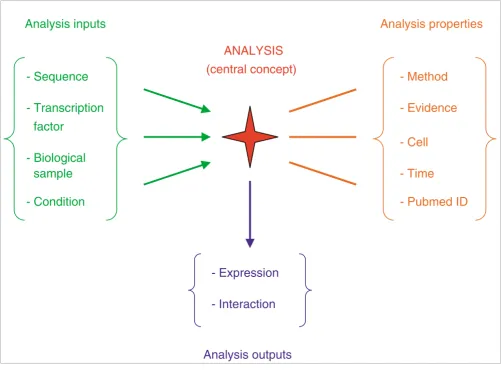
PAZAR is designed around two main concepts: first, the necessity for unambiguous identification of the chromosome location for any given cis-regulatory element (CRE) using genomic coordinates (this restricts the allowed species to those for which a genome assembly is resolved); and second, a flexible database schema allowing for the capture of annota-tions derived from a wide range of experiments (Figure 2). In brief, nucleotide sequence and transcription factor (TF) information is stored independently. Relationships (for example, TF 1 binding to sequence A) are established through an 'analysis' object, which describes the analysis properties (the method used, the cell type in which the experiment was performed, the PubMed abstract identifier, and so on). The TF and sequence are then treated as inputs of this analysis, the output being the effect that is observed (interaction or change in expression). This representation of data gives the database significant flexibility regarding the type of informa-tion that can be captured, a characteristic that is essential for handling the diversity of annotations most often used to describe gene regulation.
PAZAR Mall
Figure 1
provide individual binding site information, such as JASPAR [9] or computational motif predictions [28].
The aforementioned design features have been implemented using the mySQL relational database. The current database structure is developed and maintained through the DBDe-signer software application, which provides an integrated graphic development interface and tools for automatic SQL script generation and data exchange.
The wide array of PAZAR hostable datasets contains a great heterogeneity of information. To overcome the challenges imposed by such data diversity, we incorporate controlled vocabularies as a means to consistently annotate regulatory sequences and expression patterns. Bio-ontologies offer com-mon semantics for biological functional annotations [29]. Two topics requiring controlled vocabularies in PAZAR are:
cell types and tissues; and experimental methods. For the former, we chose the BRENDA Tissue Ontology as our refer-ence [30] and are providing updates to the BRENDA develop-ers on a periodic basis as PAZAR usdevelop-ers expand the vocabulary. With respect to the experiment type ontology, we are collaboratively working with the developers of the ORe-gAnno database [11].
PAZAR web interface and programming tools
As illustrated in Figure 1, the PAZAR database can be viewed as a mall bringing together independent boutiques. The CGI-based interface builds on this theme through the incorpora-tion of a mall map that serves as the entry to the search inter-face. Users can search by gene ('Genes' department store), TF ('TFMART' department store) or TF binding profile ('TF PROFILES' department store). If interested in only one
[image:4.612.54.555.87.456.2]PAZAR central concept: analysis and input/output system
Figure 2
PAZAR central concept: analysis and input/output system. The sequences and transcription factors are stored independently in the database and are then linked together as inputs of an analysis. Other types of input can be used, such as a biological sample (for example, nuclear extract) or a condition (for example, addition of a chemical compound). The analysis is defined by various properties (the method and cell type used, the PubMed identifier, and so on) and links inputs and outputs together. An output could be the observed effect, for example expression response or interaction level. The system is very flexible, allowing various combinations of inputs and outputs.
Analysis inputs
Analysis properties
ANALYSIS
(central concept)
- Sequence
- Transcription
factor
- Biological
sample
- Condition
- Method
- Evidence
- Cell
- Time
- Pubmed ID
- Expression
- Interaction
specific dataset hosted in PAZAR, users can also search this specific store by clicking either on the store on the map or on its name in the mall directory.
Use-case number 1
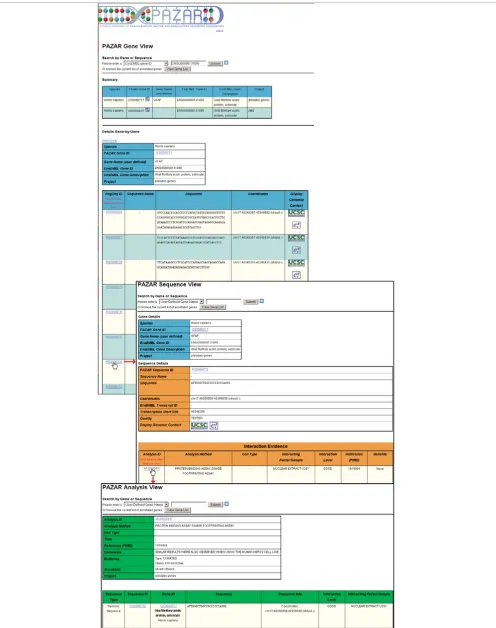
If one is looking for regulatory information for a specific gene, one should click on the 'Genes' department store and enter the gene identifier (several options are available). As a result, the gene view page is loaded with a summary table of all genes corresponding to the query. For each of the displayed genes, the list of all annotated regulatory sequences is located in tables further down the page (Figure 3). More information can then be obtained by clicking on the 'RegSeq ID' to enter the 'Sequence View' (Figure 3). From these pages one can access greater detail by clicking on the 'Analysis ID' to enter the 'Analysis View' (Figure 3). In the gene and sequence views, one can click on the UCSC or EnsEMBL icons to dis-play the sequences within the UCSC or the EnsEMBL genome browser, respectively.
Use-case number 2
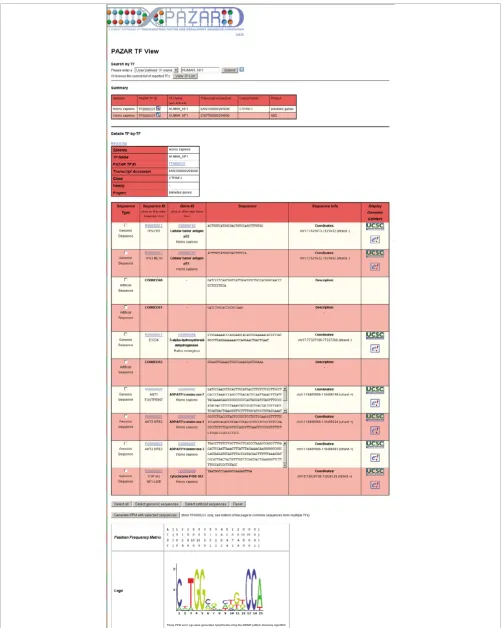
When looking for binding sites for a given TF, one can use the 'TFMART' department store. Various identifiers can be used for the query and the results will be displayed in the 'TF View' (Figure 4). First, a summary table shows all available TFs cor-responding to the query. Then, for each, the list of all anno-tated binding sites is displayed. The binding sites can refer to specific genomic coordinates, with accompanying hyperlinks that take the user to the corresponding Sequence or Gene View, or they can be artificial (for example, oligonucleotide representing a consensus sequence). All the sites are aligned and a TF binding profile is built dynamically using the MEME pattern discovery algorithm [31].
Use-case number 3
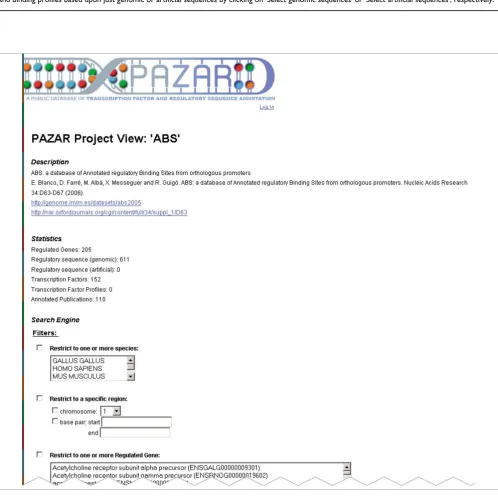
One might desire to limit queries to a single collection. To do so, the user must find the corresponding boutique in the mall map or directory and click on it. The 'Project View' provides a brief description of the dataset as well as some statistics on the data it contains (Figure 5). Below, the user can choose amongst various filters to search through the data and display it in the 'Gene View', where regulatory sequences will be grouped by the genes they regulate, or in the 'TF View', where the sequences will be grouped by the TFs with which they interact.
PAZAR provides a submission interface that one can access by clicking on 'Submit' in the left menu. This web-based streamlined user interface provides a simplified entry point to the database for non-professional curators, such as scientists that want to deposit their own experimental data to the public repository.
We have developed a Perl API (application programming interface) that hides the intrinsic complexity of the schema from database users. The object-oriented approach provides
programmers with different layers of abstraction, allowing advanced users to create 'high-layer' objects and methods to suit project-specific needs.
To best serve users, PAZAR must frequently retrieve data from external sources. For example, sequence coordinates must be updated when genome assemblies are released, updated, or re-annotated. The API pazar::talk modules make this possible by delegating all external queries to an appropri-ate pazar::talk::database module. Currently, three modules have been developed to interact with the GeneKeyDB [32], JASPAR [9], and EnsEMBL [33] databases. The open source nature of this project allows users to develop or adapt addi-tional modules to work with any database of their choice.
A PAZAR-specific exchange format has been implemented in XML (extensible markup language). In addition to facilitating data transfer between 'boutiques' and the central master database, the XML format can support custom stand-alone user interfaces that do not have direct database access. Some basic sequence features can also be exported in GFF (general feature format). API methods are available to parse PAZAR XML or GFF format data for importation into the database.
Database content
Each data collection within PAZAR is called a project and is identified by a project ID, a project name, a status and a list of users. The project status can be 'restricted' (only the project-specific users have read and write access), 'published' (only the project-specific users have write privileges, but everyone has read access) or 'open' (everyone has read and write privi-leges). For this purpose, each record in the database is linked to a project ID, allowing all projects to share the same tables within the database schema, yet retaining their project iden-tity so that they remain independent data collections.
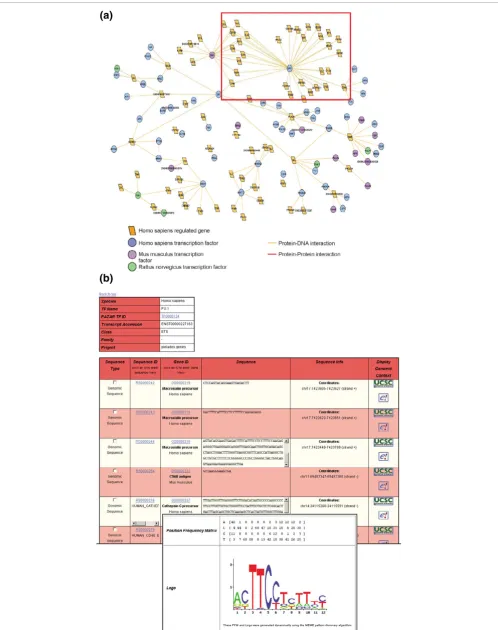
The 'Pleiades genes' project is a good example of the level of annotation that can be captured in PAZAR. This dataset is being collected by data curators working for the Pleiades Pro-moter Project [36], a Genome Canada project focused on the creation of short regulatory sequences to drive gene expres-sion in defined brain regions of therapeutic interest. Thus, one major component of the project is to identify genes expressed in specific brain regions and annotate their known regulatory sequences. PAZAR is used for this regulatory data collection, providing the required level of annotation details (experiments, cell types, level of interaction or expression, mutations, and so on). As an example of how data from PAZAR can be visualized, Figure 6a shows a graphical repre-sentation in Cytoscape [37] of the 'Pleiades genes' project, focusing on the human gene-TF interactions. The box in Fig-ure 6a highlights the human PU.1 transcription factor (also known as SPI1) and all the genes containing a recorded PU.1 binding site within the 'Pleiades genes' project. Figure 6b shows the PAZAR display for those PU.1 transcription factor binding sites and the binding profile for the combined set.
PAZAR availability and distribution
PAZAR is open-access and open-source, providing a com-pletely transparent development and data compilation. Both the code and the data (except for any restricted projects) are available through the PAZAR website [24] or the develop-ment website [38].
Conclusion: growth and development
A large fraction of gene regulation data comes from high-throughput techniques such as gene expression and chroma-tin immunoprecipitation microarrays. Unfortunately, the observed data are difficult to interpret as they often reflect contributions from overlapping processes. One means to improve the interpretation of results is to incorporate prior knowledge of regulatory processes [39,40]. The JASPAR database of TF binding profiles is widely used for such pur-poses [9], yet provides merely a fraction of the information necessary to support the research community. An excellent and extensive comparison of the existing binding site predic-tion tools [41] suggests that one of the biggest hurdles in eval-uating these tools objectively is the lack of an adequate reference collection. Thus, access to a larger pool of
experi-mentally derived reference data, such as provided by PAZAR, could facilitate both improved interpretation of high-throughput data and assessment of computational methods.
Considering the future of gene regulation databases, three things are apparent. First, the motivation and expertise of individual researchers, as well as their focus on deep annota-tion of specific pathways and processes, make boutique oper-ators a key resource in long-term compilation of regulatory sequences and annotations. Second, based on principles shared by the authors, any database should provide data and software in an open, unrestricted manner to all researchers in all settings. Third, the ongoing technical challenges for data-bases require a long-term commitment of talented technical staff. PAZAR was developed based on these observations.
While our laboratory will maintain PAZAR for the long-term as it is necessary for our on-going research, ideally the project would expand through the engagement of a cooperative research community. Recent events suggest that the global research community is prepared to participate in regulatory sequence annotation projects. In late 2006, a group of open-access motivated scientists contributed regulatory sequence annotations to the ORegAnno database [11]. While PAZAR and ORegAnno differ substantially in mission and approach, both address the need for open-access data collections and the developers are working together on common components such as controlled vocabularies. Contributions to a shared system could be combined synergistically to provide the research community with a valued resource.
Development of PAZAR will require ongoing effort to expand the data represented, the means to access the data and the quality of the data curation tools. At present, existing data collections are being added to PAZAR with the permission and collaboration of the boutique operators. We anticipate the boutique database creators will be strongly motivated to use the system as it eases their own work. For instance, most high-throughput datasets currently generated never become available through a database and web interface because of the limited time researchers want to put into this effort. PAZAR provides an easy way to make these data available and to maintain them. Readers of this paper are encouraged to con-sider opening a boutique or working with the PAZAR team to move an existing data collection into the system.
Example query: search by gene
Figure 3 (see previous page)
Example query: search by transcription factor
Figure 4 (see previous page)
Example query: search by transcription factor. By clicking on the 'TFMART' department store at the left hand side of the mall, users can perform a TF-specific query. The 'TF View', color-coded in red, is very similar to the 'Gene View' (see Figure 3) with a summary table of all of the TFs obtained from the search at the top followed by details and binding sites for each of them individually. Here, the results show that the queried TF (HUMAN_NF1) has annotations in two different projects. The binding sites can be genomic sequences with defined coordinates or they can be artificial (for example, oligonucleotide representing a consensus sequence). All the sites are aligned and a TF binding profile is built dynamically using the MEME pattern discovery algorithm [31]. Users can construct a custom scoring matrix and binding profile based upon a subset of the sequences for that TF by clicking in the check boxes of those sequences meant to be included and clicking 'Generate PFM with selected sequences'. Alternatively, users can generate scoring matrices and binding profiles based upon just genomic or artificial sequences by clicking on 'Select genomic sequences' or 'Select artificial sequences', respectively.
[image:9.612.56.554.177.675.2]Example query: search within a specific boutique project
Figure 5
Our goal is for PAZAR to become the public repository for data and annotations pertaining to transcriptional regulation. By promoting strong integration with tools for computational analysis and prediction of cis-regulatory sequences, boutique database operators will be motivated to participate in the expansion of the system.
Abbreviations
API, application programming interface; CRE, cis-regulatory element; GFF, general feature format; TF, transcription fac-tor; XML, extensible markup language.
Authors' contributions
EPC and SK participate in creating the vision of the system, designed the database and implemented the software. EPC prepared the initial draft of the manuscript. JL participated in the software and database design. SL, MS and AT tested the system, developed documentation, and compiled the Pleiades data collection. AT produced the Cytoscape figure and con-tributed to the importation of OregAnno data. JS co-super-vised the project and participated in the creation of the vision. WWW co-supervised the project, participated in the design of the system, and revised the manuscript. All authors read and provided feedback on the manuscript.
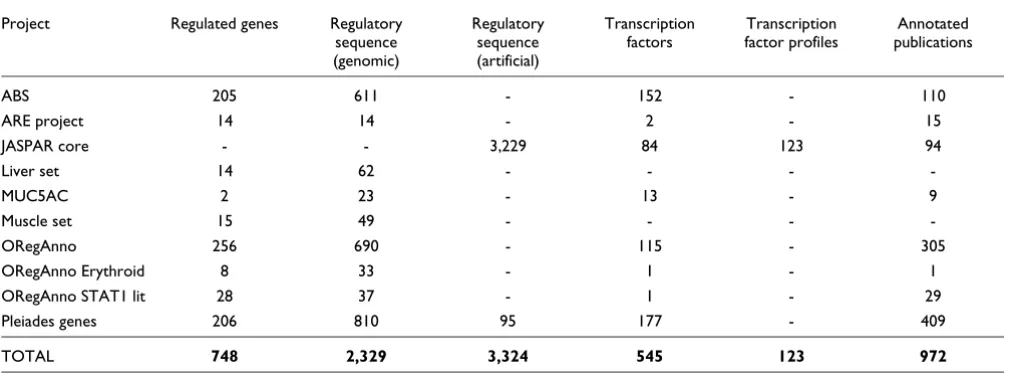
PAZAR database content on 13 July 2007*
Project Regulated genes Regulatory sequence (genomic)
Regulatory sequence (artificial)
Transcription factors
Transcription factor profiles
Annotated publications
ABS 205 611 - 152 - 110
ARE project 14 14 - 2 - 15
JASPAR core - - 3,229 84 123 94
Liver set 14 62 - - -
-MUC5AC 2 23 - 13 - 9
Muscle set 15 49 - - -
-ORegAnno 256 690 - 115 - 305
ORegAnno Erythroid 8 33 - 1 - 1
ORegAnno STAT1 lit 28 37 - 1 - 29
Pleiades genes 206 810 95 177 - 409
TOTAL 748 2,329 3,324 545 123 972
*This table includes only the experimentally validated annotations available in PAZAR and, therefore, excludes the Kellis predictions.
Visual representation of the human gene annotations of the 'Pleiades genes' project in PAZAR
Figure 6 (see following page)
[image:10.612.54.561.120.306.2]Figure 6 (see legend on previous page)
(a)
Acknowledgements
We acknowledge Dimas Yusuf for the drawing of the PAZAR mall map and Jerome Bacconnier for the PAZAR logo and Web interface design. This project is supported by funding from the GenomeCanada Pleiades Pro-moter Project, the Canadian Institute of Health Research (CIHR), Canada Foundation for Innovation, Merck and IBM. WWW is a CIHR New Inves-tigator and a Scholar of the Michael Smith Foundation for Health Research.
References
1. Farhadi HF, Lepage P, Forghani R, Friedman HC, Orfali W, Jasmin L, Miller W, Hudson TJ, Peterson AC: A combinatorial network of evolutionarily conserved myelin basic protein regulatory sequences confers distinct glial-specific phenotypes. J Neurosci 2003, 23:10214-10223.
2. Kirchhamer CV, Yuh CH, Davidson EH: Modular cis-regulatory organization of developmentally expressed genes: two genes transcribed territorially in the sea urchin embryo, and addi-tional examples. Proc Natl Acad Sci USA 1996, 93:9322-9328. 3. Ren B, Robert F, Wyrick JJ, Aparicio O, Jennings EG, Simon I,
Zeitlin-ger J, Schreiber J, Hannett N, Kanin E, et al.: Genome-wide location and function of DNA binding proteins. Science 2000, 290:2306-2309.
4. Kel AE, Kel-Margoulis OV, Farnham PJ, Bartley SM, Wingender E, Zhang MQ: Computer-assisted identification of cell cycle-related genes: new targets for E2F transcription factors. J Mol Biol 2001, 309:99-120.
5. Fickett JW: Quantitative discrimination of MEF2 sites. Mol Cell Biol 1996, 16:437-441.
6. Levy S, Hannenhalli S, Workman C: Enrichment of regulatory sig-nals in conserved non-coding genomic sequence. Bioinformat-ics (Oxford, England) 2001, 17:871-877.
7. Krivan W, Wasserman WW: A predictive model for regulatory sequences directing liver-specific transcription. Genome Res 2001, 11:1559-1566.
8. Wasserman WW, Fickett JW: Identification of regulatory regions which confer muscle-specific gene expression. J Mol Biol 1998, 278:167-181.
9. Vlieghe D, Sandelin A, De Bleser PJ, Vleminckx K, Wasserman WW, van Roy F, Lenhard B: A new generation of JASPAR, the open-access repository for transcription factor binding site profiles. Nucleic Acids Res 2006, 34:D95-97.
10. Sandelin A, Wasserman WW: Constrained binding site diversity within families of transcription factors enhances pattern dis-covery bioinformatics. J Mol Biol 2004, 338:207-215.
11. Montgomery SB, Griffith OL, Sleumer MC, Bergman CM, Bilenky M, Pleasance ED, Prychyna Y, Zhang X, Jones SJ: ORegAnno: an open access database and curation system for literature-derived promoters, transcription factor binding sites and regulatory variation. Bioinformatics (Oxford, England) 2006, 22:637-640. 12. Schmid CD, Praz V, Delorenzi M, Perier R, Bucher P: The
Eukaryo-tic Promoter Database EPD: the impact of in silico primer extension. Nucleic Acids Res 2004, 32:D82-85.
13. Bergman CM, Carlson JW, Celniker SE: Drosophila DNase I foot-print database: a systematic genome annotation of tran-scription factor binding sites in the fruitfly, Drosophila melanogaster. Bioinformatics (Oxford, England) 2005, 21:1747-1749. 14. Blanco E, Farre D, Alba MM, Messeguer X, Guigo R: ABS: a
data-base of Annotated regulatory Binding Sites from ortholo-gous promoters. Nucleic Acids Res 2006, 34:D63-67.
15. Sun H, Palaniswamy SK, Pohar TT, Jin VX, Huang TH, Davuluri RV: MPromDb: an integrated resource for annotation and visual-ization of mammalian gene promoters and ChIP-chip exper-imental data. Nucleic Acids Res 2006, 34:D98-103.
16. Grienberg I, Benayahu D: OsteoPromoter Database (OPD) -promoter analysis in skeletal cells. BMC Genomics [computer file] 2005, 6:46.
17. Zhu J, Zhang MQ: SCPD: a promoter database of the yeast Sac-charomyces cerevisiae. Bioinformatics (Oxford, England) 1999, 15:607-611.
18. Kanamori M, Konno H, Osato N, Kawai J, Hayashizaki Y, Suzuki H: A genome-wide and nonredundant mouse transcription factor database. Biochem Biophys Res Comm 2004, 322:787-793. 19. Kolchanov NA, Podkolodnaia OA, Anan'ko EA, Ignat'eva EV,
Pod-kolodnyi NL, Merkulov VM, Stepanenko IL, Pozdniakov MA, Belova OE, Grigorovich DA, et al.: Regulation of eukaryotic gene
tran-Biologiia 2001, 35:934-942.
20. Gallo SM, Li L, Hu Z, Halfon MS: REDfly: a Regulatory Element Database for Drosophila. Bioinformatics (Oxford, England) 2006, 22:381-383.
21. Wu CH, Apweiler R, Bairoch A, Natale DA, Barker WC, Boeckmann B, Ferro S, Gasteiger E, Huang H, Lopez R, et al.: The Universal Protein Resource (UniProt): an expanding universe of pro-tein information. Nucleic Acids Res 2006, 34:D187-191.
22. Hamosh A, Scott AF, Amberger JS, Bocchini CA, McKusick VA: Online Mendelian Inheritance in Man (OMIM), a knowledge-base of human genes and genetic disorders. Nucleic Acids Res 2005, 33:D514-517.
23. Matys V, Kel-Margoulis OV, Fricke E, Liebich I, Land S, Barre-Dirrie A, Reuter I, Chekmenev D, Krull M, Hornischer K, et al.: TRANS-FAC and its module TRANSCompel: transcriptional gene regulation in eukaryotes. Nucleic Acids Res 2006, 34:D108-110. 24. The PAZAR Database of Transcription Factor and
Regula-tory Sequence Annotation [http://www.pazar.info]
25. Kawaji H, Kasukawa T, Fukuda S, Katayama S, Kai C, Kawai J, Carninci P, Hayashizaki Y: CAGE Basic/Analysis Databases: the CAGE resource for comprehensive promoter analysis. Nucleic Acids Res 2006, 34:D632-636.
26. Kasai Y, Hashimoto S, Yamada T, Sese J, Sugano S, Matsushima K, Morishita S: 5'SAGE: 5'-end Serial Analysis of Gene Expression database. Nucleic Acids Res 2005, 33:D550-552.
27. Ryseck RP, Bravo R: c-JUN, JUN B, and JUN D differ in their binding affinities to AP-1 and CRE consensus sequences: effect of FOS proteins. Oncogene 1991, 6:533-542.
28. Xie X, Lu J, Kulbokas EJ, Golub TR, Mootha V, Lindblad-Toh K, Lander ES, Kellis M: Systematic discovery of regulatory motifs in human promoters and 3' UTRs by comparison of several mammals. Nature 2005, 434:338-345.
29. Bodenreider O, Stevens R: Bio-ontologies: current trends and future directions. Briefings Bioinformatics 2006, 7:256-274. 30. Schomburg I, Chang A, Ebeling C, Gremse M, Heldt C, Huhn G,
Schomburg D: BRENDA, the enzyme database: updates and major new developments. Nucleic Acids Res 2004, 32:D431-433. 31. Bailey TL, Elkan C: Fitting a mixture model by expectation
maximization to discover motifs in biopolymers. Proc Int Conf Intell Sys Mol Biol 1994, 2:28-36.
32. Kirov SA, Peng X, Baker E, Schmoyer D, Zhang B, Snoddy J: GeneKeyDB: a lightweight, gene-centric, relational database to support data mining environments. BMC Bioinformatics [com-puter file] 2005, 6:72.
33. Birney E, Andrews D, Caccamo M, Chen Y, Clarke L, Coates G, Cox T, Cunningham F, Curwen V, Cutts T, et al.: Ensembl 2006. Nucleic Acids Res 2006, 34:D556-561.
34. Wang H, Zhang Y, Cheng Y, Zhou Y, King DC, Taylor J, Chiaromonte F, Kasturi J, Petrykowska H, Gibb B, et al.: Experimental validation of predicted mammalian erythroid cis-regulatory modules. Genome Res 2006, 16:1480-1492.
35. Robertson G, Hirst M, Bainbridge M, Bilenky M, Zhao Y, Zeng T, Euskirchen G, Bernier B, Varhol R, Delaney A, et al.: Genome-wide profiles of STAT1 DNA association using chromatin immu-noprecipitation and massively parallel sequencing. Nat Methods 2007, 4:651-657.
36. The Pleiades Promoter Project: Genomic Resources Advancing Therapies for Brain Disorders [http://www.pleia des.org/]
37. Shannon P, Markiel A, Ozier O, Baliga NS, Wang JT, Ramage D, Amin N, Schwikowski B, Ideker T: Cytoscape: a software environment for integrated models of biomolecular interaction networks. Genome Res 2003, 13:2498-2504.
38. The PAZAR Development Website [http://sourceforge.net/ projects/pazar]
39. Seifert M, Scherf M, Epple A, Werner T: Multievidence micro-array mining. Trends Genet 2005, 21:553-558.
40. Dohr S, Klingenhoff A, Maier H, Hrabe de Angelis M, Werner T, Sch-neider R: Linking disease-associated genes to regulatory networks via promoter organization. Nucleic Acids Res 2005, 33:864-872.