III.METHODS
In this chapter there there are some discussions about research methods which
consist of design, subject, instrument, data collecting technique, validity and reliability, procedure, data treatment, and hyphotesis testing. These topics will be explained as follows.
3.1. Design
This research was conducted to compare students’ vocabulary achievement between those who were taught through Clustering Technique and Derivational Exercises in Learning vocabulary. By comparing these techniques, the researcher
found out which one was better between clustering technique and derivational exercises to increase students’ achievement in learning and also how far the techniques incease sudents vocabulary achievement. The researcher chose two
groups or classes for conducting the research. Both classes were experimental classes. Both of the classes were given a pre-test of vocabulary. After that, the
classes were given a treatment. One class used clustering technique and another class used derivational exercises. After giving the treatment, the researcher gave a post test for both classes.
researcher used two groups pretest-post test design because the researcher investigated which one between clustering technique and derivational exercises that could be more effective for students’ achievement in learning vocabulary.
The research design, that is two group pretest-post test design, is illustrated as
follow:
G1 T1 X1 T2
G2 T1 X2 T2
In which,
T1: pretest for students’ vocabulary achievement before treatment is given
T2: post test for students’ vocabulary achievement after treatment is given.
X1: clustering technique
X2: derivational exercises
In this research there were two variables that were dependent variable and independent variable. The dependent variable was the two techniques that were used as a treatment in teaching vocabulary for the students. On the other hand,
independent variable was students’ score in vocabulary test. The score showed a data about students’ vocabulary achievement and be used to identify which one is
better between clustering technique and derivational exercises.
3.2. Population and Sample
The population of this reseach were all of the students of the second grade students of SMAN 1 Kalirejo. There were seven classes of the second grade
chose two groups or two classes as the samples for her research. After choosing the two classes, the researcher determined which one would be taught through clustering technique and which one would be taught through derivational
exercises randomly by using a coin. The researcher used purposive sampling because she tried to find the sample with equal ability between two classes for
conducting the research. The researcher considered the score of mid semester test, and a suggestion from English teacher who taught the samples by looking at their assigment score to determine the samples of the research.
3.3. Instrument
In this research, the reasearcher used some instruments for conducting her research. The instruments were pre-test and post test of vocabulary in form of written test using incomplete text and the students was asked to complete the text
with the words that had been provided following the test. The instrument of this reaserch would be explained as follow:
a. Pre-test of vocabulary
For the pre-test of vocabulary, the researcher used matching words. The researcher made 25 incomplete senteces and provided the mising words in the
left side of the test. The students should match the word to fill in the incomplete sentences in the right side of the test. The omition words were the content words that is noun, verb, adjective and adverb. The researcher
distinguished the total number of the omition words for each class based on the frequency of the words appearance. So, there were different number
word frequency level. Then, the researcher gave the direction in the test to find the suitable word to complete the sentences.
Table 1. Table of Specification of Pre-test
No Aspect Items Total Percentage
1 Noun 2,3,5,6,7,8,9,12,13,17,18,23,24 13 52 %
2 Verb 1,10,19,20,21,22 6 24 %
3 Adjective 4,11,15 3 12 %
4 Adverb 14,16,25 3 12 %
Total 25 100%
b. Post test of vocabulary
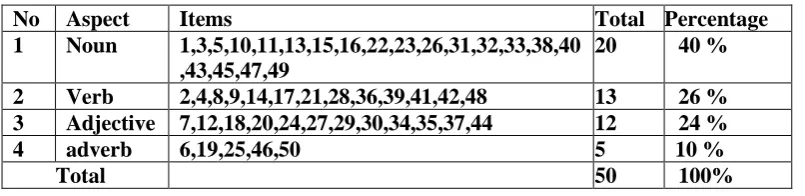
Post test of vocabulary used a complete text. The researcher omitted 50 words
in the text and listed the omitted words under the text randomly. The omitted words are the content words that is noun, verb, adjective and adverb. There
were two kind of text in this test, Hortatory Exposition and Narrative text. Each text had 25 omition words to be completed by the students. The researcher chose these texts because it based on the teaching material that had
been given in the treatment. Then, the researcher gave the direction in the test to find the suitable word to complete the texts.
Table 2. Table of Specification of Post test
No Aspect Items Total Percentage
1 Noun 1,3,5,10,11,13,15,16,22,23,26,31,32,33,38,40 ,43,45,47,49
20 40 %
2 Verb 2,4,8,9,14,17,21,28,36,39,41,42,48 13 26 %
3 Adjective 7,12,18,20,24,27,29,30,34,35,37,44 12 24 %
4 adverb 6,19,25,46,50 5 10 %
Total 50 100%
3.4. Data Collecting Technique
For collecting the data, the researcher gave pre-test and post test of
[image:4.595.107.510.544.642.2]researcher scored the test so that the data was in form of interval data. After conducting pre-test and post test, the researcher compared the result to find out the students’ achievement in learning vocabulary and to analyze whether clustering
technique or derivational exercises which gave a better improvement. Further explanation about pre-test and post test of vocabulary is given as follows:
a. Pre-test
The pre-test of vocabulary was intended to investigate that the two samples of the research are equal in vocabulary achievement. The material was based on
the curriculum for the second grade of senior high school students in the second semester. The researcher made 25 incomplete sentences. The words
omit was included in the content word that is noun, verb, adjective, and adverb. Time allocation is 45 minutes. The researcher gave this test in the first meeting before the students were given a treatment. The researcher gave this test on
Monday February, 10th 2014. b. Post test
Post test was done after the researcher gave a treatment in form of teaching
activity. The post test was intended to know whether the students’ vocabulary achievement improved or not and how far the improvement was. This test used
3.5. Validity and reliability
In order to get the data which was needed by the research, the researcher tried to use an appropriate instrument to measure the result of the reaserch. The good research was a research which the instrument is based on validity and reliability.
The researcher conducted try out of the test in order to know the validity and reliability of the instrument. So, the researcher used the same test item for pre test
to be tried out before it is used to test the subject. This test consist of 25 items in form of written vocabulary test by completing the sentences with an appropriate
word. Try out of the test was conducted to the population of the research. Here, the researcher gave a brief explanation about validity and reliability.
a. Validity
Heaton (1991) states that validity of the test is the extent to which it measures
what it is supposed to be measure. It meant that the test should measure every items that included in one aspect that would be measured. So, when we were going to conduct the test, we should know or identify what kind of aspect or
content included in the topic of the subject for the test itself. Furthermore, to know whether the test has a good validity, the researcher looks from the content and
construct validity. - Content validity
Based on Hatch and Farhady (1982) content validity is the extend to
which the test measures a representative sample of the subject matter content. The focus of the content validity is adequacy of the sample and not simply on
teaching material in order to fulfill the requirement of content validity. Meanwhile, the researcher constructed the test in line with the material which was given when the researcher conducted the treatments. The researcher
omitted a number of words based on their word classes by looking at the word frequency level. So, the number of every word class was omitted based
on the frequency of its appearance in the text.
The number of the words omitted for each word class in the instrumen was decided as follows.
Wo = x Two
Wo = word which was omitted for each word class
Wc = total number of word in the same class in the text
Wt = total number of word in the text
Two = total word which was omitted in the test
- Construct validity
Fries (1973) as cited in Arbainaya (2012) classified English vocabulary or word into content word, function word, subtitute word, and distributed
word. The content word is divided into noun, verb, adjective and adverb. Based on the theory above, the researcher wanted to measure students’
achevement in learning vocabulary using written test of vocabulary. In this
Validity for the test can be identified by using this formula:
r = √
r = coefficient of point biserial correlation Mp = the average score of each items
Mt = the average score from the total score
Sdt = standard deviation of the total score
p = a number of students with correct answer
q = a number of students with wrong answer
Both content and construct validity had been tested using inter rater validity by asking seven students of English Education Study Program. Most
of them stated that the tests were acceptable to measure students vocabulary achievement.
b. Reliability
Reliability is consistency of the test. Heaton (1991) stated that reliability
denotes the extend to which the same marks or grades are awarded if the same test papers are marked by (i) two or more different examiners or (ii) the same
examiner on different occasions. In short, in order to be reliable a test must be consistent in its measurement.
Reliability for the whole test can be found by using this formula.
) )
Where N = the number of items in the test
x = the standard deviation of all the testees’ scores
r = reliability (Heaton:1991)
The criteria of reliability:
High : 0,90 – 1,00 Moderate : 0,50 – 0,89
Low : 0,00 – 0,49
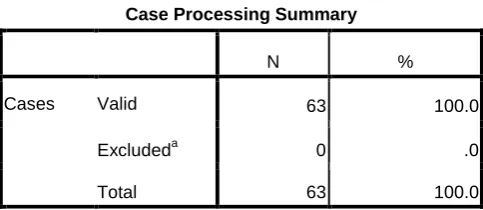
After analyzing the result of pre-test and post test of vocabulary from both classes using SPSS 16.0, the researcher found that cronbach’s alfa of the test was
[image:9.595.113.355.475.580.2]0.457. It meant the reliability of the test was still low. This was the table of the analysis.
Table 3. Reliability of the test
Case Processing Summary
N %
Cases Valid 63 100.0
Excludeda 0 .0
Total 63 100.0
a. Listwise deletion based on all variables in the procedure.
Reliability Statistics
Cronbach's
Alpha N of Items
3.6. Procedure
The procedure of this research was explained as follow:
1. Constructing instrument for pre-test and post test and materials for teaching. 2. Selecting the population and samples of the research. The population used in
this research were the students in the second grade of SMAN 1 Kalirejo and the sample were class XI IPS 1 and class XI IPS 2.
3. Trying out the instrument (test of vocabulary), the try out test was done in class XI IPS 3.
4. Giving a pre-test for students in order to identify the level of vocabulary achievement.
5. Conducting a treatment. The reasercher taught vocabulary for the subject of
the research using these two technique. One class used clustering technique and one another used derivational exercises.
6. After giving a treatment, the students were given a post test to identify
whether the techniques give an improvement for students’ vocabulary achievement.
7. The last, after getting all the data, the researcher analyzed the data by using SPSS to know the result.
3.7. Data Treatment
After collecting the data, the researcher analyzed the data by using Independent Group T-Test in SPSS (Statistical Program for Social Science). The
vocabulary to find out the result of the students’ vocabulary achievement. The result of the test was in form of score or interval data. After getting the result the researcher analyzed how far the improvement of students’ vocabulary
achievement after given a treatment and which one is better between clustering techniques and derivational exercises for teaching vocabulary.
Therefore, the writer used homogeinity and normality test to treat the data
taken from result of pretest. The results of the treatment were as follows. A. Homogeinity test
The homogeinity test was used to know whether the data in both experimental classes were homogenous or not. The data which were analyzed were the score from pre-test. From the result of the analysis, the data were not
homogenous based on the criteria for the hypothesis if p>α by using level of significant 0.05. In this test level of significancy of the test was 0.003.
B. Normality test
Normality test was used to know whether the data in both experimental classes were normally distributed or not. Based on the analysis using SPSS
16.0 the data showed that there were distributed normally. In this research, the criteria for the hypothesis are H1 is accepted if p>α by using level of
significant 0.05.
3.8. Hypothesis Testing
vocabulary achievement and which technique gave better improvement for the students vocabulary achievement.
The hypothesis were as follow:
H0 : There is no significant difference between the students’ vocabulary
achievement taught through clustering technique and derivational exercises.
H1 : There is significant difference between the students’ vocabulary
achievement taught through clustering technique and derivational
exercises.
After all the data had been collected, the writer used statistical analysis using Independent Group T-Test to test the hypothesis. Based on the result of the analysis, the data showed that both technique gave an improvement in students’