274
Chapter 37
Fish Condition Factor as Bioindicator of Water Quality on Mangrove Ecosystems
at Labuhan Maringgai, Indonesia.
Tugiyono1,a, Jani Master1,b
1
Department of Biology Faculty of Mathematics and Natural Sciences University of Lampung [email protected] ,
Abstract. This paper discuss on the use of fish Condition Factor (CF) as a bioindicator of water quality level in
mangrove ecosystems at Labuhan Maringgai, Indonesia. The results shows that fish CF, in the research site, are mostly higher than one. The following are the value for each fish species: Mystus nigriceps (1,23), Eleutheronema tetradactylus (0,93), Valamugil seheli (1,09), Mallotus villosus (1,61), Paraplagusia blochi (0,56), Lutjanus Griseus (2,22), Epinephelus fuscoguttatus (1,74), Lutjanus campechanus (1,74), Argyrops Bleekeri (3,07), Macrones microchus (1,19), Arius sagor (1,03), Lates calcarife (1,23), Plotusus canius (0,52). Regarding to the measured CF, it is known that the water quality at the concerned mangrove ecosystem is suitable for fish survival (fish CF > 1). Measured water quality at the concerned site was considered as mild to moderately polluted, proved by Pollution Index values of 1.84 to 8.34. Nitrate and turbidity, in particular, were failed to meet the water quality standard.
Keywords: Condition factor, Labuhan Maringgai, Mangrove ecosystems, Pollution index
I.
Introduction
Lampung Mangrove Center consist of 700 Ha of mangrove forest located in the village of Margasari, Labuhan Maringgai which is part of East Lampung Regency. The Mangrove Center was established based on the regent letter No. 660/305/04/SK/2005/1546/J.26 /KL/2005 on May 10, 2005.Mangrove forest is a type of forest located in areas influenced by the tidal fluctuation (coastal and estuaries). Plant species that grow in the forest are mostly tolerant to high salinity level. In addition, mangrove ecosystem is a system consisting of organisms (plants and animals) that interact each other as well as with their habitat environmental factors [1,2].
It has been well known that there are two principal functions of mangrove ecosystems, namely the ecological function and economical function.Based on ecologically perspective, mangrove ecosystem play their role as the following a) a source of organic material for aquatic ecosystem, b) food source for marine organisms, c) habitat of marine organisms, d) spawning and nursing ground for marine organisms and e) protect land from abrasion. Mean while in term of economical point of view, mangrove forests provide a) source of building materials, b) firewood, c) raw materials of paper, d) food, medicine and textile, b) tourism spot [2,3].
275
Mollusks which are often found on the stem or roots of the mangroves is snails (Littorinidae) and oysters (Bivalvia) which are mostly lived in the rooting side of mangroves. It is well known that shrimp and particularly crab are very abundant on the mangrove ecosystem, they live with how to make a hole in the soft substrates, such as mangrove crabs (Scylla, sp), crab (Uca sp), small crab attaching (Portunus sp), soldier crabs (Muctiris sp), stone crabs (Grapsus sp) and various ghost crabs (Dotia, Cleistostoma). They life by eating any kinds of detritus from both the sea and land. They are also supports their life in the ecosystem by filtering both plankton and zooplankton. The mangrove area is suitable location for nursery grounds, feeding grounds, and spawninggrounds of most shrimp and also for saltwater fish particularly mullet, before their lives and migrate to the deep sea [3,4,5].
Condition Factor (CF)
Condition Factor is the Fulton’s formula [weight/length3] x100, which is widely used to determine the nutritional state of fish and it is also used to evaluate the fattiness of fish [6]. The CF can also be used as an indicator of health status or fitness level of particular fish [7]. The CF can also be used as an indicator for monitoring the nutrition and health status of concerned fish populations during a long period of exposure time [8]. The value of CF is influenced by age, gender, season, maturity level of the gonads, the fulfillment of the gastric contents, type of consumed food, and development level of the fish muscles. On particular type of fish, the weight of its gonad is more than 15% of its total weight. In case of female fish, CF value will dramatically decrease after their eggs has been released from their ovaries [9].
Pollution Index (PI)
Quality of water is commonly determined by using the pollution index (IP). Pollution index used to determine contaminants compare to the standard of water quality parameters.The pollution index is however only can be measured for specified sites, which then be used to interpret for wider area of water. The method will be able to be directly connected to the water quality standard both based on concerned parameter and particular water usage [10].
II.
Research Methods
Time and place
This research was conducted during period of June-July 2015. The research was performed in the Mangrove Centrelocated atMargasari, East Lampung Regency, Lampung, Indonesia.
Research Approach
1) Diversity And Status Of Fish Condition
276
The water quality parameters which were analyzed include: turbidity, total suspended solid (TSS), total dissolved solid (TDS), temperature, salinity, nitrates, nitrites, sulfides, ammonia, phosphate, sulfate, chemical oxygen demands (COD), biological oxygen demands (BOD), and dissolved oxygen (DO).2) Determination Of Condition Factor
Analysis was conducted to define the status of the fish condition. The method was determined based on the value of the Condition Factor (CF), derived from the Fulton’s formula, [gram/(centimeters)3] x 100 [6].
3) Determination of the level of quality of waters with pollution index (PI).
C / L
2
C / L
2PI M R
2 (1)
L = the concentration of raw water quality
C= the concentrations of measured parameters in situ M = maximum
R = average
Evaluation of the value of the PI is :
0≤PI≤1.0: meet the raw quality (good condition) 1.0 ≤PI≤5.0: light polluted,
5.0 ≤PI≤10 : moderately polluted PI >10:heavily polluted [10].
III.
Results and Discussions
A.
Diversity Index
Based on the sampling results, it was obtained 15 fish species with diversity index of 2.35. The diversity index 2.35 can be considered that the fish diversity in the concerned mangrove forest ecosystems is in a good category [11]. The fish species which was encountered most frequently (dominant) is Mystus nigriceps. The reason could be due to the fact that the main food of the species is a small shrimp which can be easily found in the area of study.
B.
Fish Condition Status
277
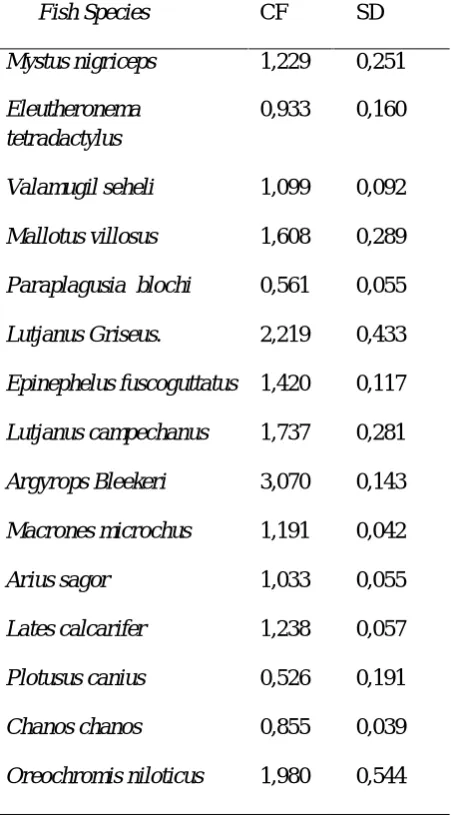
Table 2. Value of Fish Condition FactorFish Species CF SD
Mystus nigriceps 1,229 0,251
Eleutheronema tetradactylus
0,933 0,160
Valamugil seheli 1,099 0,092
Mallotus villosus 1,608 0,289
Paraplagusia blochi 0,561 0,055
Lutjanus Griseus. 2,219 0,433
Epinephelus fuscoguttatus 1,420 0,117
Lutjanus campechanus 1,737 0,281
Argyrops Bleekeri 3,070 0,143
Macrones microchus 1,191 0,042
Arius sagor 1,033 0,055
Lates calcarifer 1,238 0,057
Plotusus canius 0,526 0,191
Chanos chanos 0,855 0,039
Oreochromis niloticus 1,980 0,544
Results of the study shows thatmost fish (10 species) has a value of CF more than one. While the rest three fish species has value of CF less than one, this is most probably due to the fish shape, which is more cylindrical compare to the other species. In particular, [6] mentioned that CF based on Fulton’s formula was not suitable for the cylindrical–shaped fish. As a comparison, it was also carried out the CF calculations for cultivated, in ponds, fish (Chanos chanos and Oreochromis niloticus) with the value of CF are 1.98 and 0.85 respectively. The value was then used as an evaluation indicator of health and fitness conditions of fish [7]. Fish could be considered in a healthy condition if there are enough food and fish seem fatter/fleshy, so fish tends to be heavier compare to its visual length. Fish in those conditions will have a value of CF higher than one. On the other hands, fish that consume less food, skinny, and slender fish has a value of condition factor of less than one [12]. The CF value affected by many factors such as the condition of the organism itself, environmental conditions, the number of organisms, as well as the availability of food. The better condition of the environment, the higher factor conditions will be [13]. As stated by [14] waters within mangrove ecosystems can provide a natural system in maintaining fishery productivity.
278
C.
Pollution Index (PI)
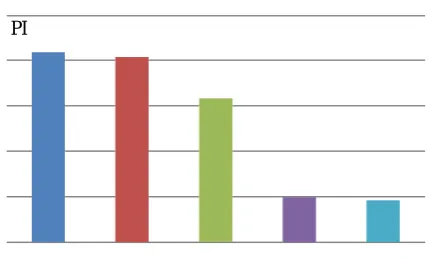
The calculation results of the pollution index can be found in Fig. 1.
[image:5.595.196.411.106.235.2]PI
Fig. 1. Value of Pollution Index (PI)
The water quality within mangrove ecosystems at the research site was considered to be, based on the PI values, a light polluted to moderately polluted. The criteria is based on the marine life quality standard according to [17]. The water quality parameters that exceed the standard are nitrates and turbidity. Nitrate, as an indicator of fertility levels, could be sourced from the decomposition of organic materials such as domestic waste, detritus of mangrove plants and other water plants [18].
IV.
Conclusions
Mangrove forest ecosystem at the village of Margasari Village is strongly support the life of the fish populations in the area. Fish populations, based on the value of diversity index, is considered in a good condition (H=2.35).The condition status of the fish at the concerned site was mostly in a healthy condition and fleshy (CF > 1). In addition to that, Water quality conditions at the concerned site was considered in the high fertility rate and plenty of natural food available for the fish population.
V.
Acknowledgement
279
References
[1]. Anonymus, Profile Of Lampung Mangrove Center. The Team Of Lampung. Mangrove Lampung Team Center. Research Institutions University Of Lampung. Bandar Lampung Indonesia, 2010, pp. 1-19, (Indonesian),
[2]. A. Kustanti, Mangrove Forest Rehabilitation Masterplan of Coastal East Lampung, University of Lampung, Bandar Lampung, 2008, pp. 1-10, (Indonesian).
[3]. D.G. Bergen, Ecosystems and Natural Resources of coastal and Ocean Management as well as Principle (Synopsis). The Center Studies Coastal and Ocean Resources, Bogor Agricultural University 2002, pp. 16-25, (Indonesian),
[4]. A. Nontji, Sea Archipelago. CV. Jambatan, Jakarta, 2005, pp. 12-25, (Indonesian).
[5]. Tugiyono, 2010.“Fertility evaluation of ecosystems of the Coastal Waters in the village of Sriminosari sub-district of Labuhan Maringai Regency of East Lampung Province of Lampung”.Proceedings of the National conference of Limnology 5 th, ISBN 987-979-8163-14-2, 2010, pp. 23-28, (Indonesian). [6]. Z. Lucky, Methods for the diagnosis of fish diseases. Amerind Publishing Co. Put. Ltd. New Delhi,
1977, pp.10-21.
[7]. C.B. Estudillo, M.N. Duray, E.T. Marasigan, A.C. Emata, 2000. Salinity tolerance of larvae of the mangrove red snapper (Lutjanus argenthimaculatus) during ontogeny. Aquaculture 190, 155-167. [8]. M.T. Hoque, F.M.Yusoff, A.T. Law, M.A. Syed, 1998. Effect of hydrogen sulphide on liver somatic
index and Fulton’s Condition Factor in Mystus nemurus. Journal of Fish Biology 52, 23-30
[9]. PSM. C.Barnham, A. Baxter,. Condition Factor, K, for Salmonid Fish. Department Primary Industri. State of Victoria, ISSN: 1440-2254, 2003, pp.1-5.
[10]. Anonymus, The Decision of the Minister of State for the Environment no. 115 in 2003, about the Determination of the Status of Water Quality Guidelines, Jakarta Indonesia, 2003, pp.1-15, (Indonesian).
[11]. Samingan Tjahjono, Procedure for prediction and assessment of impacts on vegetation. A collection of national conference papers: Forecasting methodology in the analysis of impacts on environmental Assesment. PPLH cooperation PPLH-LP, IPB with BK-PSL and BAPEDAL, Bogor, 1992, pp.1-12, (Indonesian),
[12]. H. Richter, C. Luckstadt, U.L. Fockeu, K.Becker, 2000. An Improved Procedure to assess fish condition on the basis of length-weight relationships. Arch.Fish.Res. 48 (3):226-235.
[13]. M.I. Effendie,. Fisheries Biology Methods. Foundation Of Dewi Sri. 199, pp. 15-23, (Indonesian). [14]. I. Nagelkerken, S.J.M. Blaber, S. Bouillon, P. Green, M. Haywood, L.G. Kirton, J.O. Meynecke, J.
Pawlik, H.M. Penrose, A. Sasekumar, and P.J. Somerfield, 2008. The habitat function of mangroves for terrestrial and marine fauna. Aquatic Botany 89: 155–185.
[15]. A. Nehemiah, J.D. Maganira, C. Rumisha, 2012. Length-Weight relationship and Condition Factor of Tilapia species grown in marine and fresh water pond. Agric. Biol. J. N. Am., 2012, 3(3): 117-124. [16]. Tugiyono, N. Cahyani, R. Supriyanto, dan S. Hadi 2011. Biomonitoring of Effects Following Exposure
of Fish to Sugar Refinery Effluen. Modern Applied Science 5:39-45.
[17]. Anonymus, The Decision of the Minister of State for the Environment no. 51 in 2004, about Standard of sea water Quality, Jakarta Indonesia 2004, pp. 1-10, (Indonesian).