Journal of Criminal Law and Criminology
Volume 66 | Issue 1
Article 7
1975
Skyjacking Crime Control Models
W. William Minor
Follow this and additional works at:
https://scholarlycommons.law.northwestern.edu/jclc
Part of the
Criminal Law Commons
,
Criminology Commons
, and the
Criminology and Criminal
Justice Commons
This Criminal Law is brought to you for free and open access by Northwestern University School of Law Scholarly Commons. It has been accepted for inclusion in Journal of Criminal Law and Criminology by an authorized editor of Northwestern University School of Law Scholarly Commons.
Recommended Citation
SKYJACKING CRIME CONTROL MODELS
W. WILLIAM MINOR*
A model of crime control is an abstraction which may be inferred from specific crime con-trol policies. Consideration of the models im-plicit in specific policies permits the social sci-entist to evaluate the broader implications of various crime control strategies. It further per-mits policy-makers to detect and eliminate con-tradictory aspects of their policies, thereby maximizing effectiveness in terms of stated objectives.
Historically, the two dominant approaches to crime control have been the deterrence model and the positivistic rehabilitation model. More recently, a prevention' model has emerged as an alternative control system for some forms of crime.
There are three major issues which a crime control model must address: effectiveness, fiscal cost and social costs. By these criteria, neither the deterrence model nor the rehabilita-tion model has been very successful.
Deterrence appears to be effective only for instrumental offenses committed by those with a high stake in conformity. Two examples are parking violations and "snitch" shoplifting.2 Fiscally, a deterrence model would require a massive machinery to ensure swiftness, sever-ity and certainty of punishment for all offenders.3 Due to the enormous social costs
* PhD Candidate, School of Criminology, Florida State University.
The author wishes to thank the Federal Aviation Administration for the provision of skyjacking data and other information used in this article.
I As used herein, "prevention" refers to the elimination of the opportunity for crime through modification of the environment in which crime oc-curs. See generally C. R. JEFFERY, CRIME PREVEN-TION THROUGH ENVIRONMENTAL DESIGN (1971).
2 M. CAMERON, THE BOOSTER AND THE SNITCH (1964); W. CHAMBLISS, CRIME & THE LEGAL PROCESS 365-72 (1969); E. ZIMRING & G. HAWKINS, DETERRENCE (1973); Chambliss, The Deterrent Influence of Punishment, 12 CRIME & DELINQUENCY 70 (1966). See also Tittle & Logan, Sanctions and Deviance: Evidence and Remaining
Queszons, 7 LAW & SOcIETY Rxv. 371 (1973). 3 Jeffery estimates that a ninety-fold increase of the entire criminal justice system would be
neces-involved,4 such a machinery would probably be impracticable in a democratic society.
As correctional statistics routinely indicate, the rehabilitation model has also been ineffec-tive for crime control. Further, the rehabilita-tion model is a reactive system, incapable of being employed until after the crime occurs.5 Although the fiscal cost of a rehabilitation model is enormous,6 attention is now being increasingly focused on the social costs of re-habilitative systems. Involuntary commitment, denial of due process, stigmatization, indeter-minate commitment and lack of effective treat-ment are problems which have tarnished the rehabilitative ideal.
The prevention model discussed in this paper is one of "mechanical" or "primary" tion. As Lejins notes, in this form of preven-tion model, obstacles are placed in the way of the potential offender so that it becomes diffi-cult or impossible for him to commit an of-fense. This preventive action does not involve the personality of the individual since there is no attempt to influence his intentions by
sary. Jeffery, Environmental Design and the Pre-vention of Behavioral Disorders and Criminality, (paper presented at the Centre of Criminology, University of Toronto, January 25, 1973).
4 A fully-applied deterrence model would require nullification of customary procedural safeguards, such as the freedom from unwarranted search and seizure, or the right to trial. For a description of the use of such a deterrence model during emer-gency conditions, see H. SALISBURY, THE 900 DAYS
516-19 (1969). Even a limited deterrence model, however, raises certain ethical issues, such as the application of exemplary penalties. Andenaes, The General Preventive Effects of Punishment, 114 U. PA. L. REv. 949 (1966).
s C. R. JEFFERY, CRIME PREVENTION THROUGH ENVIRONMENTAL DESIGN 18-20 (1971).
6 REPORT OF THE PRESIDENT'S COMMISSION ON LAW ENFORCEMENT AND ADMINISTRATION OF
JUJS-TICE, TASK FORCE REPORT: CRIME AND ITS IMPACT -AN ASSESSMENT 53-56 (1967).
7See
generally F. ALLEN, THE BORDERLAND O'SKYJACKING
threatening punishment or by changing his "motivation. As a result, the term mechanical -prevention is suggested8
There is little support for such a prevention 'model. Decker found that installation of park-ing meters which rejected slugs and displayed the last coin deposited in a coin view window reduced the rate of slug usage more effectively than labels warning of severe legal penalties.9 NIewman found that certain types of architec-tural design were related to crime rates in public housing developments.1 0 Jeffery argues that:
Current emphasis is placed on indirect con-trols on the individual criminal after the offense has occurred. The model to be devel-oped and supported in this book is one of di-rect controls over environmental conditions be-fore the offense has occurred. It is economically less expensive to design an envi-ronment in which crimes are not possible than to rehabilitate all who have the opportunity to commit crimes.1
Jeffery's faith, however, rests more on the -demonstrated failures of the deterrence and re-habilitation models than on the demonstrated success of a prevention model.
Because the prevention model has rarely been applied, systematic analysis of its effec-tiveness, fiscal cost and social costs has not previously been available.12 Consequently, it is
8 Lejins, The Field of Prevention, in
DELIN-QUENCY PREVENTION 5 (W. Amos & C. Wellford
eds. 1967). Brantingham describes primary preven-tion as the eliminapreven-tion of the opportunity for crime through modification of the environment in which crime occurs, as opposed to the identifica-tion and treatment of predelinquents (secondary prevention) or the prevention of recidivism by convicted offenders (tertiary prevention). Bran-tingham, Spatial Analysis of Crime and Primary Prevention (paper presented at Regional Confer-•ence for Criminal Justice Planning Personnel, Tallahassee, Florida, September 18, 1973).
0 Decker, Curbside Deterrence?, 10
CRImiNOL-.oGY 127 (1972).
10 0. NEWMAN, DEFENSIBLE SPACE (1972). See .also Jeffery, Environmental Design and the Pre-vention of Behaviorial Disorders and Criminality (paper presented at the Centre of Criminology, University of Toronto, January 25, 1973).
11 C. R. JEF7ERY, CRIME PREVENTION THROUGH
ENVIRONMENTAL DESIGN 20 (1971) (italics in original).
12 Newman, for example, does not explicitly dis-cuss the fiscal and social costs of defensible space design. NEWMAN, supra note 10.
necessary to consider the history of a particu-lar crime and efforts to control it in the United States. It is the contention of this arti-cle that the history of skyjacking control ef-forts represents a movement from a deterrence model to a prevention model. This movement permits a case-history analysis of the effective-ness, fiscal cost and social costs of preventive
crime control.
SKYJACKING IN THE UNITED STATES
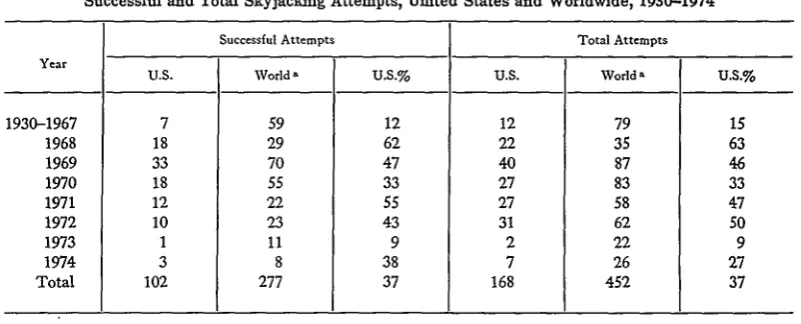
As indicated in Table 1, about 40 per cent of all skyjackings and skyjacking attempts have involved United States aircraft (37 per cent of successes and of attempts for 1930-1974,'44 per cent of successes and 43 per cent of attempts for 1968-1974). In the United States, 102 (61 per cent) of the 168 attempts have been success-ful.3 The history of skyjackings in the United States may be divided into three phases, accord-ing to the dominant motives of the skyjackers: escape, political terrorism and extortion.1 4
The apparent motive of most American skyjackings has been escape to Cuba. 86 of the 102 successful skyjackings have terminated there. Prior to 1961, the United States' only experience with skyjacking was the receiving, welcoming and granting of political asylum to refugees fleeing Castro's Cuba.'5 Thus, when the first American airliner was diverted to Cuba in May, 1961, the United States was caught in a politically embarassing situation. That plane was held by the Cuban government for almost a month before it was exchanged for a Cuban naval vessel moored in Key West. American skyjackers considered Cuba a haven for the next decade, even though their reception there was uncertain: Some were welcomed as friends of the Cuban people; some were returned to the United States; and some were imprisoned in
13 Unless otherwise cited, all data on hijacking are derived from Fmxw.L AVIATION ADMINumsRA-TIoN, CIVIL AVIATION SEcURITY SERVICE, WORID-WIDE REPORTED HIJACKING ATTEMPTs-SuMmARI-ZATION, (Jan. 1, 1975) [hereinafter cited as
HIJACK-ING ATTEMPTS].
14 Cf. Sundberg, Political Hijacking, in PoLITIcs, CRIME AND THE INTERNATIONAL SCENE 108 (F. Adler & G. Mueller eds. 1972);. R. TURI, C.
F Z , R. SHELDON & J. MATTHEws, DESCRIPTIVE STUDY oF AIRCRAFT HIJACKING 143 (1972).
15 R. TURI, supra note 14, at 143.
TABLE 1
Successful and Total Skyjacking Attempts, United States and Worldwide, 1930-1974
Successful Attempts Total Attempts Year
U.S. World U.S.% U.S. World U.S.%
1930-1967 7 59 12 12 79 15
1968 18 29 62 22 35 63
1969 33 70 47 40 87 46
1970 18 55 33 27 83 33
1971 12 22 55 27 58 47
1972 10 23 43 31 62 50
1973 1 11 9 2 22 9
1974 3 8 38 7 26 27
Total 102 277 37 168 452 37
SOURCE: FEDERAL AVIATION ADMINISTRATION, CIVIL AVIATION SECURITY SERVICE, "WORLDWIDE REPORTED HIJACKING ATTEm'ss-SuMMARIZATION," (January 1, 1975).
1 Including United States.
Cuba.6 Six of the seven successful skyjackings
(of twelve attempts) in the United States
be-tween 1961 and 1967 terminated in Cuba. Skyjackings increased dramatically in 1968, when 18 of 22 attempts were successful in reaching Cuba.
In 1969, skyjackings to Cuba continued, but in that year the United States was introduced to skyjacking as a form of political terrorism.1 7 On August 29, 1969, two members of the Popular Front for the Liberation of Palestine (PFLP) hijacked an American air-liner, flew it to Damascus, and, after releasing the passengers and crew, destroyed the air-craft. The PFLP conducted several other ter-rorist skyjackings against Israel, the United States and other pro-Israeli states in 1969 and 1970. The culminating action was Operation Abu Thalaat, which resulted in the destruction of four jetliners in September, 1970. It enabled
16 U.S. NEws & W. REP., Dec. 4, 1972, at 44;
J. AREY, THE Sxy PIRATs 49-74 (1972).
17 The distinction between terror and terrorism must be noted. Although any skyjacking may
evoke terror (a state of extreme fearfulness), the
concept of terrorism implies the systematic use of violence by an organized party or group in order
to achieve its goals. Hardman, Terrorisrn, 14
EN-CYCLOPEDIA OF THE SOCIAL SCIENCES 575 (E.
Se-ligman ed. 1937). See also Hutchinson, The Con-cept of Revolutionary Terrorism, 16 J. CONFLICT RESOLUTION 383 (1972). For a fuller discussion of terrorist skyjackings see Sundberg, supra note 14.
the PFLP to exchange hostages for prisoners captured during earlier operations, but the ac-tion also incensed world opinion and led to the subsequent crushing of the PFLP by the Royal
Jordanian Army.'5
The extortion phase of skyjacking began on November 24, 1971, when D.B. Cooper ex-torted $200,000 from Northwestern Airlines and parachuted into the forest near Woodland, Washington. 9 Since Cooper's successful and famous extortion skyjacking, there have been
twenty-one other extortion attempts in the
United States, including several attempts to
duplicate Cooper's act. None, however, have been ultimately successful.2 0
1s Sundberg, supra note 14, at 116.
19 Sagarin identifies Cooper as an "anti-hero."
Sagarin, New Offenses: New
Offenders-Intro-duction, in POLITICS, CRmME AND THE INTERNA-TIONAL SCENE 9 (F. Adler & G. Mueller eds.
1972).
20 In three of the twenty-one attempts, the
sky-jackers reached their destination, but were either
placed in custody there or had the extorted funds confiscated and returned. Only Cooper is presumed
free with the money he extorted. Air Transport Association, Hijacking/Extortion Attempts: A Study of Futility (mimeographed,
[image:4.454.25.426.64.226.2]SKYJACKING
SKYJACKING CONTROL EFFORTS2 1
Efforts to control skyjacking may be best un-derstood as representative of underlying crime -control models. Viewed in this sense, the history ,of skyjacking control efforts demonstrates a progression from a deterrence model to a pre-vention model of crime control. (Because of the -crime's unique combination of characteristics, a rehabilitation model has never been seriously proposed as a solution to the problem of sky-jacking. The underlying reasons have been that skyjacking requires little technical skill; occurs with low frequency; is highly visible; may be very costly; arouses great fear; and is non-repetitive.2 2)
Demands for government action to control skyjacking occurred immediately after the first American hijacking in 1961. Public reaction included demands for military action against Cuba, United Nations' intervention and a man-datory death penalty for skyjackers. On Sep-tember 5, 1961, a federal anti-hijacking bill was enacted, providing for a minimum twenty year sentence and a maximum punishment of death for convicted skyjackers.22 The Federal Avia-tion AdministraAvia-tion (FAA) authorized air-lines to arm flight crews, but the airair-lines de-clined on the basis that inflight gun battles would be more dangerous than complying with the demands of hijackers. The Air Lines Pi-lots Association (ALPA) urged pre-flight pas-senger searches, and three airlines requested permission from the Civil Aeronautics Board (CAB) to deny passage to anyone refusing to be searched for weapons. The search proposal was not employed by the airlines, however, for fear of offending passengers.
In 1963, the United States and sixty other nations participated in the International Con-ference on Air Law in Tokyo, Japan. The con-ference was held under the auspices of the In-ternational Civil Aviation Organization .(ICAO), an agency of the United Nations. At the conclusion of the conference, the United States and fifteen other nations initialed the
21 Specific citations to the material used in this section may be obtained from the author.
22 The only known repeat hijacker is Leila Khaled, a PFLP leader, who hijacked aircraft on August 28, 1969 and September 6, 1970. DoMESTIC AND FOREIGN AIRc AFr HIJACUNGS, supra note
20.
23 49 U.S.C. § 1472.
"Convention on Offenses and Certain Other
Acts Committed on Board Aircraft." This
con-vention recognized "unlawful seizure of
air-craft" as an offense, provided for restoration
of property and permitted-but did not
man-date-extradition or punishment of hijackers
by contracting states. The United States did
not formally ratify the convention until 1969,
following the dramatic upsurge in the number
of American skyjackings in 1968 and 1969.
In 1964, the FAA ordered cockpit doors
locked during flight as a preventive measure
against skyjackings. Because a hijacker could
still threaten stewardesses and passengers, this
was not a very effective measure and it was
partially rescinded sixteen months after taking effect. Nevertheless, it should be noted that
this was the first measure enacted on the basis
of prevention rather than deterrence.
In July, 1968, the United States State
De-partment offered free rides from Miami to
Cuba for Cuban exiles wishing to return. The
hope was that this action would remove the
motivation for skyjackings by Cubans wishing
to return to their homes.
In addition, more direct preventive efforts
received serious consideration. The Air
Trans-port Association (ATA) initiated a study of a
magnetometer developed by Lockheed, while House Republicans prepared legislation to
re-quire bullet-proofing of all pilot cabins.
24By
early 1969, the FAA was considering measures
for the detection of potential hijackers before
an actual skyjacking could be attempted.
Indirect approaches were also pursued,
how-ever. Air service boycotts of countries refusing
to extradite hijackers were proposed;
coopera-tion between the United States and Cuba was
encouraged
;25and the need for an
interna-tional treaty was stressed. In March, 1969, the
International Federation of Air Line Pilots Associations (IFALPA) threatened a pilots' strike unless governments took action to extra-dite or prosecute skyjackers. In September,
2 N.Y. Times, Dec. 1, 1968, at 33, col. 1. This
legislation was not enacted, presumably because
the threat to passengers and stewardesses would
not have been affected.
25 As
a result, on February 15, 1973, the United
States and Cuba signed a treaty providing for
punishment or extradition of hijackers. N.Y.
Times, Feb. 16, 1973, at 1, col. 5.
1969, the United States and other nations fin-ally ratified the 1963 Tokyo Convention and sought to update extradition treaties. All of these actions were based on the assumption that successful prosecution of skyjackers would deter future attempts.
Nevertheless, the movement toward a pre-ventionf model had begun. In February, 1969, at the peak of the skyjacking phenomenon, the FAA authorized physical searches of passen-gers to be conducted at the airlines' discretion. Between October, 1969 and January, 1970, three major airlines initiated use of a system devel-oped by the FAA. This system utilized an elec-trical Wveapon-detection device directed at passengers who fit the "behavioral profile" of past skyjackers. The initial flurry of optimism which greeted this system faded in February, 1970, however, when an Eastern Air Line plane was hijacked at Newark airport while the pro-file/magnetometer system was in use. Subse-quently, the FAA admitted that their profile/ magnetometer system was "primarily a deter-rent." 26
Another change in policy toward skyjackers began in 1970. Previously, airlines had fully cooperated with skyjackers, on the theory that cooperation posed less of a threat to passengers and crew than active opposition would. But, on July 4, 1970, Trans World Airlines officials be-came convinced that hijacker Arthur Barkley was a suicidal and irrational saboteur, and or-dered that the plane be refused permission to take off after refueling. In an unclear sequence of events, passengers spontaneously deplaned through emergency exits, the FBI shot out the plane's tires, and FBI agents rushed and cap-tured Barkley.
The PFLP's ,Operation Abu Thalaat in Sep-tember, 1970 escalated both national and inter-national efforts to control skyjacking. Although armed guards had quietly been em-ployed on selected flights since 1962, a highly-publicized force of permanent "Sky Marshalls" was now created, and Congress was asked to provide $28 million to fund the program. In-ternationally, The Hague Convention for the Suppression of Unlawful Seizure of Aircraft was held in December, 1970. Neglecting the escape cases which comprised the majority of
26 AIR LINE PILOT,
May, 1970, at 18.
skyjackings, The Hague Convention was almost exclusively concerned -with the recent PFLP terrorism. The convention mandated prosecu-tion or extradiprosecu-tion of all hijackers, even for those fleeing political persecution.
In 1971, the use of weapons detectors ex-panded and 75 per cent of the 1200-man Sky Marshall force was shifted to ground duty. Additional efforts were made to make a public gesture of strict treatment of skyjackers. For example, FAA Administrator Shaffer urged courts to impose the death penalty on con-victed skyjackers, and a twenty-four hour worldwide pilot strike was held to protest the lack of international cooperation. Then, in July, 1972, the FAA instructed airlines to modify their operating manuals to require airport offi-cials and airline crews to disarm or overpower hijackers whenever possible.
Nevertheless, by 1972, the primary emphasis was shifting to prevention. In January, 1972 the FAA ordered tighter screening of passen-gers and baggage. On July 7, 1972 the FAA issued an emergency order requiring security checks of all passengers on shuttle-type flights. In August, 1972, the FAA mandated the refusal of boarding to passengers who fit the behav-ioral profile, unless physically or electronically searched.
Prevention measures were fully implemented in 1973. By January 5, 1973, airports were re-quired to electronically screen all passengers and to inspect all carry-on items. By February 5 (later extended to February 16 by court order), local law enforcement officers were re-quired to be stationed at all passenger check points during boarding periods. As will be dis-cussed below, these measures virtually elimi-nated subsequent skyjackings in the United States.
CONTROL EFFoRTs: SUMMARY
Skyjacking crime control methods in the United States have passed through four succes-sive but overlapping stages, with the later and more expensive steps being taken only after the demonstrated failure of earlier ones.
SKYJACKING
the first American hijackings, and although they have continued to the present, they com-prised the only actions taken through 1968. Examples of this response include international conventions (Tokyo, 1963; The Hague, 1970; Montreal, 1971) and the real and threatened pilot strikes. The manifest purpose of these ac-tions was to increase the severity and certainty -that is, the deterrent effectiveness-of pun-ishment for hijackers. On another level, how-ever, they may be considered a form of symbolic protest.2 7
Skyjackings abated for a few years after 1961, but resurged in 1968. The second phase of control efforts began in February, 1969 with the establishment of the FAA Task Force on Deterrence of Air Piracy. Consistent with the American positivistic tradition, this group fo-cused on the psychological characteristics of skyjackers, and developed the "behavioral pro-file" system of detection which was used until 1973. Although this was a more direct ap-proach and incorporated some aspects of pre-vention (control efforts were temporally prior to the crime), the primary intention was de-terrence.
The interception phase was also a deterrent measure intended to enhance the certainty of capturing and punishing skyjackers. It began in late 1970 after the PFLP's Operation Abu Thalaat. The futility of the Sky Marshall pro-gram was soon recognized, 2
however, and a major reduction in the number of flying agents began in 1971.
After the demonstrated failure of preceding efforts, the prevention stage began on January 5, 1973 with the mandated screening of all pas-sengers and the searching of all carry-on bag-gage.
QUESTIONS FOR A PREVENTION MODEL
As noted earlier, there are three major is-sues which a model of crime control must address: effectiveness, fiscal cost, and social costs. These issues will be examined in relation to the prevention model of skyjacking control.
2 7
See generally J. GusFriE., SYmBoLIC
CRu-SADE
(1963).
28 Turi, supra note 14, at 134; N.Y. Times, Jan. 17, 1973, at 36, col. 1; N.Y. Times, Oct. 27, 1971, at 13, col. 1. But see Sundberg, supra note 14, at 124.
Effectiveness
For several reasons it is difficult to confi-dently assert the effectiveness of skyjacking control efforts. First, various control measures have been applied in different manners. Mag-netometers, for example, were initially tested at only a few airports and their use gradually increased throughout the system. Second, the effect of control efforts is cumulative. Since previous efforts were not abandoned as new controls were applied, it is difficult to isolate the effects of any particular measure. Finally, the late 1960's were a time of great social un-rest and rapidly changing social conditions. These social conditions may possibly be re-flected in the changing number, styles and mo-tives of hijackings. With these reservations in mind, we proceed to an interpretation of the data.
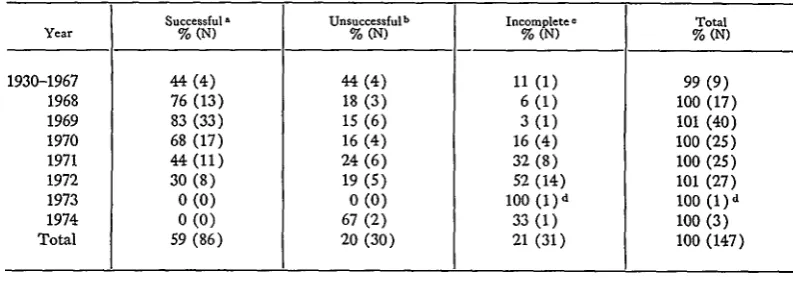
Data from which the effectiveness of control measures may be inferred are presented in Tables 2 and 3. It should be noted that there are several possible ways to measure "effectiveness" from these data.
If the goal is deterrence, then the data should reflect a decline in the total number of skyjacking attempts following the introduction of a deterrence program. Until 1973, the data for the United States do not reveal such a decline. Thus, if there was any deterrent effect of control efforts before 1973, it was not of a magnitude to be reflected by these data. Addi-tionally, Table 1 indicates that the proportion of worldwide skyjacking attempts occurring in the United States remained relatively con-stant from 1969 through 1972. This lends fur-ther support to the interpretation of the data as revealing no major deterrent effect of con-trol programs before 1973.
TABLE 2
Successful, Unsuccessful, and Incomplete Skyjackings, United States and Worldwide, 1930-1974
United States Othera
Year
Sb Uc I d Total S U Total
% (N) % (N) % (N) % (N) % (N) % (N) % (N)
1930-1967 58 (7) 33 (4) 8 (1) 99 (12) 78 (52) 22 (15) 100 (67) 1968 82 (18) 14 (3) 5 (1) 101 (22) 85 (11) 15 (2) 100 (13) 1969 83 (33) 15 (6) 3 (1) 101 (40) 79 (37) 21 (10) 100 (47)
1970 67 (18) 15 (4) 19 (5) 101 (27) 66 (37) 34 (19) 100 (56)
1971 44 (12) 22 (6) 33 (9) 99 (27) 32 (10) 68 (21) 100 (31)
1972 32 (10) 23 (7) 45 (14) 100 (31) 42 (13) 58 (18) 100 (31)
1973 50 (1) 0 (0) 50 (1) 100 (2) 50 (10) 50 (10) 100 (20)
1974 43 (3) 29 (2) 29 (2) 101 (7) 26 (5) 74 (14) 100 (19) Total 61 (102) 19 (32) 20 (34) 100 (168) 62 (175) 38 (109) 100 (284)
SOURCE: FEDERAL AVIATION ADMINISTRATION, CIVIL AVIATION SECURITY SERVICE, "WORLDWIDE REPORTED
HIJACKING ATTEmTs-SuMARIZATION," (January 1, 1975).
NOTE: Totals which do not add to 100% are due to rounding error.
a Worldwide, excluding United States.
b Successful. Hijacker controls flight and reaches destination or objective.
Unsuccessful. Hijacker attempts to take control of flight but fails. Hijacking may be averted either in flight or on the ground.
d Incomplete. Hijacker is apprehended or killed during hijacking or as a result of "hot pursuit."
0 For other countries, the "incomplete" category is combined with "unsuccessful," due to lack of adequate data.
TABLE 3
Successful, Unsuccessful, and Incomplete Skyjackings, United States Scheduled Air Carriers, 1930-1974
Successfula Unsuccessfulb Incomplete' Total
Year % (N) % (N) % (N) % (N)
1930-1967 44 (4) 44 (4) 11 (1) 99 (9)
1968 76 (13) 18 (3) 6 (1) 100 (17)
1969 83 (33) 15 (6) 3 (1) 101 (40)
1970 68 (17) 16 (4) 16 (4) 100 (25)
1971 44(11) 24(6) 32(8) 100 (25)
1972 30 (8) 19 (5) 52 (14) 101 (27)
1973 0(0) 0(0) 100 (1)d 100 (1)d
1974 0 (0) 67 (2) 33 (1) 100 (3)
Total 59 (86) 20 (30) 21 (31) 100 (147)
SOURCE: DEPARTMENT OF TRANSPORTATION, FEDERAL AVIATION ADMINISTRATION, "HIJACKING ATTEMPTS
ON U.S. SCHEDULED AIR CARRIER AIRCRAFT," (January 24, 1975).
NOTE: Totals which do not add to 100% are due to rounding error.
Hijacker controls flight and reaches destination or objective.
b Hijacker attempts to take control of flight but fails. Hijacking may be averted either in flight or on the ground. c Hijacker is apprehended or killed during hijacking or as a result of "hot pursuit."
[image:8.454.22.419.397.539.2]SKYJACKING
yearly increase in the percentage of incomplete attempts from 1969 through 1973 indicates that in many cases, hijackers can be subdued after they have taken control of a flight. Examination of individual incidents20 reveals that this suc-cess is not attributable to the Sky Marshall pro-gram. Rather, the success of the program is due to the airlines' opposition policy and to the in-creased willingness of law enforcement agen-cies to rush planes which have landed to refuel or pick up a ransom.80
If the goal is prevention, however, the most important statistic is the number of successful hijackings. A completely successful prevention program would be indicated by the elimination of successful or incomplete hijackings, al-though there would not necessarily be any ef-fect on the number of unsuccessful attempts (unless there was also a deterrent effect). The data in Table 2 show a dramatic decline in the number of hijacking attempts and successes in 1973 and 1974, suggesting that the prevention measures begun in January, 1973 have been successful. The effectiveness of the prevention program is more clearly evident, however, in Table 3, which excludes helicopters, charter planes and private aircraft, which have gener-ally not been subject to prevention or other hi-jacking control measures. Since the prevention program began, there have been only three at-tempts to hijack scheduled American air carriers, none of which have been successful.
Examination of these three incidents,31 how-ever, reveals characteristics of those hijackings which may not be preventable under the cur-rent system. Of the two unsuccessful 1974 hi-jackers, one utilized hostages to force his way aboard an out-of-service aircraft, and the other murdered a terminal policeman and the co-pilot before killing himself. These events, and the 1973 Rome massacre by terrorist hijackers, demonstrate that a prevention program may not be effective against well-organized,
politi-29DOMEsTIC
AND FOREIGN AIRCRAFTHIyAcK-INGS, supra note 20.
30 This may also be a reflection of the increase in the number of extortion hijackings, since it is necessary to land and open the outer doors in order to collect the ransom. Escape and terrorist skyjackings usually do not necessitate these ac-tions.
31DoMEsTIc AND FOREIGN AIRCRAFT
HIJACK-INGS, supra note 20.
cally motivated terrorists or extremely desper-ate individuals. Those willing to engage in suf-ficient violence are still capable of hijacking an aircraft. On the other hand, the one incomplete hijacking of 1974 was effected by use of a razor blade, a nail and an emergency axe, suggesting that resourceful individuals may be able to circumvent prevention measures with-out excessive violence.3 2 However, as Arey noted, most of the individuals attempting sky-jackings were amateurs, who were neither very resourceful nor very determined. Moreover, there was little evidence of conspiratorial ac-tivity, suggesting that most hyjackers could be deterred.3 3 Consistent with Arey's analysis, the dramatic decrease in the number of skyjacking attempts from 1968-1972 to 1973-1974 attests to the deterrent effectiveness of the prevention program.
The effectiveness of a prevention strategy may be called into question by two alterna-tive explanations of the post-1972 decrease in skyjackings. The first of these is to consider skyjacking a crime "fashion" or "fad" which has run its course.34
The imitative nature of many skyjackings, especially in the cases of flights to Cuba and the parachute-extortion cases,3 5 lends some support to this hypothesis. The fad hypothesis, however, does not ade-quately account for the precipitousness of the decline in American skyjackings after 1972. Moreover, dismissing skyjacking as a passing fashion, without identifying the conditions for its rise and subsequent decline, is nomencla-ture, not explanation.
The other possible explanation is that
sky-32 In describing the relationship between crimi-nals and those interested in crime prevention, Sutherland noted that there is a positive correlation in the development of techniques of crime and of crime prevention. E. SUTHERLAND
&
D. CRESSEY,CRIMINOLOGY 258 (8th ed. 1970).
33 Arey observed that the pre-1969 hijacking at-tempts were usually not politically motivated and that the actual hijackings were inadequately planned and executed. The belief that the hijackers themselves were generally incompetent led to the hope that if hijackings were made increasingly dif-ficult, this type of hijacker would be deterred. AREY, supra note 16, at 235.
34
E.
SUTHERLAND& D.
CRESSEY, supra note 31, at 260.35 For a discussion of the role of the media in disseminating novel crime techniques see Sagarin, supra note 19, at 7.
jacking is a symptom of social tensions, and that its decline simply reflects a decrease in so-cial unrest. Several aspects of the data in Table 2 support this explanation. First, the peak of the skyjacking phenomenon-1968 and 1969-coincided with the United States' deep-est involvement in Vietnam and with the final stages of the 1960's riots and demonstrations. Second, the end of United States military in-volvement in Vietnam coincided with the dra-matic decrease in American skyjackings. Fi-nally, the number of skyjacking attempts in other parts of the world also declined after
1970, possibly suggesting a general decrease in social tensions.
In several respects, however, the social ten-sions hypothesis appears deficient. First, with few exceptions,3 6 no link between skyjack-ing and the Vietnam war is evident. Most American skyjackers were not protesting the war, evading the draft, or taking any sort of war-related action. Thus, the simultaneity of the conclusion of the United States' involve-ment in Vietnam and the major decline in skyjackings appears more coincidental than causal. Second, the social tensions hypothesis does not explain why the principal skyjacking era coincides only with the end of the major period of riots and demonstrations. Third, be-cause "social unrest" is a difficult concept to identify operationally, it is difficult to state whether social tensions are in fact declining. By some measures (e.g., riots, assassinations), social tensions in the 1970's have lessened, but by others (e.g., violent crime rates, changes in heads of state, political kidnappings) they have not.3 7
Finally, although both American and worldwide skyjacking rates have declined since 1969 or 1970, an abrupt decline is noted only for the United States. This coincides with the imposition of the prevention program.
These three explanations (fad, social
ten-36 There have been only four Vietnam-related hijackings: February 9, 1968; September 18, 1970; June 11, 1971; and July 2, 1972. DOMESTIC AND FOREIGN AIRcRAFT HIJACKINGS, supra note 20.
37 For statistics on the increasing crime rate for violent crime see FEDERAL BUREAU OF
INVESTIGA-TION, CRIME IN THE UNITED STATES: UNIFORM CRIME REPORTS 59 (1973). For a discussion of the number of political kidnappings in recent years see
STAFF OF HOUSE COMM. ON INTERNAL SECURITY,
93i CONG., 1sT SEss., REPORT ON PoLr.ICA KID-NAPPINGS (Comm. Print 1973).
sions and prevention effectiveness) are not mu-tually exclusive, and a theory of skyjacking etiology would probably need to consider all three. Our present concern, however, is whether the apparent effectiveness of a preven-tion model for skyjacking control can be ex-plained away by larger social processes. In this case, neither of the two alternative explana-tions appears to adequately account for the difference in American skyjacking rates for
1968-1972 and 1973-1974.
Fiscal Costs
When considering the fiscal costs of skyjack-ing control programs, two comparisons are of interest. The first is a comparison of the cost of a control program with the costs of skyjack-ing itself. The second is a comparison of alter-native control programs.
Due to the absence of systematic data on the costs of skyjacking, the author has been un-able to make the first kind of comparison.38 Nevertheless, based on data which are available, some general observations may be noted. First, different forms of hijackings result in varied costs. Escape flights to Cuba, which comprise the great majority of hijackings in the United States, are relatively inexpensive. Extortions have been less frequent but more expensive, since the average ransom paid has been over $400,000. Even so, almost all extorted funds have been recovered, and the net loss to the airlines has not been crippling.3 9 Most expen-sive, but least frequent, have been the terrorist bombings which have destroyed at least three American jetliners.
A second observation is that while most hi-jackings have been relatively inexpensive in financial terms, the airlines are vulnerable to severe financial losses through extortion or terrorism unless preventive measures are taken. Finally, it may be impossible to
deter-38 Part of this problem is due to the fact that the Federal Aviation Administration, the Air Transport Association and the International Civil Aviation Organization have not maintained
statis-tics on this particular point.
SKYJACKING
mine whether the airline industry's constant emphasis on skyjacking control has been based primarily on concern for public safety or on self-interest. Public statements have regularly emphasized the former but in this instance both interests are served by a prevention policy.
The second fiscal comparison which is avail-able is a comparison of the costs of alternative control programs. The first phase of control ef-forts (legislation, public statements and inter-national conventions) was virtually cost-free, but had no detectable effect on the number of skyjackings. Since the costs were split between the federal government and the individual air-lines, the cost of the profile/magnetometer sys-tem is difficult to estimate. In addition, these costs varied with the extent to which the sys-tem was employed. It has been estimated, how-ever, that a version of this system designed for full coverage of United States' airports might be more expensive than the current prevention program.40
In contrast, cost information is available for both the Sky Marshall program and the passenger screening (prevention) pro-gram. The prevention program cost an esti-mated $120 to $150 million in 1973, as com-pared to the estimated annual cost of $28 to $30 million for the Sky Marshall program. The greater expense of the prevention system may be placed in perspective by the realization that it is deferred by a 59-cent surcharge on each flight coupon.4'
Social Costs
The third issue which a crime control model must address is whether the advantages out-weigh the social costs. For the prevention model of skyjacking control, three types of so-cial cost are considered below.
4 0
AVIATION WEEK,
June 11, 1973, at 31.
4 1The Air Transport Association estimated that the prevention program would cost the airlines $150 million per year. U.S. NEws & W. REP., Jan. 15, 1973, at 17. N. K. Edwards, Chief of In-Flight Security for the Federal Aviation Administration, estimated that the airlines would receive $114 mil-lion from the 59-cent surcharge on each ticket to pay for their security activities under the prevention program, and added that the federal government has spent $6.4 million on magnetometers. During fiscal years 1972 and 1973, the federal government spent $30 million and $28 million, principally to support the Sky Marshall program. Letter from N. K. Edwards to author, November 9, 1973.
The most obvious form of social cost curred under the prevention model is the
in-convenience and indignity of being
electronically screened and having one's bag-gage physically searched. Although most pas-sengers have accepted the necessity for the searches, a number of regular business travel-ers have complained about delays resulting from the screening process. However, when the FAA announced in June, 1973 that it was considering returning to a modification of the "behavioral profile" system, public opinion was overwhelmingly in favor of the prevention sys-tem. This forced the FAA to announce that it was not planning to relax security after all.42 Another social cost issue is the questioned legality of airport searches under the fourth amendment. Although the use of "official" fed-eral antihijacking systems has been approved in dicta,4 3 the indiscriminate searches con-ducted under the current prevention system may face constitutional challenge, since they are conducted with neither warrant nor prob-able cause. They cannot accurately be described as consent searches, since one's right to travel is impinged if consent is not granted. Also, they may not be considered investigative stops, since there are typically no "specific and arti-culable facts which . . . reasonably warrant that intrusion." 44 A more appropriate legal ra-tionale for these searches may be that of intru-sions sui generis, for which the reasonableness of the search is tested by "balancing the need to search against the intrusion which the search entails." 45
Whatever legal rationale is used to justify these searches, the fact remains that most re-sultant arrests are for possession of narcotics
-AVIATION
WEEK, June
11, 1973at 31;
AvIA-TION WEEK,May 7, 1973, at 26; N.Y. Times,
August 11, 1973, at 50, col. 1; N.Y. Times, June 5, 1973, at 1, col. 7.43United States v. Lopez, 328 F. Supp. 1077 (E.D.N.Y. 1971).
44 Terry v. Ohio, 392 U.S. 1, 21 (1967).
45 Camara v. Municipal Court, 387 U.S. 523, 536-37 (1967). For a discussion of the constitu-tionality of airport searches see Kraus, Searching for Hijackers: Constitutionality, Costs and Alter-natives,
40 U.
CHI. L. REV.383 (1973); Wright,
Hijacking Risks and Airport Frisks: Reconciling Airline Security with the Fourth Amendment, 9 CRim. L. BuLL. 491 (1973) ; Note, Airport Security Searches and the Fourth Amendment, 71 CoLum. L. REv. 1039 (1971).
or other nonviolent offenses, rather than for possession of weapons. To protect against the overzealous law enforcement which this in-vites, Wright has suggested two safeguards: the right to terminate the search at any time by declining to board the aircraft, and the ex-clusion of any evidence found which does not relate to air piracy, sabotage or other crimes of violence. Although it is questionable at this point whether these guarantees will be adopted in future court decisions, it is clear that appro-priate legal safeguards are at least possible within the prevention model of skyjacking control.4 6
The final social cost issue is crime displace-ment. Several studies have suggested that crime control efforts may have more effect on the form or location of crime than on its
ac-tual incidence.47 It must then be determined
whether this has occurred under the prevention model of skyjacking control, and if so, whether the modifications are worse than the original evil.
Because the incidence of skyjacking is lower than for other forms of violent crime, it is im-possible to determine whether the prevention program simply channeled potential hijackers into other forms of deviance. However, psy-chological studies of hijackers have indicated that, except for the terrorist activities, the skyjackings are typically poorly planned, half-heartedly executed and frequently motivated on rather short notice either by media cover-age of previous events or by the apparent sim-plicity of the offense.48 It appears unlikely that hijackers who are thwarted by a prevention program would be driven into other forms of crime.
The form of skyjacking, however, does ap-pear to have been affected by the prevention program. The recent hijackings of helicopters and small chartered aircraft4 s are obvious
ex-46Wright, supra note 45, at 513; cf. Kraus, supra note 45.
47 E. SUTHERLAND & D. CRESsEY, supra note 32, at 260;
J.
TOBIAS, CRIME AND INDUSTRIAL SOCIETY IN THE NINETEENTH CENTURY 187 (1967). Black, Forms and Reforms of Whoredom: Notes on the Sociology of Prostitution and Moral Enterprise (Working Paper No. 15, Center for Research on Social Organization, Department of Sociology, University of Michigan, March, 1966).48 J. AREY, supra note 16, at 235.
amples.&4 9 More serious, however, is the in-creased violence associated with skyjacking at-tempts during the prevention phase of control efforts. In October, 1972, four hijackers avoided the electronic screening measures in effect by shooting their way aboard the aircraft, killing a gate agent and wounding a ground crewman.50 If security measures had been less restrictive, the hijacking might have been a routine diver-sion to Cuba, with no loss of life. In another at-tempted hijacking, Samuel Byck in February, 1974 killed an airport policeman and the co-pilot before taking his own life. Finally, the terrorist skyjacking in Rome in December, 1973 resulted in the deaths of at least thirty people. It should be noted, however, that exces-sive violence was apparently an intentional aspect of both the Rome massacre and the Byck murder-suicide, not necessitated by the
prevention program.5 1
SUMMARY AND CONCLUSIONS
The history of skyjacking control efforts in the United States demonstrates a progression from a deterrence model to a prevention model of crime control. The prevention model was adopted only after the demonstrated inability of deterrent measures to control skyjacking. The fiscal cost of the prevention program is four to five times the cost of previous control efforts, but this cost has not drawn strenuous opposition. There are also social costs associ-ated with the prevention model, including in-convenience, indiscriminate searches of ques-tionable legality and possible displacement of crime. Of these, the most serious issue is the unresolved legal status of the searches.
Since skyjacking is one of the few crimes for which a prevention model has been adopted, consideration of its relevant charac-teristics should be instructive for determination of other offenses which may be more appropri-ately controlled through prevention of the of-fense rather than through deterrence or rehabilitation of the offender.
49DOsMESTIC AND FoREIGN AIRCRAFT
HIJACK-INGS, supra note 20. The numbers of these incidents may be obtained by subtracting the N's in Table 3
from the corresponding N's in Table 2. 50 N.Y. Times, Oct. 30, 1972, at 1, col. 2. 53 U.S. NEws & W. REP., Mar. 4, 1974, at 21;
SKYJACKING
The first characteristic is the high demand for effective control of the offense. Because skyjacking is a crime which poses great threat to both life and property, it was actively op-posed by an influential traveling public, a major industry and a large government bu-reaucracy. A second characteristic is that the large financial cost of the prevention program was able to be passed on to the affected public without imposing financial hardship on any in-dividual or group of inin-dividuals. Third, the so-cial costs associated with the prevention pro-gram have not proven excessive, although there is possibility for abuse of the search process by overzealous enforcement agents. Fi-nally, skyjacking is an offense which can only