DEC-JAN-2015, VOL-II, ISSUE-VII www.srjis.com Page 1064 ASSESSMENT OF PRO-POOR URBAN REFORMS WITH SPECIFIC REFERENCE TO BASIC SERVICES TO THE URBAN POOR (BSUP) AND RAJIV AWAS YOJANA
Kavita Yadav, Ph. D. Author is Assistant Professor in the Department of Commerce of Shaheed Bhagat Singh (Eve.) College (University of Delhi).
Magnitude and dimension of urban poverty manifest itself in the emergence of exclusionary urban processes characterised by lack of basic services to slum dwellers and low income groups. Pro-poor components of JNNURM become very relevant in this context. This paper tries to analyse the pattern of work done under the Sub-Mission of JNNURM on Basic Services to the Urban Poor (BSUP) and Rajiv Awas Yojana. State level analysis reveals that performances of Andhra Pradesh, Gujarat, West Bengal, Maharashtra, Tamil Nadu, Uttar Pradesh, Karnataka, Delhi and Kerala are satisfactory in terms of number of dwelling units constructed under the BSUP of JNNURM. Alarmingly, Jharkhand, Bihar, Rajasthan, Goa, Uttrakhand, Arunachal Pradesh, Jammu & Kashmir and Himachal Pradesh performed badly. Serious intervention is needed in these states. Rajiv Awas Yojana was launched with the main objective of making Indian cities ‘slum free’. Lack of clear road map for its time-bound implementation puts a question mark on its success.
Introduction : 17.4 per cent of urban Indian households live in slums (Census of India, 2011). The percentage of persons below the poverty line in 2011-12 has been estimated as 13.7 per cent in urban areas. The respective ratio in 2004-05 was 25.7 per cent. The poverty ratio has declined in urban areas over the period of 2011-12 to 2004-05. However, the living condition of urban poor, particularly in slums, needs to be improved. The sub-mission of JNNURM on Basic Services to the Urban Poor (BSUP) becomes very significant in this context. The main thrust of the sub-mission on Basic Services to the Urban Poor is on integrated development of slums through projects for providing shelter, basic services and other related civic amenities with a
Scholarly Research Journal's is licensed Based on a work at www.srjis.com 1.795, 2013 SJIF© SRJIS2014
SRJHSEL/BIMONTHLY/DR. KAVITA YADAV(1064-1070)
DEC-JAN-2015, VOL-II, ISSUE-VII www.srjis.com Page 1065 view to provide utilities to the urban poor. States /cities, as part of the sub mission II, Basic Services to the Urban Poor (BSUP) under the Jawaharlal Nehru National Urban Renewal Mission (JNNURM) are required to “Earmark at least 20-25 percent of developed land in all housing projects (developed by public and private agencies) for Economically Weaker Section (EWS) and Lower Income Group (LIG) category with a system of cross subsidisation”. This reform is aligned with the goal of “Affordable Housing for All” in the National Urban Housing and Habitat Policy, 2007 (NUH&HP). The NUH&HP mandates reservation of “10-15 percent land in new public/ private housing projects or 20-25 percent of FAR (whichever is greater) for EWS/ LIG housing through appropriate legal stipulations and special initiatives”.
The slow progress under Rajiv Awas Yojana puts a question mark on its success1. Speedy implementation of the programme at national scale is needed to reach the total slum population in a time bound manner, without which the Mission becomes ineffective.
As per the report of the Technical Group on Urban Housing Shortage (2012-17) constituted by the Ministry of Housing and Urban Poverty Alleviation (MoHUPA), Government of India there is a shortage of 18.78 million dwelling units out of which nearly 96% belongs to the Economically Weaker Sections (EWS) and Lower Income Group (LIG) Households.
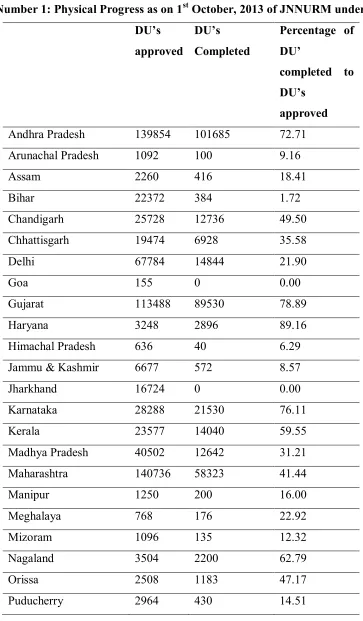
State Level Analysis : Andhra Pradesh tops the list of best performing states in terms of number of dwelling units constructed under the BSUP of JNNURM (table no. 1). The other well performing states are Gujarat, West Bengal, Maharashtra, Tamil Nadu, Uttar Pradesh, Karnataka, Delhi and Kerala.
Jharkhand and Bihar need serious intervention in the implementation of BSUP programmes. Work done in north-eastern states is not satisfactory.
Andhra Pradesh, Karnataka, Gujarat and Haryana reported high percentage of dwelling units completed to dwelling units approved (more than 70 per cent).
Jharkhand, Bihar, Rajasthan, Goa, Uttrakhand, Arunachal Pradesh, Jammu & Kashmir and Himachal Pradesh reported very low percentage of dwelling units completed to dwelling units approved (less than 10 per cent).
SRJHSEL/BIMONTHLY/DR. KAVITA YADAV(1064-1070)
[image:3.612.125.488.91.712.2]DEC-JAN-2015, VOL-II, ISSUE-VII www.srjis.com Page 1066 Table Number 1: Physical Progress as on 1st October, 2013 of JNNURM under BSUP
DU’s approved
DU’s Completed
Percentage of DU’
completed to DU’s
approved
Andhra Pradesh 139854 101685 72.71
Arunachal Pradesh 1092 100 9.16
Assam 2260 416 18.41
Bihar 22372 384 1.72
Chandigarh 25728 12736 49.50
Chhattisgarh 19474 6928 35.58
Delhi 67784 14844 21.90
Goa 155 0 0.00
Gujarat 113488 89530 78.89
Haryana 3248 2896 89.16
Himachal Pradesh 636 40 6.29
Jammu & Kashmir 6677 572 8.57
Jharkhand 16724 0 0.00
Karnataka 28288 21530 76.11
Kerala 23577 14040 59.55
Madhya Pradesh 40502 12642 31.21
Maharashtra 140736 58323 41.44
Manipur 1250 200 16.00
Meghalaya 768 176 22.92
Mizoram 1096 135 12.32
Nagaland 3504 2200 62.79
Orissa 2508 1183 47.17
SRJHSEL/BIMONTHLY/DR. KAVITA YADAV(1064-1070)
DEC-JAN-2015, VOL-II, ISSUE-VII www.srjis.com Page 1067
Punjab 7376 1600 21.69
Rajasthan 11151 765 6.86
Sikkim 254 52 20.47
Tamil Nadu 92272 44332 48.04
Tripura 256 256 100.00
Uttar Pradesh 68217 31557 46.26
Uttrakhand 1610 151 9.38
West Bengal 157933 81218 51.43
Source: Ministry of Housing & Urban Poverty Alleviation
Andhra Pradesh and Gujarat are frontrunners in taking advantage of this initiative.
Revisions in the legislations undertaken by the Government of Andhra Pradesh and Gujarat to accommodate the needs of the EWS/ LIG category have been explained in detail.
Restructuring the Hyderabad Master Plan : Till August 2008, the Hyderabad Metropolitan Development Authority (HMDA) had prepared nearly 20 Zonal Plans and two Master Plans aimed at promoting affordable housing for the economically weaker sections co-ordinated with building regulations for new and old constructions. Through this process, HMDA managed to identify nearly 50 acres of developed land for EWS housing. Initiatives undertaken in the Master Plan included:
Layout Development: 5 percent of total developable land to be returned to HMDA for providing Master Plan facilities. This principle is only applicable for Green Field Areas such as Hyderabad Airport Development Area, Outer Ring Road Growth (ORR) Corridor and extended areas of Hyderabad Development Area.
At least 5 percent each, of the total project land to be developed for EWS (maximum plot size of 50 sq mts) and LIG (maximum plot size of 100 sq mts) housing; the option of developing EWS instead of LIG plots rests with the developer.
If the above is not feasible, the developer may provide equivalent number of plots (or
SRJHSEL/BIMONTHLY/DR. KAVITA YADAV(1064-1070)
DEC-JAN-2015, VOL-II, ISSUE-VII www.srjis.com Page 1068 feasible to provide for such units within the project site then these are to be provided within 5 Kms radius of the project site or hand over equivalent amount of land for the same purpose to HMDA or other such public agency.
Town Planning in Gujarat : The Gujarat Town Planning and Development Act (GTPUDA), 1976 provides for Town Planning Schemes through Private-Public Partnership with reservation of land for housing EWS groups. The Municipal Corporation of Surat has used the provision to secure 394 hectares of land for housing for the poor under the BSUP component of JNNURM. The General Development Control Regulations (GDCRs) under the Act specify details such as density of the settlement (maximum 225 dwellings per hectare), plot size( between 18 sq m to 40 sq m), height (maximum ground plus one structure) etc. so that the housing so created is used by the target group only .
Government of Gujarat has also repealed the Urban Land Ceiling and Regulation Act (ULCRA) and the State Revenue Department has transferred the excess land to the Urban Local Bodies at a nominal rate with the condition that the ULBs use the land to construct low cost housing for socially and economically poor. SPARC, Nirman (the financial and construction arm of SPARC), the National Slum Dwellers Federation and Mahila Milan (known as the ‘Alliance’) have been working together on infrastructure and housing issues in slum areas for over twenty years. Access to finance emerged as a big obstacle. At this point, Community Led Infrastructure Finance Facility (CLIFF) was set up with funds from DFID (approximately £6.8 million) and SIDA (approximately £1.5 million). CLIFF works closely with the Alliance to implement upgrade programmes in Dharavi slums in Mumbai and in urban Bangalore. Funds from CLIFF are used only as guarantee or as bridge loans.
The above best practices need to be replicated in other states.
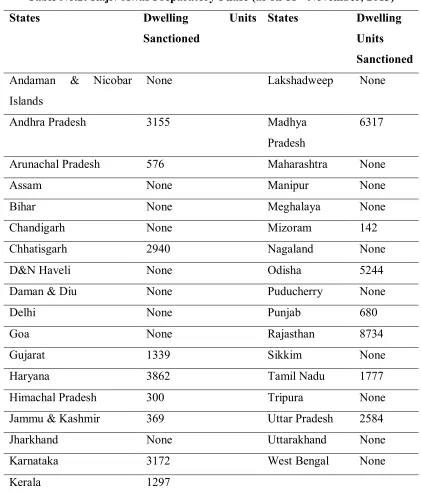
Rajiv Awas Yojana : Tenurial security in slums is essential for improvement in living condition. Rajiv Awas Yojana was launched with the main objective of making Indian cities ‘slum free’. Lack of clear road map for its time-bound implementation puts a question mark on its success2. Under the preparatory phase of Rajiv Awas Yojana, no dwelling units are sanctioned in many states (table no. 2). Maximum number of dwelling units is sanctioned in Rajasthan,
2 Kundu, Amitabh. 17, April 27, 2013. “Making Indian Cities Slum-Free”. Economic and Political Weekly. Vol-
SRJHSEL/BIMONTHLY/DR. KAVITA YADAV(1064-1070)
[image:6.612.95.516.145.637.2]DEC-JAN-2015, VOL-II, ISSUE-VII www.srjis.com Page 1069 followed by Madhya Pradesh. No dwelling units are sanctioned in many states. Alarmingly, Delhi and Maharashtra also fall in this category of states.
Table No.2: Rajiv Awas Preparatory Phase (as on 18th November, 2013)
States Dwelling Units
Sanctioned
States Dwelling Units Sanctioned Andaman & Nicobar
Islands
None Lakshadweep None
Andhra Pradesh 3155 Madhya
Pradesh
6317
Arunachal Pradesh 576 Maharashtra None
Assam None Manipur None
Bihar None Meghalaya None
Chandigarh None Mizoram 142
Chhatisgarh 2940 Nagaland None
D&N Haveli None Odisha 5244
Daman & Diu None Puducherry None
Delhi None Punjab 680
Goa None Rajasthan 8734
Gujarat 1339 Sikkim None
Haryana 3862 Tamil Nadu 1777
Himachal Pradesh 300 Tripura None
Jammu & Kashmir 369 Uttar Pradesh 2584
Jharkhand None Uttarakhand None
Karnataka 3172 West Bengal None
Kerala 1297
Source: Ministry of Housing & Urban Poverty Alleviation
SRJHSEL/BIMONTHLY/DR. KAVITA YADAV(1064-1070)
DEC-JAN-2015, VOL-II, ISSUE-VII www.srjis.com Page 1070 Kapasan-II, Nimbahera, Pratapgarh and Udaipur.
As per the draft of the ‘State Affordable Housing Policy for Urban Areas’, creation of an enabling environment for providing “affordable housing for all” with special emphasis on EWS and LIG and other vulnerable sections of society such as Scheduled castes/Scheduled Tribes, Backward Classes, Minorities and senior citizens, physically challenged persons is essential to ensure that no individual is left shelter less.
Conclusion : Serious intervention is needed in underdeveloped states like Jharkhand, Bihar and Rajasthan for successful implementation of sub-mission of JNNURM on Basic Services to the Urban Poor (BSUP). Performances of Andhra Pradesh, Gujarat, West Bengal, Maharashtra, Tamil Nadu, Uttar Pradesh, Karnataka, Delhi and Kerala are satisfactory in terms of number of dwelling units constructed under the BSUP of JNNURM. Under the preparatory phase of Rajiv Awas Yojana, no dwelling unit is sanctioned in many states. Dwelling units are sanctioned in only 16 states and UTs. Implementation phase projects have been started only in few cities. Slow and unsatisfactory progress of Rajiv Awas Yojana put serious question mark on its future course of action.
References :
1. Census of India, 1991. 2. Census of India, 2001. 3. Census of India 2011.
4. Dupont, V. “Slum Demolitions in Delhi since the 1990s: An Appraisal”, Economic and Political Weekly, July 12, 2008.
5. Kundu, Amitabh. 2012. “Political Economy of Making Indian Cities Slum-Free”, Berkeley.
6. Kundu, Amitabh. 17, April 27, 2013. “Making Indian Cities Slum-Free”. Economic and Political Weekly. Vol- XLVIII No. 17.
7. Mahadevia, Darshini. ‘Tenure Security and Urban Social Protection in India’, CSP Research Report 05, January, 2011.