by increased travel distance within larger maze.
Dr C Biakhlupuii*, Dr.Sangita Sen*
*
Department of Physiology, Institute of Post Graduate Medical Education & Research (IPGMER), Kolkata, West Bengal
DOI: 10.29322/IJSRP.8.3.2018.p7522 http://dx.doi.org/10.29322/IJSRP.8.3.2018.p7522
Abstract- Aim: This study aims to examine the effect of radial maze size (number of locations) on learning and performance efficiency of rats, i.e., do rats economize their physical effort when exploring the bigger maze and to assess the effect of sequence of training , 8-arm after 24-arm maze versus 24-arm after 8-arm maze, on relative performance of each rat in the two mazes. Materials and method: 22 Albino rats of Wistar strain obtained from National Institute of Nutrition Hyderabad, India were divided into two groups and were trained in 8-arm maze following training in 24-arm and vice-versa. The performance of the two groups were compared after obtaining plateau phase from the 10 trial moving average of Reference memory error for locating the onset of plateau phase. Results : One group of rat which were trained in 24 arm maze followed by 8-arm maze shows decrease in percentage Reference memory error in 8-arm maze .i.e., 2nd maze(P-value=0.003). The other group which were trained in 8-arm maze followed by training in 24-arm maze shows decrease in percentage Reference memory error in 24-arm i.e.2nd maze (P value= 0.001). Conclusion: The present study shows that rats after being trained in one radial maze perform better in another radial maze as far as Reference memory error in fully trained stage is concerned. This shows that repeated training with allothetic cues improves the ability to perform a task irrespective of maze size .
Keywords: Allothetic cues, Cognitive map, Radial Maze, Reference Memory Error.
I. INTRODUCTION
his study aims to examine the effect of radial maze size (number of locations) on learning and performance efficiency of rats, i.e. do rats economize their physical effort when exploring the bigger maze and to assess the effect of sequence of training, 8-arm after 24-arm maze versus 24-24-arm after 8-24-arm maze, on relative performance of each rat in the two mazes.
Since the report of Olton and Samuelson (1976)1, the radial maze become a popular preparation for the study of animal memory. As rats develop cognitive map while navigating maze these maze studies are used to study spatial learning and memory in rats2.
The strategies used by rats to find food in mazes with multiple food locations, such as a partially baited radial maze are thought to reflect foraging strategies used by these animals in their natural habitat3. For efficient task solving between foraging session, rats must employ a win stay strategies based on long-term reference memory ( Ewa Jakubowska-Dogru.et.al.2003) 4.
II. MATERIALS & METHODS
22 Albino rats of Wistar strain obtained from National Institute of Nutrition Hyderabad, India were divided into two groups and were trained in 8-arm maze following training in 24-arm and vice-versa. The performance of the two groups were compared after obtaining plateau phase from the 10 trial moving average of Reference memory error for locating the onset of plateau phase.
The present study was approved by IAEC,544/CPCSEA ,Ref no:IAEC/SS-1/2016/UCM-93.
Animals:The22 albino rats of Wistar strain were used during the experiments. The rats were obtained from National Institute of Nutrition, Hyderabad, India.
Food Reward: Soaked Bengal Grams.
8-ARM MAZE: Arrangement of Cues: Zero (0) watt light bulbs of different colour; three in numbers each light source is visible from the central choice area. Each bulb was enclosed in different shape.
24-ARM MAZE:
Arrangement of Cues: High contrast 3D objects of different shape, seven in number, were placed outside the maze along the arms at regular intervals at such height that these objects could be seen from the large central area.
III. RESULTS
One group of rat (n=13) were trained in 24-arm maze followed by training in the 8-arm maze. The other group (n=9) were trained in 8-arm maze followed by training in the 24-arm maze and reference memory error were compared.
Table 1: COMPARISON BETWEEN REFERENCE MEMORY ERROR IN RATS (n=13) TRAINED IN 24-ARM FOLLWED BY 8-ARM MAZE.
[image:4.612.35.570.386.515.2]We compared the percentage of RME of rats between 24 –arm and 8-arm maze. MEAN, SD value for 24-arm and 8-arm maze are 8.231±6.170 and1.385±2.022 respectively. The p-value of percentage error is 0.003875947 which is statistically significant.
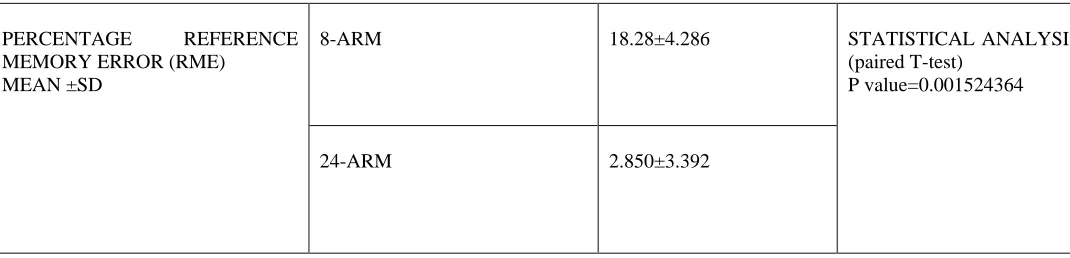
Table 2: COMPARISON BETWEEN REFERENCE MEMORY ERROR IN RATS (n=9) trained in 8-ARM FOLLWED BY 24-ARM MAZE.
We compared the percentage of reference memory error in 8-arm maze and arm maze. The MEAN±SD value for 8-arm and 24-arm are 18.28±4.286 and 2.850±3.392 respectively. The P value of percentage error is 0.001524364 which is highly significant.
PERCENTAGE
REFERENCE MEMORY ERROR
MEAN±SD
24-ARM 8.231±6.170 STATISTICAL ANALYSIS
(paired T test)
P VALUE=0.003875947
8-ARM 1.385±2.022
PERCENTAGE REFERENCE MEMORY ERROR (RME)
MEAN ±SD
8-ARM 18.28±4.286 STATISTICAL ANALYSIS
(paired T-test) P value=0.001524364
FIGURE1: GRAPHICAL PRESENTATIN OF REFERENCE MEMORY ERROR OF RATS TRAINED IN 8-ARM
Table 2 depicts the comparison of RME between 8-arm and 24-arm maze where the rats were first exposed to 8-arm and then to 24-arm where the performance in the 2nd maze, although larger was better than the smaller 8-arm maze. The comparison showed statistically significant improvement in the performance in the 2nd maze (p=0.0015).
The statistically significant improvement in reference memory performance in the second maze indicates that prior maze-experience has a significant impact on the reference memory of rats. This conjecture is consistent with the studies of Maaswinkel and Whishaw 199911, Stuchlik et al. 200112, Wallace et al. 200213, who also commented that after additional training with idiothetic cues a stable performance level can be reached.
V. SUMMARYANDCONCLUSION
In the present study, we observed that rats after being trained in one radial maze perform better in another radial maze as far as reference memory in fully trained stage is concerned. This shows that repeated training with allothetic cues improves the ability to perform a task irrespective of maze size. The results of this study neither prove nor contradict the hypothesis that rats visit nonrewarded locations partly as foraging exploration and that rats economize their physical effort when exploring the bigger maze.
ACKNOWLEDGEMENT
First of all I would like to thank Almighty God. I would like to acknowledge the unconditional support, affection and help that I have received from my family and friends for which words are not sufficient to express. I would like to express my heart-felt gratitude to my respected teacher Prof. (Dr.) Sangita Sen, Professor, Department of Physiology, I.P.G.M.E&R, for her constant supervision, immense help, inspiration, affection and invaluable advice towards the completion of my work. I am highly obliged and grateful to her.
REFERENCES
[1] Olton D, Samuelson R. Remembrance of places passed: Spatial memory in rats. Journal of Experimental Psychology: Animal Behavior Processes. 1976;2(2):97-116.
[2] Tolman EC. Cognitive maps in rats and men. Psychological review. 1948 Jul;55(4):189.
[3] Dale RInnis N. Interactions between response stereotypy and memory strategies on the eight-arm radial maze. Behavioural Brain Research. 1986;19(1):17-25. [4] Jakubowska-Dogru E, Umut Gumusbas U, Kara F. Individual variation in the spatial reference and working memory assessed under allothetic and idiothetic
orientation cues in rat. Acta neurobiologiae experimentalis. 2002 Dec;63(1):17-24.
[5] Brown MF. The effects of maze-arm length on performance in the radial-arm maze. Animal Learning & Behavior. 1990 Mar 1;18(1):13-22. [6] Lynch K. The image of the city. MIT press; 1960.
[7] Tulving E, Pearlstone Z. Availability versus accessibility of information in memory for words. Journal of Verbal Learning and Verbal Behavior. 1966 Aug 1;5(4):381-91.
[8] Dallal NL, Meck WH. Hierarchical structures: chunking by food type facilitates spatial memory. Journal of Experimental Psychology: Animal Behavior Processes. 1990 Jan;16(1):69.
[9] Hulse SH, Fowler HE, Honig WK. Cognitive processes in animal behavior. Lawrence Erlbaum; 1978.
[10] Daneman M, Carpenter PA. Individual differences in working memory and reading. Journal of verbal learning and verbal behavior. 1980 Aug 31;19(4):450-66. [11] Maaswinkel H, Whishaw IQ. Homing with locale, taxon, and dead reckoning strategies by foraging rats: sensory hierarchy in spatial navigation. Behavioural
brain research. 1999 Mar 1;99(2):143-52.
[12] Stuchlik A, Fenton AA, Bures J. Substratal idiothetic navigation of rats is impaired by removal or devaluation of extramaze and intramaze cues. Proceedings of the National Academy of Sciences. 2001 Mar 13;98(6):3537-42.
[13] Wallace DG, Gorny B, Whishaw IQ. Rats can track odors, other rats, and themselves: implications for the study of spatial behavior. Behavioural brain research.
2002 Apr11;131(1):185-92.
AUTHORS
First Author – Dr.C.Biakhlupuii,MD(Physiology),IPGMER,Kolkata,West Bengal,[email protected].
Second Author – Dr.Sangita Sen,MD(Physiology),Ph.D,Professor,Department of Physiology,IPGMER,Kolkata,west Bengal,India.