S T U D Y P R O T O C O L
Open Access
Comparison of face-to-face versus email guided
self-help for binge eating: study protocol for a
randomised controlled trial
Paul E Jenkins
1,2*, Amy Luck
1, Alison Burrows
1and Nicky Boughton
1Abstract
Background:Guided self-help is a recommended first-step treatment for bulimia nervosa, binge eating disorder and atypical variants of these disorders. Further research is needed to compare guided self-help that is delivered face-to-face versus via email.
Methods/Design:This clinical trial uses a randomised, controlled design to investigate the effectiveness of providing guided self-help either face-to-face or via e-mail, also using a delayed treatment control condition. At least 17 individuals are required per group, giving a minimumNof 51.
Discussion:Symptom outcomes will be assessed and estimates of cost-effectiveness made. Results are proposed
to be disseminated locally and internationally (through submission to conferences and peer-reviewed journals), and will hopefully inform local service provision. The trial has been approved by an ethics review board and was registered with ClinicalTrials.gov NCT01832792 on 9 April 2013.
Keywords: Guided self-help, Eating disorders, Email, Clinical trial
Background
Psychological therapy is the recommended treatment for eating disorders characterised by recurrent binge eating, with evidence-based self-help recommended as a first step of treatment [1]. However, few studies have looked at how best to deliver this form of treatment, although outcomes and treatment adherence appear better when guidance is available from a healthcare professional (for example, [2-4]), known as guided self-help or GSH. Fur-thermore, GSH has demonstrated particular cost-effectiveness, even when highly trained clinicians are used to administer the treatment [5], and a number of other RCTs have supported the utility of cognitive behaviour therapy (CBT)-based self-help in the treatment of recur-rent binge eating (see [6] for a review). Typically this has been delivered face-to-face, but email-assisted therapy has been suggested as a helpful way of obtaining professional treatment without the need for face-to-face contact that is popular with patients and therapists [7]. It is potentially
less costly for health service providers, and may be more acceptable to certain subgroups of patients, for example, those who might not wish to attend face-to-face appoint-ments [8]. As eating disorders services often cover large populations, many individuals are required to make a long commute in order to attend appointments (for example, [9]) and so treatments delivered over the Internet can cir-cumvent many of the difficulties associated with this. Simi-larly, treatments that require less face-to-face contact can be perceived as more empowering (for example, [10]) and are more cost-effective [11].
Guided self-help also has potential beyond specialist eating disorders (ED) services. Högdahlet al. [12] argue that bibliotherapy with email support has a similar con-tent but is less costly than CBT and other Internet-based approaches. They argue that if effectiveness of such an approach can be established, it can be used in both spe-cialist and non-spespe-cialist settings“due to minimal ther-apist training and low cost” (p. 38; see also [13]). In the UK, for example, Improving Access to Psychological Therapies (IAPT) is a programme within the National Health Service (NHS) that supports delivery of recom-mended guidelines for anxiety and depression and has * Correspondence:[email protected]
1
Cotswold House Eating Disorders Service, Oxford Health NHS Foundation Trust, Warneford Hospital, Oxford, UK
2
University of Birmingham, Edgbaston, Birmingham, UK
more recently expanded to treat other mental illnesses and long-term physical health conditions [14]. Guided self-help significantly contributes to the interventions delivered by IAPT services [14], although its application to eating disorders (and adults in particular) is not uni-form. Given that EDs are associated with significant dis-ability and cost-of-illness (for example, [15]) - both areas targeted by the IAPT programme- the IAPT service may be well-placed to support the delivery of GSH to suf-ferers of some of these disorders (for example, see [16]). Although limited data exist on the effectiveness of GSH in primary care, with significant early termination of treat-ment (for example, [17]), rates of bulimia nervosa (BN) and binge eating disorder (BED) appear to be amongst the highest seen in affected groups. Only a minority of suf-ferers seek professional help and therefore being able to offer a variety of methods of delivering help may go fur-ther to reducing the devastating impact of these illnesses.
A previous randomised controlled trial (RCT) [18] com-pared different forms of guidance and found that, although face-to-face guidance was superior to both telephone-based guidance and self-help with minimal guidance, tele-phone contact demonstrated promising results and may be useful when face-to-face contact proves difficult to ar-range. A more recent RCT [19] compared Internet-based GSH to a waiting list control for individuals with BN or BED. A self-help book [20] was provided, and associated guidance took the form of email contact with a graduate psychology student. The treatment condition resulted in significant symptom improvement compared to a waiting list control. This was maintained at six-month follow-up and appeared comparable to results of face-to-face treat-ment in other studies, although no direct test of this was carried out. A recent study by Wagner et al. [21] compared GSH and an Internet-based CBT program with therapist support in a sample of 155 females with BN or atypical BN. The two treatments were found to be com-parableand effective in reducing ED symptoms at end-of-treatment and follow-up up to 18 months.
In addition to documented efficacy in favour of self-help, there is some emerging evidence that GSH for normal-weight binge eating disorders (that is, BN and BED) can be provided through methods other than face-to-face contact with a therapist (the term‘therapist’is pre-ferred here; see below). There have, however, been few controlled studies directly assessing and comparing the ef-fectiveness of different treatment modalities, and a recent review concluded that there exists a “lack of direct com-parisons of Internet-based treatments to face-to-face treat-ments” for eating disorders [22, p. 549]. Only a small number of studies have compared different forms of guid-ance in GSH, and only one study has looked at email support compared to a control condition [19]. One RCT comparing Internet-delivered CBT versus face-to-face
group CBT [22] is currently ongoing. Further research is needed to identify the efficacy and feasibility of diffe-rent forms of guidance in order to develop cost-effective and beneficial treatments that can be adapted to patient need.
Objectives and hypotheses of the RCT
The overall aim of the trial is to evaluate whether ther-apist support within GSH can be as effective when deliv-ered via email as when delivdeliv-ered face-to-face. In this paper, we detail the design and methods of the current trial, and clarify the four main aims of the study. Specific-ally, these are to: (1) compare the effectiveness of face-to-face versus email GSH during treatment and at follow-up; (2) determine relative attrition and drop-out across the two treatments; (3) look at predictors of outcome in GSH (see below); and (4) determine the relative cost-effectiveness of these two treatments. The study also em-ploys a waiting list control condition. The current paper describes the protocol on which the clinical trial is based, in line with suggested guidance (for example, [23]).
In terms of the primary outcome measure, it is ex-pected that both treatment conditions will be superior to the waiting list control condition (for example, [4,18]). Although there is a limited amount of evidence in eating disorders, it is hypothesised that both treatments (face-to-face and email GSH) will be comparable in terms of effect-iveness (for example, [24]) in reducing binge eating frequency (see also [21]). It is expected that similar re-sults will be found with secondary outcome measures, drop-out and cost-effectiveness, although these variables have not yet been studied in detail in this way.
Methods and design Study setting and trial design
to withdraw at any time. The research was conducted in compliance with the Declaration of Helsinki and Good Clinical Practice (GCP) and will be reported in line with Consolidated Standards of Reporting Trials (CONSORT) guidance.
Eligibility criteria
To be eligible for participation, individuals registered with a General Practitioner covered by Oxford Health NHS Foundation Trust must: (1) demonstrate regular binge eating (defined as either subjective or objective bu-limic episodes) in the context of an eating disorder; and (2) be aged 17.5 or older. Participants are excluded from the trial if they reported any of the following: (1) body mass index (BMI) < 18.5; (2) recent rapid weight loss (defined at >1 kg/week); (3) any major medical condition that might interfere significantly with treatment; (4) current excessive drug or alcohol use; and (5) active and untreated psychosis or severe depression. Other contra-indications to GSH (such as developmental disability that would impair the ability to participate in the treat-ment, or severe and complicated EDs) also represent exclusion criteria.
Participant information sheets
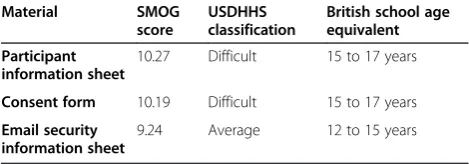
Participant Information Sheets were approved by the Research Ethics Committee (REC), and provide an over-view of the study for potential participants. Researchers are also on hand to explain the information contained in the information sheet and to ensure fully informed consent, documented with signed consent forms. Par-ticipants are not deceived in any way. Readability of information sheets was also considered and assessed using the SMOG Grading index [25]. The SMOG was calculated using an online calculator developed by its author (http://www.harrymclaughlin.com/SMOG.htm) and can generate equivalent grade levels for compre-hension, which can also be categorised in line with the United States Department of Health and Human Services (USDHHS) standards (for example, [26]). SMOG levels and equivalent classifications and school ages for the par-ticipant materials used in the present study are reported in Table 1.
Interventions
All eligible patients are offered participation in the trial following a team discussion within the Eating Disorders Service (EDS) and are then randomly assigned to one of the three conditions. This involves meeting with one member of the research team who will go through the trial protocol and information sheets. This is not the pa-tient’s individual clinician, but the appointment can poten-tially occur directly before or after a planned appointment if this is more convenient for the participant. This helps ensure completion of questionnaires and enables the par-ticipant to ask any questions directly relating to the trial. If individuals decide not to participate in the trial, they are offered treatment as usual.
Both GSH interventions are based on a self-help treat-ment [20,27] that has docutreat-mented efficacy, and a copy of the book is provided to patients. The treatment is “program-led”[28]; that is, the aim of the therapist is to support the patient in adhering to the principles of the book, and thus does not require extensive clinical train-ing. The treatment is designed so that non-specialist therapists can readily administer this intervention [29].
Face-to-face GSH
This treatment follows the self-help manual,Overcoming Binge Eating[20,27], and provides 10 sessions of face-to-face therapist care, with each session lasting 20 to 25 mi-nutes. The first session may last longer than this, due to a need to review since the patient was last seen at the EDS and to allow the patient more time to socialise to treatment (see [28]). Guidance for the provision of GSH has been provided in Fairburn [28], and 10 sessions are provided over a period of 12 weeks. There is no specific guidance about the frequency of sessions, although the initial sessions are recommended to be at least weekly with the remaining sessions being adapted to suit the pa-tient’s progress [28]. A typical format might be to have the first eight sessions weekly, with the remaining two occurring over the following month (that is, fortnightly).
[image:3.595.56.291.651.733.2]The second edition of the book in particular [27] might be considered as ‘multicomponent GSH’ as it has been based on Cognitive Behaviour Therapy-Enhanced (CBT-E) [30] and designed to address many core elements of an eating disorder, including topics such as self-monitoring, psychoeducation and regular weighing. The support pro-vided in this RCT is, adopting the taxonomy suggested by Glasgow and Rosen [31], likely to fall somewhere between ‘therapist-administered’and‘minimal contact’. A more re-cent paper [32] has elaborated further on this taxonomy, suggesting that the form of GSH used here is best de-scribed as‘minimal contact therapy’as opposed to‘ therap-ist-administered’, the latter being where self-help material “augments the impact of a standard therapy”(p. 90,). The recent review of Farrand and Woodford [33] found a lack Table 1 Readability estimates for participant information
sheets
Material SMOG score
USDHHS classification
British school age equivalent
Participant information sheet
10.27 Difficult 15 to 17 years
Consent form 10.19 Difficult 15 to 17 years
Email security information sheet
of studies adopting this taxonomy, although the definition suggested by Glasgow and Rosen [31] (and the more up-dated modifications from Newman et al. [32]) might be difficult to determine a priori. Many evaluations of self-help treatment have considered both of these categories together under the wider umbrella of‘GSH’and, while the lack of definition regarding the degree of involvement from professionals is a shortcoming of the existing lit-erature [33], it is hoped that a retrospective assess-ment of this can be made in the current study. It would be interesting to look at the content of GSH sessions retrospectively to consider the degree of support (that is, ‘therapist-administered’ or ‘minimal contact’) as a pos-sible moderator of outcome. In terms of treatment in the current study, GSH was devised by the developer to involve a therapist, but to a lesser degree than in con-ventional CBT (see [28]). The treatment was designed to be used by non-specialist therapists who help the patient follow the GSH programme [29] by providing support, en-couragement and monitoring of progress. Therapists also discuss goals and elements of the programme identified by patients as those that they wish to raise (for example, parts they donot understand, disagree with or parts that are not especially relevant), as well as potential solutions.
Of note, the term‘therapist’is used here to refer to those individuals on the‘professional side’of the patient-therapist dyad. However, some authors (for example, [34,35]) have argued that use of this term in self-help could set up certain expectations about the treatment that might hamper pro-gress; thus, terms such as‘guide’and‘facilitator’have alter-natively been used. As in other treatments and manuals the precise term used could be modified to suit the individual setting (for example, see [36]).
Email supported GSH
This treatment involves patient-therapist contact via e-mail. Patients are advised to follow the treatment closely (which is divided into ‘steps’) and instructed to contact the therapist at least once a week, and can receive feed-back up to twice a week for a period of 12 weeks [19]. Email is the preferred medium for all communication, with face-to-face and telephone appointments occurring at a minimum. The one exception to this is that the first appointment is always conducted in person so that the patient can meet their therapist, receive a copy of the manual, be weighed at the clinic and so on. As sparse guidance exists on how best to implement email sup-ported GSH, the treatment has been conceived firstly to parallel the face-to-face condition (see above); for ex-ample, contact is less frequent towards the end of the sessions. We have, secondly, followed the methodology of Ljotsson et al. [19] as this was the first example of providing GSH with the current manual with email sup-port. Participants could (although this is not an exclusive
list): get feedback on homework and progress; ask ques-tions; and receive guidance regarding the self-help pro-gram. A more recent study [12] has described a similar intervention, although less detail is reported on the exact nature of support. The focus of supervision and the practice of treatment were to follow the guidelines of the therapist’s manual [28]. In the current study, thera-pists are advised to follow similar guidelines to the face-to-face condition. For example, therapists will still aim to discuss problems, identify solutions and monitor pro-gress; the treatment is proposed to be delivered in a similar manner, but via the medium of email. The focus in both treatment conditions is on the eating disorder, and therapists may only address other issues if they are of “immediate relevance to the binge eating problem” ([28], p. 9). Email can be sent securely by both patient and therapist although patients will have to agree to download a software package from Cisco and create a password (this is optional, although it enhances data se-curity). Identification of any significant increased risk (for example, medical, suicidal) would prompt a tele-phone call or face-to-face meeting from the therapist.
Delayed treatment condition
The delayed treatment condition lasts 12 weeks, and data obtained from this period serve as waiting list con-trol conditions. As at other stages of treatment, if, at re-view, participants wish to opt out of the study they will receive treatment as usual. There is no six-month follow-up for this condition.
Primary and secondary outcomes
The primary outcome will be frequency of objective bulimic episodes, as assessed by the Eating Disorder Examination Questionnaire (EDE-Q) (see below). Compar-isons will be made between pre-treatment, post-treatment and follow-up in the intervention groups. Secondary out-come measures include overall eating psychopathology, other ED behaviours, such as self-induced vomiting, psy-chological distress, self-esteem, functional impairment and healthcare usage, assessed by self-report (see below). Some of these variables (for example, severity of ED psychopath-ology) will be considered as predictors of outcome, as well as considered aspossible mediating or moderating variables, such as therapeutic alliance or type of thera-peutic support.
Assessments and timeline
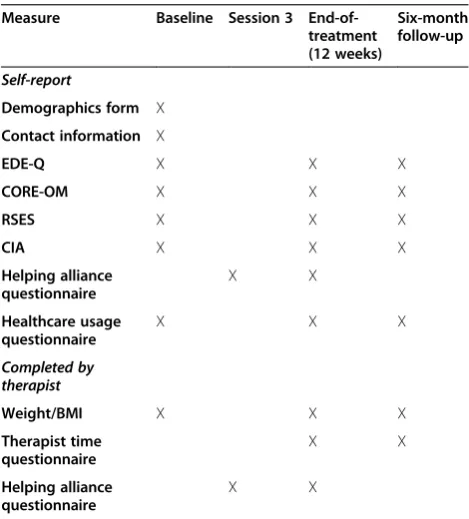
further. If they are then eligible for, and consent to, the trial they meet with one of the research team to give written consent. The assessment procedure is outlined in Table 2.
Data from the following measures will be collected: The EDE-Q v6.0; [37] is a self-report questionnaire that assesses eating disorder symptoms and has good psychometric properties [38]. Participants rate how fre-quently they have experienced symptoms (both attitu-dinal and behavioural) of an ED over the last month on a 0 to 6 scale (ranging from“no days”to“every day”).
The Clinical Outcomes in Routine Evaluation-Outcome Measure (CORE-OM; [39]) is a self-report measure of general psychological distress. Thirty-four items assess symptoms over the preceding week and are rated on a five-point frequency scale (from“not at all”to“most or all of the time”), which can generate a global score indicating overall functioning. Its utility in eating disorders has been demonstrated [40].
The Rosenberg Self-Esteem Scale (RSES; [41]) comprises 10 items that measure global self-esteem. Responses are given on a four-point scale from 1 (“strongly agree”) to 4 (“strongly disagree”), with half of the items reverse-scored.
The Clinical Impairment Assessment (CIA; [42]) is a 16-item self-report measure assessing psychosocial im-pairment resulting from ED symptoms. Participants are asked to consider the preceding 28 days and to indicate to what degree symptoms of an ED have affected different
areas of their life. Responses range from “Not at all” to “A lot” (scored from 0 to 3), and a total score (0 to 48) can be calculated giving an overall indication of functional impairment. The CIA has demonstrated acceptable psy-chometric properties across a range of samples [43].
The Helping Alliance questionnaire (HAq-II; [44]) is a 19-item measure of therapeutic alliance, showing good psychometric properties. It comprises both positive and negative items (which are reverse-scored), and includes both a patient- and therapist-version. Statements regard-ing the therapeutic alliance are rated from 1 (“strongly disagree”) to 6 (“strongly agree”). A mean score is calcu-lated by adding up all items (reverse-scoring as appro-priate), calculating a mean, and then multiplying this by 19 (which should be identical to the total score if all items are completed). Thus, scores range from 19 to 114 (with higher scores indicating better alliance). It has the advantage of assessing alliance independent of symptom improvement and has been used in previous ED treat-ment studies (for example, [45]).
In addition, a measure assessing healthcare use devel-oped specifically for this study will be given (see Additional file 1). This will be administered with the standard pack of questionnaires (that is, at start-of-treatment, end-of-treatment and follow-up) for individuals who con-sent to the study. An estimate of cost effectiveness will be made by monitoring resource use directly associated with different treatment conditions (for example, therapist time spent providing care). The proportion of binge-free days (estimated through the EDE-Q) will also be used to estimate cost effectiveness (for example, [46]). Therap-ist time will be estimated using a simple checklTherap-ist of time spent engaged in treatment-related activities. The mea-sures listed should allow comparison with other studies [33] and also overcome some of the shortcomings in previous studies, such as limited estimates of cost-effectiveness. Self-report measures may also limit obser-ver bias, although this may be open to subject bias. The lack of a structured clinical interview (for example, the Eating Disorder Examination) is also a shortcoming, al-though patients are screened on the basis of meeting cri-teria for an eating disorder, following an interview with an experienced clinician.
Sample size
[image:5.595.56.291.447.707.2]A power calculation (using anα(two-tailed) of 0.05, an an-ticipated effect size of 1.0 and a desired power of 0.8) sug-gested that a minimum number of 17 individuals per group [47], thus a minimum N of 51 is required. This was based on the findings of Ljotssonet al. [19], who reported a reduction in Global EDE-Q scores during self-help treat-ment of 1.1 (SD= 0.9). Notable variability in effect sizes for GSH treatment has been reported, with a recent sys-tematic review of self-help interventions finding an overall Table 2 Schedule for assessment
Measure Baseline Session 3 End-of-treatment (12 weeks)
Six-month follow-up
Self-report
Demographics form X
Contact information X
EDE-Q X X X
CORE-OM X X X
RSES X X X
CIA X X X
Helping alliance questionnaire
X X
Healthcare usage questionnaire
X X X
Completed by therapist
Weight/BMI X X X
Therapist time questionnaire
X X
Helping alliance questionnaire
X X
effect size of 0.54 (95% CIs 0.36 to 0.72) across eight stud-ies [33] and another [48] citing effect sizes for the fre-quency of binge eating ranging from .03 to 2.68. Effect sizes in such studies have been shown to be affected by factors such as level of pathology, sample (for example, community vs. clinical), and length of follow-up [33]. Therefore, we are aiming for a minimum N of 51, but ideally closer to 44 per group [47] to account for this vari-ability and to minimise the risk of the study being under-powered. Thus, a minimum overall recruitment sample of 102 is sought, estimating dropout at 50%, slightly less than the 55% reported by Loeb et al. [3] and higher than the approximately 23 % reported by Ljotssonet al. [19]. Attri-tion rate has been considered as an important factor in evaluating such trials [48]. Therefore, in the current study, an attempt is made to more clearly define individuals who do not complete treatment, for example, noting at what point participants ceased treatment (for example, [49]).
Allocation
Participants who have given written consent to participate will be randomly assigned to a waiting list, face-to-face GSH, or email GSH condition, with a 1:1:1 allocation as per a computer-generated random number sequence. Numbers are stratified (for example, 0 to 0.333) and cor-respond to allocation to a treatment arm. If participants in the waiting list condition wish to remain in the trial, they will then be randomised to one of the two treatment con-ditions using the same method, but with a 1:1 allocation. In order to further enhance allocation concealment, the allocation for the first cohort of cases (the number is not disclosed here) has been determineda priori. If more indi-viduals than this are recruited, the procedure will be re-peated. Reviews have highlighted unclear randomisation procedures in many RCTs [33], and this method should limit predictability of allocation due to use of“a random and unpredictable assignment sequence” ([50]; see also [51]). Although this was conducted by the Chief Investiga-tor (CI) (rather than an external researcher), sequence generation was completed prior to the first participant being recruited and participants are allocated only after full informed consent is received. In line with GCP guid-ance, full consent is obtained at least 24 hours after meeting with a member of the research team, and thus treatment allocation is not known at the time of recruit-ment, keeping allocation concealed until treatment is assigned [50].
Data collection
Data from the EDE-Q provide the primary outcome variable - binge eating frequency. Secondary variables in-clude compensatory behaviours (for example, self-induced vomiting), and ED psychopathology, as well as constructs assessed by the other measures (self-esteem, psychological
distress, functional impairment). Weight and BMI are not outcome variables, but may be included in analyses, for ex-ample, to give demographic information or as covariates. Other routine demographic information (for example, eth-nicity) will also be recorded. Participants are asked to complete self-report measures (mailed or otherwise given by hand) at start-of-treatment, end-of-treatment and six-month follow-up (with the exception of the HAq-II; see Table 2). Data will be stored on a secure computer server and analysed with computer statistics software (for example, SPSS IBM Corporation, Armonk, NY, USA). Oxford is the lead site for data coordination. In order to promote data quality, data will be examined for impossible values and a sample of electronic data (around 10%) will be double-checked by another researcher with raw data. Blinding is not used in this study, and so an emphasis on appropriate outcome measurement and allocation con-cealment is crucial [50,51].
Statistical methods
Regarding the primary aim - comparing active treatment and control condition - results will be analysed using analysis of variance and t-tests. Effect sizes will also be assessed, and expressed appropriately (for example, Cohen’s d). Logistic regression analyses will look at pre-dictors of outcome, and potential mediators and moder-ators might also be considered. However, a number of existing studies addressing this issue have been under-powered [33] so this remains an important consider-ation. Differences in outcome variables will be analysed (for example, throughχ2, regression) to examine attrition/ drop-out. In terms of cost-effectiveness, analyses will be conducted based on data obtained through the health util-isation questionnaire, therapist time questionnaire and measures of functional impairment (CIA) and ED symp-toms (EDE-Q).
Therapists, training and supervision
that the workforce may change over the course of the study; therefore, it is impossible to say at this point pre-cisely who will comprise the personnel.
The training and background of therapists has also been identified as an issue in therapist-administered treatments [52-54]. In the current trial, all therapists are specifically trained in the use of GSH, which involves ex-tensive reading of the book, consultation of the therapist manual and supervision with the CI, a clinical psycholo-gist experienced in the provision and supervision of GSH. As in the original effectiveness study [29], supervi-sion is closer for a therapist’s first few cases. Therapists are recruited from the local NHS (Mental Health) Trust and no prior experience in working with EDs is required. Most are likely to be recruited from the Eating Disorders Service providing the treatment, although therapists from other services (for example, Child and Adolescent Mental Health Services(CAMHS)) have expressed inter-est. Although research has found mixed results (includ-ing some find(includ-ing no differences in clinical outcomes) when considering different ‘types’ of therapists, ther-apist factors have been found to be important, even in Internet-delivered interventions (for example, [55]), and both research and clinical practice may benefit from a focus on “what the therapist actually does”[56], p. 282. To this end, clinical notes (including email tran-scripts) are regularly reviewed by the supervisor, in part also to maintain treatment fidelity.
An‘understudy’system is in place (for example, [30]) in case of therapist absence, although this is recom-mended to be avoided wherever possible. All therapists are instructed to familiarise themselves completely with the treatment manual and to read specific preparatory material (such as the therapist manual). Therapists meet with the CI prior to the start of the trial in order to dis-cuss any major concerns or to raise any questions. Their adherence to the protocol will be monitored through supervision and meetings with the Chief Investigator. Therapists keep electronic notes of each session, in addition to a record of direct time spent on patient care (for cost-effectiveness evaluation). Patients are allocated to therapists according to site and therapist availability.
Dr. Jenkins serves as the overall supervisor for the study as well as the on-site supervisor for one of the lo-cations (Oxford). Other lolo-cations are supervised on-site by other senior psychologists with extensive experience in eating disorders. In order to pilot a novel medium of supervision, therapists receive cross-site supervision from Dr. Jenkins via an online, secure, discussion forum. Questions and responses can be posted such that all therapists involved in the study have access to this whenever they have a secure Internet connection. This also allows detailed analysis of the content of supervision for evaluation purposes.
Data monitoring
Research governance The local REC will review the project at least annually, including safety and progress reports from the principal investigator. Any significant modifications to the protocol will be submitted for ap-proval to the REC prior to implementation and in ac-cordance with policies. Case report forms (CRFs) are also kept, in line with GCP principles.
Protocol adherence and untoward eventsNon-negligent indemnity is provided by Oxford Health NHS Foundation Trust, which is responsible for monitoring the safety of any data obtained and also acts as the study sponsor. Data are kept on a secure server, which requires password ac-cess. The Trust monitors the study and has authority to review the protocol and suspend the trial, and also en-sures that the study is being conducted according to the protocol. Any adverse events identified in the study are immediately reported to the Trust. A pilot study will be conducted to evaluate both the methodology and to give a more accurate estimate of sample size requirement (see [57]). A new edition of the self-help book [27] has re-cently been released and an amendment to the protocol submitted to the local REC has permitted use of the sec-ond edition with all but the first 15 individuals, who will form a pilot study.
Trial closureThe end of the trial will be the date of the last follow-up of the last participant.
Confidentiality All study-related information will be stored securely, with participant information kept in locked file cabinets in areas with restricted access. Unique partici-pant identifiers will be used (rather than names) to main-tain confidentiality, although a document linking these two identifiers will be kept in case of need (for example, a par-ticipant later requesting that their data be removed). Data files including the full dataset will not include names to en-sure confidentiality.
Discussion
forums as part of mental health treatment (for example, [59]). As is also suggested in the recent review of Aardoom and colleagues [60], future studies would benefit from investigating therapeutic alliance across face-to-face and Internet-delivered treatments. Although some limita-tions of the current design exist (for example, imperfect al-location concealment, lack of blinding, lack of a placebo control (see [31]), it is hoped that the results of this meth-odology will produce high ecological and external validity, as this (clinical) sample is recruited through a typical UK healthcare service, and may be described as a ‘pragmatic RCT’[51].
Although Internet-delivered interventions have prom-ise and appear to be highly acceptable ([60]; see also [61]), there are many potential drawbacks. Some studies report negative feedback regarding email communication (for example, [7,62]), and individuals may require add-itional commitment or motivation than a treatment requir-ing face-to-face attendance. Further, although computer literacy is increasing (that is, the“digital divide”is decreas-ing; [63]), some individuals do not have access to the ne-cessary materials that may be required for email therapy (for example, [64,65]). As a number of authors have sug-gested, it may be the case that‘e-therapy’is appropriate for some, but not for others. It is hoped that the results of the current trial might go some way towards supporting thera-peutic equivalence for the two treatments, and thus give patients more choice when accessing treatment.
Results of this study are hoped to inform different ways of delivering the‘first step’of eating disorders care. It aims to determine the relative effectiveness of email-provided care compared to traditional face-to-face care and a control condition. Furthermore, it aims to look at novel methods of supervision and to evaluate the cost-effectiveness of these interventions. In this way, it is hoped that clear directions for future research and care provision might be identified, ideally those that offer patients with eating disorders the most effective treatments, in a man-ner that suits them, with the best economic value.
Trial status
The trial is now recruiting (as of August 2013), and is scheduled to continue until July 2017.
Additional file
Additional file 1:Measure to assess healthcare use.
Abbreviations
BED:Binge eating disorder; BMI: Body mass index; BN: Bulimia nervosa; CBT: Cognitive behaviour therapy; CIA: Clinical Impairment Assessment; CORE-OM: Clinical Outcomes in Routine Evaluation - Outcome Measure; ED: Eating disorder; EDE-Q: Eating Disorder Examination Questionnaire; EDS: Eating Disorders Service; GCP: Good Clinical Practice; GSH: Guided self-help; HAq-II: Helping Alliance Questionnaire; NHS: National Health
Service; NICE: National Institute of Health and Care Excellence; IAPT: Improving Access to Psychological Therapies; REC: Research Ethics Committee; RCT: Randomised controlled trial; RSES: Rosenberg Self-Esteem Scale.
Competing interests
The authors declare that they have no competing interests.
Authors’contributions
PEJ and NB conceived of the study, and participated in its design and coordination and drafted the manuscript. AB and AL offered additional comments on the design and revised the manuscript. All authors read and approved the final manuscript.
Acknowledgements
The authors would like to thank Professors C. G. Fairburn and G. T. Wilson for helpful comments and assistance in designing the methods for the study. They would also like to acknowledge the assistance of Dr. Rachel Woolrich and our appreciation also goes to all therapists and assessors involved in the study.
Oxford Health NHS Foundation trust provided financial support for the conduct of this research. The Trust has no direct involvement in study design and analysis, writing the manuscript, or the decision to submit for publication. Submission of this work was supported by the University of Birmingham.
Received: 20 September 2013 Accepted: 8 May 2014 Published: 22 May 2014
References
1. National Institute for Clinical Excellence:Eating Disorders: core Interventions in the Treatment and Management of Anorexia Nervosa, Bulimia Nervosa and Related Eating Disorders.London: National Institute for Health and Care Excellence; 2004.
2. Fairburn CG, Carter JC:Self-help and guided self-help for binge eating problems.InHandbook of Treatment for Eating Disorders.Edited by Garner DM, Garfinkel PE. New York: Guilford Press; 1997:494–499.
3. Loeb KL, Wilson GT, Gilbert JS, Labouvie E:Guided and unguided self-help for binge eating.Behav Res Ther2000,38:259–272.
4. Ruwaard J, Lange A, Broeksteeg J, Renteria-Agirre A, Schrieken B, Dolan CV, Emmelkamp P:Online cognitive-behavioural treatment of bulimic symptoms: a randomised controlled trial.Clin Psychol Psychother2013, 20:308–318.
5. Wilson GT, Zandberg LJ:Cognitive-behavioral guided self-help for eating disorders: effectiveness and scalability.Clin Psychol Rev2012, 32:343–357.
6. Stefano SC, Bacaltchuk J, Blay SL, Hay P:Self-help treatments for disorders of recurrent binge eating: a systematic review.Acta Psychiatr Scand2006, 113:452–459.
7. Robinson P, Serfaty M:Getting better byte by byte: a pilot randomised controlled trial of email therapy for bulimia nervosa and binge eating disorder.Eur Eat Disord Rev2008,16:84–93.
8. Robinson PH, Serfaty MA:The use of e-mail in the identification of bulimia nervosa and its treatment.Eur Eat Disord Rev2001,9:182–193.
9. Simpson S, Bell L, Knox J, Mitchell D:Therapy via videoconferencing: a route to client empowerment?Clin Psychol Psychother2005, 12:156–165.
10. Simpson S, Knox J, Mitchell D, Ferguson J, Brebner J, Brebner E: A multidisciplinary approach to the treatment of eating disorders via videoconferencing in north-east Scotland.J Telemed Telecare2003, 9:37–38.
11. Crow SJ, Mitchell JE, Crosby RD, Swanson SA, Wonderlich SA, Lancanster K: The cost-effectiveness of cognitive behavioural therapy for bulimia nervosa delivered via telemedicine versus face to face.Behav Res Ther 2009,47:451–453.
13. McKenna G, Hevey D, Martin E:Patients’and providers’perspectives on bibliotherapy in primary care.Clin Psychol Psychother2010, 17:497–509.
14. Department of Health:Talking Therapies: a Four-Year Plan of Action.London: Department of Health; 2011.
15. Simon J, Schmidt U, Pilling S:The health service use and cost of eating disorders.Psychol Med2005,35:1543–1551.
16. Banasiak SJ, Paxton SJ, Hay P:Guided self-help for bulimia nervosa in primary care: a randomized controlled trial.Psychol Med2005, 35:1283–1294.
17. Walsh BT, Fairburn CG, Mickley D, Sysko R, Parides MK:Treatment of bulimia nervosa in a primary care setting.Am J Psychiatry2004, 161:556–561.
18. Palmer RL, Birchall H, McGrain L, Sullivan V:Self-help for bulimic disorders: a randomised controlled trial comparing minimal guidance with face-to-face or telephone guidance.Br J Psychiatry2002,181:230–235.
19. Ljotsson B, Lundin C, Mitsell K, Carlbring P, Ramklint M, Ghaderi A:Remote treatment of bulimia nervosa and binge eating disorder: a randomised trial of internet-assisted cognitive behavioural therapy.Behav Res Ther 2007,45:649–661.
20. Fairburn CG:Overcoming Binge Eating.New York: Guilford Press; 1995. 21. Wagner G, Penelo E, Wanner C, Gwinner P, Trofaier M-L, Imgart H, Waldherr
K, Wöber-Bingöl C, Karwautz AF:Internet-delivered cognitive-behavioural therapy v. conventional guided self-help for bulimia nervosa: long-term evaluation of a randomised controlled trial.Br J Psychiatry 2013,202:135–141.
22. Bulik CM, Marcus MD, Zerwas S, Levine MD, Hofmeier S, Trace SE, Hamer RM, Zimmer B, Moessner M, Kordy H:CBT4BN versus CBTF2F: comparison of online versus face-to-face treatment for bulimia nervosa.Contemp Clin Trials2012,33:1056–1064.
23. Chan A-W, Tetzlaff JM, Gøtzsche PC, Altman DG, Mann H, Berlin J, Dickersin K, Hróbjartsson A, Schulz KF, Parulekar WR, Krleža-JerićK, Laupacis A, Moher D:SPIRIT 2013 explanation and elaboration: guidance for protocols of clinical trials.BMJ2013,346:e7586.
24. Carlbring P, Nilsson-Ihrfelt E, Waara J, Kollenstam C, Buhrman M, Kaldo V, Söderberg M, Ekselius L, Andersson G:Treatment of panic disorder: live therapy vs. self-help via internet.Behav Res Ther2005, 43:1321–1333.
25. McLaughlin GH:SMOG grading: a new readability formula.J Reading 1969,12:639–646.
26. Walsh TM, Volsko TA:Readability assessment of internet-based consumer health information.Respir Care2008,53:1310–1315.
27. Fairburn CG:Overcoming Binge Eating.2nd edition. New York: Guilford Press; 2013.
28. Fairburn CG:Guided Self-Help for Bulimia Nervosa: Therapist’s Manual.Oxford: University of Oxford; 1999.
29. Carter JC, Fairburn CG:Cognitive behavioural self-help for binge eating disorder: a controlled effectiveness study.J Consult Clin Psychol1998, 66:616–623.
30. Fairburn CG:Cognitive Behavior Therapy and Eating Disorders.New York: Guilford Press; 2008.
31. Glasgow RE, Rosen GM:Behavioral bibliotherapy: a review of self-help behavior therapy manuals.Psychol Bull1978,85:1–23.
32. Newman MG, Szkodny LE, Llera SJ, Przeworski A:A review of technology-assisted self-help and minimal contact therapies for anxiety and depression: is human contact necessary for therapeutic efficacy? Clin Psychol Rev2011,31:89–103.
33. Farrand P, Woodford J:Impact of support on the effectiveness of written cognitive behavioural self-help: a systematic review and meta-analysis of randomised controlled trials.Clin Psychol Rev2013,33:182–195.
34. Traviss GD, Heywood-Everett S, Hill AJ:Guided self-help for disordered eating: a randomised control trial.Behav Res Ther2011,49:25–31. 35. Rogers A, Oliver D, Bower P, Lovell K, Richards D:Peoples’understandings
of a primary care-based mental health self-help clinic.Patient Educ Couns 2004,53:41–46.
36. Weissman M, Verdeli H:Interpersonal psychotherapy: evaluation, support, triage.Clin Psychol Psychother2012,19:106–112.
37. Fairburn CG, Beglin SJ:Assessment of eating disorders: interview or self-report questionnaire?Int J Eat Disord1994,16:363–370. 38. Peterson CB, Crosby RD, Wonderlich SA, Joiner T, Crow SJ, Mitchell JE,
Bardone-Cone AM, Klein M, Le Grange D:Psychometric properties of the
eating disorder examination-questionnaire: factor structure and internal consistency.Int J Eat Disord2007,40:386–389.
39. Barkham M, Margison F, Leach C, Lucock M, Mellor-Clark J, Evans C, Benson L, Connell J, Audin K, McGrath G:Service profiling and outcomes benchmarking using the CORE-OM: toward practice-based evidence in the psychological therapies.J Consult Clin Psychol2001,69:184–196. 40. Jenkins PE, Turner HM:An investigation into the psychometric properties
of the CORE-OM in patients with eating disorders.Counsel Psychother Res in press.
41. Rosenberg M:Society and the Adolescent Self-Image.Middletown, CT: Wesleyan University Press; 1989.
42. Bohn K, Fairburn CG:The Clinical Impairment Assessment questionnaire (CIA).InCognitive Behavior Therapy and Eating Disorders.Edited by Fairburn CG. New York: Guilford Press; 2008:315–316.
43. Jenkins PE:Psychometric validation of the clinical impairment assessment in a UK eating disorder service.Eat Behav2013,14:241–243. 44. Luborsky L, Barber JP, Siqueland L, Johnson S, Najavits LM, Frank A, Daley D:
The Revised Helping Alliance Questionnaire (HAq-II): psychometric properties.J Psychother Pract Res1996,5:260–271.
45. Carter O, Pannekoek L, Fursland A, Allen KL, Lampard AM, Byrne SM: Increased wait-list time predicts dropout from outpatient enhanced cog-nitive behaviour therapy (CBT-E) for eating disorders.Behav Res Ther 2012,50:487–492.
46. Lynch FL, Striegel-Moore RH, Dickerson JF, Perrin N, Debar L, Wilson GT, Kraemer HC:Cost-effectiveness of guided self-help treatment for recurrent binge eating.J Consult Clin Psychol2010,78:322–333. 47. Faul F, Erdfelder E, Lang A-G, Buchner A:G*Power 3: a flexible statistical
power analysis program for the social, behavioral, and biomedical sciences.Behav Res Methods2007,39:175–191.
48. Beintner I, Jacobi C, Schmidt UH:Participation and outcome in manualized self-help for bulimia nervosa and binge eating disorder– a systematic review and metaregression analysis.Clin Psychol Rev2014, 34:158–176.
49. Eysenbach G:The law of attrition.J Med Internet Res2005,31:e11. 50. Moher D, Schultz KF, Altman DG:The CONSORT statement: revised
recommendations for improving the quality of reports of parallel-group randomised trials.Lancet2001,357:1191–1194.
51. Hotopf M:The pragmatic randomised controlled trial.Adv Psychiatr Treat 2002,8:326–333.
52. Bower P, Gilbody S:Managing common mental health disorders in primary care: conceptual models and evidence base.BMJ2005,330:839. 53. Coull G, Morris PG:The clinical effectiveness of CBT-based guided
self-help interventions for anxiety and depressive disorders: a systematic review.Psychol Med2011,41:2239–2252.
54. Robinson E, Titov N, Andrews G, McIntyre K, Schwencke G, Solley K:Internet treatment for generalized anxiety disorder: a randomized controlled trial comparing clinician vs. technician assistance.PLoS One2010,5:e10942. 55. Almlöv J, Carlbring P, Berger T, Cuijpers P, Andersson G:Therapist factors in
Internet-delivered cognitive behavioural therapy for major depressive disorder.Cogn Behav Ther2009,38:247–254.
56. Paxling B, Lundgren S, Norman A, Almlöv J, Carlbring P, Cuijpers P, Andersson G:Therapist behaviours in Internet-delivered cognitive behaviour therapy: analyses of e-mail correspondence in the treatment of generalised anxiety disorder.Behav Cogn Psychother2013,41:280–289. 57. Lancaster GA, Dodd S, Williams PR:Design and analysis of pilot studies:
recommendations for good practice.J Eval Clin Pract2004,10:307–312. 58. Bedrosian RC, Striegel RH, Wang C, Schwartz S:Association of binge eating
with work productivity impairment, adjusted for other health risk factors.J Occup Environ Med2012,54:385–393.
59. Wagner B, Schulz W, Knaevelsrud C:Efficacy of an internet-based intervention for posttraumatic stress disorder in Iraq: a pilot study.Psychiatry Res2012, 195:85–88.
60. Aardoom JJ, Dingemans AE, Spinhoven P, Van Furth EF:Treating eating disorders over the internet: a systematic review and future research directions.Int J Eat Disord2013,46:539–552.
61. Dölemeyer R, Tietjen A, Kersting A, Wagner B:Internet-based interventions for eating disorders in adults: a systematic review.BMC Psychiatry2013, 13:207.
63. Ybarra ML, Eaton WW:Internet-based mental health interventions. Ment Health Serv Res2005,7:75–87.
64. Andrewes H, Kenicer D, McClay C-A, Williams C:A national survey of the infrastructure and IT policies required to deliver computerised cognitive behavioural therapy in the English NHS.BMJ Open2013,3:e002277. 65. Kenicer D, McClay C-A, Williams C:A national survey of health service
infrastructure and policy impacts on access to computerised CBT in Scotland.BMC Med Inform Decis Mak2012,12:102.
doi:10.1186/1745-6215-15-181
Cite this article as:Jenkinset al.:Comparison of face-to-face versus email guided self-help for binge eating: study protocol for a randomised controlled trial.Trials201415:181.
Submit your next manuscript to BioMed Central and take full advantage of:
• Convenient online submission
• Thorough peer review
• No space constraints or color figure charges
• Immediate publication on acceptance
• Inclusion in PubMed, CAS, Scopus and Google Scholar
• Research which is freely available for redistribution