Designing and Development of Teacher Module for
Online Computerized Examination Having One Word
Answer Questions and Validating the Answer by Use of
Phonetic Algorithm
Vimal P.Parmar
*, Dr. CK Kumbharana
** *DResearch Scholar, Dept. of Comp. Sci., Saurashtra University, Rajkot. Gujarat, INDIA **
Head, Guide, Department of Computer Science, Saurashtra University Rajkot. Gujarat, INDIA
Abstract- Today online computerized examination is widely used
to automate the examination process and quick evaluation of student saves amount of time for teachers. Hours of time and efforts are required for preparation of question papers and evaluating the answer sheet by teachers in manual examination system. But manual examination system is an effective examination system which involves objective as well as subjective types of questions. To make online examination system as effective as manual system, it requires tremendous amount of time and human effort to build an intelligent system that not only allows taking online examination but also performs automatic evaluation with vast amount of knowledge. In such types of questions, taking user response as an input is easier than the evaluation of answers. This paper is intended as an effort to introduce subjective type of questions in an online examination. The questions are included as one word answer questions and fill in the blanks type of questions. Computer is an intellectual device capable of processing and helping robust question answer by teacher. During entering question answer set, there may be chances of error in preparation of the test specifically to answers. Typographical errors or misspelled word can result into incorrect evaluation. By using computer as an intellectual tool that can be used as a solution for such a problem. Online examination is used in most of the educational institutes and software organizations having multiple choice questions but by adding one word question answers improves assessment process.
This paper is about to design a teacher module to help preparing robust question answer pair set by testing the entered answer for typographical error and generating a set of homophones phonetically similar to the entered misspelled word answer. Teacher model allows preparation of questions for various subjects to test the correctness of the model.
Index Terms- Online examination, computerized test, Automatic
Evaluation, Objective and subjective tests, MCQ, One word question answer, Pattern recognition, Artificial intelligence, Teacher module.
I. INTRODUCTION
nline computerized test with one word answer is required to prepare robust error free answer key. If key contains any misspelled or typographical error in any answer then it will
directly affect the evaluation process. For this, a teacher model is designed, developed and implemented that will help teacher for preparing a test by using homophone and semantic map mechanism. The semantic map of homophones is used for fast retrieval of family of homophones by reducing the necessary processing. The model is constructed and evaluated for different types of question of various subjects. By incorporating such types of questions in an MCQ type test help better evaluation of student that not only evaluates objective knowledge of a student but tries to evaluate subjective type of knowledge. For comprehensive evaluation of subjective type knowledge requires more efforts and time but this paper can be considered as a firsts step toward this direction. The model is tested against set of test cases. Once the teacher model is completed, the test is ready to be conducted for the students. Model uses help of phonetic algorithm for generating, selecting and correcting the misspelled words. The same kind of mechanism can be applied to student model when the student attempts for an answer. The model is implemented using Java programming language as an open source language.
The model constructed in the research paper behaves like having artificial intelligence at some extent by generating and suggesting set of alternatives of given wrong word with spelling mistake. Pattern recognition to recognize homophone family is optimized by use of semantic map construct otherwise it requires more processing of comparison and searching. At last the solution is concluded with future scope.
II. INTRODUCTION OF PHONETIC ALGORITHMS
Phonetic algorithms integrated with semantic map construct are used to generate the family of homophone words for a given invalid word. Few common phonetic algorithms are described herewith [12][13][16].
A. Soundex algorithm is one of the oldest algorithm which was developed by Robert C. Russell and Margaret K. Odell in 1918 returning a four character string for the given word[14].
B. Daitch-mokotoff soundex is a modified version of original soundex and named as D-M soundex which was designed in 1985 by Gary mokotoff
and later improved by Randy Daitch to match surnames of Slavic and German languages and returning the six digit numeric code for the given word.
C. Kolner phonetic algorithm functions similar to as soundex algorithm but was designed for German words.
D. Metaphone variation of algorithms identifies homophones for most of the English words and that’s why these algorithms are used for many English spell checkers as well as dictionaries. First version of metaphone algorithm was developed by Lawrence Phillips in 1990. Then next metaphone version by him was the double metaphone which has included other languages too. In 2009 the third metaphone version was released by him with the accuracy of 99% of English words[15].
E. NYSIIS means New York state Identification and Intelligence System known as NYSIIS phonetic algorithm developed in 1970 which has achieved increased accuracy over soundex algorithm.
F. The match rating Approach (MRA) is a phonetic algorithm which uses distance calculation between two words and developed by Western Airlines in 1977.
G. The Caverphone phonetic matching algorithm was developed by David Hood at the University of Otago in New Zealand in 2002.
All the described algorithms have advantages and special usage for which they are developed. By combining more than one algorithm it is possible to achieve the desired accuracy of phonetic comparisons. The algorithms are used in teacher’s module of test preparation to generate set of homophone words for the given word with typographical error.
III. TEXT PATTERN RECOGNITION
Text pattern recognition has many diverse applications in computer science. Text pattern recognition is one of the recent trends in research area of computing. Pattern recognition recognizes an object having specific characteristics that uniquely identifies, describes and differentiates it from any other objects. Popular techniques of pattern recognition are listed below [8][9]. Statistical Pattern recognition
Probability Density Estimation Fuzzy set theory techniques Neural network
Machine learning and signal processing
Text pattern recognition has many computer applications some of them are listed below [7].
A. Recognizing synonyms or antonyms of a given word from large set of words.
B. Recognizing homophones for a given word from a large set of words.
C. Recognizing specific text from voice.
D. Recognizing texts from different set of hand written texts.
E. Recognizing character patterns for OCR
F. Recognition texts from an image, flash file or video
G. Recognition palindrome text(s)
H. Recognition related contextual texts for a given word
I. Recognition grammatical error in text
All the above applications may use different pattern recognition technique. The teacher’s module presented in this paper uses text pattern recognition to recognize set of homophones having similar pronunciation for a given word from the large number of words to prepare semantic map of homophone words and involving it in an online examination system which is designed for one word answer question and fill in blank type question. Generated semantic map of homophones using phonetic algorithms simplifies the searching and recognizing process.
IV. TEACHER MODULE FOR ONE WORD ANSWER COMPUTERIZED TEST MODEL
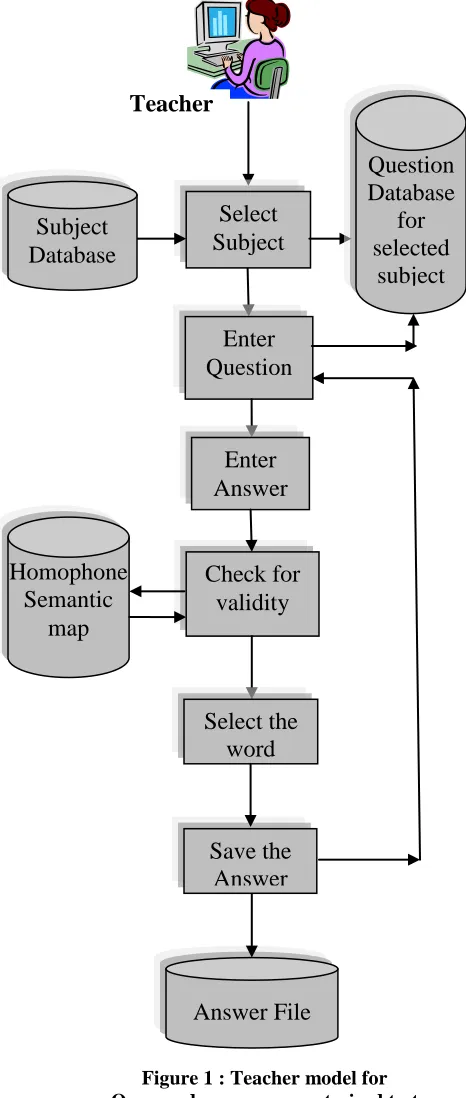
answer set for one subject same process is repeated for other subjects. The prepared set is error free as it consists of correct answers without any typographical error that will directly be compared for evaluation and thus it provides preparation of robust test with helping teacher by providing suggestions.
The teacher model for online computerized test is depicted in the following figure 1
[image:3.612.35.268.163.712.2]
Figure 1 : Teacher model for One word answer computerized test
V. TESTING OF TEACHER FOR DIFFERENT SUBJECTS
The teacher model described is implemented and tested for various subjects. Here to demonstrate the behavior of the model following ten tables each of which consists of one question for one subject with misspelled input answer and generated suggestion to correct the answer and the correct answer. Teacher is required to select correct one as an answer. Here for simplicity one question is listed and model can be experimented for as many number of questions of as many number of different subjects. The outcome of the model guarantees to store the answer with correct spelling. Entered misspelled answers are intentionally entered as wrong for testing purpose only .
Subject 1 : Computer
Question Which is an intelligent device? Input
misspelled Answer
Komputr
Generated suggestions
1. COMPTER 2. CHAMPETRE 3. COMPUTER Correct
Answer COMPUTER
Subject 2 : Chemistry
Question Kekule found a round structure of six hydrocarbon known as ________.
Input misspelled Answer
benzin
Generated suggestions
1. BENZENE 2. BENZINE 3. BENZONE 4. BOUNCING Correct
Answer BENZENE
Subject 3 : Mathematics
Question An equation of X with maximum power of 2 is known as_______ equation.
Input misspelled Answer
quadretic
Generated
suggestions 1. QUADRATIC Correct
Answer QUADRATIC
Subject 4 : English
Question Give the noun form of ‘obey’.
Input misspelled Answer
obadians
Generated 1. OBEDIENCE
Teacher
Select
Subject
Subject
Database
Question
Database
for
selected
subject
Enter
Question
Enter
Answer
Check for
validity
Homophone
Semantic
map
Select the
word
Answer File
Save the
suggestions Correct
Answer OBEDIENCE
Subject 5 : Biology
Question In human which bone is the largest and heavy?
Input misspelled Answer
femar
Generated suggestions
1. FEMUR 2. FOMOR 3. FUMARIA Correct
Answer FEMUR
Subject 6 : Physics
Question Albert Einstein invented the theory of ________.
Input misspelled Answer
rilativiti
Generated
suggestions 1. RELATIVITY Correct
Answer RELATIVITY
Subject 7 : General Knowledge
Question Marie curie invented radioactive element _______.
Input misspelled Answer
radiam
Generated suggestions
1.RADIUM 2.RADOME 3.REDEEM 4.RETAMA 5.RETEM Correct
Answer RADIUM Subject 8 : Geography
Question Sahara desert is present in which continent?
Input misspelled Answer
Afrika
Generated suggestions
1.AFRIC 2.AFRICA Correct
Answer AFRICA
Subject 9 : Science
Question “Science” is derived from Latin word meaning that _________.
Input misspelled Answer
nolege
Generated suggestions
1.KNOWLEDGE 2.NEOLOGY Correct
Answer KNOWLEDGE
Subject 10 : C Programming Language
Question To compare more than one conditions which expression is useful?
Input misspelled Answer
lojikal
Generated suggestions
1.LOGICAL 2.LOGICALLY Correct
Answer LOGICAL
VI. CONCLUSION
The constructed model can be implemented using any programming language supporting database and file handling capabilities with support of creating user friendly interface. The model is tested for ten different questions for different subjects. The model proves success for the diverse area of the words and thus can be useful for preparing a test for almost any kind of subject. The correctness of the model depends on the vocabulary of the word list and the phonetic algorithms applied for homophone recognition. Further improvement can be possible by extending the word list including the nouns. Further the model is useful for effective evaluation of the student, helpful to teacher and beneficial to the student and can be extended in future for online computerized examination.
REFERENCES
[1] Automated answering for subjective examination – Asmita Dhokrat, Gite Humant R., C. Namtrata Mahender - International Journal of Computer Applications (0975 – 8887) Volume 56– No.14, October 2012
[2] Assessment of Answers: Online Subjective Examination - Asmita Dhokrat, Gite Hanumant R , C.Namrata Mahender Proceedings of the Workshop on Question Answering for Complex Domains, pages 47–56, COLING 2012, Mumbai, December 2012.
[3] Automated Assessment of Short One-Line Free-Text Responses With Identifying Word Ordering Navjeet Kaur & Kiran Jyoti - Special Issue of IJCCT, ISSN (ONLINE) : 2231–0371, ISSN (PRINT) : 0975–7449, Volume- 3, Issue-1
[4] Automated Assessment of Short One-Line Free-Text Responses In Computer Science Navjeet Kaur & Kiran Jyoti
[5] National Online Examination System: An Architectural Perspective Pradeep Kumar, Pankaj Nirwan , P Govind Raj
[7] Anatomy of pattern recognition MAYANK PARASHER, SHRUTI SHARMA, A.K SHARMA, J. P. GUPTA - Indian Journal of Computer Science and Engineering, ISSN : 0976-5166 Vol. 2 No. 3 Jun-Jul 2011 [8] Classification Techniques in Pattern Recognition- Lihong Zheng and
Xiangjian He - Conference proceedings ISBN 80-903100-8-7 WSCG’2005, January 31-February 4, 2005 Plzen, Czech Republic
[9] Pattern Recognition Techniques - Seema Asht and 2Rajeshwar Dass, International Journal of Computer Science and Telecommunications [Volume 3, Issue 8, August 2012]
[10] Analysis and Comparative Study on Phonetic Matching Techniques Rima Shah, Dheeraj Kumar Singh International Journal of Computer Applications (0975 – 8887) Volume 87 – No.9, February 2014
[11] Name and Address matching strategy – White Paper Series Truth Technologies December 2010
[12] Vimal P. Parmar, Dr. CK Kumbharana “Study Existing Various Phonetic Algorithms and Designing and Development of a working model for the New Developed Algorithm and Comparison by implementing it with Existing Algorithm(s)” International Journal of Computer Applications (IJCA) ISSN: 0975 – 8887 Volume 98 / Number 19 (ISBN: 973-93-80883-19-1) DOI : 10.5120/17295-7795
[13] Phonetic algorithm meaning and description http://en.wikipedia.org/wiki/Phonetic_algorithm
[14] Soundex algorithm description and working mechanism http://en.wikipedia.org/wiki/Soundex
[15] Metaphone algorithm description and working mechanism,http://en.wikipedia.org/wiki/Metaphone
[16] Homophone and related linguistic concept https://en.wikipedia.org/wiki/Homophone
[17] Vimal P. Parmar, Apurva K. Pandya, Dr. CK Kumbharana “Determining the Character Replacement Rules and Implementing Them for Phonetic Identification of Given Words to Identify Similar Pronunciation Words” Futuristic Trends on Computation Analysis and Knowledge Management (ABLAZE) 2015 International Conference at Greater Noida, India Pages : 272-277 Print ISBN : 978-1-4799-8432-9 DOI : 10.1109/ABLAZE.2015.7155010 Publisher : IEEE
AUTHORS
First Author – Vimal P.Parmar, Research Scholar, Dept. of Comp. Sci., Saurashtra University, Rajkot. Gujarat, INDIA, [email protected]
Second Author – Dr. CK Kumbharana, Head, Guide