Theoretical and experimental studies on centripetal
acceleration using the Phyphox application
Sahlan
*, Ishafit
*, Suritno Fayanto
**
Department of Master in Physics Education, University of Ahmad Dahlan, Indonesia
DOI: 10.29322/IJSRP.9.09.2019.p9322 http://dx.doi.org/10.29322/IJSRP.9.09.2019.p9322
Abstract- This study aims to determine the value of centripetal
acceleration using phyphox app on Android, in terms of experimental and theoretical. Android is connected to a PC via the same WiFi network or using tethering by entering the search address available in the Phyphox application, after connecting the android is placed at the end of the electric motor, then the electric motor is driven with a circular path. The data collection process begins by running the Phyphox application through a PC to collect measurement data, Data collected on android exports to Ms Excel has done averaging techniques, the obtained angular velocity, centripetal acceleration, and time. The results of the experimental analysis showed centripetal acceleration values obtained from android as = 9,768429 m/s2 and in theory obtained
value as =9,768996144 m/s2 with erorr= 5,8040x 10⁵.
Index Terms- Android, Phyphox, Learning Physic, Sensor, Education
I. INTRODUCTION
hysics learning requires the skills of a teacher in transferring the knowledge he has to students so that students can understand the concept material they teach [1]. Studying physics can get through two approaches, analytical and experimental verification [2]. Therefore, in developing learning tools, a teacher is required to always make updates in applying learning methods in the classroom, so students can easily understand them both in terms of physical theory and experimental concepts.
Physics learning objectives include understanding and applying the scientific method of inquiry and design techniques to conduct research, solve problems, and the ability to do analysis; understand facts and concepts integrated into physics; and understand the relationship between science (physics), technology, and society [3]. However, in the current reality that most teachers teach physics is still limited to analytical theory, whereas the experimental evidence is still lacking because there are still many schools that do not have complete laboratory facilities to conduct laboratory. Presentation of learning materials without variation or lack of facilities and infrastructure is one of the obstacles in the delivery of material in the learning process [4] and requires quite expensive fees to say it. Therefore we need an alternative or solution to overcome this. One alternative that used is to use existing smartphones in students as a learning medium. The choice of smartphone based on the growing trend of using Android among students where teachers can easily use it
as a tool to do practical work in class without having to pay expensive fees.
In a survey of 132.7 million people carried out by Asosiasi Penyelenggara Jasa Internet Indonesia (Indonesia name) shows that the average Indonesian internet user uses Android and 18,4% or around 24.4 million including 10-24 years old. It shows that the number of Internet users at a young age, and there are about 69,8% of Internet users are among students [4]. With the survey results above, it is very appropriate for teachers in schools to be able to take advantage of this by directing students to use Android as a practical tool in the classroom.
Android is a new media that can use as an experimental tool to make it easier to analyze circular motion [5]. The flexibility of Android in integrating hardware components, among others, cameras, microphones, sensor tools accessories and others, as well as software development makes this mobile device potentially useful for conducting scientific experiments [6]. Besides android is a tool that many students have so that teachers are able to use this as a tool to help students understand physical concepts by doing a fun experiment using Android without having to charge students to hold tools and materials to support the practicum, whereas previous researchers have shown that Android can be used in circular motion as an experimental tool in teaching physics [7].
Android usage among young people widely spread and constant development of the technology with the availability of free applications on mobile phones it is easy to use in conducting experimental measurements and scientific demonstrations [8]. Moon et al., The use of smartphones in the classroom can increase student motivation to study science, especially physics [9]. As reported by Yunita et al., 86.67% of students has increased this value after using android and can improve students' understanding of the material presented [10]. In addition, by using Android students can replace traditional learning methods towards more modern learning by integrating the data obtained and can be analyzed quickly [11].
Development of technology in the field of learning, especially physics learning, many sensors have emerged that integrated into the Android chip, let us say one of them is Android Phyphox. Phyphox is an application program that integrates various sensors on modern Android, such as accelerometers, gyroscopes, and pressure sensors, as a basis for various experimental measurements [12]. Phyphox android apps have been selected for general physics teacher at the study site used to use android. In addition, the experimental results recorded by the sensor on the Phyphox application can be exported in Excel format, making it
easier to share via Bluetooth, email, BBM, Share-it, Wi-fi, or WhatsApp. With this convenience, the opportunity to apply Android in learning will be more efficacious [13]. One small example that can use is in circular motion material, which is when a particle moves in a circle at a constant rate [14]. Circular motion is one of the materials in learning physics that can be explained by experiments; one of the quantities in a circular motion is centripetal acceleration. Newton was the first to recognize the importance of circular motion. He showed that if a particle moves with a constant velocity v in a circle of radius r, the particle has a large acceleration v/r2 and head towards the centre of the circle. This acceleration is called centripetal acceleration [15]. However, some literature studies only focus on the aspects of circular motion without considering the centripetal acceleration
Therefore, this is what underlies so that the authors are interested in studying theoretical studies on circular motion using the application of Phyphox
II. THEORETICAL REVIEW
A. Centripetal acceleration
In a circular motion, the magnitude of instantaneous acceleration equal to the square of the speed v divided by radius R. the direction perpendicular to v and is along the radius, Because the acceleration always leads to the centre of the circle is often called centripetal acceleration [10]. An object that moves in a circle in a continuous circle will accelerate, although the
speed remains the same
(
v
1
v
2
v
)
[16]. [image:2.612.351.503.102.225.2] [image:2.612.41.279.392.512.2]A B
[image:2.612.347.548.445.664.2]Figure 1. A description of the acceleration of centripetal motion
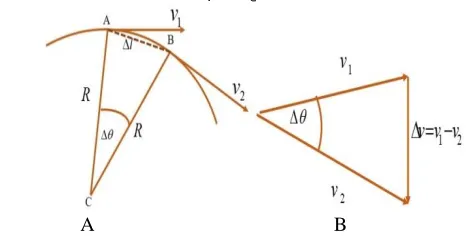
Figure 1 illustrates the motion of a particle at a constant rate in a circular radius R concentrated C. Particles moving from A to B during ∆t. Changes in velocity vector ∆v during this time shown in Figure 1 (B) [15]. Figure 1 shown the conventional centripetal acceleration obtained using the following equations:
Relations centripetal acceleration and angular velocity:
2 2 t s s
r
a
r
a
(1)Under certain conditions the speed will change due to the effect of friction, friction will cause a slowdown in rotation. Constant angular velocity (ω0) will change to (ωt), so the
equation becomes :
t
0
t
(2)Centripetal acceleration depends on
2 in equation (1) So the equation is obtained as follows: Substitution equation (2) toequation (1)
(3)
In uniform circular motion is always accelerating towards the center, the acceleration is called centripetal acceleration [15], the direction of the acceleration is always perpendicular to the instantaneous velocity and the value of the centripetal acceleration is always constant, while the circular motion changes irregularly still using the equation (see equation 1) but because the value of linear velocity changes for each different point in its movement, the centripetal acceleration value is not constant [14]
B. Phyphox
The phyphox application (as an acronym for physical telephone trials) and released on the Google Play Store and Apple's App Store in September 2016
[17].
Phyphox is a free website and application for use on PC, Android and IOS. Phyphox (in English and German) is a blog, wiki, and a list of physics experiments that can use with Android, some of them are available to see how the app works [12].Figure 2. App views Phyphox
Phyphox is one application that is very helpful in conducting physics experiments. In the Phyphox application, we can utilize sensors related to physical materials, including materials related to acoustics, mechanics, and chronometers [18]. Phyphox is an application that makes it easy to analyze and collect data quickly
and efficiently [15]. This application can activat from an android or tablet. Data reading can be a problem if the screen is not visible because this device is sure to be placed on a moving object; for that has been provided mirroring mode ("remote access") directly on the computer.
Figure 3. Tablet share the screen with PC [19]
In order to get mirroring is necessary to ensure a PC connected via Wi-Fi networks on the same network (or connected via tethering), This application also provides a private IP address that is inserted directly into the PC's browser that enables remote access to connect with mobile devices [18]. Students can see the data collected during the experiment, but they need to export data to a computer to carry out further data analysis for numerical integration in spreadsheet software such as Excel [12]. Using an acceleration sensor it must be considered that the sensor measures the acceleration in a moving system. Therefore, the device displays centrifuges rather than centripetal acceleration values [20].
In this study, we measured the extent of the vector. Using a phyphox application to find the value of centripetal acceleration, it should be noted several things like the following, if in the process of data collection should be ensured android position is placed at rest on the medium used, the vibration of the medium used is very influential on the sensor readings in obtaining data on android.
III. METHODOLOGY RESEARCH
A. Tools and materials
Tools and materials used are Android, electric motors, Acer notebooks, and Phyphox applications
B. Experimental Procedure
[image:3.612.317.569.133.302.2]Experimental procedures in this study start from:
Figure 4. Scheme research procedures
1) Preparation
The preparatory stage begins with installing applications on Android Phyphox, enable remote access on Android to connect with a PC via the same wifi network or connect via tethering,
Phyphox application provides a private IP address that can enter into a PC browser where remote access can connect to a mobile device, prepare an electric motor that will move in a circle then Android is placed on an electric motor, measuring the length of the radius from the centre of the circle to the Android position
2) Data Collection Phase
Design tools used in data retrieval:
Figure 5. Experimental design
Information Figure 5: 1. Notebook Acer
2. Android vivo Y31 3. Stapper
3) Data analysis
From the results of data retrieval using Android exported to Microsoft Excel, produces several quantities, including time (t) angular velocity (ω) and centripetal acceleration (as).
Furthermore, from the data, an average technique is used to find the value of centripetal acceleration and plotted in graphical form to produce graphs of the relationship of centripetal acceleration and angular velocity with time.
4) Reading Charts
From the results of the data plotted in graph form relationships centripetal acceleration and angular velocity versus time is analysed by looking at the relationship chart it can conclude from the experimental results obtained by using the application phyphox
IV. RESULT AND DISCUSSION
This study was conducted experiments to calculate the value using the centripetal acceleration phyphox application on Android. In the process of data collection must be ensured that no excessive vibration on the electric motor because it will affect the Android sensor data collection process.
0 2 4 6 8 10 12 14 16
0 10 20 30 40 50
Acc
eler
a
tio
n (
m
/s
2
)
Time (s)
0 1 2 3 4 5 6 7 8 9 10
0 20 40 60 80 100
Ang
ula
r
v
elo
cit
y
(
ra
d/s
)
[image:4.612.36.299.61.261.2] [image:4.612.321.582.65.280.2] [image:4.612.317.582.80.546.2] [image:4.612.39.293.298.478.2]Time (s) Figure 6. Graph of measurement results from Android
Figure 7. Centripetal acceleration analysis using Android
After the data obtained are exported in the form of Microsoft Excel for analysis. From these results, an average technique is used to find the average value of each quantity generated from Android to be used in theoretical calculations and to find the centripetal acceleration value of the experimental results by using the standard technique. The experimental results obtained as in Table 1.
Table 1. The experimental results of the Android
t ω as α = Δω/Δt
22,34621 1,881667 9,768429 -0,00186
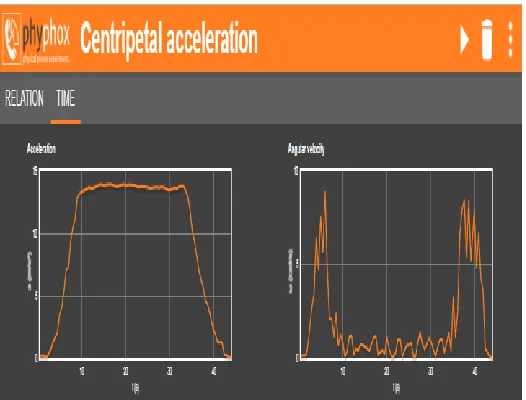
Table 1 obtained the results of measurements using Android on an electric motor using the standard technique in Microsoft Excel obtained. The description of the centripetal acceleration relation to time and angular velocity to time can be view in Figure 8 and Figure 9.
[image:4.612.314.576.311.546.2]Figure 8. Graph relationship centripetal acceleration versus time
Figure 9. Graph relationship angular velocity versus time
Based on Figure 9 concluded that the electric motor used in this experiment to apply the concept of uniform circular motion (ω0), but in the process of taking data takes place influences
from outside so that the movement of an electric motor turns into circular motion changes irregularly (ωt), so it can be seen in
the chart Figure (8).
The values of quantities obtained from measurements taken by android are included in equation (3) to prove the theory, with the terms of the radius
r
= 0,15 meters, so that the centripetal acceleration values obtained by as = 9,768996144 m/s2. Then theThere are several things that can cause the accuracy of the data is less precise, among others, the case of vibration on experimental device because the researchers used a stepper motor as the driving means of the position holder android on an electric motor that is less straight in the vertical direction, and tilt position notch tools are not evenly floor causing changes in the speed of the electric motor.
V. CONCLUSION
From the results of the study showed that phyphox applications on Android could use as a tool of physics experiments and scientific demonstrations both in class and can use at home, so it helps without having to pay expensive in doing practical work. From the research that has done centripetal acceleration values obtained through the application phyphox and compared with the results obtained from the theory has a perfect similarity with a minimal error value
ACKNOWLEDGEMENT
Our thanks to The Chairman of Department of Master in Physics Education and SENTRAL Laboratory, University of Ahmad Dahlan have helped and supported this research so that this research can complete
REFERENCES
[1] F. Fatmawati, L. Sukariasih, S. Fayanto, and H. Retnawati, “Investigating the effectiveness of inquiry learning and direct learning models toward physics learning,” Proceedings of the First International Conference on Progressive Civil Society (ICONPROCS 2019), 2019
[2] I. Y. Putra, S. F. Sigalingging, and D. L. Saraswati, “Penentuan ketinggian dan kecepatan minimum benda pada track melingkar vertikal,” Jurnal Riset dan Kajian Pendidikan Fisika, vol. 5, no. 1, p. 46, 2018.
[3] O. Okimustava, I. Ishafit, N. Suwondo, R. Resmiyanto, and A. R. I. Praja, “Pengembangan kuliah eksperimen fisika dengan teknologi multimedia,”
Jurnal Riset dan Kajian Pendidikan Fisika, vol. 1, no. 1, p. 1, 2014. [4] D. Susanti, “Buku suplemen berbasis android sebagai media pembelajaran
pada materi,” vol. VII, pp. 1–8, 2018.
[5] P. Vogt and J. Kuhn, “Analyzing radial acceleration with a smartphone acceleration sensor,” Physics Teacher, vol. 51, no. 3, pp. 182–183, 2013. [6] R. D. Septianto, D. Suhendra, and F. Iskandar, “Utilisation of the magnetic
sensor in a smartphone for facile magnetostatics experiment : magnetic field due to electrical current in straight and loop wires,” Physics Education, vol. 52, no. 015015, pp. 1–7, 2017.
[7] E. Ballester, J. C. Castro-Palacio, L. Velazquez-Abad, M. H. Gimenez, J. A. Monsoriu, and L. M. S. Ruiz, “Smart physics with smartphone sensors,”
Proceedings - Frontiers in Education Conference, FIE, vol. 2015-February, no. 2015-February, pp. 3–6, 2015.
[8] J. Kuhn and P. Vogt, “Analyzing spring pendulum phenomena with a smart-phone acceleration sensor,” The Physics Teacher, vol. 50, no. 8, pp. 504–505, 2012.
[9] S. C. Moon and S. Hong, “Effect of using a smartphone sensor in a physics class on motivation for science learning,” New Physics: Sae Mulli, vol. 65, no. 1, pp. 66–70, 2015.
[10] I. Yunita, E. Sudarmilah, and Y. S. Nugroho, “Physics formula application based on mobile android for tenth-grade high school,” Department of Informatics, Surakarta, pp. 1–14, 2013.
[11] M. Á. González et al., “Teaching and learning physics with smartphones,”
Journal of Cases on Information Technology, vol. 17, no. 1, pp. 1–14, 25AD.
[12] G. Lo Giudice, "Davvero prof prendiamo I nostri cellular ? Fisica in Mobile Learning," 2018.
[13] Saprudin, Liliasari, A. S. Prihatmanto, and Andhy Setiawan, “The Potential of gamification in developing pre-service physics teachers’ critical and creative thinking skills,” Omega: Jurnal Fisika dan Pendidikan Fisika, vol. 5, no. 1, pp. 7–14, 2019.
[14] A. P. Tipler and G. Mosca, Physics for scientist and engineers. 2004.
[15] H. D. R. A. F. Young, Fisica_Universitaria_Vol_2__ed_12 Sears-Zemansky, vol. 2, no. 11. 2009.
[16] D. C. Giancoli, Physics: Principles with Applications Solutions Manual, vol. 2. 2014.
[17] S. Staacks, S. Hütz, H. Heinke, and C. Stampfer, “Advanced tools for smartphone-based experiments: Phyphox,” Physics Education, vol. 53, no. 4, pp. 1–8, 2018.
[18] J. A. Sans et al., “Smartphone: a new device for teaching Physics,” pp.
415–422, 2015.
[19] Anonymous, “phyphox,” RWTH Aachen University, 2019. [Online]. Available:
https://play.google.com/store/apps/details?id=de.rwth_aachen.phyphox&hl =en_US.
[20] K. Hochberg, J. Kuhn, A. Müller, and K. Hochberg, "Using Smartphones as experimental tools – effects on interest, curiosity and learning in physics education Journal of Science Education and Technologie University of Kaiserslautern , Department of Physics / Physics Education Research Group Faculty of Sci."
AUTHORS
First Author – Syahlan, Master Student in Department of Physics Education University of Ahmad Dahlan, email:
Second Author – Ishafit, Lecturer in Department of Master in Physic Education University of Ahmad Dahlan, Email: [email protected]
Third Author – Suritno Fayanto, Department of Master in Physics Education University of Ahmad Dahlan, Email:
Correspondence Author – Syahlan . Email
![Figure 3. Tablet share the screen with PC [19]](https://thumb-us.123doks.com/thumbv2/123dok_us/9047491.976112/3.612.74.270.118.245/figure-tablet-share-screen-pc.webp)