The Effect of Crop Rotation On Soil Essentials
Elements
Ariuntsetseg Dugar, Davaa Lkham, Solongo Gonchig
School of Agroecology, Mongolian university of life science, Mongolia
DOI: 10.29322/IJSRP.9.08.2019.p9217 http://dx.doi.org/10.29322/IJSRP.9.08.2019.p9217
Abstract- Usually short turnover of our country's soil and climatic conditions and crop rotations, type of crop, there are few deficiencies. Therefore, soil and climate conditions change and warming to ongoing the dispensation extend substitutions, diversification of crop.
Evaluating crop rotation in the environmental and climate change have intensified agroecologically sensitive conditions central agricultural area production of grain, studied the major nutrient elements based on a long-term resident survey in the brown soil.
The correlation between soil total carbon and total nitrogen r = 0.92 deep plow soil (0-20 cm), r = 0.63 subsoil deep (20-40 cm) or is strong and moderately dependence. Accordingly, crop rotation it looks evaluating to be possibly the major elements of the soil.
Index Terms- carbon, nitrogen, crop, fallow, wheat
I. INTRODUCTION
arming has drawn special attention in the cropped framing scientific study of crop rotation. Crop rotation is many fields growing fallow and crop space and time. Crop rotation in the additionally incurring of soil physical, chemical, and biological properties, special effects to crops that became definite. Usually a short turnover of our country's soil and climatic conditions and crop rotations, type of crop, there are few deficiencies. Therefore, soil and climate conditions change and warming to ongoing the dispensation extend substitutions, diversification of crop.
The aim of the study will be evaluating crop rotation in the environmental and climate change have intensified agroecologically sensitive conditions central agricultural area production of grain, studied the major nutrient elements based on a long-term resident survey in the brown soil.
Purposes
• The influence of crop rotation into soil nutrient contents of the resident research field
• Comparison between crop rotation versions
II. MATERIALS AND METHODS
Location: “NART” Research, Training and Production Center, MULS, Bornuur Sum, Tov Aimag (N48°41′
E 106°15′). The annual mean precipitation at Nart is 160-235 mm with a mean annual maximum temperature of 18°C. The experimental plots at Nart were located on Mollisol and Kastanozem soil. These soil series consist of dark-brown colored, low deep soils with a slope of <2%, developed in loess 1.5 to 2 m thick over till under prairie
vegetation. Soil pH(H2O) 7.0~7.6, soil electrical conductivity 0.06~0.14 dS m-1, Max. Water Holding Capacity
44~55%(W/W), Bulk density (0-20cm) 1.14~1.35 g cm-3, Total corban (Plow layer) 15~20 g kg-1, total
nitrogen (Plow layer) 1.6~2.0 g kg-1, Available Nitrogen (Plow layer) 60~80 mg kg-1 (Toriyama, K. Davaa, L.
Solongo, G. Yamasaki, S.). Soils were sampled in May and September 2016 at the Nart site, this followed at least six full cycles of the 3-yr rotation at both sites. At the Nart site, three soil cores with 3.1 cm diam. were taken with a hand-held split-core sampler in each subplot. Samples were cut in the field at depths of 0 to 20 cm, 20 to 40 cm, and stored in plastic bags in a refrigerator.
Field experiment variants were:
• Wheat with fallow- (fallow-wheat-wheat)
• Wheat cont.14 yrs- Wheat cropped for 14 years
• Rotation A -potato-oat/barley-fallow-wheat
•
ISSN 2250-3153
• Rotation C -millet- green manure-potato-wheat
• Rotation D- oat-mustard-potato- wheat
Soil total carbon (TC), total nitrogen (TN) and available nitrogen (Av.N) were analyzed for top soil (0-20cm) and sub soil (20-40cm).
Laboratory research methods:
• Total carbon and nitrogen of combustion method by Sumigraph NC-830 0C
• Available nitrogen of incubation with upland moisture (ca. 20% W/W) after 10 weeks at 30 ℃ inorganic N was determined
III. STUDY RESULTS
[image:2.612.111.525.243.448.2]Crop rotation is to keep the quality of the soil organic matter. Effect rotations, crop rotation, and planted farming system, depending on the type of soil organic matter content are kept stable.
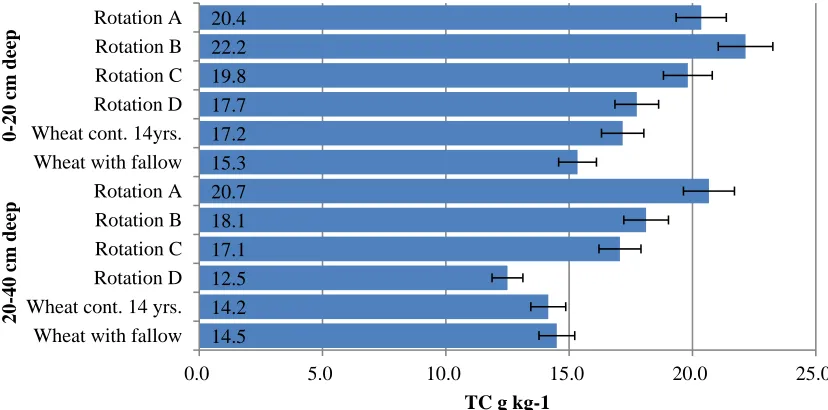
Figure 1. Effect of crop rotation on soil total carbon
Soil carbon in the 0-20 cm depth experience in rotation B version most more or other versions was more 1.8-6.9 g kg-1, wheat with fallow version minimum or other versions of 1.9-6.9 g kg-1 lower. Conspicuously to the total carbon in the 0-20 cm depth of soil concentrations rotations in planted types has shown that while many more.
However, amount of the total carbon to a depth of 20-40 cm in rotation A most more or other versions were more 2.6- 8.2 g kg-1, rotation D version minimum or other versions of 1.7-8.2 g kg-1 lower. Crop rotations in the mustard version of the low accumulation of organic carbon content are related to lower leaves.
14.5 14.2 12.5 17.1 18.1 20.7 15.3 17.2 17.7 19.8 22.2 20.4
0.0 5.0 10.0 15.0 20.0 25.0
Wheat with fallow Wheat cont. 14 yrs. Rotation D Rotation C Rotation B Rotation A Wheat with fallow Wheat cont. 14yrs. Rotation D Rotation C Rotation B Rotation A
TC g kg-1
20
-4
0
cm
d
eep
0
-2
0
cm
d
ISSN 2250-3153
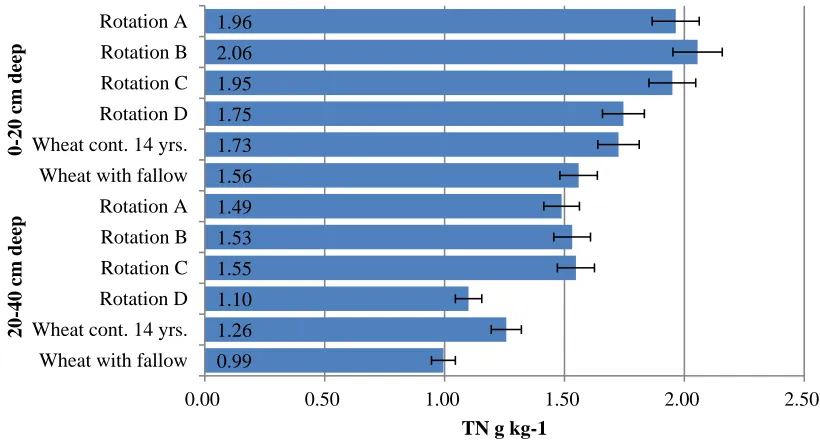
Figure 2. Effect of crop rotation on soil total nitrogen
This table has been showing that soil total nitrogen was more 0.1-1.07 g kg-1 rotation B (corn- barley/oat-
potato-wheat) version than other versions. It is a crop rotation version leave the green mass and cultivation is related to specifics the soil.
Figure 3. Correlation between soil total carbon and total nitrogen
The correlation between soil total carbon and total nitrogen r = 0.95 deep plow soil (0-20 cm), r = 0.79 subsoil deep (20-40 cm) or is strong and moderately dependence. Accordingly, crop rotation it looks evaluating to be possibly the major elements of the soil.
0.99 1.26 1.10 1.55 1.53 1.49 1.56 1.73 1.75 1.95 2.06 1.96
0.00 0.50 1.00 1.50 2.00 2.50
Wheat with fallow Wheat cont. 14 yrs. Rotation D Rotation C Rotation B Rotation A Wheat with fallow Wheat cont. 14 yrs. Rotation D Rotation C Rotation B Rotation A
TN g kg-1
20
-4
0
cm
d
eep
0
-2
0
cm
d
eep
y = 0.075x + 0.4255 R² = 0.982
0.00 0.50 1.00 1.50 2.00 2.50
0.0 10.0 20.0 30.0
TN
g
k
g
-1
TC g kg-1 Plowsoil (0-20 cm)
y = 0.0631x + 0.3 R² = 0.6351
0.00 0.20 0.40 0.60 0.80 1.00 1.20 1.40 1.60 1.80
0.0 5.0 10.0 15.0 20.0 25.0
TN
g
k
g
-1
[image:3.612.108.534.381.580.2]ISSN 2250-3153
Figure 4. Soil carbon and nitrogen ratio
Total carbon and nitrogen ratio rotation B the highest C: N = 10.8 in the 0-20 cm depth. Experience, which shows that the total area of mineralization appears to have been low. Total carbon and nitrogen ratio wheat with fallow the highest C: N = 14.6 in the 20-40 cm depth. Subsoil at wheat with a fallow version of the C: N ratio is plowed fallow explain the link to the rotation.
14.6 11.3
11.4 11.0
11.8
13.9 9.8
10.0 10.2 10.2
10.8 10.4
0.0 2.0 4.0 6.0 8.0 10.0 12.0 14.0 16.0 18.0
Wheat with fallow Wheat cont. 14 yrs. Rotation D Rotation C Rotation B Rotation A Wheat with fallow Wheat cont. 14yrs. Rotation D Rotation C Rotation B Rotation A
20
-4
0
cm
d
eep
0
-2
0
cm
d
eep
2.6 2.9 3.1 3.9 4.6 3.7 3.2 4.6 6.4 7.0 7.3 6.2
0.0 1.0 2.0 3.0 4.0 5.0 6.0 7.0 8.0 9.0
Wheat with fallow Wheat cont. 14 yrs. Rotation D Rotation C Rotation B Rotation A Wheat with fallow Wheat cont. 14 yrs. Rotation D Rotation C Rotation B Rotation A
AvailableN (mg/100g )
20
-4
0
cm
d
eep
0
-2
0
cm
d
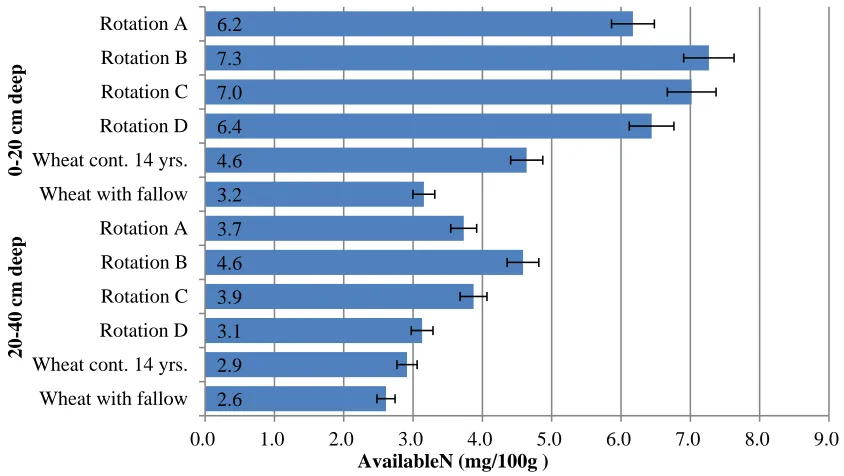
[image:4.612.104.526.417.655.2]soil is the maximum of rotation B version but was 2.6 mg in 100 gr dry soil is the minimum of wheat with fallow. Accordingly, if the soil is available nitrogen at a plow soil ongoing tends to be subsoil than ever mineralization of the soil (r = 0.73).
IV. CONCLUSION
According to the results of our study
Rotation versions the rotation B (C=22.2 g kg-1, N=2.06 g kg-1, Av.N=7.3 mg 100gr-1) version of the best performance, crop rotational agricultural technology and economically need to add the important sown.
Under wheat production system, fallow system might enhance the decrease trend of soil fertility.
At the end of the evaluation of is showing that there is a need to increase the number of rotations in sown
REFERENCES
[1] Etana, A., Hakansson, I., Zagal, E., Bucas, S., 1999. Effects of tillage depth on organic carbon content and physical properties in five Swedish soils. Soil Till. Res. 52, 129–139.
[2] Franzluebbers, A.J., Arshad, M.A., 1996. Soil organic matter pools with conventional and zero tillage in a cold, semiarid climate. Soil Till. Res. 39, 1–11. [3] Havlin, J.L., Kissel, D.E., Maddux, L.D., Claassen, M.M., Long, J.H., 1990. Crop rotation and tillage effects on soil organic carbon and nitrogen. Soil Sci. Soc. Am.
J. 54, 448–452.
[4] Malhi. S.S., Johnston. J.J., Schoenau. Z.H., Wang and Vera.C.L “Seasonal biomass accumulation and nutrient uptake of wheat, barley and oat on a Black Chernozem soil in Saskatchewan. 2006
[5] Nelson, D.W., and L.E. Sommers “Total carbon, organic carbon and organic matter”. 1996
[6] Toriyama, K. Davaa, L. Solongo, G. Yamasaki, S. Decrease of soil C and N in Mongolia grassland soil after conversion to cultivated land. JIRCAS Journal. 2014
AUTHORS
First Author – Ariuntsetseg Dugar, Doctoral candidate at Argoecology school of Mongolian University of Life Sciences, Ulaanbaatar
Mongolia, [email protected]
Second Author – Davaa Lkham, Professor, Ph.D. of Argo-ecology school at Mongolian University of Life Sciences,
Third Author – Solongo Gonchig, Professor, Ph.D. of Argoecology school at Mongolian University of Life Sciences,