A Study on Academic Attitudes that Affect the Post-
Graduation Programmes
V.Maheswari
*and R.Haridas
***
Research Scholar, Department of Management Studies, Karpagam University, Coimbatore, Tamilnadu, India **
Assistant Professor, Department of Business Administration, Government Arts College (Autonomous), Salem, Tamilnadu, India. guidance
Abstract- There has been a lot of research debating on why many students have not pursued their post graduation. This debate has explored the academic reasons that affect the students’ choice. One of them is lack of adequate guidance that could have helped students to understand the educational requirements thereby making them competitive enough to climb the success ladder. Another reason can be that students from economically poor background find it difficult to crack the highly competitive examinations. Most of the students have failed because of the lack of academic guidance which if given at the right time could have helped them to continue their studies. The random sampling technique was used to select the sample for the study. A sample of this study comprises both male and female students of various departments in Arts and Science Colleges of Coimbatore district, Tamilnadu. The data was collected from 625 students drawn on the basis of survey methods. Likert five point scale was used to analyze the data. The present study is related to the academic attitude and the demographic variables like gender, habitat and income. In this study, the researcher has found that majority of students do not continue their higher education because of academic attitudes.
Index Terms- Academic, Attitudes, students, gender, habitat, income, postgraduate.
I. INTRODUCTION
uman life if full of tasks and sub tasks. The vision of higher education in India is to realize the country’s human resource
demographic variables had considerably influenced the academic attitude of the students. So the researcher decided to carry on the research on the academic attitudes that affect the students continuing their higher education.
II. REVIEWOFLITERATURE
The research literature demonstrated some academic attitudes that affect the students not pursuing higher education. Corcoran (2002)4 looked at the ways which shift the size of the higher
education sector affected the students’ attitudes towards the institution. One of the findings of this project is that the staff and students here, by and large, like one another. Makinen et al (2004)5 have measured the level of commitment felt by their subjects in their subject major to socialising within the institution, and to a particular future career as indices of motivation. More than one third of students without either of these expressed commitments considered a change of major, five percent considered quitting the course altogether. This is reflected in the proportion of students who actually did change subjects or those who withdrew. Christie et al (2004)6 have found
that among their subjects, no single reason emerged as being particularly important in tipping the scales towards a decision to leave. They have noted that students would usually under-represent their own academic difficulties and this could also have assumed to play a part in their decision.
potential to its fullest with equity and inclusion. In recent years, the nation has embarked upon initiating a number of development linked strategies for promotion of higher education. The demand and supply of qualified manpower in the Indian economy integrated with the world economy show signs of structural change. The expected gross enrolment ratio is 15 percent to 30 percent by the year 20201. The UGC report 2010-2011 states that only 12 percent of the students have joined post- graduation programmes2. One of the reasons for the low intake of students at the post graduation level is lack of adequate academic guidance that could have helped the students to understand the requirements and move towards the development of their goal3. The present study entitled “A study on Academic Attitudes that affect the Post-Graduation Programmes” is an empirical research in higher education focusing on academic performance and aspirations among students in Coimbatore district of Tamilnadu State. In this study, the focus is mainly on the academic attitudes that affect the students who do not pursue the post-graduation programs. There are varieties of academic attitudes like subject papers,work load, medium of language, student teacher relationship, passing marks, stress, learning materials etc. In this study, three demographic variables like gender, habitat and income were analysed. The above said
Barbara Cooke (2012)7, has observed that student who chooses the‘wrong’ major often confuses between choosing a major and choosing their first career. It reveals that the students do not hope to continue their educational career. From the above review of related literature, it is seen that various reasons affect the higher education sector.
III. OBJECTIVES
1. To evaluate the students’ academic attitude that affects their entry into post graduation programmes.
2. To investigate the relationship between students’ academic attitude and other personal variables like Gender, Habitat and Income.
IV. METHODOLOGY
The research design constitutes the blueprint for the collection, measurement and analysis of data. In this study the researcher had surveyed and used questionnaire method to collect the data from the students. The design of the study also allows the researcher to ensure full representation of the population interest. A sample of this study comprises both male
and female students of Arts and Science colleges of Coimbatore www.ijsrp.org
International Journal of Scientific and Research Publications, Volume 4, Issue 6, June 2014 ISSN 2250-3153
District, Tamilnadu. A sample of 625 students was selected using the random sampling technique. The researcher used a Likert scale to measure. This scale consists of five points to construct the questionnaire for primary data collection. The scale was used to construct after the identification of various dimensions of academic attitudes of the respondents. On the basis of, the demographic variables like gender, habitat and income that most influence the academic attitudes of respondents, data was coded and a database was created using the SPSS package. The collected data was analysed and the hypothesis was tested using chi square statistical analysis. The variables had a significant influence on student’s academic attitudes and personal variables.
2
V. HYPOTHESIS
1. Student’s gender influences the students’ academic attitude towards post-graduation programmes.
2. Student’s habitat influences the students’ academic attitude towards post-graduation programmes.
3. Student’s family income influences the students’ academic attitude towards post-graduation programmes.
VI. RESULTSANDDISCUSSION
6.1 Academic attitude and Gender
[image:2.612.143.453.498.669.2]This was a survey of academic attitudes of students relating to the demographic variable ‘Gender’. It can be measured in terms of percentage analysis and chi square test. The results are presented in Table No - 1.
Table No. 1
Results of Chi-square Analysis of Academic Attitude with respect of Gender
Level of Description
Academic Attitude
Male Female Chi-square value df P value
302 323 1.210 623 0.546
significance
0.05
(Source: primary data)
Test of Hypothesis 1: Academic Attitude and Gender
From the research data in Table no.1, it is seen that to a great extent, the male and female respondents have participated. The percentage analysis shows that female respondents are more in number when compared to the male respondents. Further analysis using chi square analysis presented the academic attitude considered in the study as personal variable gender. Each of the academic attitude variables is compared with the study fact and chi square test is applied and the results are presented with a suitable hypothesis.
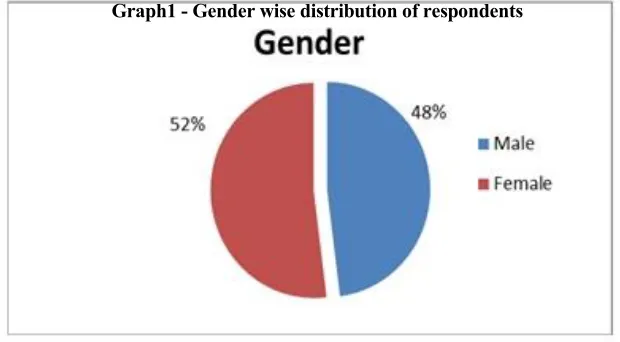
The results of chi square value are 1.210, p value 0.546 and the degree of freedom 623. The chi-square significance level stands at 0.05. So the findings indicate that the majority of the respondents were female with a percentage of 52 and the rest were male with a percentage of 48. It indicates that the academic attitudes of male and female respondents have no significant (p value >0.05) relationship at a level of significance. It is concluded that the majority of female respondents faced academic difficulties. For ex., difficulty to learn subject papers, the medium of instruction being English and the fear of presentation when it comes to seminar. So they are not interested to join the post graduation programmes.
Graph1 - Gender wise distribution of respondents
(Source: Primary Data)
ISSN 2250-3153
The Graph .1 represents gender wise distribution of the respondents. 6.2. Academic attitude and Habitat The p-value of 0.546 was found that it is not significant at 0.05 levels
with 623 degrees of freedom. The results concerning the academic attitudes of male and female students towards post-graduation programs did not differ significantly. So, null hypothesis was accepted.
[image:3.612.180.472.421.572.2]In this study, the academic attitude relates to the demographic variable ‘Habitat’. The statistical tool like percentage analysis and chi-square analysis are applied. The results are presented in Table No.2.
Table No. 2
Results of Chi-square Analysis of Academic Attitude with respect of Habitat
Description
Academic Attitude
(Source: primary data)
Habitat Respondents
Rural 487
Urban 118
Sub urban 20
Chi-
square df P value
value
2.841 621 0.585
Level of
significance
0.05
Test of Hypothesis 2: Academic Attitude and Habitat
The second hypothesis is framed as the habitat of students that affect the academic attitude. Basically, habitat is divided into three categories (1) rural, (2) urban and (3) suburban. The above Table no. 2 indicates that rural background respondents are more in number than the urban and sub-urban respondents. The chi-square value is 2.841; P value 0.585 with degree of freedom 621 and the level of significance is 0.05.
Each academic attitude is compared to the habitat variable by using chi square test. The findings indicated that the major academic attitude of respondents do not have any significant influence with demographic variable habitat being significant level 0.05. This shows that most of the students are from rural background. So, the students were literally pushed to academically backward class because they were unable to enter the post graduation programmes.
Graph 2 - Habitat wise distribution of respondents
(Source: Primary Data)
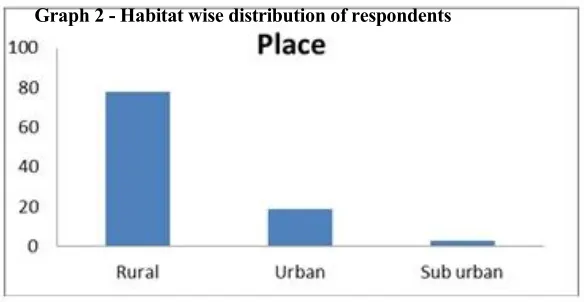
The Graph-2 shows the habitat of respondents. In the above picture, the highest respondents came from a rural area, comprising a percentage of 78. The remaining 19% of the respondents came from urban place. The lowest number of respondents came from a sub-urban area comprising 3% only. The p-value of 0.585 was greater than the significant 0.05 levels with 621 degrees of freedom. The results relating to the academic attitude of rural, urban and sub-urban respondents did not differ significantly. So, null hypothesis was accepted.
6.3. Academic attitude and Income
The purpose of the study is to find out the relationship between the income level of respondents and their academic attitudes. The statistical tools implemented are percentage analysis and chi-square analysis. The following results are presented in Table No. 3.
International Journal of Scientific and Research Publications, Volume 4, Issue 6, June 2014 4 ISSN 2250-3153
Table No. 3
Results of Chi-square Analysis of Academic Attitude with respect of Income
Description Income
Below Rs.15,000 Rs.15,001 -
Academic Rs.25,000
Attitude Rs.25,001 -
Rs.50,000 Above Rs.50,001 (Source: primary data)
Respondents
490
105
16
14
Chi-square value
7.386
P Level of
Df
value significance
619 0.287 0.05
Test of Hypothesis 3: Academic Attitude and Income
The above analysis indicated that the income level of the respondents affect the academic attitude of higher education. The majority of the respondents came from those who earn below Rs.15,000 income level. The lowest number of respondents came from those who earn above Rs.50,001 income level. In this section, the results of chi-square analysis are calculated at
chi-square 7.386 and degree of freedom 619. The final p value 0.287 above is at the significant level of 0.05. The results concluded that academic attitudes have no significant influence (p value > 0.05) on the income level. It concluded that the respondents were from poor background because they are not continuing the post graduation programmes.
Graph 3 - Income wise distribution of respondents
(Source: Primary Data)
VII. MAJOR FINDINGS
Based on the results are academic attitudes were analysed relating to the gender, habitat and income. From the findings, it is
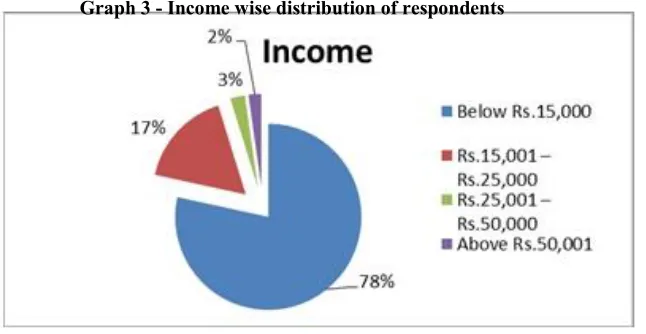
observed that the majority of the respondents were females with The above graphical representation expresses the family
income level of the respondents. The graph shows that 78% of the respondents are below Rs.15,000 income level, 14% of the respondents are between Rs.15,001 and Rs.25,000 income level, 3% of the respondents are between Rs.25,000 and Rs.50,000 income level and only 2% of the respondents are above Rs.50,001 income level. The majority of the respondents came from below Rs.15000 income level. The p-value of 0.287 was more than the significant level at 0.05. It indicates that the academic attitude of family income level of respondents has not differed significantly. So, null hypothesis was accepted.
58 percent, 78 percent of respondents came from the rural area and the highest number of respondents' income level is below Rs.15000. The study findings indicate that the academic attitudes have no significant relation to gender, habitat and income level. The respondents were from poor background and in addition they had lowest financial support so they find it difficult to continue higher education. So the government should provide financial support, create more awareness of higher education, give technological background and other improvement steps should be taken to help them continue their higher education.
[image:4.612.158.481.357.524.2]ISSN 2250-3153
VIII. CONCLUSION
A nation’s strength and development depend on its educational system. In this study, the findings may help in providing useful suggestions and information. The study highlights the variables and attitudes found in higher education. It is evident that lack of academic guidance and counseling directly affect the students and their higher studies. The students from their end should take education seriously and try to excel in their field. Also, they need to develop their technical skills and for this there should be an encouraging educational environment to support their research. Further, the government should also take necessary efforts to encourage research and help students.
REFERENCES
[1] Higher Education in India (Strategies and Schemes during 11th plan period (2007-12) for universities and college) UGC Report January 2011 Chapter 1and 2, pp. 1 and 3.
[2] www.ugc.ac.in
[3] Avtar Singh, Jayesh Patel & Roshni Desai “Attitude of Student Teachers towards Continuous Comprehensive Evaluation With Reference To Gender, Caste and Habitat”, Educational Confab, Vol 2, No.1 January 2013.
[4] Corcoran, P (2002). Students and universities: a dysfunctional relationship. Paper presented at the ATEM/AAPPA Conference, Canberra, August 2002. [5] Makinen, Jarkko, Olkinuora, Erkki and Lonka, Kirsti (2004). Students at
risk: students’ general study orientations and abandoning/prolonging the course of studies. Higher Education 48, 173 - 188
[6] Christie, H, Munro, M and Fisher, T (2004). Leaving university early: exploring the differences between continuing and non-continuing students. Studies in Higher Education 29 (5). 617 - 636.
[7] Barbara Cooke. “Choosing the "Wrong" Major,” Friday, April 8, 2011. Oct. 19. 2012.
AUTHORS
First Author - V.Maheswari, Research Scholar, Department of Management Studies, Karpagam University, Coimbatore, Tamilnadu, India.
Second Author - R.Haridas, Assistant Professor, Department of Business Administration, Government Arts College
(Autonomous), Salem, Tamilnadu, India.