Early Childhood and Elementary Education Dissertations
Early Childhood and Elementary Education Department
Spring 5-11-2018
COGNITIVE DISSONANCE AND
TEACHERS: WHEN BELIEFS AND
MANDATES COLLIDE
Julie McFaddin
Follow this and additional works at:https://scholarworks.gsu.edu/ece_diss
This Dissertation is brought to you for free and open access by the Early Childhood and Elementary Education Department at ScholarWorks @ Georgia State University. It has been accepted for inclusion in Early Childhood and Elementary Education Dissertations by an authorized administrator of ScholarWorks @ Georgia State University. For more information, please [email protected].
Recommended Citation
McFaddin, Julie, "COGNITIVE DISSONANCE AND TEACHERS: WHEN BELIEFS AND MANDATES COLLIDE." Dissertation, Georgia State University, 2018.
This dissertation, COGNITIVE DISSONANCE AND TEACHERS: WHEN BELIEFS AND MANDATES COLLIDE, by JULIE E. MCFADDIN, was prepared under the direction of the candidate’s Dissertation Advisory Committee. It is accepted by the committee members in partial fulfillment of the requirements for the degree, Doctor of Education, in the College of Education and Human Development, Georgia State University.
The Dissertation Advisory Committee and the student’s Department Chairperson, as
representatives of the faculty, certify that this dissertation has met all standards of excellence and scholarship as determined by the faculty.
_________________________________ Lynn Hart, Ph.D.
Committee Chair
_________________________________ Caroline Sullivan, Ph.D.
Committee Member
_________________________________ Rachel Fiore, Ph.D.
Committee Member _________________________________
Date
_________________________________ Lynn Hart, PhD
Chairperson, Department of Early Childhood and Elementary Education
_________________________________ Paul A. Alberto, Ph.D.
By presenting this dissertation as a partial fulfillment of the requirements for the advanced degree from Georgia State University, I agree that the library of Georgia State University shall make it available for inspection and circulation in accordance with its regulations governing materials of this type. I agree that permission to quote, to copy from, or to publish this
dissertation may be granted by the professor under whose direction it was written, by the College of Education and Human Development’s Director of Graduate Studies, or by me. Such quoting, copying, or publishing must be solely for scholarly purposes and will not involve potential financial gain. It is understood that any copying from or publication of this dissertation which involves potential financial gain will not be allowed without my written permission.
All dissertations deposited in the Georgia State University library must be used in accordance with the stipulations prescribed by the author in the preceding statement. The author of this dissertation is:
Julie Elizabeth McFaddin
Early Childhood and Elementary Education College of Education and Human Development
Georgia State University
The director of this dissertation is:
Lynn Hart, Ph.D.
Early Childhood and Elementary Education College of Education and Human Development
Julie Elizabeth McFaddin ADDRESS: 1409 Oldfield Road
Decatur, GA 30030
EDUCATION:
PROFESSIONAL EXPERIENCE:
2017-present Instructional Coach/I.B.
Coordina-tor
City Schools of Decatur 5th Ave. 4/5 Academy
2011-2017 5th Grade Teacher
City Schools of Decatur 5th Ave. 4/5 Academy 2010-2011
2001-2010
Middle Grades Math Instructional Coach
Evans-Newton Incorporated Teacher (K-5)
DeKalb County Schools
PRESENTATIONS AND PUBLICATIONS:
McFaddin, Julie E. (2016, October). Engaging elementary students in productive struggle.
GCTM Math Teachers Conference, Rock Eagle, GA.
Ed.D. 2018 Georgia State University
Curriculum and Instruction Elementary Mathematics
Masters Degree 2007 Kennesaw State University
Middle Grades Mathematics
Bachelors Degree 1998 Clemson University
COLLIDE
by
JULIE MCFADDIN
Under the Direction of Dr. Lynn Hart
ABSTRACT
ensure all students receive quality mathematics instruction, all while feeling pressures related to high stakes testing. As many of us work for and await a paradigm shift in our American educa-tion system away from the focus on high-stakes testing, these stories offer other teachers shared experiences that may be similar to their own, and possibly strategies for coping with their own conflictions.
by
JULIE MCFADDIN
A Dissertation
Presented in Partial Fulfillment of Requirements for the
Degree of
Doctor of Education
in
Curriculum and Instruction
in
Early Childhood and Elementary Education
in
the College of Education and Human Development Georgia State University
DEDICATION
ACKNOWLEDGMENTS
The journey to the completion of this dissertation, while relatively short, has been a winding road of different questions and evolving ideas. Despite all of the changes and revisions this study has been through, the constant has been the group of amazing women that signed on three years ago to guide and support me through this process. Dr. Lynn Hart has been willing to meet with me in various coffee shops all over Decatur, GA to provide feedback and answer countless questions. Even though I continued to use contractions right until the very end, she continued to read and re-read sections until I got it right. Thank you for your clear guidance, direct feedback and ability to guide me back to the focus of the question. Dr. Rachel Fiore, signed on when I thought I may explore elementary science, but stayed with me despite changing topics, questions and methodology. Thank you for your feedback that has helped me think
beyond my own context and examine the “why” of this study. Dr. Caroline Sullivan walked with me one summer day discussing methodology. She challenged me by asking one question: “What is your goal?” Once she helped me understand that narrative inquiry would be the methodology to reach my intended goal, she then graciously agreed to join my committee. On top of the many other hats you wear, you examined my study with a qualitative lens. Thank you for your
guidance not only with this dissertation, but the entire Ed.D. program. Each of the members of my committee brought a necessary and varied perspective to this process that ensured I met my goals, and I will always be grateful for their professional support and guidance.
completing this dissertation without our group support sessions, which is what our classes often turned into. I know we will stay in touch as we continue on our professional journeys. Best wishes to each of you, and I look forward to working with you again in the future as we seek to change the world of education. We, the small and fierce 2015 Cohort, are getting our fancy hats and will have the letters behind our names to make some waves in the field of education.
Finally, I have to thank my wonderful family. Cat and Vaughan, you have spent the last three years giving me the space, time and a listening ear to complete this work. Cat, my
Table of Contents
LIST OF FIGURES ... viii
CHAPTER 1 ... 1
Introduction ... 1
Problem Statement ... 2
Purpose Statement ... 3
Research Question ... 3
Significance of Study ... 4
Delimitations ... 4
Limitations ... 4
Assumptions ... 5
Operational Definitions ... 5
Theoretical and Conceptual Framework ... 7
Constructionism ... 7
Constructivism ... 7
Critical Theory ... 10
Cognitive Dissonance ... 12
Organization of Remaining Chapters ... 13
Conclusion ... 14
Introduction ... 15
Experiences in High-Stakes Testing Environments ... 15
Limited Teacher Autonomy ... 18
Teacher Beliefs and Efficacy ... 21
Teacher Self-efficacy ... 22
Teacher Beliefs ... 23
Teacher Beliefs and Mathematics ... 24
Gap in Research ... 26
Conclusion ... 26
CHAPTER 3 ... 29
Introduction ... 29
Narrative Inquiry as a Methodology ... 29
Justification of Methodology ... 30
Limitations ... 33
Context of Research ... 33
Sampling ... 35
Field Texts Collection ... 36
The Researcher’s Diary ... 36
Conversation and Interviews as Conversation ... 37
Lesson Plans and Student Work ... 38
Visual Data... 39
Data Analysis ... 40
Timeline of Study ... 44
Conclusion ... 45
CHAPTER 4 ... 46
Results ... 46
Researcher Narrative Beginnings ... 46
The beginning of my own teaching journey ... 47
New legislation, new paradigm ... 48
A change of context ... 49
Pressure to conform ... 50
Walter Brown ... 52
Becoming a teacher ... 53
Experiences with testing ... 54
Journey as a math teacher ... 58
A move from the classroom ... 59
Instructional decision-making ... 61
Chasing time ... 63
Strategies for coping with conflicts related to high-stakes testing ... 64
Thea Johns ... 66
Early career ... 66
South elementary ... 67
Instructional beliefs ... 72
A conscious decision not to be pressured... 78
Coping with confliction ... 81
Bridgette Johnson ... 82
Early years and testing ... 82
A new school, a new idea ... 85
Everyone should be the same ... 89
Strategies for coping with dissonance ... 91
Conclusion ... 93
CHAPTER 5 ... 94
Discussion ... 94
Caring and Relationships ... 94
Creativity and teaching mathematics ... 96
Connecting Participant Narratives to Research ... 101
Implications of for Professional development ... 103
Implications for further research ... 106
Conclusion ... 107
REFERENCES ... 109
LIST OF FIGURES
Figure 1. Timeline of data collection process ………..42-43
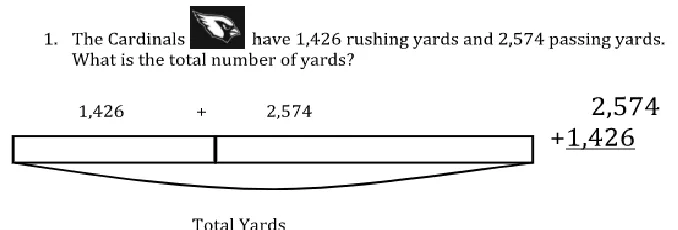
Figure 2. Sample task from Walter………62
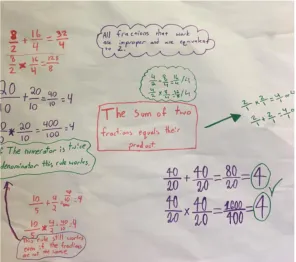
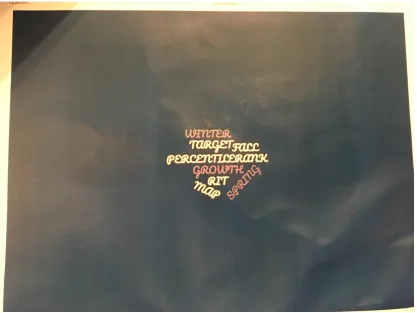
Figure 3. Walter: Visual data……….…63
Figure 4. Sample task from Thea………...76
Figure 5. Sample task from Thea………...76
CHAPTER 1
Introduction
When I think back to my own positive experiences in school, I think about relationships I had with teachers and peers. I remember engaging activities like school plays, art contests and simulated archeological digs. These experiences were, in many cases, not associated with a final grade or summative assessment at all. What prompted me to enter the field of teaching were the positive relationships I built with children during my time as a camp counselor during college. I wanted to make a difference in children’s lives and engage students in meaningful experiences. Over the course of the last fifteen years, legislation that requires accountability through high-stakes tests has shifted the experience of education for teachers and students. High-high-stakes testing has eliminated much of the humanity that used to be essential in educating students in the United States. Humans are naturally curious beings, but in today’s schools, teachers feel compelled to act in ways that may not foster the natural curiosity of their students.
edu-cation conversation (Vasquez Heilig, Khalifa, & Tillman, 2014). Many instructional decisions have already been made for teachers and students by policy, often with no consideration for the experiences and cultural frame of the teacher, students, and communities in which they are situ-ated (Valenzuela, 2013). “Robots with artificial intelligence are presently being tested as public school teachers or teacher assistants in several countries including the United States” (Ekle, 2012, p. 3). Teachers feel pressures due to high-stakes tests and research shows the negative in-fluences that high-stakes testing has on instructional practice. Will all humanity be removed from the American education experience? Or will teachers, students and other stakeholders take action that counters the negative influence high-stakes testing has had on education in American class-rooms?
Problem Statement
for many teachers, this brings about dissonance in their beliefs and practice. Teachers can decide to act counter to their beliefs or choose to not conform their practices to mandates and pressures. In order to bring about consonance, there must be a change in belief or change in action. As we wait and work for a paradigm shift away from the high-stakes test driven educational era, it is critical that teachers reflect on decisions they make in the classroom that will impact student ex-perience.
Purpose Statement
The purpose of this study was to explore how three upper elementary teachers reconcile conflicts in beliefs about sound instructional practice in a high-stakes testing environment in or-der to highlight ways teachers persevere. The methodology of narrative inquiry allowed me to
portray the experiences of these educators. Narrative inquiry is a qualitative methodology that
allows others to understand personal experiences through the telling of stories. “Stories lived and
told educate the self and others” (Clandinin & Connelly, 2000, p. 26). That is to say, through the
telling of stories all stakeholders, researchers, participants and those reading the accounts, have
opportunity to learn and change. Narrative inquiry also supports the idea that knowledge is
co-constructed by the researcher and participant (Clandinin & Connelly, 2000 & Clandinin, 2013).
This study strives to provide an opportunity for participants to make their stories known, as well
as to offer strategies to other teachers for coping with similar conflicting beliefs.
Research Question
Significance of Study
Teachers make decisions each and every day that impact student learning. Research shows that the impact of high-stakes tests includes narrowed curriculum, teacher-centered in-struction and loss of teacher autonomy. My research is significant because the goal is to highlight the places where teachers do have control over the learning experiences and opportunities of their students. While there are numerous mandates and the feelings to conform instructional practices can be overwhelming, each teacher decides what and how they will teach their students each day. I want to focus on the power and control that teachers do have to impact student learn-ing despite what research shows concernlearn-ing the impact of high-stakes testlearn-ing. There is no sign that policymakers will do away with accountability measures in the near future. I demonstrate that there are decisions that teachers can and do make each day in their classrooms that impact student experience and learning despite high-stakes testing.
Delimitations
I collected data for this research August through December 2017. I selected three upper elementary teachers that have experienced conflicts with beliefs about sound instructional prac-tice and impacts of high stakes testing. The participants work as fourth and fifth grade teachers at Townville Elementary School. Data collection is limited to two school terms, which is about twelve weeks.
Limitations
home-room teachers and share experiences as homehome-room teachers and support teachers as part of their stories.
Assumptions
This study was prompted by my own experience with cognitive dissonance when the in-structional leader at my school asked me to implement more teacher-directed math instruction based on isolated math skills that were identified on a standardized test we use to measure stu-dent growth. This conflicted with my problem-solving based mathematics classroom. At the time, I had strong beliefs that the best teaching practices are student-centered instructional strate-gies where students are allowed to discover, construct, and argue about new ideas and concepts. The pressures of high-stakes tests resulted in pressure from my superiors for more teacher-centered strategies as well as constraining the curriculum I was teaching (Au, 2013). I entered this study with the assumption that other teachers feel those same pressures and dissonance and they make choices about what to do with those pressures. I also believe that, given more auton-omy and professional development, teachers would choose student centered educational strate-gies grounded in constructivist learning theory for their students.
Operational Definitions
In this section I describe several key terms and how they will be used in my study. Lan-guage is important and the words you choose matter. People will interpret terms in ways that make sense to them. I want to be clear in my use of key terms and how they fit with my experi-ences and understanding.
Cognitive dissonance: Cognitive dissonance occurs when one’s private beliefs are in
Constructionism: the worldview or paradigm that posits that meaning is constructed ra-ther than discovered. It claims that ra-there is no meaning until humans interpret the world that ex-ists around them. (Crotty, 2015)
Defensive teaching: Defensive teaching is defined as teachers reducing requirements to
the minimum that is required by standards and assessments (McNeil, 2000).
Narrowed curriculum: Narrowed curriculum is defined as content curriculum that is
segmented, deleted or constrained due to minimum requirements of high-stakes tests (Au, 2013; Lipman, 2009; McNeil, 2000)
Experiential education: Experiential education is defined as education focused on student
experience. Dewey stated, “the school must represent life—life as real and vital to the child as that which he carries on in the home, in the neighborhood, or the playground” (Dewey,
1929/2013, p. 35).
High-stakes testing: A test is defined as high stakes when results are used to make deci-sions that impact all stake-holders: students, teachers, schools, and communities as a whole (Au, 2013). High-stakes tests can be national, state, or local mandates. High-stakes tests have results that are reported to the public (McNeil, 2000).
Radical Constructivism: Knowledge is constructed by the individual based upon his or her own experiences (Von Glasersfeld, 1995). Radical Constructivism is not a theory of learning or teaching, but of knowing. (Steffe, 2016)
Social Constructivism: Knowledge and understanding is constructed within the context of
society and culture. (Ernest, 1994). Social Constructivism is radical constructivism within the context of the mathematics classroom (Steffe, 2016). Learning mathematics is process that in-volves individual construction within the frame of mathematics practices of a wider society (Cobb, 1994).
Theoretical and Conceptual Framework
Constructionism
The paradigm that I use to frame this research is constructionism. Constructionism pur-ports that meaning is not objective or subjective; rather it is constructed through relation (Crotty, 2015). Consciousness is what determines meaning. Constructionists do not believe that objects did not exist prior to consciousness, rather that there was no meaning prior to consciousness. Constructionism purports that there is no one truth, but rather various interpretations of what is true. There can be more useful interpretations, but not more true interpretations (Crotty, 2015). The research for this problem will be relational in that the teachers construct meaning through their interaction with the experience and I will construct meaning by interacting with the teach-ers. It is the relation between teachers, their experience and the researcher that will determine what is found in this process.
Constructivism
prob-lems and others. Constructivism as a philosophical theory initially emerges in the 18th century with Giambattista Vico and his idea of “the only way of “knowing” a thing is to have made it” (Ultanir, 2012). It began to show up more as a teaching theory during the early 20th century with philosophers and theorists during progressive movement in education. The concept that students do not learn merely through being told, but through experience and construction of knowledge was key in many progressive education reform schools. Constructivist theories essential to this research include Dewey’s experiential education (Dewey, 1938) and Von Glasersfeld’s radical constructivism (Von Glasersfeld, 1995), and social constructivism (Vygotsky, 1978 & Bruner, 2013)
Dewey stated, “the school must represent life—life as real and vital to the child as that which he [she] carries on in the home, in the neighborhood, or the playground” (Dewey, 1929/2013, p. 35). He was a pragmatic that posited that education must be connected with life experiences of the child. He further argued that with industrialization, educators could not possi-bly determine the future students would live in as adults. This is even truer today in our technol-ogy-driven global society. The focus of education should be to give students “command of him-self [herhim-self]” so that “he [she] will have the full and ready use of all his capacities” (Dewey, 1929/2013, p. 35). Dewey posited that students learn only when the subject matter consists of experiences that are consistent with the students’ everyday lives. He was a proponent for experi-ential education for all students (Dewey, 1929/2013), and that this type of education could only happen in a true democracy. Dewey believed that knowledge was constructed through individual experiences within one’s own context. His works shows the relationship between the individual learner and the experiences created by the teacher. Dewey stated that all experiences were not of the same value. Teachers can create experiences that have both positive and negative impact on student learning (Dewey, 1938).
cultural theory, the individual and social realms of construction new knowledge and understand-ing cannot be separated (Ernest, 1994 & Cobb, 1994). Radical constructivism purports individu-al construction, but that construction of knowledge takes place within the experiences the teach-ers provide as facilitator. Von Glasteach-ersfeld’s concept of radical constructivism also claims that no individual construction is more or less correct than another, but each construction of knowledge can be judged by accepted norms. All construction of knowledge is not equal. While each indi-vidual constructs their own knowledge that is not more or less correct, there are accepted norms that all knowledge construction can be judged by.
Constructivist learning theory and experiential education posit the importance of experi-ence of the individual situated in context as related to learning. My study will seek to construct stories of individuals’ experience with cognitive dissonance. The focus of my research explores experiential education and constructivist learning theory within a mathematics classroom, there-fore aligning with the athere-forementioned theorists. In order for learning to have meaning, teachers must consider the experience of the individual students, and use that experience to facilitate op-portunities to for individuals to construct new understanding. For teachers that lean toward a more constructivist perspective of learning, the impacts of high-stakes testing can be counter to their basic beliefs about what is good for students and how they construct knowledge in the classroom. The researcher, participants and their students will all construct knowledge through-out the process of this study.
Critical Theory
fos-tering skills that students living in a global society will need. The current high-stakes test-driven era of education does not support the implementation of these opportunities (Noddings, 2013). Critical theory is fundamental to this research because I believe that current societal structures allow high-stakes testing to continue to silence students and teacher voices. Participants that have experienced the conflict in question will struggle with historical and societal structures in educa-tion that promote the use of high-stakes testing.
that are one-size fits all, and do not consider the individual experiences or societal expectations they may face.
In analyzing instructional strategies that participants use, I drew from Paulo Friere’s (1972/2000) concepts of problem-posing education versus banking education. Critical pedagogy, as introduced by Friere, contended that society is situated in an oppressor and oppressed relation-ship dynamic. He argued that the purpose of education should be to move away from this rela-tionship by encouraging teachers to use the classroom as an opportunity to facilitate critical thinking opportunities for students. He described oppressors as being oppressed themselves through their use of oppression and as being original perpetrators of violence through the use of oppression. He went on to characterize the oppressed as dehumanized through their oppression and stated that they are the only ones that can end the oppression. Freire claimed that oppressors use banking education in which students are receivers of information that teachers “deposit” the information they deem necessary to maintain the current oppressive society. It is a passive form of education that requires no critical reasoning and consideration of individual experience or context. Friere stated that educators should strive toward problem-posing education in which teachers act as facilitators of knowledge. Students become active participants in their learning and seek to think critically and analyze information presented to them. Problem-posing education is connected to constructivist theories of learning. Students must bring their own experiences into the classroom; apply what they know to struggle with perturbations they experience in order to become critical thinkers and active participants in constructing knowledge that is applicable to their lives.
I also considered the theory of cognitive dissonance (Festinger & Carlsmith, 1959) when looking at decisions teachers make when their beliefs about sound instructional practices are in conflict with processes and impacts of high-stakes tests. Leon Festinger first proposed the theory of cognitive dissonance in 1957. Cognitive dissonance occurs when one’s private belief is in conflict with one’s actual public statement or actions (Festinger & Carlsmith, 1959). Festinger and Carlsmith (1959) found that the amount of dissonance a person feels decreases as the pres-sure to act or speak contrary to their private beliefs increases. That is to say that as prespres-sure in-creases, a person must work to lessen the dissonance they feel in some way. According to this theory, teachers must work towards bringing private beliefs and public acts into consonance. Many teachers are faced with the challenge of living with the belief that high-stakes testing does not have a positive impact on their classroom and the students’ learning, yet they are still held accountable to high-stakes testing and the policies and procedures that come with them.
Organization of Remaining Chapters
Conclusion
CHAPTER 2
Introduction
The goal of this research was to co-construct the stories of elementary teachers that have experienced cognitive dissonance in their beliefs about quality math instruction and the pressures that teachers in a high-stakes testing environment may feel. In this chapter, I present what re-search about teacher experiences in high-stakes testing environments as well as explore the ways teacher beliefs have played a role in instructional decision-making. A critical review of literature revealed the following themes:
1) High-stakes testing environments have narrowed the focus of curriculum and
generat-ed more teacher-centergenerat-ed instruction
2) High-stakes testing environments have limited teacher autonomy
3) Teacher beliefs and efficacy impact instructional decision-making Experiences in High-Stakes Testing Environments
about ways in which teaching has been influenced by the pressures related to high-stakes testing as well as how teacher beliefs and efficacy play a role in instructional decision making.
Narrowed Curriculum and Teacher-focused Instruction
High-stakes testing reforms have had a number of effects on instructional practices of teachers. Au (2007/2013) conducted a qualitative metasynthesis of 49 published studies in order to develop a broad understanding of the way high-stakes testing influences curriculum at the classroom level. He coded qualitative studies and found three dominant themes: subject matter content, pedagogy, and structure of knowledge. Au’s qualitative metasynthesis showed that high-stakes testing has resulted in the narrowing of curriculum content, pedagogical practices have shifted towards more teacher-centered instruction, and the structure of knowledge presented is more fragmented. Narrowing curriculum content refers to the practice of teaching only tested content. Teachers feel pressure to only present material that is on the test, therefore limiting what is taught to test content. They may also present that information in a fragmented way in order to cover tested material in limited time. That is to say, a teacher responsible for teaching students multiplication of multi-digit numbers may focus solely on the procedures of the multiplication algorithm through direct instruction as a time saving measure. Connections to other operations, modeling, algebraic thinking, and problem solving may or may not be highlighted in order to cover all tested content, instead of teaching the material and related mathematical connections.
Many of the curriculum decisions are made for teachers at a district or school level, espe-cially in locations that are struggling to meet expectations on high-stakes tests
2009). Wills and Sandholtz explored, through case study, what happened when a local school administration gave a fifth grade teacher the autonomy to teach in the way she saw fit rather than giving in to curriculum mandates from the local district as a result of test performance. The re-searchers observed and videoed a total of 66 lessons for the case study. Despite the autonomy allowed by the principal for this teacher, she still used predominately teacher-centered instruc-tional practices. At times, she chose to skip instruction in low-stakes subjects to allow more time for high-stakes tested subjects, mathematics and language arts. The concept of constrained pro-fessionalism is introduced in this study. Constrained professionalism refers to the idea of teachers seemingly having autonomy, yet feeling constrained in instructional and curriculum choices as “consequences of test-based accountability even in a school where the principal supported teach-er autonomy” (p. 1066). Professionalism is the concept that a highly trained individual has the knowledge base to make decisions specific to the field of work. Even in a school where the teacher was provided with decision making power concerning curriculum in her classroom, the teacher was constrained by the pressure of the upcoming standardized tests that would be used to make important decisions for herself and her students.
should be learning in schools in order to prepare them for the world they will face. The teachers in this study experienced constrained professionalism and chose to use defensive teaching strate-gies(McNeil, 2000) when they eliminated creative experiences for students in order to ensure the material for the high-stakes test was presented.
As teachers begin feel the pressures of high-stakes tests, they may also begin to use de-fensive teaching (McNeil, 2000) strategies. Dede-fensive teaching is defined as teachers responding to federal, state, district, and school mandates by limiting the material presented to students. In this approach, teachers present only what is required for testing and the material is presented as lists, facts, and in other very controlled ways. Teachers that experience constrained professional-ism may choose to use defensive teaching strategies to cope with the pressures related to high-stakes testing. McNeil conducted a case study at a Texas charter school just as the paradigm shift towards a focus on high-stakes testing began. McNeil found that, even in schools that usually pride themselves on the use of instructional strategies that educate the whole child, the more mandates given from their supervisors, the more teachers controlled the curriculum in their own classrooms. While this study began as an inquiry into student learning, McNeil saw how stand-ardization and high stakes testing shifted teacher practice as well. She observed that even in schools that previously used more student-centered instructional strategies, teachers decided to use teacher-directed strategies in an effort to more efficiently cover the required material for the upcoming test. In a mathematics classroom, in order to cover material teachers focus on direct instruction of procedures of the skills rather than taking time to focus on problem solving, dis-course, and making connections to other mathematical domains.
Today teachers live in an educational era of common, standards-based assessments that are used to make important decisions concerning schools, students, and teachers (Au, 2007/2013, Darling-Hammond, 2010, Lipman 2009). NCLB and its successor, ESSA, connect common as-sessments to the state curriculum. NCLB linked performance on these asas-sessments to grade pro-motion for students and to teacher and school evaluations (Popham, 2004/2008). Stillman and Sleeter (2005/2013) examined the concept of frame, which refers to the amount of control stu-dents and teachers have over the knowledge taught within a classroom. The stronger the frame, the more control or voice teachers have in instructional planning and curriculum. In Stillman and Sleeter’s qualitative study of standards documents in California, they coded documents for themes and counted words related to their thematic analysis. Stillman and Sleeter found that when the curriculum is decided with a top-down structure, as in NCLB, the framing is weak, meaning that the amount of control students and teachers have over the learning in their class-rooms is weakened and that teaching becomes prescribed.
less opportunity for critical thinking for students. Lipman saw there was a “continuum of en-forcement” (p. 369) of accountability measures. Specifically, schools that did well on standard-ized tests allowed teachers to have more autonomy in planning and developing opportunities for critical thinking. Schools that performed poorly on standardized tests were monitored and often taken over by reform programs or the state, a process that that diminished the control teachers have in planning critical thinking oriented instruction for students.
In today’s high-stakes test driven education system, decisions about curriculum and even resources used to teach are often made at the district, state, or even national level. Endacott et al. (2015) questioned the influence of standardization on teacher perception of agency and profes-sionalism. They used a descriptive survey research design with follow-up interviews to collect data on teacher experience and the effect on teacher job satisfaction. There were 1,303 survey responses and interviews of 28 teachers of elementary, middle, and high school teachers.
was “a system of surveillance and threats designed to keep teachers in line with a narrow focus of raising test scores” (Endacott et al., 2015, p. 428). That is to say, teachers felt little power to make curricular choices in classrooms due to the important decisions connected to tests that af-fect them and their students. Some teachers feel they should teach only the content of test in or-der to ensure that test scores are acceptable.
The current research on high-stakes testing environments shows that outcomes include curriculum that is narrowed and constrained by teachers in order to cover everything that stu-dents will be tested on. Despite the decisions to control curriculum, teachers also report feeling less autonomy and having less input in what and how their students learn. NCLB and its succes-sor, ESSA, has led to more top-down decision-making, which can leave teachers feeling power-less and as though their input has little influence on what and how they can teach students each day.
Teacher Beliefs and Efficacy
how much effort people will expend on an activity, how long they will persevere when confront-ing obstacles, and how resilient they will prove in the face of adverse situations” (Pajares, p. 544, 1996). A teacher that is efficacious in her ability to teach math will be more likely to use mean-ingful problem solving that encourages rich mathematical discourse despite the time that this type of conceptually based teaching requires. A teacher that is less efficacious may be more will-ing to stick to a procedures-based lesson due to the pressures to teach all the standards which the students will be tested on. Teachers who believe in constructivist learning and are efficacious in their ability to implement classroom mathematical instructional practices that support student-centered learning and may maintain this type of classroom despite pressures they may feel from high-stakes testing.
Teacher Self-efficacy
Teacher Beliefs
Thomas (2013) conducted a qualitative study with focus group interviews questioning teacher beliefs and classroom practices in Pakistan. He found that despite the fact that teachers believed that constructivist, student-centered instructional methods encourage higher-order thinking skills they stated they did not use this methodology in their classrooms. Teachers stated they believed that classroom management was more of a concern when utilizing more student-centered instructional practice. Thomas also found that teachers felt they were ill prepared with pedagogical content knowledge (Shulman, 1986) and this lack of preparation inhibited their abil-ity to use constructivist, student-centered teaching practices. This study is an example of teach-ers recognizing that one instructional style may be better for students; yet other beliefs about the implementation of practices overrode those activities that could have been more student-centered in nature. As Fang (1996) stated in his review of research on teacher beliefs and practices, incon-sistency with stated teacher beliefs and perceived practice is not unusual. The context of each individual classroom, including district mandates, teacher prior experience, physical space and available materials, can all cause teachers to make decisions and engage in actions that may con-flict with their stated theoretical beliefs.
Both participants felt that test the prep portions of the curriculum did not address individual stu-dent need, however both participants thought the larger injustice would be to not do everything possible to ensure students pass the high-stakes test at the end of the year. The findings of this study show that use of high-stakes testing can affect teacher beliefs about teaching and learning. Although teachers state that they believe in student-centered practice that encouraged critical thinking, they may choose to act in ways that counter that stated belief. When districts mandate particular programs and tests are used to determine the success of a student, teachers may be in-clined to shift their beliefs about what they believe is best for learning in order to meet the re-quirements of mandates and testing.
Teacher Beliefs and Mathematics
classroom. Her Platonist beliefs structure held true to her classroom practice. The focus of her instruction was discrete concepts that she taught through teacher-centered practices. Sally, the more experienced teacher, viewed mathematics learning in the problem-solving category, how-ever viewed mathematics in a Platonist way. Her experience seemed to be the factor that most affected her beliefs about how students should learn mathematics. The findings of the study sup-port that it is possible for teachers to hold different beliefs about mathematics as a discipline and mathematics in school.
Research has shown time and again that teacher beliefs often differ from their observed mathematics instruction. There are other factors to consider when exploring teacher beliefs about sound mathematics instructional practice. Cross Francis (2014) explored, through case study, in-consistencies in observed instructional practice and three teachers’ stated beliefs. Despite appar-ent inconsistency, when the researcher examined interview data further, there were other beliefs that over-rode the instructional decision-making. For example, one teacher stated that she did not like using worksheets and preferred more problem-solving focused instruction. In an initial in-terview she also stated that her students’ parents preferred worksheets because this is what they felt most comfortable. Local schools and districts also often dictate that teachers use a specific curriculum. In this case, other factors including parent wishes and school mandates prevailed over the teacher’s beliefs.
is also extremely important in teacher-decision making. If a teacher is not self-efficacious they may be less likely to act in a way that counters pressures and mandates due to high-stakes test-ing.
Gap in Research
The purpose of this research was to examine what teachers actually do when their beliefs about mathematics teaching and learning are in conflict with pressures they feel due to the role of high-stakes testing. I have found studies that examine conflicts of teacher belief and experiences in high-stakes testing environments. I focused this review of research on qualitative studies of largely upper elementary schools, students and teachers. I was curious to see what the current qualitative studies are showing about experiences with teaching in high-stakes testing environ-ments. I have yet to find research that considers what teachers do in the context of a school and system that claims to be focused on encouraging constructivist, student-centered instructional practice, yet are still held accountable to high-stakes tests. The context of this research is what makes it unique and original. I believe there is a plethora of research that shows the negative out-comes of implementing high-stakes testing (Darling-Hammond, 2010, Endacott et al., 2015, Valenzuela, 2013, & Vazquez et al., 2014), yet teachers continue to work in a neo-liberal, high-stakes test driven educational era (Darling-Hammond, 2010, Endacott et. al., 2015, & Ravitch, 2014). What do teachers do when, at the school and district levels constructivist, student-centered teaching practices are celebrated and promoted, but test data are what drives School Improvement Plans and are used to write teacher goals on teacher evaluation instruments?
Conclusion
de-veloping critically-minded students is clear to many educators, yet mandates and controls put in place by requirements for high-stakes testing can cause teachers to make decisions that may not be focused on student learning. Though relatively small in number, I did find examples of teach-ers, theorists and school leaders who choose to act against pressures of high-stakes testing in ef-forts to include constructivist, experiential, and problem-posing education for students. Lipman (2009) presented examples that counter hegemonic education: The Citizens Schools Project in Brazil and the Rethinking Schools project based in Milwaukee. McNeil (2000) offered examples of schools where teachers collaborate together to create learning experiences that are problem-posing, constructivist, and experiential.
CHAPTER 3
Introduction
I used narrative inquiry to explore the stories of teachers that struggle with the pressures they feel from mandatory high stakes tests and conflicting personal beliefs about effective math-ematics instructional practice. The question driving this research is: How do upper elementary teachers reconcile conflicts in beliefs about sound mathematics instructional practice in a high-stakes testing environment? Narrative inquiry allowed me, as the researcher, to live alongside participants and co-construct the story of their experiences. I approached this inquiry with the theoretical frame of constructionism and employed methodologies in keeping with
co-construction of experience. I collected data through interviews, conversations, artifacts and the use of a researcher’s diary. In the following sections I describe narrative inquiry as a methodolo-gy, justify choosing narrative as the methodology for this research and include detailed plans for conducting the inquiry as well as my plan for analysis protocol.
Narrative Inquiry as a Methodology
dis-tinct fields comes a methodology that allows the researcher to engage in a journey of co-construction of story and experience.
As a methodology, narrative inquiry is grounded in Dewey’s conception of experience. Dewey posits that experience consists of objects and events in the world, however those objects and events are transformed through human context (Dewey, 1938). This relational or transac-tional ontology is fundamental to narrative inquiry (Clandinin, 2013). Each transaction and rela-tionship created within the shared context will shift and change not only the experience, but also its story. “Working within this ontology of experience shapes narrative inquiry in a particular way. By highlighting the temporality of knowledge generation, we draw attention to understand-ing that experience is always more than we can know and represent in a sunderstand-ingle statement, para-graph, or book” (p. 15). This commitment to Dewey’s ontological view of experience separates narrative inquiry from other forms of qualitative research.
Justification of Methodology
conversation I had with a committee member as we walked back from lunch one summer day helped me to realize that narrative inquiry was a methodology to consider for my research ques-tion.
Why is it important to tell the stories of teachers that have beliefs about sound mathemat-ics instructional practice that are in conflict with high stakes testing? Why is co-constructing their stories of value to our educational world? Clandinin (2013) claimed that as researchers, we should consider three ways in which researchers should justify their study: a) personal justifica-tions, b) practical justifications and c) social justifications.
Personal justifications
For me it is important to conduct this research because I have experienced conflict with beliefs about sound mathematics instructional practice and influences of high stakes testing. I have had to struggle at times with whether to follow outside recommendations and give into the pressures of the test, or continue with what I believe to be good practice, constructivist-based student-focused learning opportunities for example. I know what I chose to do to bring conso-nance with my beliefs and the pressures of the test, but I am wondering what other teachers do in similar situations. Research supports the position that high-stakes tests have shown negative out-comes students and learning. I do believe that our current high-stakes testing educational para-digm is beginning to shift, however I think this research is important to provide other educators with real-life experiences to hold on to as we wait and work for this shift to occur.
to-gether. I do not seek to extract themes from cases, but to simply describe experiences of partici-pants. After consideration of goals, question and epistemology I realized that narrative inquiry is the methodology that will allow me to “work with and from a transactional or relational ontolo-gy” (Clandinin, 2013, p. 16) that is essential to who I am.
Practical justifications
The practical justification for this research is grounded in the fact that despite ample re-search that shows high-stakes testing has negative impacts on teachers, students and communi-ties; they are still used to make important educational decisions (Au, 2007/2013, Lipman 2009, Darling-Hammond, 2010). What I have found to be missing in research is the consideration of ways in which teachers deal with knowing what they should be doing to meet student needs, while at the same time knowing their students will be held accountable by a single test. By shar-ing the stories of teachers that have found ways to cope with their own cognitive dissonance as related to their personal beliefs and pressures of high-stakes testing, I offer strategies, comradery and even hope to other teachers that are waiting for a paradigm shift in education. Narrative in-quiry is the methodology that allowed me to create co-constructed stories with participants that best represent experiences.
Social justifications
challenge students. Noddings (2015) stated that 21st century students would not be prepared for living in a global community if we continue to allow high-stakes test to drive our educational practice. Through this narrative inquiry, I strive to provide justification for other educators for social action that results in shifts away from negative impacts of high-stakes testing.
Limitations
The limitations of this research include time constraints of the study, subjectivity of the researcher and ethical considerations. I collected data for my research for a time span of twelve weeks, which is two school terms. The limited time frame is due to time constraints of the re-searcher’s doctoral program. Also, I enter the field with prior experience with the phenomenon under study. By including the researcher’s diary as a data collection source, I will make my own subjectivity for the phenomenon apparent. Finally, there are ethical considerations for using the method of narrative inquiry. There is tension that can arise when taking someone else’s experi-ence or story and using it or writing it in your own words. I used the feedback the participants provided during the construction of research texts in order to ensure that the experiences align with the participants’ conception of truth. Participants’ indicated whether they felt the narrative represented their experiences accurately.
Context of Research
males and 6% white males. In total there were 36 homeroom teachers and 30 support and special area teachers.
Townville Elementary performed with higher percentages of students meeting grade level expectations than many other elementary schools in the same urban area on the
state-mandated end of grade assessment. The state state-mandated test results for the 2016-2017 school year showed that 70% or higher of the student population was testing at or above proficiency in both English Language Arts and Mathematics tests. In 2016, the surrounding metro area showed 40% of students testing at grade level or above and the state showed an average of 35% of students testing at or above grade level (Townville school report). The student population at Townville comes from predominately upper middle class homes,with highly-educated family members. The community in which Townville Elementary School was situated is just four square miles and has a population of 21,957 according to U. S. Census data from July 2015. The median household income is $77,202 and 70% of people have a bachelors degree or higher. The racial makeup of the community is 73% white, 20% black or African American, 3% Asian, 3% Latino/a and 2.5% two or more races (United States Census Bureau, 2015).
and participants should be living alongside and co-constructing the story throughout. More ac-cess means that I had more opportunity to live alongside participants and share their stories.
Sampling
This research shares the stories of 3 teachers at Townville Elementary that had experi-enced conflict between their personal beliefs about good instruction and participation in high-stakes testing. I used criterion-based sampling because I needed to identify teachers who have actually experienced this conflict. Teachers must have experienced the phenomenon that will be studied (Roulston, 2011). There are teachers that do not struggle with mandates due to high-stakes tests and their beliefs about mathematics teaching practice.
To introduce the study, I placed flyers that were an invitation to attend a brief informa-tional session in teacher mailboxes in the front office. The flyer placed in teacher boxes had the following questions:
1) Do you have concerns related to high stakes testing?
2) Have your concerns related to high stakes testing conflicted with your beliefs about teaching math content?
3) Have your concerns related to high stakes testing conflicted with your beliefs about in-structional format in your mathematics classroom?
4) Would you be willing to share your stories of conflicts with concerns about high stakes testing and beliefs about how/what students best learn mathematics?
5) Would you be willing to share mathematics lesson plans, and de-identified student work samples with the researcher?
session was held on the school’s campus after school hours. If a teacher had not experienced the described tension, nor are they willing to discuss and share their experience with me, then they could not be included in this study. In order to develop a relationship that includes trust and shar-ing on both the parts of the researcher and participants (Clandinin & Connelly, 2000), teachers needed to be willing to discuss and share their experiences.
Three teachers attended the information session. All three teachers placed the consent form in my mailbox the following day. I was surprised that the teachers that chose to participate were all support teachers. Two of the teachers were gifted teachers. They work with groups of students that qualify to receive gifted services at our school. The third teacher is an Early Inter-vention Program (EIP) teacher. He works with students that struggle to meet grade level expecta-tions on state and local testing, but do not qualify to receive special education services. There are a number of reasons that 4th and 5th grade classroom teachers did not choose to attend the infor-mation session and I discuss this more in Chapter 5 in the section on implications for further re-search.
Field Texts Collection
In narrative inquiry, data are referred to as field texts. I interacted with participants in a space Clandinin (2013) refers to as the field. As I lived alongside participants in the field I creat-ed and collectcreat-ed field texts that were uscreat-ed for the telling of stories.
The Researcher’s Diary
I wrote several times each week, and sometimes daily, in the diary in order to accurately chroni-cle and reflect upon the research experience. Some days I recorded only a few sentences to de-scribe interactions with participants or thoughts that came to mind. On days that I had interviews with participants or classroom visits, the entries were longer to reflected upon these conversa-tions. This process of utilizing a researcher’s diary was an opportunity to engage in framing my own narrative beginnings. Narrative inquiry is an ongoing reflexive and reflective methodology (Clandinin, 2013) and documentation of this allowed me to inquire into my own experiences be-fore, during and after each inquiry.
Conversation and Interviews as Conversation
An essential source of data for my research was conversations and interviews as conver-sations. I worked alongside participants each day at school. Conversations we had at in the hall-way or in meetings also become part of the field texts that I collected. These informal and spon-taneous conversations were documented and described in the researcher’s diary. Interviews as
conversations, such as those that came from the semi-structured interview, allowed me to ensure
time it takes to transcribe, a number of colleagues and friends suggested I have the recording transcribed by an outside source. However, I transcribed all of the recorded data myself in an ef-fort to interact with the data in a more intimate way. I felt that the act of sitting, listening, and typing each of the words of my participants allowed me to become more engrossed in their expe-riences. I felt transcribing the interviews myself helped me begin to understand their experiences and hear things that did not stand out to me in the initial interviews. Entering the interview with a constructionist conception assumes that the interviewee and the researcher will co-construct the data and all parts of conversation will be perceived as data (Roulston, 2011). I have included a list of sample questions for the semi-structured interviews in the Appendix A. These questions were used solely to guide the conversation. The purpose of providing sample questions ensured that I gained information that addressed the research question being asked. Depending upon par-ticipants’ responses, some questions listed were omitted or modified.
Field Notes and Classroom Observations
I visited each participant’s math classroom twice. The initial class observation took place the week after the initial semi-structured interview. The final classroom visit took place the week before the second semi-structured interview. The purpose of the classroom visits was to observe mathematics instruction and take notes on questioning, interactions with students and use of ma-terials. The field notes included sketches of desk and table arrangements, quotes from teachers and students as well as descriptions of tasks students were asked to complete.
Lesson Plans and Student Work
docu-ment, and that content is not the most important aspect of a docudocu-ment, but rather analyzing the document’s production and function gives a deeper understanding for the researcher. In other words, how and why the document was created is more important than what the document actu-ally says or is. I believe that using documents such as lesson plans and student work gave a deeper insight to instructional decisions teachers make for students. Two of my participants, Thea and Walter chose to share lessons and tasks they created. There are several examples of their created texts in their narratives in Chapter 4. Documents provide a layer of the story that could not be achieved through conversations alone. In the interviews, participants shared deci-sions they made about instruction, lesson plans and student work because of beliefs and/or influ-ences of high-stakes testing.
Visual Data
For our scheduled interview on _____________, please provide one or more photographs that represent the experience of impacts of high-stakes testing and the cognitive disso-nance this creates for you and your beliefs about quality instructional practice. The pho-to(s) should not contain students. They can be literal or figurative in nature. Be creative and please share with me how the photos represent your experience.
Two of the participants, Thea and Walter, chose to provide visual data and their photos are em-bedded in their narratives in Chapter 4. This type of data gave participants complete control of the outcome of the empirical data. These photos became a focus of our final conversations and interviews as they told their stories and reflected upon the interim research texts.
Data Analysis
I began data analysis with an inquiry into what Clandinin (2013) refers to as my own nar-rative beginnings. Researcher narnar-rative beginnings are the researcher’s telling of their stories (Clandinin, 2013). I told my own story as related to the research in question. This process began prior to beginning conversations with participants. My research question comes from a collection of experiences that have impacted my beliefs about good instruction and experiences of teaching in a post-NCLB educational era. These experiences have shaped who I am as a researcher and it is important to situation myself in the research that I conducted.
I began collecting field texts after I constructed my own narrative beginnings. The field texts include the researcher’s diary, conversations as interviews, documents and visual data de-scribed in the previous section. Clandinin (2013) explained that after collecting field texts, a re-searcher must go through the process transferring field texts into interim texts.
in-terviews and asked them to communicate any concerns they may have had. They could have chosen to write on the copy I gave them or I offered to write on my own copy as they pointed out issues. I also provided drafts of their experiences obtained and recorded in the researcher’s diary and asked for feedback in the same way. Participants had three to five days to read the texts and give their approval or objections to what I had created before I moved on to the next part of the research process. There is a tension that exists in this space of the inquiry process because of the shift of power that exists (Clandinin, 2013). It is the participants’ story, but I, as the researcher, was claiming it and telling it. Dialogues during this process can lead a researcher to produce more field texts to ensure that participants see the research texts as “authentic and compelling” (Clandinin, 2013, p. 47). That is to say, if a participant had the interim text and offered further insight or a shift in their story, I would have needed to create a different version of the interim text to include in the final research text. For example, Thea realized that I did not include her mathematics endorsement in the original interim text. I made changes for her approval. Walter gave feedback concerning spelling and grammatical errors that I addressed. Bridgette did not have any changes she wanted to see made, but she did comment on the fact that reading the tran-scription of her words was challenging. She realized that she uses filler words that she was not aware of previously.
Date: Event/Data Collec-tion
Description:
8/27/17 Invite teachers to
at-tend information ses-sion
Researcher invited teachers through notice in teacher mailbox about information session regarding partici-pation in research
9/5/17 Information session Researcher led information session.
9/6/17 Participants selected
and informed
Researcher selected participants based upon specified criteria.
8/1-9/5/17 Researcher will write
narrative beginnings
It is necessary to situate your own narrative begin-nings prior to data collection. Researcher spent the time leading up to data collection writing my own narrative story.
9/11/17 Begin researcher’s
di-ary
Researcher made notes and wrote in researchers diary on an almost daily basis. The researcher created inter-im texts of data included in the diary. The researcher shared interim texts from researcher’s diary.
Week of: 10/2/17 Interview 1: Document Data, Visual Data, Interview
Researcher conducted first interview with partici-pants. Participants shared lesson plans, student work and photos as part of the interview. At this point, searcher will also shared first interim texts from re-searcher’s diary.
10/15/17 Share interim text
from Interview 1 and Researcher’s Diary with participants
Researcher provided participants with transcriptions from first interview for approval. Participants could have made notes or verbally told researcher their notes or comments about the construction of text.
10/23/17 Participants will
pro-vide feedback to re-searcher
By this point the participants needed to provide feed-back or comments on the interim texts.
10/23/17-11/20/17
Researcher constructs Research Texts for Interview 1 data
This is when the researcher had approval to construct narratives of the first interview and Researcher’s Dia-ry thus far.
11/29-12/8/17 Interview 2:
Document Data, Visual Data, Interview
Researcher conducted final semi-structured interview with participants. Participants shared lesson plans, student work and photos as part of the interview. At this point, researcher also shared further interim texts
12/15/17 Share interim text
from Interview 2 and Researcher’s Diary with participants
Researcher will provide participants with transcrip-tions from first interview for approval. Participants can make notes or verbally tell researcher their notes or comments about the construction of text
12/18/17 Participants will
pro-vide feedback to re-searcher
This is when the researcher will have approval to construct narratives of the final interview and Re-searcher’s Diary far.
1/3/17 Researcher will
con-struct Research text for Interview 2 and Researcher’s Diary
1/3/17 Researcher will pre-sent participants with research texts from Interview 2 and Re-searcher’s Diary through 12/15/17
This is the last approval participants will provide until the dissertation is drafted. Researcher will have to do final checks with participants to ensure approval and co-construction of experiences.
Figure 1: Timeline of data collection process
Analysis of research texts
The first phase of analysis began with the composition of research texts. Narrative ac-counts will portray the experience of both researcher and participants, as it will be in the time and space of the study (Clandinin, 2013). There is a question of power and ownership that I needed to be aware of as I moved through this stage of the inquiry process. Pinnegar and Daynes (2007) asked the following questions: “Who owns the story? Who can tell the story? Who can change it? Whose version is convincing?” (p.34). I had to be mindful of the tension that con-structing participants’ narrative accounts could raise. The relational aspect of narrative inquiry will be of the utmost importance in this phase of study.
high-stakes testing environment. Bridgette did not share an image with me in response to the elicitation for visual data.
The second phase of analysis was to read the narrative accounts and identify narrative threads. Narrative threads are “particular plotlines that threaded or woven over time and place through an individual’s narrative account” (Clandinin, 2013, p. 132). This is where I looked for plotlines that led to an understanding of each participant’s experience with the phenomenon of conflicts in beliefs about effective mathematics instructional practice in a high stakes testing en-vironment. In narrative inquiry, there may or may not be common threads across participants to highlight. In this study there were a few common threads that I discuss in Chapter 5. Portraying the individual experience was the goal of this study, however if there were common threads across participants, I also shared those ideas.
Timeline of Study
Conclusion
I entered my doctoral program with the preconceived notion that I would most definitely choose a research project that would employ quantitative methodology. I am a “math person” after all. I learned early on in my doctoral journey that it was the question and theoretical frame-work that lead to the methodology. As my journey continued, I realized that I was going to need to use a qualitative methodology in order to gather the data I would need to address my wonder-ings. As I shaped my question, I realized that I was seeking to explain experiences and that I be-lieve there is power and importance in those individual stories. Narrative inquiry is a methodolo-gy grounded in experience, which is what I am seeking to portray.
CHAPTER 4
Results
The purpose of narrative inquiry is to co-construct narratives with participants who, in this study, portray their experiences with cognitive dissonance created by conflicts in beliefs about sound mathematics instruction in a high stakes testing environment. Chapter 4 contains the results of this research; the narratives co-constructed over the course of several months. I begin with a narrative about my own experiences with conflicts related to high stakes testing in an ef-fort to ground my own preconceived notions about the experience under study. The three narra-tives that follow represent the experiences of my participants: Walter Brown, Thea Johns and Bridgette Johnson. The order in which the narratives are presented represent a timeline of expe-rience. Walter’s story comes first, as he recalls pressures related to testing prior to No Child Left Behind (NCLB). Thea and Walter began teaching about the same time, but her experiences with pressures related to testing begin later. Bridgette’s story comes last because she began teaching after NCLB was signed into law. Each section provides the story of a participant’s journey into teaching, beliefs about mathematics instruction, experiences with pressures related to testing and strategies for coping with conflicts in beliefs about quality math instruction and influences of high stakes testing.
Researcher Narrative Beginnings