Order Flow, Information and Trading Behaviour in
Foreign Exchange and Equity Markets
Jinhui Luo
London School o f Economics and Political Science
Submitted in Partial Fulfilment o f the Requirements o f the Degree of
Doctor o f Philosophy
University o f London
UMI Number: U 1 8 3 3 0 0
All rights reserved
INFORMATION TO ALL U SE R S
The quality of this reproduction is d ep en d en t upon the quality of the copy subm itted. In the unlikely even t that the author did not sen d a com plete m anuscript
and there are m issing p a g e s, th e se will be noted. Also, if material had to be rem oved, a note will indicate the deletion.
Dissertation Publishing
UMI U 183 3 0 0
Published by ProQ uest LLC 2014. Copyright in the Dissertation held by the Author. Microform Edition © ProQ uest LLC.
All rights reserved. This work is protected against unauthorized copying under Title 17, United S ta tes C ode.
ProQ uest LLC
rM£££ S
F
S ^ i+ .o
Acknowledgements
I am greatly indebted to Charles Goodhart, Jon D anielsson and R ichard Payne for their inspirations, suggestions and com m ents throughout past years. I also w ant to thank Paolo V itale w ho has led m e into the areas o f M arket M icrostructure.
D uring the course o f m y PhD study I have benefited enorm ously from the com m ents m ade by various academ ics and m arket participants I have m et in sem inars and conferences. In particular, I w ould like to thank R ichard Lyons, M ichael M elvin, Tim othy Simin, A ndrew Patton and Stephen Sapp. T hey have read one o r m ore chapters o f this w ork and contributed valuable com m ents and criticism .
This w ork w as m ainly com pleted w hile I w as a research assistant in the Financial M arkets G roup (FM G). D avid W ebb (director o f FM G ) and other colleagues and students in the FM G have never hesitated in lending their hands w hen they are needed and I feel deeply indebted to their support and help.
M ost o f the w ork contained in this dissertation has been presented in various sem inars and conferences. These occasions have produced substantial feedback that leads to subsequent im provem ents o f the work. I w ould like to express m y gratitude to the participants in sem inars at the London School o f Econom ics, O xford U niversity, the R oyal H ollow ay (U niversity o f London), the 8th A nnual International Finance C onference (A tlanta, U SA ), the 2002 A nnual C onference o f N orthern Finance A ssociation (Alberta, Canada) and the 2002 V enice Sum m er Institute.
I greatly appreciated the funding support from the K .C. W ong Education Foundation and ESRC.
Abstract
It has been show n in the literature that under asym m etric inform ation, trading process itse lf is a part o f pricing m echanism and order flow is the vehicle o f inform ation transm ission and has a profound im pact on prices. This thesis is com posed o f three m ajor closely connected parts on order flow econom ics: (1) exchange rate determ ination and inter-m arket order flow effect, (2) m arket conditions and order flow im pact and (3) lim it order execution and m icrostructure factors.
The first part o f this thesis em pirically investigates the price im pact o f order flow in four m ajor currency m arkets and the results show that order flow has strong im pact on exchange rates in all four m arkets and over various sam pling frequencies. In a new result, inter-m arket effect is discovered w here exchange rate m ovem ents in one m arket can be explained b y the order flow in other relevant m arkets. In term s o f forecasting ability, the order flow m odel out-perform s random w alk m odel that has so far beaten all m acro-based exchange rate m odels.
The second part addresses the dependence structure betw een flow and price change in the FX m arkets and finds that flow -retum relationship is not linear as assum ed in the previous literature. O rder flow tends to be m ore inform ative and has larger im pact on prices w hen m arket spreads are large, volum e is low or volatility is high. These results cannot be fully explained by existing m icrostructure m odels.
Contents
1 Introduction 7
1.1 Information, Order Flow and Asset P ricin g ... 7
1.2 Order Flow Effects in FX M a r k e ts ... 14
1.2.1 Issues, Methodology and D a t a ... 15
1.2.2 Main Results and C ontribu tio n... 18
1.3 Market Conditions and Price Impact o f Order F l o w ... 19
1.3.1 Issues, Methodology and D a t a ... 19
1.3.2 Main Results and C o ntrib utio n... 21
1.4 Limit Order Execution P r o b a b ility ... 23
1.4.1 Issues, methodology and D a t a ... 24
1.4.2 Main Results and C o n trib u tio n s ... 27
2 Exchange Rate Determination and Inter-Market Order Flow Effects 30 2.1 In tro d u c tio n ... 30
2.2 The FX Markets and the D a ta ... 35
2.2.1 The foreign exchange m a r k e ts ... 35
2.2.2 The Data ... 36
2.2.3 Filtering and time a g g re g a tio n ... 38
2.3 Own Order Flow and Foreign exchange rate Determination . . . . 39
2.5 Forecasting Ability A n a l y s i s ... 45
2.5.1 Meese-RogofFOut-of-Sample F o re c a s ts ... 46
2.5.2 Genuine F o r e c a s tin g ... 48
2.5.3 Order Flow Forecasting ... 49
2.6 D iscussion... 50
2.7 C o n c lu s io n ... 53
3 Market conditions, order flow and exchange rates determination 64 3.1 In tro d u c tio n ... 64
3.2 The informativeness o f order f l o w ... 68
3.3 M e th o d o lo g y ... 71
3.3.1 Core m o d e l ... 71
3.3.2 Nonlinearity t e s t ... 73
3.3.3 Nonlinearity m o d e llin g ... 75
3.4 Data D e s c r ip tio n ... 77
3.4.1 The D a t a ... 77
3.4.2 Filtering and time a g g re g a tio n ... 78
3.5 Estimation and Analysis ... 79
3.5.1 Quintile m o d e l ... 79
3.5.2 Recursive least squares regression m o d e l ... 81
3.5.3 Interaction m o d e l... 83
3.5.4 LSTR m o d e l ... 84
3.6 Seasonality and Simultaneity T e s t ... 86
3.6.1 Intra-day S e aso n ality ... 86
3.6.2 Simultaneity T e s t ... 88
3.7 D iscussion... 90
4 Limit Order Execution Probability: Evidence from the London Stock
Exchange 109
4.1 In tro d u ctio n ... 109
4.2 Analysis D e s ig n ... 113
4.2.1 Factor selection and hypothesis s p e c if ic a tio n ... 113
4.2.2 Empirical m o d e llin g ... 120
4.3 Market and Data D e s c rip tio n ... 121
4.3.1 Limit order trading in L S E ... 121
4.3.2 Data d e s c r ip t io n ...123
4.3.3 Intraday p a tte rn ... 124
4.4 The Impact of Factors on Limit Order Execution Probability . . . 125
4.4.1 Volume Effect ... 125
4.4.2 Price aggressiveness and S p r e a d ... 127
4.4.3 Size e ffe c t... 128
4.4.4 Potential market p re ssu re ...129
4.4.5 V o la tility ... 130
4.5 Estimation o f execution p ro bability... 131
4.5.1 Estimating the execution p ro b a b ility ...131
4.5.2 Predict the execution probability: An e x p e r im e n t... 134
List of Tables
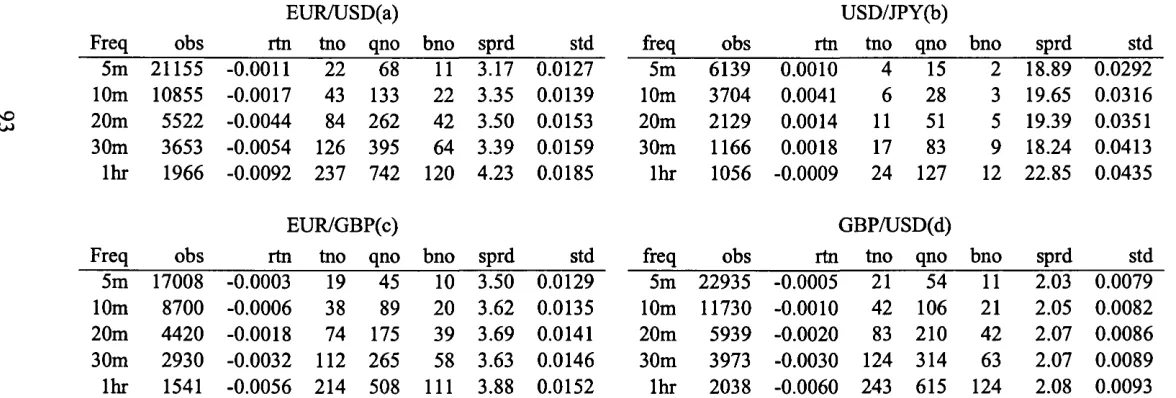
2.1 Summary o f time aggregated databases... 55
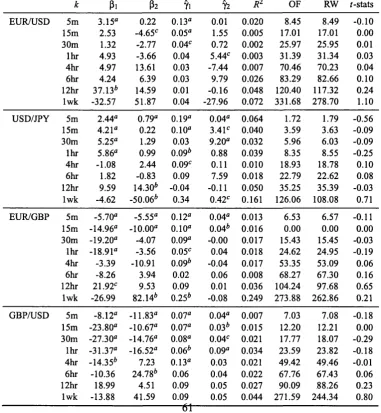
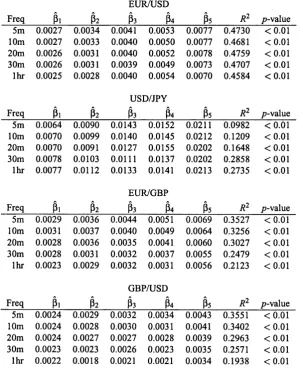
2.2 Explaining Exchange Rates with Order F lo w ... 56
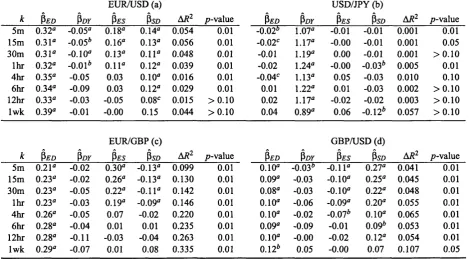
2.3 Inter-market Information flow ... 57
2.4 Inter-market information flow ex p erim en ts... 58
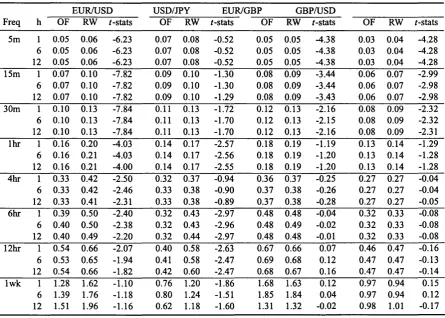
2.5 M eese-Rogoff (1983) forecasting experiments: Root M ean Squared Errors ( R M S E ) ... 59
2.6 Out-of-sample forecast e x p e r im e n ts ... 60
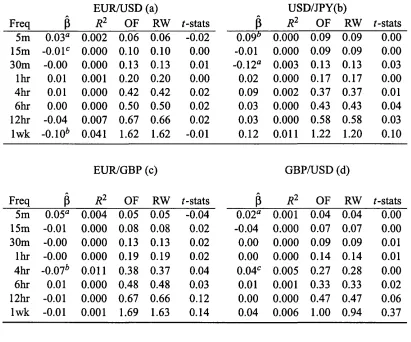
2.7 Forecasting Order Flow Out-of-Sample ... 61
3.1 Summary o f aggregated d a t a b a s e s ... 93
3.2 Spread effect on price impact o f order flo w ... 94
3.3 Volatility effect on price impact o f order f l o w ... 95
3.4 Volume effect on price impact o f order f l o w ... 96
3.5 Relationship between order flow informativeness and spread . . . 97
3.6 Relationship between order flow informativeness and volatility . . 98
3.7 Relationship between order flow informativeness and volume . . . 99
3.8 Coefficients estimates for LSTR m o d e l... . 1 0 0 3.9 Seasonality impact a n a ly sis ...101
3.10 Simultaneity a n a ly s is ... 102
4.1 Characteristics o f FT30 S to c k s ...137
4.2 Sample o f SETs Data (AL. 1 June 2 0 0 1 ) ... 138
4.3 Summary statistics o f limit orders o f FT30 s t o c k s ...139
4.4 Volume and Execution P ro b a b ility ... 140
4.5 Price aggressiveness and bid-ask s p r e a d ... 140
4.6 Execution Probability o f Different Size G r o u p s ...141
4.7 Price Aggressiveness o f Different size G r o u p s ... 141
4.8 PMP impacts and Execution P r o b a b ility ... 142
List of Figures
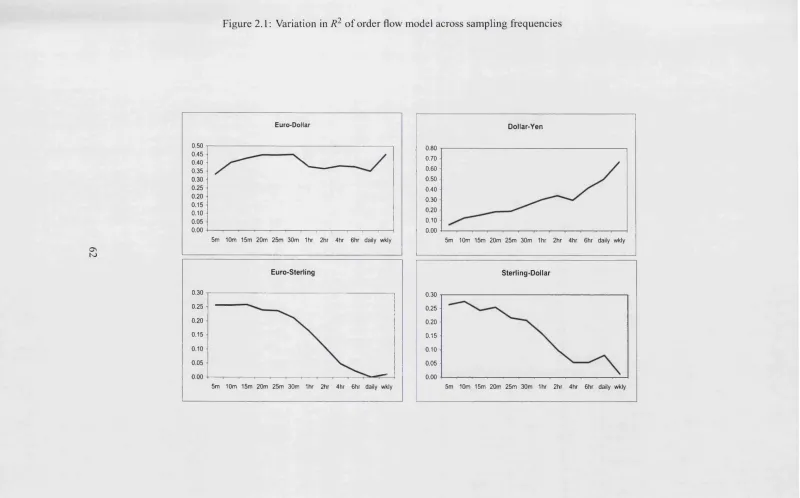
2.1 Variation in R2 o f order flow model across sampling frequencies . 62
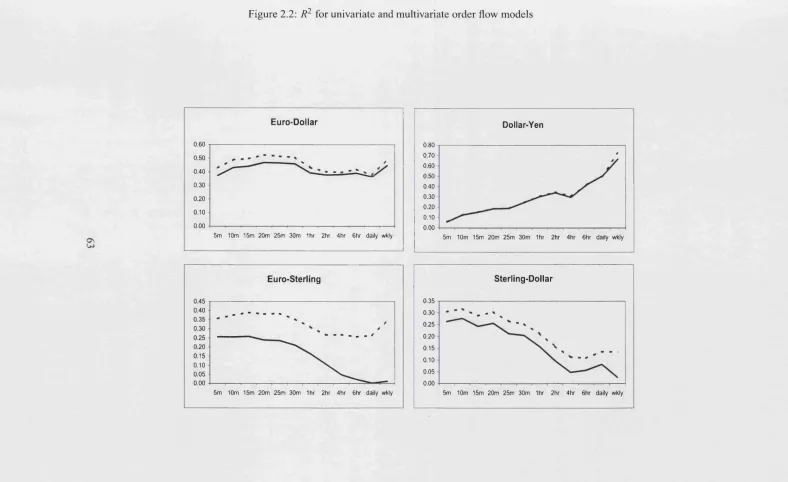
2.2 R 2 for univariate and multivariate order flow m o d e ls ... 63
3.1 Function P(Z,)) from recursive model (Zt is s p r e a d ) ... 104
3.2 Function p(Z,) from recursive model (Zt is v o la tility ) ... 104
3.3 Function p(Z/) from recursive model (Zf is v o lu m e )...105
3.4 Evolution o f p along spread in recursive model ... 105
3.5 Evolution o f P along volatility in recursive m o d e l ...106
3.6 Evolution o f p along volume in recursive m o d e l ... 106
3.7 Shift o f price impact o f order flow with s p re a d ...107
3.8 Shift o f price impact o f order flow with v o l a t i l i t y ... 107
3.9 Shift o f price impact o f order flow with v o l u m e ... 108
4.1 L-measure and price a g g re s s iv e n e ss ... 146
4.2 Intraday pattern o f limit o r d e r s ... 147
4.3 Volume E f f e c t... 148
Chapter 1
Introduction
1.1 Information, Order Flow and Asset Pricing
A vast number o f financial assets are bravely priced by markets everyday. A principle task o f finance theory is to understand how the assets are priced. In the standard asset pricing paradigm, to value an asset, one only needs to account for the delay and the risk o f payments. John Cochrane puts this idea as “...price equals expected discounted payoff. The rest is elaboration, special cases and a closet full o f tricks that make the equation useful for one or another application” (See Cochrane (2001), Page xiii).
Under textbook perfect market conditions where all information about the ex pected payoff is public and the mapping mechanism from information to price is common knowledge and effortless,1 we can apply Cochrane’s pricing formula to any asset easily. Under these assumptions, price formation, the mapping process from information to equilibrium price, is automatic and instant; all transactions take place at a publicly agreed equilibrium price to realize risk sharing and the
trading mechanisms and trading activities are irrelevant to asset pricing.2
As it has been widely accepted now that these assumptions, however, are not necessarily true in reality. We have seen a large amount o f researches, both theo retical and empirical, demonstrating that some information about the asset future payoff is not public and is dispersed among millions o f investors as private in formation (see, for example, Bagehot (1971), Grossman and Stiglitz (1980), Kyle (1985), Glosten and Milgrom (1985), French and Roll (1986), Hasbrouck (1991a, 1991b), Payne (2003), to name a few.). It is also widely acknowledged that differ ent investors might have different interpretation o f the same piece o f information and the mapping mechanism is not homogeneous. Isard (1995, pp. 182) describes this embarrassment in a context o f foreign exchange determination:
...economists today still have very limited information about the re lationship between equilibrium exchange rates and macroeconomic fundamentals. Accordingly, it is hardly conceivable that rational mar ket participants...could use that information to form precise expecta tions about the future market-clearing levels o f exchange rates.
When information structure is asymmetric, market is believed to play a role o f information aggregation. How is the dispersed information aggregated or how the private information is incorporated into the prices? Expectations model (for example, Grossman (1976) and Grossman and Stiglitz (1980)) usually assume a fiction o f representative Walrasian auctioneer who collects orders and finds the market clearing prices. The process starts with investors submitting their optimal demand conditional on their own private information, the auctioneer collects the orders and announces a potential price, investor revise their optimal demands con ditional on the price and their information. The process o f submitting demand =>
announcing potential price => revising demand continues until there are no more demand revisions, the equilibrium price is found and information is aggregated. Clearly there is no transaction taking place outside the equilibrium price and the final trading activities play no role o f price discovery but only serve as means of market clearing.3
Certainly there exist markets that bear at least an approximate resemblance to the Walrasian framework4. But there are many other financial markets where price-setting cannot be convincingly argued to fit in this picture. For example, in the foreign exchange markets and in the main trading periods o f most stock exchanges, trading takes place continuously and there are specific market partici pants playing roles far more active in price-setting than the Walrasian auctioneer does. The market maker or specialist in many exchanges do not have the lux ury o f going through the repetitive process o f submitting demand => announcing
potential price => revising demand before setting the actual transaction prices.
Also importantly, the insiders, such as those in Kyle (1985), might not even have the incentives to submit a fully informative demand and demand revision during the Walrasian auction process5. How are the ’’equilibrium prices” formed?6 The easiest way to demonstrate the information incorporation mechanism is by using Glosten and Milgrom (1985) framework. Assume there are informed and liquid ity traders in the market. The market maker sets the ask price at to the expected value o f an asset after seeing a trader wishing to buy (i.e. Et [V\Buy\. at depends on the conditional probability that V is either lower or higher than his prior belief
Vo given that a trader wishes to buy. The bid price bt is defined similarly given
3 It seems that, in this Walrasian framework, the process o f submitting dem and =» announcing potential p ric e =*> revising demand is contributing to the price discovery.
4For example, the open and close auction call at the London Stock Exchange. 5This valuable incentive argument is suggested by Richard Lyons.
that a trader wishes to sell. If the liquidity traders are assumed equally likely to buy or sell whatever the information, good news will result in an excess o f buy orders and bad news will result in an excess o f sell orders. This implies that the conditional probability incorporates the new information that the market maker learned from observing the order flow and is hence a posterior belief about the asset value. The posterior will become a new prior in the next round o f trading. As the trading takes place continuously, the updating process continues and the information ’’flows” into the prices.
In the above Bayesian learning process, trading activity is clearly relevant to the price discovery per se. Trading, the signed transaction quantities in particular, not only serves as a mechanism o f market clearing, but also serves as a vehicle o f information transmission. Dispersed private information is effectively incorpo rated into prices through trading order flow.
Order flow in the market microstructure literature is defined as the net o f buy initiated orders and sell initiated orders. It is a measure o f market“opinion”. It should be noted that order flow is fundamentally different from trading volume which has no direction and has no clear relation with the price setting. It should be also pointed out that order flow is different from the classic demand-supply pressure. Classic demand-supply is associated with public information and price changes due to demand-supply imbalance do not need transactions. Clearly here price changes due to order flow as in the Bayesian learning process are associated with trading activities. It is through the trading activities that non-public informa tion is incorporated into the prices.7 In this sense, order flow is informative and can be used to explain price changes.
Turning to the empirical side, there is an increasing amount o f evidence show
ing the strong impact o f order flow on asset returns in both equity and foreign ex change markets. Hasbrouck (1991a, 1991b), Hasbrouck and Seppi (2001), French and Roll (1986) and Chordia, Roll and Subrahmanyam (2002) study equity mar kets and Evans and Lyons (2002a), Caia et al. (2001), Rime (2000), Danielsson, Payne and Luo (2002) and Payne (2003) study foreign exchange markets. The evidence from all these research works amounts to a simple point: order flow is informative and has significant impact on returns.
I f price is driven by order flow, then what drives order flow? Like many other important issues in finance, economists still only have very limited understanding to this fundamental question. This question can be exploited in the following two sub-questions:
1. Can order flow convey public information or can public information drive order flow?
2. W hat information is behind the order flow that drives price?
The second question is very important but also more complex. Even though it is believed that order flow contains information valuable for forecasting price (see, for example, Goodhart (1988)), it is less clear what this information might be about. In a broad sense o f asset pricing, there are two types o f information that is relevant to asset price: information about future payoff and information about the discount factor or pricing k ern el8. In theory, order flow is overwhelmingly as sumed to convey the first type o f information (for example, Kyle (1985), Glosten and Milgrom (1985) and Easley and O ’Hara (1992)) but the empirical evidence is limited.9 Evans and Lyons (2002a), Rime (2000) and Danielsson and Payne and Luo (2002) find strong contemporaneous correlations between flows and returns in foreign exchange markets, the horizons over which the returns and flows are measured are at relatively short (from five minutes to one week). Though authors working with high frequency data believe that results based on certain intervals, such as daily or weekly, are consistent with the story that order flow conveys fun damental information on future payoffs because the price impacts can be seen as ‘permanent’, those who believe fundamental information on future payoff should last much longer (above one month, for example) think that the existing results are not hard evidence and the evidence from much lower frequency data is still desired.
On the other hand, there is increasing amount o f evidence showing that order flow conveys information about the discount factors.10 Caia et al. (2001) find that order flow reveals private information about the portfolio shifts that have signif icant impact on the dramatic changes o f USD/JPY rate in 1998. In their survey
8Campbell and Shiller (1988) demonstrate that a large part o f variation in aggregate equity values appears to be due to changes in discount rates rather than changes in expected payoff.
9Evans and Lyons (2003) and Love and Payne (2002) find order flow is useful in conveying macro news which can be interpreted as news regarding future payoff.
paper, Gehrig and M enkhoff (2002) provide evidence that order flow conveys in formation on semi-fundamentals, such as short-term trading objective, liquidity consideration and portfolio shifts, which has short-run price impacts. Overall, so far we see more evidence that order flow conveys information relevant to short and medium term price movements than the evidence that order flow conveys in formation about future payoff, a view labelled by Froot and Ramadorai (2002) as
weakflow-centric view.
If information conveyed by order flow is less important in the long run than in short or medium run, is it still useful to study order flow for a better under standing o f asset pricing? The answer is yes for two reasons. Firstly, the concept o f ‘fundamentals” o f an asset is far more elusive than it appears to be. For exam ple, in most theoretical models, the fundamentals refer to the final payoff o f an asset and is assumed to be static. However, it is almost impossible for an investor to tell what is the final payoff o f a stock or an exchange rate. Even for the same piece o f public information (on future payoff), different investors can draw dif ferent conclusions and will take different actions based on their own understand ing. Market order flow serves as a vote counter and aggregates information on economic factors, some o f which even economists do not understand quite well. Given the dismal empirical result on the relationship between“fundamentals” and the actual asset prices (such as exchange rate disconnect puzzle, excess volatility puzzle), the order flow approach, humble but more practical, can lead us closer to understanding price behaviour. Secondly, the short to medium term price forma tion process, like the long-term relationship between asset prices and the ultimate economic variables, is also o f profound importance for market participants.11.
Investors having short investment horizons obviously care about such short to medium term price behaviour. Policy makers, like central banks and regulators, are also turning to the micro market behaviour to better understand many classic financial issues like intervention and financial crisis.12 Order flow, though itself is only a proxy for the economic variables that drive asset prices, it can neverthe less serve as a m edia which allows us to study price evolution on one hand and to telescope the ultimate and elusive economic variables on the another hand.
This thesis contains three closely connected articles on order flow economics: (1) exchange rate determination and inter-market order flow effects, (2) market conditions and order flow impact and (3) limit order execution and microstructure factors. These research works extend the existing literature on order flow and enhance our understanding o f price formation process in foreign exchange and equity markets. The following sections in this chapter provide a b rief outline o f the motivations and m ain results obtained in subsequent chapters.
1.2 Order Flow Effects in FX Markets
Chapter two is based on co-joint work with Jon Danielsson and Richard Payne, ’’Exchange Rate Determination and Inter-Market Order Flow Effects”. It further examines the price impact o f order flow across different exchange rates and over a range o f sampling frequencies, investigates information flow across related mar kets and tests the forecasting power o f order flow models.
1.2.1 Issues, Methodology and Data
Empirical models o f exchange rate determination, especially at intermediate esti mation horizons, have frustrated economists at least since the M eese and Rogoff (1983a, b) result that macro-based exchange rate models have little in-sample ex planatory power and underperform a random walk in out-of-sample forecasting. In the empirical finance literature, there is, however, a long tradition o f studying the higher frequency relationship between the prices and trading volume (see, for example, Clark (1973), Tauchen and Pitts (1983)). Such analysis cannot help re solve M eese-Rogoff puzzle, not least because volume is directionless and bears no information on the direction o f exchange rate movements. Recently, researchers have investigated the price impact o f order flow, a variable that is fundamen tally different from volume. For example, Hasbrouck (1991a) and Madhavan and Smidt (1991) study equity markets. Cohen and Shin (2002) and Danielsson and Saltoglu (2002) study fixed income markets. Lyons (1995), Payne (2003), and Evans and Lyons (2002a) study foreign exchange rate markets. In these empirical microstructure researches order flow has been shown to be a key determinant in high frequency asset price changes.
From the perspective o f benchmark rational expectations models o f asset pric ing or exchange rate determination, the importance o f order flow is puzzling. Such models predict that prices should respond to new information without any consistent effect on order flow. Intuitively, when new information arrives every agent immediately revises his/her estimate o f the value and thus there are no rea sons/opportunities for one-sided trading. Thus one must look beyond these mod els to find a rationale for order flow’s effects on prices.
vey information about micro factors (e.g. shifts in hedging demands) and macro factors (e.g. public announcements). While the micro information is specific to individual agents, macro information can be also interpreted differently across agents. Consider an economy where agents have asymmetric information and/or disagree about the asset pricing model. In that case, disagreements between FX market participants regarding the manner in which exchange rates are determined or the non-public information relevant for exchange rate determination will be re vealed in order flow and thus flow can be used to explain (and possibly forecast) exchange rates in the short to medium term. Recent empirical work supports this intuition, e.g. Evans and Lyons (2002a) who find strong dependence o f daily ex change rate changes on daily order flow, even after accounting for macroeconomic fundamentals.
Chapter two is aimed to investigate the importance o f order flow for exchange rate determination and extends the extant research in three areas:
1. Extend the earlier results o f Evans and Lyons (2002a) who only consider the daily sampling frequency and two currency pairs. Using a unique data set which contains four currency pairs (EUR/USD, EUR/GBP, GBP/USD and USD/JPY) and spans nine months on average, this research investigates the relationship between order flows and exchange rate changes across fre quencies, ranging from five minutes to one week and for four rates. The relatively long time-series dimension o f our data and the fact that we have four exchange rates to consider, we can examine how the explanatory power o f order flow changes with sampling frequency and whether the effects of flows are consistent across currency pairs.13
2. The flow-retum relationship is investigated in an inter-market framework.
Specifically, we investigate whether order flows in other relevant markets (e.g. EUR/USD) have explanatory power for exchange rate changes (e.g. GBP/USD) beyond its own order flow. This research is motivated by the following economic reasoning: a currency trader who has private informa tion regarding the future value o f a currency, say the dollar, could profit from this information in many possible currency markets e.g. GBP/USD, USD/JPY, EUR/USD. Given the informational links between all dollar re lated markets, order flow in one market has important implication for the asset in another m arket14.
3. This work goes beyond prior work on the contemporaneous relationship be tween returns and flows to evaluate the forecasting power o f order flows for exchange rates. In theory (e.g. Kyle (1985)), order flow generated by in formed trading has the property o f autocorrelation because informed traders behave strategically and split their demand in a sequence o f trades. Here we seek to understand whether, using order flows and in some cases past returns also, we can generate forecasts that improve upon naive statistical alternatives. Thus we test whether empirical models based on order flow can pass the tests that standard macroeconomic models failed. O f course, the analysis conducted here is at much higher sampling frequencies than those considered by Meese and Rogoff (1983a), but the possibility that one can generate useful, non-trivial forecasts o f rates at the daily level indicates that one might also be able to do so at lower frequencies.
1.2.2 Main Results and Contribution
We study the explanatory and forecasting power o f order flow for exchange rates changes for our major exchange rates at sampling frequencies ranging from 5 minutes to 1 week. The key results include;
• The contemporaneous relationship between flows and changes in rates is significant for all four rates but model explanatory power varies across sam pling frequencies. At intra-day frequencies the flow-retum relationship is strong for all four rates. At the daily and weekly level, there is still strong explanatory power o f order flow for exchange rates changes for EUR/USD and USD/JPY but not for EUR/GBP and GBP/USD.
• However, when one examines the inter-market effects o f order flows, one sees that price changes for EUR/GBP and GBP/USD are strongly affected by EUR/USD order flow and, taking these effects into account, at daily and weekly sampling frequencies overall flows have strong explanatory power for the Sterling rates.
• An analysis o f the forecasting power o f order flows, using the technique of Meese and R ogoff (1983a, b), demonstrates that flow analysis outperforms a naive benchmark across essentially all sampling frequencies for all rates.
• A simple true out-of-sample forecasting experiment using order flows does not provide terribly valuable exchange rate forecasts. There is, however, evidence that order flow can be forecast out o f sample.
flow effects are new and provide direct empirical evidence for the international currency competition model by Lyons and Moore (2003) who assume informed currency traders can exploit their information advantage by in-direct trading. Fi nally, the results from forecasting experiments indicate order flow has potential to forecast exchange rates and provide a step stone for a more sophisticated forecast ing model development.
1.3
Market Conditions and Price Impact of Order
Flow
Order flow drives price because it carries information. Order flow will have larger impact on prices when it is more informative, and vice versa. Chapter three, ’’M ar ket Conditions, Order Flow and Exchange Rates Determination”, investigates how informativeness o f order flow changes under different market conditions in foreign exchange markets.
1.3.1 Issues, Methodology and Data
variation for DEM/USD and USD/JPY respectively. Rime (2000) shows that order flow can explain 30 percent o f return variation for NOK/DEM on a weekly basis. Chapter two will provide further evidence that order flow has explanatory power for exchange rate changes for EUR/USD, GBP/USD, USD/JPY, and EUR/GBP at higher frequency levels and within an inter-market framework
The microstructure approach to exchange rate analysis is based upon a simple idea that order flow carries information and thus has explanatory power for price movements. The existing research work in this line has largely assumed that the informativeness o f order flow is constant even if the market experiences dramat ically different situations. Is this assumption valid? This question hasn’t been addressed in the extant empirical literature.
Turning to theory, we don’t have a better answer either. There is little con sensus among the existing microstructure theories on at what market conditions order flow could be more informative. In the models o f Admati and Pfleiderer (1988) and Subrahmanyam (1991), both the informed and the discretionary liq uidity traders can strategically choosing their trading time and such strategic be havior will impact on the informativeness o f order flow. Admati and Pfleiderer (1988) predict that informativeness o f order flow will be positively correlated with bid-ask spreads and negatively correlated with volatility and trading volume.
In the information uncertainty model o f Easley and O ’Hara (1992), however, the occurrence o f trades is associated with information events. W hen a trade oc curs, the market maker will update his/her belief towards a higher probability o f some information events and adjust the quotes accordingly. The model predicts that order flow is more informative when spreads are high, volatility is high and trading volume is high.
mechanism o f order flow is important from the point o f views o f both academics and market participants. Chapter three attempts to address these issues by study ing a simple empirical model:
APt = a + (3* Qt + £ r (1-1)
where APt is price change and Qt is aggregated order flow within time interval
[t — 1, /] respectively.
Generally speaking, the information effect o f order flow will be captured by the regression coefficient p. In words, the more informative the order flow the larger the P, and vice versa. If order flow is not equally informative, p is expected to be a function o f some structural parameter Zt measuring market conditions, i.e,
P = P(Z,).
The main objective o f chapter three is to empirically characterize the func tion p(Zt ), where three market condition measures are examined: bid-ask spread, volatility and trading volume. The data used in this study is transaction level data collected by Reuters D2000-2 in the inter-dealer spot FX markets. It covers four major currency pairs (EUR/USD, EUR/GBP, GBP/USD and USD/JPY) and spans nine months on average between 1999 to 2000.15
1.3.2 Main Results and Contribution
The major findings include:
• The informativeness o f order flow is not constant under different market conditions as was assumed in the existing empirical microstructure liter ature. This result highlights the non-linearity in the relationship between
order flow and price movement.
• Order flow tends to be more informative when bid-ask spreads are high, volatility is high or trading volume is low. This relationship is significant and persistent across different sampling frequencies and exchange rates.
• The relationships between the price impact o f order flow and the market conditions are significantly captured by our Interaction model and Logistic Smooth Transition Regression (LSTR) model. In particular, the empirical results from the LSTR model also suggest that the price impact o f order flow shifts within a relative small range o f market conditions that the market is very likely to experience.
It should be noted that the measure o f order flow informativeness in this re search relies on the aggregation o f order flow. Working on a transaction base, the regression model (1.1) might be distorted by the transitory liquidity effect. Through aggregation, the liquidity trades can be largely cancelled out over time. In this research we have run a set o f robustness tests, including testing seasonality impact and experimenting regression (1.1) in an inter-market framework in which liquidity effect does not exist at all.
This research work challenges a widely adopted assumption in previous empir ical market microstructure literature that order flow is equally informative under different market conditions. The evidence provided here indicates that the equal informativeness assumption is ungrounded. The non-linearity identified in this study implies that the flow models can be improved by taking into account the market conditions.
model nor with those o f Easley and O ’H ara’s information uncertainty model. So far, to my knowledge, we haven’t seen any theoretical models that explicitly take market conditions as an input element in pricing mechanism. Although to develop a theory that better explain the empirical results presented in chapter three is not within the research agenda o f this thesis, I believe future research on this issue will be worthwhile.
1.4 Limit Order Execution Probability
Limit order is one o f the major types o f order commonly seen in electronic trading systems. With a limit order, one needs to specify the desired transaction price and the quantity/size to buy or sell. Once a limit order is submitted, it will sit in a queue usually called limit order book. For limit order trading, most exchanges maintain a strict price and time priority.16 For a limit buy order, when market transaction price is at or below the pre-specified price o f the limit order, the limit order will be partially or completely executed depending on the size o f the incoming sell order. For a limit sell order, execution condition is similar. A salient feature o f limit order is that limit orders are usually executed at better prices than the best offers (for buy limit order) or bids (for sell limit order) available at the time o f limit order submission, but there is no guarantee o f execution. Non-execution implies implicit cost. Chapter four investigates various factors that might impact on the execution probability o f limit orders.
1.4.1 Issues, methodology and Data
As more and more stock exchanges are adopting the automatic order-driven sys tems, limit order has been widely used as a major trading means. Comparing with market order, the benefits o f limit order includes price improvement (buy at bid price or sell at ask price) and no price uncertainty. However, the benefit does not come without cost: execution is not secured. Since non-execution cost could be very high, investors trading with limit order need to evaluate the execution prob ability o f their submission strategies and take this into account in forming the investment decisions.17
Chapter four analyzes how such probability can be affected by various fac tors and attempts to provide a method to evaluate the execution probabilities o f different order submission strategies. The issue is clearly important to the mar ket participants, especially to the trading desk o f institutional investors for whom the trading cost is among the top concerns.18 It is also important from market structure point o f view: limit order placement has important impacts on market liquidity and spread dynamics. In the classic market microstructure models, in formed traders are overwhelmingly assumed to use market orders to exploit their information advantage. However, there is experimental evidence showing that in formed investors do not restrict themselves to market orders. In an experiment study, Bloomfield, O ’Hara and Saar (2002) find informed traders can use more limit orders than liquidity traders do in certain market conditions. Actually the use o f the limit order by informed investors who want to buy can be rationalized
,7For example, Donald Keim and Ananth Madhavan wrote in the a article that ’’the implicit costs...associated with m issed trading opportunities...are significant relative to explicit costs and realized portfolio returns”. Source: Financial Times, 23 July 2002.
in following simple model (similarly for those who want to sell):
f n m = E [ v \s ] - ( p ask + XQ2)
< ( 1.2)
[ m = n ( K ) ( ^ [ v | 5 ] - y ) + ( i - n ( K ) ) o
where the nm and 7t/ are expected profit o f trading quantity of Q by using market and limit order respectively, ^[v^] is the expected value o f the asset conditional on the private signal s. p ask is current market ask price and p l is the price o f limit order. X is the price impact coefficient in the sense o f Kyle (1985). II is the probability o f execution o f limit order, n is a function o f k, a vector o f factors
which can impact on the limit order execution probability.
In the above setup, observation o f private signal wouldn’t necessarily lead to the use o f market orders. By using a market order, informed investors can secure a transaction but have to pay the transaction costs, including bid-ask spread and price impact cost, which is measured by XQ2. By using a limit order, though the transaction price could be lower (p l < p ask + XQ2), the execution is not secured
(n
<1).
Under certain market conditions (for example, when execution probabil ity and spread are large), informed trader might be better off by using limit order rather than market order. An implication o f this simple model is that limit order could also convey information, a point that I believe is o f profound importance in market microstructure but is largely ignored in existing literature.Clearly, the execution probability, II, is a key factor affecting investors’ de cision on the choice between different types o f orders. A better understanding o f how such probability is determined — the objective o f this research — will not only have important implications for practitioners but also can enhance our knowledge o f price discovery process in limit order trading systems.
impact on limit order execution (Cohen, Maier, Schwartz and Whitcomb (1981), Angel (1994), Glosten (1994), Kumar and Seppi (1992), Seppi (1997), Handa and Schwartz (1996), Parlour (1998) and Foucault (1999), Chung, Ness and Ness (1999), Biais, Hillion and Spatt (1995) and Ahn, Bae and Chan (2001) ,etc). The focus o f these studies, however, is not on the limit order execution itself but is mainly on the choice between market order and limit order and how such choice impacts on m arket equilibrium.
Works on limit order execution are relatively few and most concentrate on time-to-execution. Foucault, Kadan and Kandel (2001) develop an equilibrium model for time-to-execution o f limit orders. In another work, Lo, Mckinlay and Zhang (2002) compare three different econometric models for the time-to-execution o f limit orders and find the time-to-execution is sensitive to limit price and other explanatory variables. Current research focuses on the execution probability and can be seen as complementary study o f this line o f literature.
Research in chapter four is also related to microstructure literature on prof itability study o f order submission strategies. Handa and Schwartz (1996) and Harris and Hasbrouck (1996) compare the ex post profitability o f different order submission strategies in NYSE. This chapter uses a sample o f FT30 stocks from limit book system o f London Stock Exchange (LSE) to analyze how limit order execution probability is affected by various factors and evaluate such probability ex ante. Obviously the analysis conducted in this chapter is a building block to extend the profitability analysis in real time.
o f the all factors examined in the first stage. In this way the factors can be tested simultaneously. Moreover, the estimates can be feedback into to model to evaluate the execution probability o f different limit order submission strategies in real time.
1.4.2 Main Results and Contributions
Chapter four empirically investigates the impacts o f various microstructure factors on the limit order execution probability and models such probability o f limit order submission strategies. The main results are,
• For a given stock, price aggressiveness, measured as the extent to which a limit order betters the best existing quote on the same side, has a significant positive impact on the limit order execution probability. In General, spread
is negatively correlated with unconditional limit order execution probabil ity. W hen price aggressiveness is controlled, spread impact is particularly strong. Potential Market Pressure (PMP), a difference between the buying pressure and selling pressure built up on the limit order book, has significant impact on the execution probabilities. For buy (sell) orders, the larger PMP, the smaller (larger) execution probability.
• Across different stocks, market liquidity, measured as trading volume o f a stock, has strong impact on the limit order execution probabilities. Trading less liquid stock, a trader have to post a more aggressive limit price to get the same likelihood o f execution as trading liquid stocks.
• Volatility has positive impact on limit order execution but much weaker compared with price aggressiveness, spread or PMP.
• The limit order execution probability is modelled as a function o f a vector o f factors (price aggressiveness, spread, PMP, order size, volatility and time o f day) in a probit model. The estimation results indicate that the proposed model is capable o f capturing the features regarding the relationship be tween limit order execution probability and its major determinants and can be used to forecast the such probabilities o f different limit order submission strategies.
In previous researches, a set o f factors have been assumed to have important impacts on the order submission19. Chapter four attempts to test these predictions thoroughly by using a unique data set from the London Stock Exchange. The empirical results on the impact o f spread and aggressiveness provide direct sup porting evidence for the model predictions o f Foucault et al. (2001). Volatility, which is the key driving force o f market liquidity dynamics in theoretical mod els is found to have only slight impact on limit order execution while potential market pressure, which has been escaped the economists’ scope, is found to have profound impact on the limit order execution in our sample. This research work tries to establish some ’’stylized facts” for further theoretical research on the liq uidity demand-supply in the limit order trading system.
In the existing market microstructure literature, both theoretical and empirical, market order is believed to be the vehicle o f information transmission. As argued in previous subsection, in equilibrium, the choice between limit order and market order depends on the expected execution probability which in turn depends on
Chapter 2
Exchange Rate Determination and
Inter-Market Order Flow Effects
2.1 Introduction
Empirical models o f exchange rate determination, especially at intermediate esti mation horizons, have frustrated economists at least since the Meese and Rogoff (1983a, b) result that macro-based exchange rate models underperform a random walk in forecasting ability. In the empirical finance literature, there is, however, a long tradition o f studying the higher frequency relationship between the price o f financial assets and trading volume.1 Such analysis cannot help resolve the Meese-Rogoff puzzle, not least because volume is directionless, i.e., a change in volume cannot predict the direction o f FX changes. Recently, researchers have investigated the impact o f signed volume, i.e., the decomposition o f volume into transactions initiated by sellers and buyers, separately. The difference between seller and buyer initiated volume is termed order flo w, a variable that is funda mentally different from volume. Order flow has been shown in empirical mar-
ket microstructure research to be a key determinant in high frequency asset price changes.2 Several authors, e.g. Lyons (1995), Payne (2003), and Evans and Lyons (2002a) study the relationship between order flow and foreign exchange rates. The objective o f this chapter is to investigate the relationship between order flow and FX rates, extending extant research in three aspects: providing augmented evi dence regarding the dependence o f prices on flows, examining inter-market order flow effects, applying M eese-Rogoff methodology to test the forecasting power of order flow model.
From the perspective o f benchmark rational expectations models o f asset price or exchange rate determination, the importance o f order flow is puzzling. Such models predict that prices should respond to new information without any consis tent effect on order flow. Intuitively, when new information arrives every agent im mediately revises his/her estimate o f value and thus there are no reasons/opportunities for one-sided trading. Thus one must look beyond these models to find a rationale for order flow’s effects on prices.
In general terms, order flow can be a determinant o f prices in environments where agents do not share the same information or where they do not agree on the model by which asset prices are determined. In this context, order flow can conveys information about micro factors (e.g. shifts in hedging demands) and macro factors (e.g. public announcements). While the micro information is spe cific to individual agents, macro information can also be interpreted differently across agents. Consider an economy where agents have asymmetric information and/or disagree about the asset pricing model. In that case, the agents’ trading strategies and, in particular, aggressiveness, might reveal underlying information regarding future payoffs or change o f risk premia and hence affect asset price
changes. Recent empirical work supports this intuition. For example, Evans and Lyons (2002a) find strong dependence o f daily exchange rate changes on daily order flow, even after accounting for macroeconomic fundamentals.3
The objective o f this chapter is to investigate the importance o f order flow for exchange rate determination. In this we extend the earlier results o f Evans and Lyons (200a) who only consider the daily sampling frequency and one currency pair a time. We investigates the relationship between order flow and exchange rates across frequencies, ranging from five minutes to one week. Furthermore we study four currency pairs (EUR/USD, EUR/GBP, GBP/USD and USD/JPY) and explicitly model the impact o f order flow across markets, e.g. investigating the impact o f EUR/USD order flow on EUR/GBP exchange rate. Finally, we apply Meese-Rogoff methodology to test whether the order flow models beat a random walk in forecasting.
Our data derives from transaction-level information obtained from the Reuters D2000-2 electronic brokers and covers approximately 10 months for EUR/USD and GBP/USD and eight months for EUR/GBP and USD/JPY. The sample starts in 1999 and ends in 2000. Our analysis consists o f three set o f empirical exercises.
First, we evaluate how order flow is contemporaneously related to changes in exchange rates across sampling frequencies. Taking advantage o f the rela tively long time-series dimension o f our data and the fact that we have four ex change rates to consider, we can examine how the explanatory power o f order flow changes with sampling frequency and whether the effects o f flows are consistent across currency pairs.
Second, we look at the dependence o f exchange rate changes on order flows from other markets by investigating whether order flows in one currency pair have explanatory power for another currency pair.
Finally, in order to investigate order flow from a macroeconomic perspective, we evaluate the forecasting power o f order flows for exchange rates. Here we seek to understand whether, using order flows and perhaps past returns, we can generate forecasts that improve upon naive statistical alternatives. Thus we test whether empirical models based on order flows can pass the M eese-Rogoff test.
The results from these three research questions provide new insights into the market microstructure analysis o f high frequency exchange rates as well as the macroeconomics analysis o f medium term exchange rate determination.
First, we demonstrate that, within a single market, contemporaneous order flow significantly explains exchange rate changes, across sampling frequencies. We however observe considerable differences in the explanatory power of the var ious regressions. For EUR/USD rate, R 2 hovers around 40% across frequencies, while for USD/JPY the R 2 increases with aggregation, from 6% at five minutes to 67% at one week. In contrast, R2 for both GBP rates decreases with aggregation from 26% at five minutes to 1% at one week. Taken in isolation, the results from GBP regressions are somewhat puzzling.
pact o f EUR/GBP order flow on EUR/GBP rate. However this investor can also trade GBP/USD and EUR/USD to exploit his information advantage if the in direct markets are liquid and price impacts are small4. Obviously the order flow in GBP/USD and EUR/USD markets conveys information about EUR/GBP. From the practical perspective, market players in the one market will keep their eyes open to the price changes and order flows o f other markets. Dealers in EUR/GBP market will adjust the EUR/GBP quote when observing positive order flow in EUR/USD market or negative order flow in GBP/USD market, both indicating a appreciation o f Euro against Sterling. In this case, we will observe price change in EUR/GBP rate without companying EUR/GBP order flow.
These results suggest that while basic own order flow model may be appropri ate for the largest currencies, it is less so for smaller currencies with many traded exchange rates such as GBP.5 While Rime (2000) finds that order flow are signif icant in explaining EUR/SEK, the EUR contract is the only traded currency for SEK. In contrast, there are multiple traded currency pairs for GBP. As a result, information regarding SEK will go through EUR/SEk order flow, while the in formation regarding GBP can flow through any traded currencies. Furthermore, this provides significant evidence o f strong information links between FX mar kets, with small markets dominated by larger ones. This effects persist across our frequencies and strengthen with aggregations, suggesting that these information links may persist beyond our sampling frequencies.
The final key result is on the forecasting o f exchange rates. First, we use Meese and R ogotf (1983a, b) framework, and find that the order flow models almost always yield a better forecast (in RMSE terms) than does a random walk model.
4In that case, we w ill see a negative order flow in GBP/USD market and a positive order flow in EUR/USD market.
This result is consistent across sampling frequencies and currencies. Therefore, the order flow model passes the M eese-Rogoff test that macroeconomic models have failed so often. We note however that Meese-Rogoff test is not a genuine out-of-sample forecasting test. We run such a test with simple specification and find that order flow does not perform particularly well in forecasting exchange rates. We find however that order flow itself can be forecasted. This suggests that a more sophisticated specification for a pure forecast model for exchange rates may provide significant forecasting power.
In sum, our results suggest that order flow analysis can be very useful in un derstanding exchange rate determination. From a low frequency, macroeconomic perspective, order flows can contribute strongly to our ability to explain exchange rate changes while they allow one to improve exchange rate forecasts most dra matically at a microstructure level. While further work using longer data samples would be useful to verify and clarify our results, the analysis here clearly points to the information content o f order flow.
The rest o f this chapter is structured as follows. Section 2.2 outlines FX mar ket, our data sources and our processing o f the data. Section 2.3 presents our analysis o f the explanatory power o f order flow for exchange rates in single mar ket and section 2.4 presents our inter-market analysis results. The following sec tion presents the forecasting results. Some discussion o f our findings is given in Section 2.6 and Section 2.7 concludes.
2.2
The FX Markets and the Data
2.2.1 The foreign exchange markets
cated in major money centres, including London, New York, Tokyo, Zurich and Hongkong. These banks operate as dealers, trading with each other as well as with non-bank customers. Unlike equity market, FX market is a 24 hours market and has no opening and closing procedure. But, since the market activities (in the sense o f quoting and trading) are very sparse on weekends and some holidays, it is practically viewed as closed during these periods.
Following Lyons (2001), we divided the spot FX market into three segments by their information structure characteristics: customer-dealer, brokered inter dealer and direct inter-dealer. The customer-dealer segment is usually thought as the major source o f information in the FX markets. However, due to the lack o f transparency, the transactions between dealers and their non-bank customers largely remain private information to the dealer themselves. The brokered inter dealer market is thought to be the most transparent part o f the FX spot market and most o f the transactions are conducted through EBS or Reuters D2000-2, the two major electronic dealing systems in this market.6
2.2.2 The Data
The data set used in the research comes from the brokered segment o f the inter dealer FX market and are drawn from the Reuters D2000-2 system. Thus the data contains no information on customer-dealer FX trades or on direct (i.e. non intermediated) trades between dealers.7 A subscriber to D2000-2 sees the follow ing items on the trading screen, for up to 6 exchange rates:
• Best limit buy and sell prices
6EBS, Reuters D 2000-2 are brokered inter-dealer systems and Reuters D2000-1 is a bilateral direct inter-dealer system. EBS claimed to handle 37% o f the brokered trade in London and it is believed that Reuters has the same share. See Payne (2003).
• The quantities available for trade at the best prices
• An indicator o f the characteristics o f the last trade rder flow can be forecast out o f sample.
The raw data set is composed o f tick level information (including transactions and firm quotes), covering four major floating rates: EUR/USD, EUR/GBP, GBP/ USD and USD/JPY. Each transaction record contains a time stamp for the trade, a variable indicating whether the trade was a market buy or sell and the transaction price. For the quotes, each record contains a time stamp, bid and ask prices.8 Thus we do not need to make use o f potentially inaccurate, ad hoc algorithms to assign trade direction. The samples for EUR/USD and GBP/USD cover a period o f ten months from 28 September 1999 to 24 July 2000. Samples for EUR/GBP and USD/JPY cover a period o f eight months from 1 December 1999 to 24 July 2000. One limitation o f the data supplied is a lack o f information about the size o f each trade. Thus we cannot analyze whether the Dollar value o f order flow matters over and above order flow measured simply in terms o f numbers o f trades.9 Neverthe less this high frequency data set has two valuable characteristics: long sample periods and multiple exchange rates. The long sample period ensures reasonable statistical power for various econometric tests and the broad currency scope pro vides a platform to check the robustness o f model estimation cross-sectionally on major floating exchange rates.
8Chapter two will only use transaction information and Chapter three will use information on both transaction and quote
2.2.3 Filtering and time aggregation
For the later analysis, we time aggregate the transaction-level data to various de grees. Prior to time aggregation, however, we remove sparse trading periods from the data. Such sparse trading periods include the overnight periods, weekends, some world-wide public holidays and certain other dates where the feed from D2000-2 is very low.10
The analysis focuses on 8 different time aggregation levels: 5 minutes, 15 minutes, 30 minutes, 1 hour, 4 hours, 6 hours, 1 day and 1 w eek.11 Note that the definition o f one day in this research corresponds to a trading day defined as the interval between 6 and 18 DST. Thus one day covers 12 rather than 24 hours. Similarly, one week covers 5 trading days. The time aggregation is done as follows. First, The sample is scanned along calendar time. At every observation point the last transaction price is recorded along with the excess o f the number o f market buys over market sells since the last observations point. The logarithmic price changes is constructed from the price data.
After filtering and aggregation, 32 databases (8 sampling frequencies x 4 ex change rates) are created. These aggregated databases are the foundation for the model estimations and their properties are summarized in Table 2.1. As mentioned above, the long sample periods are valuable in that after filtration and aggregation we still have a decent number o f observations at our lower sampling frequen cies. For example, at the daily level, we have 201 observations for EUR/USD and GBP/USD and 160 observations for EUR/GBP and USD/JPY. The sample periods covers a time during which there was a depreciation o f the EUR against the USD
10Ovemight is defined as a period from 18:00 to 6:00 DST next day. It should be noted that this definition is only proper for the traders in London and N ew York, but not for the traders in Asian markets. It corresponds to the portion o f the day when trade on D2000-2 is least intensive, even for USD/JPY.
and GBP, a depreciation o f GBP against USD and a depreciation o f JPY against USD. These market trends are reflected in the columns o f each panel in Table 2.1 that display mean returns. Comparing panel (b) with the other three panels, it is clear that the number o f trades in USD/JPY is far less than for the other three mar kets. GBP/USD is the most heavily traded pair with EUR/USD and GBP/USD just behind. These numbers reflect two things. First, Reuters D2000-2 has poor coverage o f JPY markets and, compared to its competing system (EBS), has a minority share in EUR/USD trade. In contrast, D2000-2 dominates trade in GBP rates.
2.3 Own Order Flow and Foreign exchange rate De
termination
The study o f the high frequency relationship between price changes and order flow has a long tradition in the market microstructure literature. In contrast, it is only recently that such relationships have been studied at lower sampling frequency pairs, such as daily or weekly.
We begin simply by tracking how the explanatory power o f order flow for price changes varies across sampling frequencies and across currencies. To this end we run a set o f regressions o f the following form;
AP ( k \ t = a(* )/ +
P(*)/e(*),y+ e,
(2.1)
ffe-quencies, our analysis looks at four exchange rates from a sampling frequency o f 5 minutes all the way through weekly.
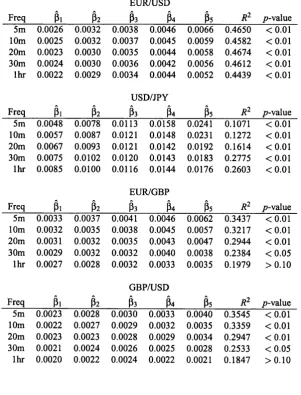
Table 2.2 contains the estimation results for model (2.1) for our four exchange rates and over the entire spectrum o f time aggregation levels.12
At the highest frequencies (less than one hour) there is significant effects from order flow for all currencies, with the strongest effects for EUR/USD and R2
ranges from 33% to 45%. These results confirm what microstructure economists have long known — order flow carries information for high-frequency asset price determination. People who are sceptical to the information explanation may think that the regressions at very high frequencies are simple capturing the liquidity effects.
As a result, from the point o f view o f exchange rate determination, we move toward lower frequencies. Consider first results from the daily frequency fre quency, initially for EUR/USD and USD/JPY in order to provide comparability with Evans and Lyons (2002a).13 Their daily USD/DEM and USD/JPY regres sion R 2 were just over 0.60 and 0.40 respectively which are broadly consistent with our results. The results reported in this research directly corroborate those o f Evans and Lyons (2002a).
However, our results on the GBP related exchange rates are m uch less sup portive o f their results. By looking at the low frequency regressions in the final two panels o f Table 2.2, one can see that the explanatory power o f order flow for GBP/EUR and GPB/USD is very poor. At sampling frequencies exceed
12Since the normality o f our return data is rejected by the Jarque-Bera test (not reported), we also experimented with a LAD estimator for these regressions, but the results were not qualitatively affected.
ing one hour, in no single case does the regression R 2 exceed 0.10, although in five o f the eight cases the order flow variable is statistically significant. Thus, at least for GBP, the assertion that order flow matters for exchange rate determina tion when one moves towards sampling frequencies that matter to international macroeconomists appears less secure than our EUR/USD and USD/JPY results suggested.
A graphical representation o f these results using a somewhat more dense set o f sampling frequencies is given in Figure 2.1. The figure clearly demonstrates the importance o f order flow regardless o f sampling frequency for EUR/USD and USD/JPY but also points to the declining effect o f order flow in the Sterling mar kets.
2.4 Inter-market Order Flow Analysis
Most existing order flow research focuses on one asset at a time. However, since exchange rates are relative prices o f currencies, and three o f our exchange rates form a triangle relationship, it is o f interest to investigate how order flow in one currency pair might be used to explain the exchange rate o f another currency pair. This is denoted as inter-market order flow analysis.
The reason for considering inter-market effect is the peculiar nature o f cur rency markets. In theory, an informed currency trader can have multi-route trad ing strategies to exploit his information. In a broad sense, consider, e.g., a trader has superior information about the future value o f USD, perhaps that USD can be expected to appreciate vis-a-vis other currencies. The trader can exploit this information by trading in USD/JPY, EUR/USD, GBP/USD, and so on. Holding others constant, an order flow in one market (e.g. GBP/USD) can convey valuable
information to other relevant markets (USD/JPY). Given the fact that three o f the currency pairs used in this study forms a perfect triangle system, this multi-route trading possibility is particularly important because any trading within the triangle system can be realized by direct or in-direct trading. Suppose a investor has supe rior information about the relative value o f EUR to GBP (e.g. Euro will appreciate in the future). He can buy EUR directly in EUR/GBP market and in this case we will see the standard single market result, i.e., a positive impact o f EUR/GBP or der flow on EUR/GBP rate. However this investor can also trade GBP/USD and EUR/USD to exploit his information advantage if the in-direct markets are liquid and price impacts are small. This reasoning is actually in line with the argument o f vehicle currency literature that transaction cost is the major determinant on the choice o f trading currencies (e.g. Matsuyama et al. (1993) and Rey (2001)). Under this hypothesis, order flow in GBP/USD and EUR/USD markets conveys information about EUR/GBP. Since liquidity suppliers in one market can observe the order flow in other market, they can revise their valuation o f a currency without actual trading.
It is in this analysis that the multi-currency nature o f our data set becomes extremely useful. The inter-market effects is investigated by extending (2.1) to include the order flow from all currency pairs, while still remaining within the lin ear specification that relates price changes in market i to contemporaneous order flows in all four markets. The specification is given below;
AP (k)tf = a{k)i + Y i m i j Q { k ) u + t i , < , i , j = E D ,S D ,E S ,D Y (2.2)
j
and all sampling frequencies, while the change in R2 is shown in Figure 2.2. Con