Teaching Ethics for Professional Practice
Maria Castro Romero
A professional discipline’s ethical code is meant to reflect the profession’s values and purposes, and it is each individual's responsibility to know, understand and professionally abide to the particular standards for the professional group of which they are a member. However, teaching ethics cannot be a mere translation of teaching professional codes. Since ethics are not universal, the chapter will begin by briefly commenting on ethics codes in the UK and those of several other countries, to demonstrate how professional ethic codes are borne out of particular contexts, followed by:
the link between the personal and the professional
some ways in which we can harness trainees’ development as ethical professionals
how we can measure teaching and practice/placement outcomes
Different aspects of this chapter will be relevant to the diverse professional training courses available for psychologists, counsellors and psychotherapists, with this chapter particularly focusing on the teaching of ethics. Whilst the aim of this chapter is to be of use to trainers and trainees in any of the wide range of available courses, specific examples from personal experience teaching on the Professional Doctorate in Clinical Psychology at the University of East London (UEL) will be utilised to ground the discussion.
Professional Ethics Codes
There are a number of professional bodies in the UK regulating psychologists, counsellors and psychotherapists. The British Psychological Society (BPS), the British Association of Counsellors and Psychotherapists (BACP), Health and Care Professions Council (HCPC) and the United Kingdom Council for Psychotherapy (UKCP) all have their own professional standards described in their individual codes, which members are expected to follow. Similarly, in other countries professional societies also subscribe to professional codes of conduct and ethical practice, as do our European neighbours, for example, in France, the Société Française de Psychologie (SFP), Italy, the Consiglio Nazionale Ordine Psicologi (CNOP), and Spain, the Colegio Oficial de Psicólogos (COP) and also further afield, the American Psychological Association (APA), and the Australian Psychological Society (APS).
the code in the form of ethical reflection, rather than an obligation to follow the principles1.
Reconstructing Ethics
The fact that there is such variation in ethical codes within one continent might maintain our curiosity about the range of positions taken when we include other countries in other continents. Notwithstanding the fact that there are European (European Federation of Psychologists’ Associations, 2005) and global codes (International Union of Psychological Science, 2008), more widely embracing codes may be impossible to incorporate locally depending on each country’s code (Stevens, 2010) and the levels of conflict with legal frameworks (Fisher, 2008).
The deontological2 direction of ethics in our profession is Western, rather than multicultural or international and, hence, implies a privilege of particular views over others, which (no matter how well intended) can be perceived by some of the peoples or communities with whom we work, as dissonant at best, and oppressive at worst (see Chapter 19 for further discussion). It is, therefore, important to think critically about ethical codes, as arising contextually and, in the UK (our context), as holding Anglo-centric values, or an admittedly “British eclectic tradition” (BPS, 2009:4). In addition, whilst statements such as “You must act in the best interests of service users” (Standard 1, HCPC, 2008) would not be debated by anyone, what should be deconstructed –and, in doing so, would highlight differing opinions, and possibly opposing outcomes– is what this statement means, for example:
How are ‘best interests’ defined?
Who decides what are service users’ best interests? Whose voice/s is/are stronger?
Who is involved, and how, are ‘best interests’ defined?
What professional and personal ideas affect the decision-making process?
To answer these and other questions, in addition to the wider context of ethical codes, taking into account that the personal and professional is inextricably linked (see Chapter 4), it is important to also be aware of the ethics professionals bring with them into the profession from their heritage and personal journeys.
The personal and the professional
Following on from the previous section, as professionals, we must harness reflexivity and reflection, as both awareness and inquiry into one’s own personal ethics are necessary in order to practice ethically. As Freire (1998) reminds us, “our awareness of our unfinishedness makes us responsible beings, hence the notion of our presence in the world as ethical…it is only because we are ethical that we can also be unethical” (p.56). To be constantly mindful of this caution, I think of being ethical not as a state to which we aspire and can reach through appropriate training but as an action, as something we achieve by what we do, in what we do, upon which (as ‘responsible beings’) we need to be reflecting. In acknowledging the link between the personal and professional both our integrity and accountability are enhanced (Tomm, 1993), thus, also our being in the world ethically.
1“La complexité des situations psychologiques s’oppose à l’application automatique de règles. Le
respect des règles du présent Code de Déontologie repose sur une réflexion éthique et une capacité de discernement, dans l’observance des grands principes suivants“
Perhaps because thinking about and discussing ethics is not generally part of most people’s day to day life in our society, it is quite possible for people to grow up and study through formal education without having much of a sense of their ethical principles. This is not to say that some people will be unethical or without ethics, but that they may not have an explicit awareness of the values by which they live. However, by the time people get to the point of professional training, as well as enough background in the profession usually (both in academia and clinical practice), a degree of reflexivity and self-awareness has to be demonstrated in order to succeed in accessing training. Although it is assumed that most trainees will have a good idea of their value base and this is a starting point, we need to move beyond becoming aware and making explicit our principles, to examine their history, consequences and contingencies, including:
Where do these ethics come from?
Which discourses are they privileging and which they are undermining? What do these ethics do to how we position ourselves in the world and how
we relate to others?
What do these ethics do to how we position others (particularly people seeking our help) and how does this positioning influence their relating to us and to themselves?
Therefore, it is important for training courses to begin with an engagement with ethics as central to training. As an example, on the first day of the UEL programme, we utilise the Tree of Life methodology (Ncube, 2006) to reflect on personal values and history as a welcome and getting to know each other. Throughout the three years of training, different pedagogical processes will need to be utilised to aid the development of trainees as ethical professionals.
The following fictitious vignette has been introduced to facilitate reflection on the above questions in relation to concrete ethical dilemmas raised by possible situations counsellors, psychotherapists and psychologists could encounter in their work: Vignette 1
Teaching ethics
Two male and one female white British, middle class psychologists, on ending their training programme, go to an African country, an ex-colony of Britain, to work for six months in a Trauma Service set up to provide Cognitive Behavioural Therapy (CBT) for Post Traumatic Stress Disorder (PTSD). The Trauma Service was initially set up by UK psychologists because CBT is recommended by the UK National Institute for Health and Clinical Excellence (NICE) guidelines for the treatment of PTSD in the UK, but the service is now led by a local psychiatrist and other local professionals. On their return to the UK, the three recently qualified psychologists recruit students in their final year of training to go back to Africa to work providing clinical supervision in the Trauma Service and training and teaching on local Counselling and Counselling Psychology programmes.
Are the recently qualified psychologists:
1. Acting in a manner that demonstrates awareness of their gendered, ethnic and class-related, identity, assumptions, beliefs and values?
2. Showing an awareness of historical context of colonialism and oppression and how this may influence what they bring to the Trauma Service and their relationships with the other professionals and service users?
3. Demonstrating a critical appraisal of categories such as PTSD and sensitivity to cultural differences in the application of NICE guidelines and CBT?
4. Respecting the ability of the psychiatrist and the other professionals in managing the Trauma Service and providing supervision and training?
Not only is ethics teaching (as the matter of ethics itself) complex and multidimensional, and it involves the person as a whole (Pasmanik & Winkler, 2009), teaching is itself an ethical act, of co-involvement, co-researching and jointly venturing (Freire, 1972, 1998), and is ultimately transformative for the educator and educands3. It is important to first contextualise where this teaching of ethics occurs, i.e., the ideas influencing our teaching, and my particular ethical base. The UEL Professional Doctorate in Clinical Psychology is the oldest in the UK and it has historically favoured critical thinking –the relevance of this for teaching ethics is discussed below– and a social constructionist epistemology over modernist assumptions about absolute truth, situating knowledge claims in context instead (read the work of Mary Boyle, the course Director for 30 years). I trained at UEL and, in addition to these ideas, the Narrative Framework (e.g., White & Epston, 1990), Paulo Freire’s work (1972, 1974, 1998) and Ignacio Martín-Baró’s Liberation Psychology, in particular, the idea of doing psychology as doing ethics (Martín-Baró, 1994), guide not only my teaching but my thinking (and writing) about the teaching of ethics.
Ethics in the curriculum for professional training
In the UK, the UKCP Standards of Education and Training in Psychotherapy with Adults (2012) consider ethics throughout, with one specific basic requirement for courses: “Training courses shall publish the Code of Ethics and Practice to which they adhere.” (p.8), with an additional standard in Child Psychotherapy around “knowledge base and practical competence” in “Legal and Ethical Issues” (2008:4). The BPS too sets particular standards for the accreditation of professional doctorates in clinical psychology; teaching ethics is the second of these standards (Box 1), however, there is no guidance on how to best achieve this.
Box 1 Programme Standard 2: Working Ethically
The programme must include teaching on the British Psychological Society’s Code of Ethics and Conduct, and evaluation of students’ understanding of working ethically, as appropriate to the level of study.
The inclusion of this standard reflects the particular importance of ethics and ethical practice to psychologists.
The Society’s Code of Ethics and Conduct and supplementary ethical guidelines provide clear ethical principles, values and standards to guide and support psychologists’ decisions in the difficult and challenging situations they may face.
Students need to understand the ethical frameworks that apply to their research, and how to engage with these, as well as understanding the ethical implications of the research that they encounter and working with people more generally.
In evaluating students’ understanding of working ethically, education providers should have in place mechanisms for identifying and dealing with academic and professional misconduct, as appropriate to the programme(s) offered. The programme should consider the ways in which these mechanisms are publicised to students.
Source: Accreditation through partnership handbooks. Guidance for clinical psychology programmes (British Psychological Society, 2010)
Early research carried out in the US found basic books used in undergraduate teaching may not mention ethics or when they do it is only in relation to research (Matthews, 1991). There seems to be no research of this kind in the UK4 and, whilst there may well be a different landscape here, it remains unclear to what extent graduates will be conversant with ethics codes prior to commencing professional training. Furthermore, research shows that knowledge of ethical codes is not enough,
as their guidance is not unproblematic. This is due to several reasons, such as conflict with legal parameters (Knapp et al., 2007; Fisher, 2008), psychologists agreeing with principles but not following these in clinical practise (Smith et al., 1991), not always consulting or steering themselves by ethics codes (Alvear et al., 2008) or feeling safer to follow their own judgment when they are more experienced (Clemente, Espinosa & Urra, 2011), perhaps departing from ethical codes in relying on previous resolutions of ethical conflicts and related outcomes.
Whilst there are different models for teaching ethics, such as the Acculturation Model (Handelsman, Gottlieb & Knapp, 2005), ethics teaching requires the development of critical thinking, i.e., critical reflexivity and reflection. Teaching post-structuralist theories (e.g., Foucault, Gergen) introduces a useful frame of reference from the very beginning of training because “critical reflection involves making explicit any ethical, political or social issues” (Smith, 2011:217) and their effects. Hence, it makes sense for ethics teaching to be integral to all components of the programme, with some sessions explicitly focussing on critical and ethical reflection, for example:
Accreditation and regulation overview Clinical Psychology and Epistemology Psychology in Context
Issues of Difference
Professional and Personal Identity Understanding Power
Working in Systems with which we disagree Appraising Quantitative Research
Appraising Qualitative Research Social Inequalities
Topics such as these are often new to trainees, and in many cases questioning of their previous knowledge. Unsurprisingly, we frequently hear trainees in the beginning of training say that they feel ‘de-skilled’ or have lost their confidence. This resonates with the first of Taylor’s (1987) four stages in the transformative process of learning to think critically: disorientation, exploration, reorientation and equilibrium. Although stages models may over-simplify the learning process –and any process for that matter– we could say that we try to help trainees onto the last stage of Taylor’s model by year three but this may not happen until, once qualified, people reorient themselves to their work context and find their equilibrium in their particular setting. To assist development in a stimulating, perhaps challenging but supportive manner, various building blocks can be employed in teaching ethics.
Video recording and public reflecting
“There is nothing as effective as public reflection in training therapists to think and talk in respectful, non-pathologising terms about the people they
work with.” Freeman and Combs (1996:285)
Some practice sessions include actors experienced in presenting clinical scenarios to enhance learning. Also, there are sessions throughout the training programme, again in small groups including a member of the team, in which each trainee takes their turn to present one or two examples of their current practice so the group can help the trainee in unpacking assumptions, making links between the theory taught on the course and the work they are doing on placement and so on.
Experts by experience
Whilst reflecting with a group of peers and tutors goes some distance in promoting ethical ways of thinking and talking about the work trainees encounter, it is key to involve experts by experience, or service users, in teaching; not just as another audience, but possibly the one audience to which we should be most accountable, because when people are ‘othered’ they are made more vulnerable to misconduct on the part of professionals. Further, breaking the them-us divide is not only a way to transparently hold ourselves accountable but an act of being ethical. Experts by experience are involved in teaching on every component on the programme, which includes planning (e.g., deciding on content) and conducting the teaching, and setting exam questions to evaluate this. They are also involved in research, not in the usual capacity as participants but as consultants or co-researchers. Additionally, a number of people who have used or are using services are part of an Expert Panel (with variable and open membership) to scrutinise and maintain ethics at the centre of the academic, research and practice aspects of the programme.
Personal and Professional Skills Development (PPSD)
This component runs through the three years of training, using a range of structures to facilitate ethical personal and professional development of trainees. Teaching sessions, in the style of workshops, are aimed at providing trainees with a space to critically reflect on the development of the profession, their professional identity and their place within the profession and wider contexts. These workshops are followed by small group sessions to provide a space, facilitated by the same tutor throughout training, to develop greater self-awareness and reflexivity.
In year two and three of the programme, in addition to the small PPSD groups there are whole-cohort group sessions led by one external and one internal facilitator. It is intended that through PPSD trainees will be:
Familiar with general issues, such as registration, legal issues, codes of conduct, (e.g., the HPCP’s Standards of Conduct, Performance & Ethics) etc., and the extent to which these might conflict with the interests of the people with whom we work Able to identify and monitor their own level of self-awareness and ongoing
development needs in this area;
adopting an appropriately critical approach to reflective and reflexive practices; and understanding of their own gendered, ethnic, class-related, etc., history, identity, assumptions, beliefs, values and behaviour and their relevance to clinical practice
Understanding of how inequalities have evolved and been maintained in service provision within the NHS and of innovative services developed to be accessible and empowering to the people with whom we work
Although assessing the outcomes of ethics teaching is not unproblematic and runs the risk of simplifying something that in a way is not possible to formalise (Smith, 2011), there is a trimodal approach to the evaluation of teaching outcomes.
The following fictitious vignette illustrates how those desired outcomes could become directly relevant to challenges presented throughout the working life of psychotherapists, counsellors and psychologists:
Vignette 2
Evaluating outcomes of ethics teaching
This is possibly a more difficult task than the evaluation of other teaching outcomes, because it is not a matter of mechanically following a set of generalised, guiding ethical principles but centring ethical practice as something of personal responsibility. The clinician-to-be should see each therapeutic conversation as a unique ethical encounter. This is not to say that we can or should do away with ethical codes, but that there needs to be a critical engagement with these and, as well as the specificity of the person, family, group, organization or community with whom we are working at any particular time, personal ethical responsibility needs to be central to ethical practice. Evidence of ethical professional development should be found on various forms of assessment.
Academic work
In our programme, there are one Essay and four Practical Reports, four Exams, a Service Related Research and a Thesis project to complete throughout the training programme; for all of these, the marking criteria includes “ethical and professional aspects” (see Box 2). In addition, each year there are Essay titles specifically requiring a deep engagement with ethical issues, such as:
A psychotherapist has been away for a month from the unit in which she is based. On her return, she meets Rose, an older woman who was admitted the day after she left and she learns that the woman has spent the whole month nearly mute, looking at the floor, sat on a chair when out of her bed, and often crying. When her daughter visits Rose asks her to take her home to care for her husband, who is housebound. Rose is kept in the unit although she is not under a section of the Mental Health Act and no Capacity Act Assessment has been carried out. The psychiatrist thinks Rose may have dementia and will need to go into residential care but there is no firm diagnosis. The psychotherapist engages with Rose, and with her daughter when she visits, and Rose becomes more communicative and active in the unit, helping other inpatients. The psychotherapist will soon leave the service and joins the Occupational Therapist in a home assessment, which goes very well and leads to plan a discharge home. After a few sessions preparing for endings, the psychotherapist says goodbye to Rose who is sad that they will no longer be working together and requests a contact number from the psychotherapist for when she is in need when she is back home, as she feels the psychotherapist was the only person that truly helped her.
1. How might professional codes of conduct conflict with the interests of Rose and how might this conflict be negotiated?
2. What may be the consequences of respecting this request and what may be the consequences of disregarding it both for Rose and for the psychotherapist?
3. Was it enough for the psychotherapist to work with Rose, her daughter and the unit’s team, or should the psychotherapist have involved Rose’s husband and son, who only sees her when he attends planning meetings?
4. Is it legal or ethical to keep Rose in the unit when she is asking to be home?
If social inequalities are a main source of psychological problems what can clinical psychology contribute to this and how?
“If you try to help people from a higher level, all you can succeed in doing is
plucking them from their roots, pulling them away from what is most important to them.” (Denborough et al., 2006:41) What are the implications of this statement for psychological theory-practice OR psychological research?
In answering some of these questions, and in the Practical Reports, trainees are encouraged to write in first person, to embody their ideas, which makes these able to be critically explored (Fook, 2002).
Box 2 Marking criteria for Professional & Ethical Issues
Score 0-1 2-3 4-5 6-7 8-9 10 No
consideration of ethical or professional issues Little evidence of awareness of ethical issues or professional issues. Acknowledges ethical and professional issues; but with limited appreciation of import. Sound ethical reasoning. Focuses on professional issues and perspectives. Subtle ethical reasoning demonstrated. Shows good comprehension of professional issues. Excellent appreciation of ethical issues. Evidence of independent thought on professional dilemmas. Clinical work
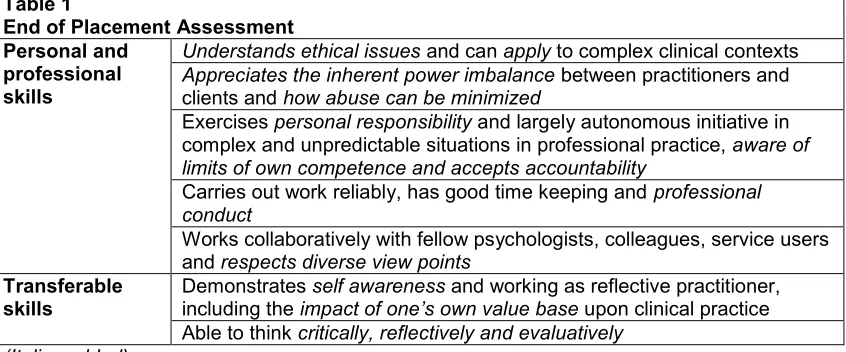
[image:8.595.89.512.497.673.2]Learning on placement is evaluated by the clinical supervisor and reviewed formally with one member of the programme team at midpoint, through a Mid-Placement Review meeting; the same tutor will follow the development of each trainee through the three years of training. At the end of each of the six placements there is a formal assessment of all aspects of learning on placement; the End of Placement Assessment, with qualitative and quantitative feedback on a range of competencies, including ethical professional development –each aspect is rated from 0 (not evident) to 3 (established); Table 1 contains examples on two domains.
Table 1
End of Placement Assessment Personal and
professional skills
Understands ethical issues and can apply to complex clinical contexts
Appreciates the inherent power imbalance between practitioners and clients and how abuse can be minimized
Exercises personal responsibility and largely autonomous initiative in complex and unpredictable situations in professional practice, aware of limits of own competence and accepts accountability
Carries out work reliably, has good time keeping and professional conduct
Works collaboratively with fellow psychologists, colleagues, service users and respects diverse view points
Transferable
skills Demonstrates including the impact of one’s own value baseself awareness and working as reflective practitioner, upon clinical practice Able to think critically, reflectively and evaluatively
(Italics added)
Critically reflecting on ethics teaching
Since, as stated earlier, teaching is an ethical act, the educator must be ethical, living and teaching with coherence to be an example of integrity –an example of ‘doing as I say’. Our commitment to critical reflection needs to start from our own practice, and it is only by continuing to scrutinise our own work that we can take ownership of our position, rather than impose our assumptions on others. Freeman and Combs (1996) gathered some narrative practices that help this process:
Situating ourselves (i.e., transparency)
Listening and asking questions (i.e., not making assumptions) Accountability practices (e.g., counter-practices)
Externalising conversations (i.e., collaborative relationships) Reflecting practices (e.g., outsider witness practice)
Acknowledging the effects of relationships on us (i.e., catharsis)
Critical reflection of our own values and how these link to our knowledge, including of course psychological knowledge, facilitates the building of relationships in which we are not omnipotent teachers or experts but “fallible human beings” (Freeman & Combs, 1996:275), to some extent redressing the power imbalance in teaching relationships so trainees can contextualise the teaching and critically engage with us as actors in their learning, i.e.,‘educands’.
Conclusion
Developing as an ethical professional is interlinked with developing critical thinking, which includes a reflection on context and what one brings (reflection and reflexivity). Therefore, I began the chapter by reconstructing ethics codes as contextual, first problematising ethics as universal; ethics codes privilege a particular story of a specific time and place. They should neither be viewed as prescriptions to follow nor discarded, but understood as principles with which to critically engage in developing a practice of being ethical. Second, linking the personal and professional. When we export our assumptions, including psychological concepts and models, we are imposing particular ethical underpinnings, communicating that what we know is right – which may by default set up the dichotomy ‘what others know is wrong’, or perhaps not quite as good.
I presented ethics teaching as a collaborative endeavour set within particular programme structures. Perhaps one way of thinking about our approach to ethics teaching would be as turning the critical gaze inwards: through reflexiveness, reflecting and ‘ethicalising’ psychology, i.e., thinking of the ethics implicit in psychological knowledge and models and their practical application.
The ideas and practices presented here are just one possibility that fits well with our ethos; the close of this chapter should not be a coming to an end but adding to the continued reflection on ethics and the teaching of ethics.
“I cannot perceive myself as a presence in the world and at the same time explain it as a result of forces completely alien to me. If I do so, I simply renounce my historical, ethical, social and political responsibility for my own
Reflective questions
1 Why is critical thinking important in developing as an ethical professional? 2 How should ethics teaching be part of the curriculum in professional training? 3 What teaching methods would work best for you in developing as a critical and
ethical professional?
4 What difference might this learning do in terms of your thinking and practise?
References
Alvear, K., Pasmanik, D., Winkler, M.I. & Olivares, B. (2008) ¿Códigos en la postmodernidad? Opiniones de psicologos/as acerca del Código de Ética
Profesional del Colegio de Psicologos de Chile A.G. Terapia Psicológica, 26, 215-228.
British Psychological Society (2009) Code of Ethics and Conduct. Guidance
published by the Ethics Committee of the British Psychological Society. Leicester:
British Psychological Society.
British Psychological Society (2010) Accreditation through partnership handbooks.
Guidance for clinical psychology programmes. Leicester: British Psychological
Society.
Clemente, M., Espinosa, P. & Urra, J. (2011) Ethical Issues is Psychologists’
Professional Practice: Agreement Over Problematic Professional Behaviours Among Spanish Psychologists. Ethics & Behaviour, 21 (1), 13-34.
Colegio Oficial de Psicólogos (2010). Codico Deontologico. Retrieved from
http://www.cop.es/pdf/Codigo-Deontologico-Consejo-Adaptacion-Ley-Omnibus.pdf
Denborough, D., Koolmatrie, K., Mununggirritj, D., Marika, D., Dhurrkay, W. & Yunupingu, M. (2006). Linking Stories and Initiatives: A narrative approach to working with the skills and knowledge of communities. The International journal of
Narrative Therapy and Community Work, 2, 19-51.
European Federation of Psychologists’ Associations (2005) Meta-Code of Ethics http://ethics.efpa.eu/meta-code/
Fisher, M.A. (2008) Protecting Confidentiality Rights: The Need for an Ethical Practice Model. American Psychologist, 63 (1), 1-13.
Fook, J. (2002) Critical Theory and Practice. Sage: London.
Freeman, J. & Combs, G. (1996). Narrative Therapy: The Social Construction of Preferred Realities. London: Norton.
Freire, P. (1972). Pedagogy of the Oppressed. Harmondsworth: Penguin.
Freire, P. (1974). Education for critical consciousness. New York: Continuum.
Handelsman, M.M., Gottlieb, M.C. & Knapp, S. (2005). Training ethical
psychologists: An acculturation model. Professional Psychology: Research and Practice, 36, 59-65.
Health and Care Professions Council (2008) Standards of conduct, performance and ethics.
http://www.hpc-uk.org/assets/documents/10003B6EStandardsofconduct,performanceandethics.pdf
Health and Care Professions Council (2012) Guidance on conduct and ethics for students.
http://www.hpc-uk.org/assets/documents/10002C16Guidanceonconductandethicsforstudents.pdf
International Union of Psychological Science (2008) Universal Declaration of Ethical Principles for Psychologists http://www.iupsys.net/about/governance/universal-declaration-of-ethical-principles-for-psychologists.html
Knapp, S., Gottlieb, M., Berman, J & Handelsman, M.M. (2007) When Laws and Ethics Collide: What Should Psychologists Do? Professional Psychology: Research and Practice, 38 (1), 54-59.
Martín-Baró, I. (1994) Writings for a Liberation Psychology. Harvard University Press: Harvard.
Matthews, J.R. (1991) The Teaching of Ethics and the Ethics of Teaching. Teaching of Psychology, 18 (2), 80-85.
Ncube, N. (2006) The Tree of Life Project: Using narrative ideas in work with
vulnerable children in Southern Africa. The International Journal of Narrative Therapy
and Community Work, 1, 3-16.
Pasmanik, D. & Winkler, M.I. (2009) Searching for Orientation: Guidelines for Teaching Professional Ethics in Psychology in a Context with a Post-Modern Emphasis. Psykhe, 18 (2), 37-49.
Smith, E. (2011) Teaching critical self-reflection. Teaching in Higher Education, 16
(2), 211-223.
Smith, T.S., McGuire, J.M., Abbott, D.W. & Blau, B.I. (1991) Clinical ethical decision-making: An investigation of the rationales used to justify doing less than one believes one should. Professional Psychology: Research and Practice, 22, 235-239.
Société Française de Psychologie (2012). Code de déontologie des psychologues.
http://www.codededeontologiedespsychologues.fr/LE-CODE.html
Stevens, M.J. (2010) Etic and emic in contemporary psychological ethics. Europe’s Journal of Psychology, 4, 1-7.
Taylor,M. (1987). Self-directed learning: More than meets the observer’s eye. In D. Boud and V. Griffin (eds) Appreciating adults learning: From the learner’s
perspective. 179-196. London: Kogan Page.
UK Council for Psychotherapy (2012) Standards of Education and Training. The Minimum Core Criteria Psychotherapy with Adults. London: UKCP.
UK Council for Psychotherapy (2008) Standards of Education and Training. Guidelines for Sections for the Development of Training Standards in Child Psychotherapy: Full Training. London: UKCP.