Making Sense of Emergent Properties
in IT Enabled Call Centre Operations:
An Interpretive Systems Analysis
Approach
A thesis submitted for the degree of
Doctor of Philosophy in Information Systems
at
The London School of Economics and
Political Science
by
Stephen S. Corea
UMI Number: U615610
All rights reserved
INFORMATION TO ALL USERS
The quality of this reproduction is dependent upon the quality of the copy submitted.
In the unlikely event that the author did not send a complete manuscript and there are missing pages, these will be noted. Also, if material had to be removed,
a note will indicate the deletion.
Dissertation Publishing
UMI U615610
Published by ProQuest LLC 2014. Copyright in the Dissertation held by the Author. Microform Edition © ProQuest LLC.
All rights reserved. This work is protected against unauthorized copying under Title 17, United States Code.
ProQuest LLC
789 East Eisenhower Parkway P.O. Box 1346
T
h£- S £S
f
^173
I
I
O I 3 I O I
ABSTRACT
A major focus of contemporary IS research is the emergent nature of organisational use of information technologies: its contextual, evolutionary, often unanticipated character. Most studies have approached this topic from the viewpoint of emergence in IT based practices as a process, led by social actors. However, the investigation of emergence as a property has been neglected. The systems thinking approach is particularly concerned with emergent properties, but has hitherto been poorly developed for the socio-technical analysis of IT use.
In redress, this research presents a new framework of interpretive systems thinking for performing such analysis. This framework permits a researcher or organisational analyst to form an understanding of emergent phenomena in IT based operations as constituted by the interaction of various elements or factors in relations of contrariety, contradiction or association. The emergent nature of an organisation’s activities may consequently be illuminated in terms of principle tensions or contradictions, that shape its trajectory of transformation, or form a persistent pattern in its functioning. This method of analysis is applied to two case studies of IT based call centre operations.
ACKNOWLEDGEMENTS
CONTENTS
1 SCOPE OF INQUIRY...9
1.1 Introduction... 10
1.2 Importance of research topic... 12
1.3 Study motivations and background... 15
1.3.1 The need for a systems perspective... 15
1.3.2 The need to develop the sociotechnical systems approach 17 1.3.3 The need to study call centre operations...19
1.4 Clarification of terms and approach... 23
1.4.1 Emergent organisational functioning... 23
1.4.2 Definitions: system, whole, macro, domain, structure...27
2 LITERATURE REVIEW...30
2.1 Emergent organization: theory and research... 30
2.1.1 IT based work operations... 31
2.1.2 IS development practices... 41
2.2 Potential for further research...44
2.2.1 The emergent nature of IT u se ... 45
2.2.2 Contradictions and tensions in IT u se ... 53
2.3 Sociotechnical systems analysis... 55
2.3.1 Limitations of the sociotechnical systems approach...58
2.3.2 Contemporary systems thinking... 60
2.3.3 Requirements for a new framework...66
2.4 Call centre operations... 66
2.5 Formulation of research inquiry...69
2.5.1 Statement of research question... 70
2.5.2 Themes of inquiry... 70
3 THEORETICAL FRAMEWORK...72
3.1 Background ideas and assumptions...73
3.1.1 General approach... 73
3.1.2 The hermeneutic method and systems thinking...75
3.1.3 A narrative mode of analysis...76
3.1.4 The role and function of the framework...78
3.2 The process of inquiry...79
3.2.2 The cycle of interpretive engagement...83
3.3 Concepts and tools of analysis...84
3.3.1 Narrative programs... 85
3.3.2 Boundary qualifications... 90
3.3.3 Relations of signification... 92
3.4 Extending sociotechnical systems inquiry... 95
4 RESEARCH DESIGN... 102
4.1 Research approach...102
4.1.1 Principle IS research approaches... 103
4.1.2 Approach taken in this study... 106
4.2 Research method...107
4.2.1 Alternative methods... 108
4.2.2 The case study method... I l l 4.3 Detailed research design...114
4.3.1 Site selection... 114
4.3.2 Overview of case inquiry... 115
4.3.3 Data collection... 117
4.3.4 Data analysis... 120
4.4 Methodological issues...124
5 CASE STUDY 1...130
5.1 Boots the Chemists...131
5.2 Boots customer services...133
5.2.1 Implementation of call centre operations... 133
5.2.2 Scale of call centre activity... 135
5.2.3 Work organization: customer interface... 136
5.2.4 Work organization: corporate interface... 141
5.2.5 Work performance: operational challenges... 143
5.3 Analysis of Boots call centre operations...153
5.3.1 Preliminary understanding from NP analysis... 153
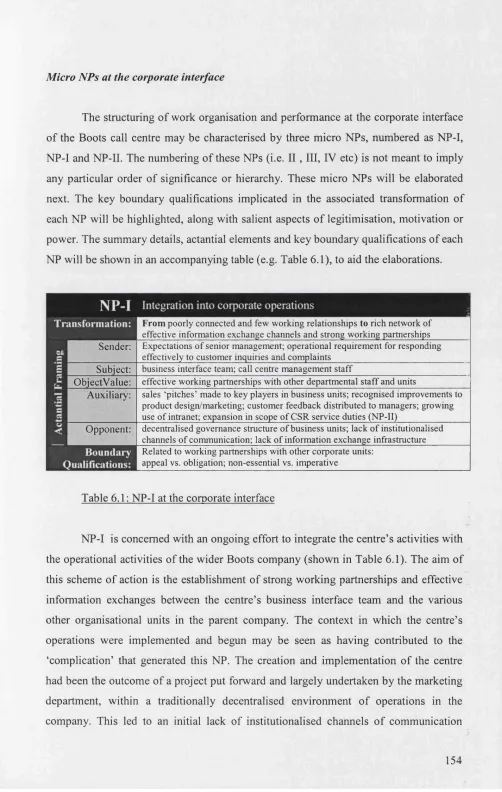
M icro NPs at the corporate in te rfa c e... 154
M icro NPs at the customer in terfa ce... 158
The macro N P... 163
5.3.2 The emplotment of call centre operations... 166
5.4 Evaluation of case study...174
6 CASE STUDY I I ... 178
6.2 BBC customer services... 180
6.2.1 Implementation of call centre operations... 181
6.2.2 Scale of call centre activity...184
6.2.3 Work organization: customer interface... 185
6.2.4 Work organization: corporate interface... 190
6.2.5 Work performance: operational challenges... 195
6.3 Analysis of BBC call centre operations...205
6.3.1 Preliminary understanding from NP analysis...205
M icro NPs at the corporate in te rfa ce... 206
M icro NPs at the customer in te rfa c e... 212
The macro N P... 217
6.3.2 The emplotment of call centre operations... 221
6.4 Evaluation of case study... 229
7. DISCUSSION AND INSIGHTS... 232
7.1 The emergent nature of IT based operations...233
7.1.1 Utility of the systemic emphasis... 233
7.1.2 Utility of the systems appreciation framework...242
Navigating a relevant dom ain... 242
Conducting supra-individual a n a lysis... 246
7.2 Dynamics of technology-organisation integration... 249
7.2.1 Conceptualising the nature of interaction...249
7.2.2 Corporate integration of call centre operations...256
7.3 Rethinking performance in sociotechnical systems... 258
7.4 Developing interpretive systems inquiry...264
7.4.1 Theoretical innovation in systems thinking...264
7.4.2 Methodological utility of systems inquiry ...267
7.4.3 Use of the systemic appreciation framework...272
7.5 Summary of insights... 275
8. CONCLUSION... 277
8.1 Outcomes of study...277
8.1.1 Development of systems thinking for IS contextual study 278 8.1.2 Illumination of the emergent nature of IT use...278
8.1.3 Multifaceted analysis of IT-organisation interactions... 279
8.1.4 Extension of the IS sociotechnical systems approach... 280
8.2 Limitations of study...280
8.3.1 Implications for IS research... 282
8.3.2 Implications for management... 283
8.4 Conclusion...284
BIBLIOGRAPHY...286
APPENDIX:... 313
A.1: List of interviewees...313
A.2: Diagrammatic aid used in interviews...314
LIST OF FIGURES
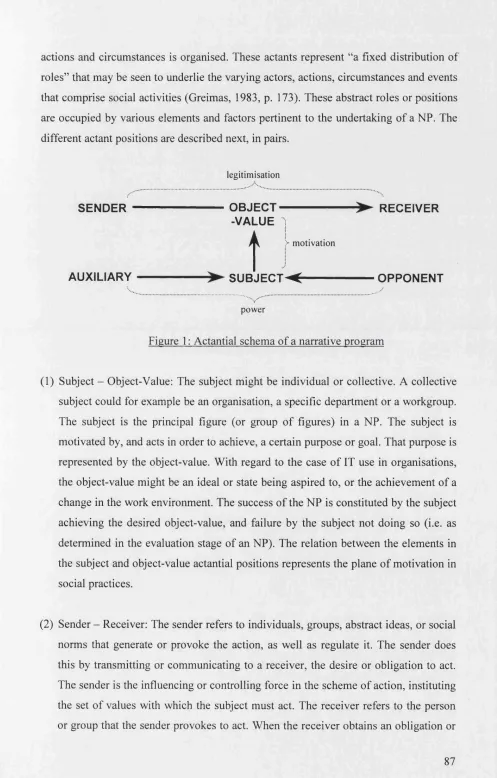
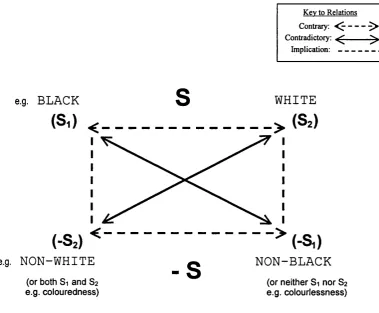
Figure 1: Actantial schema of a narrative program... 87Figure 2: The semiotic square ... 92
Figure 3: A framework for interpretive sociotechnical systems analysis...97
Figure 4: Customer service vision for Boots call centre... 134
Figure 5: Performance targets at Boots call centre... 139
Figure 6: Summary boundary qualifications (Boots)... 166
Figure 7: Transformation in value of service activity for B oots...168
Figure 8: Shaping of appropriateness of customer service activity...170
Figure 9: Shaping of control over customer service interactions... 172
Figure 10: Extracts from the ‘BBC Promises to you 2000/2001’ booklet 187 Figure 11: Extract from the ‘BBC Promises to you 2000/2001 ’ booklet... 205
Figure 12: Summary boundary qualifications (BBC)...220
Figure 13: Contrasting transformations in quality of services... 223
Figure 14: Shaping of accountability to audience needs and interests... 227
LIST OF TABLES
Table 1: Various meanings of emergent/emergence...23
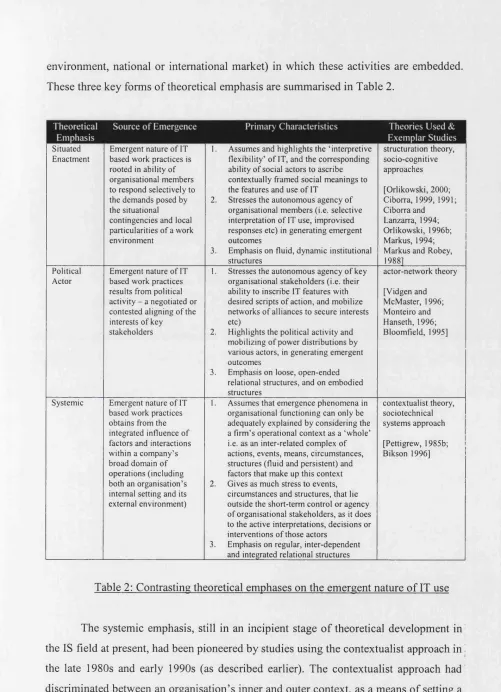
Table 2: Contrasting emphases on the emergent nature of IT use... 48
Table 3: Phases of case study investigations... 117
Table 4: Interview guidelines... 118
Table 5: Types of interview probes... 119
Table 6.1: NP-I at the corporate interface (Boots)... 154
Table 6.2: NP-II at the corporate interface (Boots)... 156
Table 6.3: NP-III at the corporate interface (Boots)... 157
Table 7.1: NP-IV at the customer interface (Boots)... 158
Table 7.2: NP-V at the customer interface (Boots)... 160
Table 7.3: NP-VI at the customer interface (Boots)... 162
Table 7.4: The macro NP-0 (Boots)... 163
Table 8.1: NP-I at the corporate interface (BBC)...207
Table 8.2: NP-II at the corporate interface (BBC)...208
Table 8.3: NP-III at the corporate interface (BBC)...210
Table 8.4: NP-IV at the corporate interface (BBC)...211
Table 9.1: NP-V at the customer interface (BBC)...213
Table 9.2: NP-VI at the customer interface (BBC)...214
Table 9.3: NP-VII at the customer interface (BBC)...216
Table 9.4: The macro NP-0 (BBC)... 217
CHAPTER ONE: SCOPE OF INQUIRY
1. OVERVIEW
Let us start with a bird’s-eye view of this inquiry. In recent times, the emergent
nature of organisational work operations around the use of information technology (IT) - its context-embedded, evolutionary and unanticipated character - has become a major research focus within the field of Information Systems (IS). A significant stream of IS studies has investigated the way that IT based work operations are uniquely shaped by the particular socio-historical context they are embedded in, and evince features that are unexpected. Most of these IS studies may be said to have approached the explanation of emergence in organisational functioning from an enacted first-person perspective, and from a focus on studying emergence as a process. In other words, these IS studies have elaborated the emergent nature of IT based operations from the viewpoints, decisions and actions of the organisational actors involved, thus accounting for the way in which the viewpoints and actions of such actors can, as a process over time, lead to emergent phenomena in IT based practices. As a result of this the IS field has gained considerable knowledge of organisational emergence from a processual, agency-based perspective.
1.1 INTRODUCTION
Since the early 1990s, the emergent nature of organisational functioning around the use of information technology (IT) has grown in importance as a focus of research inquiry in the field of Information Systems (IS). Prior to this, the integration of IT into organisational processes had been widely promoted in the IS theoretical and business literature from the standpoint of planned, deliberate changes, based on ideal visions and rational projections. The introduction and use of IT was presented as enabling radical improvements in work organisation and strong gains in performance (Davenport, 1993). In practice however, it became apparent that organisations were widely differentiated in their ability to carry out such planned co-adaptations of work processes and the use of computer technologies (Scott-Morton, 1991). Subsequently, IS studies investigating the form and consequences of IT based work practices and business transformation projects evoked growing recognition that it was the emergent nature of such practices or projects - their contextually shaped, evolutionary, dynamic and often unanticipated nature - that significantly conditions the processes and outcomes of IT use in specific organisations (e.g. Orlikowski, 1996a,b; Bikson, 1996).
Conspicuously missing however, from the recently arisen theoretical approaches that have been adopted to elaborate the emergent nature of IT based work operations in organisations, has been the use of systems thinking as a method for studying emergence. Systems thinking proposes that it is important to investigate and understand complex phenomena like organisational functioning holistically, as irreducibly integrated wholes. It places specific emphasis on identifying emergent properties, which are properties that are exclusive to such wholes, and not deducible from any of their constituent elements. The relative absence of systems based inquiry in past IS studies on the emergent nature of IT use is remarkable, given its theoretical emphasis on emergent properties and its benefit of an integrative, inter-relational form of analysis. Nevertheless, strong reasons can be adduced for this. The traditional systems approach came under severe criticism during the 1970s (e.g. Silverman, 1970) which significantly undermined its validity as a theoretical platform for providing insightful description of the nature of organisations or dynamic social phenomena. The approach was seen to be highly inadequate, because of its essential premise of treating organisations as analogous to natural (i.e. biological) or mechanical systems, with fixed, pre-determined goals: this foreclosed the consideration of any emergent, evolutionary modes of functioning (Ciborra, 1987).
stultifying traditional form of systems thinking, to be recast and reformulated with new concepts and analytical tools for treating emergent organisational phenomena (Lin and Comford, 2000). This approach stood in need of a new basis of systems thinking.
This exploratory study took up the challenge of recasting sociotechnical systems inquiry. It undertook to do this by extending the application of systems thinking beyond natural/mechanical or designed systems. This study develops the hermeneutic focus of contemporary systems thinking in the new direction o f illuminating the interactions of organisational elements (that generate emergent phenomena) as signification systems - patterned inter-relationships of significance by which human activity, artefacts, events or circumstances are invested with meaning or value. As this thesis shall make evident, key advantages may be gained in studying the emergent nature of IT based operations from this extension of systems thinking. The rest of this chapter furnishes a background for latter elaborations. It first elaborates the significance of this research topic in section 1.1.2. The motivations for pursing this study are introduced in section 1.2, as well as its empirical context of IT enabled call centre work environments. Section 1.3 undertakes to clarify the meanings of key terms in upcoming discussions, and the assumptions that have shaped my approach in studying the emergent nature of IT based operations.
1.2 IMPORTANCE OF RESEARCH TOPIC
The topic of emergent organisational functioning in the use of IT is a relatively recent focus of inquiry in the IS field. It has gained prominence in IS and management literature for practical and theoretical reasons. The theoretical reasons are more crucial.
over the effects of emergence phenomena in business undertakings and social activity. They have induced increased focus on methods to deal with this operational dimension.
From a theoretical standpoint, the rising prominence of IS research concern with the issue of emergence in organisational activity can be ascribed to two major reasons. Firstly, the focus on the emergent conditions of organisational functioning and change has grown as a reaction to an older established trend of technological determinism in the IS field. Technological determinism refers to the perspective that an IT system has predictable and inevitable impacts on the host organisation in which it is introduced. IT is assigned causal agency from this standpoint, being seen as a root explanatory cause of organisational changes. However, the contradictory findings of numerous IS research studies have disproved the validity of such a perspective (Markus and Robey, 1988). Morgan and Lawler (1984) concluded that it was not that the adoption and use of IT produced no effects, but that the effects that resulted were interaction effects. The introduction and use of IT could be associated with an amplifying of certain features of organisational functioning and transformation, but it could not be used exclusively to account for their existence.
models, aimed at predicting consequences, have not been able to adequately deal with the complexity of organisational operations.
Secondly, theoretical focus on the emergent nature of IT based organisational functioning may be said to have increased in reaction to the perceived shortcomings of methodologically planned, ‘rational actor’ models of change. A substantial portion of early IS theory had been marked by the fundamental assumption of economic rationality in individual and collective action: organisational members were seen as subscribing to a common goal of maximising economic efficiency, and as embodying correct ways of behaviour in the implementation of IS projects (Kling, 1980). Processes of change were regarded as being strictly pre-conceivable, and amenable to shaping by formal methods. Theoretical focus in rational actor approaches have thus focussed deeply on the correct construction and observance of formal plans and methods, based on pre-conceived functions, as the way to control and predict the form and consequences of strategic and operational levels of change (Ciborra, 1991,1987; Suchman, 1987). In addition, rational actor approaches coincided with a prevalence of stage models of IT innovation in firms, which neatly reduced the innovation process into discrete temporal episodes, reflecting linear, cause-and-effect sequences (Galliers and Swan, 1999).
1.3 STUDY MOTIVATIONS AND BACKGROUND
This study drew from a confluence of several perceptions. At a general level, the motivation for this inquiry lay in the perceived necessity and potential for developing the sociotechnical systems theoretical approach in the IS field. This particular school of thought, elaborated shortly, has unique features that were seen to strongly recommend its application in studying the emergent nature of IT based organisational functioning. The central feature of the IS sociotechnical systems theoretical approach, unique among other approaches, is its fundamental basis in systems thinking. The perceived scope for extending existing IS understanding of the emergent nature of organisations, through the development and application of a systems based approach, constituted the principal inducement for undertaking this study. This and other motivations are explained next.
1.3.1 The need for a systems perspective
The systems thinking approach has been promoted by prominent IS researchers in the contemporary field (Lee, 2000; Checkland, 1999; Galliers, Mingers and Jackson, 1997; Klein, 1996). Systems based approaches have had a long history of application in the general arena of sociological theory, extending back to the 1950s. During the 1970s however, the systems approach came under severe criticism (e.g. Silverman, 1970), and as a result fell from grace in fashionable social theory. The form of systems thinking at that time was largely based on ‘functionalism’. This was a key sociological framework which, promoted by leading theorists (e.g. Parsons, 1960; Merton, 1964), was premised on viewing organisations analogously as biological organisms. The method of analysis offered by that form of systems thinking however, were regarded as too simplistic for elucidating the social complexities of organisational functioning, as well as incapable of treating meaning structures or issues of signification in work milieus (Silverman, 1970).
ideas and concepts are now seen as mental constructs used by an observer (or group of observers) for framing an understanding of a particular process or situation (Checkland, 1981). Implicit to the adoption of a systems approach or perspective by a researcher or analyst (as I, as a researcher, do in this study) is the idea that he/she will give an account "of the world, or part of it, in systems terms; his purpose in so doing; his definition of his system or systems; the principle which makes them coherent entities; the means and mechanisms by which they tend to maintain their integrity; their boundaries, ... and components; their structure." (Checkland, 1981, p. 102.)
These contemporary theoretical advancements in systems thinking have been viewed as having significantly enlarged the applicability of the systems approach in IS research (Galliers et. al, 1997). However, only in the research arena of IS development methodologies have such new, contemporary forms of systems thinking been noticeably applied (e.g. Mingers, 2000; Lycett and Paul, 1999; Checkland and Schools, 1990; Checkland, 1981).
1.3.2 The need to develop the sociotechnical systems approach
The IS sociotechnical systems approach is based on the traditional concepts and formulations of sociotechnical systems theory (Pasmore, 1995; Eijnatten, 1993; Emery and Trist, 1960), in the organisational studies field. This longstanding school of thought owes its origin to a study, in 1949-51, of the problems surrounding the introduction of mechanisation technologies in the coal-mines of South Yorkshire, England (Trist and Bamforth, 1951). It is concerned with the design and management of technology-based work environments in organisations. The tenets of this theory are fundamentally rooted in systems thinking. In its classical (i.e. traditional) formulation, sociotechnical systems theory posits that an organisation is a complex whole composed of two separate sub systems. The social system, comprising the form and elements of social organisation, represents the human needs, interests and aspirations of individuals and social groups. The technical system, comprising the form and elements of product/service creation (i.e. procedures, control mechanisms, technology), represents the requirements for economic efficiency that are implicit to a company’s operations. Sociotechnical systems theory asserts that successful organisational performance hinges on the degree to which the needs of the social and technical sub-systems can be managed in reciprocal balance, and collectively attuned with respect to the demands of the external operational environment (Pasmore, 1995; Trist et al., 1963). This theory is postulated that performance gains will be heightened if a collated ‘fit’ is achieved in organisations between different social and technical priorities (or factors) that are often incongruous (Mumford, 1996).
Those traditional ideas have informed the IS sociotechnical systems approach*, a narrow but influential stream of work in the IS field (Lin and Comford, 2000; Garrety and Badham, 2000; Mumford, 1997, 1996; Bikson, 1996; Land and Hirschheim, 1983; Bostrom and Heinen, 1977; Mumford and Weir, 1979). Studies in this approach have, in the past, mainly been concentrated on IS development practices, and the challenges of securing successful IT based change in the workplace. Their contributions have been
mainly methodological (Lin and Comford, 2000). The sociotechnical systems approach has been instrumental in instilling awareness among researchers and practitioners of the need for the active participation of employees, and other stakeholders, throughout the various stages of IS development in organisations (e.g. Land and Hirschheim, 1983).
Leading proponents of the IS sociotechnical systems approach, however, have asserted a clear need for further theoretical development at present. This approach is in strong need of modification or expansion of its conceptual resources, and its methods of analysis, to cater to contemporary theoretical and practical concerns (Lin and Comford, 2000; Mumford, 1997). The scope of application of sociotechnical systems analysis is in need of expanding beyond its hitherto predominant focus on IS development activity, to include also the study of IT systems in ongoing use (Lin and Comford, 2000). Most importantly, a critical need has been asserted for developing and recasting this approach to deal with the emergent nature of organisational functioning in the use of IT (Lin and Comford, 2000; Pasmore, 1995). This approach has lacked concepts and analytical tools for dealing with organisational structuring over time. These needs constituted a broad motivation underlying this study.
In addition, the development of the sociotechnical systems approach was seen to offer the potential for increasing current IS understanding of emergent organisational functioning in one particularly important area. Truex (1991), had also stated, during the 1990 IFIP WG8.2 conference mentioned earlier (at the start of section 1.3.1), that IS research on the emergent nature of organisations was especially under-developed in the study of contradictions that arise in the process of IT adoption and use. This assertion has been strongly echoed more recently by Robey and Boudreau (1999).
conflict or inconsistency in organisational functioning, was seen as opportune. It offered the potential for answering the need in the IS field, just mentioned, of an approach that can theoretically illuminate the contradictions and conflicts implicated in the emergent nature of IT use. Thus, the application of the sociotechnical systems approach seemed strongly warranted, given the scope it offered for elucidating, from a systems viewpoint, the various inconsistencies and tensions that are engendered in particular IT based work settings. This perception was another crucial motivation in the undertaking of this study.
1.3.3 The need to study call centre operations
The selection of an empirical setting in which to study the emergent nature of IT based operations was an important one. This setting was to be used to facilitate the development and application of a new form of systems based sociotechnical inquiry. This section first briefly describes the nature of IT based call centre work environments. It then elaborates the broad motivations for selecting to study call centre operations.
IT enabled nature o f call centre work environments
ACD provides up-to-the-minute statistical information on individual and overall group activities, used typically by supervisory staff to monitor the performance of CSRs.
The use of IT systems is central to the service work activity at such centres. The organisation and performance of work involves a close partnership between the tracking and information management capacities of IT tools and the competencies of individual employees. CSR staff rely heavily on the use of information management and database software for recording, checking and retrieving information for customer inquiries and other issues. Typically several kinds of software are utilised, one of which is invariably a customer relationship management (CRM) database system. This system is used by CSRS to record notes on the nature and outcome of each contact or interaction with customers. Other CSRs can refer to these records when dealing with the customer in the future, so as to better understand him/her and ideally provide higher rapport and service quality. The customer data captured in the CRM system is typically used to form reports that aid in identifying particular areas of service/product improvement or creation.
calls in the ACD queue will be fed first to CSRs with a higher precedence. The range of parameters for configuring the environment of the ACD queue is typically very wide, and varies according to different packages available on the market. Modifications to the ACD’s configuration are usually made by CSR supervisory staff. The supervisor uses a central computer monitor that displays ongoing performance data on various aspects of call-handling activity. He/she closely tracks this data and suitably configures the ACD. Modifications to the ACD’s configuration are done to obtain, as close as possible, a match between the availability of CSR staff resources (i.e. skill-sets) and the prevailing profile of customer needs suggested by the volume and pattern of incoming call traffic. Properly done such modifications will raise the call-handling performance (i.e. response times etc) of the centre as a whole, in regard either to all incoming calls, or to calls only of a particular category or type.
It may thus be apprehended from the preceding descriptions that call centres are fundamentally IT based organisational forms, and that the use of IT capacities is bound up closely in the functioning. This essentially IT based work environment o f call centres presented itself as a particularly appropriate empirical setting in which to pursue this study’s research goals, for general and specific reasons.
General reasons for studying call centres
The second general motivation for investigating call centres lay in a perceived need to extend the theoretical resources of the IS sociotechnical systems approach in the specific setting of a service work environment. Mumford (1997), a leading proponent of the IS sociotechnical systems approach, reported that recent work in this stream had relinquished a traditional focus on employee development issues as the primary focus of organisational analysis. Instead, work within this approach is at present concentrated on the analytical illumination of organisational process structures, used for the strategic rethinking of priorities and effort. Mumford declared the primary contemporary role of the sociotechnical systems approach to be the creation and application of knowledge or techniques for aiding firms to be more effective and responsive towards their customers. However, much of the past formulations of the sociotechnical systems school of theory occurred within the context of studies of production or manufacturing firms, rather than the service sector, as noted by Pasmore (1993) and Pava (1987), who argued that its traditional concepts of analysis, such as variances and match/fit, originated from studies in firms typified by the use of mechanised technologies. These notions are seen as being less applicable for analysing operations involving information-intensive work or IT use.
1.4 CLARIFICATION OF TERMS AND APPROACH
As a final preliminary, this section will clarify some key terms and assumptions
that will be feature in the following elaboration and discussions o f the thesis. The notion
o f emergence is first clarified, in terms o f how it has been investigated and portrayed in
prior IS research. The way in which it will be principally studied and elaborated in this
study will then be identified. Following this, other key terms will also be clarified.
1.4.1 Emergent organisational functioning
The central concept o f emergent (and similarly its root notion, emergence) has
encompassed several associated meanings or implications in the IS theoretical literature.
However, a broad, pertinent distinction may be made between the state o f emergence as
a ‘process’ and as a ‘property’, as will be made evident in the following brief review o f
theoretical formulations. To aid in clarifying the way the notion o f emergent has been
used with regard to organisational operations and IT use, initial reference may be made
to the Oxford English Dictionary (1989), which identifies seven strands o f meaning that
approximate the way the term emergence has been used in IS and organisational theory.
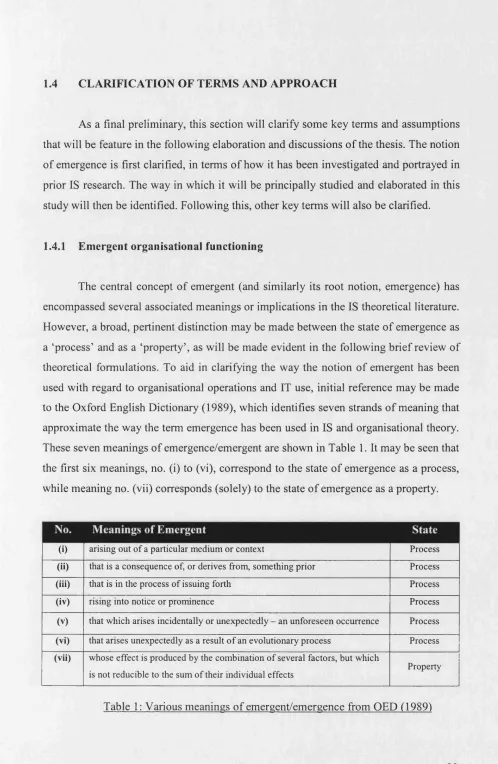
These seven meanings o f emergence/emergent are shown in Table 1. It may be seen that
the first six meanings, no. (i) to (vi), correspond to the state o f emergence as a process,
while meaning no. (vii) corresponds (solely) to the state o f emergence as a property.
(0 arising out o f a particular medium or context Process
(H) that is a consequence of, or derives from, something prior Process
(iii) that is in the process o f issuing forth Process
(iv) rising into notice or prominence Process
(v) that which arises incidentally or unexpectedly - an unforeseen occurrence Process
(vi) that arises unexpectedly as a result o f an evolutionary process Process
(vii) whose effect is produced by the combination o f several factors, but which
is not reducible to the sum o f their individual effects
Property
[image:25.595.28.526.27.791.2]The process-oriented notion of emergence has been strongly emphasised in past IS research and theoretical conceptualisations. This is apparent in the way the following review of important IS studies have appropriated the use of this term in investigations or; formulations. It may be seen that the process-oriented meanings of emergence, namely no. (i) to (vi) above, have been accentuated.
Truex, Baskerville and Klein (1999) asserted that contemporary organisations should primarily be regarded as being fundamentally ‘emergent’, which they defined as “the state of being in continual process, never arriving but always in transition” (p. 117). They thus placed emphasis on the dynamic quality in the notion of emergence: the property of being in perpetual transition and flux, reflected in meaning no. (iii). They ascribed the source of emergence in organisations to persistent interactions between their members: “these [emergent] organisational features are products of constant social negotiation and consensus building” (p. 117). Their claim reflects the derivative quality of emergence: its grounding in, and issuance from, a context of interaction, as implied in meanings no. (i), (ii) and (iii). This contextual basis is stressed in Suchman’s (1987) description of the emergent nature of human performance in IT based work practices. She described such performance as situated - rooted in the unique and localised sphere of contextually framed perceptions, social circumstances, available material resources, and unforeseen occurrences that organisational members engage with in the course of daily work. Nardi (1996, p. 71) noted that Suchman’s work emphasises “the emergent, contingent nature of human activities, the way that activity grows directly out of the particularities of a given situation.” Suchman (1987) also highlighted the quality of unexpectedness, as in meaning no. (v).
in the use of IT, laid emphasis on the quality of novelty that accords with meanings no. (i), (v) and (vi). In another study, he characterised the emergent outcomes of the use of IT as drifting (Ciborra, 1996), involving slight or ample shifts between anticipated and eventual roles. Such drift is seen to stem from the manifold interactions between “the plasticity of the artefact and the multiform practices of actors involved” (Ciborra, 1996, p.9). This idea of drift parallels meaning no. (vi). Orlikowski stressed meanings no. (v) and (vi) in her early application of structuration theory to studying the process of IT use in firms (i.e. 1992, 1996). She differentiated emergent change from anticipated changes, which had been planned beforehand and had transpired as intended, and opportunistic changes, that had not been planned prior to the project but were deliberately introduced to exploit unexpected opportunities in its course. In recent work Orlikowski (2000) has expanded her conception of emergence to also encompass the ongoing and recursive constitution of institutional structures, norms and interpretive schemes in organisations, termed by her as emergent structures. This denotes meanings no. (i), (ii) and (iii).
The process-oriented elucidation of the concept of emergence in IS theory, has persistently been associated with the meanings or significance that the members of an organisation attach to an IT system, or to the activities connected with the system’s use. This particular association was affirmed by Markus and Robey (1988, p. 595) during an elaboration on social structuring around the use of IT [italics added for emphasis]:
The emergent perspective attributes causality to complex indeterminate interactions between technology and human actors in organisations. Central to the emergent perspective is the social meaning ascribed to information technology. This perspective accounts for conflicting research findings about impacts by demonstrating the different meanings the same technology acquires in different social settings.
Similarly, IS researchers that have formulated definitions of emergent processes in their reports (e.g. Boddy, 2000; Orlikowski, 1996b; Markus, 1994), or that have studied the dynamics of emergent consequences triggered by the deployment of a new technology system (e.g. Bowers, 1994; Barley, 1986), invariably link the notion of emergence to the negotiation of social signification or meanings by organisational members regarding the use or properties of technology systems.
organisational functioning. This meaning of emergent is tied to the quality of holism (i.e. meaning no. vii), in which a particular property is associated exclusively with a whole, and encompasses more than the sum of its parts (note: the idea of a ‘whole’ will be further clarified shortly).
An emergent property refers to characteristics exhibited on the level of a whole ensemble of interacting elements, but not by those elements on their own (Checkland, 1999; Weinberg, 1975; Bertalanffy, 1971). Emergence as a property is thus associated with the notion of wholeness: an irreducible or indivisible unity of a set of constituent elements. Correspondingly, emergent properties are a key feature of ‘systems’, which are conceptual models of phenomena as organised wholes, consisting of parts in inter relationship and interaction (Checkland, 1981). The origin of the idea and importance of emergent properties stems from the work of several early thinkers, including a biologist, Ludwig von Bertalanffy, in the 1940s. Bertalanffy was one of the first to assert the idea of a system to study the principles of organization at various levels in the manifestation of natural phenomena (Bertalanffy, 1971). He identified the importance of key qualities or properties of behaviour associated with the higher or macro-level configuration of a phenomenon, but that could not be isolated at the lower or micro-level components or processes which formed the phenomenon. Emergent properties are thus conceptualised as occurring at the macro-level of a phenomenon or situation being studied.
In this research study, the investigation of IT based work operations was mainly
1.4.2 Definitions: system, whole, macro, domain, social structure
It is necessary to clarify some terms that will feature recurrently at certain points in upcoming discussions: system, whole, macro/micro, domain, and structure. The key concept of a system as used in this thesis will imply a model of an observed situation or phenomenon (Avgerou and Comford, 1998): it is not to be confused with the situation itself. Thus, a system is clearly seen as the conceptualisation of a particular person or observer: it does not exist independently of the person, as it is the person that observes or views a phenomenon or situation as a system. The ‘systems of signification’ related to an understanding of IT enabled call centre operations in organisations, which I set out to identify and elaborate in this research study using two case studies, are thus to be recognised as my being own conceptualisation (or synthesis of understanding) regarding the nature of such operations. This notion of a system I adopt in my analyses resembles a pattern or model of understanding.
The term ‘whole’ is a key notion in the discussions of this thesis. It derives its particular implication from the way it is used in the systems thinking approach, where it is not meant to imply the vulgar sense of ‘everything’, but is an analytical distinction instead (Checkland, 1981). The notion of a whole refers to a organised set of interacting elements or factors that are perceived by an observer to be relevant or pertinent to the understanding of a particular concept or phenomenon (Checkland, 1981; Weinberg, 1975). The notion of a whole thus implies an ordered arrangement, in which the parts that make up the whole are positioned, or participate together, in an organised manner. The notion also implies the viewpoint of an observer (i.e. a researcher or analyst). Thus, in my thesis, the way I analyse each case account of IT enabled call centre operations as a ‘whole’ corresponds to the way I crystallised an integrated understanding of disparate, fragmented data I had obtained in the case studies.
this research is concerned with developing and applying the use of systems thinking, a macro scope of analysis is frequently referred to, as being necessary for and consistent with the incorporation or integration of a broad set of elements and factors into inter related, integrated analytical ‘wholes’.
The term ‘domain’ also recurs, typically during in phrases referring to a domain of IT based work operations (or IT based work practices). This term broadly encompass
both the actual elements and processes of (IT based) work operations or practices in an organisation, as well as the social, historical and material context or setting in which the operations occur. The concept of a domain of IT based work operations is multifaceted and unbounded (i.e. there are no clear boundaries differentiating ‘context’ and ‘text’, or indicating where a context ends). Such complexity and unboundedness is characteristic of all real-world settings, as in the case of the two organisations whose IT enabled call centre operations were studied in this research. It is a difficulty any IS study aimed at elucidating an account of the contextual shaping of IT base work operations must cope with. In this research, the framework of systems thinking that is introduced was aimed particularly at providing a useful analytical mechanism for delineating the domain of IT based work operations of an organisation in a multi-faceted, and orderly-bounded way.
Another key term that recurs in this thesis is ‘social structure’. Lopez and Scott (2000) have distinguished three main types of social structure: institutional structure, embodied structure, and relational structure. Institutional structure refers to “rules or resources” of behaviour (Giddens, 1979, p.66; Giddens, 1984) such as norms, roles, rules, interpretive frames or power, that enable or constrain the actions of social actors (i.e. individuals or groups). Institutional structures are akin to Wittgensteinian ‘rules of the game’. Following Giddens (1984), institutional structure are viewed as not having an independent, material existence: they are virtual, abstract entities which are only ‘instantiated’ in human action or practices, as being both the medium and outcome of such practices. A type of institutional structure that will be emphasised in this thesis is social ‘institutions’. Institutions refer to ingrained systems of premises, patterns of action and expectations, or regulative structures, that provide the basis of validity for, or that shape, the way organisational members perceive and act (Avgerou, 2000; Scott,
Embodied structures refer to institutional structures (i.e. norms, rules, scripts, interpretive codes) that are physically realised or embodied in material artefacts, and thus shape or constrain the behaviour of social actors (although institutional structures also shape the behaviour of human agents, they are not ‘embodied’, since ontologically they exist out of space-time, and are only realised at the moment of the constitution of action i.e. Giddens, 1979, p. 65). Relational structure refers to the patterned relations or inter-relations between humans and/or artifacts in a group, or between the elements of a system. Systems thinking is strongly concerned with relational structure: the relatedness of the parts of an organised whole (Katz and Kahn, 1966). The systems approach places prime value however, on achieving a broad, inter-relational, integrated form of analysis, and will thus typically include analytical consideration of institutional or embodied, in addition to relational, structures.
In adopting a systems thinking approach as method of inquiry, this study sought to be broadly inclusive and integrative in its analysis of the way IT enabled call centre operations are shaped in organisational environments. It was thus seen as necessary, in order to be thus comprehensive, to make a related distinction between ‘structures’ and ‘conditions’ in this thesis. Conditions, in contrast to the virtual existence of institutional structures, shall be taken to designate material resources or circumstances that enable or constrain the behaviour of individuals and groups.
CHAPTER TWO: LITERATURE REVIEW
2. INTRODUCTION
Since the early 1990s, the IS and management literature has devoted increasing attention to the emergent nature of work performance and transformation around the use of IT. This aim of this chapter is to review current understanding of the emergent nature of IT based work practices in organisations, and to identify the key potential for further research and theoretical elaboration that shaped this inquiry.
The chapter is outlined as follows. The first section (2.1) broadly review the way in which the emergent nature of organisational functioning around the use of IT systems has been elucidated by prominent theoretical approaches and empirical studies. From this review, the potential for further research is identified on the basis of shortcomings in current IS knowledge. The second section (2.2) discusses this potential, as a basis for forming this study’s aims and themes of inquiry. The sociotechnical systems approach is consequently presented as an appropriate theoretical platform from which to address the identified key shortcomings. The third section (2.3) critically assesses the adequacy of sociotechnical systems theory as a conceptual platform for explicating the emergent nature of IT based work practices. The theoretical limitations of this systems school of thought are thus specified as requirements to be met in developing a new sociotechnical systems analytical framework for studying the emergent nature of organisations. The fourth section (2.4) reviews past studies of call centre work environments, the empirical setting chosen for supporting the development and application of this framework. The last section (2.5) consolidates these observations on the potential for further research by defining this study’s research question, and its themes of inquiry.
2.1 EMERGENT ORGANISATION: THEORY AND RESEARCH
approaches and empirical studies that have contributed to its growth and prominence. In general however, key studies of emergent organisational phenomena may be classified by their focus on either one of two broad topic areas. These topic areas are: (i) IT based organisational work operations; and (ii) IS development practices. The focus of inquiry in this research study is specifically confined to the first area i.e. IT based operations. However, theoretical and empirical developments within the second topic area (i.e. IS development practices) were seen to be relevant to the specification and elaboration of this inquiry. Therefore the following review of theoretical approaches and research studies will be organized around these two topic areas.
2.1.1 IT based work operations
The first topic area pertains to theoretical focus on the nature and transformation of IT based operations in organisations. This also encompasses theoretical attention on the agency of actors and artifacts, different types of structures and conditions, and other aspects of an organisation’s domain of operations, that impinge upon (and are changed through) the process of IT use. This first topic area has received most of the IS research attention on the emergent nature of organisations. The major theoretical approaches that have been adopted to illuminate the emergent nature of IT based work practices, and their interaction with institutional features of the operational domain, are contextualist theory, structuration theory, actor-network theory, socio-cognitive approach and IS- organisation coevolution theory. These approaches, as well as key empirical studies, are elaborated next.
formulated this approach with the explicit aim of eliciting enriched understanding of the dynamics of change in particular organisations.
Contextualist theory is concerned with the continuous interplay between three analytical components: the context of change, the content of change, and the process of change (Pettigrew, 1987). The context refers to the socio-cultural environment in which changes occur: it includes both an inner context, namely social structures and properties within the organisation, and an outer context, or the larger socio-economic and political environments of the industry and the markets that the organisation operates within. The content refers to the organisational elements that are undergoing transformation, while process refers to the continuous, interdependent sequence of actions and events that constitute the alteration. Discriminating those various components of context, content and process in an organisation thus allows for an investigation of the salient linkages between the characteristics of the enfolding institutional environment and the ongoing actions of employees. The emergent nature of organisational functioning is elaborated through an extended bi-planar analysis. Key inter-level relationships posited between contextual variables and content factors on a vertical plane are examined during several time sequences (representing past, present and future conditions) on a horizontal plane.
In the 1990s, a considerable body of IS research grew around the application of Gidden’s structuration theory (1984) to the study of organisational transformation. The importance of that theory lies in its attempt to reconcile the constraining properties of institutional structure with the reflexive intentionality of human agency. It achieves this by positing structure as a duality: the actions of individuals both form, and are informed by, the institutional structures innate to their social context (e.g. structures of meaning, power, legitimacy). The theory’s grounding of the production of institutional structures in ongoing and contextually situated human actions makes it a sophisticated conceptual resource for studying the perpetuation and transformation of institutional properties in IT practices (Orlikowski, 2000). Dissimilar interpretations of this theory have informed different streams of IS research: Jones (1999) provides a critical review. With regard specifically to clarifying the nature of emergent organisation however, two broad types of structurationist approaches may be distinguished in IS literature. These differ in the treatment of IT as endogenous or exogenous to the mechanism of structuration.
The first approach, exemplified by the structurational model (Orlikowski, 1993, 1992; Orlikowski and Robey, 1991) and adaptive structuration model (DeSanctis and Poole, 1994; Poole and DeSanctis, 1990), has positioned technology as endogenous and central to the structuration process. Respective applications of these models are found in Boddy (2000), and Majchrzak, Rice, Malhotra, and King (2000). In Orlikowski’s (1993) model, IT is viewed as being an embodiment of institutional properties and structures, such as normative rules, control policies and political interests. Gidden’s ideas are translated directly by Orlikowski into a conception of technology as a structurational mechanism. IT is posited to be a duality, being seen to be both a constituting influence upon (i.e. enabling or constraining), and the constituted product of, human action. A key notion introduced by Orlikowski to account for the amenability of IT to being shaped by the actions of organisational members is the concept of ‘interpretive flexibility’. This concept emphasizes the variability of IT’s properties. Rather than being a fixed product, the features and use of IT are open to the changing ascription of different significations or meanings, and subject to ongoing construction and configuration, by various actors (i.e. designers, decision makers, end users) in organisational domains.
1993). During its design stage, the material features and interpretive properties of an IT system are at their most plastic and emergent state, as they undergo evolving fabrication and refinement. Subsequently, following implementation and the setting in of routine use, IT’s material features are seen to stabilize and ossify. Technology’s interpretive properties continue to be emergent however, as users change their attitudes and actions throughout its lifespan (Boddy, 2000). In the adaptive structuration model of DeSanctis and Poole (1994), IT is also depicted as an embodiment of institutional structures and properties, that are collectively termed as its ‘spirit’ (i.e. ethos). Jones (1999) points out that this model also places emphasis on the manner social structures are produced and altered within the technology. However, the fundamental premise of this structurationist approach, that social structures are embedded in a technology’s material properties, is inconsistent with Gidden’s idea of structuration theory (Jones 1999). In his formulation, structures are inseparable from human agency, and only exist as virtual entities; they are not inscribed into technology.
A second approach of IS structurationist work has avoided such ontological conflation by treating the technology’s material properties as exogenous to the recursive cycle of structuration (Orlikowski, 2000; Boland, 1993; Walsham, 1993; Walsham and Han, 1991; Barley, 1990, 1986). In this approach, the use of technology is seen as the source of emergence of institutional structures and properties in organisational activity. The most developed articulation of this second approach is the practice-lens model of structuration by Orlikowski (2000). In a significant revision of her earlier structurational model, she jettisons the idea of technology as an embodiment of institutional structures, and of technology usage as a passive appropriation. Instead, she places central focus on the emergent structures of repeated and ongoing technology use. By doing this, she overcomes a problem in her earlier model: reconciling its premise that an IT system and its embodied social structures are frozen after implementation with the observation that users continue to engage in emergent uses and interpretations of the system through its lifetime. Orlikowski also infuses a more proactive notion o f human agency into her new model, by drawing on Weick’s concept of enactment.
processes by which organisational members actively construct a picture of their world: it also expresses a recognition that they directly shape their environment through their own actions (Scott, 1998). The adoption of this concept permits Orlikowski (2000) to account for unexpected uses of IT: "... [users] can and do circumvent inscribed ways of using the technologies, either ignoring certain properties of the technology, working around them, or inventing new ones that go beyond or even contradict the designers’ expectations and inscriptions” (p. 407). This reconceptualisation imbues a greater sense of a provisional and situated quality to characterisation of IT based activity. Orlikowski unites these ideas in her pivotal concept of technologies-in-practice, which refers to the enacted production and reproduction of institutional properties and structures through the recurrent, context-specific use of technology. The notion of technologies-in-practice represents a hybridised, abstract conceptualisation of IT, which takes into account its contingent social and technological properties.
The importance of an organisation’s political context and power relationships in shaping its use of IT was established by IS studies in the early 80’s (e.g. Markus, 1983; Kling, 1980). However, elaborations of the evolutionary nature of power relations that saturate IT practices were lacking in conceptual richness, until a significant number of IS studies in the 1990s began to take recourse to the ideas and rich vocabulary of actor- network theory (Callon, 1992; Latour, 1987). Actor network theory considers the social and technical aspects of human activity to be indivisible. It conceives of the interactions between heterogeneous organisational and technology elements, which it refers to alike as actors, in terms of networks of linkages. Actor network theory’s essential premise is that human activity is fundamentally shaped by a negotiated or contested aligning of the interests of key actors, both human and non-human (Walsham, 1997; Hanseth and Braa, 1998). Hence, institutional norms and standard social practices pertaining to the use of IT systems are seen to emerge from the political activity and mobilizing of power distributions by various individuals or groups in firms (Vidgen and McMaster, 1996; Monteiro and Hanseth, 1996; Bloomfield, 1995; Bloomfield and Vurdubakis, 1994).
The analytical strength of this theory lies in the new concepts it supplies for illuminating the political dynamics behind the formation of collaborative networks of human and technological elements in organisations (Walsham, 1997). Organisational actors deliberately undertake a process of translation, whereby they ‘enrol’ other actors to their viewpoint, or ‘inscribe’ intermediaries, such as artefacts, IT systems or software tools with scripts of action (i.e. embodied structure). Thus, a network of alliances is constructed (i.e. relational structure). The development of each network is characterised by convergence, designating the strength of congruence that is engendered by a series of translations, or by divergence, referring to expansion of a network by the transference of an actor’s viewpoint to other actors and intermediaries (Callon, 1992). Though actors seek to stabilise their network, such hybridised associations of humans and artefacts require constant consolidation and repair, as changes elsewhere within the network, or encroachments by other networks, threaten to transform or dissolve it.
1997; Williams and Edge, 1996), is its failure to account adequately for the influence of institutional properties within a macro scope of analysis. Actor-network theory is seen as endowing too much local autonomy and power to organisational actors. Both Reed and Habers (cited in Walsham, 1997) claim that the approach is too asymmetrical in its analysis, in focussing on the way that the micro actions of actors contribute towards the production of the macro institutional order, to the neglect conversely of how the macro order shapes the local interactions and conventions of actors and intermediaries. While this theory’s analytical mechanism and concepts have thus invoked greater clarity and fine-grained analysis in studying the formation of micro social structures (Monterio and Hanseth, 1996), it may appear to be less qualified for incorporating the broader picture of social institutions and material conditions instrumental to the shaping of IT based work operations in organisations.
shaped by the interaction between the pre-existing and emergent formative contexts of the organisation.
Kallinikos (2002), in another key study within this approach, parts significantly from the prominent constructivist viewpoint in the IS field which maintains that the emergent outcomes of IT use in organisations stem from the capacity of organisational members to ascribe a significant range of meanings to IT (i.e. interpretive flexibility), and to mould its properties of use within particular contexts of operation. He contends that this view is an inaccurate assessment of the structural malleability and constitutive impact of such systems. He develops a counter argument based on earlier work, that had explicated the proposition that work cognitivisation is the most consequential feature of contemporary IT based work practices (Kallinikos, 1999, 1995; Zuboff, 1988). In those studies, IT systems were found to introduce rigidly structured and inflexible signifying conventions into workplace milieus. In contradistinction to the constructivist viewpoint, Kallinikos asserts that the emergent, situated nature of contemporary organisational functioning is conditioned by the dynamics of interplay between the context-embedded actions of organisational members and the context-free nature of IT systems. Computer technologies are disclosed as cross-contextual systems, that are assembled from highly abstracted and idealised images of work and social organisation. As imposing systems of cognitivisation, they are seen to invite only strictly circumscribed and standardised ways of participating in the world, irrespective of the unique circumstances of particular contexts of use. Drawing on the example of ERP systems, that have imposed inflexible routines and rigid procedures of work organisation in many firms, Kallinikos comes to the conclusion that emergent outcomes are not unbounded, nor specifically contingent upon interpretive latitude to the extent that has been notably supposed: “Local reshaping and drift away from the original goals to which any technology was originally brought to bear upon (Ciborra, 2000) take place along highly selective paths, and with forms other than those commonly assumed” (Kallinikos, 2002, p. 16).
identity construction; retrospective; focussed on and extracted by cues; enactive of sensible environments; social; ongoing; and driven by plausibility rather than accuracy. Correspondingly, the process of IT adoption and use was conceived by Seligman (2000) as being informed by a recurring and evolving cognitive framework of anticipations and assumptions, held by the adopter. This cognitive framework undergoes evolutionary changes as deviations from, or disconfirmations of, previous held beliefs or assumptions are encountered and accommodated. This model of the emergent nature of IT adoption practices is restricted, however, by its focus on the individual adopter. It appears to be more useful for studying small group behaviour or micro processes related to IT use.
Weick’s (1993) notion of organisational design as ‘improvisation’ is central to Orlikowski’s (1996) formulation of the situated change perspective, a theoretical model of emergent organisational change around the deployment of IT. This perspective also draws from work on situated cognition by Hutchins (1991) and Suchman (1987). This model posits that organisational change comes about subtly but incrementally, through an ongoing series of improvised adaptations and adjustments in work practices. These adaptations are made by organisational members in response to unanticipated demands, or in order to exploit convenient opportunities, in their work situations. Change is thus seen as being rooted in ordinary, everyday circumstances, and endemic to the perpetual task of coordinating and adjusting resources and human effort. This model of change as a continuous process contrasts with other models that view change processes as episodic or cyclical, and at times revolutionary in outcome (e.g. Anderson and Tushman, 1990; Tushman and Romanelli, 1985).
contributed (along with pioneering studies by Ciborra, 1991; and Ciborra and Lanzarra, 1994) to heighten the profile of improvisation as a crucial component of work practices. Ciborra has further extended the foundational role of improvisation in IT based activity through a broader and more detailed conceptual treatment (Ciborra, 1999).
Another theoretical approach to the study of emergent organisational operations is represented by the IS-organisation coeveolution model, developed in the course of a longitudinal study by Cecez-Kecmanovic and Kay (2001) on the introduction of a new IT system in an investment banking firm. The conceptual basis of this model is drawn from studies in the technology literature that have employed a sociocultural evolution model to describe the organising process. The main features of this model are change sequences of variation-selection-retention, and their hierarchical classification in terms of three categorical levels: components, services and system. Components designate social or technological elements of work operations; services refer to actions performed for clients; the system level refers specifically to policies and standards for regulating the firm’s work practices. Those change sequences of variation-selection-retention are seen to operate in each of those three levels.
A variation-selection-retention sequence may be illustrated thus: a discontinuity in existing IT technology interjects variation into organisational work practices, leading employees to consider or experiment with novel ways of task performance; selection occurs when one out of alternative variants of performing a specific activity is chosen; and retention succeeds as a new practice is routinised and refined incrementally through recurrent use. Cecez-Kecmanovic and Kay (2001) had observed frequent manifestations of such change sequences throughout their two-year study, but they did not occur in a neatly ordered, linear progression. Instead, innovation in work activities and IT use, and changes to institutional properties (e.g. norms and policies), were seen to take place in a messy disassociated manner. The researchers traced the aggregate effects of the changes from the grassroots to the global level, using their hierarchical framework. In addition to intended consequences, the implementation of the IT system also led to unanticipated effects, such as changes in the status differentials of analysts working for the company.
Kay, 2001). It posits the outcome of macro organisational change as being a cumulative progression of complex changes at the micro level. However, an apparent shortcoming of this model may be said to be its uni-directionality: changes at the micro level are seen to ‘force’ changes in policies and standards at the macro level. Moreover, although the label system by which the macro-level is nominated lends it the suggestion of a broad scope of analysis, such analysis is only limited to changes in the policies and standards of service production invoked by the ‘grassroots’ pressures of micro-events. As a result, it may be asserted that Cecez-Kecmanovic and Kay’s (2001) coevolution model does not demonstrate sufficient analysis or appreciation of how factors at a macro level of the organisation, such as conditions within its extended chain of operations or in its external operational environment, influence or impinge upon (i.e. enable or constrain) changes at the micro-level. Preceding paragraphs have thus described key theoretical formulations and studies regarding the emergent nature of IT based operations in organisations. The next section looks at approaches and studies within the second topic area.
2.1.2 IS development practices
This topic area encompasses theoretical focus on the need for the continual re development and adaptive re-design of software systems in companies, in consequence of the nature of organisations as dynamic, evolutionary entities, with recurring revisions in their IS requirements (i.e. from new business functions, revised operational goals, fluid strategies). Major IS theoretical approaches that have focussed on this area are the organisational emergence approach, activity theory, and sociotechnical systems theory.
Paul (1999) echoed this viewpoint, asserting that social regularities are emergent and constantly shifting. In consequence, established IS development methodologies need to be revised to handle requirement specifications which are incomplete, ambiguous, and subject to dynamic negotiations, and to incorporate continuous design and maintenance activity (Truex et al., 1999; Kawalek and Leonard, 1996). The argument of Truex et al. (1999) however, appears to be under-specified in its theoretical basis and elaboration. It may have overstated the extent of volatility in organisations. To deny that organisations have stable structures is problematic since it ignores the existence of inertia, which is an integral part of the fabric of change in many firms (Andreu and Ciborra, 1998; Keen, 1981). Nevertheless, their work has brought useful attention to the need for IS design practices to address emergent phenomena.
A theoretical approach which has recently come to prominence, in studies of the design of computer systems within their contexts of use, is activity theory (Bertelsen and Bodker, 2000; Kuutti, 1991). This approach is seen to be especially suited for the study of emergent organisational phenomena in IS development practices (Truex, 1991; Bodker, 1991). This theory takes object-oriented (i.e. motivated) human activity as its basic unit of analysis. Such activity is held to be mediated by social artefacts such as IT tools, concepts or language. The objects of activity are partially given and partially emergent. Understanding an activity thus requires consideration of its systemic context (Bertelsen and Bodker, 2000): all activity occurs within a social community, and is also mediated by rules, methods, division of labour etc. The most significant postulate of this theory is that activity systems are seen to be fundamentally ‘disturbance-producing’ in nature: contradictions, incompatibilities, paradoxes and tensions are held to be central aspects of their functioning (Engestrom, 1987).
procedures in the host or