item and our policy information available from the repository home page for further information.
Author(s): Ichimura, Maki; Arunachalam, Subramaniam; Jahankhani, Hamid Title: New training framework for lean manufacturing – an empirical study Year of publication: 2007
Citation: Ichimura, M., Arunachalam, S., Jahankhani, H.(2007) ‘New training framework for lean manufacturing – an empirical study’ Proceedings of Advances in Computing and Technology, (AC&T) The School of Computing and Technology 2nd Annual Conference, University of East London, pp.174-183
Link to published version:
NEW TRAINING FRAMEWORK FOR LEAN
MANUFACTURING – AN EMPIRICAL STUDY
Maki Ichimura, Subramaniam Arunachalam and Hamid Jahankhani
University of East London, School of Computing and Technology {M.Ichimura, S.Arunachalam, Hamid.Jahankhani}@uel.ac.uk
Abstract: Lean Manufacturing (LM) has been one of the centrepieces of manufacturing enterprises since Toyota has magnificently improved its manufacturing performance through implementing Toyota Production System (TPS). Moreover, it has been proven that LM is the manufacturing system that improves shop floor performances. Success stories of LM have led a large number of manufacturing companies to attempt to implement LM in order to improve their shop floor performance and retain competitiveness. However, LM is not an easy system to adapt. Implementing lean manufacturing is a never ending continuous task. Training is known as a vehicle to assist the implementation process. This paper summarises the overview of LM and workforce issues within lean environment. It then addresses the result of questionnaire survey which carried out within UK-based manufacturing companies. Finally, it proposes a training framework to train the production workers in lean environment.
1. Introduction
In recent manufacturing environment, the manufacturing organisations have found difficulties with finding the long-term competitive advantages within the traditional source of competitive advantages such as natural resources, innovation of technology, or/and economies of scale. Moreover, manufacturing enterprises are facing increased worldwide market and competition. Companies have to meet the rapidly changing customers’ demand and market requirements as quickly as possible without decreasing its productivity or even with increasing productivity. To meet this challenge, LM has been paid a huge attention. Although it was slow pace, many UK-based manufacturing have attempted to implement LM. Some of the LM implementation has been very successful resulted in reduction in costs, improved delivery time, increased profitability, and so on; however, many others have not been so
successful and have not yet achieved the expected result. In order to be successful in developing lean environment, workforce training plays a significant role. UK-based manufacturing companies have realized the importance of workforce training in order to increase productivity, quality of work and worker flexibility, yet, they are reducing training budgets as they consider the training as a ‘cost’ not an investment. (NTO Group, 2002)
2. Short introduction of LM
growing variety of products” (Womack et. al. 1990)
LM aims at providing the highest level of customer service through a systematic and continuing searching non-value-added activities and wastes and eliminating them. According to Womack’s research on Japanese automotive companies’ production, Japanese firms have achieved high quality, low cost and short lead time by eliminating buffers and obstacles from the production lines. LM is a series of techniques and philosophies that aim to identify and eliminate all kinds of wastes – ‘Seven Wastes’ – or in Japanese ‘Muda’ – have been identified – 1) Waste of overproduction, 2) Waste of waiting for machines or operators, 3) Waste in transportation, 4) Waste of processing itself, 5) Waste of inventory, 6) Waste of movement of operators and 7) Waste of making defective products.
3. Workers’ requirements in LM
There are three main requirements of workers in LM; flexibility and multi-skilled, team work and flexibility and high motivation. Flexibility is required not only in LM operations but also in recent manufacturing environment. The workers are required to be capable of adapting to the complexity of any unexpected changes in work environments, customer orders, product development and rapid pace of technology changes and keeping the same level of performance quality. Under LM environment, worker flexibility can be achieved by developing multi-skilled workers. Other aspect of LM is that it is completely based on the team work; therefore, team work is considered as the heart of LM. In relation to multi-skilled, each worker is required to be capable of performing all the others’ tasks in his/her
team (cross-training). Team working provides a chance to communicate with other workers and give suggestions in the group – kaizen circle. It also motivates and encourages workers by competing with other groups. Workers’ high motivation is one of the triggers to run effective LM operations. Lean Production is “fragile” which relies on the contributions of skilled and motivated workers in order to make achievable LM philosophies, i.e. just-in-time inventory, small lot production, quick die changes, quality self-inspection, and/or a mixed product flow. (MacDuffie, 1995) In other words, if the workers deny their attention at spotting problems and their skill at solving them, the whole idea of LM will fail. The success of the adoption of LM is affected by the willingness of workers to collaborate.
4. Training issues
4.1 Training in general
training framework or programme for workers in manufacturing environment. (Pennathur et al., 2003) Companies develop training programmes themselves with own proficiency. (Mitel et al., 2004)
4.2 Training in LM
Even though LM theories and philosophies show many good ideas, LM is not a problem free solution for the troubles and challenges which manufacturing companies are facing. In order to make LM work effectively, workforce training is an important issue as many proponents of LM give heavy attention on training. When a manufacturing company introduce LM at operational level, training is the backbone of the implementation process. Unfortunately, there are still many UK companies which do not have an extensive understanding of training endeavour even though they have noticed the importance of training. Without substantial understanding of training strive, such whole training process seems merely waste of resources, time and money. It is obvious that training is an inevitable issue for any manufacturing companies to maintain their competitiveness and matter-of-course it is the fundamental of LM implementation process. Moreover training itself is a comprehensive subject and should be considered as one of the business strategies thus organising a strategic training is a complicated process. To make LM workable and profitable, the firm has to take the initiative a strategic training program in applying the LM.
5. An empirical study
It can be assumed that training is carried out in different ways and different approaches in many manufacturing
companies. As there is no right or wrong answer for training programme, each company has own characteristics and approaches for training. An empirical study was carried out to investigate on workforce training and LM issues in different UK-based manufacturing companies. The result will help to review training activities carried out in organisations and problems which they are facing to. The empirical study was carried out by postal questionnaire. The questionnaire was composed of 50 questions to select single and/or multiple choice answers, questions to write open answers, and questions to select the rank according to the levels of perception. The questions were focused on general training, LM and LM training. Out of 250, there were 23 responses from UK-based manufacturing companies; 6 large companies, 7 medium companies and 13 small companies. In this section, some remarkable findings are addressed.
Positive results:
¾ The percentage of the companies which use team-working in shop floor was 100%. The result was considered to be very positive in terms of LM implementation processes. It shows that companies are either taking the right initiatives or having a good potential to facilitate adapting of LM practices in their production systems. ¾ The existence of training evaluation
positive point of view, the percentage of the companies (57%) which has an evaluation process is relatively high; on the other hand, from the negative point of view, 43% without evaluation processes is to be high figure.
¾ The percentage of the companies (9%) that consider LM as “Not important at all” is considered to be quite low and positive result. This is because that 91% of the companies deems LM to be, in some sense, important. Moreover, the percentage 74% that responded “Extremely important” or “Very important” can be seen as very high number and it augments the assumption of companies’ high interests in the LM.
Negative results:
¾ The percentage of companies (74%) which have the written training procedure can be interpreted in both positively and negatively. From the negative point of view, the percentage could be seen as rather low as the fact that training written procedure is the fundamental of training actions. Moreover, disappointingly, there were four companies which did not have a plan to have a training procedure in the future. It can be assumed that the companies only carry out ad-hoc training and has not yet realised the importance of training procedures. ¾ The existence of training evaluation
process is a critical part. From the negative point of view, 43% of the companies which do not have evaluation processes are to be high figure. It could be that the companies undervalue the importance of evaluation process which requires maximising the training activities’ outcomes.
¾ The percentage of the companies (57%) which realise to have some problems with their current training programme considered to be fairly low. One of the fundamental principles of LM is “keep finding a problem and continuously improve it.” According to the LM philosophy, the author assumes that there is no perfect training programme. Even though it seems to be a flawless one, there is always a gap to be improved. Therefore, it was an author’s assumption that 43% companies which responded not to have any problems with training programme has not yet actually realised the problems. Amongst the problems stated by the respondents, the author paid further attention to the following statements than others as the critical issues to be tackled:
• Unstructured training programme
• Insufficient training document
• No evaluation or review process
• Only focused on output rather than training itself
• On-the-job training only
• Staff find difficulty in picking up new ideas of LM
¾ It was revealed that essential skills (leadership, team building and decision-making) to support LM operation were not trained in more than half of the organisations.
workers or the workers are not willing to be involved in LM. Without workers’ good understanding LM, it is not likely that company achieve effective LM operations.
¾ Following the above result, it is surprising that 75% companies have responded that it was not difficult to train assembly workers to fit into lean environment. This result is opposed to the above result and throw the questions such as “if it is not difficult, why workers do not have good understanding?” and “if it is not difficult, why the companies have not come yet very close to LM operations?” This result could be interpreted that 1) there is a gap between companies’ management and their workers, 2) the companies are lacking in the skills in delivering LM knowledge, or 3) the companies underestimate the difficulty of LM operations.
6. New training framework
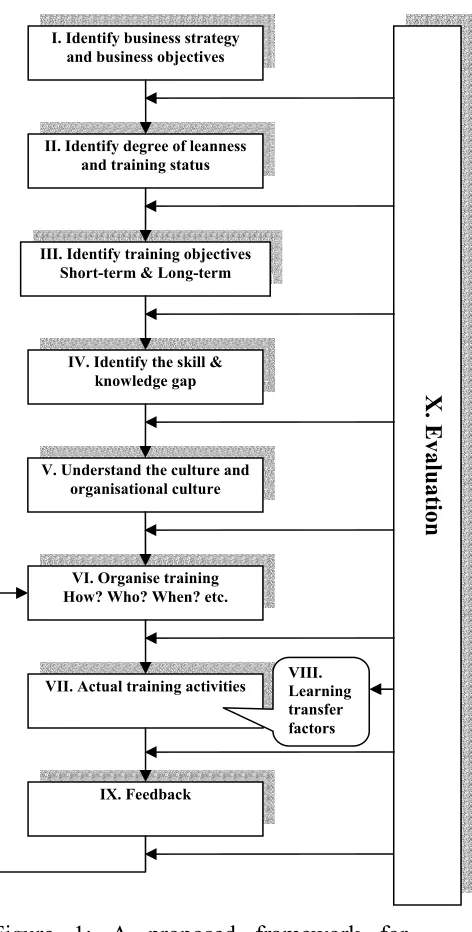
[image:6.595.312.548.104.570.2]Existing literature and the result of the empirical survey have shown the need for training framework. It is revealed that UK manufacturing companies are not satisfied with their training programme and LM implementation process. However, there is no one set of rules that offers the way to organise training for workers in lean environment. Hence, training for workers in lean environment needs to have a concrete framework which could provide a basis practices to work on. Figure 1 illustrates the proposed training framework which is developed based on the literature survey and the results of empirical study.
Figure 1: A proposed framework for training
I. Business strategy – Achanga et al. (2006) mentioned that strategy and vision are the most critical success factor of LM implementation. Therefore the first step of developing training plan is to identify business strategies. It is important to make clear “who we are,” “where we are (among the competitors, in the market, etc.),” “where we want to go and until when,”
I. Identify business strategy and business objectives
II. Identify degree of leanness and training status
III. Identify training objectives Short-term & Long-term
IV. Identify the skill & knowledge gap
VI. Organise training How? Who? When? etc.
VII. Actual training activities
IX. Feedback
VIII. Learning transfer factors V. Understand the culture and
organisational culture
“what the customers’ needs are,” and “what are the organisations’ objectives and aims of business.” In addition to the above business questions, it is essential to identify “what we want to benefit from LM at organisational level” and/or “what are the aims and objectives of implementing LM at management level.” Identifying business strategies also facilitate management control, serving as a way to unite individual workers into one solid organisation.
II. Identify degree of leanness and training status – At this stage, two points will be reviewed; Degree of leanness and Current training. They aim to identify how far the company achieve lean and how effectively the company’s training are currently carried out. The result can be considered as either strength or weakness of the current company’s operation. The identified weaknesses are the gaps that companies can improve and which, as a result, lead a better performance. It also gives the idea what the company needs to focus on during the training planning and sessions.
III. Identify training objectives and aims – Training objectives and aims are the results that organisations want to achieve and are related to business strategy. They can exist at both organisational level and individual level. However, organisational level objectives can be broke down to the individual level as workers’ objectives are the primary objectives to achieve organisational ones. The objectives and aims have to be realistic, meaningful, specific, and achievable. They can be divided into short-term and long-term depending upon the time scale or business priority. Furthermore, if the production workers can involve into this stage, it can
be foreseen the benefits for the firm since the workforces may have better propositions for training programme and might feel they are considered as an important part of the training.
IV. Identify the skill and knowledge gap – After objectives and aims are set, locating skill and knowledge gap between present status and future requirement is vital. Evaluation of the current skill and knowledge should be neither overestimated nor underestimated; otherwise the training will not make any meaningful contribute to both workers and organisations.
V. Understand the organisational culture – Every organisation has its own unique culture even though they might have not intentionally tried to build it. Every worker is expected to follow those cultures. In most cases, organisational culture has been created unconsciously, based on the values of top management or core people. The organisational culture serves as a basis of organisation’s management system. Workers have been and will be attempting to change the culture according to their preferences and business conditions.
(Atkinson, 2004) Therefore, the current attention focused too much on applying lean tools rather than creating lean culture is not the best answer for implementation of LM. Hence, it is essential that the present organizational culture is analysed in order to detect how individuals are able to accept changes and how to create the culture. However, it can be inferred that assessing the organizational culture would be a demanding task in practical.
VI. Organise training – This is the phase at which detail training plans are organised. There are some questions to be answered in this stage such as;
1) Who is the most suitable worker for training?
2) Who will be the trainer?
3) When is the best time to carry out the training?
4) Which training method is the most suitable?
5) What kind of material or equipment will be used?
6) Where will be the training take place? In order to carry out the most effective training, these elements need to be systematically and deliberately encapsulated in training strategies and/or policies adapted by organisations.
VII. Actual training – This is the actual implementation phase where chosen training methods take place. It is important to encourage the participants in order to make the training activities more rewarding for themselves and organisations. Even if the training objective seems extremely easy to achieve, trainers should not expect trainees to learn new skill or knowledge very quickly. To answer this, trainees have to hear, see, try, and retry.
VIII. Learning transfer factors – It is important to remember that the gained knowledge will be lost. One month from the training day, 40% of gained knowledge will be lost and it rises up to 90% after a half year. (Globerson et al., 2001) In addition to knowledge loss due to time, interestingly, there are different retention rate according to how they learn. (Pont, 1995) Pont mentioned that learners retain about;
10% of what they read 20% of what they hear 30% of what they see
50% of what they both hear and use 70% of what they say
90% of what they say and do
It can be found that the level of retention is much greater when training method is more participative than passive. However, each worker has different motivation and characters to learn. Therefore, in practice, the trainers need to offer better training approach for each worker. Identifying and assessing each trainee’s learning process are complicated and delicate task. It is an important task in order to optimise training efficiency and maximize knowledge transfer. It requires deep knowledge, understanding and research in human science. Therefore, organization without such skills, it is recommended to outsource specialists to carry out this task.
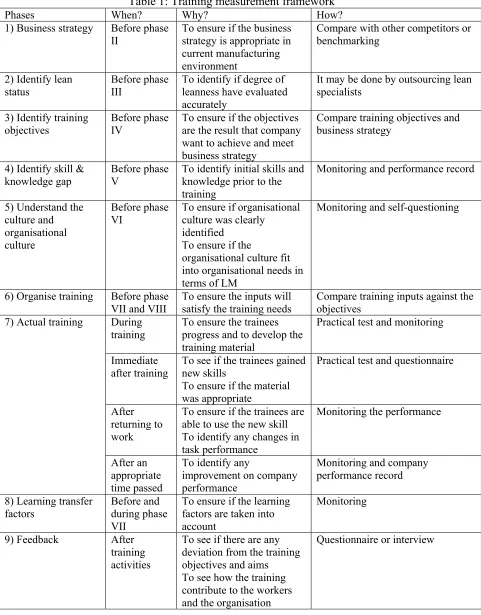
Table 1: Training measurement framework
Phases When? Why? How?
1) Business strategy Before phase II
To ensure if the business strategy is appropriate in current manufacturing environment
Compare with other competitors or benchmarking
2) Identify lean status
Before phase III
To identify if degree of leanness have evaluated accurately
It may be done by outsourcing lean specialists
3) Identify training objectives
Before phase IV
To ensure if the objectives are the result that company want to achieve and meet business strategy
Compare training objectives and business strategy
4) Identify skill & knowledge gap
Before phase V
To identify initial skills and knowledge prior to the training
Monitoring and performance record
5) Understand the culture and organisational culture
Before phase VI
To ensure if organisational culture was clearly
identified To ensure if the
organisational culture fit into organisational needs in terms of LM
Monitoring and self-questioning
6) Organise training Before phase VII and VIII
To ensure the inputs will satisfy the training needs
Compare training inputs against the objectives
During training
To ensure the trainees progress and to develop the training material
Practical test and monitoring
Immediate after training
To see if the trainees gained new skills
To ensure if the material was appropriate
Practical test and questionnaire
After returning to work
To ensure if the trainees are able to use the new skill To identify any changes in task performance
Monitoring the performance 7) Actual training
After an appropriate time passed
To identify any
improvement on company performance
Monitoring and company performance record
8) Learning transfer factors
Before and during phase VII
To ensure if the learning factors are taken into account
Monitoring
9) Feedback After
training activities
To see if there are any deviation from the training objectives and aims To see how the training contribute to the workers and the organisation
X. Evaluation – It is a backbone of whole training agendas as it can perform as a tool to identify if the training programme has been carried out efficiently and improve training programme for future training. If the training progress seems going out of the way according to the evaluation, it enables the firm to rectify without wasting further time, money and resources. Table 1 summarises the evaluation process when, why and how to carry out.
7. Conclusion
The empirical study was carried out in order to investigate workforce training LM issues within UK-based manufacturing companies. The result and literatures suggest that developing a training framework for workers in lean environment is essential to initiate LM implementation and to achieve highly effective LM operation. Moreover, there are accepted facts that LM ameliorates shop floor performances, yet the benefits can be maximised only when a company can obtain well-trained and highly motivated workers. In this research, we have proposed a new workforce training framework to fit into lean environment. This proposed model not only provides a systematic training programme but also ensures the efficiency of training by implementing evaluation process concurrently. Further research is currently being carried out to validate the framework.
REFERENCES
Achanga, P., Shehab, E., Roy, R., and Nelder, G. (2006) “Critical success factors for lean implementation within SMEs” Journal of Manufacturing Technology Management Vol. 17 No. 4, pp. 460-471
An NTO Group for Engineering Project (2002) May, “Engineering sector workforce development plans: A review of sector workforce development plans for the engineering and related work”
Atikinson, P. (2004) “Lean & Mean: A Cultural Issue,” Control, No. 5, pp18-23 www.iomnet.org.uk
Ehrlich, B. G. (2002) “Transactional Six Sigma and Lean Servicing: Leveraging Manufacturing Concepts to Achieve World-Class Service,” St. Lucie Press
Globerson, A. and Kormen, A. (2001) “The use of just-in-time training in a project environment,” 19, pp279-285
MacDuffie J. P. (1995) “Workers’ Roles in Lean Production: The Implications for Worker Representation” In Babson, S. ed., “Lean Work: Empowerment and Exploitation in the Global Auto Industry,” Detroit, Mich: Wayne State University
Mitel, A. and Pennathur, A. (2004) “Advanced technologies and human in manufacturing workplaces: an interdependent relationship,” International Journal of Industrial Ergonomics, vol. 33, pp295-313
Pennathur, A. and Mital, A. (2003) “Worker mobility and training in advanced manufacturing”, International Journal of Industrial Ergonomics, Volume 32, Issue 6, Pages 363-388
Riding, R. and Mortimer, J. (2002) “A study of the on-the-job training of production line operatives in manufacturing companies,” International Journal of Training and Development, 4: 2, pp111-123
The Manufacturer (2003) “World class manufacturing: Research report – part of the Industry Research programme from The Manufacturer,” supported by Deloitte & Touche, Learning + Skills Council, and Oliver Wight