University of East London Institutional Repository: http://roar.uel.ac.uk
This paper is made available online in accordance with publisher policies. Please scroll down to view the document itself. Please refer to the repository record for this item and our policy information available from the repository home page for further information.
To see the final version of this paper please visit the publisher’s website. Access to the published version may require a subscription.
Author(s): Mouratidis, Haralambos.
Article Title: Secure Tropos: An Agent Oriented Software Engineering
Methodology for the Development of Health and Social Care Information Systems
Year of publication: 2009
Citation: Mouratidis, H. (2009) ‘Secure Tropos: An Agent Oriented Software
Engineering Methodology for the Development of Health and Social Care Information Systems’, International Journal of Computer Science and Security, 3(3) 241-271.
Link to published version:
http://cscjournals.org/csc/manuscript/Journals/IJCSS/volume3/Issue3/IJCSS-81.pdf
DOI: (not stated)
Information on how to cite items within roar@uel:
Secure Tropos: An agent oriented software engineering
methodology for the development of health and social care
information systems.
Haralambos Mouratidis
School of Computing and Technology, University of East London,
4-6 University Way, Docklands, E16 2RD, London, England
Abstract
A huge amount of health and social care related information needs to be stored and
analysed; with the aid of computer systems this can be done faster and more efficiently.
As a result, computerised health and social care information systems are gaining
popularity. The development of such systems, mostly so far, follows an ad-hoc pattern.
However, in order to effectively deal with the characteristics of such systems such as
size, security, unpredictability, and openness; appropriate software engineering
methodologies and paradigms should be employed for their development. This paper
defines a set of requirements that a methodology should demonstrate and it argues for
the appropriateness of the Secure Tropos agent oriented methodology for the
development of health and social care information systems. The applicability of the
methodology is demonstrated with the aid of a real-life case study, the electronic Single
Assessment Process system, an information system to support integrated assessment of
the health and social care needs of older people. The application of the proposed
methodology on the case study indicated that the methodology satisfies the identified
requirements.
Keywords: Health and social care information systems development, methodologies,
1.
Introduction
Almost every nation is facing problems (managerial, administrative, and/or clinical)
with the delivery of health and social care to its citizens [1]. It has been argued [2] that
information technology can provide the answer to some of these problems.
Consider as an example the problems associated with the health and social care of older
people such as duplication of assessments, lack of awareness of key concepts of need
and fragmentation of care. To overcome these problems national policy in England is
the development of the Single Assessment Process (SAP). The Single Assessment
Process [3] aims to create closer working for providing primary health and social care
for older people and other groups. In a distributed health care setting different health
care professionals such as general practitioners and nurses, must cooperate to provide
older persons with appropriate care and they must also work closely with social care
professionals, such as social workers, because health and social care needs overlap
amongst older people. Moreover, a huge amount of data needs to be available to the
appropriate professionals to allow them to take the correct decisions.
It has been recognised [3] that computerising this process is a very important step
for the success of the single assessment process. Computer systems will help to
automate some of the tasks involved, such as the management of the health and social
care teams, and the appointments’ procedures; as well as allowing to store and analyse
important information faster and more efficiently, thus giving health and social care
professionals more time for the actual care of the older people.
Because of the advantages introduced by the use of computerised systems, such as
systems for every area of the health and social care sector, from systems to link General
Practitioners’ information to systems which provide support to care assistants.
However, such systems demonstrate an inevitable complexity due to their
characteristics, such as size (due to the large amount of data and information that needs
to be stored as well as the large amount of processes involved), security (privacy of
health and social care information has been widely recognised as one of the important
issues for the health and social care sector), unpredictability (the health and social care
sector is by nature unpredictable due to its dynamic environment), and openness (due to
their wide interconnection with other systems, such as police registers). Therefore,
system developers must employ software engineering methodologies to assist them
during the development of a system by providing, for instance, methods to elicit the
system requirements and develop a design that meets these requirements.
Nevertheless, most of the times, an ad-hoc approach is taken for the development of
health and social care information systems, partially because current software
engineering methodologies are not well suited for the development of such systems.
First of all, they fail to deal effectively with the complexity introduced by these
systems. Secondly, they fail to provide a clear ontology, which will allow both system
developers and users/stakeholders to actively contribute to the development of a system.
Thirdly, they fail to consider security as an integral part of the development process.
Therefore, it is important to develop methodologies that will overcome the above
limitations, and will allow the development of health and social care information
systems in an effective and efficient manner. In doing so, it is important to define the
requirements that a methodology for health and social care information systems should
This paper defines such requirements and it presents Secure Tropos, an agent
oriented methodology, which is an extension of the Tropos methodology [14]. Tropos
demonstrates characteristics that make it ideal for the development of health and social
care information systems. Firstly, it allows a deeper understanding of not only the
system, but also of the environment in which the system would operate. Secondly,
Tropos employs the same concepts and notations throughout the development process
leading to a homogeneous development that is easier to understand by non-software
engineering experts (such as the health and social care professionals). Thirdly, it
employs real life concepts and therefore it narrows the gap between the concepts used
by the health and social care professionals and the system developers. Moreover, Secure
Tropos adds a fourth important characteristic by considering security issues as an
integral part of its development process; therefore leading to the development of secure
systems, something very important in the case of health and social care information
systems.
The paper is structured as follows. Section 2 defines some important requirements
that a software engineering methodology should demonstrate to be suitable for the
development of health and social care information systems. Section 3 provides an
introduction to the agent oriented software engineering paradigm, necessary for the
readers to understand the rest of the paper. Section 4 discusses the appropriateness of
the Secure Tropos methodology in the development of health and social care
information systems, indicating why Secure Tropos is more suitable, than other
methodologies, for the development of these systems. Section 5 presents the
methodology, whereas Section 6 demonstrates its applicability with the aid of the
presents related work and section 8 concludes the paper and describes areas of future
work.
2.
The requirements of a software engineering
methodology for the development of health and social
care information systems.
During the development of, health and social care or otherwise, information systems,
software engineers employ guidelines, notations and follow structure processes to help
them go through the development faster and more efficiently. In other words, they
employ methodologies. To emphasise the need of a methodology Birrell and Ould argue
“anyone undertaking software development, on no matter what scale, must be strongly
advised to establish a methodology for that development –one or more techniques that,
by careful integration and control, will bring order and direction to the production
process” [4].
According to Booch [5] “a methodology is a collection of methods applied across
the software development life cycle and unified by some general, philosophical
approach”. Thus a methodology is considered to be a pre-defined series of steps that
helps designers to understand a problem and model a solution. Although a methodology
must guide through its steps, on the same time it must be flexible and allow creativity.
Moreover, there are requirements that methodologies specifically employed for the
development of health and social care information systems, should demonstrate. As
argued by Norris [1], “the term healthcare is a deceptively simple one embracing
multiple, inherently complex, sets of processes and interactions”. As a result, health and
social care information systems are, usually, large complex systems. Therefore, the
interrelated subsystems, each of which is also decomposed to smaller subsystems, until
the lowest element of the system is defined. Therefore:
Requirement 1: An appropriate methodology should provide concepts and procedures
to decompose effectively the system to smaller, easier to understand and develop
components.
Moreover, due to the dynamic and unpredictable nature of the health and social
care infrastructures, the relationships between the subsystems might change over time,
and new subsystems might often be added into (or removed from) the main system.
Therefore:
Requirement 2: An appropriate methodology should allow developers to iterate during
the development stages and easily modify/add/delete the various components of the
system.
In addition, the description of health and social care systems usually takes place by
identifying the relationships between the stakeholders/users and their interaction with
the system. However, there is a fundamental difficulty in eliciting these relationships
due to the abstraction gap between the concepts used by health and social care
professionals to describe the functionalities of the system, and the software engineers to
model such functionalities. Moreover, as a result of the difficulty to understand/been
explained the concepts involved, health and social care professionals, usually, are not
actively involved in the development of the system under development resulting in the
development of a system that does not actually meet the needs of its users. Therefore:
Requirement 3: An appropriate methodology should provide concepts that are easily
understood not only by the system developers but also from the system’s
Most of the developers have limited knowledge of the health and social care sector,
and as a result, and due to the limited involvement of health and social care
professionals, find it difficult to understand the implications of their analysis and
designs. Therefore:
Requirement 4: An appropriate methodology should allow developers to model not
only the system but also the environment in which the system will be deployed as well as
the relationships between the different stakeholders/users of the system.
Additionally, security is an important issue when developing health and social care
information systems as such systems contain sensitive information which should be kept
private. It has been argued in the literature [6,7] that in order to identify potential
conflicts, which could lead to vulnerabilities, between security and the functionalities of
the system; security should be considered from the early stages of the system
development. Therefore:
Requirement 5: An appropriate methodology should allow developers to consider
security issues throughout the development stages by providing concepts and processes
customised to security.
Thus, to demonstrate the suitability of the Secure Tropos methodology in the
development of health and social care information systems, we must demonstrate the
degree at which Secure Tropos meets the above requirements. However, before doing
this, it is important to provide a brief overview of agent oriented software engineering,
to enable readers with limited knowledge of it, to understand the paradigm in which
3.
Agent Oriented Software Engineering
As mentioned above, Tropos is based on the agent oriented paradigm. Agent oriented
software engineering is based on the concept of an agent1. The term agent derives from the present particle of the Latin verb agere, which means to drive, act, lead or do [8].
One of the most widely used definition of an agent, by Wooldridge and Jennings [9],
defines it as “…. A hardware or (more usually) software based computer system that
enjoys the following properties:
1. Autonomy. Agents operate without the direct intervention of humans or
others, and have some kind of control over their actions and internal state.
2. Social ability. Agents interact with other agents (and possibly humans)
via some kind of agent communication language.
3. Reactivity. Agents perceive their environment, (which may be the
physical world, such as a user via a graphical user interface, a collection of other
agents, the Internet, or perhaps all of these combined), and respond in a timely
fashion to changes that occur in it.
4. Pro-activeness. Agents do not simply act in response to their
environment; they are able to exhibit goal-directed behaviour by taking the
initiative”.
Agent Oriented Software Engineering introduces an alternative approach, than
other software engineering approaches, in analysing and designing complex distributed
computerised systems [10,11,12]. According to this, a complex computerised system is
viewed as a multiagent system [11] in which a collection of autonomous software
agents (subsystems) interact with each other in order to satisfy their design objectives.
Therefore, developers view the system as a society, similar to a human society,
consisting of entities that possess characteristics similar to humans such as mobility,
intelligence and the capability of communicating.
4.
The arguments for the suitability of Secure Tropos for
the development of health and social care information
systems.
It is important, when arguing for the suitability of the Secure Tropos methodology for
the development of health and social care information systems, to discuss agent
orientation with respect to the requirements defined in Section 2.
According to Jennings and Wooldridge [13] an agent oriented approach is effective
in partitioning the problem space of a complex system. A complex computerised system
can be decomposed into smaller components, the same way that a multiagent system
can be decomposed into the elements that constitute the system (software agents). As
mentioned above, when adopting an agent oriented view of a system, the system is
viewed as a society similar to a human society, consisting of entities that possess
characteristics similar to humans such as mobility, intelligence and the capability of
communicating. This allows decomposing the system easier by mapping the real life
counterparts of a system to a software subsystem (agent).
Moreover, agent orientation is well suited for the development of dynamic
environments, in which the structure of the system changes. Agent structures provide a
variety of stable intermediate forms, meaning that individual agents or organisational
grouping can be developed in relative isolation and then added into (or removed from)
the system in an incremental manner [13].
This higher (than other software paradigms) level of abstraction employed in the
development of software systems results in modelling a system in terms of autonomous
entities with characteristics similar to humans. This introduces a close-to-real-life
modelling of the system and therefore makes the development of the software system
natural. In turn, this helps to narrow the gap between real life and modelling, by
allowing developers to reason about the software system using concepts and mental
qualities known to them from the real life. This is particularly true in the case of health
and social care information systems, where the high level of abstraction, and the usage
of concepts close to real life – such as goals, tasks, actors- leads to a better mutual
understanding between the system developers (computer scientists) and system users
(health and social care professionals) since system developers can better explain the
functionalities of the system, by decomposing it to smaller autonomous entities (agents)
that posses characteristics similar to humans, such as mobility and the ability to
communicate, and the system users can use the concept of an agent to describe more
precisely the needs of the system.
Additionally, the agent oriented software engineering paradigm presents a feasible
approach for the integration of security to software engineering. This is mainly due to
the appropriateness of agent oriented philosophy for dealing with the security issues that
exist in a computer system. Security requirements are mainly obtained by analysing the
attitude of the organisation towards security and after studying the security policy of the
organisation. As mentioned in [13] agents act on behalf of individuals or companies
interacting according to an underlying organisation context. The integration of security
within this context will require for the rest of the subsystems (agents) to consider the
causing the propagation of security requirements to the rest of the subsystem. In
addition, the agent oriented view is perhaps the most natural way of characterising
security issues in software systems. Characteristics, such as autonomy, intentionality
and sociality, provided by the use of agent orientation allow developers first to model
the security requirements in high-level, and then incrementally transform these
requirements to security mechanisms.
On the other hand, Secure Tropos in particular demonstrates some key features that
make it ideal for the development of health and social care information systems. Firstly,
it covers the early stages of requirements analysis [14], and thus allows for a deep
understanding of not only the system itself, but also of the environment where the
system will operate and as a result it helps to better understand the interactions and the
relationships that will occur in the system. This is, as discussed above, very important in
the development of health and social care information systems since it allows
developers to obtain a clear idea of the environment in which the system will be
deployed as well as the interactions between the different health and social care
professionals involved and as a result develop a system which is customised to that
particular environment and meets the necessities of its users.
Secondly, Secure Tropos employs concepts such as stakeholders, actors, goals,
tasks, capabilities, and dependencies which are concepts used in real world situations.
This results in introducing during the development process concepts familiar to both
users/stakeholders and system developers, and therefore minimise the abstraction gap
between the concepts used by health and social care professionals and software
Moreover, Secure Tropos uses the same concepts and notations throughout the
development stages. This leads to a uniform development that enables system users
(health and social care professional in our case) to be involved throughout the
development stages and not only during the requirements elicitation stage.
Another important key feature of Secure Tropos is the consideration of security
issues during the development of the system. The security requirements of the various
health and social care professionals involved with the system are identified with the aid
of security related concepts such as security constraints and secure goals. This enables
system developers to understand the security requirements of the system by analysing
the security related concepts imposed to the various stakeholders/ users of the system.
Then, these requirements can be transformed to (security related) functionalities that the
system has to satisfy.
To validate our claims, we have applied Secure Tropos to the development of the
electronic Single Assessment Process (eSAP) system case study. However, before
illustrating this, the next section provides an overview of the concepts and the
development stages of the methodology for readers not familiar with it.
5.
Description of Secure Tropos
Secure Tropos is an extension of the Tropos methodology. Tropos2 is a novel agent oriented software engineering methodology tailored to describe both the organisational
environment of a multiagent system and the system itself, emphasizing the need to
understand not only what organisational goals are required, but also how and why the
intended system would meet the organisational goals. This allows for a more refined
2 The name Tropos derives from the Greek “Τρόπος” which means “way of doing things” but also has
analysis of the system dependencies, leading to a better treatment not only of the
system’s functional requirements but also of its non-functional requirements, such as
security, reliability, and performance [15].
Tropos supports the idea of building a model of the system that is incrementally
refined and extended from a conceptual level to executable artefacts, by means of a
sequence of transformational steps [16]. Such transformations allow developers to
perform precise inspections of the development process by detailing the higher level
notions introduced in the previous stages of the development. In addition, since the
methodology employs the same notation throughout the development process, such a
refinement process is performed in a more uniform way as compared, for example, to
UML-based methodologies where the graphical notation changes from one development
step to another (for example, from use cases to class diagrams). Moreover, Tropos
allows developers to consider security issues as an integral part of the system
development. The security process is one of analysing the security needs of the
stakeholders and the system in terms of security constraints imposed to the system and
the stakeholders; identify secure entities that guarantee the satisfaction of the security
constraints and assign capabilities to the system to help towards the satisfaction of the
secure entities. In Secure Tropos, a security constraint is defined as a restriction
related to security issues, such as privacy, integrity and availability, which can
influence the analysis and design of a multiagent system under development by
restricting some alternative design solutions, by conflicting with some of the
A security constraint contributes to a higher level of abstraction, meaning that
security constraints do not represent specific security protocol restrictions3, which
restrict the design with the use of a particular implementation language. This higher
level of abstraction allows for a generalised design free of models biased to particular
implementation languages. Regarding the constraint metamodel, a security constraint is
captured through a specialisation of constraint into the subclass security constraint.
In addition, Tropos adopts the i* modelling framework [18], which uses the
concepts of actors, goals and social dependencies for defining the obligations of actors
(dependees) to other actors (dependers), and the novelty of the methodology lays on the
fact that those concepts are used to model not just early requirements, but also late
requirements as well as architectural and detailed design [19]. Using the same concepts
during the development stages of a multiagent system provides the advantage of
reducing impedance mismatches between different development stages, and therefore
streamlines the development process [19].
The system and its environment are viewed as a set of actors, who depend on other
actors to help them fulfil their goals. An actor [18] represents an entity that has
intentionality and strategic goals within the multiagent system or within its
organisational setting. An actor can be a (social) agent, a position, or a role. Agents can
be physical agents, such as a person, or software agents.
A goal [18] represents a condition in the world that an actor would like to achieve.
In Tropos, the concept of a hard-goal (simply goal hereafter) is differentiated from the
concept of soft-goal. A soft-goal is used to capture non-functional requirements of the
3 Such security restrictions should be specified during the implementation of the system and not
system, and unlike a (hard) goal, it does not have clear criteria for deciding whether it is
satisfied or not and therefore it is subject to interpretation [18]. For instance, an example
of a soft-goal is “the system should be scalable”. On the other hand, a secure goal
represents the strategic interests of an actor with respect to security. Secure goals are
mainly introduced in order to achieve possible security constraints that are imposed to
an actor or exist in the system. However, a secure goal does not particularly define how
the security constraints can be achieved, since alternatives can be considered.
A task represents, at an abstract level, a way of doing something [15]. The
fulfilment of a task can be a means for satisfying a goal, or for contributing towards the
satisficing of a soft-goal. Secure Tropos allows reasoning about the different ways the
actors can achieve their goals, by enabling developers to model alternative tasks that
actors might employ to achieve their goals. Similarly, a secure task is used to define
precisely how a secure goal can be achieved, by representing a particular way of
satisfying a secure goal.
A resource [15] presents a physical or informational entity that one of the actors
requires. The main concern when dealing with resources is whether the resource is
available and who is responsible for its delivery. On the other hand, a secure resource
can be defined as an informational entity that is related to the security of the information
system. Secure resources can be divided into two main categories. The first category
contains secure resources that display some security characteristics, imposed by other
entities, such as security constraints, secure goals, secure tasks and secure dependencies.
The second category of secure resources involves resources directly associated with the
security of the system. For example, consider the authorisation details file of a
A dependency [18] between two actors represents that one actor depends on the
other to attain some goal, execute a task, or deliver a resource. The depending actor is
called the depender and the actor who is depended upon is called the dependee. The
type of the dependency – goal, task, resource- describes the nature of an agreement
(called dependum) between dependee and depender. By depending on the dependee
for the dependum, the depender is able to achieve goals that it is otherwise unable to
achieve on their own, or not as easily or not as well [18]. Moreover, a secure
dependency [17] introduces security constraint(s) that must be fulfilled for the
dependency to be satisfied. Both the depender and the dependee must agree for the
fulfilment of the security constraint in order for the secure dependency to be valid. That
means the depender expects from the dependee to satisfy the security constraint(s) and
also that the dependee will make an effort to deliver the dependum by satisfying the
security constraint(s). There are three different types of a secure dependency:
Dependee Secure Dependency, in which the depender depends on the dependee and
the dependee introduces security constraint(s) for the dependency. The depender must
satisfy the security constraints introduced by the dependee in order to help in the
achievement of the secure dependency. Depender Secure Dependency, in which the
depender depends on the dependee and the depender introduces security constraint(s)
for the dependency. The dependee must satisfy the security constraints introduced by
the depender otherwise the security of the dependency will be in risk. Double Secure
Dependency, in which the depender depends on the dependee and both the depender
and the dependee introduce security constraints for the dependency. Both must satisfy
A capability [15] represents the ability of an actor of defining, choosing and
executing a task for the fulfilment of a goal, given certain world conditions and in
presence of a specific event. A secure capability represents the ability of an
actor/agent to achieve a secure goal, carry out a secure task and/or deliver a secure
resource.
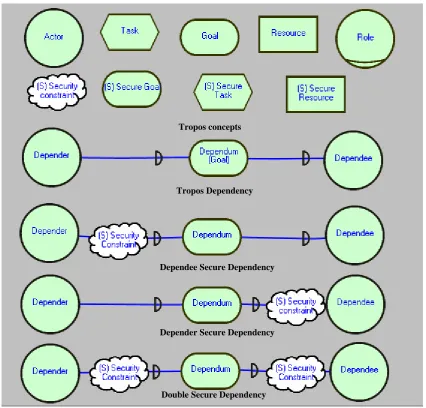
A graphical representation of the Tropos concepts is illustrated in Figure 1.
Tropos concepts
Tropos Dependency
Dependee Secure Dependency
Depender Secure Dependency
[image:19.595.85.512.247.655.2]Double Secure Dependency
Figure 1: Tropos concepts graphically
Tropos defines its own modelling language [14] in terms of a UML metamodel.
provides the basis for metamodel extensions; the metamodel level, which provides
constructs for modelling knowledge level entities and concepts; the domain level, which
contains a representation of entities and concepts of a specific application domain; and
the instance level, which contains instances of the domain level. For instance, consider
an entity as an example of the meta-metamodel, an actor as an example of the
metamodel level, a doctor as an example of the domain level and John as an example of
the instance level. In addition, the meta-metamodel level of the language allows the
inclusion of constructs for the formal definition of the Tropos concepts. In particular a
formal specification language, called Formal Tropos, is under development [20]. Formal
Tropos [20,21] offers all the concepts of graphical Tropos, such as actors, goals and
dependencies, supplemented with a rich temporal specification language, inspired by
KAOS [22].
The Secure Tropos methodology covers four main software development stages.
During the early requirements analysis stage, developers are concerned with the
understanding of a problem by studying an existing organisational setting. This involves
the identification of the domain stakeholders and their modelling as social actors. In
particular, developers model the stakeholders as actors, their intentions as goals, and
their relationships as dependencies. Through a goal-oriented analysis [16], the actors’
goals are decomposed into more precise goals and sometimes into tasks that if
performed by the actor, allow for goal achievement. From the security point of view,
security constraints are imposed to the stakeholders of the system (by other
stakeholders). Such constraints are initially expressed in high level statements, and they
actors to satisfy them. The output of this phase is an organisational model, which
includes relevant actors and their respective dependencies and security entities.
In the late requirements analysis stage, the system-to-be is specified within its
operational environment, together with relevant functions and qualities. This description
models the system as an actor, who has a number of dependencies with the actors
identified during the previous stage. These dependencies indicate the obligations of the
system towards its environment, and therefore define the system’s functional and
non-functional requirements. Moreover, security constraints are delegated to the
system-to-be and appropriate entities are assigned to satisfy them.
During the architectural design stage, the system’s global architecture is defined
in terms of subsystems, interconnected through data and dependencies. In particular,
subsystems are represented as actors and data/control interconnections are represented
as (system) actor dependencies. This stage is divided into three steps. The first step
includes the definition of the overall architectural organisation by introducing new
actors to the system and delegating to them some of the goals of the system. The second
step includes the identification of the capabilities needed by the actors to fulfil their
goals and tasks and the third step involves the identification of a set of agent types and
the assignment of capabilities to those agents. From the security point of view, any
possible security constraints and secure entities that new actors might introduce are
analysed. Additionally, the architectural style of the multiagent system is defined with
respect to the system’s security requirements and the requirements are transformed into
a design with the aid of security patterns. The final output of this stage is a set of
software agents corresponding to the actors of the system, each characterised by its
In the detailed design stage, each architectural component is defined in further
detail in terms of inputs, outputs, control, security and other relevant information. This
stage is based on the specifications resulting from the analysis of the previous stages
and therefore the reasons for a given element at this stage can be traced back to the early
requirements analysis. For this stage, Secure Tropos uses elements of the Agent Unified
Modeling Language (AUML) [23] to complement the features of i*.
It must be noted that Tropos is not a “laboratory” methodology but it has been
motivated by a number of case studies [14,19].
6.
Case Study
The assessment of health and social care needs is at the heart of good practice in the
care of older people. Older people often have multiple impairments and health
problems, and complex support systems involving several health and social care
practitioners and family carers. Sharing of assessment information is important to avoid
unnecessary repetition and to ensure that all relevant information is available to support
effective care planning. Recognition of the need to share assessment information has
stimulated standardisation of assessment methods. These in turn have been used to help
standardise care planning and referrals following assessment.
In March 2001, the (English) Department of Health published its National Service
Framework (NSF) for Older People’s Services [3]. The NSF sets national standards
for the health and social care of older people.
Standard 2 of the National Service Framework, which refers to person-centred care,
includes requirements to establish a single assessment process for integrating the
assessment of health and social care needs of older people. Local health and social care
convergence towards a fully integrated and electronically based national system. The
Department issued further guidance in February 2002, listing requirements for contact,
overview, specialist and comprehensive assessment, and a range of assessment
instruments, which could be used for these types of assessment.
Information technology has the potential to improve efficiency and effectiveness in
the collection and sharing of assessment information. An information system, called
hereafter, the electronic single assessment process (eSAP) system, to support integrated
assessment of the health and social care needs of the older person, should therefore
build on contact and overview assessment in primary care, with maximum involvement
of the older person in prioritising the assessment domains and in care planning.
6.1
A TYPICAL SCENARIO
Our aim in this paper is not to provide a complete analysis and design of the electronic
single assessment process (eSAP) system, but rather to illustrate how the Secure Tropos
methodology can be effectively used in the development of a health and social care
information system. As a result, we focus our illustration to a specific scenario related
to the functionality of the electronic single assessment process. This allows us to define
well the boundaries of the system, and as a result it makes the understanding of the
methodology easier for the readers, since only important issues of the methodology are
presented without going into unnecessary details.
The following scenario has been used in this paper for the analysis and design of
the electronic single assessment process.
“An 81 years old lady, widow, lives in her house. Her daughter lives nearby but
she has children of her own and therefore she is unable to provide full care to her
The daughter visits the mother’s General Practitioner (GP) to describe her concern
about her mother’s health. Her mother has become unsteady on her feet and may have
had a number of falls. Single assessment process has been introduced, so the GP asks
the daughter to complete the EasyCare [24] contact assessment and the information is
entered into the GP’s computer. The GP sees the daughter concerned about her
mother’s health and asks his practice nurse to visit the old lady to perform an overview
assessment.
The old lady’s information is transferred to the nurse’s computer along with
referrals and instructions, e.g. the daughter of the patient is concerned about her
mother’s health so please perform an overview assessment. The nurse receives the
information and arranges to visit the old lady by generating and sending a letter to the
old lady and her daughter giving details about visit and ask availability. The daughter
replies (also provides her mother’s response) that the date/time is suitable.
The nurse visits the old lady and completes most of the EasyCare assessment except
from the health promotion module. From the evaluation of the other modules the nurse
concludes the old lady has a number of problems with her house, which increase the
risk of falls, she needs help with dressing and also she is not getting the appropriate
financial benefits. Then the nurse asks the old lady if the information can be shared, and
the old lady accepts. The nurse then produces a care plan summarising all the problems
identified and the actions to be taken. She also makes two referrals one to a Social
Worker (SW) - to check for a care assistant to help the old lady with dressing and to
check about financial benefits- and a second to an Occupational Therapist (OT) -to
perform a house assessment for need and adaptation. She then forwards the care plan
contact information to the Social Worker and the Occupational Therapist. In addition, a
copy is produced for both the old lady and her daughter and the care plan is signed.
Later, the old lady is visited by the Occupational Therapist who performs the house
assessment and decides that the house needs to be adapted to the old lady’s needs. The
O.T. then makes a referral to the Equipment Services for equipment and also provides
the contact information of the old lady. In addition, the O.T. forwards to the GP, nurse
and the S.W. a copy of the house problems, needed equipment and informs them that a
referral has been made to the Equipment Services.
The Social Worker visits the old lady and identifies that the old lady must apply for
financial benefits. A form is produced, filled in, and sent to the Benefits Agency together
with old lady’s contact and bank information. In addition, the Social Worker agrees to
employ a Care Assistant (C.A.) to help the old lady with dressing. A Care Assistant is
identified and the Social Worker asks the old lady if she feels comfortable with the
identified Care Assistant and the old lady agrees. Contact and overview assessment
information is sent to the Care Assistant by the Social Worker. Also, because of the
employment of a Care Assistant, the benefits must be adjusted. The social worker
informs the benefits agency about it.
While the Care Assistant visits the old lady, she realises that the health promotion
module of the overview assessment is not completed. She notifies the nurse and prompts
the old lady to fill in the module. When the module is complete, the C.A. sends the
information to the General Practitioner, the nurse and the Social Worker.
One of the observations of the Care Assistant was that the old lady didn’t have her
blood pressure taken for the last 5 years, so she alerts the nurse and the G.P. The
check the blood pressure of the old lady. The nurse visits the old lady to review all the
actions of the care plan and also check the old lady’s blood pressure. The care plan is
updated and for the time being the old lady gets everything she needs.”
6.2
DEVELOPING THE ESAPThe above scenario provides the basis for the development of the system. As mentioned
in the previous section the first phase of the Tropos methodology is the early
requirements analysis.
6.2.1 Early requirements analysis
During the early requirements analysis the software engineer models the dependencies
between the stakeholders (actors). For this reason, the Secure Tropos methodology
introduces actor diagrams [14]. In such a diagram, actors (graphically represented as
circles4) are modelled together with their
goals (represented as ovals), soft-goals
(represented as bubbles), security constraints (represented as clouds) and their
dependencies (represented as links between the actors indicating the dependum).
From the scenario presented above, the following actors are derived:
Older Person: The Older Person actor represents patients aged 65 or above,
assessed for their health and social care needs. In the presented scenario, the old lady
plays this actor. The Older Person must provide information about their health and
social care situation, and also receive information such as a summary of their needs and
a copy of their care plan. To provide information, the Older Person must undertake
assessments. This requires the Older Person to agree with the health and social care
professionals on the date/time that the assessments will take place. In addition, the
Older Person must understand the procedures clearly, have access to information
regarding their care 24 hours every day, and also decide if their information will be
shared between the professionals’ (and possibly other people) involved in their care.
Also, the Older Person must follow the care plan indicated by the health and social
care professionals. Therefore, the help of carers (informal-like the daughter- and
paid-like the care assistant-) is required.
Nurse:The Nurse performs the overview assessment to the Older Person. To do this,
the Nurse must contact the Older Person and arrange a meeting. After performing the
assessment the Nurse identifies the care needs of the Older Person, and according to
those needs she provides referrals. Also the Nurse must ask for the older person’s
consent in order to share information with others who may be involved in the care of the
Older Person. She generates a care plan and produces a copy of it for the Older
Person. In addition, the Nurse informs everyone involved (taking into account the
consent of the Older Person) about the care plan and the condition of the Older
Person. The Nurse is also responsible for regular review of the care plan.
General Practitioner: The General Practitioner performs the contact assessment,
provides referrals to the Nurse to perform an overview (or any different kind she/he
thinks is appropriate) assessment, and provides the older person’s contact information.
In addition, the General Practitioner receives alerts and information regarding the
Older Person, such as the care plan, possible referrals, and updates of the care plan.
Social Worker: The Social Worker receives referrals (indicating the problems
occurred) and the actions to be performed, and also information about the Older
Person such as contact information and a copy of the care plan. According to the
referrals, the Social Worker identifies the needs of the Older Person and takes
assistant (if necessary) and also dealing with benefits problems that the Older Person
might have. After identifying particular problems the Social Worker provides referrals,
informs the other professionals involved in the care of the Older Person and updates
the care plan. In addition, the Social Worker manages the care assistant.
Secondary Care Professional: Secondary care professionals (or specialists)
undertake assessment and care following referral by primary care professionals. Some
secondary care professionals such as community psychiatric nurses work at the interface
between primary and secondary care. During the single assessment process, secondary
care professionals, usually, do specialist and comprehensive assessments. In the
presented scenario, the Occupational Therapist plays this role. The Occupational
Therapist receives referrals from the Nurse along with the contact and overview
assessment information of the Older Person. She performs a specialist assessment and
identifies specialist needs of the Older Person. According to the identified needs, the
Occupational Therapist provides referrals, informs the other professionals involved in
the care of the Older Person and also updates the care plan.
Care Assistant: The main aim of the Care Assistant is to help the Older Person
with everyday needs. The Care Assistant receives information about the Older
Person, such as contact and overview assessment, and updates any of those if
necessary by providing to the Nurse possible needs of the Older Person. In addition,
she informs the General Practitioner, the Social Worker and the Nurse of any
updates regarding the older person’s information.
Informal Carer: Informal carers include unpaid family members, friends, and
neighbours who help meet older persons’ needs for care and support, including meeting
with shopping) and personal (help with dressing) care needs. In the presented scenario
the daughter of the old lady plays this role.
Care Manager:A Care Manager, usually a Social Worker or a Nurse, coordinates
the delivery of care to the Older Person and plans the work of the care assistants. In
the presented scenario, the Social Worker plays the Care Manager.
Benefits Agency: The Benefits Agency actor represents a financial agency that
helps older persons financially.
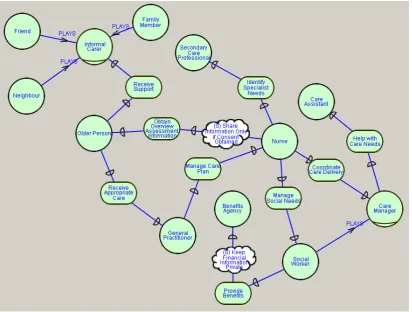
[image:29.595.93.506.305.617.2]The dependencies, between the above actors are modelled as shown in Figure 2.
Figure 2: Partial Actor diagram for the eSAP
For instance, the Older Person depends on the General Practitioner to Receive
Appropriate Care and on the Informal Carer to Receive Support. On the other hand,
the Nurse depends on the Secondary Care Professional to Identify Specialist
to Identify Social Needs and on the Older Person to Obtain Overview Assessment
Information.
However, one of the most important and delicate matters for the Older Person is
the privacy of their personal medical information and the sharing of it. Therefore, the
Older Person imposes a security constraint (share information only if consent
Obtained) on the Nurse for the Obtain Overview Assessment Information
dependency to be valid. In addition, the Social Worker imposes a security constraint
(Keep Financial Information Private) on the Benefits Agency for the Provide
Benefits dependency to be valid.
Modelling the dependencies and the security constraints of the individual actors
allows developers to model the functional and security requirements of the system
according to the real needs of its stakeholders. For example, in the presented analysis,
the lack of identifying the security constraints between the Nurse and the Older
Person, or the Social Worker and the Benefits Agency would result in a design that
would miss important information regarding the security of the system.
When the stakeholders, their goals and the dependencies between them have been
identified, the next step of this phase is to analyse in more depth each goal relative to
the stakeholder who is responsible for its fulfilment. For this reason, Tropos employs
goal diagrams. In a goal diagram, each actor is represented as a dashed-line balloon
within which the actor’s goals, security constraints and dependencies are analysed. The
nodes of the diagram represent goals, soft-goals, tasks, security constraints, and
secure entities whereas the links identify the different kinds of relationships between
those nodes. Moreover, these links can be connected with external dependencies
actor’s boundary [18]. Means-end, contribution and decomposition analysis is used in
goal diagrams. Means-end analysis is a form of analysis, consisting of identifying goals,
tasks, and/or resources that can provide means for reaching a goal [14]. Contribution
analysis is a form of analysis that discovers goals and tasks that can contribute
positively or negatively to the achievement of another goal. It is worth mentioning that
contributions could be positive or negative [14]. These are graphically represented with
plus (+) and minus (-) signs respectively. When a sign is not used, it is assumed the
contribution is positive. Decomposition analysis defines the decomposition of a root
goal/ task into sub goals /tasks.
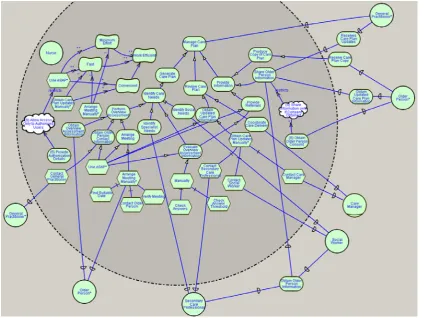
As an example of a goal diagram, consider the Nurse actor shown in Figure 3. The
main goal of the Nurse5 is to Manage the Care Plan. To satisfy this goal the Nurse must Generate the Care Plan, Review the Care Plan and Provide Information.
However, the Share Information only if Consent Obtained security constraint
imposed to the Nurse by the Older Person (see Figure 2) restricts the Share Older
Person Information goal of the Nurse. For the Nurse to satisfy this constraint, a
secure goal is introduced Obtain Older Person Consent.
Furthermore, the analysis indicates that the Use of eSAP will enable the Nurse
actor to work more efficiently, with less effort, convenient and faster. However, an
analysis [17] regarding the security of the eSAP system indicates that Authorisation is
required for the eSAP system (in order to help towards the Privacy security feature).
Figure 3: Partial Goal Diagram for the Nurse Actor
Therefore, the security constraint Allow Access Only to Authorised Users,
which restricts the Use eSAP task, is imposed to the Nurse actor. To help towards the
satisfaction of the imposed security constraint the secure goal Provide Authorisation
Details is introduced to the Nurse as indicated in Figure 3.
Modelling the actors internally leads to a more precise definition of the why of the
system functionality, and this subsequently helps to verify how the final system
implementation matches the stakeholders’ real needs.
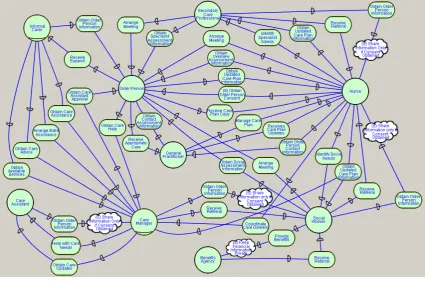
When all the actors have been further analysed, the actor diagram is refined, as
shown in Figure 4, and any possible new dependencies identified during the internal
Figure 4: Refined Actor Diagram
This is important since during the actors’ internal analysis it is possible that new
goals are discovered, which the actors might not be able to satisfy by themselves.
Therefore, new dependencies are introduced to enable an actor to delegate to another
actor the goals that cannot accomplish on their own. Introducing new dependencies
between the actors according to the goals/tasks derived from the internal analysis that
takes place in each actor is a common task in Secure Tropos and it is very important
since it helps to identify clearly the relationships between the actors and also indicates
how the analysis of the goals of one actor can influence the dependencies between this
actor and the other actors. Refining the dependencies and the social relationships of the
actors this way, leads to a more precise definition of the why of the system
functionalities, and as a last result, helps to verify how the final implementation matches
the real needs [17]. Also, with regards to security the refinement of the actor diagram is
redefinition of the security constraints imposed to particular dependencies or the
addition of new security constraints. As an example, consider the security constraint
ShareInformation Only if Consent Obtained. This security constraint was imposed
to the Nurse, as shown in Figure 2, by the Older Person as part of the Obtain Overview
Assessment Information dependency. However, the internal analysis of the Nurse
indicated that this security constraint restricts in fact the Share Older Person
Information goal of the Nurse. Therefore, in the refined actor diagram, the security
constraint has been imposed to all the newly discovered (after the internal analysis of
the actors) dependencies that involve the Share Older Person Information goal.
One of the most important issues in the development of the electronic Single
Assessment Process system, as in any health and social care information system, is to
precisely identify the environment that the system will be situated. This means to
identify the intentions of the users, anyone related to the system, and the relationships
between those. This is necessary in order to identify the functional and non-functional
requirements of the system-to-be. Secure Tropos helps towards this direction during the
early requirements analysis stage, since the final output of the early requirements
analysis is a clearly defined organisational model, which includes relevant actors
(users), their intentions and their respective dependencies (relationships).
6.2.2 Late requirements analysis
During the late requirements analysis the system-to-be, in our case study the electronic
Single Assessment Process system, is described within its operation environment along
with relevant functions and qualities. The system is presented as one or more actors,
dependencies define all functional and non-functional requirements for the
system-to-be.
During the Nurse analysis, modelled in Figure 3, it was identified that the Nurse
can achieve some of the goals either manually or by using the electronic single
assessment process (eSAP) system. Consider for example, the Arrange Meeting goal
of the Nurse actor. This can be fulfilled either by the task Use eSAP or by the task
Arrange Meeting Manually. However, the analysis, presented in Figure 3, showed that
by using an information system, the eSAP system, the Nurse will be able to work more
efficiently, with less effort, faster and more conveniently than trying to achieve the task
manually. Similar conclusions were drawn for all the actors of the system [14].
Therefore, it was decided that the use of eSAP provides advantages over the manual
achievement of most of the actors’ tasks, and as a result the responsibility for the
achievement of those tasks was delegated to the eSAP system.
Therefore, in our analysis, the eSAP system has been introduced as another actor
that receives the responsibility for the fulfilment of some of the goals identified during
the early requirements analysis for the actors of the system. In other words, some goals
that the actors of the system cannot fulfil or are better fulfilled by the eSAP system are
delegated to the eSAP System.
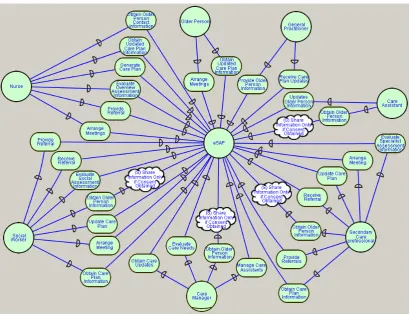
The actor diagram including the eSAP system and the refined dependencies6 is shown in Figure 5. For instance, it was identified during the early requirements analysis
6 It is worth mentioning that the dependencies of the
Informal Carer actor are not
delegated to the eSAP system, since it is assumed at this point that the Informal Carer
that the Arrange Meetings and Obtain Updated Care Plan Information goals of the
[image:36.595.93.505.137.452.2]Older Person will be achieved better with the aid of the eSAP system.
Figure 5: Actor diagram including the eSAP actor
Therefore to indicate this, two goal dependencies have been added from the Older
Person to the eSAP system actors. It is worth mentioning that along with
dependencies, security constraints are also delegated. For example, before the
introduction of the eSAP system, the Social Worker was depending on the Nurse to
Obtain Older Person Information. However, this secure dependency involves the
security constraint (restricting the Nurse) Share Information Only if Consent
Obtained. With the introduction of the eSAP system, the Social Worker actor
depends on the eSAP for the satisfaction of the Obtain Older Person Information
secure dependency. Therefore, the satisfaction for this dependency is delegated from the
satisfaction of the Share Information Only if Consent Obtained security constraint,
and as a result the eSAP becomes responsible for satisfying it.
To satisfy all the delegated dependencies, the main goal of the eSAP system has
been identified as to Automate Care. By performing a means-end analysis, presented
in Figure 6, it was identified that for the eSAP System to fulfil the Automate Care
goal, the following sub-goals must be accomplished: Assist with Assessment
Procedures, Provide Older Person Information, Manage Care Plans and
Schedule Meetings. Each of these sub-goals can be furthered analysed by employing
means-end analysis. For example, the Manage Care Plans goal can be accomplished
with the fulfilment of the Generate Care Plan, Manage Care Plan Updates,
Provide Care Plan Information, Manage Referrals and Identify Care Assistants
[image:37.595.80.505.415.695.2]sub-goals.
From the security point of view, three main constraints imposed, by the desired
security features of the system, Privacy, Integrity and Availability, to the eSAP’s main
goal. These are Keep System Data Private, Keep Integrity of the Data and
Maintain Data Availability. In addition, the eSAP system must satisfy the Share
Information Only if Consent Obtained security constraint imposed to the eSAP by
the secure dependencies delegated by the other actors. Each of these secure constraints
can be satisfied with the aid of one or more secure goals. For example, the Keep
System Data Private security constraint can be fulfilled by blocking access to the
system, by allowing access only from a central computer, or by ensuring system
privacy. However, the first two contribute negatively to the usability of the system, i.e.
the system will be secure but it will not be used. On the other hand, the Ensure
System Privacy secure goal is considered the best solution since it provides security to
the system and it doesn’t affect (dramatically) its usability.
Thus, for the eSAP to satisfy its security constraints the following secure goals
have been identified as shown in Figure 6: Ensure System Privacy, Ensure Data
Integrity, Ensure Data Availabilityand Ensure Consent has been Obtained. These
can be furthered analysed. For example, the Ensure System Privacy goal is further
analysed into the Perform Authorisation Checks and Perform Cryptographic
Procedures secure goals. Both of those goals must be fulfilled for the Ensure System
Privacy goal to be satisfied.
An important issue at this point is to check whether the goals assigned to the eSAP
system satisfy all the goals delegated to the system by the other actors. Thirty (30) goals
were delegated to the eSAP system as shown in Figure 5. From these goals, fifteen of
satisfied by the Provide Older Person Information goal, five are satisfied by the
Assist with Assessment Procedures goal (and its sub-goals), and four of them are
satisfied by the Schedule Meetings goal.
As it can be seen from the analysis presented in this section, the late requirements
analysis stage follows the same analysis techniques used in the early requirements
analysis. The main difference is the idea of introducing the system as another actor.
Such an approach is very important and provides advantages since it helps to identify
clearly the relationships and the dependencies between the system and the environment
that the system will be situated. Medical Information Systems, such as the electronic
Single Assessment Process, more often are introduced to environments in which non or
very little computer expertise is found. Defining clearly the roles and the dependencies
of the actors and the system helps to identify the functional and non-functional
requirements of the system-to-be according to the real needs of the stakeholders. Also,
by analysing the system within its operational environment helps to delegate
responsibility for the achievement of goals to the system (by other stakeholders) and
also identify new dependencies between the system and its stakeholders. This leads to
the definition of functional and non-functional requirements for the system, which
would be very difficult to identify otherwise. In addition, the way the system is analysed
within the late requirements stage, provides developers with the ability to consider
different alternatives for satisfying the system’s goals and decide, by checking for
example if the alternative contributes positively or negatively to other goals of the
6.2.3 Architectural design
When the system goals have been identified, the next step of the development cycle
involves the definition of the system’s global architecture in terms of subsystems
(actors) interconnected through data and control flows (dependencies). To achieve this,
Secure Tropos employs different processes during the architectural design stage, such as
the Addition of new actors, in which new actors (and sub-actors) are added to make the
system interact with the external actors, to take responsibility to fulfil one or more goals
of the system and to contribute positively to the fulfilment of some non-functional
requirements; the Capabilities identification, in which the capabilities needed by the
actors to fulfil their goals and tasks are identified; and the Agents assignment, in which
a set of agent types is defined assigning to each agent one or more different capabilities.
The first step on the architectural design is the choice of the architectural style to be
used for the system. For the eSAP system a client/server architectural style has been
chosen [17], as opposed to a mobile agents style. Mainly, this decision took place
because the client/server style contributes more to the security of the eSAP system than
the mobile agents style [17].
When the architectural style has been chosen, the next step of the architectural
design stage aims to decompose the system in order to identify internal actors who will
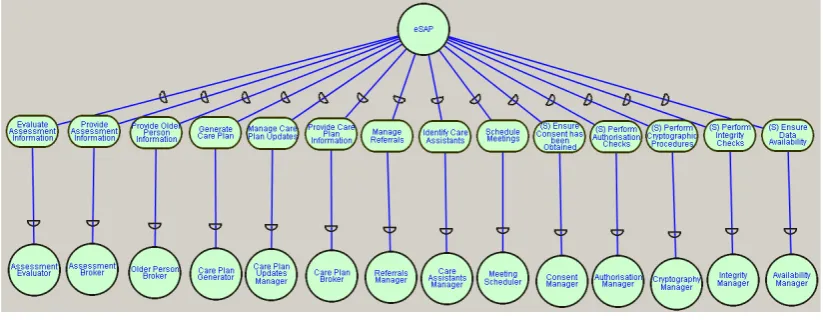
satisfy the system’s goals. In the presented example, the eSAP actor is decomposed, as
shown in Figure 7, to internal actors and the responsibility for the fulfilment of the
Figure 7: Partial Decomposition of the eSAP system
For instance, the Evaluate Assessment Information goal is delegated to the
Assessment Evaluator, whereas the Provide Assessment Information goal is
delegated to the Assessment Broker. In addition, the Older Person Broker and the
Consent Manager actors have been introduced to the eSAP system to fulfil the
responsibility (identified during the late requirements analysis – see Figure 5)of the
eSAP system to satisfy the secure dependency Obtain Older Person Information
together with the Share Information Only if Consent Obtained security constraint.
However, the new introduced actors must be furthered analysed and their
dependencies with the other (existing and new) actors must be furthered investigated.
Such an analysis is important since it helps developers to identify dependencies between
new and existing actors, introduce new actors to the system-to-be and, as a result of this,
refine the goals of the system or even possibly introduce new goals to the system, which
would be very hard to identify otherwise.
An important point at this stage of the development is the identification of the
actors to deliver the security goals of the system. This is important because, as opposed
to the identification of actors to deliver the functional goals of the system, the
developers). To help developers with this task, Secure Tropos employs a security
pattern language [17]. Security patterns can greatly help to identify the required actors
in a structured manner, which does not endanger the security of the system, by
providing a solution customised to the problem.
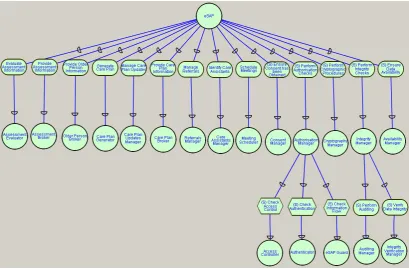
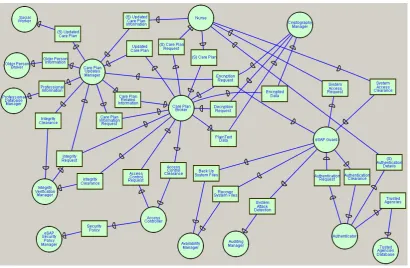
For example, from the internal analysis of the eSAP, presented in Figure 6, it was
concluded that Information Flow, Authentication and Access Control checks must be
performed in order for the eSAP system to satisfy the secure goal Ensure System
Privacy. In the case of the information flow secure task, the eSAP should be able to
control how information flows within the system, and between the system and other
actors. For example, the system should be able to control who requires access to the
system and, by considering the security policy, to grant or deny access to the system.
With respect to the Authentication checks, the system should be able to authenticate
any agents that send a request to access information of the system, and in the case of the
access control, the system should be able to control access to its resources.
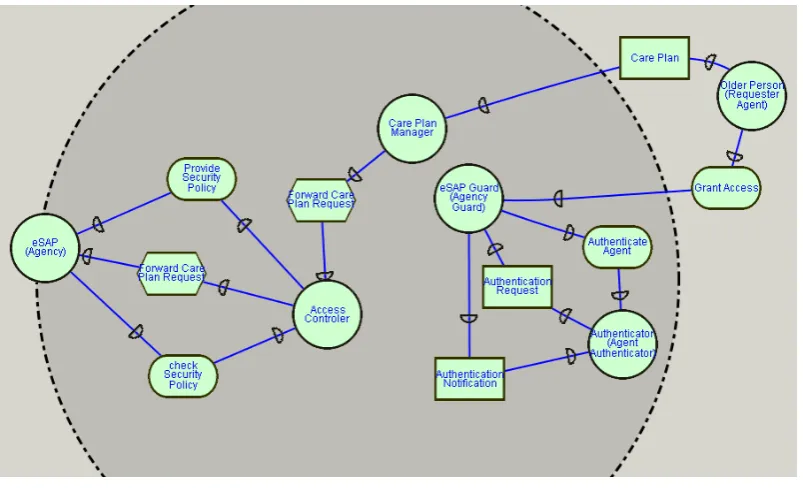
The pattern language7 proposed in [17] can be used to fulfil the above-mentioned secure goals of the eSAP system. Three main patterns are employed by the language:
The Agency Guard, which provides a single non-bypassable point of access, the Agent
Authenticator which provides authentication services to an agency, and the Access
Controller, which provides access to resources according to a security policy.
Therefore, in the case of the eSAP, the Agency Guard pattern can be used to check
grant/deny access to the system according to the security policy, the Agent
Authenticator pattern can be used to provide authentication checks and the Access
7 Although different patterns might be employed, the chosen language has been developed with agent