Munich Personal RePEc Archive
Are positive reactions to bad news
plausible? the consideration of fraud
detection in audit and reporting delays
Yim, Andrew
Cass Business School, City University London
10 September 2011
Online at
https://mpra.ub.uni-muenchen.de/33297/
Are Positive Reactions to Bad News Plausible?
The Consideration of Fraud Detection in Audit and Reporting Delays
Andrew Yim∗ September 10, 2011
Abstract
I formulate a model to emphasize the fraud detection role of auditors in the financial market and relate the role to audit and financial reporting delays. The model focuses on asset misappro-priation fraud, which is one of the two types of fraud US and international auditing standards require auditors to consider. In the model, an auditor considers whether to perform extended audit procedures after observing a red flag generated from regular audit procedures. An audit delay is represented by the event of extending audit procedures and manifested as a financial reporting delay observed by the market. I derive a simple closed-form condition characterizing when a positive market reaction to a delay is possible. The condition provides a theoretical basis for formulating empirically testable hypotheses. I discuss why the fundamental logic be-hind the counter-intuitive positive-reaction condition also applies to accounting fraud, as well as other contexts (e.g., internal control weakness disclosure). Documented evidence in the liter-ature suggests that “positive reactions to bad news” (PR2BN) is a general phenomenon. Other empirical implications of the model, with suggestions for regression equation specifications, are also discussed. (JEL M42/G32/K42)
Keywords: Audit delay, financial reporting lag, extended audit procedures, red flag, fraud detection, SAS 82, SAS 99.
∗Faculty of Finance, Cass Business School, City University London, 106 Bunhill Row, London EC1Y 8TZ, UK.
Acknowledgment
Contents
1 Introduction 1
2 Background 6
3 A Model of Extended Audit for Fraud Detection 7
4 Equilibrium of the Model 12
4.1 Diversion and Extended Audit Decisions . . . 12
4.2 Audit Fee . . . 13
4.3 Outside Ownership . . . 15
5 Delay Likelihood and Market Reaction 16 5.1 Effects on Delay Likelihood . . . 16
5.2 Market Reaction to Delay . . . 19
6 Discussion 21 6.1 Positive Reactions to Bad News: Plausible? . . . 21
6.2 Crisis as Opportunity Lying in the Middle of Danger . . . 23
6.3 Empirical Proxies for Ex Ante Probability of Fraud . . . 25
6.4 Other Related Studies . . . 26
7 Concluding Remarks 27
A Illustrative Example of an Empirical Test Design 1
1
Introduction
On June 4, 2009 came the news of the alleged fraud in Countrywide Financial, the largest mortgage loan provider in the US before the credit crunch hit (Morgenson 2009). The allegation to Coun-trywide reminds people of a long expected but unfulfilled role of auditors in the financial market: fraud detection (see e.g. Johnson 2010). In this paper, I formulate a model to emphasize this role and relate it to audit and financial reporting delays that have long been studied in the literature.1
The Statement on Auditing Standards No. 99 (SAS 99) requires auditors to consider fraud in conducting audits (Ramos 2003).2
Similarly, the International Auditing and Assurance Standards Board (IAASB) also has a standard on auditors’ responsibilities relating to fraud in audits, namely the International Standard on Auditing 240 (ISA 240). Both standards concern fraud as an inten-tional act resulting in a misstatement in financial statements and distinguish between two types of fraud: (i) fraudulent financial reporting (e.g., falsification of accounting records); (ii) misappropria-tion of assets (e.g., false expenditures and theft of cash) (SAS 99, paragraph 6; ISA 240, paragraph 3). The recent literature on fraud predominantly focuses on the first category with little attention given to the second.3
Compared to fraudulent financial reporting, asset misappropriation is by no means less impor-tant. According to a 2010 survey by the Association of Certified Fraud Examiners (ACFE), nearly 90% of the reported fraud cases in the US involve some form of asset misappropriation (Association of Certified Fraud Examiners 2010), whereas less than 5% of them involve financial statement fraud. The median dollar losses are substantially higher in the financial statement fraud cases than in asset misappropriation fraud. But this is not necessarily true outside the US (see e.g. KPMG 2010).4
In another recent survey with 3,037 respondents from 54 countries, two-thirds of those respon-dents who have experienced economic crime in the year before the survey suffered asset misappro-priation (PricewaterhouseCoopers 2009). Confining to US companies with accounting fraud, the
Fraudulent Financial Reporting: 1998-2007 study commissioned by the Committee of Sponsoring Organizations of the Treadway Commission (COSO) finds that 14% of the cases also involve mis-appropriation of assets (Beasley, Carcello, Hermanson, and Neal 2010, Table 9, page 17). Thus, auditors should not neglect fraud risk involving asset misappropriation in carrying out their duties. The model of this paper discusses diversion of firm resources, which is closer to asset
misappro-1
Prior models of fraud detection such as Matsumura and Tucker (1992) have not related the fraud detection role of auditors to audit and financial reporting delays.
2
“Auditors will enter a much expanded arena of procedures to detect fraud as they implement SAS no. 99. The new standard aims to have the auditor’s consideration of fraud seamlessly blended into the audit process and continually updated until the audit’s completion.” (Ramos 2003).
3
Recent studies on accounting fraud include Kedia and Rajgopal (2011), Feng, Ge, Luo, and Shevlin (2011), Dyck, Morse, and Zingales (2010), Kedia and Philippon (2009), Karpoff, Scott Lee, and Martin (2008), Karpoff, Lee, and Martin (2008), Graham, Li, and Qiu (2008), and Fich and Shivdasani (2007).
4
priation fraud as classified by US and international auditing standards.5
Consistent with SAS 99, the model has an auditor considering whether to perform extended audit procedures, depending on whether a red flag is observed after regular audit procedures. Plenty of examples suggest that financial reporting delays are often the consequence of extending audit procedures to investigate accounting irregularities.6
A financial reporting delay thus suggests to outside investors that a red flag was observed by the auditor and has triggered extended audit procedures.7
The difference between regular and extended audit procedures can be related to the context of the Bagnoli, Kross, and Watts (2002) study. They observe that firms voluntarily disclose in advance the expected earnings announcement dates, and the market reacts adversely to each day of delay. Presumably the extent of regular audit procedures is ascertained during the audit planning phase and should be communicated to a client at the beginning of the whole process. Hence, the extent of regular audit procedures is likely to be a factor affecting the client firm’s expectation on when it can make the earnings announcement. A delay occurs in the model when the auditor extends audit procedures in response to some red flag observed after performing regular audit procedures.8
Since the delay is triggered by some red flag, it changes the market’s expectation about the existence of fraud in the firm. Consequently, the market might react adversely to the delay.
The analysis of this paper formalizes the intuitions above. Most important, it yields a new result that is not easy to discover without rigorously analyzing a formal model. Specifically, I show that a
positivereaction to a delay is possible when it is perceived by market investors as “on the whole good news” under certain circumstances.9
Such circumstances are fully characterized in closed form by a
5
Despite the distinction between fraudulent financial reporting and asset misappropriation, their impacts on a firm can be similar. For example, an executive might prepare fraudulent financial reporting to exaggerate firm performance and thereby obtain a larger bonus, or avoid being fired. In either case, firm resources are lost as a result of the over-compensation to the executive not as competent as believed. More important, the misstated performance might prevent the firm from reacting timely and properly to the business conditions, which may lead to severe losses. On the other hand, fraudsters misappropriating a firm’s assets obviously would not let the company accountant know and state the correct firm value on financial reports. So similar misstatements in financial reporting and losses to a firm occur, regardless of the two types of fraud.
6
For instance, “Sensormatic Electronics Corp.’s accounting firm has expanded the scope of its annual audit, forcing the company to delay its annual earnings report and raising the possibility of downward revisions to past earnings” (Wall Street Journal, 1995). Another example is Royal Ahold, a Dutch retail group with subsidiaries such as Stop & Shop in the US and Albert Heijn in the Netherlands. “The audit of Ahold’s consolidated 2002 has been extended because of a number of new internal investigations at US Foodservice (the unit at the heart of the financial scandal) .... Deloitte & Touche, which is carrying out the audit, said that, while important progress had been made in these investigations, various delays in their completion had placed the resumption of important parts of the total audit some four to six weeks behind schedule. ... Based on the information received to date, intentional accounting irregularities involving earnings management and misapplications of generally accepted accounting principles were found ...” (Decision News Media SAS, 2003).
7
In a conversation with a recently retired Big4 audit firm partner, he confirmed that red flags observed during audits can trigger additional audit work and result in financial reporting delays of clients. He explained that clients constantly give pressure to urge completing the audits as soon as possible but additional audit work, if deemed necessary, is important to auditors’ risk management.
8
Consistent with this feature of the model, Kinney Jr. and McDaniel (1993) wrote that “[p]resence of [client factors such as poor internal controls or intentional violation of the securities acts by client management] is expected to lead to increased year-end audit work and audit/client negotiations about the best disclosure action.” Ettredge, Li, and Sun (2006) also report that audit delays are positively associated with the likelihood of the clients receiving modified audit opinions and their restating financial reports.
9
market-positive-reaction condition. The condition is simple enough for one to see through the underlying economic determinants.
In the model, the auditor takes up the audit engagement of a client firm managed by an en-trepreneur referred to as an “insider.” The insider needs capital to invest in a project. He is interested in raising external capital. Outside investors and the auditor are aware of the possibility that the insider can secretly divert some resources from the firm for his private benefit. The outside investors and auditor therefore behave strategically to guard against the potential (but not imme-diately noticeable) misappropriation, say, by accepting only properly priced equity offering terms and by extending audit procedures adequately.
An audit delay in the model is represented by the event of extending audit procedures. Such a delay might not be immediately observable to outside investors in reality. According to Givoly and Palmon (1982), “[t]he single most important determinant of the timeliness of the earnings announcement is the length of the audit.”10
I therefore assume an audit delay is manifested as a financial reporting delay, although the latter is not explicitly modeled here.
The first main result of the paper concerns the equilibrium likelihood of an audit and financial reporting delay. I find that the delay likelihood decreases when the reliability of regular and extended audit procedures increases and/or when the prior probability of having a dishonest insider reduces. Intuitively speaking, the more reliable audit procedures are, the lower the chance of observing a false-positive red flag and the higher the chance of catching a dishonest insider. He is thus less aggressive in choosing the extent of diversion. Consequently, the auditor has less incentive to perform extended audit procedures frequently. As a result, a delay occurs less often. If the prior probability of having a dishonest insider is lower, it triggers a red flag less often. A delay is thus less often seen.
In this model, outside investors worry about an insider secretly diverting firm resources for his private benefit. The diverted resources is recoverable if and only if the fraud is discovered timely by the auditor.11 When outside investors see a financial reporting delay, which in this model is due to an audit delay, they know two things have happened. First, the auditor must have observed some
red flag of potential fraud; otherwise, extended audit procedures would not have been triggered. So outside investors should revise the expected firm value downward. However, an audit delay also means the auditor is doingextra work, increasing the chance of discovering a fraud and recovering any diverted resources. For this reason, outside investors should revise the expected firm valueupward. Whether the overall market reaction is negative or positive depends on the relative magnitudes of
adjusted returns (CARs) of the entire group of late-announcer firms are negative. However, they also document that the third quartile of CARs is positive and growing as the delay lengthens, suggesting that a delay is not merely bad news.
10
Since 2004 the relation between earnings announcement lag and audit report lag has changed somewhat owing to unintended consequences of Public Company Accounting Oversight Board (PCAOB) Auditing Standards No. 2 on internal control and No. 3 on documentation. See Bronson, Hogan, Johnson, and Ramesh (2011) and Krishnan and Yang (2009) for details.
11
these opposing effects.
The key result of the paper is the positive-reaction condition indicating when a positive market reaction to a delay is possible. Specifically, the percentage deviation of the after-delay market value of the firm from its before-delay value is positive if and only if the delay is “on the whole good news,” i.e.,
(1−θ) (1−p) + (1−q)
1 +λ∗
b
<1. (1)
If the red flag generated from regular audit procedures is not so informative (captured by a high probabilityp of a false-positive red flag), a delay may simply be a false alarm, and there is little to worry about by outside investors. When the prior probabilityθof having a dishonest insider is high, a delay resulting from a red flag observed by the auditor can be good. The delay is particularly good when extended audit procedures are very effective in detecting fraud (captured by a high probability
q of discovering evidence of fraud if it exists), leaving little chance for a fraud to sneak through. Because the equilibrium outside ownershipλ∗ cannot exceed 100% and the penalty multiplierb for
a fraudster caught is non-zero, a delay can be on the whole good news to outside investors when the ex ante probability of fraud, the imprecision of a red flag, and the effectiveness of detecting fraud are all high, i.e.,θ,p, and q are close to 1.
The positive-reaction condition can provide a basis for developing hypotheses for empirical testing. Two examples are given below. Further details on how the model can guide empirical test designs are discussed in appendix A.
Hypothesis 1. A positive market reaction to a delay is more likely for a firm with weaker corporate governance and internal control (i.e., higherθ).
Hypothesis 2. Negative market reactions to delays are weaker for firms with weaker corporate governance and internal control (i.e., higherθ).12
The most significant contribution of the paper is identifying the puzzling phenomenon of pos-itive reactions to bad news (PR2BN) and explaining the insight behind the phenomenon. The phenomenon is not specific to the audit and reporting delay context. It also exists in other inter-esting contexts such as internal control weakness disclosure (see details in section 6).
My model is built upon the Newman, Patterson, and Smith (2005) (hereafter NPS) model, which is useful for understanding related investor protection issues. Illustrating the PR2BN puzzle through a mild modification to their model is no less challenging than by crafting a completely new model. The benefit from such a constrained challenge is the understanding of different issues using a unified framework. The mild modification substantially limits the flexibility in crafting the model solely for providing an ex post rationalization to a phenomenon. This study provides an example of how working with a formal model can help in discovering new insights. I was not aware
12
of the PR2BN phenomenon when I formulated the model inspired by SAS 99. It was only after the positive-reaction result had been derived did I notice that there is consistent empirical evidence in the literature.
The phenomenon of PR2BN is counter-intuitive. It can easily go unnoticed when researchers’ attention is on the negative average reaction. Even when PR2BN are noticed, some researchers might not report such distracting findings not central to the main issues of their studies. For reasons like these, it is not easy to find documented examples of the phenomenon. The clearest and most robust example that I am aware of is the positive abnormal returns to internal control weakness disclosure reported in Panel B of Table 4 in Beneish, Billings, and Hodder (2008). Although the average reaction is negative, positive abnormal returns consistently constitute over 32% of the uncontaminated sample (i.e., with no other news in the 3-day event window), regardless of the choice of the control sample for measuring normal returns.
The second contribution of the paper is arousing the interest of empirical researchers to study the underlying reasons behind the PR2BN phenomenon in different contexts. As explained, in-stances of the phenomenon are rarely documented in published research. By providing a theoretical explanation to the phenomenon in a particular context and suggesting empirical tests based on the model, this paper serves the purpose of stimulating empirical research to discover and analyze more instances of the phenomenon and thereby deepen the understanding.
The third contribution of the paper is the empiricist-oriented theoretical modeling style intro-duced in this study. To facilitate follow-up empirical research, I derive theoretical results in closed form, giving clearer guidance on empirical research designs. More specific functional forms and ex-ogenous parameters are used in the model to capture the fundamental first-order effects of relevant economic forces. I provide a detailed discussion of the empirical implications of the model, includ-ing suggestions for regression equation specifications. In doinclud-ing so, I open a dialog with empirical researchers and stimulate closer interaction between empirical and analytical researchers.
The fourth contribution is the formulation of a theoretical framework for examining the like-lihood of and market reaction to an audit and financial reporting delay. Empirical studies have examined such issues extensively.13
However, rarely have the studies developed hypotheses for test-ing ustest-ing any formal theoretical model. Prior analytical models on financial reporttest-ing timeliness follow the voluntary disclosure literature, assuming a financial reporting delay is a voluntary, strate-gic decision (e.g., Gennotte and Trueman 1996). These models are completely different from mine that emphasizes the fraud detection role of auditors in the financial market and the involuntariness of a financial reporting delay arising from an audit delay.
The rest of the paper is organized as follows. The next section briefly reviews the background
13
of SAS 99 that has inspired the model of this paper. The model setup is described in section 3, with different parties’ equilibrium decisions analyzed in section 4. Empirical-oriented readers can skip section 4 and jump directly to section 5, where I discuss the model’s empirical implications. Such readers can go back to the preceding section for a glance of the analysis when doing so is necessary to understand the empirical implications. Section 6 explains the generality of the PR2BN phenomenon beyond the particular context of the model and the nature of the “bad news” in the phenomenon. In addition, the section discusses empirical proxies for a key parameter of the model, namely the ex ante probability of fraud, and relates the paper to several other studies. Concluding remarks are provided in section 7. An illustrative example of an empirical test design is given in appendix A. Technical proof and derivation are relegated to appendix B.
2
Background
The debate on the fraud detection role of auditors in the financial market has a long history. It was initially framed by the accounting profession as an expectation gap issue. Advocates argued that the assumed integrity of the management is a necessary starting point for an audit engagement. This debate cooled down slightly in the 90’s. It has gained attention again following the collapse of Arthur Andersen, one of the biggest five accounting firms in the world. Its collapse was closely tied to the accounting scandals of a number of companies, including the telecommunication giant WorldCom and especially the energy giant Enron.
The American Institute of Certified Public Accountants (AICPA) first officially emphasized the fraud detection role of auditors in the release of SAS 82 in 1997. This statement superseded SAS 53The Auditor’s Responsibility to Detect and Report Errors and Irregularities released in 1988. EntitledConsideration of Fraud in a Financial Statement Audit, SAS 82 is the first SAS mentioning fraud in the title. The then Securities and Exchange Commission (SEC) Chief Accountant Michael H. Sutton praised SAS 82 for “referring to fraud by name, for the first time, instead of by the more euphemistic term ‘irregularities’ and for describing over 40 fraud risk factors that auditors must consider in planning and performing an audit.” (Journal of Accountancy, Feb. 1997)
In short, this standard requires an auditor to consider whether misstatements identified by audit test results may be indicative of fraud and if so, the auditor should attempt to obtain additional audit evidence to clarify the situation. Considering red flags from audit test results and obtaining additional audit evidence are decisions auditors should think about carefully in assessing fraud risks. They are also two important elements of the model formulated in the next section to understand the fraud detection role of auditors in the financial market.
3
A Model of Extended Audit for Fraud Detection
The model formulated here has a setup similar to the NPS modification of the Shleifer and Wolfenzon (2002) model. I depart from the NPS model mainly in the strategic consideration of extending audit procedures contingent on the red flag observed, if any.14
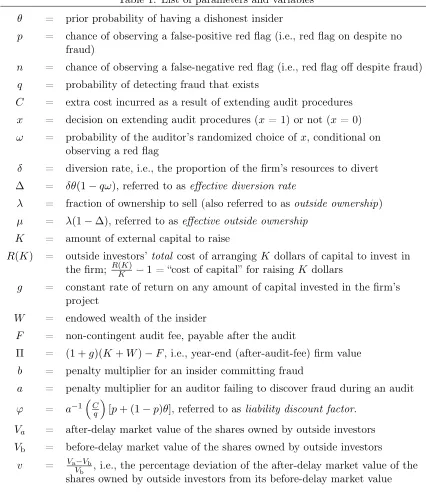
In the following, I first outline the basic setup, followed by a description of the sequence of events in the model. Table 1 summarizes the notations used.
The model has an auditor with a client firm managed by an entrepreneur, or “insider” in NPS’s terminology. The insider initially owns all the shares of the firm, whose only asset comes from the insider’s endowed wealthW >0.15
The firm needs an exact amount of external capital, denoted by
K >0, to add toW to invest in a project with a known rate of returng >0.16
Outside investors and the auditor are aware of the possibility that the insider can secretly divert some resources from the firm for his private benefit. As a result, the firm value suggested by the firm’s financial statements actually overstates the underlying true value. The outside investors and auditor therefore behave strategically to guard against the potential (but not immediately noticeable) misappropriation, say, by accepting only a properly priced equity offering term and by extending audit procedures adequately. All parties in the model are risk neutral.
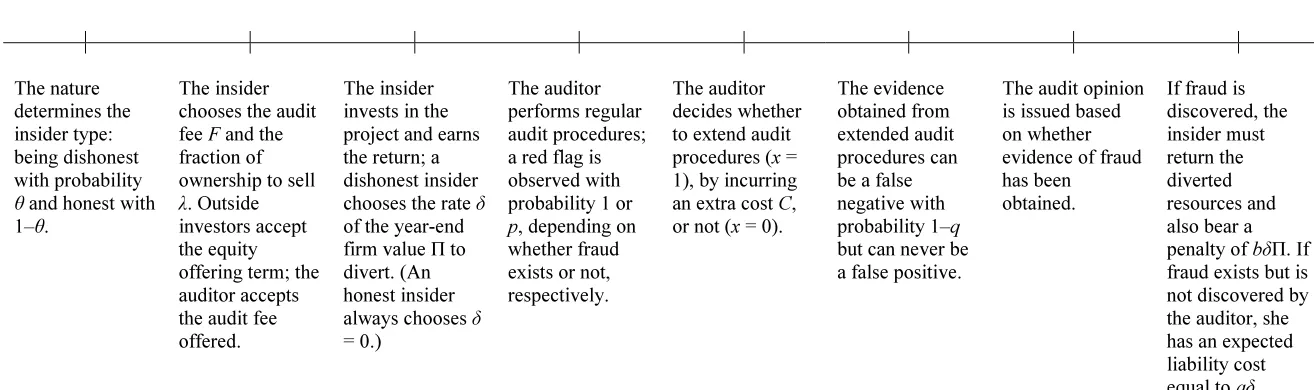
Below is the sequence of events in the model, which is summarized with the timeline in Figure 1. The model structure and parameters are common knowledge to the insider, outside investors, and auditor.
14
Patterson and Smith (2007) have analyzed a model with a “two-round” audit similar to the one examined here. They study the effects of SOX on an auditor’s choice of effort in performing control tests (the “first-round” audit) before doing substantive tests (the “second-round” audit). The auditor in their model always performs both rounds of audit. Therefore, their setup is more like a refined modeling of the regular audit procedures of my model, which are performed unconditionally. By contrast, the auditor in my model may or may not perform extended audit procedures, depending on the outcome of regular audit procedures.
Patterson and Smith’s model, however, is more general in the sense that they allow audit choices in both rounds, which lets them address the issues in their paper. Smith, Tiras, and Vichitlekarn (2000) analyze the interaction between internal control assessments and substantive testing using a similar model also with audit choices in both rounds. In contrast, I simplify the “two-round” audit setup by allowing an audit choice only in the second round. This facilitates deriving closed-form results that are useful for guiding empirical hypotheses for testing.
15
The intuitions of the model apply to initial public offering (IPO) as well as secondary equity offering (SEO) situations. The assumption of the insider initially owning all the shares is for convenience only. At the expense of more complicated expressions with an additional parameter for the initial ownership level, similar results hold with the assumption relaxed.
16
1. The nature determines the type of the insider: honest or dishonest. The prior probability of having a dishonest insider is θ, where 0 < θ <1. An honest insider never diverts the firm’s resources, whereas a dishonest one will make the diversion decision strategically.17
2. The insider simultaneously chooses a non-contingent audit fee,F, and a fraction of ownership to sell,λ. For simplicity, only pure strategies in choosingF andλthat constitute the pooling equilibrium is considered here.18
The choice of F and λis constrained by competitive audit and financial market conditions. A competitive audit market requires that the audit fee F
leaves an auditor zero expected profit. Moreover, a competitive financial market requires that outside investors’ total cost of investment is equal to the value of the investment.19
Further details of this condition will be provided shortly.
3. The insider offers the audit feeF, payable after the audit, to an auditor to secure her services for a year-end audit.20
The insider also offers the equity offering termλto outside investors. Given competitive audit and financial market conditions and anticipating the insider’s equilib-rium choices, the auditor accepts the audit engagement at the fee offered, and outside investors accept the equity offering term.
4. The insider invests K+W in the project, earns the return, and then chooses the diversion rateδ, i.e., the proportion of the year-end (after-audit-fee) firm valueΠ=(1 +g)(K+W)−F
to divert.
5. At the end of the year, the auditor follows standard practice to perform regular audit proce-dures. For simplicity, the cost of these procedures is normalized to zero. The procedures may result in a red flag for potential fraud. The chance of afalse positive, or a Type I error, (i.e., 17
It is not new in the economics literature to make the parsimonious assumption of two exogenous types of players with one being “irrational.” An example is the widely cited paper by Kreps, Milgrom, Roberts, and Wilson (1982). Another example is Erard and Feinstein (1994), of which the authors assume that there is an exogenous fraction of inherently honest taxpayers. This assumption is made to cope with some perplexing empirical facts often described as the “Why people pay tax” puzzle in the tax compliance literature.
Accounting studies have also recognized that some people do behave honestly when they should behave strategically given the monetary incentives. A widely cited example is Evans, Hannan, Krishnan, and Moser (2001). Mounting evidence of similar “irrational” behaviors have been documented in the experimental economics literature, with the ultimatum game being an often cited example (see Camerer and Thaler 1995).
18
I focus on the pooling equilibrium because this is the only interesting case. Although a separating equilibrium might exist in a more general setup, it cannot exist in the one considered here. If an honest insider had a way (e.g., by choosing a high reputation auditor) to separate himself from a dishonest insider, the auditor and outside investors would not require “premiums” in the audit fee and equity offering terms to price-protect themselves, and the auditor would never extend audit procedures. Given competitive financial and audit markets, these terms obtained by a honest insider must be more favorable than what can be obtained by a dishonest insider in such a hypothetical separating “equilibrium.” Consequently, a dishonest insider is always better off by mimicking whatever a honest insider does to pool with him. This invalidates the supposition that a separating equilibrium exists in the current setup.
19
Here the “competitive financial market” condition means outside investors are under perfect competition to provide capital to the firm. It does not mean outsides investors themselves face a capital supply curve that is perfectly elastic.
20
red flag on despite no fraud) is p=Pr{red flag | no fraud}>0.21
For simplicity, the chance of a false negative, or a Type II error, (i.e., red flag off despite fraud) is assumed to be zero, i.e., n = Pr{no red flag | fraud} = 0. I require that the red flag is an informative signal of potential fraud so that false positives are less likely than true positives, i.e.,p <1.22
6. Conditional on whether a red flag is observed, the auditor makes the decision xon extending audit procedures (x = 1) or not (x = 0). She incurs an extra cost C in extending audit procedures.
7. The auditor cannot give a qualified opinion unless audit evidence supports the opinion. More definite, though not completely conclusive, evidence is available only when extended audit procedures are performed. So the auditor can only issue an unqualified opinion if extended audit procedures have not been performed.
8. With probability q > 0, the evidence obtained from extended audit procedures is a true positive (i.e., proving the existence of fraud). While the evidence can also be a false negative (i.e., suggesting no fraud despite fraud) with probability1−q, it can never be a false positive (i.e., showing fraud despite no fraud).23
9. The audit opinion is issued based on whether evidence of fraud has been obtained.24
10. If fraud is discovered, the insider must return the diverted resources and also bear a penalty equivalent to a monetary fine proportional to the amount of resources diverted, i.e.,bδΠ, where
b >0. The parameter bindicates the severity of the penalty to an insider committing fraud, as in NPS’s model. If fraud exists but is not discovered by the auditor, it will nonetheless have a non-zero chance to be discovered in the future, resulting in some liability cost to the auditor. The present value of the expected liability cost is assumed to be proportional to the
21
The assumption of a non-zero probability of a false positive is consistent with the observation that “while symp-toms of fraud (“red flags”) are observed frequently, the presence of such issues is not necessarily indicative of fraud” (see Hogan, Rezaee, Riley, and Velury 2008).
22
The results of the paper are essentially unchanged under the more general assumption ofn≥0with the false-to-true-positive likelihoodratio p
1−n <1. This likelihood ratio requirement is equivalent to the monotone likelihood ratio
property (MLRP) often assumed in moral-hazard agency models. To see this, first note that the relation between the existence of fraud and the observation of a red flag is analogous to that between a binary action and a binary outcome in a moral-hazard setting. Thus, the following is equivalent to the MLRP:
Pr{red flag | fraud}
Pr{red flag | no fraud}>
Pr{no red flag | fraud}
Pr{no red flag | no fraud},
which can be written as 1−pn <1.
23
NPS assume the auditor does only a one-round audit with the fraud detection probabilityq depending on the amount of resources invested in the audit. In contrast, the auditor here always performs regular audit procedures, with the possibility of also performing extended audit procedures. To focus on this unique aspect of the model, I simplify other aspects with assumptions like an exogenous q. Closed-form results can also be obtained without affecting the fundamental structure of the equilibrium if alternativelyq is proportional to the diversion rateδ.
24
diversion rate, i.e., aδ, where a >0. The parameterais referred to as the penalty multiplier for the auditor, as in NPS’s model.25
When the auditor decides whether to take the offer F for the audit engagement and subsequently determines whether to extend audit procedures (x = 1) or not (x = 0), she knows the insider’s choice ofλ, which is set to ensure outside investors are not worse off by investing in the firm. The auditor does not observe the privately chosen diversion rate δ but will make decisions based on an equilibrium conjecture about it. The insider chooses δ after securing the auditor but before she comes in to do the year-end audit. When he makes the diversion decision, he knows everything except for whether the auditor will observe a red flag and her decision on x that follows. Such information about the red flag and extended audit are not known to outside investors either when making the investment decision in response to the insider’s equity offering term. Nor do they observe
F andδ.26
They nonetheless make the decision based on equilibrium conjectures about choices not known to them at that time. Anticipating equilibrium behaviors of other parties and himself, the insider chooses F andλat the very beginning.
To detail the competitive financial market condition, let R(K)≡(1 +r)K, withr > 0, denote outside investors’ total cost of arranging the capital to invest in the firm. For example, if the K
dollars are arranged by borrowing from banks, the total cost of arranging the capital would be the principal plus the interest, andr = R(KK) −1 would be the borrowing interest rate. A competitive financial market requires that the equity offering termλleaves outside investors indifferent between investing or not investing in the firm. That is to say, the total cost of investment, R(K), equals the value of the investment, i.e., the fractionλof the expected year-end (after-audit-fee) firm value.
To ensure that the insider’s equilibrium choice of λ exists and is an interior solution (and therefore the comparative statics analysis to be carried out later is valid), I assume that the insider hassufficient wealth such that the following inequality holds:27
R(K)< µ1[(1 +g)(K+W)−aϕ], (2)
where
µ1 = 1 +b(1−ϕ)
1 +b (3)
and
25
Like NPS, I make the simplifying assumption that the insider’s and auditor’s expected penalties are deadweight losses unrelated to outside investors’ payoff.
26
The assumption that outside investors cannot observe the audit fee at the moment of making the investment decision is consistent with the US regulatory requirement of disclosing the audit feeafter the year end. Whether the audit fee is observable actually is inessential here because in equilibrium all players can correctly anticipate the audit fee as though it was observable.
27
Fully expanding (2) by substituting into it theµ1, ϕ, andR(K)gives an inequality in terms of g,r,a, b, and
other parameters. The inequality can hold even forW = 0if alternatively I assume that the penalty multipliersaand
ϕ=a−1
C q
[p+ (1−p)θ]. (4)
The constant µ1 is the upper bound of a variable µ, referred to as the effective outside ownership, to be defined shortly. It will be clear thatµ andλmap to each other uniquely.
It will also be clear that the aϕ on the right hand side of (2) is equal to the equilibrium audit fee determined in the model. Therefore,
Π(ϕ) = (1 +g)(K+W)−aϕ (5)
is the equilibrium year-end (after-audit-fee) firm value before any diversion. The constant ϕ sum-marizes the effects of several parameters of the model and is larger when (i) the penalty multiplier
a that constitutes the auditor’s expected liability cost is smaller; (ii) the “unit” audit cost C/q
of the extended audit procedures is larger; (iii) the false-positive probability p that captures the imprecision of the red flag as an early warning is higher; (iv) the prior probability, θ, of having a dishonest insider is higher. I will come back to the intuitive interpretation of the constantϕ later. For the model to be interesting, the audit procedures have to be sufficiently reliable. Specifi-cally, this means q > 1+1b, which requires that the probability q of detecting a fraud that exists is sufficiently high. The probability has to be high enough such that given the severity of the penalty to a fraudster, represented byb, the insider would rather not divert any resources if anticipatingx= 1 with certainty. Otherwise, it would be in the auditor’s interest to always extend audit procedures without conditioning on the observation of a red flag. The model would become indistinguishable from the setting already studied by Patterson and Smith (2007).
It will be clear shortly that [1 +p(1θ −1)]−1 is the posterior probability of the existence of a
fraud after observing a red flag. Given that a fraud exists, the probability of detecting it is q. Note that a is essentially the auditor’s expected liability cost of not detecting a fraud with a diversion rate ofδ = 1. Therefore, the condition
C < aq
1 +p(1θ −1), (6)
referred to asaffordable audit cost, ensures that after observing a red flag, extending audit procedures reduces the expected liability cost related to a “full-diversion” fraud by an amount that exceeds the extra cost of audit. This condition is sufficient to deter “full diversion,” preventing the uninteresting corner case ofδ = 1 to constitute an equilibrium. Throughout my analysis, I assume the condition holds.
by a dishonest insider. Therefore, I only need to analyze the decisions from the angle of a dishonest insider.
4
Equilibrium of the Model
4.1 Diversion and Extended Audit Decisions
After observing a red flag, the auditor weighs the incremental benefit against the incremental cost to decide whether it is gainful to extend audit procedures. Given any conjecture δ on a dishonest insider’s diversion decision, the incremental benefit of extending audit procedures is a reduction in expected liability cost equal toaδqPr{fraud|red flag}. In equilibrium, this benefit must be equal to the incremental cost C.
The equilibrium diversion rate chosen by a dishonest insider is given by the condition below:
δ∗= C
aqPr{fraud|red flag}. (7)
Since an honest insider never diverts any resources, the prior probability of fraud is simply the prior probability of having a dishonest insider. By the Bayes’ rule,
Pr{fraud|red flag}= 1
1 +p(1θ −1). (8)
Hence,
δ∗= C/q
a1 +p(1θ −1)−1. (9)
This expression of the equilibrium diversion rate shows clearly its determinants. They are (i) the “unit” audit cost C/qof the extended audit procedures; (ii) the penalty multiplier afor the auditor when a fraud was not detected; (iii) the reliability of the red flag as an indicator of fraud, captured by the posterior probability of having a dishonest insider, i.e.,1 +p(1θ −1)−1.
Given the equilibrium conjecture δ∗, the auditor is indifferent between choosing x = 1 or x =
0. Letω denote her randomized strategy of extending audit procedures after observing a red flag, i.e., ω = Pr{x = 1|red flag}.28
The auditor will not extend audit procedures unless a red flag is observed. Thus, the only way to detect a fraud that exists is to follow through the sequence of observing a red flag, extending audit procedures, and finding evidence of fraud. In other words, a dishonest insider knows that the chance of being caught is qω.
If a dishonest insider successfully diverts a fraction of the firm’s resources without being detected, his payoff is the sum of (i) diverted resources that he can enjoy personally,δΠ, and (ii) his share of the firm value after the diversion, (1−λ)(1−δ)Π. However, if the diversion is detected by the auditor,
28
he must return the diverted resources and bear the penalty. His payoff becomes (1−λ)Π−bδΠ. Given any conjectureω, the expected payoff of a dishonest insider selecting a diversion rateδ is as follows:29
[δΠ + (1−λ)(1−δ)Π](1−qω) + [(1−λ)Π−bδΠ]qω. (10)
In order for δ∗ given by (9) to constitute an equilibrium, the diversion rate must satisfy the
first-order condition below:
λ(1−qω) =bqω. (11)
This condition uniquely determines the auditor’s equilibrium randomized strategy of extending audit procedures, characterized by
ω∗ = λ
(λ+b)q. (12)
In the following subsections, I continue the analysis by determining the equilibrium audit fee and fraction of ownership to sell.
4.2 Audit Fee
The auditor’s expected profit prior to performing regular audit procedures is
F− {Cω[θ+ (1−θ)p] +aδθ(1−qω)}. (13)
The first term inside the curvy brackets is the expected cost of extending audit procedures. The cost is incurred only when a red flag is observed, which happens with probability θ+ (1−θ)p, followed by the outcomex= 1, which occurs with probability ω. The second term inside the curvy brackets is the expected liability cost. The auditor will bear the liability cost aδ if a fraud exists but is undetected during the audit. This has a chance of θ(1−qω) to occur.
Given a competitive audit market and anticipating the insider’s and auditor’s equilibrium choices, the equilibrium audit fee F∗ will be set such that the auditor in equilibrium earns zero
expected profit. In other words, the fee is determined by substituting the equilibrium ω∗ and δ∗
into (13) and then setting it to zero to solve for the equilibriumF∗. This is the audit fee offered by
the insider and accepted by the auditor in equilibrium:
F∗=aδ∗θ, (14)
whereδ∗ is given by (9).
The equilibrium audit fee does not depend on ω∗ because in equilibrium δ∗ is chosen to make
the auditor indifferent between extending audit procedures or not. Since the cost of performing
29
regular audit procedures has been normalized to zero, the audit fee only needs to be high enough to cover the auditor’s expected liability cost, as though she had never considered extending the audit procedures.
Substitute δ∗ into (14), the equilibrium audit fee becomes
F∗ =
C q
[p+ (1−p)θ]. (15)
The false-positive probabilitypmeasures the imprecision of the red flag as an early warning. Ideally one would like regular audit procedures to have a low p so that false positives occur rarely. In other words, the red flag is more informative when p is smaller. Consequently, the decision on extending audit procedures can be made more efficiently. The equilibrium audit fee can thus be lower. Similarly, F∗ is lower when the extended audit procedures are more effective in detecting
fraud, i.e., q is higher. In a society with a higher moral standard, people are more likely to be honest, i.e., θis lower, which results in a lower equilibrium audit fee.
It is useful to recognize that F∗=aϕ andϕ=δ∗θ, where the constantϕis defined in (4). Note
that ϕ=F∗/ais between 0 and 1. This ratio may be referred to as a liability discount factor. To
see why, consider the limiting case where both θand δ∗ are nearly 1. The auditor in equilibrium is
indifferent between performing and not performing extended audit procedures. She anticipates that her expected payoff would be equivalent to that without extending the audit procedures. Since θ
andδ∗are nearly 1, it is almost certain that she would need to bear the “full diversion” liability cost,
i.e., a. Therefore, she would not accept the audit engagement unless the audit fee F∗ is as much as a. In general, the audit fee is set according to the anticipated fraction of the “full diversion” liability cost to be paid by the auditor. This fraction is lower if the expected liability cost, determined byθ
and δ∗, is lower.
A priori, one might expect that through ω∗ = λ
(λ+b)q, the audit fee F∗ should be affected by
the ownership sold to outside investors, λ. This endogenous variable may be seen as a measure of the misalignment of interest between the insider and other shareholders. If λ = 0, the insider is the only shareholder of the firm and has no incentive to divert resources. The diversion incentive is strongest when λ = 1. In this model, the strategic interaction between the auditor and her client can result in an equilibrium audit fee independent of λ. When λ is lower, one might think that the fraud risk should be lower and hence the auditor would not extend audit procedures so often. Extra costs would be incurred less frequently, resulting in a lower audit fee. This however is not the complete story. When the auditor worries less because of a lowerλ, she has a weaker incentive to extend audit procedures. Therefore, a dishonest insider worries less about being caught and has a stronger “induced” incentive to divert resources. In the end, the two effects balance out and have no net impact on the equilibrium audit fee.30
30
The discussion here cautions against regression analysis that uses an endogenous variable likeλto explain another endogenous variable likeF. Ideally, equations specified for regression analysis should have only exogenous variables as explanatory variables and endogenous variables as dependent variables.
I summarize the observations about the equilibrium audit fee as the following proposition.
Proposition 1 (Effects on equilibrium audit fee). The equilibrium audit fee F∗ decreases when
(i) the reliability of regular and/or extended audit procedures improves, i.e., p is lower and/or q is higher, or (ii) the chance of having a dishonest insider reduces, i.e.,θ is lower. Formally,
∂F∗ ∂p >0,
∂F∗
∂q <0, and
∂F∗ ∂θ >0.
4.3 Outside Ownership
Given any conjectures about ω, δ, and F, outside investors’ expected benefit from accepting the insider’s equity offering term is
λ(1−δ)Πθ(1−qω) +λΠ[1−θ(1−qω)], (16)
where Π = (1 +g)(K +W)−F is the year-end (after-audit-fee) firm value.31
The probability
θ(1−qω) in the first term above is the chance of both having a fraud (i.e., dishonest insider) and not having it detected during the audit. If this event occurs, the value of the shares owned by outside investors is only λ(1−δ)Π. If the insider is honest, or if the fraud of a dishonest insider is detected during the audit, outside investors have a claim on the undiverted firm, which is the λΠ
in the second term above.
A competitive financial market implies that in equilibrium λwill be chosen to equate the ex-pected benefit in (16) with outsider investors’ total cost of arranging the capital, i.e. R(K). This condition is expressed as the equation below:
R(K) =µ[(1 +g)(K+W)−F], (17)
where
µ=λ(1−∆) (18)
with∆ =δθ(1−qω)referred to as theeffectivediversion rate. This rate∆differs from the diversion rate δ because there is a chance that the insider is honest. Even if he is dishonest, diversion may be detected during the audit and therefore unsuccessful. Given the effective diversion rate ∆, it is intuitive to refer toµas theeffective ownership sold to outside investors (or simply effective outside ownership). From (20) provided below, it will be clear that 0< µ < λ for all λ >0 and µ= 0 for
λ= 0. Whenλ= 1,µ equalsµ1= 1+b1+(1−bϕ).
By choosing the effective outside ownership,µ, a dishonest insider indirectly chooses the fraction
capture some important forces affecting the two variables); (ii) the relationship is spurious; (iii) the causality runs fromF toλ. I will in section 5.1 show that the last possibility is consistent with the model.
31
of ownership to sell,λ. To see how the equilibrium λ∗ is determined, consider the equations below,
which are (17) and (18) evaluated at the equilibriumF∗ ,δ∗, and ω∗:
R(K) =µΠ(ϕ), (19)
µ=λ
1− bϕ (λ+b)
, (20)
where Π(ϕ) = (1 + g)(K +W) −aϕ and ϕ = a−1C
q
[p+ (1−p)θ]. The second equation is equivalent to the quadratic equation of λbelow:
λ2+b(1−ϕ)λ=µ(λ+b), (21)
which has only one root between 0 and 1 for any given µ between 0 and 1. This solution of the equation, denoted by λ(µ), defines a one-to-one mapping between µ and λ. Obviously, the equilibrium µ∗ is uniquely determined by (19). Accordingly, the equilibrium λ∗ = λ(µ∗) is also
uniquely determined.
The following comparative statics result is useful for signing the association between outside ownership and audit fee to be discussed later.
Lemma 2. The equilibrium outside ownership λ∗ and effective outside ownership µ∗ are related to
the liability discount factor ϕ as follows:
dλ∗ dϕ
=
dµ∗ dϕ
+ bλ∗
(λ∗+b) 1− b2ϕ
(λ∗+b)2
−1
>0, (22)
dµ∗ dϕ
= aR(K)
Π(ϕ)2 >0, (23)
where Π(ϕ) = (1 +g)(K+W)−aϕ and ϕ=a−1
C q
[p+ (1−p)θ].
In the next section, I examine some implications of the model, namely how the reliability of regular and extended audit procedures and the ex ante probability of fraud may affect the likelihood of and market reaction to an audit and financial reporting delay.
5
Delay Likelihood and Market Reaction
5.1 Effects on Delay Likelihood
Consider first the likelihood of an audit delay, manifested as a financial reporting delay. The delay occurs if and only if the event {x= 1} happens, i.e., the auditor has chosen to extend audit procedures. Conditional on a red flag, the event happens with probability ω∗. Outside investors
understand that a red flag will be observed by the auditor if (i) the insider is dishonest, or (ii) he is honest but the red flag is a false positive. Case (i) has a chance of θto occur, and case (ii) a chance of p(1−θ). Thus the equilibrium likelihood of a delay is
Pr{x= 1} = ω∗[θ+p(1−θ)] (24)
= λ∗[p+ (1−p)θ]
(λ∗+b)q . (25)
To see clearly what determines the likelihood, it is convenient to look at the log transformation of the relation above:
logPr{x= 1}= log
λ∗ λ∗+b
+ log [p+ (1−p)θ]−logq. (26)
If the equilibrium outside ownershipλ∗ could be held constant,32then the delay likelihood is higher
when the ex ante probability of fraud is higher (i.e., θ is higher), the imprecision of a red flag is higher (i.e., p is higher), and the effectiveness of extended audit procedures for fraud detection is lower (i.e., q is lower). A higher ex ante probability of fraud triggers a red flag more often. It is thus more likely to see a delay. A red flag appears more often if the red flag is less precise, i.e., false alarms occur more often. A delay thus appears more often. If the effectiveness of extended audit procedures is lower, the chance of seeing a delay is higher because extended audit procedures must be performed more often to provide the same equilibrium level of deterrence to a dishonest insider. The log-transformed relation can be used as a basis for specifying a regression equation to empirically test the effects of the above-mentioned factors on the delay likelihood. There are two caveats. First, finding adequate proxies for the informativeness of regular audit procedures and effectiveness of extended audit procedures might be difficult. If auditors in a competitive audit market are believed to have similar audit technologies, the −logq may be treated as the intercept to be estimated. Similarly, with a proxy for θ included in the regression equation, the estimated coefficient may be interpreted as reflecting the level ofp.33
Finding a firm-level proxy forθis also challenging. Suppose that the chance of having a dishonest insider is related to the insider’s moral standard. Arguably this may be traced back to his family and education background. Suppose one believes that whether the insider grew up in primary and high schools with strong religious heritages might be relevant. Then observable characteristics like these can be considered proxies for θ. Alternatively, one can argue that θ is closely related to the
32
Theλ∗can be held constant if the change inθ,p, orqdiscussed here is balanced out by a covariation inCto fix
the value ofϕthat enters the equation system (19) and (20). All these factors affectλ∗only throughϕ. 33
inherent risk of a firm. Then variables like industry, capitalization, and beta can also be used as proxies for the ex ante probability of fraud.34
The second caveat of specifying a regression equation based on (26) is the endogeneity of the outside ownership λ∗. Note that λ∗ correlates with other factors in the relation through ϕ that
enters the equation system (19) and (20). Suppose that the random disturbances affectingλ∗ and
the delay likelihood are uncorrelated. Then the estimated coefficient ofθ is unbiased despite direct inclusion of λ∗ as an explanatory variable in the regression equation. A bias arises if the random
disturbances are correlated. To mitigate the bias, a 2SLS regression procedure may be used to first regress λ∗ on θ and other exogenous control variables. Then the predicted value of λ∗ can
be included as an explanatory variable in the regression equation specified based on (26). The procedure can control for the bias, provided the control variables for constructing the predictedλ∗
are exogenous, or proper instruments are used to proxy for the variables.
Alternatively, one can consider a reduced-form regression equation based on (26) that includes the exogenous determinants of the outside ownership but not λ∗ itself. Because some of these
determinants are already in (26), the predicted signs of such factors need to be determined more carefully than by merely assuming that λ∗ is being held constant. The next proposition provides
the result to sign the effects of those factors. The proposition follows directly from Lemma 2.
Proposition 3 (Association between outside ownership and audit fee). For variations in ϕdriven by variations in θ, p, and/or q, the equilibrium outside ownership λ∗ is positively associated with
the equilibrium audit fee F∗, i.e.,
dλ∗ dϕ
∂F∗ ∂ϕ
>0.
Recall that F∗ = aϕ. Therefore, by Proposition 1, ∂ϕ/∂θ > 0, ∂ϕ/∂p > 0, and ∂ϕ/∂q < 0.
Moreover, λ∗λ+∗b is increasing in λ∗. With dλ∗/dϕ > 0, the signs of the exogenous factors’ effects on the delay likelihood remain the same, regardless of holding λ∗ constant or not. This result is
formally stated as the proposition below.
Proposition 4 (Effects on delay likelihood). The equilibrium delay likelihood decreases when (i) the reliability of the regular and/or extended audit procedures improves, i.e., p is lower and/or q is higher, or (ii) the ex ante probability of fraud reduces, i.e.,θis lower. Holding constant these factors and the penalty multiplier b for a dishonest insider, the equilibrium delay likelihood is positively associated with the equilibrium outside ownership λ∗.35 Formally,
dPr{x= 1}
dp >0,
dPr{x= 1}
dq <0, dPr{x= 1}
dθ >0, and
∂Pr{x= 1}
∂λ∗ >0.
34
I thank a referee for suggesting this view and the proxies.
35
5.2 Market Reaction to Delay
To see how the financial market should react to a delay, I look at the difference between the expected firm values before and after a delay. Note that outside investors’ ownership of the firm will be worth
λ∗Π(ϕ) if the insider is honest or dishonest but with the fraud detected timely. In contrast, if the
insider is dishonest and the fraud is not detected during the year-end audit, the diverted resources will be irrecoverable and outside investors’ shares will be worthλ∗(1−δ∗)Π(ϕ)only. Given these, the
expected firm value is determined by the probability of undetected fraud. Thus, all that matters to the change in expected firm value is the posterior probability Pr{undetected, fraud|x = 1}
conditional on a delay, relative to the unconditional prior probability, i.e.,
θ(1−qω∗) = bθ
λ∗+b. (27)
Recall that a delay could not have occurred unless a red flag was observed. Therefore,36
Pr{undetected, fraud|x= 1}= 1−q
1 +p(1θ −1). (28)
Intuitively, this means conditional on a delay, the posterior probability of undetected fraud is lower when the extended audit procedures are more effective in detecting fraud, i.e., q is higher. Note that 1 +p(1θ −1)−1 is the posterior probability of having a dishonest insider after observing a red flag, i.e., Pr{fraud|red flag}. Suppose the regular audit procedures that generate a red flag are more informative, i.e.,pis lower, or the ex ante probability of fraud is higher, i.e.,θis higher. Then Pr{fraud|red flag} is higher and consequently the posterior probability of undetected fraud after observing a delay is also higher.
Compared below are the unconditional and conditional probabilities of undetected fraud. The comparison highlights the key intuition behind the condition on whether a positive reaction to a delay is possible:
Pr{undetected, fraud} > Pr{undetected, fraud|x= 1} ⇐⇒ Pr{undetected|fraud}
| {z }
Pr{fraud}
| {z }
> Pr{undetected|fraud, x= 1}
| {z }
Pr{fraud|x= 1}
| {z }
⇐⇒ (1−qω∗) θ > (1−q) θ
θ+p(1−θ)
This inequality is equivalent to the positive-reaction condition to be stated shortly.37
Component-by-component comparisons indicate that Pr{undetected|fraud} =1−qω∗>Pr{undetected|fraud, x=
1}=1−qbutPr{fraud}=θ<Pr{fraud|x= 1}= Pr{fraud|red flag} =1 +p(1θ −1)−1= θ θ+p(1−θ).
When the ex ante probability of fraud,θ, is sufficiently high, the difference between θand θ θ+p(1−θ)
is small compared to the difference between 1−qω∗ and1−q. Consequently, the first component
of the probability on each side of the inequality will dominate, allowing the condition to hold. This
36
The derivation of the posterior probability is provided in the appendix.
37
intuition about the effect of θ provides the basis for developing Hypotheses 1 and 2 stated in the introduction.
Let Vb and Va denote respectively the expected market values of the shares owned by outside investors before and after observing a delay. The market reaction to a delay can be represented by the percentage deviation of Va fromVb, denoted byv:
v≡ Va−Vb
Vb
= λ
∗Π(ϕ)[1−δ∗Pr{undetected, fraud|x= 1}]
λ∗Π(ϕ)[1−δ∗Pr{undetected, fraud}] −1 (29)
=
δ∗
h
bθ λ∗+b −
1−q
1+p(1 θ−1)
i
1− λbϕ∗+b
(30)
= ϕ
1−(1−θ) (1−p)−(1−q) 1 + λ∗
b
1−ϕ+λ∗
b
[p+ (1−p)θ] . (31)
Since 0 < ϕ < 1, the denominator of the expression for v above is positive. Below is the last result of the paper.
Proposition 5 (Market reaction to delay). The market reaction to a delay, measured by the per-centage deviation of the post-delay market value of the outside ownership from the pre-delay market value, is equal to
v= ϕ
1−(1−θ) (1−p)−(1−q) 1 +λ∗
b
1−ϕ+λ∗
b
[p+ (1−p)θ] , (32)
which is positive if and only if
(1−θ) (1−p) + (1−q)
1 +λ∗
b
<1. (33)
The inequality above provides a necessary and sufficient condition for observing a positive market reaction to a delay. If such a market reaction is observed, a delay is perceived by outside investors as on the whole good news. When will this happen?
If the red flag generated from regular audit procedures is imprecise, the delay so triggered may well be just a false alarm to outside investors. When the ex ante probability of fraud is high, observing a red flag by the auditor can actually be good to outside investors because the red flag may trigger an extended audit. This is especially good when the extended audit is very effective in detecting fraud, leaving little chance for a fraud to sneak through. Thus a delay can be on the whole good news to outside investors when the ex ante probability of fraud, the imprecision of a red flag, and the effectiveness of extended audit procedures for detecting fraud are all high.38
38
The condition in the proposition above can serve as a basis for specifying a logistic regression equation. The dependent variable of the regression is binary with the value equal to 1 for a positive market reaction observed following a delay. The condition suggests that if the equilibrium outside ownershipλ∗ could be held constant, the odd of seeing a positive market reaction increases withθ, p, andq. On the other hand, holding constant θ,p,q, andb, an increase in the equilibrium outside ownershipλ∗ (e.g., driven by variations inC,a,g, and/orW) makes the positive reaction condition
harder to be met. If taking into account the effects ofθandpon the equilibrium outside ownership, only q has an unambiguously positive effect on the odd of seeing a positive market reaction to a delay.
Even for q, its effect on the magnitude of the market reaction, |v|, cannot be unambiguously determined. This ambiguity is due to the appearance ofλ∗ both in the top and bottom components
of v. However, if b is very high in a country, given that λ∗ cannot exceed 1, one would expect the
changes in λb∗ as a result of the changes in other factors could be negligible. In such circumstances, a higher q would result in a lower ϕ and accordingly could lead to a smaller top component and a larger bottom component of the expression of|v|, assuming thatvis negative. That is to say, when the market reaction to a delay is negative, outside investors perceive a delay as less of bad news if extended audit procedures are more effective in detecting fraud, giving outside investors stronger protection.
6
Discussion
6.1 Positive Reactions to Bad News: Plausible?
I have provided an intuitive explanation to the seemingly counter-intuitive result of a positive reaction to an audit and reporting delay. Despite the specific context of the model, the logic of the reasoning holds generally: If there is potentially good news wrapped inside bad news, PR2BN are plausible. The generality of the logic implies that PR2BN should occur in other contexts. However, for reasons explained in the introduction, instances of PR2BN are rarely documented in the academic literature. Provided below are a few examples that I am aware of.
Like fraud discovery, internal control weakness (ICW) disclosure has potentially good news wrapped inside bad news. Obviously, the shareholders of a company would like the company to have no ICW. However, if such weaknesses exist anyway whether they are brought to light or not, it is better to have them disclosed and thereby raise the chance of remediating them than leave the weaknesses unaddressed.
of the control sample for measuring normal returns. Using control firms matched by industry and size, industry and performance, or industry and earnings quality, they find that the proportion of positive reactions is in the range of 32% to nearly 39% for the uncontaminated samples and 44% to 50% for the potentially contaminated samples (see Panel B of their Table 4).
Beneish, Billings, and Hodder (2008) also report other findings that are consistent with the logic behind PR2BN. For example, for firms with Big 4 auditors, about 45% of the price reactions are positive. The proportion drops to only 22% for firms with small auditors. This finding is consistent with the view that as higher-quality gatekeepers, Big 4 auditors can facilitate the remediation of discovered ICW. In line with this, Gupta and Nayar (2007) report in their Table 5 higher stock price reactions (i.e., either less negative or maybe more positive) to ICW disclosure for firms with Big 4 auditors.
Another example of PR2BN is about dividend changes. Because managers are reluctant to cut dividends unless earnings decreases are persistent (Koch and Sun 2004), reductions in dividends are regarded as bad news. Many studies have shown that average share price reactions to dividend cuts or omissions are negative (e.g., Woolridge 1983, Dhillon and Johnson 1994, and Christie 1994). However, reasons have been proposed to argue that there might be potentially good news wrapped inside the bad news of dividend reductions. For example, reducing cash dividends could be a way to facilitate internally financed growth (Ghosh and Woolridge 1989). Interestingly, Hallock and Mashayekhi (2003) document that during 1970-2000, the mean 3-day cumulative excess returns to cash dividend decrease announcements are positive for six of the years for the smallest 20% of firms. When confining to the largest 20% of firms, positive average reactions occurred even more often: about eleven years during the 31-year period. For the full sample of firms, the average reactions to cash dividend decreases are positive for at least four of the years (see Figures 6A, 6B, and 6C of the study).
Table 5 of Bagnoli, Kross, and Watts (2002) also demonstrates that PR2BN are possible (see footnote 9). However, this example of PR2BN does not constitute supporting evidence for the explanation advanced here (based on audit delays) because annual and interim earnings announce-ments are pooled together in their analysis. In contrast, Table 4 of Begley and Fischer (1998) separately reports the cumulative market adjusted pre-announcement returns of late announcing firms for annual and interim announcements. The 3-day returns are significantly negative for in-terim announcements but not significantly different from zero for annual announcements. While this is not a clean test for the explanation advanced here, the findings are consistent with the argument for potential benefits resulting from audit delays.
the Form 12b-25 filing) and returns data available for analysis, 1,204 of them give an explanation based on accounting/auditing related issues, whereas 145 are due to asset acquisitions/dispositions, with another 112 due to financial distress. In the full sample without returns data requirements and including observations with multiple reasons, the frequencies of the three reasons are 1,721, 426, and 444, respectively (see their Table 1).
6.2 Crisis as Opportunity Lying in the Middle of Danger
So far I have assumed that the benefit of a timely discovery of fraud is the recovery of diverted resources. This is merely for modeling convenience. Alternatively, a multiple-period model could have been formulated to allow a fraudster to steal from the firm without any possibility of recovery and to continue to do so as long as the fraud is not revealed. In such an alternative formulation, the benefit of an early discovery of fraud is to stop further irrecoverable losses of firm resources. Despite this change, the intuition of the fundamental logic remains the same but the technical analysis is more tedious.
I have also assumed that the type of fraud committed by the dishonest insider is asset misap-propriation. But the fundamental logic behind PR2BN is unchanged as long as (i) any problematic issues (e.g., fraudulent reporting or questionable accounting choices) of which the concern triggers an audit delay (e.g., due to extended audit procedures or simply lengthier auditor-client negotia-tions) are costly to the shareholders, and (ii) if the issues indeed exist, the auditor’s timely response helps stopping such issues or preventing/limiting them in the future. Whether the revelation of the problematic issues is potentially good news or purely bad news depends on whether the news is a
crisis, defined as an opportunity for improvement lying in the middle of a danger.
What opportunities for improvement can the revelation of fraud lead to? Some studies find that following the revelation of fraud, there are improvements in corporate governance/internal control attributes and operating/stock price performance. For example, Marciukaityte, Szewczyk, Uzun, and Varma (2006) have examined a sample of firms charged with financial reporting, government, or stakeholder fraud or regulatory violation in the US during 1978-2001. They find that after the accusation of fraud, the firms increase the proportion of outsider directors on their boards and subcommittees. Compared to a no-fraud control sample, firms charged with fraud show similar subsequent long-run stock price and operating performance. The results suggest that improvements in corporate governance/internal control after fraud accusations help restoring investor confidence and firm performance.
Kedia and Philippon (2009) also find improvement in firm performance, in terms of resource allocation efficiency and productivity, after misreporting is detected. They study a sample of firms identified by the US General Accounting Office (GAO) as involving accounting irregularities leading to materially misstated financial results. During periods of suspicious accounting, the firms over-employ in labor and over-invest in capital. Following fraud detection, they reduce over-employment and investment and improve in productivity.