The Adoption of the E-Banking: Validation of the
Technology Acceptance Model
Regaieg Essafi Raida, Bouslama Néji
Institute of Management Sciences, Tunisia Faculty of Economic Sciences and Management, Tunis, Tunisia Email: [email protected], [email protected]
Received May 27, 2013; revised June 27, 2013; accepted July 4, 2013
Copyright © 2013 Regaieg Essafi Raida, Bouslama Néji. This is an open access article distributed under the Creative Commons At-tribution License, which permits unrestricted use, disAt-tribution, and reproduction in any medium, provided the original work is prop-erly cited.
ABSTRACT
This paper is based on the technology acceptance model which has been adopted by several previous researches. The purpose of the study is to determine the factors that explain the adoption of e-banking by professional in “Business to Business” relationships. It explores the determinants of use of the Internet in the relationship between bank and firm and it validates the model in Tunisian context. This paper has tested that perceived usefulness and perceived ease determine the attitude of the use, and that attitude determines the intent to use of e-banking by means of the multiple regressions. The originality of this study is the exploration of the determinants of use of e-banking by professional in order to pro- mote its adoption.
Keywords: Bank on Internet; Perceived Usefulness; Perceived Ease; Intent to Use
1. Introduction
The Technology Acceptance Model is a model of general acceptance for several types of technology. It explains the adoption of information technologies, the adoption of the microcomputer [1] and the adoption of the Internet [2]. In this research, we will inspire to this model [3], which has benefited from a good validation in several empirical studies [4,5], and it explains the behavior of in- formation technology adoption [6]. Thus the proven re- levance of Technology Acceptance Model justifies its ap- plication to this research. Indeed, given the number of re- search that supported the Technology Acceptance Model, this model will provide a reference for the identification of the determinants of Internet use in the relationships between bank and firm. So how is the Technology Ac- ceptance Model able to explain determinants of the use of the Internet by the leaders of companies in Tunisia?
2. The Technology Acceptance Model
(Davis 1989)
The theory of reasoned action was developed by Ajzen and Fishbein [7]. In their model from the research in so- cial psychology, they define the links between beliefs, attitudes, norms and intention. The behavior of the indi- vidual is determined by its intention of adoption or rejec-
technology. The model is based on the assumption that the acceptance of the information system is determined by the intentions of using the system. That the intentions are influenced by the attitude of the individual to the use of the information system and that this attitude is influ- enced by the perceived usefulness and ease of use. It is a model that explains how the characteristics of technology affect perception and later its use [11]. This model has been tested empirically by several studies [11-13]. Tech- nology Acceptance Model was cited 425 times in research between 1989 and 2000 [11]. It has been tested on differ- ent groups and organizations and was analyzed by vari- ous statistical tools [14]. This model was applied to seve- ral modes of uses of technologies such as the use of the e-mail [3,15], the use of the Word processors [15,16], the use of groupware [5], and the use of the world wide web [17].
The original TAM was supported by several research- ers such as in presentation of the factors of acceptance of the web site [18], in implementation of the ERP system [19], in the study of the determinants of acceptance of telemedicine [20]. This model was also supported in the context of the use of computers at work [21] and the use of the web [22,23] to test the e-learning. Referring to a Meta-analysis realized between 1980 and 2001 [24], on the work using TAM, all research shows the existence of significant relations between the perceived usefulness, perceived usability, the attitude and intention. Based on the acceptance of the technology model developed by Davis and the attitudinal model [25-27], we will consider that the usefulness and ease of use are therefore the key variables in the model of Davis given the importance of their impact on behavior. Therefore, we consider that the intention of Internet use is influenced by the attitude to the use of the Internet which is determined by the per- ception of the ease and the usefulness of Internet use.
3. Conceptual Framework
3.1. The Perception of the Use of Internet
According to De Vito [28] the perception is the process of awareness of many stimuli affecting our senses; it af- fects the stimuli or messages received. In marketing, “is the process by which a consumer becomes aware of its marketing environment and the interpreter in such a way as it is in agreement with its reference scheme [29]”. The theory of the adoption and diffusion of innovation postu- late that use of innovation tend to influence the behavior of the adoption of this innovation [30].
3.1.1. Ease Perceived of Internet Use
It’s a concept used by the work of the acceptance of the technology. Ease of use means non-complexity and the
use of a system without mental effort [3].
It includes the judgments of the efforts required to use technology [3] and expresses the degree to which inno- vation is difficult to understand or use [30,31]. The per- ceived usability refers to the effort expected by the indi- vidual. This built also refers to the complexity of Rogers [30] which expresses the degree to which the innovation is difficult to understand or use. In 1989, Davis defined the ease perceived by the degree to which the user of the system does not require a great effort. He believes that the facility is: “the degree with which a person grows that the use of a specific system is free of any effort”. In- deed, the user can be to focus on his work and therefore improves its performance. The definitions of the ease of use and the personal efficiency are identical [11,32]. This definition is a criterion to be considered in the design of a tool of ease of use. The concept of usability is widely used in the literature on the acceptance of a technology by users and on the behavior of users. This concept de- termines the adoption [33]. The ease of use is regarded as an important determinant of the use of the technology [34]. It determines the intent of its use [11]. Katz showed that the complexity of technology and discomfort with the use of the computer, represent obstacles to the adop- tion of the Internet [35]. Indeed, ease of use affects the intent for the use of the Web [36]. Similarly, in a study conducted in Singapore on a comparison between the adopters of the e-banking and non-adopters of this new financial distribution channel, Gerrard and Cunningham noted that among the factors that influence the adoption of the Bank on the Internet is the fact that they found that the use of Internet offers less complexity [37]. This was also approved by Qureshi and khagan [38]. Thus, at the level of this research and based on the work of Davis [3], ease of use of Internet bank will be seen as a determinant of Internet use.
3.1.2. Perceived Usefulness of Internet Use
the technology improves the performance of the user in the organization [30], and assimilate the concept of use- fulness to benefit, “defined as the degree to which an in- novation is seen as being better than its formulated pre- cursors”. The perceived utility refers to the benefits that the organization think derive from the use of the Internet in terms of gain of time, gain money, convenience and access to additional information [6,30]. It equates utility and functionality [43]. Perceived usefulness is one of the determinants of use. It is an important determinant of the intent of the use of the technology [44] as the use of the Internet [45] and the acceptance of the use of the online bank [38]. Bendana and Rowe show that the utility of use influences consumption on the Internet and based on the fact that the benefit of innovation is positively correlated with the rate of adoption [46]. We will consider in this research that usefulness perceived of the use is one of the factors supporting the use of Internet.
3.2. Attitude of the Use of Internet
The concept of attitude occupies a central place in the analysis of the behavior of the consumer. Traditionally, attitudes are considered sustainable mental predisposa- tions, speaking in a manner favorable or unfavorable to the object and that lead the individual to respond in a de- termined sense. The attitude is the psychological ten- dency depending on a degree of favor or disfavor [47]. It may refer to one of the perceived benefits [40]. The atti- tude expressed positive or negative evaluation to make the behavior [3]. A first difficulty related to this concept is the abundance and variety of the definitions. Other au- thors have defined the attitude, by establishing a relation- ship between attitude and needs with which it is associ- ated. Howard offers the following definition: “the atti- tude to a mark is defined as the degree of satisfaction of its requirements that the consumer considers that this brand can bring him.” [48]. The attitude towards innova- tion explains the adoption decision and it is considered as an explanatory determinant of the acceptance of the use of technology [3,30]. Indeed, the attitude towards the merchant site is represented as the predisposition of Inter- net users to respond in a manner favorable or unfavorable to a web site [49].
3.3. The Intent of the Use of Internet
Ajzen and Fishbein define the intent as an intermediate factor between attitude and behavior. They demonstrated the existence of a relationship between the behavior and intent [7]. The theory of reasoned action and the theory planned behavior are theories explaining the intention. One of the key to the success of implementation of new technologies is the intention of their use [50]. The use of a system is a reflection of the acceptance of the technol-
ogy by users [11]. The use of new technologies [24], or even their current adoptions are determined by the be- havioral intention of their uses [42].
4. Perception and Attitude
The perception of the characteristics of the use of the In- ternet is the first factor that determines the formation of attitudes towards this new technology. In effect, the ap- proach adopted for Internet is the result of processing the user of certain attributes and characteristics of the Inter- net tool [51].
- The ease of the perceived use and attitude to the use of the Internet: We consider that the adoption or not of trade depends on the attitude which is a function of the perceived ease of use of the Internet [26-52]. Perceived ease of use positively affects the attitude to the use of self-service technology and specifically the use of the Internet [52]. Indeed, very often the difficulties of navi- gation are cited as barriers to purchase online [53]. The ease of use influences consumption on the Internet [3,46]. The diffusion of innovations depends on the perception of the complexity of the product, so we can consider that the perception of the degree of difficulty of use of the Internet is one of the explanatory factors of its use which affects the degree of its dissemination [30-54].
Bank on the Internet will have a favorable attitude to- wards its use.
H1: The ease perceived the use of Internet in the rela- tionship between banks and firm positively influences the attitude of its use.
- The usefulness of the perceived use and attitude to the use of the Internet.
Perceived use consequences influence behavior by an indirect effect via attitudes. Indeed, in information sys- tem [59], there is a causal relationship between the per- ceived usefulness of the use and the attitude to the use of the technology [1]. Nelson, Todd and Davis report that the acceptance of a system and therefore its use is due for much utility [3,15]. Other studies have also reported that the utility is positively related to the use of a system [60]. The usefulness of e-mail is considered a dimension that has a direct effect on the satisfaction of users and on the degree of use of the tool. On the use of the Internet, the perceived use of usefulness is source of a positive atti- tude [27,39,60]. The perceived utility is the first deter- minant of the use of online stores [41]. In the banking, perceived usefulness of Internet is a determinant of the attitude to its use [61]. So we will consider that the adop- tion depends on the attitude which is a function of the value perceived in the use of the Internet. Where we will lead to the following hypothesis:
H2: The value perceived in Internet use in the rela- tionship between bank and firm positively influences the attitude of its use.
5. Attitude and Intent to Use
Several studies require the existence of a positive rela- tionship between a positive attitude and intent of acquisi- tion [62]. Thus psychologists developed the hypothesis that attitudes influence the behavior [63]. The attitude is a factor that influences the behavior [64]. It’s directly correlated with intention [25]. So there is a large and sig- nificant link between attitude and intention of adoption [1]. According to Al Ali, the characteristics of innovation beliefs determine the intention of the behavior [65]. Thus, the attitude is considered as a determinant for the use of the technologies [3,24,26]. A favorable attitude to the use of the Internet can have a positive effect on the intention to use this new technology of self-service [25,26]. In this same context, Internet use is influenced by attitudes to the use of the Internet [66,67].
The behavior on the web is influenced by the attitude of the individual to this new technology [68]. This is also verified at the level of the Bank on the Internet [61]. Bas- ed on these theoretical developments, we will consider that:
H3: The attitude to the use of the Internet in the rela-
tionship between bank and firm influences positively the intention of use.
6. Methodology of Research
The questionnaire was administered at 130 Tunisian busi- ness leaders by following the method of convenience. The questionnaire was administrated conducted accord- ing to the technique of face to face (118 questionnaires) and the technique of administration via Internet (12 ques- tionnaires). Concerning the operationalization of vari- ables, we are based on the adaptation of the existing mea- sures scales in the literature to the context of Internet use at the relationship between bank and firm. Factor analy- sis was conducted under SPSS17, accordingly to deter- mine the dimensionality of the scales of measurement. We conduct ACP analysis with varimax rotation. To en- sure the purification and the reliability of the scales of measures adapted to the use of the Internet in the rela- tionship between bank and firm, we assessed cronbach alpha (its value varies between 0.778 and 0.96). We have retained the factors having a value greater than 1 (the va- lue varies between 1.812 and 4.324). The items with low factor contributions (less than 0.50 values) and those whose contributions were shared between several factorial axes have been eliminated. To test causal relationships, we will apply the methods of linear regressions.
6.1. Test of the Influence of Perceived Ease and Perceived Usefulness on the Attitude
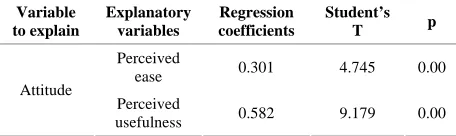
To test the influence of ease and usefulness perceived on the attitude to the use of the Internet, we used the method of multiple regression and we verified the absence of high co linearity between the explanatory variables (per- ceived usefulness and perceived ease). Tolerances and VIF are close 1 and within the recommended limit (VIF = 1.152 is less than 3 and tolerance = 0.868 is greater than 0.3). Explanatory variables usefulness and perceived ease of use are not correlated, which is indicating a qual- ity of the model index. So we can go to test the influence of the perceived usefulness and ease on the attitude to the use. The calculated F is equal to 79.756, which is greater than the critical value of F (2, 127) = 2.82 (at the level of confidence 0.05), so we can conclude that the regression model is of quality. R square = 0.557, it means that the model explains 55.7% of the variation of the intention of Internet.
- Impact of perceived ease on the attitude:
Ease T = 4.745, it’s greater than 1.96, and the sign of Beta is positive (0.301), (Table 1) so we can conclude that ease perceived of Internet has a positive impact on the attitude to its use, so the H1 hypothesis is validated.
- Impact of the perceived usefulness on attitude:
Table 1. Influence of the ease and usefulness on the attitude.
Variable to explain
Explanatory variables
Regression coefficients
Student’s
T p
Perceived
ease 0.301 4.745 0.00 Attitude
Perceived
usefulness 0.582 9.179 0.00
Note: Prepared from the data collected by the researcher.
of Beta is positive (0.582), (Table 1) therefore we con- clude that usefulness perceived the use of Internet has a positive influence on the attitude to its use, so the H2 hypothesis is validated.
6.2. Test of the Influence of the Attitude on the Intention
The calculated F is equal to 108. 057, which is greater than the value critical (1, 128) f = 3.84 (at the level of confidence 0.05), so we can conclude that the regression model is of quality. R square = 0.458, which means that attitude explains 45.8% of the variation of intent.
T in absolute value is equal to 10.395, which is greater than 1.96 (significant) and the sign of Beta is positive (0.667) (Table 2). We can conclude that attitude influ- ences positively the intention of Internet use in the rela- tionship between banks and firm therefore the H3 hy- pothesis is validated. The results converge with the hy- potheses assumed by TAM and other previous research which supported it by postulating that the ease of use positively influence the attitude to the use which influ- ences positively to turn the intention of using the Internet in the relationship between bank and firm. Finding that this technology is clear and understandable and easy to operate motivates the behavior of the user who will ex- perience an attitude conducive to the use, as a conse- quence the triggering of intent to positive use. The use- fulness of the use is revealed through the positive con- tributions of the use such as the improvement of the per- formance of the work, the development of a positive ap- preciation of technology deemed as beneficial to the man- agement of the company. This variable will in turn posi- tively influence the attitude which will positively influ- ence the intention of Internet use in the in the relation- ship between bank and firm (Figure 1).
There is the model tested in the Tunisian context to explain the determinant of the use of Internet banking by the leaders. This model tested in our study demonstrate that perceived ease and perceived usefulness determines the attitude and that attitude determine the intent if use of e-banking.
7. Conclusion
[image:5.595.58.286.103.171.2]The majority of existing research explaining the deter-
Table 2. Influence of the attitude on the intention.
Variable to explain
Explanatory variable
Regression coefficient
Student’s
T p
Intention Attitude 0.677 10.395 p = 0.00
Note: Prepared from the data collected by the researcher.
[image:5.595.306.539.146.263.2]Note: Tested in Tunisian context in order to determine the use of e-banking by the leaders.
Figure 1. The model explained the determinants of the use of Internet banking.
minants of the use of Internet technology is based on the factors of explanation of the adoption at the report the “Business to Consumer”. But in the “Business to Busi- ness” report, it is important to understand the diffusion of technology among professional. The determination of ex- planatory factors of the intention of Internet use in the re- lationship between bank and firm became more neces- sary competitiveness. Thus, through explaining the fac-tors that determine the intention of Internet used in the relationship between bank and firm, we are referred to the TAM model which has been widely supported by previous research [3,25,27] and we have tested the TAM model in the context of the use of technology among pro- fessionals.
REFERENCES
[1] M. Igabria, G. B. Davis and T. Guimaras, “Testing the De- terminants of Microcomputer Usage via Structural Equa- tion,” Journal of Management Information System, Vol. 11, No. 4, 1995, pp. 9-30.
[2] M. C. Cheung and C. Chang, “Perceptual Factors Under- lying User Preferences toward Product Form of Mobile Phones,” Industrial Ergonomics, Vol. 27, No. 4, 2001, pp. 247-258. doi:10.1016/S0169-8141(00)00054-8
[3] F. D. Davis, R. P. Bagozzi and P. R. Warshaw, “User Ac- ceptance a Computer Technology: A Comparison of Two Theoretical Models,” Management Science, Vol. 35, No. 8, 1989, pp. 982-1003. doi:10.1287/mnsc.35.8.982 [4] K. Mathieson, “Predicting User Intentions Comparing the
Technology Acceptance Model with the Theory of Plan- ned Behavior,” Information Systems Research, Vol. 2, No. 3, 1991, pp. 173-191. doi:10.1287/isre.2.3.173
[6] D. Phuangthon and S. Malisawan, “A Study of Behavi- oral Intention for 3G Mobile Internet Technology: Preli- minary Research on Mobile Learning,” A Proceedings of the 2nd International Conference on E-Learning for Know- ledge-Based Society, Bankok, 4-7 August 2005.
[7] I. Ajzen and M. Fishbein, “Understanding Attitudes and Predicting Behavior,” Prentice Hall Inc., Upper Saddle River, 1980.
[8] I. Zaoui and A. E. Akremi, “L’intention D’achat du Con- sommateur sur Internet: Déterminants et Rôle Modérateur de la Confiance, cas du site Marchand du Magasin Géné- ral,” The 8th AIM Conférence, Grenoble, May 2003.
[9] D. Harker and Van Akkeren, “Mobile Data Technologies and SME Adoption and Diffusion: An Empirical Study on Barriers and Facilitators,” The Australian Journal of Information Systems, Vol. 9, No. 2, 2002, pp. 3-16.
[10] D. François and S. P. Antoin, “Une Analyse des Déter- minants de L’acceptation de la Messagerie Electronique par des Personnels Administratifs à L’université,” Systè- me d’Information et Management, Vol. 7, No. 4, 2002, p. 127.
[11] V. Venkatesh and F. D. Davis, “A Theoretical Extension of the Technology Acceptance Model: Four Longitudinal Studies,” Management Science, Vol. 46, No. 2, 2000, pp. 186-204. doi:10.1287/mnsc.46.2.186.11926
[12] G. C. Bruner and A. Kumar, “Explaining Consumer Accep- tance of Handheld Internet Devices,” Journal of Business Research, Vol. 58, No. 5, 2005, pp. 553-280.
doi:10.1016/j.jbusres.2003.08.002
[13] Y. Foxalle and Pallister, “Technology Acceptance: A Me- ta Analysis of the TAM,” Journal of Modeling in Mana- gement, Vol. 2, No. 3, 2007, pp. 251-280.
[14] D. Gefen, “E-Commerce: The Role of Familiarity and Trust,” Omega, Vol. 28, No. 6, 2000, pp. 725-737. doi:10.1016/S0305-0483(00)00021-9
[15] D. R. Adams, R. N. Peter and A. Tod, “Perceived Useful- ness, Ease of Use and Usage of Information Technology: A Replication,” Management Information System Quar- terly, Vol. 16, No. 2, 1992, pp. 227-247.
[16] R. P. Bagozzi and R. Warshaw, “User Acceptance of Com- puter Technology: A Comparison of Two Theoretical Mo- dels,” Management Science, Vol. 35, No. 8, 1989, pp. 982-1003. doi:10.1287/mnsc.35.8.982
[17] A. L. Ledrer, D. J. Maupin, M. P. Sena and Y. Zhuang, “The Role of Ease of Use, Usefulness and Attitude in the Prediction of World Wide Web Usage,” CRP, 1998.
[18] E. Huang, “The Acceptance of Women-Centric Websites,” The Journal of Computer Information Systems, Vol. 45, No. 4, 2005, pp. 75-83.
[19] A. K. Gyampah and F. Salam, “An Extension of Techno- logy Acceptance Model in an ERP Implementation Envi- ronment, Information and Management, Vol. 41, No. 6, 2004, pp. 731-745. doi:10.1016/j.im.2003.08.010
[20] P. Y. K. Chau and P. Hu, “Investigating Health Care Pro- fessionals Decisions to Accept Telemedicine Technology: An Empirical Test of Competing Theories,” Information and Management, Vol. 39, No. 4, 2004, pp. 297-311.
[21] S. S. Liaw and H. M. Huang, “An Investigation of User
Attitudes toward Search Engines as an Information Re- trieval Tool,” Computers in Human Behavior, Vol. 19, No. 6, 2003, pp. 751-765. doi:10.1016/S0747-5632(03)00009-8 [22] F. Lin and J. Wu, “An Empirical Study of End-User Com-
puting Acceptance Factors in Small and Medium Enter- prises in Taiwan: Analyzed by Structural Equation Mod- eling,” Journal of Computer Information Systems, Vol. 44, No. 3, 2004, pp. 98-108.
[23] N. Ndubisi, R. Supinah and P. Gurting, “The Extend Tech- nology Acceptance Model and Internet Banking Usage In- tention,” International Logistics Congress Proceeding, Tur- key, December 2004.
[24] P. J. Legris and P. C. Ingham, “Why Do People Use Infor- mation Technology, A Critical Review of the Technology Acceptance Model,” Information and Management, Vol. 40, No. 3, 2003, pp. 191-204.
[25] L. Moez and F. Selma, “Les Déterminants de L’achat sur Internet: Revue de la Littérature et Proposition de Mo- dèle,” 2004. www.iae.univ-nantes.fr/emarket/emarket
[26] J. R. Leroy Robinson, W. Greg Marshall and M. B. Stamps, “Sales Force Use of Technology: Antecedents to Techno- logy Acceptance,” Journal of Business Research, Vol. 58, No. 12, 2005, pp. 1623-1631.
[27] C. E. Porter and N. Donthu, “Using the Technology Ac- ceptance Model to Explain How Attitudes Determine In- ternet Usage: The Role of Perceived Access Barriers and Demographics,” Science Direct, Journal of Business Re- rearch, Vol. 59, No. 9, 2006, pp. 999-1007.
[28] J. A. DeVito, “Les Fondements de la Communication Hu- maine,” Edition Gaétan Morin, 1993.
[29] C. Dussart, “Comportement du Consommateur et Straté- gie de Marketing,” McGraw Hill, New York, 1983, p. 77.
[30] M. Rogers, “Diffusion of Innovations,” 4th Edition, The Free Press, New York, 1995.
[31] G. C. Moore and I. Benbasat, “Development of an Instru- ment to Measure the Perceptions of Adopting an Informa- tion Technology Innovation,” Information Systems Re- search, Vol. 2, No. 3, 1991, pp. 192-222.
[32] T. Hill, N. D. Smith and M. F. Mann, “Role of Efficacy Ex- pectations in Predicting the Decision to Use Advanced Technologies: The Case of Computers,” Journal of Ap- plied Psychology, Vol. 72, No. 2, 1987, pp. 307-313. [33] E. Karahanna and D. W. Straub, “The Psychological Ori-
gins of Perceived Usefulness and Ease of Use,” Informa- tion and Management, Vol. 35, No. 4, pp. 237-250.
[34] I. Ajzen, “From Intentions to Actions: A Theory of Plan- ned Behavior, Action Control: From Cognition to Behav- ior,” New York, 1985.
[35] J. Katz, “Motives, Hurdles and Droputs,” Communications of the ACM, Vol. 40, No. 4, 1997, pp. 97-102.
[36] P. Don and R. Martha, “Le One to One: Valoriser Votre Capital Client,” Les Editions d’Organisation, 1998.
[37] P. Gerrad and J. B. Cunningham, “The Diffusion of Internet Banking among Singapore Consumers,” Interna- tional Journal of Bank Marketing, Vol. 21, No. 1, 2003, pp. 16-28. doi:10.1108/02652320310457776
Acceptance of Online Banking in Developing Econo- mies,” Journal of Internet Banking and Commerce, Vol. 13, No. 1, 2008, p. 1.
www.arraydev.com/commerce/jibc/
[39] M. L. Matthew, A. L. Ostrom, R. I. Roundtree and M. J. Bitner, “Self-Service Technologies: Understanding Cus- tomer Satisfaction with Technology-Based Service En- counters,” Journal of Marketing, Vol. 64, No. 3, 2000, pp. 50-64. doi:10.1509/jmkg.64.3.50.18024
[40] A. K. Au and P. Enderwick, “A Cognitive Model on Atti- tude toward Technology Adoption,” Vol. 15, No. 4, 2000, pp. 266-282.
[41] L. D. Chen, M. L. Gillenson and D. L. Sherrel, “Enticing Online Consumers: An Extended Technology Acceptance Perspective,” Information Management, Vol. 39, No. 8, 2002, pp. 705-719. doi:10.1016/S0378-7206(01)00127-6 [42] L. Moez, M. Khalifa and A. Frini “What Makes Con-
sumers Buy from Internet? A Longitudinal Study of On- line Shopping,” IEEE Transaction on Systems, Man and Cybermetics, Vol. 30, No. 4, 2000, pp. 421-432. doi:10.1109/3468.852436
[43] N. C. Goodwin, “Functionality and Usability,” Commu- nication of the ACM, Vol. 30, No. 3, 1987, pp. 229-233.
[44] P. Y. K. Chau, “An Empirical Assessment of a Modified Technology Acceptance Model,” Journal Management Information Systems, Vol. 13, No. 2, 1996, pp. 185-204.
[45] A. L. Ledrer, D. J. Maupin, M. P. Sena and Y. Zhuang, “The Technology Acceptance Model and the World Wide Web,” Decision Support Systems, Vol. 29, No. 3, 2000, pp. 269-282. doi:10.1016/S0167-9236(00)00076-2
[46] M. Bendana and F. Rowe, “Du Minitel à l’Internet: Per- ception du Risque et Transition Chez les Internautes Utili- sateurs des Services Bancaires,” Annales des Télécom- munications, Vol. 58, No. 1-2, 2003, pp. 197-211.
[47] A. H. Eagly and S, Chaiken, “The Psychology of the At- titudes,” Harcourt Brace College Publishers, New York, 1993.
[48] J. A. Howard, “Consumer Behavior in Marketing Strat- egy,” Prentice Hall, Englewood Cliffs, 1989.
[49] Q. Chen and W. D. Wells, “Attitude toward the Site,” Jour- nal of Advertising Research, Vol. 39, No. 5, 1999, pp. 27-37.
[50] C. Amel, “Implantation d’un ERP (Entreprise Ressource Planning): Antécédents et Conséquence,” XVème Confé- rence Internationale de Management Stratégique, Annecy/ Genéve, 13-16 June 2006.
[51] S. Debbabi, S. Baile and M. Daassi, “La Fidélité à un Site Marchand: Les Déterminants et le Rôle Médiateur de la Confiance et de la Satisfaction,” Actes du Colloque Cy- ber-Gestion, Montpellier, 2003.
[52] A. O’cass and T. Frenech, “Web Retailing Adoption: Ex- ploring the Nature of Internet Users Web Retailing Be- havior,” Journal of Retailing and Consumer Services, Vol. 10, No. 2, 2003, pp. 81-94.
doi:10.1016/S0969-6989(02)00004-8
[53] C. Ranganathan and S. Garrapathy, “Key Dimensions of Business to Consumer Web Sites,” Information and Ma- nagement, Vol. 39, No. 6, 2002, pp. 457-465.
doi:10.1016/S0378-7206(01)00112-4
[54] G. Alexander, “La Notion de Confiance et le Droit du Commerce Electronique,” LX Electronica, Vol. 12, No. 3, 2008, pp. 1-20.
[55] T. L. Childers, J. Peck and S. Cason, “Hedonic and Utili- tarian Motivations for Online Retail Shopping Behavior,” Journal of Retailing, Vol. 77, No. 4, 2001, pp. 511-535. doi:10.1016/S0022-4359(01)00056-2
[56] P. A. Dabholkar, “Consumer Evaluation of New Techno- logy-Based Self Service Options: An Investigation of Al- ternative Models of Service Quality,” International Jour- nal of Research in Marketing, Vol. 13, No. 1, 1996, pp. 29-51. doi:10.1016/0167-8116(95)00027-5
[57] M. Weiss, “Bricks to Clicks: What Drives Customer Use of the Internet in a Multi-Channel Environment,” Work- ing Papers, 2000.
[58] M. S. Sohail and B. Shanmugham “E-Banking and Cus- tomer Preferences in Malaysia: An Empirical Investiga- tion,” Information Sciences, Vol. 150, No. 3-4, 2003, pp. 207-217. doi:10.1016/S0020-0255(02)00378-X
[59] N. K. Malhotra and J. D. McCort, “A Cross-Cultural Comparison of Behavioral Intention Models: Theoretical Consideration and an Empirical Investigation,” Interna- tional Marketing Review, Vol. 18, No. 3, 2001, pp. 235- 269. doi:10.1108/02651330110396505
[60] R. L. Thompson, C. A. Higgins and J. M. Howell, “Per- sonal Computing: Toward a Conceptual Model of Utili- zation,” Management Information System, Vol. 15, No. 1, 1991, pp. 125-143. doi:10.2307/249443
[61] J. M. Pearson and Md N. Khalil, “The Influence of Trust on Internet Banking Acceptance,” Journal of Internet Banking and Commerce, Vol. 12, No. 2, 2007, 10 p. www.arraydev.com/commerce/jibc/
[62] R. P. Bagozzi, “Attitudes, Intentions and Behavior: A Test of Some Key Hypotheses,” Journal of Personality and Social Psychology, Vol. 41, No. 4, 1981, pp. 607- 627. doi:10.1037/0022-3514.41.4.607
[63] C. Derbaix and J. Bree, “Comportement du Consomma- teur, Présentation des Textes Choisis,” Edition Econo- mica, Paris, 2000.
[64] J. V. Petrof, “Comportement du Consommateur et Mar- keting,” Les Presses de l’Université Laval,Quebec City, 1998.
[65] Al A. Samer, “La Crédibilité Perçue Comme Facteur Explicatif du Comportement des Internautes,” Journée du e-Marketing, Université de Nantes, Nantes, 2004.
[66] J. H. Zhu and H. Zhou, “Diffusion, Use and Impact of the Internet in Hong Kong: A Chain Process Model,” Journal of Computer Mediated Communication, Vol. 7, No. 2, 2002. www;Ascusc.org/jcmc/vol7/issue2/hongkong.html
[67] D. J. Atkin, L. W. Jeffres and K. A. Neuendorf, “Under- standing Internet Adoption as Telecommunications Be- havior,” Journal of Broadcasting and Electronic Media, Vol. 42, No. 4, 1998, pp. 475-409.
doi:10.1080/08838159809364463
[68] J. Moon and Y. Kim, “Extending the Tam for a Word Wide Web Context,” Information and Management, Vol. 38, No. 4, 2001, pp. 217-230.