ISSN Online: 2156-8278 ISSN Print: 2156-8251
Optimization of Synthesis Conditions of
LiMn
2
−
x
Fe
x
O
4
Cathode Materials Based on
Thermal Characterizations
Sam Chiovoloni1, Cristaly Moran2, Peter K. LeMaire1, Rahul Singhal1*
1Physics and Engineering Physics, Central Connecticut State University, New Britain, CT, USA
2Science, Technology, Engineering & Mathematics (STEM) Division, Naugatuck Valley Community College,
Waterbury, CT, USA
Abstract
We have synthesized LiMn2−xFexO4 (x = 0, 0.25, and 0.50) cathode materials for applications in Li ion rechargeable batteries via sol-gel method. We stu-died thermal characteristics of as synthesized materials using differential scanning calorimetry (DSC) and thermogravimetric analysis (TGA). In order to optimize the synthesis conditions, we studied X-ray diffraction (XRD) of synthesized cathode materials at various temperatures, based on the transi-tions obtained from DSC/TGA. The XRD results can be co-related to the thermal behavior of the synthesized cathode materials and the synthesis con-ditions optimized.
Keywords
Cathode Materials, Thermal Analysis, Li Ion Rechargeable Batteries, Process Optimization, X-Ray Diffraction, Differential Scanning Calorimetry
1. Introduction
Due to technological developments and the continuous depletion of fossil fuel, the development of new power sources is of great interest. With the recent de-velopments in the area of green energy production such as solar and wind ener-gy, the need for high energy density energy storage devices has become equally important [1] [2] [3]. Li ion batteries have the highest energy densities among the commercially available rechargeable batteries [4] [5]. The commercially available Li ion batteries suffer from various drawbacks such as poor cyclability, rate performances and toxicity [6]. Keeping this in view, the research communi-How to cite this paper: Chiovoloni, S.,
Moran, C., LeMaire, P.K. and Singhal, R. (2017)Optimization of Synthesis Conditions of LiMn2−xFexO4 Cathode Materials Based on Thermal Characterizations. American Journal of Analytical Chemistry, 8, 51-59. http://dx.doi.org/10.4236/ajac.2017.81004
Received: November 6, 2016 Accepted: January 8, 2017 Published: January 11, 2017
Copyright © 2017 by authors and Scientific Research Publishing Inc. This work is licensed under the Creative Commons Attribution International License (CC BY 4.0).
ty is working towards the development of new cathode materials [7] [8] [9] [10] [11]. The preparation of phase pure cathode materials for Li ion rechargeable batteries is very time consuming, since the process involves trying so many combinations of temperature and annealing time. Various authors have analyzed thermal behaviors in conjunction with X-ray diffraction (XRD), to understand the reaction mechanism for the synthesis of LiMn2O4 cathode materials. There is the need to continue work in this area to optimize the synthesis of these very important groups of energy storage materials.
In order to get a better understanding of the different possible by-products, Berbenni and Marini [12] studied the thermal decomposition processes taking place in solid state mixtures of Li2CO3-MnCO3(xLi = 0.10 - 0.50, xLi = lithium ca-tionic fraction) in air and nitrogen flow by thermogravimetric analysis (TGA) and X-ray powder diffraction studies. They found that the formation reaction of LiMn2O4 and Mn3O4 was completed by about 720˚C. At higher temperatures, complex reactions take place, resulting in the formation of the compounds Li2Mn2O4 and LiMnO2 with excess of Mn3O4. It was also reported that in the mixture of Li2CO3-MnO, formation of LiMn2O4 is a two stage process, where Li2MnO3 forms first, followed by reaction with excess Mn2O3 to yield LiMn2O4 [13]. It has been reported that LiMn1.95M0.05O4 (M = Al, Co, Fe, Ni, Y) cathode materials can be synthesized by combustion method using lithium hydroxide, manganese nitrate, M-nitrates (M = Al, Co, Fe, Ni, Y), and urea as precursor materials. The thermal behavior of the reaction mixture and synthesized powder revealed that the spinal phase can be achieved in 1 minute at 280˚C [14].
Michalska and coworkers [15] have studied the important stages of the syn-theses of nanocrystalline lithium-manganese oxide spinels using DSC-TGA mea- surements. They found that DSC/TGA/XRD data are co-related to each other, and all major thermal events, for all precursors occur between 500˚C - 700˚C. The mass loss during the synthesis procedure was between 51% and 64%, de-pending on the material. Above 700˚C pure spinal phase is obtained, as con-firmed by X-ray diffraction studies.
The thermal behavior of LiMn2O4 spinal was studied by Molenda and co-workers [16] using DSC/TGA in the temperature range of 300˚C - 900˚C in air atmosphere. They reported that the changes of mass within the studied temper-ature range are related to arrangement of the structure accompanied by the dis-appearance of cations vacancies and by the formation of the stoichiometric LiMn2O4. In the range of 820˚C - 925˚C, the mass changes corresponds to the formation or disappearance of the oxygen vacancies, while above 925˚C Mn3O4 and LiMnO2 phases were formed and released oxygen.
2. Experimental
LiMn2−xFexO4 cathode materials were synthesized via sol-gel method. The pre-cursor materials lithium acetate dihydrate (LiOOCCH3∙2H2O, 99%), iron (II) acetate anhydrous (C4H6FeO4), and Manganese(II) acetate tetrahydrate [Mn 22% (typical), C4H6MnO4∙4H2O] were procured from Alfa Aesar and used as re-ceived. All of the precursor materials were dissolved in 2-ethylhexanoic acid, followed by stirring for 1 hr at 500 rpm. The final solution was dried drop by drop on a Petri dish at 280˚C. The resultant powders were ground and stored in a glass vial for further analysis/processing.
Simultaneous DSC/TGA measurements were carried out between 50˚C and 1000˚C in alumina crucibles using Q600 SDT (by TA Instruments, USA). The data were analyzed using TA Advantage software. The measurement conditions were as follows: LiMn2O4 (sample weight = 17 mg, LiMn1.75Fe0.25O4 (sample weight = 25.5 mg), LiMn1.5Fe0.5O4 (sample weight = 28.5 mg) were heated and cooled at a rate of 10˚C/min., under flow of nitrogen gas. The X-ray diffraction studies were performed using Rigaku Mini flex-II diffractometer (wavelength of X-ray, 1.5406 angstrom.) and CuKα radiations, at a scan rate of 1˚/min. The data were collected at every 0.02˚.
3. Results and Discussions
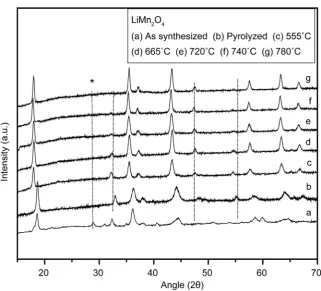
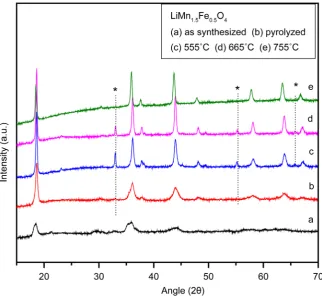
Figures 1-3 show the thermal behavior of LiMn2O4, LiMn1.75Fe0.25O4, and LiMn1.5Fe0.5O4, respectively, obtained from DSC and TGA analysis. The XRD patterns of the synthesized materials are given in Figures 4-6. It can be seen from Figures 4-6 that synthesized materials showed additional peaks, which may be due to the defects in structure. Additionally, the peaks are less intense and broader, which may be due to the lower crystallinity. Furthermore, as the calcinations temperature increases, the peaks become more sharp and intense, which may be due to the increased crystallinity. These results are in agreement as reported earlier by Molenda and coworkers [16].
Figure 1. DSC and TGA thermograms of LiMn2O4 cathode materials.
[image:4.595.66.530.421.719.2]Figure 3. DSC and TGA thermograms of LiMn1.5Fe0.5O4 cathode materials.
Figure 4. X-ray diffraction patterns of LiMn2O4 cathode materials at various calcinations
[image:5.595.212.534.411.702.2]Figure 5. X-ray diffraction patterns of LiMn1.75Fe0.25O4 cathode materials at various
calci-nations temperatures.
Figure 6. X-ray diffraction patterns of LiMn1.5Fe0.5O4 cathode materials at various
[image:6.595.212.535.406.702.2]Figure 2 showed the thermal behavior of LiMn1.75Fe0.25O4 cathode materials and corresponding XRD patterns are given in Figure 5. It can be seen from Fig-ure 2 that after pyrolysis between 200˚C - 380˚C, the mass decreases gradually from 380˚C to 750˚C, after that no significant mass loss is observed. The cor-responding XRD [Figure 5] showed the decrease in peak intensity of peaks at 33˚ and 55˚ and increasing of spinel characteristic peaks. We obtained phase pure spinel LiMn1.75Fe0.25O4 at 750˚C, which is lower than that of pure LiMn2O4 cathode materials. Similar behavior was also obtained for LiMn1.5Fe0.5O4 cathode materials, where there is mass loss up to 750˚C, and after this temperature, there is no significant mass loss [Figure 3]. The corresponding XRD patterns of LiMn1.5Fe0.5O4, obtained at various calcinations temperatures [as prepared, 555˚C, 665˚C, and 755˚C] [Figure 6] showed that phase pure material at 755˚C. Table 1 shows the crystallite size and lattice parameters of LiMn2O4, LiMn1.75Fe0.25O4, and LiMn1.5Fe0.50O4 cathode materials, calcined at various temperatures. It can be seen from the table that as the calcined temperature increases, lattice parameter also increases. Similar behavior was reported by Dziembaj and coworkers [17]. The crystallite size was calculated using Scherer’s equation. The average crystal-lite sizes were found to be in the range of 13 - 40 nm. The crystalcrystal-lite size varies with the temperature and was found to be increased upon increasing annealing temperature. Our results are in agreement as reported earlier [18].
4. Conclusion
[image:7.595.209.539.568.736.2]We have successfully synthesized spinelLiMn2O4, LiMn1.75Fe0.25O4, and LiMn1.5 Fe0.50O4, cathode materials via sol-gel method. The thermal behavior of the syn-thesized materials is in agreement with the results obtained from X-ray diffrac-tion studies. Based on the results obtained from thermal and structural studies, the synthesis conditions for the cathode materials can be optimized. We ob-tained the optimum calcinations temperatures for LiMn2O4, LiMn1.75Fe0.25O4, and LiMn1.5Fe0.5O4 as 850˚C, 750˚C, and 750˚C, respectively. Further characteriza-tions such as X-ray photoelectron spectroscopy and micro-Raman spectroscopy may be carried out to provide better understanding of the reaction mechanism.
Table 1. Lattice parameter and crystallite size of LiMn2−xFexO4 cathode materials.
Material temperature (˚C) Annealing Average lattice parameter (Å) Average crystallite size (nm)
LiMn2O4
665 8.3595 20.13
720 8.3727 19.68
740 8.3906 27.6
780 8.3643 25.70
LiMn1.75Fe0.25O4 625 8.2601 12.99
755 8.2725 39.65
LiMn1.5Fe0.5O4
555 8.2462 26.7
665 8.2473 22.32
Acknowledgements
The authors are thankful to Dr. Faris Malhas, Dean School of Engineering, Science and Technology, Central Connecticut State University (CCSU) for his support in the acquisition of the Q600 SDT. The financial support received from CCSU AAUP university research grant (No. ARLEMJ), and Connecticut NASA Space Grant are gratefully acknowledged.
References
[1] Larcher, D. and Tarascon, J-M. (2015) Towards Greener and More Sustainable Bat-teries for Electrical Energy Storage. Nature Chemistry,7, 19-29.
https://doi.org/10.1038/nchem.2085
[2] Armand, M. and Tarascon, J.-M. (2008)Building Better Batteries. Nature,451, 652- 657. https://doi.org/10.1038/451652a
[3] Lin, M.C., Gong, M., Lu, B., Wu, Y., Wang, D.Y., Guan, M., Angell, M., Chen, C., Yang, J., Hwang, B.J. and Dai, H. (2015)An Ultrafast Rechargeable Aluminium-Ion Battery. Nature,520, 324-328. https://doi.org/10.1038/nature14340
[4] Chen, J.M., Hsu, C.H., Lin, Y.R., Hsiao, M.H. and Fey, T.K. (2008)High-Power Li-FePO4 Cathode Materials with a Continuous Nano Carbon Network for Lithium-
Ion Batteries. Journal of Power Sources,184, 498-502. https://doi.org/10.1016/j.jpowsour.2008.04.022
[5] Huang, B., Shi, P.F., Liang, Z.C., Chen, M. and Guan, Y.F. (2005)Effects of Sinter-ing on the Performance of Hydrogen Storage Alloy Electrode for High-Power Ni/ MH Batteries. Journal of Alloys and Compounds,394, 303-307.
https://doi.org/10.1016/j.jallcom.2004.11.007
[6] Chen, Z., Lu, W.Q., Liu, J. and Amine, K. (2006) LiPF6/LiBOB Blend Salt Electrolyte
for High-Power Lithium-Ion Batteries. Electrochimica Acta,51, 3322-3326. https://doi.org/10.1016/j.electacta.2005.09.027
[7] Brandt, A. and Balducci, A. (2013)Ferrocene as Precursor for Carbon-Coated α- Fe2O3 Nano-Particles for Rechargeable Lithium Batteries. Journal of Power Sources,
230, 44-49. https://doi.org/10.1016/j.jpowsour.2012.11.125
[8] Lin, Y., Lin, Y., Zhou, T., Zhao, G., Huang, Y. and Huang, Z. (2013) Enhanced Electrochemical Performances of LiFePO4/C by Surface Modification with Sn
Na-noparticles. Journal of Power Sources,226, 20-26. https://doi.org/10.1016/j.jpowsour.2012.10.074
[9] Xiong, X., Wang, Z., Guo, H., Li, X., Wu, F. and Yue, P. (2012)High Performance LiV3O8 Cathode Materials Prepared by Spray-Drying Method. Electrochimica Acta,,
71, 206-212. https://doi.org/10.1016/j.electacta.2012.03.122
[10] Liu, L., Lei, X., Tang, H., Zeng, R., Chen, Y. and Zhang, H. (2015)Influences of La Doping on Magnetic and Electrochemical Properties of Li3V2(PO4)3/C Cathode
Ma-terials for Lithium-Ion Batteries. Electrochimica Acta,151, 378-385. https://doi.org/10.1016/j.electacta.2014.11.052
[11] Li, S., Xu, L., Li, G., Wang, M. and Zhai, Y. (2013) In-Situ Controllable Synthesis and Performance Investigation of Carbon-Coated Monoclinic and Hexagonal LiMnBO3 Composites as Cathode Materials in Lithium-Ion Batteries. Journal of
Power Sources,236, 54-60. https://doi.org/10.1016/j.jpowsour.2013.02.027
[12] Berbenni, V. and Marini, A. (2002)Thermogravimetry and X-Ray Diffraction Study of the Thermal Decomposition Processes in Li2CO3-MnCO3 Mixtures. Journal of
https://doi.org/10.1016/S0165-2370(00)00211-4
[13] Berbenni, V. and Marini, A. (2002)Thermoanalytical (TGA-DSC) and High Temper-ature X-Ray Diffraction (HT-XRD) Study of the Thermal Decomposition Processes in Li2CO3-MnO Mixtures. Journal of Analytical and Applied Pyrolysis,64, 43-58.
https://doi.org/10.1016/S0165-2370(01)00169-3
[14] Choi, H.J., Lee, K.M. and Lee, J.G. (2001) LiMn1.95M0.05O4 (M: Al, Co, Fe, Ni, Y)
Cathode Materials Prepared by Combustion Synthesis. Journal of Power Sources, 103, 154-159. https://doi.org/10.1016/S0378-7753(01)00835-7
[15] Michalska, M., Lipińska, L., Mirkowska, M., Aksienionek, M., Diduszko, R. and Wasiucionek, M. (2011)Nanocrystalline Lithium-Manganese Oxide Spinels for Li- Ion Batteries—Sol-Gel Synthesis and Characterization of Their Structure and Se-lected Physical Properties. Solid State Ionics,188, 160-164.
https://doi.org/10.1016/j.ssi.2010.12.003
[16] Molenda, M., Dziembaj, R., Podstawka, E. and Proniewicz, L.M. (2005)Changes in Local Structure of Lithium Manganese Spinels (Li:Mn=1:2) Characterised by XRD, DSC, TGA, IR, and Raman Spectroscopy. Journal of Physics and Chemistry of Sol-ids,66, 1761-1768. https://doi.org/10.1016/j.jpcs.2005.09.001
[17] Dziembaj, R., Molenda, M., Majda, D. and Walas, S. (2003)Synthesis, Thermal and Electrical Properties of Li1+δMn2−δO4 Prepared by a Sol-Gel Method. Solid State
Io-nics,157, 81-87. https://doi.org/10.1016/S0167-2738(02)00192-3
[18] Park, H.B., Kim, J. and Lee, C.W. (2001)Synthesis of LiMn2O4 Powder by Auto-
Ignited Combustion of Poly(acrylic acid)-Metal Nitrate Precursor. Journal of Power Sources,92, 124-130. https://doi.org/10.1016/S0378-7753(00)00512-7
Submit or recommend next manuscript to SCIRP and we will provide best service for you:
Accepting pre-submission inquiries through Email, Facebook, LinkedIn, Twitter, etc. A wide selection of journals (inclusive of 9 subjects, more than 200 journals)
Providing 24-hour high-quality service User-friendly online submission system Fair and swift peer-review system
Efficient typesetting and proofreading procedure
Display of the result of downloads and visits, as well as the number of cited articles Maximum dissemination of your research work