ί''ί?#|»
Ml
LABORATORY GUIDE
i^Efi»
¿SPI
FOR THE SELECTION OF BRAZING MATERIALS
»yr
üi
C. CAPPE
iSm
fallir
diuffi*
¡fît fl·'·
»••-•iL Í'JT
gì'!
I* ¿fi
fHIB
P^:»Mf
lT«WK» IIHÛII1 tiitaL; lüi,
'm
Joint Nuclear Research Centre
il
i
»•»'t
β
¿iî!::
:.".|J
mm
Pi
η
iß Λ
This document of the
LEGAL NOTICE
TBWft
'"η
m
m
SII κί:<*
H
S
ι . i
''•I
I'll
»¿Ι fe
ocument was prepared under the sponsorship of the Commissio: European Communities.
Neither the Commission of the European Communities, its contractor nor any person acting on their behalf:
make any warranty or representation, express or implied, with respec to the accuracy, completeness, or usefulness of the information contained
i-r, ttiic rWiimpnt nr that the use of anv information, apparatus, method
in this document, or that the use of any information, apparatus, method or process disclosed in this document may not infringe privately owned rights; or
assume any liability with respect to the use of, or for damages resulting from the use of any information, apparatus, method or process disclosed
φ.' ' ;. W.A Ui l i,· éìi
- in this document. 'L·
w
*'<'!'
;.-»nUit;
ìmwJ
the addresses hsted on cover page
C^;-TH.j
AHMÜW
m
m
wà
at the price of F.Fr. 4.45 B.Fr. 40.— DM 3.— It. Lire 500 Fl. 3.—m
' ■
i
SiWhen ordering, please quote the EUR number and which are indicated on the cover of each report.
m
¡Q&j.
Si!
m
M
ψ-m
sffi:
1 1 ~ e
m.
m
klitift'm
mm
This document was reproduced on the basis of the best available copy.
l
Mw
île!.MMM; il.
i
WWÎW
EUR 4637 e
LABORATORY GUIDE FOR T H E SELECTION OF BRAZING MATERIALS by C. CAPPELLETTI
Commission of the European Communities
Joint Nuclear Research Centre - Ispra Establishment (Italy) Materials Department - Direct Conversion
Luxembourg, March 1971 - 14 Pages - 8 Figures - B.Fr. 40.—
Orientating experiments were carried out on the wetting of various metals by different brazing alloys.
The attention is being drawn on the difference of behaviour of refractory metals submitted to brazure at low temperature ( < 1 300 °C) and at high temperature ( > 1 300 °C). In the first case wetting will be obtained by adding small amounts of metal, which alloys easely with the base metal (mainly Ni). In the other case instead the compatibility between the brazing metal and the base metal plays its own important role. In order to avoid a too vigorous attack of the base metal, a judicious choice of the geometry of the parts to be joined and of the right brazing procedure is necessary.
EUR 4637 e
LABORATORY GUIDE FOR T H E SELECTION O F BRAZING MATERIALS by C. CAPPELLETTI
Commission of the European Communities
Joint Nuclear Research Centre - Ispra Establishment (Italy) Materials Department - Direct Conversion
Luxembourg, March 1971 - 14 Pages - 8 Figures - B.Fr. 40.—
Orientating experiments were carried out on the wetting of various metals by different brazing alloys.
The attention is being drawn on the difference of behaviour of refractory metals submitted to brazure at low temperature ( < 1 300 °C) and at high temperature ( > 1 300 °C). In the first case wetting will be obtained by adding small amounts of metal, which alloys easely with the base metal (mainly Ni). In the other case instead the compatibility between the brazing metal and the base metal plays its own important role. In order to avoid a too vigorous attack of the base metal, a judicious choice of the geometry of the parts to be joined and of the right brazing procedure is necessary.
EUR 4637 e
LABORATORY GUIDE FOR T H E SELECTION OF BRAZING MATERIALS by C. CAPPELLETTI
Commission of the European Communities
Joint Nuclear Research Centre - Ispra Establishment (Italy) Materials Department - Direct Conversion
Luxembourg, March 1971 - 14 Pages - 8 Figures - B.Fr. 40.—
Orientating experiments were carried out on the wetting of various metals by different brazing alloys.
E U R 4 6 3 7 e
COMMISSION OF THE EUROPEAN COMMUNITIES
LABORATORY GUIDE
FOR THE SELECTION OF BRAZING MATERIALS
by
C. CAPPELLETTI
1971
Joint Nuclear Research Centre Ispra Establishment - Italy
A B S T R A C T
Orientating experiments were carried out on the wetting of various metals by different brazing alloys.
The attention is being drawn on the difference of behaviour of refractory metals submitted to brazure at low temperature ( < 1 300 °C) and at high temperature ( > 1 300 °C). In the first case wetting will be obtained by adding small amounts of metal, which alloys easely with the base metal (mainly Ni). In the other case instead the compatibility between the brazing metal and the base metal plays its own important role. In order to avoid a too vigorous attack of the base metal, a judicious choice of the geometry of the parts to be joined and of the right brazing procedure is necessary.
KEYWORDS
BRAZING HIGH TEMPERATURE
METALS NICKEL HEAT RESISTING METALS ALLOYS
3
-LABORATORY GUIDE FOR THE SELECTION OF BRAZING MATERIALS *)
The purpose of the present study is to provide the labora-tory technician with a practical guide which can give him rapid help in the first selection of brazing materials for joining metals to metals and, in some cases, also to ceramics.
Besides the principal commercially known brazing alloys also a number of new alloys has been tested, which are little known but nevertheless interesting.
As base materials those refractory metals have been used which occur most frequently in high temperature technology (Nb, Nb-1Zr, Ta, Mo, W etc.), but also more conventional materials have been included in the study (as e.g. Fe, Ni, FeNi, Kovar, Cu).
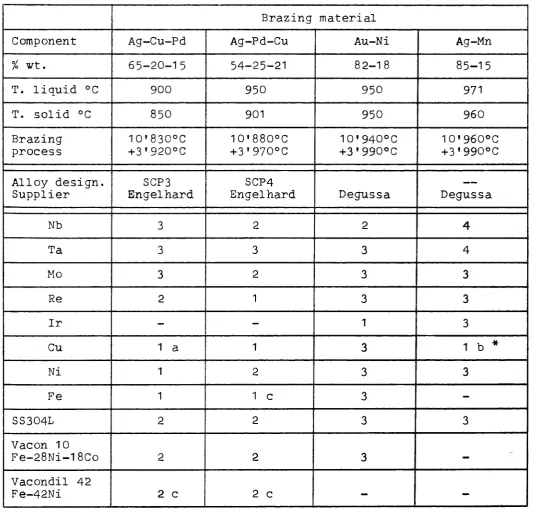
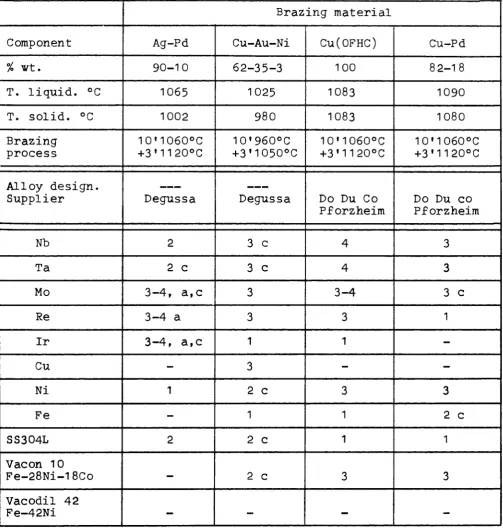
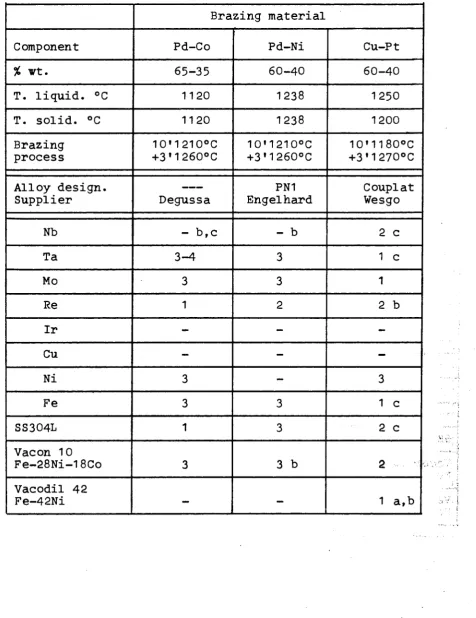
Due to the orientative character of this work, the princi-pal criterion used for the evaluation of the different brazing combinations is the surface wetting. It is characterized by a number. In cases where a reaction between brazing alloy and base material was apparent, a letter has been added to this number (see
code on the following page). The applicability of combinations
marked by "a" or "b" depends on factors such as geometry, thickness of the materials and brazing conditions. With other words, the
appearence of "a" or "b" not necessarily excludes the use of the respective combination; it may well be usable under special condi-tions or with special precaucondi-tions (e.g. flash brazing).
When no figure appears indicating the degree of wettability but only letter a or b, it should be understood that there has been alloys formation between the base metal and the brazing alloy. In some cases the sample was entirely damaged.
The tests were made by putting the brazing alloy on a
piece of plain metal sheet and then heating up under vacuum between about 10 and 10~"J Torr (furnace with Mo or Ta resistance heater).
The preparation of the samples included degreasing and some out-gasing of the base metals (for Nb, Ta, Re, Ir generally 10 minutes at 1700°C in a vacuum of some 10" Torr). The tests were evaluated by visible inspection. The results are compiled in table 1 and 2 using the following code.
1
very good wetting (wetting angle zero, good spreading) (photo 1)2 : good wetting (wetting angle nearly zero) (photo 2)
3 : sufficient wetting (wetting angle well above zero, but smaller than about 45°) (photo 3)
4 : poor wetting (large wetting angle, roughly between 45° and 90°) (photo 4)
5 : no wetting (wetting angle larger than 90°) (photo 5)
a : attack of base metal (photo 6)
b : strong attack (formation of holes in base metal) (photo 7) c : halo formation (photo 8).
REFERENCES
ClJ W.H. Kohl, Handbook of materials and techniques for vacuum tubes, Reinholds Publishing Co. (1967), p. 360.
\_2± C M . Cappelletti, C A . Busse and E.D. D'órre, Metal-to-ceramic seals for thermionic converters, Proc. Second Int. Conf.
Photo 1 : very good wetting Photo 2: good wetting
Photo 3: sufficient wetting Photo 4: poor wetting
-sä? ¿1SÏSÜV
Photo 5: no wetting Photo 6: attack of base
metal
- 6
Comments on the tables
Table 1
Upper part; The different brazing alloys which have been tested are not arranged in the order of their melting points, but accor ding to the value of the experimentally obtained "brazing tempe rature". In fact, it is this value which is most interesting for the realisation of the joint.
On the row - "brazing process": Two values of time and temperature are indicated (e.g. for Ag-28Cu: 10· at 760°C + 3' at 810°C). The first indication refers to a step of stabilization of temperature in the piece to be brazed, the second one to the proper brazing
step. The given values are those which have been used in the present experiments. Of course these values can vary considerably with
the geometry of the pieces, their mass and the brazing furnace. This pause before the real brazing is very important for pieces of complicated form and with brazings on the inside, where a large temperature difference between one point and another can cause a flow of brazing material to undesired spots.
On the row - "suppliers"; The suppliers of the materials used in the present experiments are indicated. For a larger compilation of suppliers of other markets the reader is referred to table 12.1
in reference \.Λ~1.
Table 2
In the column - "melting temperature"; As mostly new brazing alloys are concerned, no indication of liquidus and solidus temperatures is given because these values were not precisely known and the rea-ding from phase diagrams is often too inaccurate. The brazing tem-perature has been found experimentally.
In the column - "brazing process": Here the temperature of the sta-bilization step is not indicated. In general, it is around 90-95% of the brazing temperature in ° C The time depends on the geometry and the mass of the samples.
In some cases the brazing process is indicated, for example, as "1510°C to 1560°C in 3 minutes". This means that at the moment where the thermocouple of the furnace indicated 1510°C, the tempe-rature controlling program disk was stopped. The tempetempe-rature
however continued to rise and reached after 3 minutes 1560°C Evi-dently these data refer to a special type of furnace and therefore have only orientative value.
In some cases for the same brazing material the brazing process varies with the base material (see, e.g. Zr-22Nb). These are cases in which the brazing material tends to react with the base metal prior to fusion (diffusion?, reaction over the vapor phase?). Thus it can occur that the same brazing material at a certain temperature is already liquid on one material (in our
example Nb), while it is not so on the other (Ta). To obtain fusion, a temperature increase of about 60°C was necessary in the quoted example.
Table 1: Brazing alloys between 700°C and 1300°C
Component
% wt.
T. liquid °C T. solid °C
Brazing process Alloy design. Supplier Nb Ta Mo Re Ir Cu Ni Fe SS304L Vacon 10 Fe-28Ni-l8Co Vacodil 42 Fe-42Ni Brazing material Ag-Cu 72-28 779 779 10'760°C +3'810°C Ag-Cu eutectic Do Du Co
-- 9
Table 1 : Continued
Component
% wt.
T. liquid °C
T. solid °C
Brazing process Alloy design. Supplier Nb Ta Mo Re Ir Cu Ni Fe SS304L Vacon 10 Fe-28Ni-l8Co Vacondil 42 Fe-42Ni Brazing material Ag-Cu-Pd 65-20-15 900 850 10»830°C +3'920°C SCP3 Engelhard 3 3 3 2 -1 a 1 1 2 2 2 C Ag-Pd-Cu 54-25-21 950 901 10'880°C +3»970°C SCP4 Engelhard 2 3 2 1 -1 2 1 c 2 2 2 C Au-Ni 82-18 950 950 10'940°C +3'990°C Degussa 2 3 3 3 1 3 3 3 3 3 -Ag-Mn 85-15 971 960 10'960°C +3'990°C Degussa 4 4 3 3 3 1 b *
3
-3
-10
Table 1: continued
Component
% wt.
T. liquid. °C
T. solid. °C
Brazing process Alloy design. Supplier Nb Ta Mo Re Ir Cu Ni Fe SS304L Vacon 10 Fe-28Ni-l8Co Vacodil 42 Fe-42Ni Brazing material Cu-Pd-Ni-Mn 55-20-15-10 1105 1060 10»1040°C +3M1250C
CPNM2 Engelhard 3 2 2 1 -2 1 1 C 2 2 Cu-Ni 98-2 1095 1085 10'1070°C +3'1150°C
Do Du Co Pforzheim 3-4 3 4 1 -3 1 1 1 2 Ni-Mn-Pd 48-31-21 1120 1120 10'1100°C +3'1150°C NMP1 Engelhard 3 2 2 c 2 c -2 c 3 3 3-4 -Cu-Ni 95-5 1120 1090 10'1070°C +3'1170°C
-11
Table 1 : continued
Component
% wt.
T. liquid. °C
T. solid. °C
Brazing process Alloy design. Supplier Nb Ta Mo Re Ir Cu Ni Fe SS304L Vacon 10 Fe-28Ni-l8Co Vacodi1 42 Fe-42Ni Brazing material Ag-Pd 90-10 1065 1002 10M060°C +3»1120°C Degussa 2 2 c 3-4, a,c 3-4 a 3-4, a,c -1 -2 -Cu-Au-Ni 62-35-3 1025 980 10«960°C +3'1050°C Degussa 3 c 3 c 3 3 1 3 2 c 1 2 c 2 c -Cu(OFHC) 100 1083 1083 10M060°C +3'1120°C
Do Du Co Pforzheim 4 4 3-4 3 1 -3 1 1 3 -Cu-Pd 82-18 1090 1080
10'1060oC
+3'1120°C
Do Du CO
-- 12
Table 1 : Continued
Component
% wt.
T. l i q u i d . °C T. s o l i d . °C Brazing
p r o c e s s
Alloy d e s i g n . S u p p l i e r
Nb Ta Mo Re I r Cu Ni Fe SS304L Vacon 10 Fe-28Ni-l8Co Vacodil 42 Fe-42Ni
Brazing m a t e r i a l Pd-Co 65-35 1120 1120 10'1210°C +3'1260°C Degussa - b , c 3 - 4
3 1 -3 3 1 3 -Pd-Ni 60-40 1238 1238 10'1210°C +3'1260°C PN1 Engelhard - b 3 3 2 -3 3 3 b -Cu-Pt 60-40 1250 1200 10»1180°C +3'1270°C Couplât Wesgo 2 c 1 c 1 2 b -3 1 c 2 c 2
13
Table 2: Brazing alloys between 1500°C and 1900°C
B r a z i n g a l l o y
Pd
P d - 0 . 1 N i
P d - 0 . 5 N i
Pd-1Ni
Pd-2Ni
Pd-50Nb ( a l l o y ) Pd-50Nb
( c l a d w i r e )
P t
Zr-22Nb
V-30Nb-5Ti
M e l t i n g t e m p e r a t u r e
l i q . s o l i d
1552 ~" ~ <· — " ■ 1560 1769 1740 -1552 ■ " ■ " ■ " " ■ 1560 1769 1740
-B r a z i n g p r o c e s s
°C
1 0 Ί 5 3 0 + 3 Ί 5 7 0
1510 t o 1560 i n 3 min.
1510 t o 1560 i n 3 min. 1510 t o 1560 i n 3 min. 1510 t o 1560 i n 3 min. Argon 5'1620 5'1620 10M730 +3'1800 3'1740 3'1800 3*1700
3 Ί 7 8 0 +90M830
Base M a t e r i a l
Nb 3-4 b -- b 3 3 Nb1Zr
-1 a , b
1 a 1 b 1 b 2 2 -^ 3 Ta 3 c 3 c 2 c 2 c 1 c 3 2 a * 3 3 MO 4 3 2-3 1 1 C -3 2 a 3 W 3 2-3 2 1 1 C -— -Re 2 -1 1 Note I I I
Note: * Not completely molten I Wetts graphite well
Π Strong adherence on unmetalized high purity alumina
mm
røwiM
t
frin.rtIJimf!jjfii,NOTICE TO THE READER
All scientific and technical reports published by the Commission of the European Communities are announced in the monthly periodical "euro-abstracts". For subscription (1 year : US$ 16.40, £ 6.17, Bfrs 820,-) or free specimen copies please write to :
Handelsblatt GmbH "euro-abstracts" D-4 Düsseldorf 1 Postfach 1102 Germany
Office for Official Publications of the European Communities Box 1003 - Luxembourg/Station 37, rue Glesener, Luxembourg
I'-rtt » I
Wip
trørø
mm
K l
¡pil
Ulli*
To disseminate knowlei
#moj$
-ate prosperity — I m
: general prosperity and not individual riches — and with prosperity
; disappears the greater part of the evil which is our heritage from
[darker times.
ê
■
'ami*ÊÊlW&w MMM
ïi
All reports published by the Commission of the European Communities are on sale at the offices listed below, at the prices given on the back of the front cover. When ordering, specify clearly the EUR number and the title of the report which are shown on the front cover.
'■titlK* (Bul·
slip
mm
'
III
™¡t.W«¡IBi<«w Hvir'iHffihiSuin ' ' i i i i i ^ r r t m ' 1 'tÆt
rr-wi
OFFICE FOR OFFICIAL PUBLICATIONSOF THE EUROPEAN COMMUNITIES P.O. Box 1003 - Luxembourg/station
37 rue GJesener, Luxembourg (Compte chèque postal N° 191-90)
BELGIQUE — BELGIË
MONITEUR BELGE
Rue de Louvain, 40-42 - B-1000 Bruxelles BELGISCH STAATSBLAD
Leuvenseweg 40-42 - B-1000 Brussel
US
DEUTSCHLAND
VERLAG BUNDESANZEIGER Postfach 108 006 - D-5 Köln
id
i
m
y«
1d
FRANCE
SERVICE DE VENTE EN FRANCE DES PUBLICATIONS DES
COMMUNAUTÉS EUROPÉENNE:
rue Desaix, 26 - F-75 Paris 15e
?«WÊÊ
mm
fPP
É
DES
PUBLICATIONS OFFICIELLES DES COMMUNAUTÉS EUROPÉENNES
Postale 1003 - Luxembourg/gare te Glesener - Luxembourg
, Τ Λ , , Λ
LIBRERIA DELLO STATO Piazza G. Verdi, 10 - 1-00198 Roma
1
" "elf
1
il
W mimam
1NEDERLAND ♦ti* »
STAATSDRUKKERIJ en UITGEVERIJBEDRIJF
UNITED KINGDOM
CDNA04637
Æ%!ϊ í¡!í Η. M. STATIONERY OFFICE
P.O. Box 569 - London S.E.I
';Ι»*·Τ#Κάΐ3
» ι .m i' tí'fi
«'■Jk n i i . L t ' . t · » · * Τ > » H - ■ 1 H . f X ^ «ΐΓΤ™
Inl^llm
Commission of the European Communities D G . XIII - C.I.D. 29, rue Aldringer L u x e m b o u r g