Munich Personal RePEc Archive
Rethinking connectivity as interactivity:
a case study of Pakistan
Haque, Nadeem and Pirzada, Ahmed and Ahmed, Vaqar
Planning Commission of Pakistan
2011
Online at
https://mpra.ub.uni-muenchen.de/34049/
1
RETHINKING CONNECTIVITY AS INTERACTIVITY: A CASE STUDY OF PAKISTAN
Nadeem Ul Haque1 Ahm ed Pirzada2
Vaqar Ahm ed3
A Background Paper for Planning Comm ission’s New Grow t h St rat egy Prelim inary Version. Com m ent s are Welcom e
Introduction – What Do We Need?
For Pakist an t o becom e a middle-incom e count ry, GDP m ust grow at a sust ainable rat e of eight per cent , for m ore t han 20 years–a challenge t hat can be overcom e w it h proper planning and addressing of priorit y issues. If econom ic grow t h is not leveraged on a higher t raject ory, t he com ing dem ographic changes w ill im ply rising unem ploym ent , frust rat ed yout h, short age of asset s and difficult ies in com pet ing w it h neighbouring Sout h Asian count ries.
Over t he past several decades, Pakist an has faced def ence- and securit y-relat ed problem s along w it h a series of nat ural disast ers, polit ical, social and econom ic crises t hat have im pact ed virt ually all facet s of public and privat e life. Governm ent and civil society inst it ut ions, NGOs, businesses and cit izens are const ant ly in problem -solving and fire-fight ing m ode. M oving from one crisis t o anot her has deprived t he body polit ic from addressing int ellect ual and st ruct ural challenges. There is no st rat egic t hinking on how t o solve long-t erm problem s in a sust ainable m anner, and t he im plem ent at ion m echanism s of innovat ive and high im pact solut ions. The nat ional conversat ion in Pakist an sim ply cont inues t o discuss, dissect and debat e short -t erm issues m oving from one crisis t o t he next .
Like any problem -solving exercise, unpacking t he riddle of slow and unpredict able grow t h requires bold, innovat ive and holistic t hinking about w hat const it ut es grow t h, how it is sust ained and deepened, and w hat fact ors t end t o lim it grow t h in Pakist an. In a w ay, t radit ional neo-classical approach t o grow t h, w here societ y t hinks in t erm s of investing in public project s inst ead of grow t h st rat egies, is st ill som ew hat relevant . M uch of it has been t ried and t est ed and t o som e ext ent it has succeeded; but t o a large ext ent it has failed in Pakist an.
Today, Pakist an confront s a new round of challenges and urgent dem ands. It is precisely at t his m om ent —in t he aft erm at h of a devast at ing flood and w it h securit y concerns—t hat t he need t o change t he discourse about t he count ry’s developm ent has becom e m ost apparent . React ive t act ics and dependence on ext ernal aid are not helping Pakist an t o develop or realise it s pot ent ial.
1
Deputy Chairm an, Planning Commission of Pakist an
2
Consult ant (Connect ivit y Reform s), Planning Comm ission of Pakist an
3
2
Box 1 – Pakistan’s New Grow th Strategy
The New Grow t h St rat egy (NGS) proposed by Pakist an’s Planning Comm ission, is bold, innovat ive and holist ic. It is about Pakist an’s fut ure. It recognises t he need for great er private invest ment and m easures t hat im prove t he profit abilit y of investm ent. It seeks t o im prove t he investm ent clim at e, t o reduce t he cost of doing business, and t o eliminat e obst acles t o enhance efficiency and accumulat ion of knowledge.
Specifically, NGS aim s t o enhance productivity t o propel econom ic growt h and prom ot e prosperit y. It em phasises: (a) bet ter governance (w here t he governm ent set s policies and is t he um pire, not a player); (b) bet t er m anagem ent of resources and accum ulation of capit al; (c) bet ter connect ivit y; (d) m aking cit ies focal point s for creativity, not flashpoint s for conflict ; (e) involving youth and comm unities; (f) fost ering vibrant m arket s; and, (g) prom oting ent repreneurship and innovat ion t hat lead t o m ore and bet t er em ploym ent opport unit ies, especially for t he yout h and t he m arginalised.
NGS is an invit at ion t o all concerned t o have a rigorous debat e about w here our effort needs t o be placed. Regardless of t he event ual out com e of t he process, t here is no doubt a st rong consensus t hat a crit ical aspect of econom ic grow t h is t o provide an enabling environm ent—part icularly, connectivit y—for economic, polit ical and social act ivit ies.
Source: Zaidi, M . (2011). Disconnect ed? Physical Capit al, Social Capit al, And Connect ivit y For Economic Grow t h In Pakist an, Cent er f or t he Process of Change
Am ong t he m any fact ors t hat const it ut e an enabling environm ent , one of t he least addressed and m ost im port ant , is t he degree of connect ivit y t hat t he environm ent offers t o it s econom ic and social act ors. No m at t er w here and how grow t h is sought , a vit al and m ost elusive quest ion w it hin t he search for high and sust ained econom ic grow t h focuses on t he ease w it h w hich individuals, firm s, organisat ions, com m unit ies and inst it ut ions connect w it h each ot her w it hin and out side Pakist an. Put m ore sim ply, it helps analyse t he level and qualit y of connect ivit y w it hin Pakist an and globally.
In order t o answ er t his quest ion, w it hin t he cont ext of econom ic grow t h, t here is a need t o underst and connect ivit y (and physical, hum an and social capit als) and it s im pact on sust ained and sust ainable econom ic grow t h. The sim plest w ay t o concept ualise t he value of connect ivit y t o econom ic grow t h is t hrough t he fram ew ork of t ransact ion cost s. The easier it is for people t o int eract w it h each ot her, t he m ore likely it is t hat t hey w ill int eract . This sim plified m odel does not capt ure t he vast ness of t he challenges t o a m odern econom y. Nor does it capt ure t he full value t hat a w ell-connect ed econom y can offer it s cit izens, in econom ic and non-econom ic t erm s.
3
Connect ivit y needs t o be seen w it hin a broader cont ext , w hich m oves beyond t he convent ional roads, railroad net w orks, t rucking, airlines, com put er net w orks, cell phones, fibre opt ic cables et c. t o how net w orks enhance int eract ivit y, w it h efficient use of physical, hum an and social capit als – and how t hese resources are int erw oven t o produce desired out put s.
M ost people easily grasp t he not ion of physical capit al (infrast ruct ure) as com prising roads, bridges, air and sea port s, int ernet , phone and w ireless net w orks. Cars, t rains, airplanes and ships t hat use t he physical infrast ruct ure are also part of physical capit al. How ever, get t ing from one locat ion t o anot her is also possible t hrough video conferencing, em ail, Tw it t er, VoIP (Voice over Int ernet Prot ocol), m obile t elephony and fixed line t elecom m unicat ions. This entire infrast ruct ure is considered a part of t he st ock of physical capit al.
Physical capit al cannot exist in t he absence of cognit ive and t echnical capacit y t o est ablish it in t he first place, and t o use it in t he m ost efficient w ay t hereaft er. Using physical capit al requires som e basic skills, for exam ple t ruck drivers need t o know how t o use t he st ick shift on t heir Bedford or M ack t rucks. Sim ilarly, soft w are developers need t o iron out video conferencing problem s t o service t heir rem ot e client s. Scient ist s const ant ly t ry t o find cheaper alt ernat ive fuels t o m ake t he airline indust ry m ore efficient and profit able. In a sim ilar vein, cell phones began wit h t ransm it t ing just voice, t hen basic t ext in t he form of SM S, t hen m ore com plex dat a t hrough t he int ernet , and now offer live video st ream s of event s t aking place t housands of m iles aw ay.
The ingenuit y, craft sm anship, innovat ion, creat ivit y, endurance and t hirst for profit t hat drive t he const ant use and im provem ent of physical capit al const it ut e hum an capit al. Hum an capit al is m ost com m only m easured t hrough st ock of skills, knowledge, experience, reput at ion, and physical at t ribut es of people in a given econom y. It is less t angible than physical capit al and m uch m ore difficult t o m easure. It is w hat is required t o convert t he lat ent pot ent ial of physical capit al int o product ive out put . It is represent at ive of t he soft w are of econom ic act ivit y and grow t h.
But hum an capit al alone is not enough; if physical capit al is t he hardw are of an econom y, and hum an capit al is it s soft w are, anot her input needs t o be ident ified t hat is vit al t o m aking full use of hardw are and soft w are. It is inconceivable t hat t here could be m uch use of hardw are or soft w are w it hout a net w ork connect ion. What use are lapt ops and applicat ions t hat run on t hem , if t hey cannot connect t o ot her servers and users? Net w orks bring people t oget her t o int eract , by ut ilising t he infrast ruct ure, and enhancing product ivit y. The value of t hese net w orks is know n as social capit al.
The report explores t his enorm ously valuable resource w hich generat es happiness and prosperit y. To underst and social capit al, physical and hum an capit als are t aken as t he underlying resources t hat define social connect ivit y or com m unit y as t he direct ory of people one can connect w it hin a collect ive ent it y. Personal net w ork can be seen as one’s cont act -list of m em bers wit hin t he com m unit y. Social capit al can be defined as t he know ledge and experience (a) m embers of a com m unit y have of ot her m em bers and, (b) how t hey int eract opt im ally w it hin t he com m unit y, given t he form al and inform al rules, t act ics and st rat egies one learns over t im e by int eract ing w it hin t he com m unit y.
The not ion and concept of social capit al has been used since t he 19t h cent ury t o m ean goodw ill, fellow ship and m ut ual sym pat hy.4 In 1960, Jane Jacobs defined it as ‘value of net w orks’ w hich leaves open quest ions on w hat exact ly is a net w ork and how t o m easure t he value of a net w ork. Bot h are
4
4
challenging quest ions. In early 1990s, Burt and Put nam used t erm s such as friends, colleagues, norm s, t rust and cont act s t hat facilit at e coordinat ion and cooperat ion for m ut ual benefit t o define social capit al.
Fukuyam a defines social capit al as a ‘set of inform al values or norm s shared am ong m em bers of a group t hat perm it s t hem t o cooperat e w it h one anot her’.5 He sees social capit al as less bound-up in social st ruct ures t he w ay Colem an sees it . According t o Fukuyam a, ‘all social relat ions and social st ruct ures facilit at e som e form s of social capit al; act ors est ablish relat ions purposefully and cont inue t hem w hen t hey cont inue t o provide benefit s; and, social capit al is linked in a m ore germ ane way t o values and norm s of an inform al nat ure’6 w hereas, for Colem an, ‘social capit al m anifest s it self inherent ly in obligat ions, expect at ions, social relat ions, and norm s’.7
M easuring social capit al is difficult , but it clearly enables and im pact s econom ic grow t h significant ly. Like physical and hum an capit al, social capit al offers an import ant kind of connect ivit y. Roads and broadband m ay help bring people t oget her, in t angible and m easurable w ays, but t he dept h w it h w hich personal and professional associat ions, religious and t ribal affiliat ions connect people w it h each ot her is pot ent ially imm ense. Social capit al is a resource t hat grow s w it h int ensit y of int eract ion and depreciat es if not used. It can be inherit ed or acquired by associat ion—e.g. via fam ily connect ions or religious affiliat ion, or it m ay be developed t hrough int eract ions. One m ust not confuse social capit al as an end in it self but as a resource t hat is used for achieving goals, just like t echnology and labour are used for producing goods and services.
In a st udy of 630 urban and rural dw ellers in Russia it w as found t hat social capit al can be built even w hen people do not have shared backgrounds, as long as fairness, generosit y, helpfulness, and t rust exist .8 An im port ant caveat t o t he role of t rust , and cult ure in det erm ining t he levels of social capit al is provided by Sobel, w herein a review of a w ide array of research suggest s how difficult it is t o draw conclusions from cross-cult ural com parisons of t rust .9 The inst it ut ional and cult ural fram ew orks t hat fost er t rust m ay be different in different count ries and cont rolling for t hese feat ures m ay t herefore have different im plicat ions in different set t ings.
Technology is im pact ing t he new est and m ost cut t ing-edge t hinking about social capit al. Recent st udies have examined t he m anner in w hich social capit al is built and used by online com m unit ies. Ganley and Lam pe find t hat m em bers of online com m unit ies begin t o develop deep net w orks, at fairly low levels of part icipat ion.10
Em phasis on social capit al com es from observing and not icing t he recent t rend, w hich view s it as an essent ial resource for econom ic developm ent . Recent lit erat ure highlight s organisat ions t aking social capit al as an essent ial input in t heir product ion funct ion, w here it is part of organisat ion capit al just as cust om er list s, int ellect ual propert y, reput at ion, brand-nam e, processes and procedures, hum an capit al and physical asset s. When social capit al rises, m arginal product s of ot her resources also rise, w hich are m anifest ed t hrough increased product ivit y and ult imat ely as economic grow t h and prosperit y. How ever,
5
F Y Fukuyama, ‘Social Capit al and t he Global Economy’, Foreign Affairs, vol. 74, no. 5, 1995.
6
ibid
7
J C Coleman, ’Social capit al in the creation of human capit al’, American Journal of Sociology, vol.94, 1988, pp. 95-120.
8
S Gacht er, B Herrmann, and C Thoni, ‘Trust , voluntary cooperat ion, and socio-economic background: survey and experiment al evidence,’ Journal of Economic Behavior & Organisat ion, Elsevier, vol. 55, no. 4, 2004, pp.505-531.
9
J Sobel, ‘Can We Trust Social Capit al,’ Journal of Economic Literature, vol. XL, 2002, pp. 139-154.
10
5
Ost rom observes t he difficult y of creat ing social capital t hrough ext ernal int ervent ions.11 Realizing t hat t he t w o people cannot be forced t o int eract w it h each ot her, t he m ost t hat a governm ent can or should do is im prove t he infrast ruct ure necessary for int eract ion.
Sim ilarly, Facebook–a com m unit y of people on t he Int ernet , needs a com binat ion of hardw are and soft w are and t he m em bers use t heir hum an capit al (t o access and use t he plat form ), along w it h t he direct ory listing of ot her m em bers of t he com m unit y, and a w ay for cont act ing and int eract ing w it h each ot her t o achieve a com m on goal. A sim ilar role is played by libraries, com m unit y cent res, religious venues, parks and play grounds, et c. t o bring people t oget her on a single plat form w here t hey can int eract for som e com m on goal. Wit hin com m unit ies, libraries play a significant role, especially in large urban areas, colleges and universit ies, w here t hey are view ed as venues for people t o m eet and collaborat e rat her t han places for st udying, reading or borrow ing books.
[image:6.612.73.542.338.488.2]It is not just libraries and play grounds but t ransport at ion and t elecom m unicat ion t hat also play an im port ant role in developing net w orks bet w een com munit ies and cult ivat ing t hem for com m on goals.
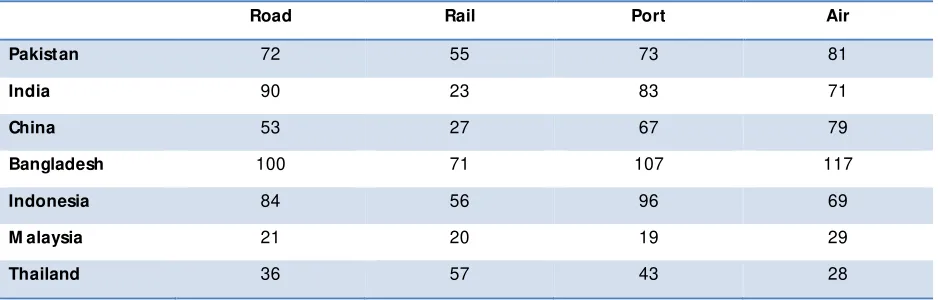
Table 1: Quality of Infrastructure
Road Rail Port Air
Pakistan 72 55 73 81
India 90 23 83 71
China 53 27 67 79
Bangladesh 100 71 107 117
Indonesia 84 56 96 69
M alaysia 21 20 19 29
Thailand 36 57 43 28
Source: Global Com pet it iveness Report 2010
As evident in Table 1, Pakist an seem s t o already have t he road infrast ruct ure in place, w hich is bet t er t han India, Bangladesh, and Indonesia, but it s rail and air infrast ruct ure leave m uch t o be desired. To increase product ivit y, exist ing infrast ruct ure needs t o be ut ilised efficiently t hrough im proved m anagement and safet y.
Alm ost all infrast ruct ure project s have relied heavily on governm ent funding wit h lit t le or no invest m ent from t he privat e sect or. Only in t he last decade did t he governm ent wit hdraw from t he t elecom sect or t hrough privat isat ion. This has result ed in considerable gains in producer and consum er surpluses. Now t he t elecom sect or has not only im proved connect ivit y in Pakist an but has also cont ribut ed PKR 109 billion t o t he Federal Board of Revenue (FBR) in 2009-10. Annual t elecom revenues have increased from PKR 144 billion at t he t im e of privat isat ion in 2005 t o PKR 358 billion in t he fiscal year 2009-10.12
11
E Ost rom, ‘Social Capit al: A fad or fundament al concept ’, Cent re for the Study of Inst itut ions, Populat ion, and Environmental Change, Indiana Universit y, 1999.
12
6
The next sect ion review s t he relevant lit erat ure w hich looks at connect ivit y as an im port ant fact or of econom ic grow t h. It is follow ed by a brief overview of t he st at e of physical and social infrast ruct ure in Pakist an t oday and also analyses how t he present st at e of infrast ruct ure and lack of social capit al induce inefficiencies in m arket s t hat const rain econom ic grow t h. The conclusion discusses a few high priorit y reform s as a w ay of im proving connect ivit y in Pakist an.
Literature Review
Im provem ent in connect ivit y creat es and cult ivat es opport unit ies by linking individuals, organisat ions, com m unit ies and m arket s, and reduces t im e and cost s required for product ive int eract ions. Som e num eric est im at es from research lit erat ure show t he effect of infrast ruct ure on grow t h. How ever, t hese est im at es need t o be com pared w it h invest m ent s in ot her econom ic act ivit ies t o det erm ine w hich ones offer t he best ret urns on invest m ent .
Efficient t ransport and t elecom m unicat ion net w orks reduce product ion and t ransact ion cost s in poor regions13 w hich serve as st im ulus for dom est ic comm erce. Em pirical research shows t hat povert y incidence in ‘good-road provinces’ and ‘bad-road provinces’ of Indonesia decline by 0.33 and 0.09 percent age point s respect ively, for every one percent age point grow t h in provincial GDP. Increase in roads also appears t o im prove t he w ages and em ploym ent levels of t he poor.14 Anot her st udy show s t hat poor households in Viet nam living in rural com munit ies w it h paved roads have a 67 per cent higher probabilit y of escaping povert y t han t hose living in com m unit ies w it hout paved roads.15
Im proved t ransport infrast ruct ure has also reduced povert y incidence in People’s Republic of China t hrough agricult ural product ivit y and non-farm em ploym ent . One per cent increase in road densit y increases agricult ural GDP per w orker by 0.08 percent age point s, non-agricult ural em ploym ent by 0.10 percent age point s and w ages of non-agricult ural workers in rural areas by 0.15 percent age point s. Am ong all infrast ruct ure project s, roads have played a m ajor role in reducing povert y–for every 10,000 Yuan invest ed on rural roads, 3.2 poor persons are est im at ed t o be lift ed out of povert y.16
Caldron and Serven find t hat infrast ruct ure developm ent has a relat ively great er posit ive im pact on t he incom e and welfare of t he poor, hence addressing issues of incom e inequalit y.17 This analysis support s Est ache’s findings t hat infrast ruct ure helps poorer individuals and underdeveloped areas t o get connect ed t o core act ivit ies, t hus allow ing t hem access t o m ore product ive opport unit ies.18 These st udies also ident ify t he posit ive im pact s of infrast ruct ure services on healt h and educat ion of t he poor, w hich boost s em ploym ent , product ivit y and grow t h.
13
C Gannon and Z Liu, ‘Povert y and Transport ,’ M imeo, The World Bank, Washington, DC, 1997.
14
I Ali and E M Pernia, ‘Infrast ructure and Povert y Reduction- What is the Connection?’, Asian Development Bank
15
P Glew w e, M Gragnolat i and H Zaman, ‘Who Gained from Viet nam’s Boom in t he 1990s? An Analysis of Povert y and Inequalit y Trends’, World Bank Working Paper 2275, Washingt on, D.C.
16
S Fan, L Zhang and X Zhang, ‘Growt h, Inequalit y, and Povert y in Rural China: The Role of Public Invest ment s’, Research Report 125, Internat ional Food Policy Research Inst it ut e, Washingt on, D.C., 2002.
17
C Calderon and L Serven, ‘The effect s of infrast ruct ure development on grow th and income dist ribution’, 2004.
18
7
Cell phones and t he Int ernet have becom e m ajor drivers of grow t h and developm ent in m any count ries. St udies have show n t hat 10 ext ra cell phones per 100 people induce 0.6 percent age point s of ext ra per capit a GDP.19 Anot her st udy indicat es t hat cell phones are m ore effect ive in prom ot ing grow t h in developing count ries (inducing an ext ra 0.81 percent age GDP point s by int roduct ion of 10 cell phones per 100 people) t han landline phones (also 10 per 100 people), but have not been as effect ive as int ernet and broadband access, w hich induce an ext ra 1.12 and 1.38 GDP percent age point s.20 How ever, t o com pare t hese gains t o ot her investm ent s t hat also increase GDP and hum an welfare is beyond t he scope of t his report .
Cell phones provide labour flexibilit y and facilit at e small ent repreneurs. One such exam ple is of Quadir (a barber) in Bangladesh. Since he w as unable t o afford t he rent for a shop, he bought a cell phone and a m ot orbike and now goes t o his cust om ers’ hom es for providing his services.21 This has enabled him t o serve a larger area and also charge a higher price for his services. Similarly, cell phones have also prom ot ed flexibilit y am ong ot her sm all ent repreneurs, such as t axi-drivers and m echanics. By providing quick access t o inform at ion, cells phones have m ade sm all m arket s m ore efficient . In Kerala, India, use of cell phones has m ade t he fish m arket s m ore efficient because fisherm en can now check t he prices in several m arket s before deciding w here t o sell.22 Through w ider use of cell phones, corrupt ion can also be reduced. In Pakist an, Zubair Bhat t i asked clerks in Jhang dist rict , w ho handled land t ransfers, t o subm it daily list of t ransact ions, giving t he am ount paid and t he m obile num ber of buyers and sellers t o find out w het her t hey had been asked t o pay bribes. The guilt y part ies w ere t hen charged form ally w hich det erred fut ure corrupt ion.23
A st udy perform ed by Caldron and Serven show s t hat grow t h benefit s of t elecom m unicat ions are higher t han t hose of t he t ransport net w orks.24 In t heir analysis, one st andard deviat ion increase in t ot al t elephone lines (t elecomm unicat ions) increases t he grow t h rat e by 3.1 percent age point s w hereas one st andard deviat ion increase in t he lengt h of road and rail net w ork (t ransport ) increases t he grow t h rat e by 1.4 percent age point s. A st udy carried out by LECG, an econom ics research and consult ing firm , quant ifies product ivit y gains for different levels of broadband adopt ion. It finds an increase in product ivit y of 0.1 percent age point s for every broadband line added per 100 people in count ries wit h m edium or high level of ICT (Inform at ion and Comm unicat ions Technology). In count ries w it h low level of ICT, increase in broadband penet rat ion creat es t he ICT eco-syst em required t o realise product ivit y gains.25 Apart from having a direct im pact on econom ic developm ent , physical connect ivit y also has an indirect effect via im provement in social capit al.
Developm ent econom ics began t o int egrat e not ions of social capit al int o research in t he lat e 1990s, and perhaps t he m ost im port ant examinat ion of social capit al wit hin a developm ent narrat ive has been carried out by M ichael Woolcock. Woolcock26 and Narayan27 found t hat social capit al could bring m ore
19
L Waverman, M M eschi and M Fuss, ‘The Impact of Telecoms on Economic Grow t h in Developing Count ries’, 2005.
20
C Z W Qiang, ‘M obile Telephony: A Transformational Tool for Grow t h and Development ’, Privat e Sector Development , Proparco's M agazine, vol. 1, no.4, 2009.
21
‘M obile M arvels, A Special Report on Telecoms in Emerging M arket s’, The Economist , September, 24t h edition, 2009
22
R Jensen, R, ‘The Digit al Provide: Information (Technology), M arket Performance, and Welfare in the Sout h Indian Fisheries Sect or’, The Quart erly Journal of Economics, vol. CXXII, no.3, 2007, pp.879-924.
23
‘M obile M arvels, A Special Report on Telecoms in Emerging M arket s’, The Economist , September, 24t h edition, 2009
24
C Calderon and L Serven, ‘The effect s of infrast ruct ure development on grow th and income dist ribution’, 2004.
25
‘Economic Impact of Broadband: An Empirical St udy’, LECG, 2009.
26
M Woolcock, ‘Social Capit al and Economic Development : Tow ard a Theoretical Synt hesis and Policy Framework’, Theory and Societ y, vol. 27, 1998, pp.151-208.
27
8
opport unit ies and t hus alleviat e povert y and prom ot e econom ic developm ent . Kaw achi and Berkm an found t hat social cohesion, t ies and t rust are posit ively associat ed wit h self-rat ed healt h st at us, and negat ively w it h m ort alit y and crim e rat es in a comm unit y.28 In a similar vein, Helliw ell and Put nam found t hat a com m unit y’s level of social capit al is posit ively associat ed w it h school perform ance.29
Knack and Keefer explore t he relat ionship bet w een econom ic perform ance in 29 m arket econom ies and t he levels of t rust and civic norm s in t hose econom ies. They observe t hree t hings: (1) t rust and civic cooperat ion have significant im pact on aggregat e econom ic act ivit y; (2) horizont al net w orks (measured by m em bership in groups) are unrelat ed t o t rust and civic norm s (cont rolling for educat ion and incom e) and t o econom ic perform ance; and (3) low social polarisat ion, and form al inst it ut ional rules t hat const rain t he governm ent from act ing arbit rarily, are associat ed w it h t he developm ent of cooperat ive norm s and t rust .30
Akdere and Robert s have summ arised som e key advant ages and disadvant ages of social capit al. They highlight t hree im port ant benefit s of social capit al, as ident ified by Sandefur and Laum ann31, t o be inform at ion, influence and cont rol, and social solidarity.32
Social capit al can also lead t o problem s of free-riding w here less-hardw orking group m em bers possessing great er social capit al ‘m ake dem ands on m ore successful m em bers’. Port es summ arises t his econom ic dow nside as a process w here ‘opport unit ies for ent repreneurial accum ulation and success are dissipat ed’.33 The quest ion of group ow nership oft en leads t o confusion about w het her social capit al benefit s t he group or t he individuals.34 Ot her disadvant ages of social capit al, m ent ioned by Akdere and Robert s are ‘exclusion of out siders’ and ‘dow nw ard levelling of norm s’.35 Specialised social capit al w it hin a com m unit y can deny access t o out siders—e.g. sugar-m ill ow ners m ay collude t o cont rol sugar supply and seek legal prot ect ion (by bribing or lobbying) m aking it difficult for pot ent ial suppliers t o supply t o t he m arket . Similarly, m afia families and criminal gangs dam age social norm s. Labour unions can also use int ernal linkages t o influence decision m aking in ways w hich lead t o inferior out com es.
It is not just t he quant it y of connect ivit y infrast ruct ure w hich effect s grow t h and incom e dist ribut ion but also how efficient ly it is used. One quart er of t he grow t h different ial bet w een Africa and East Asia, and 40 per cent of t he grow t h different ial bet w een high and low grow t h count ries is due t o t he difference in t he effect ive use of infrast ruct ure resources.36 The effect iveness of infrast ruct ure depends on t he efficiencies of agencies and inst it ut ions, w hich are relat ed t o physical infrast ruct ure development , such as t he Nat ional Highw ay Aut horit y (NHA) in t he case of Pakist an.37
28
I Kaw achi and L F Berkman, ‘Social Cohesion, Social Capit al and Healt h’, in Social Epidemiology, Oxford University Press, 2000
29
J F Helliw ell and R D Put nam, ‘Educat ion and Social Capit al’, NBER Working Paper Series, Vol. 7121, 1999.
30
S Knack and P Keefer, ‘Does Social Capit al Have an Economic Payoff?’, The Quart erly Journal of Economics, vol. 112, 1997, pp.1251-1288.
31
R L Sandefur and E Laumann, ‘A Paradigm for Social Capit al’, Rat ionalit y and Societ y,vol. 10, no.4, 1998, pp.481-501.
32
M Akdere and P Robert , ‘Economics of Social Capit al: Implicat ions for Organisat ional Performance’, Advances in Developing Human Resources, vol. 10, no. 6, 2008, pp.802-816.
33
A Port es and P Landolt., ‘The dow nside of social capit al’, The American Prospect, vol. 26, no. 94, 1996, pp.18–22.
34
L Crudelli, ‘Social Capit al and Economic Opport unities’, Journal of Socio Economics, vol. 35, no.5, 2006, pp. 913-927.
35
ibid.
36
C Hult en, ‘Infrast ruct ure Capit al and Economic Grow th: How Well You Use It M ay Be M ore Import ant than How M uch You Have’, NBER Working Paper 5847, 1996.
37
9
Connectivity in Pakistan
Toget her t elecom and t ransport sect or of Pakist an account for m ore t han 12 per cent of t ot al GDP. Telecom sect or has a share of t w o percent of GDP but cont ribut es 6 t o 7 per cent in t ot al t ax revenue. Transport at ion sect or has a m uch bigger GDP share of 10.5 per cent and also provides over 6 per cent of em ployment in t he count ry.
According t o t he World Bank ‘alt hough t he [t ransport ] sect or is funct ional, it s inefficiencies (long w ait ing and t ravelling t im es), high cost s, and low reliabilit y are dragging t he count ry’s econom ic grow t h. These fact ors also reduce t he com pet itiveness of t he count ry’s export s, increase t he cost of doing business, and const rain Pakist an's abilit y t o int egrat e int o global supply chains, w hich require just -in-t ime delivery. The poor perform ance of t he sect or is est im at ed t o cost t he econom y about 5 per cent of GDP every year’.38
Road and Trucking
Road Infrastructure
The federal budget exhibit s a st rong bias t ow ards financing t he const ruct ion and m aint enance of roads. Since 1996, t ot al road lengt h has increased by 13 per cent t o 259,618 km in 2010, out of w hich 70% (179,290 km ) are high-t ype (paved) roads. Nat ional Highw ays and M ot orw ays const it ut e 4.2 per cent of t he t ot al road net w ork and handle m ore t han 85 per cent of t ot al com m ercial t raffic in Pakist an.39
M ost of Pakist an’s highw ays and m ot orw ays are along t he Nort h-Sout h corridor w it h N-5 act ing as t he m ain art ery carrying 55 per cent of t he count ry’s int er-cit y t raffic. Ot her m ajor roads include N-55 (Indus Highw ay), N-25, N-65, N-40 (RCD Highw ay) N-45, N-50, N-70, N-35 (Karakoram Highw ay), M -1 (Islam abad-Peshaw ar M ot orw ay), M -2 (Islam abad-Lahore M ot orw ay) and M -3 (Pindi Bhat t ian-Faisalabad M ot orw ay). Around 60 per cent of t he road net w ork is in poor condit ion, m ainly due t o poor m aint enance, t raffic congest ion and burst t ires lit t ering t he highw ays and m aking t hem dangerous, especially at night , w hen t here is poor visibilit y. There has been a significant shift from railw ays t o roads, for bot h passenger and freight t ransport .
Over t he past few years, t here has been gradual increase in t he lengt h of paved roads and decline in low -t ype (unpaved) roads, since m ost low -t ype roads are being convert ed t o high-t ype. National Highw ay Aut horit y (NHA) has been carrying out ext ensive road developm ent project s. 30 new project s are focusing on ext ending t he net w ork by 1,000 km , including bridges, flyovers and int erchanges. NHA has also m anaged t o increase it s t oll revenue by 36 per cent over t he past year.
Anot her problem in road t ransport at ion is corrupt ion w it hin t he police syst em. Traffic law s are lax in Pakist an—breaking t he law and underage rash driving are com m on occurrences on t he road. Policem en rarely punish violat ors. They are oft en underpaid and w ork long hours and t herefore resort t o accept ing bribes in ret urn for let t ing law breakers go free. Corrupt ion is also ram pant w hen aw arding const ruct ion
38
‘Doing Business in Pakist an 2010’, The World Bank, Washingt on DC, 2010
39
10
of road project s. Roads are const ruct ed poorly w it h low st andards so t hat t hey det eriorat e quickly and cont ract s are t hen given t o t he sam e firm s for repair and m aint enance.
Trucking Services
For t ransport at ion, Pakist an relies heavily on t rucking indust ry w hich handles 96 per cent of t ot al freight t raffic.40 The num ber of regist ered t rucks is 216,043 w hile t hose frequent ly using t he roads are est im at ed t o be 196,850. Out of t he t ot al fleet , t w o-t hirds com prise single or double-axle t rucks ow ned m ainly by sm all operat ors. Nat ional Logist ic Cell (NLC) is t he largest operat or w it h a m arket share of approxim at ely 10 per cent
Low freight rat es (w hich const rain t he revenue of independent t ruckers) in t he dom est ic m arket and high im port t ariffs on high capacit y m ult i-axle t rucks (w hich varies from 30 t o 60 per cent ) are m ajor hurdles faced by independent operat ors. Low freight rat es are a result of ext rem e com pet it ion in a m arket w it h m any small, independent operat ors. Alt hough t his cont ribut es t ow ards low ering t he cost of doing business for t hose w ho use t rucking services, cost s t o societ y due t o road dam age rise significant ly from overload and int ensive use of highw ays (w hich do not get repaired and m aint ained), w ast age of edible product s and dam age t o goods during t ransport at ion, and increased rat e of accident s.
Rail Transport
Railw ays all over t he w orld have an edge in long haul and m ass scale t ransport at ion of bot h goods and passengers. In Pakist an, it w as t he prim ary m ode of t ransport unt il t he 1970s. Since t hen railw ays’ share has declined due t o t he shift in governm ent ’s preference t ow ards road. During 2005-10, budget ary expendit ure on railw ays w as only PKR 45.5 billion, whereas for nat ional highw ays it st ood at PKR 155 billion.41 Today railw ays’ share of inland t raffic has reduced from 41 per cent t o 10 per cent for passenger and 73 per cent t o 4 per cent for freight t raf fic.
Tim ely and safe delivery of goods t o t he Nort h from t he port , in t he Sout h, becam e a m ajor issue aft er t he shift in preferences of policy-m akers. Aft er t he creat ion of NLC t o clear t he goods from Karachi port , Pakist an Railw ays (PR) has found it difficult t o regain it s hist orical posit ion. This has furt her pushed PR backw ard. Since 1990-91, t ot al t rack lengt h has decreased from 8,775 t o 7,791 km . Sim ilarly, t ot al freight and passengers carried has decreased from 5,709 t o 3,925 m illion t ons and 84.9 t o 58.9 m illion people, respect ively.
In t he last decade, how ever, PR has show n an encouraging t rend in bot h passenger and freight revenue regist ering an average increase of 3.2 per cent and 4 per cent per annum , respect ively. How ever, significant reduct ion in revenue during t he past year has been at t ribut ed t o econom ic slow dow n and short age of locom ot ives due t o unavailabilit y of spare part s. The delay has been aggravat ed by reduct ion in Public Sect or Developm ent Program (PSDP) allocat ion and ot her dom est ic facilities. Engines acquired recent ly from China are also experiencing m aint enance issues, w hich have lead t o closure of various rout es.
40
‘Economic Survey of Pakist an 2009-10’, M inist ry of Finance, Government of Pakist an, 2010.
41
11
Table 2: Revenue of Pakistan Railw ays
Fiscal Year
Revenue (PKR M illion)
per cent Change
1998-99 9,310 --
1999-00 9,889 6.2
2000-01 11,938 20.7
2001-02 13,046 9.3
2002-03 14,812 13.5
2003-04 14,636 -1.2
2004-05 18,027 23.2
2005-06 18,184 0.9
2006-07 19,194 5.5
2007-08 19,973 4.1
2008-09 23,160 16.0
2009-10
Jul- M ar
16,875 -3.3
Source: Economic Survey of Pakist an 2009-10
Revenue is still very low , hardly enough t o cover salaries and pensions, w hich equal PKR 14 billion and 7 billion per annum , respect ively. In 2008-09, revenue grew by 16 per cent com pared t o t he year before but since t hen revenue has declined t o pre-2004 levels (Table 2), resulting in negat ive grow t h rat es. Despit e im proved performance during t he last decade, losses rem ain high. In 2006-07, t ot al loss w as PKR 10 billion and in 2007-08, it w as over PKR 12 billion.
Aviation
As of 2007-08, Pakist an had 35 airport s w hich handled m ore t han 14 million passengers and 318,652 m illion t ons of cargo during t he fiscal year.42 Jinnah Int ernat ional Airport in Karachi is t he busiest , w hile Lahore and Islam abad airport s also handle significant t raffic. Cargo and passenger t raffic in 2007-08 decreased from 2005-06, due t o securit y concerns and poor econom ic and polit ical environment . Passenger t raffic declined by 0.4 m illion, w hereas freight decreased from 347,674 t o 318,652 m illion t ons.
Num ber of dom est ic and int ernat ional airlines operat ing in Pakist an has rem ained about 28. Num ber of dom est ic airlines has, how ever, declined from five t o t hree in last couple of years. Aero Asia and Royal Airlines w ent out of business due t o m ism anagem ent and governm ent ’s close cooperat ion w it h PIA, w hich const rained t he econom ic space f or sm aller carriers. PIA has a m arket share of m ore t han 80 per cent in passenger t raffic and capt ures alm ost all dom est ic air-cargo t ransact ions.
On int ernat ional rout es, t here are frequent flight s t o UK and M iddle East ern count ries. Dem and on t hese rout es m ainly com es from Pakist ani labour w orking abroad. However linkages wit h ot her count ries rem ain largely infrequent and t im e consum ing. There is only one direct flight t o US (JFK Airport ) in a w eek and t hat also from Lahore only. Average t im e on a direct flight t o US is 18 hours,
42
12
w hereas on connect ing flight s it norm ally t akes m ore t han 24 hours. Sim ilarly, t here are only t w o direct flight s t o China (Beijing Airport ), each w eek. Also, t here are few flight s t o Germ any, France and ot her European dest inat ions. Connect ivit y w it h Africa, Lat in America and Sout h East Asia is also limit ed. Current ly t here is no Pakist ani airline flying t o African and Lat in Am erican count ries m ainly due t o lit t le dem and. Sout h East Asia also st ays unt ouched by Pakist ani airlines, except one or t w o direct flight s t o M alaysia. Connect ing flight s t o t hese dest inat ions are available but it t akes m uch longer t han flying direct and adds uncert aint y t o t ravel plans.
An in-dept h st udy needs t o be carried out t o ascert ain t he dem and for flight s from Pakist an t o various int ernat ional cit ies at different prices and how m uch of t hat dem and (dom est ic and int ernat ional) can be fulfilled t hrough exist ing airlines, if t here w ere no rest rict ions im posed by t he governm ent regarding t he num ber of flight s t he airlines m ay offer. Per kilom et re cost of air t ravel from Pakist an is also high relat ive t o regional econom ies (See Appendix 1).
Dom est ic connect ivit y also faces some const raint s for grow t h, due t o inadequat e airport handling, frequent bird hit s and slow check-in procedures. Dom est ic m arket largely st ays biased t ow ards PIA t hrough preferent ial rout e allocat ion, t ax benefit s and ot her prot ect ionist policies m aking it difficult for new carriers t o ent er t he aviat ion sect or. Due t o ext ra securit y checks on airlines flying t hrough Pakist an and t he recent recession in t he aviat ion sect or, int ernat ional airlines have been reluct ant t o expand in t he Pakist ani m arket .
Information and Communications Technology (ICT)
Due t o econom ic slow dow n in last couple of years, service-providers in Pakist an have t aken several cost cut t ing m easures including opt im isation of hum an resources, cut in em ployees’ perks and freezing em ployment . Recent floods have also dam aged t he exist ing infrast ruct ure w hich has forced operat ors t o divert t heir funds aw ay from net w ork expansion t ow ards repair and m aint enance.
Mobile Telephony
Rural incom e has risen in m any count ries wit h t he use of m obile phones. Wit h t he int roduct ion of prpaid services, low -incom e groups have access t o cellular w hich help provide and facilit at e incom e-generat ing act ivit ies. M obilink has int roduced a M obilink PCO syst em on t he basis of t he village phone m odel t hat provides incom e opport unit ies t o households using m obile phones t o sell phone calls t o t hose w ho cannot afford a cell phone.
13
Fixed land line penet rat ion has rem ained low despit e issuance of new licenses. Old copper-based infrast ruct ure rem ains a significant hurdle in it s grow t h. To inst all new fibre opt ics net w orks, huge invest m ent is required. Wireless local loop operat ors (Wat een and Wi-t ribe) have divert ed t heir resources t ow ards broadband expansion.
Source: Annual Report 2009-10, PTA
Internet and Broadband
Lat ely, int ernet services have experienced significant expansion w it h 13 com panies com pet ing for subscribers. According t o ISPAK (Associat ion of Pakistani ISPs) est im at es, t here were about 3.5 m illion int ernet subscribers during 2007 across Pakist an and m ore t han 17 m illion users—i.e. about 5 users per subscript ion. The num ber of int ernet users increased t o 20.5 m illion in 2009.43
Proport ion of different broadband t echnologies in Pakist an is illust rat ed in Figure 2. DSL has hist orically dom inat ed due t o t he exist ence of fixed land line infrast ruct ure. How ever, share of DSL has decreased from 100 per cent t o 53 per cent m ainly due t o successful experience of WiM ax t echnology. WiM ax w as int roduced in Pakist an by Wat een Telecom Lt d (a privat e com pany) in Decem ber 2007 and since t hen it has grow n t o 257,585 subscribers. Ot her players include Wi-t ribe and PTCL. EvDO (by PTCL) is also a w ireless t echnology w hich uses radio signal for t ransm ission. It is m ainly used t o provide m obile broadband services. Init ially WorldCall w as t he sole provider of broadband service but now PTCL has st epped up by offering EvDO in 100 cit ies in Pakist an.
Current ly broadband penet rat ion in Pakist an rem ains very low at 0.5 per cent (900,648 subscribers). This low level of penet rat ion, despit e considerable grow t h, is due t o less focus on rural areas, low lit eracy, poor com put er skills, lack of local cont ent and applicat ions, det eriorat ing st andard of fixed land lines, high cost s for pot ent ial rural subscribers, reservations am ong parent s regarding cyber securit y and child safet y, and language barriers.
43
‘The World Factbook 2010’, CIA 2010
0% 50% 100%
2003-04 2005-06 2009-10
M obilink Ufone Zong
Inst aphone Telenor Warid
Figure 1: M arket Share of Cellural Subscribers (%)
52.9%
5.5% 28.6%
0.7% 12.3%
DSL HFC WiM ax FTTH EvDO
14
Connectivity Scorecard
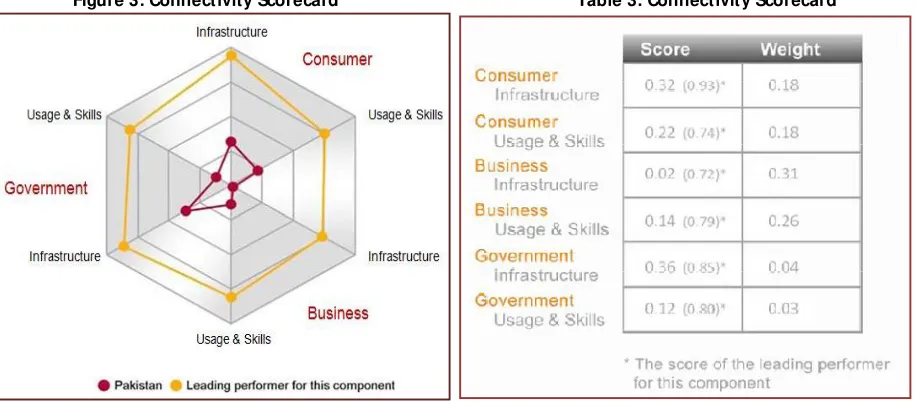
Waverm an and Dasgupt a have given Pakist an a t elecom connect ivit y score of 1.53 out of 10 in ‘Useful Connect ivit y’.44 This gives Pakist an t he low est rank in a group of 25 resource driven econom ies. In t he sam e group, India is ranked 21st and China 17t h.
Figure 3: Connectivity Scorecard Table 3: Connectivity Scorecard
Source:w w w .connect ivit yscorecard.org (2010)
Figure 3 show s Pakist an’s relat ive posit ion com pared t o leading count ries in each sub-sect or. Table 3, w hile present ing perform ance in num eric form , also show s t he im port ance of each sub-sect or w hen com put ing final connect ivit y score. Pakist an does poorly in all sect ors. How ever, score in t he consum er sect or is relat ively bet t er, m ainly due t o increasing foreign and dom est ic invest m ent in consum er-focused ICT infrast ruct ure.
Since 2001-02, foreign direct invest m ent in ICT has increased from USD 6.1 million t o USD 1.44 billion in 2007-08. This has result ed in im provem ent in consum er sect or infrast ruct ure and usage and skills com pared t o previous years.45
In t he Governm ent sect or, alt hough significant infrast ruct ure is available, w hich highlight s government int ent ion of prom ot ing ICT, but due t o poor usage and skills not all benefit s are being realised. Business sect or, w hich get s 57 per cent of t he t ot al w eight , does not score as high as t he consum er sect or, in bot h infrast ruct ure and usage and skills – business sect or scores are very low . Why t his is so, needs furt her invest igat ion and in-dept h analysis.
e-Government
Pakist an also scores poorly in e-government w hich if im proved could significant ly increase usage of ICT for bot h businesses and consum ers. A Unit ed Nat ion’s survey breaks e-governm ent developm ent process int o five phases t hat include Em erging, Enhanced, Int eract ive, Transact ional and Connect ed.46 The first st age involves online presence of various minist ries in t he form of w eb page(s) show ing st at ic
44
L Waverman and K Dasgupt a, ‘Connect ivit y Scorecard 2010’, LECG, 2010.
45
‘Broadband and Value Added Services’, Pakist an Telecommunicat ion Aut horit y (PTA), 2009
46
[image:15.612.74.532.148.349.2]15
Box 2 – Sachivalaya Vahini or e-governance in the Secretariat in Karnataka
The Secret ariat is t he apex decision m aking body of the st ate and deals wit h a large num ber of departm ent s. It involves an enorm ous am ount of comm unicat ion, keeping, m aint aining and processing a large volume of dat a files. The m anual creat ion, m ovem ent and m aintenance of files involved enorm ous delays and inefficiencies. The governm ent of Karnat aka has recently set up a Secret ariat Local Area Net w ork by connecting 1000 com puters in 40 st at e depart ment s and 6000 secret ariat s. The Nat ional Informat ics Cent re of t he st at e provided softw are support . The project has t he following com ponent s:
(a) Pat ra-t he Let t er M onit oring Syst em. This is designed for the m anagem ent of a large num ber of let ters received in t he secret ariat by scanning t hese let t ers and m oving t hem from desk t o desk, or departm ent t o departm ent ;
(b) Kadat ha-File M onit oring Syst em is t he decision support syst em t o m onit or, t rack and decide/ dispose t he files wit hout delays. Through t his syst em , elect ronic files are m oved from desk t o desk and from departm ent t o depart ment wit hout w ast e of t im e;
(c) M okaddam e-Court Case M onit oring Syst em m onit ors t he court cases in w hich governm ent is t he party. Cases received, pet itioners/ respondent s det ails, court orders, cases put up for hearing on a part icular day/ t ype can efficient ly be m anaged;
(d) Aayayaya-Budget M onit oring Syst em helps in m aking budget est im at es. It also m onit ors budget proposals once a budget is allocat ed t o departm ent s;
(e) Sibbandi-Personal Inform at ion Syst em m aint ains inform at ion about det ails of employees. Wit hin a single click, t he entire hist ory of t he em ployee can be view ed;
(f) Cust om er Support Syst em provides an online syst em t o lodge any complaint s regarding hardw are, net w ork, and applicat ion soft w are syst em. This syst em also provides online instructions for t he solut ions t o problem s.
Source: Human Developm ent in Sout h Asia 2008, M ahbub ul Haq Human Development Cent r e
inform at ion. In t he t hird st age, governm ent delivers online services such as dow nloadable form s. Services t o increase t he convenience of cit izens and a user-friendly int erface also st art becom ing evident . The fift h and final st age, w hich is t he m ost advanced level of connect ivit y, is charact erised by:
1. Horizont al connect ions (am ong governm ent agencies) 2. Vert ical connect ions (cent ral and local governm ent agencies) 3. Infrast ruct ure connect ions (int eroperabilit y issues)
4. Connect ions bet w een governm ent s and cit izens
5. Connect ions am ong st akeholders (government , privat e sect or, academ ic inst it ut ions, NGOs and civil societ y).
16
Human Capital: Why Brain Drain?
While t he im port ance of connect ivit y is em phasised, it s effect ive ut ilisat ion depends on hum an capit al (skills, know ledge and experience). Appropriat e skills are required t o cult ivat e a connect ion—for exam ple one needs t o know how t o operat e a vehicle (especially a large 18 w heel t ruck) in order t o fully benefit from t he road net w ork, or how t o use a lapt op t o connect t o t he int ernet , how t o use a cell phone t o connect rem ot ely t o int eract w it h som eone else. At a m acro level, high qualit y hum an capit al is also necessary especially w hen it com es t o t he m anagem ent of exist ing resources.
M ost of t he hum an capit al in Pakist an com prises low - t o m edium -skilled labour. High-skilled hum an capit al, finds it self w ell off in m igrat ing t o developed w orld. The end result is brain drain. If t ransm ission of know ledge and skills t akes place from high- t o m edium - and consequent ly t o low -skilled labour, w here highly-skilled keep up wit h t he recent t rends in t heir profession, brain drain can significant ly be reduced. Ot her t han im proving t he qualit y of educat ion t o develop highly-skilled hum an capit al, st rat egies m ust be devised t o ret ain and m ot ivat e t his t op of t he line labour force t hat can benefit Pakist an’s grow t h.47 Brain drain, alt hough a significant source of foreign remit t ances, ult im at ely leads t o det eriorat ion of inst it ut ional qualit y in t he hom e count ry t o w hich Haque alludes as t he ‘vicious cycle’ (See Box 3).
47
17
Box 3 – Vicious Cycle of Poor Governance and Brain Drain
For political reasons, governm ent s in poor countries have found it expedient t o expand em ploym ent w hile capping w age grow t h. Sim ilar considerations have led t o the pursuit of egalit arian policy in t he government cadre so t hat w age scales have been compressed and salary increases and prom ot ions are not merit -based. The result is t hat t here has been a large flow from t hese public sectors not only t o t he International Financial Inst it ut ions (IFIs) but also t o t he m ultinat ional sect or, internat ionally as w ell as dom est ically.
Wit h poor inst it utions and poor governance, public sect or delivery of services—personal security, physical infrastruct ure, such as roads and railw ays, clean environm ent and facilit ies t o raise children and provide a fut ure for t hem —is poor or inadequat e. Declining qualit y of services has oft en been cited as a cause of flight of hum an capit al. Poor governance can t herefore be self-reinforcing. Once it set s in, it ratchet s t axes upw ards and encourages evasion; low ers professional st andards, encouraging t he flight of bet ter professionals leaving t he poor qualit y professionals t o m anage wit h ever weakening st andards. M any int erest ing m odels have been developed t o illust rate how poor incent ives can lead t o poor allocat ion of t alent , w hich ult im at ely im pedes governance and grow t h. Societ ies w it h poor governance can be st uck in a low grow t h t rap w hich is difficult t o break out from .
Despit e numerous consult ant and t echnical assist ance report s for capacit y building and civil service reform s cit ing t he scarcit y of skills as a m ajor const raint t o developm ent , t o dat e no syst em at ic at t em pt s at developing an assessm ent of needed skills in t he poor countries has been undert aken. Yet it is obvious t o t hose involved in t echnical assist ance and t raining, t o m aint ain vigilant syst em s for supervision and regulat ion, provision of social developm ent (including healt h and educat ion), developm ent and m aintenance of infrast ructure and governance in general, key skills such as academic, financial, engineering, m anagerial, and medical are required at different qualit y levels. Continuous flight of hum an capital will ret ard t he modernisat ion process as well as t he developm ent and im plem ent ation of effect ive dom estic policy.
Source: NU Haque, ‘Brain Drain or Human Capit al Flight ’, Pakist an Inst it ut e of Developm ent Economics (PIDE), 2005.
State of Social Capital
Zaidi has analysed t he overall st at e of social capit al in Pakist an48 by looking at som e key inst rument s w hich affect and reflect t he int ensit y of social int eract ions w it hin com m unit ies such as libraries, public spaces, com m it t ees or ROSCAs, professional associat ions and labour unions. Som e key findings of t he st udy are sum m arised in Box 4.
48
18
Box 4 – Components of Social Capital
M easuring social capit al is a com plex exercise. A num ber of indicative exam ples of social capit al m ay be useful for fut ure research, and deriving som e generic policy inferences.
Professional Associations and Labour Unions
Professional and labour unions are vit al form s of social capit al for individuals w ho cannot easily influence political and economic decisions, independent ly, in the absence of unified expressions of collective interest s. Professional associations represent highly specialised and skilled labour. M em bership in professional associat ions helps in ident ifying trained professionals t hat exist in a given econom y.
The Pakist an M edical and Dent al Council report s a t ot al of 144,403 qualified and licensed doct ors and dentist s in t he country. This represent s less t han one physician per 1,000 people. M ost developed countries have a m inimum of t hree or m ore physicians per 1,000 people. M em bership of t he Inst it ut e of Chartered Account ant s, w hich certifies Chart ered Account ant s (CAs) in Pakist an, is also skew ed. 71 per cent (5,078) of CAs in Pakist an w ork in four cities: Islam abad, Raw alpindi, Lahore and Karachi. Similarly t ot al m em bership in labour unions in Pakist an, as recorded by t he Pakist an St at istical Handbook of t he St atist ics Division, has also decreased by 35 per cent since 1980. There is m ore unionised labour in t he public sect or t han in t he privat e sect or. The WAPDA (Wat er and Pow er Developm ent Authorit y) union has regularly m anaged t o prot ect t he collect ive int erest s of WAPDA em ployees.
Committees and ROSCAs
A comm on mechanism of inform al credit in Pakist an is a ‘com mit t ee’ or Rotat ional Savings and Credit Associat ion (ROSCA). ROSCAs use social collat eral (connect ions bet w een individuals and t he t hreat of social sanct ions) t o address t he problem of incom plet e cont ract s due t o im perfect inform ation and difficult enforceabilit y. ROSCAs rely t o a significant degree on social capit al. ROSCA m em bers gat her for a series of econom ically m ot ivat ed meet ings. Inform al surveys of housew ives, shopkeepers, m em bers of closely knit religious and et hnic com munities, especially in urban areas, confirm eit her part icipating in or knowing of a social comm it t ee.Num erous inst ances of policy prescriptions have called for finding a w ay t o t ake advant age of t he comm it tee syst em —an exist ing exam ple of t he econom ic value of social capit al. For exam ple, in Sm all & M edium Ent erprise Developm ent Aut horit y’s (SEM DA’s) Provincial Ent repreneurship Prom otion St rategy 2004-2008, one of t he recomm endations for helping ent repreneurs is by providing t hem wit h greater access t o comm it tees.
How ever, at t em pt s t o form alise an inform al m echanism t hat is a m anifest at ion of social capit al in action m ay be a very bad policy. The ent ire basis for t he success of ROSCAs and comm it tees is t he inform al arrangem ent . How ever t here is no verifiable dat abase of various com mit tees in Pakist an. M et rics for est im ating t he size and scope of ROSCAs are unknow n. Wit hout a subst ant ial am ount of research int o ROSCAs any concert ed or clear policy prescription w ould be speculat ive, and from t he angle of social capit al, pot ent ially det riment al t o t he comm unit ies.
Source: M Zaidi, ‘Disconnect ed? Physical Capit al, Social Capit al, And Connect ivit y for Economic Grow t h in Pakist an’, Cent re f or t he Process of Change, 2011
19
Box 5 – Libraries as Public Spaces
There is no official est im at e for t he t ot al num ber of libraries in Pakist an. The last know n survey undert aken in 1989 est im at ed a t ot al of 284 libraries in the count ry. In an int erview , officials at t he Nat ional Public Library est im ated t he num ber of public libraries t o be about 400, w hich included a caut ionary not e about w hat const it ut es a ‘public library’ at t he Tehsil level in Pakist an—oft en no m ore t han a few shelves of books inside a dist rict or Tehsil headquarters, w hich is alm ost never used.
Anecdot al evidence from bot h t he provincial and dist rict level belies t he est im at es provided. For exam ple, Sindh, w hich has 23 dist rict s, has no public libraries of any kind in sixt een of t hose dist rict s. In Raw alpindi, a dist rict w it h a populat ion of over 4.5 million, only t w o public libraries are functional. Next door, in t he federal capit al of Islam abad, w here t here are as m any as six public libraries, none are functional, lack w at er and electricit y, as w ell as t he requisite st aff. One of t he problem s has been inconsist ent library policies. In a survey of governm ent ’s perform ance in prom ot ing libraries, Bushra Alm as Jasw al, Chief Librarian at Form an Christ ian College Universit y, Lahore, illust rates t he declining t rend in effort s t o prom ot e and sust ain libraries in Pakist an since 1947. Jasw al measures perform ance on a six point scale in t he areas of planning, legal activity, developm ent and financial support . The current st at e of libraries in Pakist an is not hard t o underst and w hen review ing Jasw al’s excellent portrayal of public policy for libraries. In eras w here t here w as planning and legislat ive act ivit y, t here w as no m oney. When t here w as money, t here w as no planning.
Other Examples of Public Space
Though t here is lit tle dat a on public parks and sport ing venues for yout h, anecdot al evidence suggest s t hese spaces have skew ed usage. Pakist an’s cricket grounds or street s do not show a cross-sect ional represent ation of t he socio-economic range of Pakist anis. Low confidence in law and order sit uat ion and poor qualit y of grounds and parks could be playing a crit ical role in separat ing Pakist ani children from different economic st rat a. The traditional place w here comm unit ies sit and interact wit h each ot her, t he Pakist ani version of t he café, is t he Dhaaba. In m ore urbanised spaces, corner Dhaabas oft en adorn t he st reet s on w hich m odern cafés have come up, w hich means t hat t he socio-econom ic divide once again determ ines w here you eat and drink and w ho you interact wit h.
The Local Governm ent Ordinance 2001 included a num ber of inst rum ent s t hat sought t o leverage t he sense of comm unit y t hat is germ ane t o Pakist ani societ y in service of rural and urban development . Insaaf Com mit t ees, M usalihat-e-Anjum an and t he Cit izen Comm unit y Boards (CCBs), all sought t o help drive local solutions for local problem s by form ally recognising t he social net w orks and t rust bonds of com munities, m any of w hich had funct ioned w it hout fail for centuries. How ever, m ost of the comm unit y inst rum ent s conceived by t he Local Governm ent Ordinance 2001 w ere of course unable t o survive t he rollback of devolved local governm ent s in 2009 and 2010. This singular lack of political viabilit y for inst rument s t hat largely sought t o form ally recognise, rew ard and sust ain inform al instit ut ions of t he com munit y m ay represent an im port ant trend.
Source: M Zaidi, ‘Disconnect ed? Physical Capit al, Social Capit al, And Connect ivit y for Economic Grow t h in Pakist an’, Cent re f or t he Process of Change, 2011
library st aff. It is sad t hat valuable resources are const ruct ed, purchased and st ored but hardly ever used by our cit izens–yout h and professionals alike–and not properly m aint ained. The st at e of libraries in Pakist an is sum m arised in Box 5.
20
dedicat ed for various ‘collect ive’ act ivit ies for int eract ing, w hich develop social capit al. Similarly, m anagers of public spaces (Cent ral Park, Tim e Square, Trafalgar Square), frequent ly organise fest ivals, fairs, concert s, m arat hons and sport ing event s. In t he Unit ed St at es, school parks are open t o com m unit ies aft er school t im ings–an efficient w ay of ut ilising exist ing infrast ruct ure.
Social capit al can also be of int ernat ional nat ure—in t he form of Pakist ani Diasporas. India present s a good regional case st udy. St udent s graduat ing from Indian Inst it ut e of Technology (IIT) and Indian Inst it ut e of M anagem ent (IIM ), bot h having m any cam puses nat ionw ide, go t o t he developed w orld, especially t o t he U.S., for higher educat ion (M ast ers and PhD degrees). Since 1953, m ore t han t w ent y t housand Indians have m igrat ed t o t he Unit ed St at es. Alt hough t hese inst it ut ions of higher learning have been crit icised for encouraging brain drain from India, t he highly educat ed and w ell connect ed Indian Diaspora have provided a vit al plat form t o India for great er int ernat ional net w orking and creat ing t he t echnology hub in Bangalore, Hyderabad and ot her cit ies in India, during t he past 20 years.
Aft er liberalisat ion of t he Indian econom y, in t he early 1990s, t he past t rend of brain drain is experiencing a gradual reversal. Now , Indian Diaspora is not only invest ing in India but is cult ivat ing social capit al t hat em erged from t he hum an capit al cont ext (i.e., IIT and IIM alum s) by bringing in business cont ract s from t he Unit ed St at es (banks, m ult inat ionals, and even U.S. dom est ic firm s) t hrough t heir int ernat ional cont act s. The ret urn of t he Diaspora and t heir net w orks are being fused w it h dom est ic net w orks and cont ribut ing significant ly t owards developm ent of Indian m arket s, com m erce, inst it ut ions and overall econom ic grow t h. Over t he last decade, em erging scient ific and m anufact uring indust ries and out sourcing of t echnical jobs from Nort h Am erica and West ern Europe t o India has creat ed significant opport unit ies for t he graduat es w it hin India.
Pakist an also has a significant Diaspora. However, volat ilit y in econom ic grow t h, polit ical inst abilit y, insecurit y and lack of polit ical consensus t o pass essent ial reform s discourages t he Diaspora from invest ing in Pakist an or collaborat ing w it h local ent erprises and inst it ut ions (Box 6).
Box 6 – Three M ain Reasons for Flight of Professional Skills
1. Incentive of a higher rat e of ret urn, often at a lower risk, t o hum an capit al in t he host country. This occurs for at least t he follow ing t w o reasons:
a. Host count ries are oft en able t o offer m arket det ermined salaries, unlike t he count ries of origin w here t he public sect or int ervenes and int erferes in alm ost all professions and has an et hos of non-com pet it ive rem unerat ions.
b. Host count ries have a st able m acroeconom ic and socio-polit ical environm ent t hat provides securit y as w ell as subst antial creat ure comfort s, both of w hich oft en are in question in t he home count ry. 2. For professional grow t h, it m ight be im port ant t o be in t he professional cent ers t hat are m ainly in
developed econom ies. Wit hout participat ion in such centers and conferences, t he risk of professional m arginalisat ion and obsolescence is great.
3. Poor countries, because of resource short ages or mism anagem ent s, are frequently unable t o provide com plem ent ary input s for t he practice of t he concerned profession. For example, research scient ist s in universit ies m ay not have laborat ory facilit ies; doct ors m ay not have hospit al equipment , etc.
21
Global Connectivity
Share in int ernat ional t rade can be view ed as a proxy for global connect ivit y of any count ry as it is m ost ly t he case t hat count ries w it h organised physical and social net w orks find it m ut ually beneficial t o t ransact w it h each ot her. Pakist an’s share in int ernat ional t rade has experienced minim al change during last t hree decades. The only significant reform effort w as m ade during t he first of half of 2000-10 under t he t rade liberalisat ion program . It involved reduct ion in governm ent t rading m onopolies–especially in agricult ural sect or–rem oval of im port quot as, im port surcharge and regulat ory dut ies, and significant t ariff cut s and rat ionalisat ion. The result ing st ruct ural changes lead t o increase in t he openness rat io from 25 per cent t o alm ost 30 per cent w hich w as lat er ident ified as t he t hird m ost im port ant fact or cont ribut ing t ow ards econom ic grow t h.49 Anot her posit ive out com e w as also an init ial sign of export diversificat ion.50 How ever, t he second half, especially aft er t he financial crisis of 2008, saw a dram at ic reversal of t his policy hence elim inat ing t he benefit s accrued t ill t hen.
Today m ost of Pakist an’s export s rem ain geographically concent rat ed. In 2010, t hree m arket s (UK, US and t he EU) absorbed 64 per cent of Pakist an’s t ot al export s in goods and services. Recent ly, St at e Bank of Pakist an has also t aken significant st eps in t he direct ion t o ease t ransact ion bet w een Pakist an and Gulf count ries. This has result ed in increased inflow of remit t ances from t arget ed count ries t hrough form al channels (Figure 4).
Pakist an’s connect ivit y w it h rest of t he w orld and m ost im port ant ly t he neighbouring count ries is very limit ed. This is visible from Pakist an’s t rade share w it h India, China, Iran and Afghanist an w hich t oget her st ands at only 20 per cent of t he t ot al. Out of t his, 60 per cent com prises t rade w it h China alone w hereas t rade w it h count ries on t he w est ern border suffers from poor physical infrast ruct ure, w hile t rade w it h India is largely a question of polit ical will. The m at t er get s exacerbat ed due t o m anual processing at t he cust om s and border post s.
49
‘Pakist an: Growt h and Export Competit iveness’, Report No. 35499-PK, The World Bank, Washingt on DC., 2003.
50
‘Pakist an: Framew ork for Economic Growt h: Pakist an’, Planning Commission, Islamabad, 2011. 0
0.5 1 1.5 2 2.5
US UK Saudi
Arabia
UAE Ot her Gulf Count ries
EU Ot her
Count ries
[image:22.612.106.489.365.550.2]2011 2010
22
There is significant t rade pot ent ial w hich can be exploit ed w it h t he adopt ion of t he com binat ion of reduced rest rict ions, im proved t ransport net w ork and aut om at ed cust om post s. It is report ed t hat t he inform al t rade w it h India, Afghanist an and Iran is couple of billion dollars m ore t han w hat is report ed.
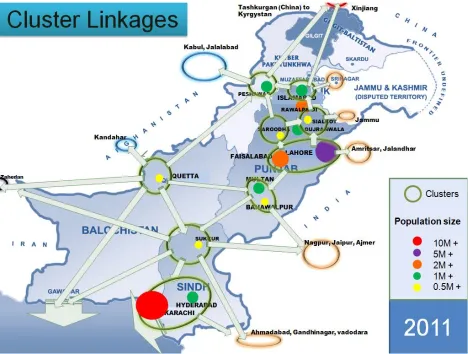
[image:23.612.74.542.179.533.2]Figure 5 highlight s clust ers along t he int ernat ional border in t he neighbouring count ries w hich could possibly be connect ed w it h dom est ic clust ers in order t o increase t rade and t herefore im prove regional connect ivit y of Pakist an.
Figure 5: Cluster Linkages
The t ot al num ber of border post s along t he west ern border rem ains roughly t he sam e. However, along t he Indian border, t here is pot ent ial of increasing t he border post s from t he current num ber of t hree (w hich include bot h fully and part ially act ive post s) t o at least five.