Munich Personal RePEc Archive
Explaining learning gaps in Namibia:
The role of language proficiency
Garrouste, Christelle
European Commission - Joint Research Centre (EC-JRC), UnitG.09
Econometrics and Applied Statistics (EAS)
2011
Online at
https://mpra.ub.uni-muenchen.de/25066/
Explaining learning gaps in Namibia:
the role of language proficiency
Christelle Garrouste*
Abstract
In a multilingual context, this study investigates the role of language skills on mathematics achievement. It compares characteristics of 5048 Grade-6 learners in 275 Namibian schools. The outcome variable is the standardized SACMEQ mathematics score collected in year 2000. Hierarchical linear modeling is used to partition the total variance in mathematics achievement into its within- and between-school components. The results do confirm the positive correlation between strong language skills variations at the school-level and low pupil mathematics scores, which may question the capacity of the current bilingual policy to provide for an effective and equal learning environment.
Keywords: Learning achievement; language skills; multilevel analysis; HLM
JEL classification: C13, C3, I2.
∗ Christelle Garrouste, PhD. European Commission - Joint Research Centre (EC - JRC), Institute for the protection and Security of the Citizen (IPSC), Unit G.09 Econometrics and Applied Statistics (EAS). Email:
1.1Introduction
The need for reconstruction after the Second World War has rapidly led to a world-wide
growth of interest in the application of large-scale scientific survey research techniques to
the study of issues related to improving the productivity of workers through an increase of
the number of literate people, among which Husén’s (1969) work and the international
research ran by the Association for the Evaluation of Education and Achievement (IEA) in
the early 1970s which encompassed twenty-three countries (see Elley, 1992, 1994;
Lundberg & Linnakyla, 1993; Postlethwaite & Ross, 1992). This trend spread
progressively to developing countries. In the 1980s the focus of these surveys slowly
moved from an increase of quantity of education to an improvement of quality of
education. Most occidental countries and an increasing number of developing countries are
now applying such techniques to undertake systematic studies of the conditions of
schooling and student achievement levels.
Summarizing the results of the IEA and other studies for developing countries,
Alexander & Simmons (1975) note the lack of consistency across studies and the
conflicting nature of the results. For instance, school-related variables, such as class size,
school size, and teacher characteristics, appeared to be significant in some countries and
non-significant (or negatively significant) in others. Finally, although non-school variables
appeared of high importance in all the studies, home background seemed to have less
influence on pupils’ performance in developing than in developed countries.
In the early 1980s, Heyman & Loxley (1983a; 1983b) examined the effects of
socioeconomic status and school factors on students’ science achievement in primary
school in sixteen low-income countries and thirteen high-income countries. They observed
that the influence of family background varied significantly with national economic
by school and teacher variables was negatively correlated with the level of a country’s
development. This result was confirmed by Saha (1983) and Fuller (1987) who examined
the effects of school factors on student achievement in the Third World. Fuller concluded
that “much of this empirical work suggests that the school institution exerts a greater
influence on achievement within developing countries compared to industrialized nations,
after accounting for the effect of pupil background” (pp. 255-6; italics in original).
Yet, more recent works based upon more sophisticated survey data have questioned
the sustainability of these results (see Gameron & Long, 2007, for a detailed discussion of
the evolution of the debate on equality of educational opportunity in the past four decades).
For instance, Baker, Goesling and Letendre (2002), who examined data from the Third
International Mathematics and Science Study (TIMSS) of 1995 and 1999, concluded that
Heyneman & Loxley’s findings for the 1970s were not observable anymore two decades
later. Baker et al. (2002) attributed the “Heyneman-Loxley effect” to the lack of mass
schooling investments in most developing countries back in the 1970s. They argued that
the expansion of education systems in developing countries during the 1980s and 1990s
was likely to have generated better educated cohorts of parents. Thus, developing countries
had beneficiated from a catching-up effect towards developed countries’ relative
composition of family and school effects on student outcomes. The authors conjectured,
however, that the Heyneman-Loxley effect might persist in countries where extreme
poverty or social upheaval such as civil war or epidemics slowed down mass schooling.
Chudgar & Luschei (2009) also revisited the Heyneman-Loxley hypothesis, using
the 2003 TIMSS data from 25 countries. They found that in most cases, family background
was more important than schools in understanding variations in student performance, but
that, nonetheless, schools were a significant source of variation in student performance,
Focusing exclusively on Southern and Eastern African countries, the survey by the
Southern and Eastern Africa Consortium for Monitoring Educational Quality (SACMEQ)
revealed corroborative results. In 2005, the SACMEQ II1 national reports showed that most countries were demonstrating large between- and school variations. While
within-school variation is an indication of differences in abilities among learners within each
school, between-school variations are an indication of equity problems within the
education system. South Africa, followed by Uganda and Namibia, demonstrated then the
highest percentage of between-school variation (see, for instance, Gustafsson, 2007, for a
detailed analysis of the South African case).
More specifically, the Namibian results displayed very poor learners and teachers
reading and mathematics scores, a definite decline in reading scores between the first
SACMEQ study of 1995 and the second one of 2000 and considerable variation among
regions (Makuwa, 2005). These results deserve further investigation in view of the high
resource allocation efforts made by the Namibian authorities to launch substantial
education reforms since independence in 1990, which included the adoption of a bilingual
language-in-education policy aiming primarily at facilitating the cognitive development
and, hence, the learning process of pupils (Skutnabb-Kangas & Garcia, 1995).
Hence, after a short review of the status of Namibian schools and political agenda
at the time the SACMEQ II was conducted (i.e. year 2000) (section 1.2), this paper
attempts to investigate the main factors explaining the poor scores of Namibian Grade-6
learners. More specifically, the objective is to see whether the home language and
1 The International Institute for Educational Planning (IIEP) designed the Southern Africa Consortium for
proficiency in English constitute significant discrimination factors in mathematics
achievement to explain the within-school and between-school variations.
This focus is geared by findings from other studies that have highlighted the
significant role of language proficiency on academic achievement. For instance, Geary,
Bew-Thomas, Liu & Stigler (1996) found that the language structure of Asian numbering
assisted Chinese children in developing meaningful early number concepts. Valverde
(1984) noted that differences in the English and Spanish languages contributed to Hispanic
Americans’ poor performance and involvement in mathematics (see also Bush, 2002, for
similar conclusions). Howie (2002, 2005) applied multilevel analysis (2002, 2005) on
South African TIMSS data to show that significant predictors of between-school variations
include pupils’ performance in the English test, their exposure to English and the extent to
which English is used in the classroom.
The method used in our work is a specific type of multilevel analysis called
Hierarchical Linear Modeling (HLM). This paper follows the theoretical steps enounced by
Bryk & Raudenbush (1988) and Hox (1995) for the use of the HLM method for education
analyses (see section 1.3 for a description of the model and data). The results are then
presented in section 1.4 and conclusions drawn in section 1.5.
1.2Namibia’s School Structure and Policy Agenda at the Time of the Study
The Republic of Namibia is situated on the south west coast of Africa and is bordered by
the Atlantic Ocean to the west, the republics of Angola and Zambia to the north and
north-east respectively and the republics of Botswana and South Africa to the north-east and south
respectively. It obtained national independence from former apartheid South African
government on March 21, 1990, after many years of political, diplomatic and armed,
uranium, diamonds, and other minerals as well as rich fishing grounds, there are wide
disparities in the distribution of incomes. With a per capita income of US$2,000 Namibia
may be regarded as a middle income country. Yet, the richest 10 percent of the society still
receives 65 percent of the incomes. As a consequence, the ratio of per capita income
between the top 5 percent and the bottom 50 percent is about 50:1 (Makuwa, 2005). This
provides a brief understanding of the socio-economic context under which the education
system has to develop in Namibia.
Since independence, Namibia has made strides in the provision of basic education,
which by 2001 had resulted in a primary education net enrolment of 94 percent of all
children aged 7-13 (in Grades 1-7), and by 2006 Namibia ranked among the top eight
African countries in term of primary completion rate (>80 percent) (Vespoor, 2006). While
much seems to have been achieved in terms of access to schooling, the quality of
education, efficiency and equity issues are since the late 1990s at the center of political
preoccupations.
Because Article 20 of the Constitution of the Republic of Namibia provides for free
and compulsory education for all learners between the ages of 6 and 16 or learners from
Grade 1 up to the end of Grade 7; and because the government has declared education to
be a priority among all other priorities in Namibia, education has received the largest share
of the national recurrent budget since independence. For instance, out of the estimated total
government current expenditure of N$8.35 billion for the 2001/2002 financial year, N$1.86
billion, i.e. about 20 percent of the budget, was earn-marked for basic education only. Of
the total amount allocated for basic education, N$986.56 million was earn-marked for
primary education and the rest for secondary education. Yet, almost 90 percent of the
money allocated for primary education was spent on personnel costs (e.g., salaries and/or
the other services and school supplies (Makuwa, 2005). As a consequence, the financial
allocation per learner ratio is more favorable to regions with more qualified staff and fewer
learners than to rural regions with more unqualified teachers and large pupil-teacher ratios.
Finally, the fact that schools are authorized to collect school development funds directly
from parents is again more favorable to schools located in urban areas where parents have
an income than to schools in more remote areas.
In addition to these resource allocation issues, it is also important to highlight the
many changes that took place in the education sector between 1995 and 2000. As
explained in Makuwa’s (2005) report, there were for instance more learners and more
schools in 2000 than in 1995; the department of Sport was added to the Ministry of Basic
Education and Culture; and, more important, the HIV/AIDS pandemic became a national
problem affecting infected administrators, teachers, learners and/or parents. In view of
these new contextual settings, the Ministry of Basic Education, sports and Culture
(MBESC) defined eight new national priority areas in its “Strategic Plan” for the period
2001-2006: equitable access; education quality; teacher education and support; physical
facilities; efficiency and effectiveness; HIV/AIDS; lifelong learning; and sports, arts and
cultural heritage.
Finally, to understand the context framing the data used in this study, it is also
essential to give an overview of the structure of the Namibian primary school system. The
primary phase consists of the Lower Primary (Grades 1-4), during which mother tongue is
used as medium of instruction, and Upper Primary (Grades 5-7), during which English
becomes the medium of instruction up to Grade 12. By the year 2000, there were 998
primary schools hosting a total of 406,623 learners, of which 952 were government schools
the six most populated northern regions namely, Caprivi, Kavango, Ohangwena, Oshikoto,
Oshana and Omusati.
It is in the above milieu that the second SACMEQ survey used in the present paper
was collected and it is therefore in that frame that the results of the analysis should be
interpreted.
1.3Model and Data
The methodological approach applied in this study is a hierarchical linear modeling. The
HLM framework was developed during the 1980s by Aitkin & Longford (1986), DeLeeuw
& Kreft (1986), Goldstein (1987), Mason et al. (1983) and Raudenbusk & Bryk (1986). As
explained by Raudenbush & Bryk (1995), these procedures share two core features. First,
they enable researchers to formulate and test explicit statistical models for processes
occurring within and between educational units, thereby resolving the problem of
aggregation bias under appropriate assumptions. Second, these methods enable
specification of appropriate error structures, including random intercepts and random
coefficients, which can solve the problem of misestimated precision that characterized
previous conventional linear models and hindered their capacity to test hypotheses. Hence,
Lynch, Sabol, Planty & Shelly (2002) confirm the strength of HLM models compared to
other multilevel models to produce superior unbiased estimates of coefficients and robust
standard errors even when the assumptions required by OLS are violated.
The theoretical framework of HLM modeling we apply is the one derived from
Bryk & Raudenbush (1988) and defined by Hox (1995) consisting in 5 steps: (1) the Null
Model; (2) the estimation of the fixed effects of the within-school model; (3) the estimation
between-school effects; and (5) the estimation of the cross-level interactions between the within-
and between-school variables.
Hence, the first step in fitting an HLM model is to analyze a model with no
explanatory variables, namely the Null Model. This intercept-only model is defined by:
⎪⎩ ⎪ ⎨ ⎧
+ =
+ =
j j
ij j ij
U R y
0 00 0
0
μ β
β
(1)
Hence,
ij j
ij U R
y =μ00+ 0 + . (2)
In this null model, yij is the total raw mathematics score of individual i in school j and the
base coefficient β0j is defined as the mean mathematics score in school j. Whereas Rij
represents the pupil-level effect with variance var(Rij) (within-school variance), i.e. the
variability in student mathematics scores around their respective school means, U0j
represents the random school-level effect with variance var(U0j)≡var(β0j)=τ00
(between-school variance), i.e. the variability among school means. For simplicity, we
assumeRij to be normally distributed with homogeneous variance across schools, i.e.
). , 0 ( ~ N σ2
Rij Hence, this intercept-only model is a standard one-way random effects
ANOVA model where schools are a random factor with varying numbers of students in
From the estimation of the within- and between-school variances, it is possible to
derive the intra-school correlation ρ, which is the ratio of the between-school variance over
the sum of the between- and within-school variances, to measure the percentage of the
variance in mathematics scores that occurs between schools. This first result serves at
justifying the conduct of further variance analyses at the within-school and between-school
levels when introducing pupil-level and school-level explanatory factors.
If the intra-school correlation ρ derived from equation (2) proves to be more than
trivial (i.e., greater than 10% of the total variance in the outcome) (Lee, 2000), the next
phase consists in analyzing a model with pupil-level (within-school) explanatory variables
ij
X fixed. This implies that the corresponding variance components of the slopes are fixed
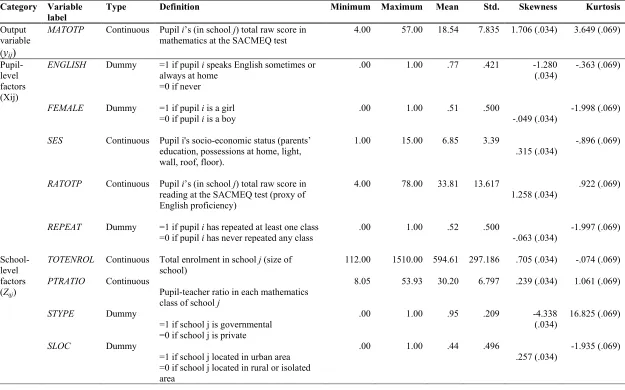
to zero. See Table 1 for a definition and statistics summary of the Xij parameters. This
fixed within-school model yields:
ij j pij p
ij ij j j ij
R U X
R X y
+ + +
=
+ +
=
0 0
00 1 0
μ
μ
β
β
, (3)
where the number of within-school explanatory variables Xij is p = 1,…,n; μ00 is the
average score for the population of each school group; μp0 is the slope of the average ratio
between each within-school variable and the pupil’s mathematics score in each type of
school; and U0j is the unique effect of school j on mean mathematics score holding Xij
constant. For each school j, effectiveness and equity are described by the pair (β0j,β1j)
(Raudenbush & Bryk, 2002).
The third step consists now in assessing whether the slope of any of the explanatory
ij j pij pj pij p
ij X U X U R
y =μ00+μ 0 + + 0 +
, (4)
where Upj is the unique effect of school j on the slope of the ratio between each
within-school variable Xij and the pupil’s mathematics score holding Xij constant. We assume
j
U0 and Upj to be random variables with zero means, variances τ00 and τ11 respectively,
and covariance τ01 .
The testing of random slopes variations is done on a one-by-one basis. As explained
by Raudenbush & Bryk (1987; 1988; 1992; 1995), the unconditional model is particularly
valuable because it provides estimates of the total parameter variances and covariances
among the βpj. When expressed as correlations they describe the general structure among
these within-school effects. Moreover, HLM derives an indicator of the reliability of the
random effects by comparing the estimated parameter variance in each regression
coefficient, var(βij), to the total variance in the ordinary least square estimates.
Next, the higher level explanatory variables Zqj (i.e., school-level factors, see
Table 1) are added to equation (4) to examine whether these variables explain
between-school variations in the dependent variable. This addition yields:
ij j pij pj qj q pij p
ij X Z U X U R
y =μ00+μ 0 +μ0 + + 0 + , (5)
with q between-school explanatory variables Z, q = 1,…,m.
The between-school variables add information about the quality of teaching and the
learning environment. The FML estimation method is again used to test (with the global
Finally, cross-level interactions between explanatory school-level variables and
those pupil-level explanatory variables that had significant slopes variation in equation (4)
are added. This last addition leads to the full model formulated in equation (6):
ij Oj pij pj pij qj pq qj q pij p
ij X Z Z X U X U R
y =μ00+μ 0 +μ0 +μ + + + , (6)
Here again, the FML estimation method is used to derive the global chi-square test to
assess the improvement of fit.
Note that relevance to the Namibian context, correlations with test scores and
correlations between input variables were taken into account in the selection of all the
within-school Xpij and between-school Zqj parameters retained for this model (see Table
1 for a description of all variables). The data used to test this model are taken from the
SACMEQ II survey. The sampling procedure for that survey was geared by
methodological recommendations to all participating countries, but with certain flexibility
to take into account contextual differences. Hence, as for all other participating countries,
the desired target population in Namibia was all learners enrolled in Grade 6 in the ninth
month of the school year (i.e. in September 2000). The net enrolment ratio for the age
group 7-13 years old who were enrolled in Grades 1 to 7 in Namibia in 2000 was 91.3
percent. However, in Namibia it was decided to exclude certain learners namely, learners
in schools with less than fifteen Grade 6 learners, learners in “inaccessible” schools, and
learners in special schools. A two-stage cluster sampling was applied using approximately
equal size clusters stratified into the 13 educational regions, which led to a final sample of
The HLM6.0 program was used in this study to partition the total variance in
mathematics scores into its within- and between-school components according to the
methodological steps described above.
1.4Results
As explained in the previous section, the output variable of our HLM model is pupil’s total
raw score in mathematics at the SACMEQ test (MATOTP). The SACMEQ II Mathematics
test is composed of three domains, namely (1) number (i.e. operations and number line,
square roots, rounding and place value, significant figures, fractions, percentages, and
rations); (2) measurement (i.e. measurements related to distance, length, area, capacity,
money, and time); and (3) space-data (i.e. geometric shapes, charts and data tables)2.
1.4.1 The Null Model
From equations (1) and (2) we find that the within-school variance var(Rij), i.e. the
variability in student mathematics scores around their respective school means, is
estimated to 25.56 and the between-school variance var(U0j)≡var(β0j), i.e. the
variability among school means, is estimated to 36.02. Consequently, the intra-school
correlation ρ, i.e. the ratio of the between-school variance over the sum of the between-
and within-school variances, is .585, which implies that approximately 58.5 percent of the
variance in mathematics scores occurs between schools. This result confirms the
proportion of between-school variations estimated by Makuwa (2005) in Namibian
mathematics and reading scores, namely approximately 60 percent between-school
variation against 40 percent within-school variation.
The Full Maximum Likelihood (FML) estimation method was used to calculate the
of the model (McCullagh & Nelder, 1989; Hox, 1995). In the HLM6.0 software estimates
the deviance as deviance=−2logL (Peugh, 2010). From the FML estimation of our null
model we obtained a deviance of 31575.86 (with 3 estimated parameters). Hence, each of
the following steps of this HLM analysis aimed at fitting a model with a lower deviance
value and the highest explanatory capacity.
1.4.2 The Within-School Model: Fixed-Effect Unconditional Model
The next phase consisted in analyzing a model with pupil-level (within-school)
explanatory variables fixed. This implies that the corresponding variance components of
the slopes were fixed to zero (see equation (3)). Based upon relevance to the Namibian
context, correlations with test scores and correlations between input variables3, five pupil-level explanatory variables (i.e. six parameters when including the intercept namely, the
base score) were retained: ENGLISH, FEMALE, SES, RATOTP and REPEAT. Table 1
defines each of these variables and presents their summary statistics.
The variable ENGLISH explores the role played by the practice of English at home
in learning achievement in a country that applies a bilingual education policy based on
mother-tongue instruction in the early phase of primary education before transiting to
English in Grade 5 upwards. It is nevertheless important to highlight that because of the
nature of the question – “How often do you speak English at home?” – inconsistency in the
responses is plausible. For instance, the fact that 76.9 percent of the sampled pupils
answered that they speak sometimes or all the time English at home does not mean that
English is the mother-tongue of 76.9 percent of that population. In reality, English is the
mother-tongue of only .56 percent of the Namibian population (Gordon, 2005). Moreover,
occurring at home. Hence, this home language parameter should not be interpreted as a
proxy of mother-tongue rather as a proxy of the linguistic home background of the pupil.
Further, with regard to the gender variable, FEMALE, in the present case, although
the mean mathematics score for boys (= 18.86) is very close to the one for girls (= 18.25)
the existence of very high variance within each group (66.41 for boys and 56.45 for girls)
justifies further exploration. In turn, SES is a computed variable measuring the pupil’s
socio-economic status (in terms of parents’ education, possessions at home, light, wall,
roof, floor) that takes values between 1 and 15. RATOTP is the pupil’s total raw score in
reading at the SACMEQ test. The reading test scores serve here as a proxy of English
language proficiency (see Geary et al., 1997; Valverde, 1984; Collier, 1992; Ehindero,
1980; Yip et al., 2003; Clarkson & Galbraith, 1992). Note that the strong correlation
expected between RATOTP and ENGLISH is present in our sample with a significance at
the .01 level (2-tailed) and that the mean reading score of pupils who never speak English
at home (= 29.86) is less than the mean score of pupils speaking sometimes or all the time
English at home (= 35.00).
Finally, REPEAT is a dummy variable taking the value of 1 if the pupil has
repeated at least one class and 0 if not. It provides information on the learning
facilities/difficulties of the pupil and serves thereby as a proxy of the pupil’s academic
background when combined with RATOTP (Bryk & Raudenbush, 1988). In our sample the
mean mathematics score of grade repeating pupils is 16.66 compared to 20.55 for pupils
on-track with much larger variance among the first (= 87.95) than among the latter group
(= 29.18).
ij j ij j
ij
j ij
ij ij
ij
R U REPEAT RATOTP
RATOTP
SES SES
FEMALE ENGLISH
MATOTP
+ + +
− +
− +
+ +
=
•
•
0 50
40
30 20
10 00
) (
) (
μ μ
μ μ
μ μ
, (3’)
where the predictors SES and RATOTP are centered around their respective group mean.
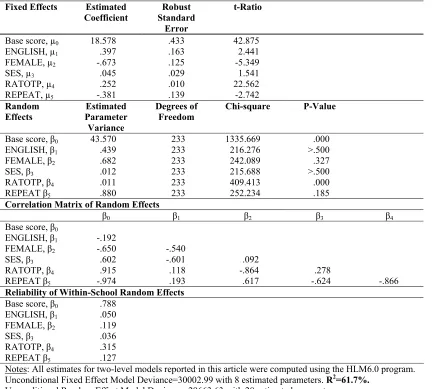
The final estimation of these fixed effects with robust standard errors is displayed
in Table 2. It appears that the most significant parameters are the average mathematic
scores at the school-level (μ0), the pupil’s gender (μ2) and the pupil’s English proficiency
level (μ4) (adjusted for the average English proficiency in the school). The slope signs
show that, whereas being a girl has an overall negative impact on individual mathematics
scores, a high mean mathematics score in the school and an individual English proficiency
above the school average have a positive impact on individual mathematics scores.
Note that the lack of statistical significance of the ENGLISH, SES and REPEAT
parameters is not strong enough to justify at this stage a removal from the model. Rather,
what the model shows so far is that speaking English at home and a higher SES
background than the school average have a positive impact (i.e. positive correlation sign)
on mathematics achievement, which confirms the theory. Moreover, grade repetition is
negatively correlated with mathematics achievement, which confirms the conclusions
reached by Verspoor (2006) in his report for ADEA. Yet, before claiming that this result
either invalidates or confirms the assumption that repetition has a negative effect on pupil’s
achievement ‘improvement’, it is important to highlight that the SACMEQ dataset does not
provide for any longitudinal data. This lack implies that it is impossible to know whether
the pupil who repeated a grade did improve its mathematics score compared to the
previous year or not. All we know from the present analysis is that, overall, pupils who
have repeated a grade perform less well than their non-repeating peers. Hence, combined
background of the pupil on mathematics scores at a fixed date t, with a higher mathematics
achievement when the pupil is on school track (no repetition) and highly proficient in
English.
The deviance of this model is 30002.99 (number of estimated parameters = 8)
which means an improvement from the null model. This fixed unconditioned model
explains 61.7 percent of the total variance in mathematics scores. The explanatory power
of this unconditioned fixed effect model will be compared to the explanatory power of the
final full model to assess the improvement of fit obtained through this hierarchical linear
modeling process (see Table 4).
1.4.3 The Within-School Model: Random-Effect Unconditional Model
The third step consisted in assessing whether the slope of any of the explanatory variables
has a significant variance component between schools:
ij j ij j j ij j j ij j ij j ij j ij j ij j ij ij ij ij R U REPEAT U RATOTP RATOTP U SES SES U FEMALE U ENGLISH U REPEAT RATOTP RATOTP SES SES FEMALE ENGLISH MATOTP + + + − + − + + + + − + − + + + = • • • • 0 5 4 3 2 1 50 40 30 20 10 00 ) ( ) ( ) ( ) ( μ μ μ μ μ μ
, (4’)
where the predictors SES and RATOTP are centered around their respective group mean.
The testing of random slopes variations was done on a one-by-one basis. Table 2
presents all the results for the within-school explanatory models (with fixed-effects and
with random-effects). At this first level of the HLM, the models are still unconditioned by
the between-school variables. As explained by Raudenbush & Bryk (1987; 1988; 1992;
of the total parameter variances and covariances among the βpj. When expressed as
correlations they describe the general structure among the within-school effects.
Table 2 shows that a high base level of achievement is associated with less grade
repetition (r = .974), higher English proficiency (r = .915), higher SES (r = .602), and male
pupils (r = .650) who do not have English as home language (r = .192). There is also a
substantial association between pupil high SES and academic achievement (with a high
negative correlation between SES and grade repetition (r = .624) and a positive correlation
with English proficiency (r = .278)).
Moreover, HLM derives an indicator of the reliability of the random effects by
comparing the estimated parameter variance in each regression coefficient, βij, to the total
variance in the ordinary least square estimates. These results are also displayed in Table 2.
As expected, the base score is rather reliable, .788, compared to the regression coefficients
which range from .036 for pupils’ SES to .315 for reading raw score (i.e. English
proficiency). This relatively low reliability may express the fact that much of the observed
variability among schools in regression slopes is due to sampling error that can not be
explained by within-school factors. The same test on the conditioned model will enable us
to ascertain or reject this interpretation.
Finally, the results of the homogeneity-of-variance tests provide statistical evidence
of significant variation within schools in each of the six random regression coefficients
(with high Chi-square statistics and 233 degrees of freedom). The probability of the
observed variability in these coefficients, under a homogeneity hypothesis, is less than .001
for β0 (base score coefficient) and β4 (English proficiency coefficient) and less than .20 for
β5 (repetition coefficient). This means that schools vary significantly in the degree to which
achievement in mathematics depends on the child’s reading score in English and repetition
Raudenbush & Bryk (1988). Despite low statistical significance, the pupil’s gender, SES
and home language status, are still retained as random parameters because of previously
reported school effects on each of them (see section 1.1).
1.4.4 The Between-School Model: Conditional Model
Next, the higher level explanatory variables Zqj (i.e., school-level factors) were added to
equation (4) to examine whether these variables explain between-school variations in the
dependent variable. This addition yields equation (5). The between-school variables add
information about the quality of teaching and the learning environment.
In this model, Zqj includes q=11 classroom and school parameters(see Table 1 for
details): TOTENROL which measures the size of the school in term of total enrolment;
PTRATIO providing the pupil-teacher ratio in each mathematics class; STYPE, a dummy
variable taking the value of 1 when the school is governmental and 0 when private; SLOC,
a dummy variable taking the value of 1 when the school is situated in an urban area and 0
when in a rural or isolated area; PRACAD, a measure of the proportion of pupils on track
(no grade repetition) in each school j; DISCLIM measuring the overall discipline climate of
the school; LGMNTY, a dummy variable taking the value of 1 when 40 percent or more of
the pupils speak English at home in school j and the value of 0 when less than 40 percent
never speak English at home (this computation follows Raudenbush & Bryk’s (1988)
computation of racial minority in the U.S. context); MSES, the mean SES in school j; TSEX
taking the value of 1 when the mathematics teacher is a female and the value of 0 when a
male; TSATPLRN taking the value of 1 when the mathematics teacher considers the pupils’
learning as very important and 0 when not important or of some importance; and
MATOTT, the mathematics raw score of the teacher, which serves as a proxy of the
Replacing these variable labels into equation (5) yields: ij j ij j j ij j j ij j ij j ij j j j j j j j j j j j j ij j ij j ij ij ij ij R U REPEAT U RATOTP RATOTP U SES SES U FEMALE U ENGLISH U MATOTT MATOTT TSATPLRN TSEX MSES MSES LGMNTY DISCLIM PRACAD SLOC STYPE PTRATIO PTRATIO TOTENROL TOTENROL REPEAT RATOTP RATOTP SES SES FEMALE ENGLISH MATOTP + + + − + − + + + − + + + − + + + + + + − + − + + − + − + + + = • • • • • • • • 0 5 4 3 2 1 011 010 09 08 07 06 05 04 03 02 01 50 40 30 20 10 00 ) ( ) ( ) ( ) ( ) ( ) ( ) ( ) ( μ μ μ μ μ μ μ μ μ μ μ μ μ μ μ μ μ (5’)
where the predictors TOTENROL, PTRATIO, MSES, RATOTP and MATOTT are centered
around their respective grand mean.
The FML estimation method was again used to test (with the global chi-square test)
the improvement of fit of the new model. After adding the between-school explanatory
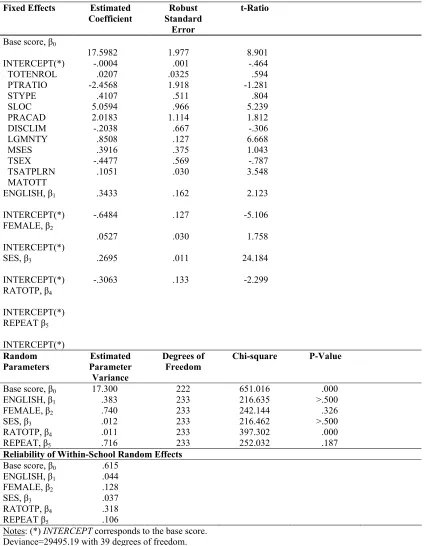
parameters, the deviance was reduced to 29495.19 with 39 degrees of freedom. Table 3
presents the results for this conditional model. What appears from this analysis is that the
proportion of students on track, the mean pupil’s SES and the level of mathematics of the
math teacher explain very significantly (significant at the .001 level) variations in the
individual mathematics scores. At a lesser level, the school’s overall disciplinary climate
and the type of school also play a significant role, with t-values of 1.812 and -1.281
respectively. The negative slope of the type of school indicates that private schools
1.4.5 The Final Model: Cross-Level Interaction Model
Finally, cross-level interactions between explanatory school-level variables and the
pupil-level explanatory variables that had significant slope variations in equation (4) were added.
This last addition led to the full model formulated in equation (6) where the predictors SES,
RATOTP, TOTENROL, PTRATIO, MSES and MATOTT were centered around their
respective grand mean:
ij j ij j j ij j j ij j ij j ij j ij j ij j ij j ij j j ij j j ij j j ij j j ij j j ij j ij j j ij ij j ij ij j ij j ij j j j j j ij R U REPEAT U RATOTP RATOTP U SES SES U FEMALE U ENGLISH U REPEAT MSES MSES REPEAT STYPE REPEAT RATOTP RATOTP MATOTT MATOTT RATOTP RATOTP MSES MSES RATOTP RATOTP PRACAD RATOTP RATOTP STYPE RATOTP RATOTP TOTENROL TOTENROL RATOTP RATOTP SES SES DISCLIM SES SES FEMALE MSES MSES FEMALE ENGLISH DISCLIM ENGLISH STYPE ENGLISH MATOTT MATOTT MSES MSES PRACAD SLOC STYPE MATOTP + + + − + − + + + − + + + − − + − − + − + − + − − + − + − + − + − + + + + + − + − + + + + = • • • • • • • • • • • • • • • • • 0 5 4 3 2 1 52 51 50 45 44 43 1 42 41 40 31 30 21 20 12 11 10 05 04 03 02 01 00 ) ( ) ( ) ( ) )( ( ) )( ( ) ( ) ( ) )( ( ) ( ) ( ) ( ) ( ) ( ) ( μ μ μ μ μ μ μ μ μ μ μ μ μ μ μ μ μ μ μ μ μ μ (6’)
Here again, the FML estimation method was used to derive the global chi-square test to
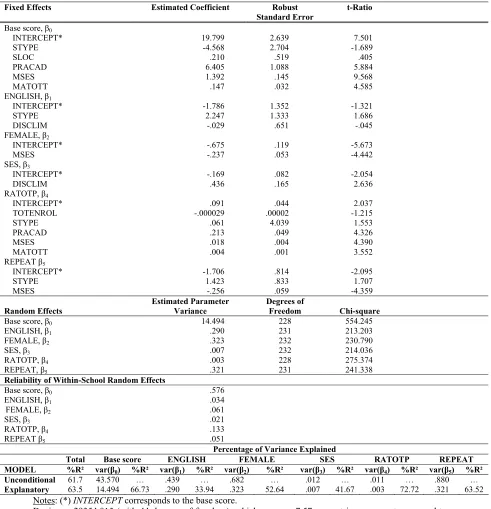
assess the improvement of fit. The deviance is now 29354.015 (with 44 estimated
parameters), which means a 7.57 percent improvement compared to the null model. The
OLS regression of the full explanatory model improved the capacity of explanation of the
variations in individual mathematics scores ( 2
Full
R = 63.5 percent) by almost 2 percent
compared to the unconditioned model (RUnconditio2 ned= 61.7 percent).
The results of the final explanatory model are displayed in Table 4 and show that
school location (SLOC), the portion of pupils on track (PRACAD), the mean SES (MSES)
of the school and the mathematics score of the math teacher (MATOTT) are taken into
account. The negative slope of the school type means that greater mathematics
achievement is associated with private schools situated in urban areas, with a high
proportion of pupils on track, a high average SES and a good mastery of mathematics by
the teacher. The effect of the school type (public or private) on the attraction of
home-English speaking pupils disappears once the disciplinary climate (DISCLIM) is taken into
account. Home-English speaking pupils tend to attend private schools where the
disciplinary climate is safer. Furthermore, low average school SES tends to be more
associated with boys than with girls (FEMALE) and pupil’s SES is associated to important
disciplinary problems. Greater reading scores are associated with public schools if they are
of small size (TOTENROL), if the proportion of pupils on track is high and the school
average SES is not too low. In addition, great reading scores are also associated with a
good mastery of mathematics by the math teacher. Finally, there seems to be less grade
repetition in public schools and in schools with a lower average SES.
The most rigorous test of the explanation power of the final model of our HLM
analysis involves acceptance of the homogeneity of residual variance hypotheses, i.e. “after
modeling each βpj as a function of some school-level variables, is there evidence of
residual parameter variation in the βpj that remains unaccounted?” (Bryk & Raudenbush,
1988, p.79). Table 4 shows evidence of significant residual variation (high Chi-square) in
base achievement score and academic background (RATOTP and REPEAT) and the
homogeneity hypothesis for the home language (p > .500), gender (p > .500) and social
differentiation (p > .500) is still not sustained. This means that the remaining variance in
pj pj
pj =β +R
βˆ ) and because of the existence of correlation between Xpij and Upj (i.e.
0 ] [Upj Xpij ≠
E ) (see Pedhazur, 1982, for a comprehensive discussion of measurement
errors, specification errors, and multicollinearity and see our annex for a detailed
discussion on the significance of this potential endogeneity bias for the validity of our
results).
Finally, the last panel of Table 4 compares the residual parameter variances from
the explanatory model with the total parameter variances estimated in the unconditional
model (i.e. the difference between the estimated parameter variance in the null model and
the estimated parameter variance in the full model divided by the estimated parameter
variance in the null model; Roberts, 2007). The proportion reduction in these parameters’
variance can be interpreted as an indicator of the power of the explanatory model. The
fitted model accounts for a substantial percentage of the variance of each within-school
parameters ranging from 33.94 percent for the home language parameter (ENGLISH) to
72.72 percent for the individual reading scores (RATOTP) which constitutes our English
proficiency proxy.
1.5Conclusions
In sum, our HLM analysis provides empirical support for the contention that academic
organization and normative environment of schools have a substantial impact on the social
distribution of achievement within them (58.5% of the variance in mathematics scores is
explained by the presence of heterogeneity between schools). On the one hand, at the
individual level, the base mathematics score of the school, followed by the academic
background of the pupil (RATOTP and REPEAT), its gender as well as its home language
hand, at the school level, the analysis shows that, overall, individual mathematics
achievement is facilitated in schools with a higher proportion of students on-track
(REPEAT), a higher average SES and a strong mastery of the subject by the mathematics
teacher (MATOTT). Pupils also tend to perform better in private schools than in
governmental schools (STYPE) which confirms the observed tendency for higher
achievement in schools with less disciplinary problems (DISCLIM).
With regard to language parameters, although the use of English at home looses a
bit of its statistical significance when comparing between-school variations, its coefficient
remains very high and confirms it as an important factor of variation in mathematics
scores. Moreover, the language proficiency parameter (RATOTP) increases even more its
explanatory capacity at the between-school level which makes it the most significant
explanatory variables of this model.
The policy and research implications of these results are four-fold. First of all, the
confirmed strong role played by linguistic parameters on learning achievement should
incite decision makers to focus their attention on assessing the effectiveness and equity of
the language-in-education policy (LiE) (Garrouste, 2007). From our analysis, it appears
that the individual low scores in Mathematics are strongly driven by overall low
achievement scores and strong within-school variations in English proficiency. This result
questions both the capacity of the Namibian bilingual policy to compensate for
heterogeneous individual exposure to the English language at home (equity) and its
efficiency to provide for a high instruction level in English by all schools (effectiveness).
The real source of this inefficiency should therefore be investigated further at the micro
level through a detailed questionnaire on the pupils’ and teachers’ home language to
estimate the proportion of pupils actually receiving their primary phase instruction in their
assessment of the literacy level in mother tongues to understand whether the low levels of
reading skills in English are indeed driven by low levels of mother tongue literacy.
Moreover, our study also reveals the need for an improvement of the quality of
resource allocations in teacher training as a prerequisite to improve the subject mastery of
teachers, but also in the development of better supervision structures to improve the
disciplinary climate in governmental schools. Thirdly, it appears important to investigate
the potential negative direct effect (on the targeted pupil) and indirect effect (via
peer-effect) of high repetition rates in primary education.
Finally, despite the fact that it is assumed to have a potential positive effect on the
fit of the final model in view of the HIV/AIDS pandemic affecting the whole country, the
health status of the pupils could not be accounted for by this study. Because less than half
of the pupils sampled (N=2199 out of 5048) answered the question related to the reasons of
their absenteeism (illness, work, family or fee not paid), and because of the very unspecific
nature of the question, this parameter could not be included in this analysis. In absence of
information about the type of illness or the duration of absenteeism in the SACMEQ II
dataset, the choice of this parameter as a proxy of the potential role of HIV/AIDS on
learning achievement would have been highly questionable.
Thus, based upon our analysis, we would like to recommend further efforts by all
concerned stakeholders to incorporate more appropriate linguistic data into large-scale
student/school surveys to better isolate the impact of LiE policies on the effectiveness and
equity of the Namibian schools.
Notes:
1
The parameters retained in this HLM analysis suffered no missing data, except for the
(1.1 percent) were missing because of non-completion of the test but these data could be
recomputed by estimating a probabilistic value from the school mean and the grand mean.
2
For a detailed overview of the levels and items composing the SACMEQ II Mathematics
test, see the blueprint in Makuwa (2005, p. 31).
3
Stem & Leaf plots of Mathematics scores by each parameter have been drawn and
revealed the existence of large variations between and/or within groups, which justify the
conduct of the present HLM analysis on these parameters to investigate the source of this
References
Aitkin, M., & Longford, N. (1986). Statistical Modeling Issues in School Effectiveness
Studies. Journal of the Royal Statistical Society, Series A, 149(1), 1-43.
Alexander, L., & Simmons, J. (1975). The Determinants of School Achievement in
Developing Countries: A Review of Research. Economic Development and Cultural
Change,26, 341-58.
Baker, D.P., Goesling, B. & Letendre, G. (2002). Socio-Economic Status, School Quality
and National Economic Development: A cross-national analysis of the
Heyneman-Loxley effect. Comparative Education Review, 46: 291-313.
Billy, J.O.G. (2001). Better Ways to do Contextual Analysis: Lessons from Duncan and
Raudenbush. In A.C. Crouter (Ed.), Does it Take a Village?: Community Effects on
Children, Adolescents, and Families. Mahwah, NJ: Lawrence Erlbaum.
Bush, W.S. (2002). Culture and Mathematics: An Overview of the Literature with a View
to Rural Contexts. Working Paper Series, 2. Louisville: University of Louisville,
Appalachian Collaborative Center for Learning, Assessment and Instruction in
Mathematics.
Clarkson, P.C., & Galbraith, P. (1992). Bilingualism and Mathematics Learning: another
Perspective. Journal for Research in Mathematics Education, 23(1), 34-44.
Collier, V.P. (1992). A Synthesis of Studies Examining Long-Term Language Minority
Student Data on Academic Achievement. Bilingual Research Journal, 16(1&2),
187-212.
DeLeeuw, J., & Kreft, I. (1986). Random Coefficient Models for Multilevel Analysis.
Ehindero, O. J. (1980). The Influence of Two Languages of Instruction on Students’
Levels of Cognitive Development and Achievement in Science. Journal of Research
in Science Training,17(4), 283-8.
Elley, W.B. (1992). How in the World do Children Read? The Hague: IEA.
Elley, W.B. (Ed.). (1994). The IEA Study of Reading Literacy: Achievement and
Instruction in Thirty-Two School Systems. Oxford: Pergamon Press.
Fielding, A., & Steele, F. (2007). “Handling Endogeneity by a Multivariate Response
Model: Methodological Challenges in Examining School and Area Effects on Student
Attainment”. Paper presented at the Sixth International Conference on Multilevel
Analysis, Amsterdam, April 16-17, 2007.
Frank, R. (2005). “Help or Hindrance?: A Multi-level Analysis of the Role of Families and
Communities in Growing up American”. Paper presented at the Population
Association of America’s Annual Meeting, Philadelphia, PA, March 31-April 3, 2005.
Fuller, B. (1987). What School Factors Raise Achievement in the Third World? Review of
Educational Research, 57(3), 255-97.
Gameron, A., & Long, D.A. (2007). Equality of Educational Opportunity: A 40-year
retrospective. In R. Teese, S. Lamb & M. Duru-Bellat (eds.), International Studies in
Educational Inequalty, Theory and Policy,Vol.1, Educational Inequality, Persistence
and Change. Dordrecht: Springer.
Garrouste, C. (2007). Determinants and Consequences of Language-in-Education Policies:
Essays in Economics of Education. Stockholm: Institute of International Education,
Studies in International and Comparative Education, 74.
Geary, D.C., Bow-Thomas, C.C., Liu, F., & Stigler, R.S. (1996). Development of
Arithmetic Computation in Chinese and American Children: Influence of Age,
Goldstein, H. (1987). Multilevel Models in Educational and Social Research. Oxford:
Oxford University Press.
Gordon, R. G., Jr. (Ed.). (2005). Ethnologue: Languages of the World, 15th ed. Dallas,
T.X.: SIL International. URL: http://www.ethnologue.com/.
Grilli, L., & Rampichini, C. (2007). “Endogeneity Issues in Multilevel Linear Models”.
Paper presented at the Sixth International Conference on Multilevel Analysis,
Amsterdam, April 16-17, 2007.
Gustafsson, M. (2007). Using the Hierarchical Linear Model to Understand School
Production in South Africa. South African Journal of Economics, 75(1), 84-98.
Heyneman, S., & Loxley, W. (1983a). The Distribution of Primary School Quality within
High and Low Income Countries. Comparative Education Review, 27(1), 108-18.
Heyneman, S., & Loxley, W. (1983b). The Effect of Primary School Quality on Academic
Achievement across 29 high- and low-income countries. American Journal of
Sociology, 88(6), 1162-94.
Howie, S. (2002). English Language Proficiency and Contextual Factors Influencing
Mathematics Achievement of Secondary Schools in South Africa. Twente: University
of Twente, Unpublished PhD thesis.
Howie, S. (2005). System-Level Evaluation: Language and Other Background Factors
Affecting Mathematics Achievement. Prospects, XXXV(2), 175-186.
Hox, J.J. (1995). Applied Multilevel Analysis. Amsterdam: TT-Publikaties.
Husén, T. (1969). Talent, Opportunity and Career: A 26 Year Follow-up of 1500
Individuals. Stockholm: Almqvist & Wiksell.
Lamb, S., & Fullarton, S. (2002). Classroom and School Factors Affecting Mathematics
Achievement: A Comparative Study of Australia and the United States using TIMSS.
Lee, V.E. (2000). Using Hierarchical Modeling to Study Social Contexts: The case of
school effects. Educational Psychologist, 35(2), 125-141.
Lundberg, I., & Linnakyla, P. (1993). Teaching Reading Around the World. The Hague:
IEA.
Lynch, J.P., Sabol, W.J., Planty, M., & Shelly, M. (2002). Crime, Coercision and
Community: the Effects of Arrest and Incarceration Policies on Informal Social
Control in Neighborhoods. Rockville, MD: National Criminal Justice Reference
Services (NCJRS).
Makuwa, D. (2005). The SACMEQ II project in Namibia: a Study of the Conditions of
Schooling and the Quality of Education. Harare: SACMEQ Educational Policy
Research Series.
Mason, W.M. (2001). Multilevel Methods of Statistical Analysis. On-Line Working Paper
Series, CCPR-006-01. Los Angeles, CA: University of California, California Center
for Population Research.
Mason, W.M., Wong, G.Y., & Entwistle, B. (1983). Contextual Analysis through the
Multilevel Linear Model. In S. Leinhardt (Ed.), Sociological Methodology 1983-1984,
14. San Francisco, C.A.: Jossey-Bass.
McCullagh, P., & Nelder, J.A. (1989). Generalized Linear Models. London: Chapman &
Hall.
Miller, J. E., & Phillips, J. A. (2002). Does Context Affect SCHIP Disenrollment?
Findings from a Multilevel Analysis. Working paper, 316. Chicago: Northwestern
University/University of Chicago Joint Center for Poverty Research.
Pedhazur, E.J. (1982). Multiple Regression in Behavioral Research: Explanation and
Peng, X. (2007). Estimates of School Productivity and Implications for Policy. Columbia,
MO: University of Missouri-Columbia. Unpublished M.A. thesis.
Peugh, J.L. (2010). A practical guide to multilevel modeling. Journal of School
Psychology, 48, 85–112.
Postlethwaite, T., & Ross, K. (1992). Effective Schools in Reading: Implications for
Planners. The Hague: IEA.
Raudenbush, S.W., & Bryk, A.S. (1986). A Hierarchical Model for Studying School
Effects. Sociology of Education, 59(1), 1-17.
Raudenbush, S.W., & Bryk, A.S. (1987). Application of Hierarchical Linear Models to
Assessing Change. Psychological Bulletin, 101(1), 147-58.
Raudenbush, S.W., & Bryk, A.S. (1988). Toward a More Appropriate Conceptualization of
Research on School Effects: A Three-Level Linear Model. The American Journal of
Education, 97(1), 65-108.
Raudenbush, S.W., & Bryk, A.S. (1992). Hierarchical Linear Models: Applications and
Data Analysis Methods. Beverly Hills, C.A.: Sage Publications.
Raudenbush, S.W., & Bryk, A.S. (1995). Hierarchical Linear Models. In T. Husén & T.N.
Postlethwaite (Eds.), The International Encyclopedia of Education, 2nd ed., 5, 2590-6. Raudenbush, S.W., & Bryk, A.S. (2002). Hierarchical Linear Models: Applications and
Data Analysis Methods. 2nd Edition. London: Sage Publications.
Rettore, E., & Martini, A. (2001). “Constructing League Tables of Service Providers when
the Performance of the Provider is Correlated to the Characteristics of the Clients”.
Paper presented at the Convegno Intermedio della Società Italiana di Statistica
Processi Metodi Statistici di Valutazione, Rome, June 4-6, 2001.
Roberts, J.K. (2007). Group Dependency in the Presence of Small Intraclass Correlation
the annual meeting of the American Educational Research Association, April 10,
2007.
Saha, L.J. (1983). Social Structures and Teacher Effects on Academic Achievement: A
comparative Analysis. Comparative Education Review, 27(1), 69-88.
Skutnabb-Kangas, T., & Garcia, O. (1995). Multilingualism for All – General Principles?
In Skutnabb-Kangas, T. (ed.), Multilingualism for All. Lisse: Swets & Zeitlinger B.V.,
European Studies on Multilingualism, 4, 221-256.
Valverde, L.A. (1984). Underachievement and Underrepresentation of Hispanics in
Mathematics and Mathematics Related Careers. Journal for Research in Mathematics
Education, 15, 123-33.
Vespoor, A. (2006). Schools at the Center of Quality. ADEA Newsletter, 18(1), 3-5.
Willms, J.D., & Raudenbush, S.W. (1989). A Longitudinal Hierarchical Linear Model for
Estimating School Effects and Their Stability. Journal of Educational Measurement,
26(3), 209-32.
Xiao, J. (2001). Determinants of Employee Salary Growth in Shanghai: An Analysis of
Formal Education, On-the-Job Training, and Adult Education with a Three-Level
Model. The China Review, 1(1), 73-110.
Yip, D.Y., Tsang, W.K., & Cheung, S.P. (2003). Evaluation of the Effects of Medium of
Instruction on the Science Learning of Hong Kong Secondary Students: Performance
33
Table 1 Parameters Definition and Sample Descriptive Statistics (N=5048)
Category Variable label
Type Definition Minimum Maximum Mean Std. Skewness Kurtosis
Output variable (yij)
MATOTP Continuous Pupil i’s (in school j) total raw score in mathematics at the SACMEQ test
4.00 57.00 18.54 7.835 1.706 (.034) 3.649 (.069)
Pupil-level factors (Xij) ENGLISH FEMALE SES RATOTP REPEAT Dummy Dummy Continuous Continuous Dummy
=1 if pupil i speaks English sometimes or always at home
=0 if never
=1 if pupil i is a girl =0 if pupil i is a boy
Pupil i's socio-economic status (parents’ education, possessions at home, light, wall, roof, floor).
Pupil i’s (in school j) total raw score in reading at the SACMEQ test (proxy of English proficiency)
=1 if pupil i has repeated at least one class =0 if pupil i has never repeated any class
.00 .00 1.00 4.00 .00 1.00 1.00 15.00 78.00 1.00 .77 .51 6.85 33.81 .52 .421 .500 3.39 13.617 .500 -1.280 (.034) -.049 (.034) .315 (.034) 1.258 (.034) -.063 (.034) -.363 (.069) -1.998 (.069) -.896 (.069) .922 (.069) -1.997 (.069) School-level factors (Zqj)
TOTENROL PTRATIO STYPE SLOC Continuous Continuous Dummy Dummy
Total enrolment in school j (size of school)
Pupil-teacher ratio in each mathematics class of school j
=1 if school j is governmental =0 if school j is private
34 Category Variable
label
Type Definition Minimum Maximum Mean Std. Skewness Kurtosis
Zqj (con’t) PRACAD DISCLIM LGMNTY MSES TSEX TSATPLRN MATOTT Continuous Continuous Dummy Continuous Dummy Dummy Continuous
Proportion of pupils on track (no grade repetition) in each school j
Overall discipline climate of the school (average of 27 dummy variables =1 if answer is “never”; =0 if answer is “sometimes/often”)1
=1 if 40 percent or more of the pupils in school j speak English at home
=0 if less than 40 percent never speak English at home
Mean SES in school j
=1 if mathematics teacher is a female =0 if mathematics teacher is a male
=1 if mathematics teacher considers the pupils’ learning as very important =0 if not important or of some importance
Mathematics raw score of the teacher (proxy of teacher’s mastery of the subject)
.00 .00 .00 1.89 .00 .00 7.00 1.00 .92 1.00 13.58 1.00 1.00 41.00 .48 .49 .05 6.85 .46 .94 23.24 .190 .180 .226 2.722 .499 .231 .343 .150 (.034) .151 (.034) .3.953 (.034) .527 (.034) .154 (.034) -3.845 (.034) .343 (.034) -.239 (.069) -.427 (.069) 13.630 (.069) -.731 (.069) -1.977 (.069) 12.786 (.069) -.439 (.069)
Notes: The skewness and kurtosis’ standard errors are displayed in brackets.
Table 2 Within-SchoolFixed and Random Effects:Unconditional Model
Fixed Effects Estimated Coefficient
Robust Standard
Error
t-Ratio
Base score, µ0
ENGLISH, µ1
FEMALE, µ2
SES, µ3
RATOTP, µ4
REPEAT, µ5
18.578 .397 -.673 .045 .252 -.381 .433 .163 .125 .029 .010 .139 42.875 2.441 -5.349 1.541 22.562 -2.742 Random Effects Estimated Parameter Variance Degrees of Freedom Chi-square P-Value
Base score, β0
ENGLISH, β1
FEMALE, β2
SES, β3
RATOTP, β4
REPEAT β5
43.570 .439 .682 .012 .011 .880 233 233 233 233 233 233 1335.669 216.276 242.089 215.688 409.413 252.234 .000 >.500 .327 >.500 .000 .185
Correlation Matrix of Random Effects
β0 β1 β2 β3 β4
Base score, β0
ENGLISH, β1
FEMALE, β2
SES, β3
RATOTP, β4
REPEAT β5
-.192 -.650 .602 .915 -.974 -.540 -.601 .118 .193 .092 -.864 .617 .278
-.624 -.866
Reliability of Within-School Random Effects
Base score, β0
ENGLISH, β1
FEMALE, β2
SES, β3
RATOTP, β4
REPEAT β5
.788 .050 .119 .036 .315 .127
Notes: All estimates for two-level models reported in this article were computed using the HLM6.0 program. Unconditional Fixed Effect Model Deviance=30002.99 with 8 estimated parameters. R2=61.7%.
Unconditional Random Effect Model Deviance=29663.63 with 28 estimated parameters.
Table 3 Between-School Fixed and Random Effects: Conditional Model
Fixed Effects Estimated Coefficient
Robust Standard
Error
t-Ratio
Base score, β0
INTERCEPT(*) TOTENROL PTRATIO STYPE SLOC PRACAD DISCLIM LGMNTY MSES TSEX TSATPLRN MATOTT ENGLISH, β1
INTERCEPT(*) FEMALE, β2
INTERCEPT(*) SES, β3
INTERCEPT(*) RATOTP, β4
INTERCEPT(*) REPEAT β5
INTERCEPT(*) 17.5982 -.0004 .0207 -2.4568 .4107 5.0594 2.0183 -.2038 .8508 .3916 -.4477 .1051 .3433 -.6484 .0527 .2695 -.3063 1.977 .001 .0325 1.918 .511 .966 1.114 .667 .127 .375 .569 .030 .162 .127 .030 .011 .133 8.901 -.464 .594 -1.281 .804 5.239 1.812 -.306 6.668 1.043 -.787 3.548 2.123 -5.106 1.758 24.184 -2.299 Random Parameters Estimated Parameter Variance Degrees of Freedom Chi-square P-Value
Base score, β0
ENGLISH, β1
FEMALE, β2
SES, β3
RATOTP, β4
REPEAT, β5
17.300 .383 .740 .012 .011 .716 222 233 233 233 233 233 651.016 216.635 242.144 216.462 397.302 252.032 .000 >.500 .326 >.500 .000 .187
Reliability of Within-School Random Effects
Base score, β0
ENGLISH, β1
FEMALE, β2
SES, β3
RATOTP, β4
REPEAT β5
.615 .044 .128 .037 .318 .106
Notes: (*) INTERCEPT corresponds to the base score. Deviance=29495.19 with 39 degrees of freedom.
Table 4 Final Explanatory Model of Mathematics Achievement
Fixed Effects Estimated Coefficient Robust Standard Error
t-Ratio
Base score, β0 INTERCEPT* STYPE SLOC PRACAD MSES MATOTT ENGLISH, β1 INTERCEPT* STYPE DISCLIM FEMALE, β2 INTERCEPT* MSES SES, β3
INTERCEPT* DISCLIM RATOTP, β4 INTERCEPT* TOTENROL STYPE PRACAD MSES MATOTT REPEAT β5 INTERCEPT* STYPE MSES 19.799 -4.568 .210 6.405 1.392 .147 -1.786 2.247 -.029 -.675 -.237 -.169 .436 .091 -.000029 .061 .213 .018 .004 -1.706 1.423 -.256 2.639 2.704 .519 1.088 .145 .032 1.352 1.333 .651 .119 .053 .082 .165 .044 .00002 4.039 .049 .004 .001 .814 .833 .059 7.501 -1.689 .405 5.884 9.568 4.585 -1.321 1.686 -.045 -5.673 -4.442 -2.054 2.636 2.037 -1.215 1.553 4.326 4.390 3.552 -2.095 1.707 -4.359 Random Effects Estimated Parameter Variance Degrees of Freedom Chi-square
Base score, β0 ENGLISH, β1 FEMALE, β2 SES, β3 RATOTP, β4 REPEAT, β5
14.494 .290 .323 .007 .003 .321 228 231 232 232 228 231 554.245 213.203 230.790 214.036 275.374 241.338
Reliability of Within-School Random Effects
Base score, β0 ENGLISH, β1 FEMALE, β2 SES, β3 RATOTP, β4 REPEAT β5
.576 .034 .061 .021 .133 .051
Percentage of Variance Explained
Total Base score ENGLISH FEMALE SES RATOTP REPEAT MODEL %R² var(β0) %R² var(β1) %R² var(β2) %R² var(β3) %R² var(β4) %R² var(β5) %R²
Unconditional 61.7 43.570 … .439 … .682 … .012 … .011 … .880 …
Explanatory 63.5 14.494 66.73 .290 33.94 .323 52.64 .007 41.67 .003 72.72 .321 63.52 Notes: (*) INTERCEPT corresponds to the base score.
Deviance=29354.015 (with 44 degrees of freedom), which means a 7.57 percent improvement compared to the null model.