http://dx.doi.org/10.4236/ape.2016.63023
The Effect of Learning Situations Problems
on the Performance and Procedural
Attitudes in Judo: The Example of the Pupils
of the School Centers for the Promotion of
Judo in Tunisia
Chokri Naffeti
1, Nejah Kacem
2, Ayman Guemri
3, Mourad Bahloul
4 1Higher Institute of Sport and Education Physics of Sfax, Sfax, Tunisia2Group for the Study of Development and Social Environment (GEDES), Faculty of Human and Social Science of
Tunis, Tunis, Tunisia
3State, Culture and Change of Society, Higher Institute of Sport and Education Physics Ksar Said, Mannouba,
Tunisia
4Higher Institute of Business of Sfax, Sfax, Tunisia
Received 24 May 2016; accepted 8 August 2016; published 11 August 2016 Copyright © 2016 by authors and Scientific Research Publishing Inc.
This work is licensed under the Creative Commons Attribution International License (CC BY).
http://creativecommons.org/licenses/by/4.0/
Abstract
Acquiring knowledge in situations of learning depends on the competence of the Tunisian Judo student’s promotion to develop new mental structures. In terms of education, it is necessary to operate a real pedagogical progression to accompany the student in the building of his own know-ledge. Within this framework, the difficulty of the judo teacher is double. Firstly, it is necessary to carry out a detailed analysis of the initial knowledge of his students and on the other hand, it must implement the pedagogical situations adapted to the rated level. This article sheds light on the study of the effect of learning on knowledge in judo among students based on situation problem. To apply these methods, we took the didactic organization and epistemological activity following its internal logic in order to highlight the modifications and design changes in the learner. To achieve these goals, we resorted to an experiment conducted on three groups: each one practices Judo by one of the three methods of learning.
Keywords
1. Introduction
Throughout their education, students should acquire knowledge. Today, the problem of knowledge lasts from 15 to 20 years. The knowledge acquired is diversified and numerous. Some is more and more specialized in a par-ticular disciplinary field forming the basis of future professional competencies; some will become general knowledge; others will be apparently forgotten. This debut issue brings a didactic reflection on the teaching of judo, its objectives and its challenges. Indeed, how to be sure that the student has understood and learned that knowledge affects him. How to be sure that education is suitable for the student. A lot of work is done in physi-cal and sports Education (EPS) and laying work on the teaching of certain APSA (swimming, athletics, collec-tive sports etc.). Some work is focused on the teaching of combat sports and in particular on judo such those of
Loizon, Margnès, & Terrisse (2004). Most of them have pedagogic objectives: (Bresciani et al., 1963; Inogai & Habersetzer, 1985) or have been conducted comprehensively from the psychological and sociological theories. Other research is focused on judo teaching at the elementary school on the didactic transposition (Bresciani, 1984; Margnes, É, Loizon, D, & Terrisse, A, 2008; Terrisse, 1996) on the evolution of the ratio of force (Colli-net, 1992); on the construction of the contents of education of judo (Janicot, 1985; Bush, 1991). In the book led by A. Terrisse, an important part regarding the didactics and pedagogy of martial arts and combat sports is found
(Terrisse, 2000). In addition, M. F. Carnus and A. Terrisse justify “significance and the use of the methodology of didactic engineering in the analysis of decisions of students in situations of opposition in Physical Education and sport” (Carnus, 2007; Terrisse, 2002). In the thesis, Loizon et al. (2004) analyzed teaching in judo practice and pondered the knowledge actually transmitted by the teachers club and EPS. The conclusion of this work shows knowledge of a very different nature transmitted in these sessions. It reflects that the comprehension of the judo’s teaching goes through “filters”, which are for the researcher means of analysis decisive in its profes-sional practice. The thesis of Eric Margnes is related to the knowledge of analysis transmitted in judo by two trainers: “Didactic intention in teaching judo, cultural choices of ethical and technical order. Case study on the teaching situations—their staging for beginners in the initial training of STAPS” (Margnes, 2002). The interest of this work lies in its successful attempt to establish a grid of analysis of this activity, differentiating two con-ceptions of judo and two modes of treatment of this activity. There is no research on the apprenticeship in situa-tions of combat in judo which marks the subject of our investigasitua-tions. The originality of our research lies in the fact that it is related to learning judo in schools of promotion in Tunisia and it would be carried out from the ap-plication of the situation problem as a pedagogic means and their impact on the students’ knowledge. The objec-tive of this study is to identify the effects of the methods of learning (with situation problem, analytical and combined) on the acquisition of performance in judo among students in the promotion of judo school.
2. Theoretical Framework
but relatable information by student prior knowledge. Without this possible link, it is likely that the student can really’ give meaning “to these information and activity which they emanate. It may not actually build its know-ledge. From the point of view of cognitive psychology, the acquisition of knowledge is not the result of a single activity mental, clearly identifiable, but is based, instead, on the articulation and coordination of various cogni-tive activities. Thus, according to Richard (1998), learn suppose to be able to implement activities, among other things, understanding, building of conceptual structures in long-term memory through selective and strategic memorization process. to treatments inferential based on prior knowledge, to develop and test hypotheses, to generalize knowledge or to recognize the class of a problem.
Two different contexts of knowledge construction can be distinguished. In one case, a student can be con-fronted with an entirely new problem situation whose resolution cannot be directly ensured by recourse to pre-vious knowledge directly for the trafficking problem. In this case, it is for the student to begin the construction of a new field of knowledge. In either case, the problem situation can be linked to prior knowledge. It is then less for the student to construct new knowledge to deepen or enhance a domain of knowledge preexisting. When it comes to building a new field of knowledge, the essential challenge for the student is to initiate the incorpora-tion of new knowledge or representaincorpora-tions in the absence of previous knowledge directly relevant. It is a problem situation that frequently goes to meet the student whenever a new concept is introduced by the teacher. Two responses are made by cognitive psychology attempt to explain this “switching” mechanism: recourse to Gener-al rules on problem solving (GPS) and the use of the anGener-alogy one way from (try of) resolve an initiGener-ally unknown problem situation is to resort to rules very general problem solving. It comes to carry out explorations, trial and error, of trial and error, and, specifically, to implement strategies of generic resolutions which could be applied to any type of problem. These strategies, named (GPS) (English: General Problem Solver) by Newell and Simon (1972), can sometimes be complex. Certainly, in judo learning is based on the action which involves to discover, to memorize the steps in solving a problem while trying to understand the principles and operation. The interest of the action learning is confront the student with a problem whose resolution is based on its activity even. This student will have to implement procedures for exploration, of trial and error, trial and error which will enable him to identify the nature, the extent of the problem. The important point is that the student will receive and have to consider positive or negative feedback from the problem situation. He can act, observe the result of its action, and infer rules of action recording can be done and should not be done. It is common that this mode of learning be adopted by science teachers who are going to introduce a phase of exploration and discovery during practical work. However, the learning by doing essentially causes the development of knowledge on the proce-dures necessary for the realization of a task or activity, but not necessarily knowledge referring to the function, objectives or the justification of this task. Thus, according to Shae Shae (1994), know-how, is not only to under-stand a procedure, it is also be able to evaluate it on the basis of the task and the functioning of the system; un-derstand the meaning and effectiveness. This mode of learning through action and discovery presents a certain danger if the teacher ensures not to somewhat “theorize” by the student the procedural knowledge he was able to acquire during the exploration phase. Otherwise, such procedural knowledge can be understood as constituting a single procedure non-decomposable to resolve a problem. It is a recipe that will be consistently applied. This recipe can make a fortune as long as the exercise lends itself to its use, but the student will be quickly in situa-tions of failure if the data of the problem is slightly different... Understand, however, how and why a recipe works, identify the interests and limits, amounted not to apply as a whole but to decompose this procedure in a series of sub-goals, or even of elementary to perform actions in including the reasons. It is certainly this condi-tion that learning through accondi-tion and discovery can prove effective. Didactics is that students are not the boxes empty, but they participate in the construction of their learning on the basis of school extra diffuse previous knowledge and on the basis of analysis and structure of the new information next to its permanent knowledge. Learning is considered to be an exploratory research of new behaviors driven by dynamic laws and not by memory research procedures illustrating the traditional conception of learning. Learning is thus defined by the construction or the stabilization of behavioral attractor State (Zanone & Kelso, 1992) that satisfies the purpose of the task, and which sets the expert coordination. In addition, the emergence of the expert behavior is designed as discontinuous and nonlinear. This discontinuity can be assessed by analysis of the qualitative evolution of behaviour. Starting from this principle, the classic design of a continuous learning with performance at the cen-tre of the process, cannot be generalized to the field of the evolution of motor coordination.
limited training of teachers, technical representation of the activity) of this activity seems, so endorsing simpli-fications suggested in the didactic proposals concerning the teaching of judo: “access to a global form of real combat from judo, with students who don’t practice them in EPS” is impossible (Baker, 1996). Also, the current didactic proposals appear to move towards an alternative between two types of educational option, that we will develop: a dual option: Baker is campaigning for “a culturalized and contextualized EPS” (Baker, 1996). He does retain, as a learning object “gripping combat sports”, that construction of the guard and the use of the strength of the opponent in a fight. To account for the goals of learning and results in cooperation and opposition, he chose two evaluation referring to “historical conceptions of judo” situations: the witnesses of a “do with knowledge” and the randoris kata characterizing the “know-how against”. Similarly, judo involves the level of proficiency is assessed in the context of the opposition. However, if combat remains the core activity, the pur-pose of judo is not in domination of the opponent but, on the contrary, the best knowledge and dominance of oneself. The perspective of the educational struggle perceives in interest that represents the search for results. The requirement of education must focus on the individual student’s commitment and a self-transcendence which cannot be reduced to the mere obtaining of victories in a framework dictated by a sporting regulations evolving. Inogai and Habersetzer (2002) report that the aims of education of judo are defined mainly by: the ac-quisition of specific techniques, individual adaptation to the evolution of the balance of forces, the affirmation of self-confidence and mastery of emotional factors. Motor, affective and intellectual student resources are thus requested to a realization of itself through situations of confrontation. Knowledge of technical, strategic or ethi-cal education is essential for judo teachers (Loizon, Margnès, & Terrisse, 2004). Knowledge identified through the implementation of the educational variables by these professionals in the teaching of judo are the bedrock foundation of the activity.
3. Materials and Methods
All concerned in our research subjects group is composed of students of primary education (6th year) belonging to the centre for the promotion of judo road to SOUKRA (Sfax). Selected students are aged 12 and are divided into three groups of 30 students with the following form:
A first group of 30 students aged 12 years 1) learns judo by the method of situation problem during the ses-sions throughout the experience.
A second group of 30 students aged 12 years 2) learns judo by the analytical method during the sessions throughout the experiment.
A third group of 30 students aged 12 years 3) learns judo by the method combined during the sessions throughout the experiment.
1) Measuring tools
Tests in our research are designed in the official program and the educational objectives of school promotion centres. Similarly, the tests are constructed by reference to tasks aimed at students of 6th year primary school centres for the promotion of judo program, published by the Directorate of physical education in collaboration with the Ministry of sport and physical education of Tunisia (2014).
2) Events of evaluation
For the sake of rigour and a litmus test of the different selected tests, we conducted a pre test.
This procedure was applied to a small sample of three groups of 5 students each. As a result, some changes in the Organization of the execution of the tests have been made:
Students were informed of the purpose and the Protocol of each test.
After the train, students spend motor performance tests, then those of the demonstration of gesture (procedural attitudes).
3) experimental protocol
The experimental protocol allows us to determine the effects of each of the methods of learning: with situa-tion problem, analytical and combined, on the knowledge among students in schools for the promositua-tion.
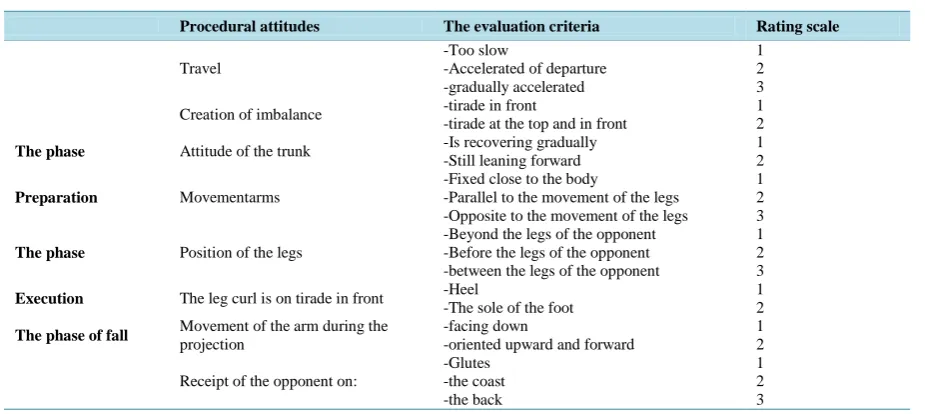
To achieve properly the objectives of this study, we considered it appropriate to begin with a diagnostic eval-uation in advance for the groups to our experience. Accordingly, all subjects underwent tests meadows which focused on performance, procedural attitudes (seeTable A1).
within the ordinary course of promotion centre, each group is taught with a single method: either by location problem, or analytical. Either by the combined method. The contents of the three methods is based on the fol-lowing form:
For education of the group learning judo by the analytical method, learning of technical elements is distri-buted throughout the period of teaching. The gesture of judo is broken down into key technical elements set out as phases of reversal in judo standing: preparation phase, execution, and the fall. Each of these phases is learned alone and apart from other elements.
For education of the group learning judo by the method of situation problem, learning the techniques is con-ducted simultaneously on the situation of opposition movement, and each student trying to learn and at the same time correcting all the elements to each teaching session.
For the teaching of the group learning judo by the combined method learning techniques is carried out on two-stroke: the gesture of judo is broken down into technical elements then it is performed simultaneously on movement.
Step 1: procurement of a pre-test to students of the three experimental groups (procedural attitudes and per-formance).
-Gexp1: (app. with situation problem). -Gexp2: (app. analytical).
-Gexp3: (app. combined). Pre-test registration.
2nd stage: Execution of a cycle of 12 sessions of learning for each group following the Organization of our experience.
-Registration of learning different sessions.
3rd stage: execution of a post-test to students of the three experimental groups (procedural attitudes and per-formance).
4th step:
-Observation of the individual behaviours of students, attack (TORI) and defence (UKE). -Observation of the resolution of the task problem for students in attack and defence.
-Identify the different indicators depending on the behavior of students on an individual level. 4) measurement indicators
Our research is to identify the effect of learning with situation problem on standing judo for this knowledge, we used four such dimensions as “Table 1”.
Acquisition expected by TORI: projected the opponent on the back using knowledge to solve a situation problem in standing judo familyas “Table 2”.
4. Results
Consideration of improvement of each group to different designs and performance, depending on the learning method used:
To assess improvement concerning the different designs and performance in each group (relative to itself), due to the use of a method of learning during a school year in judo, we proceeded to the calculation of the Stu-dent’s “t” paired.
The results of Student’s t show that according to the method of learning used, some variables of learning im-prove, within the same group, against other variables:
[image:7.595.83.541.644.717.2]Practice of judo by the situation problem method to improve both procedural attitudes and performance.
Table 1. Degree of acquisition and assessment scale. Example of sheet individual observation of the students of the centre for the promotion of judo (in judo standing).
Degree of acquisition Assessment scale
(−): Without achievements (−): 2
(+): Minimum acquired (+): 4 (++): Delete minimal achievements (++): 6
Similarly, significant progress in procedural attitude stemmed mainly from the very significant progress reg-istered in attitudes in preparation phase and phase of fall as “Table 3” (respectively p & lt; 0.0001 and p & lt; 0.001).
Learning by the combined method supports a very significant improvement in performance and procedural at-titudes in group learning by the analytical method, noted improvements show highly significant performance (thanks to knowledge of a technique). However, regarding procedural attitudes, no not there was significant im-provement. However, if it is logical that a variable performance can improve under the effect of a learning me-thod, it is no less true that the degree of improvement, may vary as a result of one method over another. This in-vites us to check which of the three methods of learning the best effect on performance. The results of this com-parison are as follows:
Performance: Judo Average statistical data of students belonging to the three groups of study at the level of the performance in judo are reflected as “Table 4”:
The results shown in the table above through ANOVA calculation which reveals a (F (2; 87) = 9.95; p & lt; 0.001 at the level of the effect of the method, F (1; 87) = 209,52; p & lt; 0.001 at the level of the effect of learn-ing and F (2; 87) = 3.14; p = 0.048 to the level of the effect of the interaction method and learnlearn-ing demonstrated a significant difference that emerges between the three experimental groups on the one hand), we are seeing, a
Table 2. Acquisition expected by TORI.
Rated
Method
Degree of acquisition Without
acquis
Acquis minimum
Acquis SUP-minimal
Acquis maximum
−(2) +(4) ++(6) +++(8)
Indicators
-No projection projection of UKE stomach -Lack of speed
-Screening of UKE without respected the
principles of attack -Slow projection
-Projection of UKE with the final phase of waterfall continuity with
the absence of one of the principles
-Rapid projection of UKE with the final phase of waterfall
continuity respecting the principles of attack
Experimental group
[image:8.595.86.538.531.634.2]Percentage (%)
Table 3. Statistical values concerning procedural attitudes and performance according to the method applied in subjects in 3 groups.
Methods Before After ∆ (Before-after)
Procedural attitudes
GMA 4.48 ± 0.93 4.79 ± 0.7 0.32 ± 1.25 GMSP 4.61 ± 0.63 5.6 ± 0.91*** 0.99 ± 0.71##
GMC 4.56 ± 1.19 5.33 ± 1.02*** 0.77 ± 0.65
Performance
GMA 2.54 ± 0.39 2.83 ± 0.4*** 0.29 ± 0.12
GMSP 2.85 ± 0.3### 3.14 ± 0.3*** 0.29 ± 0.24
GMC 2.83 ± 0.36## 3.23 ± 0.32*** 0.4 ± 0.25#+
Table 4. Average values and variances types of the performance of the three groups before and after learning.
Methods Before After ∆ (Before-after)
GMA 2.54 ± 0.39 2.83 ± 0.4*** 29% ± 0.12
GMSP 2.85 ± 0.3### 3.14 ± 0.3*** 29% ± 0.24
GMC 2.83 ± 0.36## 3.23 ± 0.32*** 4% ± 0.25#+ With regard to the “Performance”, the ANOVA showed:
a significant ‘Method’ effect [F (2; 87) = 9.95; p & lt; 0.001]; Η2 = 0.186
a significant “learning” effect [F (1; 87) = 209,52; p & lt; 0.001]; Η2 = 0.707
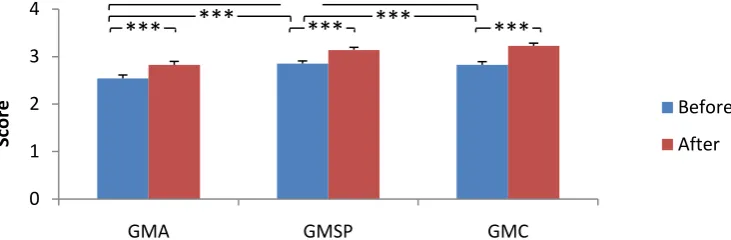
[image:8.595.91.536.660.719.2]superiority of the profile of the post-test scores. On the other hand, comparing averages is clear progress in the different groups tested, ranging from 0.29% corresponding to a minimum rate improvement up to 0.4% charac-terizing the highest progress, which explains that the three groups showed significantly different improvements statistical resolutions averages and percentages, registered in all three groups allow to observe the improvements made by each of the three methods. And that each of the groups has improved very significantly. Similarly, var-ious improvements recorded at the level of the effect (methods, learning or even at the level of the interaction method and learning) are in favor of the group teach by the method combined the performance in judo...). How-ever, we can deduce that the results achieved at the level of progress significantly participate in improving the performance students which explains the new stadium of knowledge. These advances in performance differenc-es are illustrated in Figure 1.
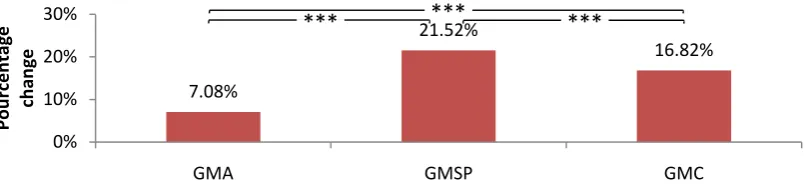
Figure 2shows that the comparison of progress is very significantly different in performance between the three groups. Thus the order relation is: combined > analytical method method > method with situation problem.
The procedural attitude: The procedural attitude was appreciated across the three phases in judo, procedural attitudes concerning the preparation, execution and fall. The results shown in the table below from the procedur-al attitudes show that different statisticprocedur-al figures, at the level of the percentages of improvements are signifi-cantly different which is explained by the difference in the averages reflecting a rate ranging from 0.32% in the group whose learning is based on the analytical method up to 0.99% for learning with situation problem in standing judo who made significantly better progress. Similarly, these advances are at the origin of the effect of learning within each group study and the interaction between (method and learning) illustrated by F (1; 87) = 52.27 report which is significant at p & lt; 0.001 at the level of learning and the F (2; 87) = 4.3 report; p = 0.017 at the level of the interaction method and learning well, the analytical method has no significant difference at the level of the procedural attitude nor under the effect of the method or the effect of learning. We can deduce that the method applied for each group does not have an effect on the procedural attitude and that the progress
Figure 1. Evolution of the performance in judo under the effect of the method used in each of the
[image:9.595.131.489.542.690.2]three groups before and after training. *Significant difference at p & lt; 0.05; *p & lt; 0.01; p & lt; 0.001.
Figure 2. Percentage change (∆ %) in the performance of the three groups. *Significant difference at
p & lt; 0.05. 0 1 2 3 4
GMA GMSP GMC
Sc
or
e Before
After
***
***
***
***
***
***
11.22%
10.05%
14.15%
0% 5% 10% 15%
GMA GMSP GMC
Po
ur
cen
ta
ge c
ha
ng
e
***
illustrated by computing the ANOVA are under the effect of learning and its interaction with the method at the level of the two groups (with situation problem and combined) as “Table 5”:
This relationship can be observed on the basis of the percentages of improvements: 0.99% (situation problem method) & gt; 0.77% (combined method) & gt; 0.32% (analytical method). The comparison between the three groups on the basis of the “X” test, postest averages “Y” and the percentage of the improvements “purified, is shown inFigure 3”.
However, although it has been demonstrated that the three groups have shown progress significantly different (significant F2), these differences are all significant? This apparent relationship is genuine and credible at all le-vels?
Comparison of improvements in the three groups taken two by two, allows us to conclude as to the meaning of each difference as “inFigure 4”:
Anova shows that the only comparison of very significant progress in procedural attitude is noted between group learning using analytics and that learning is achieved by the method with situation problem. Thus, the ap-parent order relationship is checked as regards: method with situation problem & gt; analytical method.
5. Discussion
[image:10.595.84.538.378.558.2]We have tried in our present research to study the effect of learning (by status problem, analytical and combined)
Table 5. Average values and variances types of the procedural attitude of the three groups before and after learning.
Methods Before After ∆ (Before-after)
GMA 4.48 ± 0.93 4.79 ± 0.7 0.32 ± 1.25
GMSP 4.61 ± 0.63 5.6 ± 0.91*** 0.99 ± 0.71##
GMC 4.56 ± 1.19 5.33 ± 1.02*** 0.77 ± 0.65
Figure 3. Evolution of procedural attitudes in judo under the effect of the method used in each of the three groups. *Significant difference at p & lt; 0.05; p & lt; 0.001.
Figure 4. Percentage change (∆ %) of the procedural attitude of the three groups. *Significant difference at p &
lt; 0.05. 0 2 4 6 8
GMA GMSP GMC
Sc
or
e
Before After
***
***
***
***
***
7.08%
21.52%
16.82%
0% 10% 20% 30%
GMA GMSP GMC
Po
ur
cen
ta
ge
ch
an
ge
***
***
***
With regard to the “procedural Attitude”, the ANOVA showed:
a non significant ‘Method’ effect [F (2; 87) = 2.72; p = 0.072]; Η2 = 0.059
a significant “learning” effect [F (1; 87) = 52.27; p & lt; 0.001]; Η2 = 0.375
[image:10.595.85.537.380.558.2] [image:10.595.113.516.596.688.2]on knowledge in judo among students in the school promotion centre. In the application of these methods, we took into consideration the Organization instructional and epistemological activity judo following its internal logic, in order to highlight changes and changes in design and report to knowledge in the learner. To achieve these objectives, we resorted to an experiment conducted on three groups each practice judo by one of the three methods of learning. The results obtained show that there is a “effect method” teaching differentiated both on procedural attitudes and performance. However, learning (techniques, strategies, regulations) in judo in the clas-sic relationship of teaching, the teacher speaks to the entire class and these are processes of transmission and acquisition of knowledge which are being implemented. But if the present teacher of knowledge, are we sure that they are also knowledge that students receive? Very often, the manner in which they receive and perceive them are information, that is, data that are for them little malleable, hardly reusable except to repeat them. This is often because, unlike school centres for the promotion of judo teachers, students do not have the same culture of accompaniment and contextualization of knowledge that they receive and are not yet sufficiently autonomous in their school operation; also, the mere transmission of knowledge is generally not sufficient so that they have ownership, even if the teacher of judo, as is often the case, made a double work of didactic transposition and pedagogical support to facilitate acquisitions. Our results validate our assumptions since the different teaching methods: analytical situation problem and combined have contributed, on the one hand, to a change on the psy-chomotor map (procedural attitudes and/or performance), and secondly, to a design change on the cognitive map (declarative and procedural knowledge) in judo. Regarding performance in judo, three teaching methods affect “method” significantly differentiated that emerges between the three experimental groups. However, the per-formance improvement is not directly related to changes in designs, made by different methods. The perfor-mance is thus manifested connected with declarative knowledge, or procedural knowledge. This allows us to in-fer that learning can occur both on the motor plan that perceptual and cognitive, without for all that there is a re-lationship of cause and effect on performance in particular. Also, the performance does not show necessarily conditioned in our case by the designs of the practitioners. However as said Meirieu (1990): “everyone would like to know, but not necessarily learn. We believe that physical activity, improve the designs cannot be suffi-cient alone to lead to progress in performance. Indeed, the engines acts require in addition to other variables such as factors of executions to produce better performance. May be should be a greater period of learning to enable performance factors to develop and that design changes can interact with these factors and thus produce a better performance. Also the heterogeneity of each group, learning each by a teaching method on all variables selected in our research learning can explained by the absence of relationship between improving attitudes and performance. In addition, share their characteristics, students react in the same way to the method with which they learn, that is why teacher should take account of what is common, what is different in each student and create conditions of learning suited to students to give maximum efficiency, it is in this sense that we speak of differentiated instruction. This converges with the ideas of Famose (1996), which shows that progress in motor performance continues for very long periods of time and that each particular level of performance to suggest that the skill is fully acquired is an arbitrary limit that can constantly evolve. The author adds that intellectual or verbal skills, in the field of sport, is acquired much more quickly than motor skills. Referring on the experiments of Thomas and French. The research of these authors showed that in sports, a procedural, declarative knowledge and motor skills rich and well-organized basis was essential to become an expert. They also showed that the first two types of knowledge essentially concerned the quality of decision-making, while the latter the quality of ex-ecution. Famose still reported using the experiences of Thomas, French and McPerson (French & Thomas, 1987;
McPherson and Thomas, 1991), the first two types of knowledge are learned more quickly than the last and that the first two have no connection with the acquisition of the last.
6. Conclusion
con-trol on any processes involved in the mental operations to be careful, to perceive, to memorize, to remember and to decide. They make the learners in the judo promotion centers able to choose, at the appropriate time, intellec-tual skills, declarative and procedural knowledge and motor skills that they will use to build their learning, re-member and solve the problem.
References
Amade-Escot, C. (1989). EPS Teaching Strategies: Content Offered, Design of Learning and Perspectives of Differentiation. In: Methodology and Didactics of Physical Education and Sports. Documents Compiled by Bui-Xuan. AFRAPS (STAPS), Clermont-Ferrand, 119-130. http://www.recherches-en-education.net/IMG/pdf/REE-no19.pdf
Astolfi, J.-P. (1997). The Error, a Tool for Teaching. Paris: ESF.
https://ec56229aec51f1baff1d185c3068e22352c56024573e929788ff.ssl.cf1.rackcdn.com/attachments/original/1/3/3/00261 6133.pdf
Ausubel, D. P. (1968). Educational Psychology: A Cognitive View. Holt: Rinehart et Winston.
http://www.thenhier.ca/en/node/464
Baudot, G. et al. (1975). Judo Superior, Home Judoka, Paris, France, (5 Volumes).
HTTPS://WWW.GOOGLE.TN/URL?SA=T&RCT=J&Q=&ESRC=S&SOURCE=WEB&CD=1&CAD=RJA&UACT=8 &VED=0AHUKEWJXM__TWQPOAHUEXBOKHDQBCNYQFGGZMAA&URL=HTTP%3A%2F%2FWWW.REVUE -EPS.COM%2FFR%2FJUDO-MEMENTO-CPS-FSGT-PAR-JEAN-PIERRE-ADAMI-ET-GERARD-COUTURIER_A-8 962-PDF_DL.HTML&USG=AFQJCNHZFWBT0CJZAYUY-E5AG5JCS4I3JA&BVM=BV.128617741,D.BGS Bresciani, T. (1984). A Cycle of Judo at the College Journal EP & S No. 186.
http://www.revue-eps.com/index.php?lg=fr&id_nav=105&debut=60
Bresciani, T. et al. (1963). The New Palgrave Dictionary of Economics (2nd ed.). In S. N. Durlauf, & L. E. Blume (Eds.), Palgrave Macmillan, The New Palgrave Dictionary of Economics Online. Palgrave Macmillan.
http://www.treccani.it/enciclopedia/costantino-brescianiturroni_(Il_Contributo_italiano_alla_storia_del_Pensiero:_Econo mia)
Carnus, M.-F. (2007) The “Researcher Effect” in the Observation of the Teaching Practices: Between Rationality and Sub-jectivity. Education, Université Paul Sabatier Toulouse Mirail-Toulouse.
http://www.congresintaref.org/actes_pdf/AREF2007_Marie-France_CARNUS_193.pdf
Cauzinille-Marmèche, E. (1996). The Effect of Multipresentation: Highlighting in the Resolution of an Issue of Proportio-nality. Journal of Psychology of Education, I.
http://turing.scedu.umontreal.ca/gdm/documents/ActesGDM2011.pdf
Cazorla, G. (1989). The Assessment of Capacity Engines of the Route of a Concept A the Development of a Tool. Reviewed French of Pedagogy, 89, 15-22.
http://ife.ens-lyon.fr/publications/edition-electronique/revue-francaise-de-pedagogie/INRP_RF089_3.pdf Cornu, L., & Vergniaux (1992). Didactics in Questions. Paris: Hachette Education.
https://books.google.tn/books?id=qQE1YRW7HtkC&pg=PA664&lpg=PA664&dq=CORNU,+L.+et+VERGNIOUX,+A.+ (+1992).+Les+didactiques+en+questions.+Paris:+Hachette.&source=bl&ots=RWpY7V5ksn&sig=lUWsGRflVknzvfkMD JAMcS80uCg&hl=fr&sa=X&ved=0ahUKEwjJnI7_2ubMAhUDSRoKHY5eCZ8Q6AEIITAB#v=onepage&q=CORNU% 2C%20L.%20et%20VERGNIOUX%2C%20A.%20(%201992).%20Les%20didactiques%20en%20questions.%20Paris%3 A%20Hachette.&f=false
Famose, J. P. (1988). Skills and Acquisition of Motor Skills. In J.-P. Famose, & M. Durand (Eds.), Skills and Motor Perfor-mance. Paris: Editions Revised EPS. http://f3.quomodo.com/78D73CA0/uploads/21/aptitudes-1988.pdf
French, C., & Thomas, F.(1987). The Game and the Group Games at the School. By Boeck Upper Ramazon France.
https://books.google.tn/books?id=z0IpAwAAQBAJ&pg=PA24&lpg=PA24&dq=Thomas+et+French+connaissances+proc% C3%A9drales+1987&source=bl&ots=iI7l3GvNY3&sig=rBCrM94i74yqoiA09Na5C8owrLY&hl=fr&sa=X&ved=0ahUKE
wi-trY3oifMAhVMBBoKHXtZBiwQ6AEIGjAA#v=onepage&q=Thomas%20et%20French%20connaissances%20proc%C3 %A9durales%201987&f=false
Guthrie, E. R. (1957). The Psychology of Learning. New York: Harper.
https://www.google.tn/url?sa=t&rct=j&q=&esrc=s&source=web&cd=4&cad=rja&uact=8&ved=0ahUKEwjHiO6v--bMA hWDtRoKHf6KDo4QFggtMAM&url=http%3A%2F%2Fnicolasblazy.free.fr%2FEcrit_2_Fiches_files%2FFiches%2520H abiletes%2520motrices.doc&usg=AFQjCNFaDgZY1Kn9_kKZ7rBi029viWqLWg&bvm=bv.122448493,d.d24
Herbrard, A. (1986). The EPS, Reflection and Prospects Review Co-Publications STAPS and ED Income in EPS.
http://www.culturestaps.com/site_g000108.pdf
Inogai, T., & Habersetzer, R. (2002). Judo pratique: Du débutant à la ceinture noire. Amphora.
http://www.abebooks.fr/judo-pratique-d%C3%A9butant-ceinture-noire-Inogai/18817837055/bd Inokuma, I., & Sato, N. (1986). Best Judo. Tokyo: Kodansha International.
http://www.amazon.com/Best-Judo-Illustrated-Japanese-Classics/dp/0870117866 Janicot (1985). Judo of the 15/17 Years Practice and Training. Review EP & S No. 195.
http://www.revue-eps.com/index.php?lg=fr&id_nav=105&debut=60
Jonnaert, P. (2008). The Concept of Didactic: A Lexicometric Illustrative Study of a Corpus of Definitions.
https://cudc.uqam.ca/upload/files/ORE17_concept%20didactique.pdf
Loizon, D. et al. (2004). Analysis of Teaching Practices. Management Practices Declared by Professors from Judo. E-Jour- nal (eJRIEPS), 5, 63-85.
http://www.issepks.rnu.tn/fileadmin/templates/Fcad/Analyse_des_pratiques_d_enseignement_du_judo_en_EPS.pdf Malcuit, G., & Pomerleau, A. (1977) Terminology in Conditioning and Learning. Montreal: PUQ.
http://collections.banq.qc.ca/ark:/52327/bs1761948
Margnes, E., Loizon, D., & Terrisse, A. (2008). Meaning of the Didactic Staged for Debutant in Judo in the Initial Training in STAPS.
https://hal-univ-bourgogne.archives-ouvertes.fr/hal-00562130/file/Sens_des_mises_en_scA_ne_didactiques_pour_le_dA_ butant_en_Judo_dans_la_formation.pdf
Marsenach, J., & Amade-Escot, C. (1993). The Directions of Research in the Teaching of Physical Education and Sport. Re-vue Française de Pédagogie, 103, 33-41.
http://ife.ens-lyon.fr/publications/edition-electronique/revue-francaise-de-pedagogie/INRP_RF103_3.pdf
http://dx.doi.org/10.3406/rfp.1993.1295
Meirieu, P. (1990). Learn... What, but How. Paris: ESF.
https://www.reseau-canope.fr/savoirscdi/fileadmin/fichiers_auteurs/Metier/Cours/meirieu.pdf Newell, A., & Simon, H. A. (1972). Human Problem Solving. Englewood Cliffs: Prentice Hall.
http://garfield.library.upenn.edu/classics1980/A1980KD04600001.pdf
Perrenoud, P. H. (1999). Ten New Skills to Teach. Invitation to Travel. Paris: ESF.
http://www.unige.ch/fapse/SSE/teachers/perrenoud/php_main/Textes_1999.html
Richard, J. F. (1997) La Résolution de Problèmes. In M. Richelle, J. Shark, & M. Robert (Eds), Experimental Psychology (pp. 523-574). Paris: PUF. http://fulltext.bdsp.ehesp.fr/Rsi/50/47.pdf
Richard, J. F. (1998). Mental Activities, Understand, Reason, Find Solutions. Paris: Armand Colin.
https://books.google.tn/books/about/Les_activit%C3%A9s_mentales.html?id=7BObPAAACAAJ&redir_esc=y Roegiers, X., & de Ketele, J.-M. (2000). A Pedagogy of Integration. Brussels-Paris: De BoeckUniversité.
http://www.bief.be/index.php?s=no&uid=148
Salgado, M. (2013). Performance: A Fundamental Dimension for the Evaluation of Companies and Organizations.
https://halshs.archives-ouvertes.fr/hal-00842219/document
Terrisse, A. (1996). Analysis of the Didactic Transposition in Judo: Evolution of “Knowledge Fight” in the Teaching of Judo at the School through the Magazine EPS from 1950 to 1993.
http://www.persee.fr/doc/rfp_0556-7807_1996_num_116_1_1192
Terrisse, A. (2000). Epistemology of Clinical Research in Combat Sports. In A. Terrisse (Ed.), Combat Sports and Martial Arts, State of the Art Research (pp. 95-108). Paris: La táctica deportiva y la toma de decisions.
http://www3.udg.edu/publicacions/vell/electroniques/IV_Jornades_tactica_tecnica_esportiva/pdf/05_La%20recherche_en _didactique_clinique.pdf
Vygotsky, L. (1985). Thought and Language. Paris: Editions Socials
http://www.persee.fr/doc/rfp_0556-7807_1987_num_79_1_2421_t1_0098_0000_2
Zanone, P. G., & Kelso, J. A. S. (1992). Evolution of Behavioral Attractors with Learning: Nonequilibrium Phase Transi-tions. Journal of Experimental Psychology: Human Perception and Performance, 18, 403-421.
https://books.google.tn/books?id=zpjejjytkiIC&pg=PA304&lpg=PA304&dq=Zanone+%26+Kelso,+1992&source=bl&ots =-bjA_Ge39t&sig=peU8yGxy4VuPoOkJUdeleA3CBs&hl=fr&sa=X&ved=0ahUKEwiHit7X4ubMAhUFPxoKHYeqBMc Q6AEIRDAI#v=onepage&q=Zanone%20%26%20Kelso%2C%201992&f=false
Appendix
Table A1. Observation grid for the assessment of the procedural attitude.
Rating scale The evaluation criteria
Procedural attitudes
1 2 3 -Too slow
-Accelerated of departure -gradually accelerated Travel
1 2 -tirade in front
-tirade at the top and in front Creation of imbalance
1 2 -Is recovering gradually
-Still leaning forward Attitude of the trunk
The phase
1 2 3 -Fixed close to the body
-Parallel to the movement of the legs -Opposite to the movement of the legs Movementarms
Preparation
1 2 3 -Beyond the legs of the opponent
-Before the legs of the opponent -between the legs of the opponent Position of the legs
The phase
1 2 -Heel
-The sole of the foot The leg curl is on tirade in front
Execution
1 2 -facing down
-oriented upward and forward Movement of the arm during the
projection The phase of fall
1 2 3 -Glutes
-the coast -the back Receipt of the opponent on:
Submit or recommend next manuscript to SCIRP and we will provide best service for you:
Accepting pre-submission inquiries through Email, Facebook, LinkedIn, Twitter, etc. A wide selection of journals (inclusive of 9 subjects, more than 200 journals) Providing 24-hour high-quality service
User-friendly online submission system Fair and swift peer-review system
Efficient typesetting and proofreading procedure
Display of the result of downloads and visits, as well as the number of cited articles Maximum dissemination of your research work