Munich Personal RePEc Archive
VAR forecasting using Bayesian variable
selection
Korobilis, Dimitris
December 2009
Online at
https://mpra.ub.uni-muenchen.de/21124/
VAR forecasting using Bayesian variable
selection
Dimitris Korobilis
December 2009
Abstract
This paper develops methods for automatic selection of variables in fore-casting Bayesian vector autoregressions (VARs) using the Gibbs sampler. In particular, I provide computationally efficient algorithms for stochastic variable selection in generic (linear and nonlinear) VARs. The performance of the pro-posed variable selection method is assessed in a small Monte Carlo experiment, and in forecasting 4 macroeconomic series of the UK using time-varying para-meters vector autoregressions (TVP-VARs). Restricted models consistently im-prove upon their unrestricted counterparts in forecasting, showing the merits of variable selection in selecting parsimonious models.
Keywords: Forecasting; variable selection; time-varying parameters; Bayesian
JEL Classification: C11, C32, C52, C53, E37, E47
1
Introduction
Since the pioneering work of Sims (1980), a large part of empirical macroeconomic modeling is based on vector autoregressions (VARs). Despite their popularity, the flexibility of VAR models entails the danger of over-parameterization which can lead to problematic predictions. This pitfall of VAR modelling was recognized early and shrinkage methods have been proposed; see for example the so-called Min-nesota prior (Doan et al., 1984). Nowadays the toolbox of applied econometricians includes numerous efficient modelling tools to prevent the proliferation of para-meters and eliminate parameter/model uncertainty, like variable selection priors (George et al. 2008), steady-state priors (Villani, 2009), Bayesian model averaging (Andersson and Karlsson, 2008) and factor models (Stock and Watson, 2005), to name but a few.
This paper develops a stochastic search algorithm for variable selection in lin-ear and nonlinlin-ear vector autoregressions (VARs) using Markov Chain Monte Carlo (MCMC) methods. The term “stochastic search” simply means that if the model space is too large to assess in a deterministic manner (say estimate all possible model combinations and decide on the best model), the algorithm will visit only the most probable models. In this paper the general model form that I am studying is the reduced-form VAR model, which can be written using the following linear regression specification
yt+1 =Bxt+"t+1 (1)
whereyt+1is anm 1vector oft= 1; :::; T time series observations on the dependent
variables, the vector xt is of dimensions k 1 and may contain an intercept, lags of the dependent variables, trends, dummies and exogenous regressors, andB is a m k matrix of regression coefficients. The errors "t are assumed to be N(0; ), where is anm mcovariance matrix. The idea behind Bayesian variable selection is to introduce indicators ij such that
Bij = 0 if ij = 0 (2)
Bij 6= 0 if ij = 1
whereBij is an element of the matrixB, for i= 1; ::; mandj = 1; :::; k.
pa-rameters of the unrestricted model (1), adopting the variable selection restriction (2) needs no other modification than one extra block in the posterior sampler that draws from the conditional posterior of the ij’s. Finally, unlike other proposed stochastic search variable selection algorithms for VAR models (George et al. 2008, Korobilis, 2008), this form of variable selection may be adopted in many nonlinear extensions of the VAR models.
In fact, in this paper I show that variable selection is very easy to adopt in the non-linear and richly parameterized, time-varying parameters vector autoregres-sion (TVP-VAR). These models are currently very popular for measuring monetary policy, see for example Canova and Gambetti (2009), Cogley and Sargent (2005), Cogley et al. (2005), Koop et al. (2009) and Primiceri (2005). Common fea-ture of these papers is that they all fix the number of autoregressive lags to 2 for parsimony. That is because marginal likelihoods are difficult to obtain in the case of time-varying parameters. Therefore, automatic variable selection is a convenient and fast way to overcome the computational and practical problems associated with models where parameters drift at each point in time. Although the methods de-scribed in this paper can be used for structural analysis (by providing data-based restrictions on parameters, useful for identifying monetary policy for instance), the aim is to show how more parsimonious models can be selected with positive impact in macroeconomic forecasting.
In particular, the next section describes the mechanichs behind variable selection in VAR and TVP-VAR models. In Section 3, the performance of the variable selection algorithm is assessed using a small Monte Carlo exercise. The paper concludes by evaluating the out-of-sample forecasting performance VAR models with variable selection, by computing pseudo-forecasts of 4 UK macroeconomic variables over the sample period 1971:Q1 - 2008:Q4.
2
Variable selection in vector autoregressions
2.1
The standard VAR model
To allow for different equations in the VAR to have different explanatory variables, rewrite equation (1) as a system of seemingly unrelated regressions (SUR)
yt+1 =zt +"t+1 (3)
where zt = Im x0
t is a matrix of dimensions m n, = vec(B) is n 1, and "t N(0; ). When no parameter restrictions are present in equation (3), this model will be referred to as the unrestricted model. Bayesian variable selection is incorporated by defining and embedding in model (3) indicator variables = ( 1; :::; n)
0
data likelihood to determine their posterior values. We can explicitly insert these indicator variables multiplicatively in the model1 using the following form
yt+1 =zt +"t (4)
where = . Here is an n n diagonal matrix with elements jj = j on its main diagonal, for j = 1; :::; n. It is easy to verify that when jj = 0 then j is restricted and is equal to jj j = 0, while for jj = 1, j = jj j = j, so that all possible 2n specifications can be explored and variable selection in this case is equivalent to model selection.
The Gibbs sampler provides a natural framework to estimate these parameters, by drawing sequentially from the conditional posterior of each parameter. In fact, sampling the restriction indices just adds one more block to the Gibbs sampler of the unrestricted VAR model2. For example, the full conditional (i.e. conditional on
the data and ) densities of and are of standard form, assuming the so-called independent Normal-Wishart prior. For the restriction indicators we need to sample thenelemenst in the column vector = ( 1; :::; n)0, and then recover the diagonal matrix = diagf 1; :::; ng only when computations require it. Derivations are simplified if the indicators j are independent of each other for j = 1; :::; n, i.e. p( ) = Qnj=1p j =
Qn
j=1p jj n j , where n j indexes all the elements of a vector but the j th, so that a conjuagate prior for each j is the independent Bernoulli density. In particular, define the priors
Nn(b0; V0) (5)
jj n j Bernoulli(1; 0j) (6)
1 W ishart ; S 1 (7)
where b0 is n 1and V0 is n n, 0 = ( 001; :::; 00n) is n 1, is a m m matrix, and a scalar. Note that the algorithm presented below does not depend on the asumption about the prior distribution of( ; ). The Normal-Wishart form is used here only for illustration and because it is a standard conjugate choice in Bayesian analysis which makes computations of the conditional posteriors easier (see Koop and Korobilis, 2009a). Extensions to other prior distributions are straightforward and not affected by variable selection.
Exact expressions for the conditional densities of the parameters are provided in the appendix. Here I provide a pseudo-algorithm which demonstrates that the algorithm for the restricted model (4) actually adds only one block which samples
, in the standard algorithm of the unrestricted VAR model (3).
1See for example the formulation of variable selection in Kuo and Mallick (1997).
Bayesian Variable Selection Algorithm
1. Sample as we would do in the unrestricted VAR in (3), but conditional on data beingZt, withZt =Zt .
2. Sample each j conditional on n j, , and the data from
jj n j; ; ; y; z Bernoulli(1; 0j)
preferably in random orderj,j = 1; :::; n, whereej = l
0j
l0j+l1j, with
l0j = p yj j; ; n j; j = 1 0j (8) l1j = p yj j; ; n j; j = 0 (1 0j) (9)
3. Sample as in the unrestricted VAR in (3), where now the mean equation parameters are = .
In this type of model selection, what we care about is which of the parameters j are equal to zero, so that identifiability of j and j plays no role. In a Bayesian setting identifiability is still possible, since if the likelihood does not provide infor-mation about a parameter, its prior does. When j = 0 then j is identified by drawing from its prior: notice that in this case in equations (8) - (9) it holds that p yj j; n j; j = 1 =p yj j; n j; j = 0 ;so that the posterior probability of the Bernoulli density, ej, will be equal to the prior probability 0j. Similarly, when j = 0then j is identified from the prior: the j-th column ofzt =zt will be zero, i.e. the likelihood provides no information about j, and drawing from the poste-rior of j collapses to getting a draw from its prior, i.e. ebj = b0j and Vjje = V0;jj3. Nevertheless, in both of the above cases the result of interest is that j = 0, whether because j = 0 or because j = 0, and the respective parameter is restricted.
There are several other approaches to automatic Bayesian model selection for regression models which can be generalized to VAR models. Most of them are based on introducing and sampling indicator variables as we saw above. For the specific case of the simple VAR the restriction search proposed in Algorithm 1 is computationally more intensive than other approaches, like the variable selection algorithm of George et al. (2008); see also Appendix D. Nevertheless, Algorithm 1 can easily be adopted in the case of nonlinearity in the parameters, or specifications which admit non-conjugate priors. In that respect, the remainder of this paper develops a usefull extension, namely model selection in time-varying parameters
3This holds whenV
0is diagonal, which is usually the case in practice. IfV0is a fulln nmatrix,
then the prior variance of jis obviously detemined by thej-th row andj-th column ofV0. However
VARs. Since a different value of the parameters at each time period t occurs in these models, they tend to be non-parsimonious representations of macroeconomic data. Additionally, marginal likelihood calculations may be difficult to obtain (at least in terms of computer time). In this case, variable selection offers a very easy and fast method for selection of lag length and/or exogenous predictors.
2.2
Time-varying parameters VAR model
Modern macroeconomic applications increasingly involve the use of VARs with mean regression coefficients and covariance matrices which are time-varying. Nonethe-less, forecasting with time-varying parameters VARs is not a new topic in economics. During the “Minnesota revolution” efficient approximation methods of forecasting with TVP-VARs were developed, with most notable contributions the ones by Doan et al. (1984) and Sims (1989); for a large-scale application in an 11-variable VAR see Canova (1993). However, the developement of accurate Bayesian sam-pling methods through the ’90s (Gibbs sampler), combined with modern computing power has resulted in a recent rising interest in forecasting structural instability us-ing time-varyus-ing parameters models. Canova and Ciccarelli (2004), Clark and Mc-Cracken (2010) and D’Agostino et al. (2009) are examples of forecasting multiple time-series using TVP-VAR’s, while Stock and Watson (2007), Groen et al. (2009) and Koop and Korobilis (2009b) are focusing on univariate predictions but with the use of a large set of exogenous variables.
A time-varying parameters VAR with constant covariance (Homoskedastic TVP-VAR) takes the form
yt+1 = zt t+"t+1 (10)
t = t+ t (11)
where zt = Im x0
t is an m n matrix, t is an n 1 vector of parameters for t= 1; :::; T,"t N(0; )with anm mcovariance matrix, and t N(0; Q)with Qann ncovariance matrix. Models of the form described above, and variations of it, have extensively been used for structural analysis (cite papers) and forecasting (cite papers). Obviously, the model in (10) is not a parsimonious representation of our data, and in practice most of the studies mentioned rely on quarterly data while using 2 lags of the dependent variable in order to prevent the proliferation of parameters and the estimation error.
constant parameters4. For that reason replace (10) with
yt+1 =zt t+"t+1 (12)
where, as before, t= tand is then n matrix defined in (4). For this model, the priors on and j are the same as in the VAR case, i.e. 1 W ishart( ; S 1)
and jj n j Bernoulli(1; 0j) respectively. For the time varying parameters, a prior on the initial condition is necessary which is of the form 0 Nn(b0; V0). The
random walk evolution of t, it would be desirable to restrict their prior variance in order to avoid explosive behavior. The (implied) priors for 1 to T are provided by the state equation (11), and they are of the form tj t 1; Q N t 1; Q . The covariance matrixQis considered to be unknown, so it will have its own prior of the formQ 1 W ishart( ; R 1). A Gibbs sampler for the unrestricted TVP-VAR model
exists, so that sampling from the TVP-VAR with model selection, requires only one extra block which samples , in the spirit of Algorithm 1 of the previous section. Full details are provided in the appendix.
Due to the random walk assumption on the evolution of t, it is imperative need to restrict its covariance Q otherwise draws of t will enter the explosive re-gion which might affect forecasting negatively. Primiceri (2005, Section 4.4.1.), who gives a detailed description of this issue, proposes prior hyperparameters forQ based on the OLS quantities obtained from a constant-parameters VAR on a train-ing sample. D’Agostino et al. (2009) adopt this idea in forecasttrain-ing with TVP-VAR models, and following Cogley ad Sargent (2005) and Cogley et al. (2005) they also request that only stationary draws of t are accepted. Stationarity restrictions in TVP-VAR models are satisfied if the roots of the reverse characteristic VAR polyno-mial defined by tlie outside the complex unit circle foreach and everyt= 1; :::; T. This restriction can hardly be satisfied in VARs with more than 3 variables and 2 lags (see also Koop and Potter, 2008). Additionally, in many cases a training sample might not be available due to shortage of observations.
In that respect, in this forecasting exercise I use a Minnesota-based prior to elicit the prior hyperparameters of the TVP-VAR model. This results to an Empirical Bayes prior that can be tuned using the full sample, without the need to waste useful ob-servations in a training sample. In order to avoid explosive draws, I subjectively choose the hyperparameters for the initial condition 0 and the covariance matrix Q, in order to get a very tight prior. This prior allows to overcome stationarity restrictions which make the MCMC sampler inefficient. The reader should note that I use only a single choice of hyperparameters for the Minnesota prior, without searching and comparing other choices for the TVP-VAR model. The main purpose
4Note that variable selection is parsimonious and implies that a coefficient
jt will either be
of the paper is to compare the unrestricted to the restricted (with variable selec-tion) model, so only one benchmark prior is used for the shake of this comparison. Nevertheless, examining the forecasting performance of different priors in models with time-varying parameters is a challenging, but very important idea for future research.
2.3
Prior elicitation for variable selection
The performance of the variable selection is affected by the hyperparameters which affect the mean and variance of the mean equation coefficients or t. In the case of the VAR, we already discussed that when j = 0 and a parameter j is restricted we just take a draw from each prior. That means that the prior varianceV0 cannot
be very large (to go to1) because this would imply that no predictors are selected. Kuo and Mallick (1997) propose to set b0 = (0; :::;0)0 and V0 = d In, where In is the identity matrix of dimensions n n. Then reasonable values for d would be in the range [0:25;25]. At first, this may seem like a restrictive assumption, but for VARs where the variables are approximately stationary, a prior variance on the regression coefficients of the form V0 = 10 In is fairly uninformative. In
TVP-VARs, as explained previously, it is common practice to use an Emprical Bayes prior on the variance Q. These priors are by definition informative. For the purpose of comparison, I use a benchmark Minnesota-type prior.
Finally, it should be noted that variable selection is also affected by the hy-perparameter of the Bernoulli prior of j. The hyperparameters 0j can be tuned according to the researcher’s beliefs about the number of expected restrictions in a model. As a rule of thumb, if the researcher expects or wants to impose as many restrictions as possible (for example, due to a degrees of freedom problem) then she can set 0 < 0j 0:55. Less restrictions are implied by setting 0j > 0:5. The choice 0j = 0:5is used in practice as the uninformative choice, although it implies a priori that exactly 50% of the predictors should be included; see Chipman et al. (2001) for more details.
3
Simulated numerical examples
In order to assess the performance of the model selection algorithm, this section presents the results of two examples using simulated datasets.
Example 1: Constant parameters VAR.The first exercise is the one considered in George, Sun and Ni (2008). Consider a 6-variable VAR with a constant and one
lag and constant parameters6 B = 0 B B B B B B B B @
1 1 1 1 1 1 1 0 0 0 0 0 0 1 0 0 0 0 0 0 1 0 0 0 0 0 0 1 0 0 0 0 0 0 1 0 0 0 0 0 0 1
1 C C C C C C C C A , = 0 B B B B B B @
1 0:5 0:5 0:5 0:5 0:5 0 1 0 0 0 0 0 0 1 0 0 0 0 0 0 1 0 0 0 0 0 0 1 0 0 0 0 0 0 1
1 C C C C C C A : (13)
where it holds that = ( 0) 1. 100 samples of sizeT = 50are generated, using
a random initial condition for the dependent variables y 1 U(0;1). Hence 100
VAR models are estimated using the generated samples, saving 30.000 draws from the posterior of the estimated parameters after discarding an initial 20.000 draws to ensure convergence. The prior hyperparameters (see equations (5) - (7)) are set to be uninformative: b0 = 0n 1,V0 = 9 In, 0j = 0:5for allj = 1; :::; n, = 0and S = 0 Im. The intercepts are always included in each model, so that the variable selection applies only to lags of the dependent variables.
The unrestricted VAR is just a special case of variable selection, where we im-pose all j = 1. Thus, a fully unrestricted estimate of B can be obtained using the variable selection priors and imposing always to be the identity matrix I of dimensions n n. The average over the 100 samples of the posterior mean (poste-rior standard deviations of non-zero parameters are in parentheses) of B using the unrestricted prior is
b
BU N =
0 B B B B B B B B B B B B B B B B B B B B B B @
1:05 (:51)
1:06 (:56)
1:07 (:57)
0:91 (:56)
0:79 (:56)
0:96 (:56) 0:81
(:08) :12 :10 :11 :10 :09
:05 0:71
(:12) :05 :01 :03 :05
:04 :02 0:74
(:11) :01 :01 :06
:00 :06 :06 0:75
(:12) :05 :02
:06 :01 :00 :05 0:69
(:12) :03
:00 :06 :08 :03 :07 0:72 (:12)
1 C C C C C C C C C C C C C C C C C C C C C C A
The posterior means of the unrestricted model are identical to the MLE estimate. Now define to be the k m matrix obtained from the column vector , which also includes the unrestricted constants. The average, over the 100 samples, of the posterior mean of the variable selection indices (in matrix form) b are:
b = 0 B B B B B B B B @
1:00 1:00 1:00 1:00 1:00 1:00 1:00 :09 :09 :05 :06 :07
:05 1:00 :05 :09 :05 :04
:06 :09 1:00 :14 :10 :08
:07 :11 :06 0:99 :15 :05
:05 :13 :05 :11 1:00 :10
:03 :06 :07 :08 :06 1:00
1 C C C C C C C C A
and the average of the variable selection posterior mean,BbV S are
b
BV S =
0 B B B B B B B B B B B B B B B B B B B B B B @
0:99 (:32)
1:10 (:40)
1:05 (:43)
1:02 (:42)
0:98 (:42)
1:00 (:41) 0:98
(:03) :01 :00 :00 :01 :00
:00 0:93
(:06) :04 :05 :04 :01
:01 :01 0:94
(:06) :03 :01 :02
:01 :02 :03 0:92
(:07) :04 :02
:01 :02 :01 :01 0:87
(:10) :01
:00 :02 :03 :01 :03 0:96 (:04)
1 C C C C C C C C C C C C C C C C C C C C C C A :
The elements of theb matrix can be interpreted as "probabilities of inclusion" of a certain parameter. The top row of b is 1by default, since it refers to the VAR in-tercept which was left unrestricted. Variable selection picks the correct restrictions in small samples, resulting in more accurate estimates of the VAR regression coef-ficients (compare BU Nb and BV Sb ). This is true also for the unrestricted intercepts, which are much closer to their true values. Additionally, the covariance matrix resulting from the variable selection is also more accurate than the MLE of the co-variance matrix (results not reported here).
George et al. (2008) have used the exact same setup to evaluate the efficiency of the SSVS algorithm described in Section 3.1. Comparing the matrix of restrictions,
0:5 in only a few cases. This happens because the SSVS restricts a parameter if it is too low7, while variable selection in this paper requires a parameter to be
restricted exactly to zero. However, using both algorithms model selection implies that the optimal predictive model is the one which has parameters with probability of inclusion higher than 0.5 (see Barbieri and Berger (2004) for a proof).
Example 2: Homoskedastic TVP-VAR. In the second example, 100 samples of size T = 100 are generated from a 4-variable Homoskedastic TVP-VAR with one autoregressive lag (no constant). The covariance matrix is set equal to the upper left 4x4 block of the covariance matrix specified in Example 1 (in equation (13)), and t = vec(Bt)is let to evolve according to the random walk specification (11), by setting initial condition,B0 =fBtgt=0, and a simple diagonal covariance matrix
Q, of the form
B0 =
0 B B @
:7 0 :35 0 0 :7 0 0 0 :45 :7 0
:4 0 0 :7
1 C C
A,Qj;j = 8 < :
0 , ifB0;ij = 0
0:01 , ifB0;ij >0:5
0 , ifB0;ij <0:5 :
This specification implies that the diagonal elements ofBtare time-varying with ini-tial condition 0:7, while the non-zero non-diagonal elements 0:4;0:45;0:35(which are lower than0:5) remain constant for allt(and, of course, the zero non-diagonal elements remain zero for all t). The goal here is to examine the efficiency of vari-able selection when in the true model the R.H.S. varivari-ables affect the dependent variable through a combination of constant and time-varying coefficients, but the (misspesified) model we are estimating assumes all coefficients to be time varying. The usual practice in the TVP-VAR models is to use tight databased priors. How-ever, for the purpose of this excercise realatively uninformative priors are defined
0 Nn(b0; V0)
Q 1 W ishart ; R 1
jj n j Bernoulli(1; 0j)
1 W ishart ; S 1
where the hyperparameters are set to the values b0 = 0n,V0 = 10In, = 16,R = 1, 0j = 0:5for allj = 1; :::; n, = 4andS = 1. Full details, like means and variances of the posteriors of the parameters, are difficult to present here. However, the average of the restriction indices is again very informative about the efficiency of the the variable selection algorithm to find the correct restrictions:
b =
0 B B @
1:00 :04 1:00 :04
:01 1:00 :04 :01
:02 1:00 1:00 :05 1:00 :04 :02 1:00
1 C C A:
As in the simple VAR case above, posterior means are more accurate and posterior standard deviations are smaller (results available upon request).
4
Macroeconomic Forecasting with VARs
4.1
Data and set-up
The variable selection techniques described in Section 2 are used to provide fore-casts of four macroeconomic series of the U.K. economy. In particular, the variables included in these models are the inflation rate t (RPI:Percentage change over 12 months: All items), unemployment rate ut (Unemployment rate: All aged 16 and over, Seasonally adjusted), the annual growth rate of GDP gdpt(Gross Domes-tic Product: Quarter on quarter previous year: Chain volume measure, Seasonally adjusted) and the interest ratert (Treasury bills: average discount rate). It is cus-tomary in VAR models to include only one measure of economic activity, i.e. either GDP or unemployment. The assumption here is that policymakers are interested individually, at least in the short-run, in forecasts of both GDP and unemployment. There are many reasons for having individual forecasts for unemployment and GDP growth, for example as of January 2010 it is the case that many economies are out of the global recession according to initial GDP growth rate estimates. However in the same countries (including US) unemployment is not getting lower, and price inflation is below its target level.
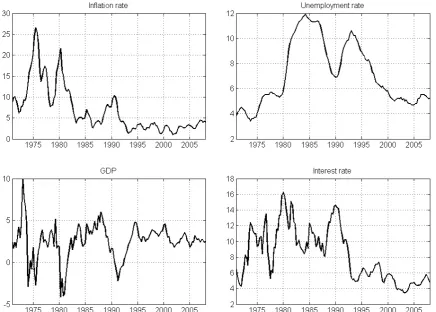
The data are obtained from the Office for National Statistics (ONS) website, http://www.statistics.gov.uk/. The available sample runs from 1971Q1 to 2008Q4. Inflation, unemployment and interest rates are measured on a monthly basis. Quar-terly series are calculated by the ONS by taking averages over the quarter (for in-flation), the value at the mid-month of the quarter (for unemployment), and the value at the last-month of the quarter (for interest rate), respectively. The data are plotted in Figure 1.
-Figure 1: Graph of the data for UK inflation, unemployment, GDP, and interest rate.
1988:Q4 is used for initial estimation, and the forecasts are computed recursively with expansion of the estimation sample each quarter. Subsequently for the period 1989:Q1 - 2008:Q4 we obtain a total of 80-hforecasts.
Iterated forecasts are obtained by estimating the models (4) and (10), writing the models in companion (VAR(1)) form, and iterating the forward up toh= 8 pe-riods ahead in order to obtain[yTb +1; :::;yTb +h], whereT is the last observation of the sample. Direct forecasts are obtained from the VAR and the TVP-VAR specifications in (4) and (10) respectively by estimating separately for h = 1,4and 8 the models with the dependent variable yt+1 replaced by yt+h, while the R.H.S. variables are still measured up to, and including, time t. When h = 1 direct and iterated fore-casts are exactly the same, since we are estimating and forecasting with exactly the same specifications.
[image:14.595.72.509.97.409.2]simulate the out-of-sample path of t. At each iteration, conditional on obtaining a draw of T and the covariancesQ, we can use the random walk evolution equation (11) to simulatehbT+1; :::;bT+hi in a recursive manner. Then conditional on know-ing these parameters, calculation of direct or iterated forecasts can be computed as in the VAR case, separately for each out-of-sample period.
4.2
Forecasting models
Dependent on the model specification and the choice of prior hyperparameters, there are 5 competing forecasting models. Common place in all models, in order to evaluate the performance of variable selection of mean equation coefficients, is that the covariance matrix is integrated out using an uninformative prior of the form p( )/ j j (m+1)=2 which is equivalent to the Whishart prior defined in (7) with the additional restriction that = 0 andS 1 = 0
m m. The 5 models are
1. VAR with variable selection (VAR VS)
The priors are jj n j Bernoulli(1;0:5) for all j = 1; :::; n, and j N(0;102)if
j is an intercept, and j N(0;32)otherwise. 2. VAR with Minnesota prior (VAR MIN)
The Minnesota prior for is of the form. N bM IN; VM IN where
Vi;lM IN =
8 > < > :
g1=p for parameters on own lags
g3=s2i for intercepts g2s2i
ps2
l
for parametersj on variable l6=i; l; i= 1; ::; m
(14)
Here s2
i is the residual variance from the p-lag univariate autoregression for variable i. The prior mean vector bM IN is set equal to 0:9 for parameters on the first own lag of each variable and zero otherwise. The hyperparameters are set to the valuesg1 = 0:5,g2 = 0:005andg3 = 100.
3. Benchmark VAR
The priors are the same as the VAR with variable selection (VAR VS), where now we do not sample j (or equivalently, restrict j = 1for all j)
4. TVP-VAR with variable selection (TVP-VAR VS) The initial condition is set to 0 N(0;42VM IN), and
jj n j Bernoulli(1;0:5). The covarianceQof the varying coefficients has the priorQ 1 W ishart( ; R)
5. Benchmark TVP-VAR
The priors are the same as in the TVP-VAR case with variable selection, but in this case j = 1for all j = 1; :::; n.
The priors for the VAR are fairly uninformative, however the TVP-VAR prior is quite tight. Althernatively we can assign to 0 a large variance, say 100I, on the basis that this is a desirable uninformative choice. However doing so, means that we increase the probability that the whole sequence of draws for t will be in the nonstationary region. This approach can be computationally cumbersome as many draws may be required as in the case of Cogley et al. (2005) who use 100.000 draws, discard the first 50.000 and save every 10-th draw. Given the dimension of the parameter space and the compuational demands of a recursive forecasting exercise, the informative variance42VM IN on the initial state is used here in order
enhance the efficiency of the Gibbs sampler. All models are based on a run of 20.000 draws from the posterior, discarding the first 10.000 draws.
The choice of the hyperparameterR 1 is based on the variance of the Minnesota
prior as well, with a scaling constant equal to0:001 (n+ 1). This might not be the optimally elicited hyperparameter of this prior for forecasting purposes, and other choices exist which the researcher ought to examine. However the purpose of this paper is, for a given prior, to compare the unrestricted model with the same model with variable selection added. Subsequently, while a specific prior can be a subject of critisism if the ulitmate purpose was to compare the performance of the TVP-VAR with that of other models (like random walk, and nonlinear models like a Markov Switching or Structural Breaks VAR), this critisism should not apply here.
4.3
Forecast evaluation
All models are evaluated using the Mean Squared Forecast Error (MSFE) and the Mean Absolute Forecast Error (MAFE). In particular, for each of the 4 variablesyi of yand conditional on the forecast horizonhand the time periodt, the two measures are computed as
M SF Ei;th =
q b
yi;t+hjt yoi;t+h
2
M AF Ei;th = yi;tb +hjt yoi;t+h
where yi;tb +hjt is the time t+h prediction of variable i (inflation, unemployment, gdp or interest rate), made using data available up to timet. yo
the formulas
d
M SF E h
i =
1
1 h 0
1 h
X
t= 0
M SF Ei;th
d
M AF E h
i =
1
1 h 0
1 h
X
t= 0
M AF Ei;th
where 0 is 1989:Q1 and 1 is 2008:Q4.
4.4
In-sample variable selection results
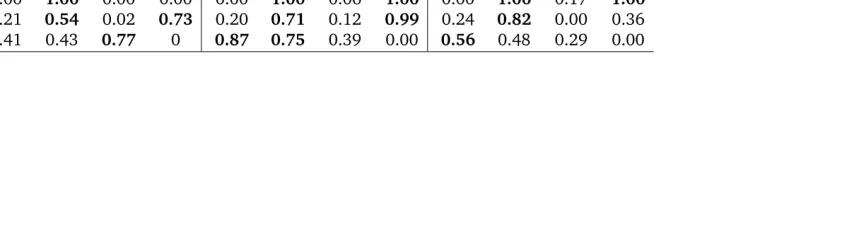
Tables 1 and 2 present variable selection results for the VAR-VS and TVP-VAR-VS models using the full sample. Entries in these tables are the means of the posterior draws of the indices for the two models. Draws from the posterior of is just a sequence of 1’s and 0’s, so that the mean can be simply interpreted as a probability of inclusion of each variable. Note that while is a column vector, results are presented in the table in matrix form, where the dependent variables are in columns and the R.H.S variables are in rows. Forh= 1the model for direct forecasts has the same specification as the model for iterated forecasts, so columns 1-4 in the tables refer to both models. However notice that for longer horizons we need to specify a different model for direct forecasts and columns 5-12 in the tables refer only to the this model specification, for horizonsh = 4and8.
The first thing to observe from Tables 1 and 2 is that for both models and for all horizons variable selection imposes many restrictions. This result is not surprising, both from an empirical and thoeretical point of view. The most recent own lag of each variable is important in most cases for all forecast horizons. Other than that, variable selection indicates only a few extra variables as important in each VAR equation, leading to quite parsimonious models. This pattern complies with the empirical results of Korobilis (2008) and Jochmann et al. (2009) using the SSVS algorithm for VAR models (see Section 3.1 above).
It is obvious that when the posterior mean of is exactly equal to 0 or 1, then a specific predictor variable should just respectively be exit or enter the best model. An interesting question is how to decide and classify a predictor when the asso-ciated probability is 0.6 or 0.3 for example. In fact, Barbieri and Berger (2004) show that the optimal model in model/variable selection for prediction purposes is the median probability model. Subsequently their proposed rule is only to select variables which have probability of inclusion in the best model higher than 0.5.
ahead inflation ( t+1) are current inflation ( t) and interest rate(rt), as well as inflation in the previous quarter ( t 1). In the TVP-VAR it is only t and t 1
which are selected, and the current level of interest rate has only probability of 0.28. In the same equation, there is weaker evidence that gdpt, ut 1and rt 1 are
good predictors, which vanishes in the TVP-VAR case (for examplert 1 has a
prob-ability of 0.61 of entering the VAR model, but only a probprob-ability of 0.41 of entering the TVP-VAR model). Similar inference can be made for the rest of variables and equations.
Table 1. Average of posterior of restrictions , forh = 1;4;8(VAR model)
t+1 ut+1 gdpt+1 rt+1 t+4 ut+4 gdpt+4 rt+4 t+8 ut+8 gdpt+8 rt+8
Intercept 0.14 0.02 0.91 0.18 0.96 0.06 1.00 0.59 0.83 0.10 1.00 0.25
t 1.00 0.00 0.06 0.02 1.00 0.01 0.22 0.10 1.00 0.04 0.10 0.20
ut 0.29 1.00 0.61 0.00 0.97 1.00 0.37 0.07 0.57 1.00 0.77 0.81
gdpt 0.61 0.05 1.00 0.06 0.47 0.52 0.03 0.47 0.14 0.04 0.06 0.08
rt 1.00 0 0.19 1.00 1.00 0.02 0.03 1.00 0.16 1.00 1.00 0.46
t 1 1.00 0.00 0.02 0.03 0.07 0.00 0.69 0.55 0.06 0.34 0.03 0.84
ut 1 0.53 1.00 0.62 0.01 0.47 1.00 0.80 0.09 0.60 1.00 0.63 1.00
gdpt 1 0.38 0.00 0.04 0.47 0.07 0.01 0.03 0.28 1.00 0.03 0.72 0.97
[image:19.595.174.716.305.470.2]rt 1 0.64 1.00 0.72 0.04 0.30 1.00 1.00 0.06 0.22 0.01 0.13 0.43
Table 2. Average of posterior of restrictions , forh = 1;4;8(TVP-VAR model)
t+1 ut+1 gdpt+1 rt+1 t+4 ut+4 gdpt+4 rt+4 t+8 ut+8 gdpt+8 rt+8
Intercept 0.25 0.51 0.94 0.82 0.86 0.32 1.00 1.00 1.00 0.42 0.91 1.00
t 1.00 0.49 0.46 1.00 0.05 0.46 0.40 0.77 1.00 0.47 0.54 0.73
ut 0.00 1.00 0.00 0.00 0.00 1.00 0.00 0.00 0.02 1.00 0.24 1.00
gdpt 0.31 0.52 1.00 0.95 0.99 0.58 1.00 0.44 0.75 0.41 0.00 0.28
rt 0.28 0.50 0.30 1.00 0.50 0.50 0.44 1.00 0.17 0.57 0.38 0.18
t 1 1.00 0.49 0.41 0.38 0.00 0.49 0.45 0.65 0.00 0.49 0.65 0.47
ut 1 0.00 1.00 0.00 0.00 0.00 1.00 0.06 1.00 0.00 1.00 0.17 1.00
gdpt 1 0.21 0.54 0.02 0.73 0.20 0.71 0.12 0.99 0.24 0.82 0.00 0.36
rt 1 0.41 0.43 0.77 0 0.87 0.75 0.39 0.00 0.56 0.48 0.29 0.00
4.5
Out-of-sample forecasting results
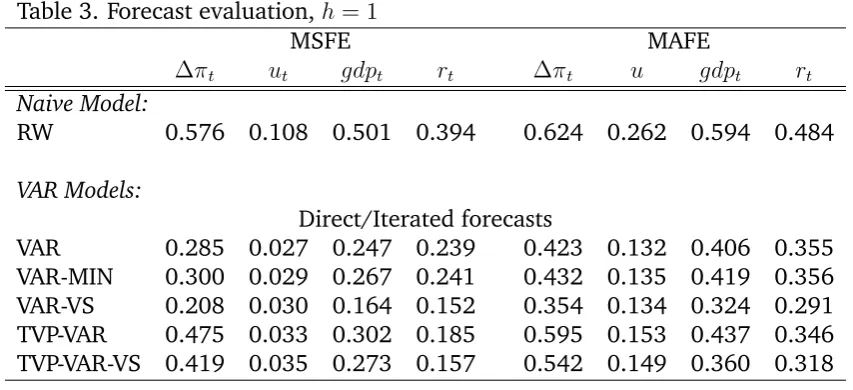
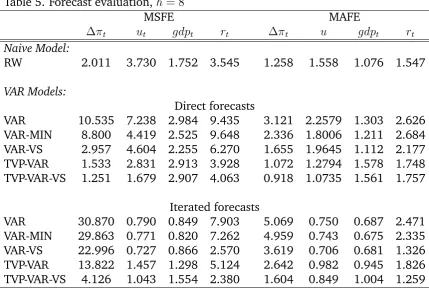
In this subsection the restricted and unrestricted VAR models are evaluated out-of-sample. Tables 3 to 5 present the MSFE and MAFE statistics over the forecasting sample 1989:Q1-2008:Q4. Although the aim of this forecasting exercise is to assess the gains from using variable selection in VAR models, for ease of comparison the MSFE and MAFE of a naive forecasting model are presented. This model is the random walk estimated for each individual time series, over the three different forecast horizons. Note that in Table 3 there is one set of results for direct and iterated forecasts, since forh= 1the model specifications are exactly the same.
The results indicate that on average we are much better off when using vari-able selection than when using the unrestricted models. For individual series it is the case that variable selection would either offer large improvements or it would give predictions similar to the unrestricted model. This would not be surprising as soon as the restrictions imposed are the correct ones. That is, it is expected that a correctly restricted model will perform at least as well as the unrestricted model. However an incorectly restricted model will most probably give predictions which are really worse than the unrestricted model (dependent on the importance of the relevant variables which are incorrectly restricted). Subsequently, the improvement in forecasting suggests that Bayesian variable selection picks correct restrictions, which lead to useful parsimonious models.
For short-term forecasts (h= 1) the multivariate VAR models, whether restricted or unrestricted, offer more accurate forecasts compared to the parsimonious naive forecasts. However this picture is reversed for more distant forecasts and the perfor-mance varies substantially for each variable, dependent on whether iterated or di-rect forecasts have been calculated. Previous results (see for example Pesaran, Pick and Timmermann 2009, and references therein) suggest that iterated forecastsmay
While MSFE and MAFE measures are very informative in our case, since the purpose is just to evaluate point forecasts, full predictive densities can be compared using predictive likelihoods. In fact predictive likelihoods averaged on all 4 de-pendent variables suggest that the restricted models (whether VAR and TVP-VAR variable selection or the Minnesota VAR prior) by reducing uncertainty about the paramaeters, tend to also reduce the uncertainty regarding predictions. Finally, note that in order to have a complete picture of the performance of variable se-lection, we should additionally compare the restricted models with the respective unrestricted models with one lag. The restricted models have a maximum lag of two and it might be the case that the "true" data generating process is a model with one lag which variable selection is not able to capture. It turns out that un-restricted VAR and TVP-VAR models with only one lag consistently forecast worse than the unrestricted models with two lags, at all forecast horizons. For the shake of brevity results on predictive likelihoods, and VAR models with different lags are not presented here but are available upon request8.
[image:21.595.75.502.393.588.2]The reader can replicate the results in this paper using MATLAB code available in http://personal.strath.ac.uk/gcb07101/code.html.
Table 3. Forecast evaluation,h= 1
MSFE MAFE
t ut gdpt rt t u gdpt rt
Naive Model:
RW 0.576 0.108 0.501 0.394 0.624 0.262 0.594 0.484
VAR Models:
Direct/Iterated forecasts
VAR 0.285 0.027 0.247 0.239 0.423 0.132 0.406 0.355 VAR-MIN 0.300 0.029 0.267 0.241 0.432 0.135 0.419 0.356 VAR-VS 0.208 0.030 0.164 0.152 0.354 0.134 0.324 0.291 TVP-VAR 0.475 0.033 0.302 0.185 0.595 0.153 0.437 0.346 TVP-VAR-VS 0.419 0.035 0.273 0.157 0.542 0.149 0.360 0.318
Table 4. Forecast evaluation,h= 4
MSFE MAFE
t ut gdpt rt t u gdpt rt
Naive Model:
RW 1.190 1.223 1.439 1.213 0.874 0.932 0.902 0.930
VAR Models:
Direct forecasts
VAR 9.714 1.382 1.374 2.761 2.695 0.989 0.874 1.421 VAR-MIN 3.674 1.307 1.347 2.928 1.696 0.966 0.864 1.465 VAR-VS 5.110 1.289 0.818 1.563 1.958 0.925 0.751 1.082 TVP-VAR 2.068 1.058 1.259 0.775 1.188 0.911 0.917 0.779 TVP-VAR-VS 1.965 1.046 0.903 0.675 1.150 0.912 0.814 0.644
Iterated forecasts
VAR 8.150 0.231 1.228 2.456 2.376 0.422 0.882 1.209 VAR-MIN 7.948 0.230 1.215 2.577 2.318 0.422 0.876 1.255 VAR-VS 7.730 0.208 1.263 1.303 2.025 0.361 0.697 0.843 TVP-VAR 3.157 1.243 1.715 1.983 1.388 0.896 1.082 1.106 TVP-VAR-VS 3.680 1.083 1.552 1.617 1.326 0.717 1.026 0.973
Table 5. Forecast evaluation,h= 8
MSFE MAFE
t ut gdpt rt t u gdpt rt
Naive Model:
RW 2.011 3.730 1.752 3.545 1.258 1.558 1.076 1.547
VAR Models:
Direct forecasts
VAR 10.535 7.238 2.984 9.435 3.121 2.2579 1.303 2.626 VAR-MIN 8.800 4.419 2.525 9.648 2.336 1.8006 1.211 2.684 VAR-VS 2.957 4.604 2.255 6.270 1.655 1.9645 1.112 2.177 TVP-VAR 1.533 2.831 2.913 3.928 1.072 1.2794 1.578 1.748 TVP-VAR-VS 1.251 1.679 2.907 4.063 0.918 1.0735 1.561 1.757
Iterated forecasts
[image:22.595.74.504.427.717.2]5
Concluding remarks
Technical Appendix
A
Posterior inference in the VAR with variable
selec-tion
In this section I provide exact details on the conditional densities of the restricted VAR model. For simplicity rewrite the priors, which are
Nn(b0; V0) (A.1)
jj n j Bernoulli(1; 0j) (A.2)
1 W ishart ; S 1 (A.3)
A.1
Algorithm 1
Given the prior hyperparameters(b0; V0; 0; ; )and an initial value for , ,
sam-pling from the conditional distributions proceeds as follows
1. Sample from the density
j ; ; y; z Nn eb;Ve (A.4)
where Ve = V0 1+PTt=1z 0
t 1zt
1
andeb = V Ve 0 1b0+PTt=1zt0 1yt+h , andzt =zt .
2. Sample j from the density
jj n j; ; ; y; z Bernoulli(1;ej) (A.5)
preferably in random orderj, where ej = l
0j
l0j+l1j, and
l0j = p yj j; n j; j = 1 0j (A.6) l1j = p yj j; n j; j = 0 (1 0j) (A.7)
likelihood of model (4), we can writel0j,l1j analytically as
l0j = exp
1 2
T
X
t=1
(yt+h Zt )0 1(yt+h Zt )
!
0j
l1j = exp
1 2
T
X
t=1
(Yt+h Zt )0 1(Yt+h Zt )
!
(1 0j):
3. Sample 1 from the density
1j ; ; y; z W ishart e;Se 1 (A.8)
where e =T + andSe 1 = S+PT
t=1(yt+h zt ) 0
(yt+h zt )
1
.
A.2
Algorithm 2
In modern matrix programming languages it is more efficient to replace "for" loops with matrix multiplications (what is called "vectorizing loops"). This section pro-vides a reformulation of the VAR, so that the summations in the Gibbs sampler algorithm (A.4) - (A.8) are replaced by matrix multiplications. For example, com-putingl0j andl1j requires to evaluatePTt=1(yt zt )0 1(yt zt )fort = 1; :::; T. In practice, it is more efficient to use the matrix form of the VAR likelihood:
Begin from formulation (1), and let y = (y0
1; ::::; y0T), x = (x01; :::; x0T) and " =
("0
1; :::; "0T). A different SUR formulation of the VAR takes the form
vec(y) = (Im x0) b+vec(") (A.9)
Y = W +e (A.10)
where Y = vec(y) is a (T n) 1 column vector, W = Im x is a block diagonal matrix of dimensions(T n) mwith the matrixxreplicatedmtimes on its diagonal,
= is am 1 vector, =vec(B0) and e = vec(") N(0; IT). To clarify
notation, vec( ) is the operator that stacks the columns of a matrix and is the Kronecker product. In this formulation,W =Im xis not equal toz = (z0
1; :::; z0T) =
(Im x1)0; :::;(Im xT)0 which was defined in (4). Additionally, note that while
and b are both n 1 vectors, they are not equal. It holds that = vec(B) and
=vec(B0).
1. Samplebfrom the density
j ; ; Y; W Nn eb;Ve (A.11)
where Ve = V0 1+W 0( 1 IT)W andeb = V Ve 1
0 b0+W 0( 1 IT)Y ,
andW =W .
2. Sample j from the density
jj n j; ; ; Y; W Bernoulli(1;ej) (A.12)
preferably in random orderj, where ej = l
0j
l0j+l1j, and
l0j = exp
1
2(Y W )
0 1 IT (Y W )
0j
l1j = exp
1
2(Y W )
0 1 IT (Y W ) (1
0j):
3. Sample 1 from the density
1j ; ; Y; x W ishart e;Se 1
wheree =T+ andSe 1 = S+ (Y x )0
(Y x ) 1, where is thek n matrix obtained from the vector = , which has elements( ij) = (j 1)k+i, fori= 1; :::; k andj = 1; :::; n.
This sampler has slight modifications compared to the one above because of the different specification of the likelihood function, but the two SUR specifications are equivalent and produce the same results. Posterior inference in the TVP-VAR model is just a simple generalization of the VAR case and it is described in the next section. Unfortunately it is not possible to formulate a TVP-VAR in the form (A.9), in order to take advantage of matrix computations.
B
Posterior inference in the TVP-VAR with variable
se-lection
yt = zt t+"t (B.1) t = t 1+ t (B.2) where t = t, and "t N(0; ) and t N(0; Q) which are uncorrelated with each other at all leads and lags. The priors for this model are:
0 Nn(b0; V0)
jj n j Bernoulli(1; 0j) Q 1 W ishart ; R 1
1 W ishart ; S 1
Estimating these parameters means sampling sequentially from the following con-ditional densities
1. Sample tj t 1; Q; ; yt; zt for all t, where zt = zt and = diagf 1; :::; ng, using the Carter and Kohn (1994) filter and smoother for state-space models (see below)
2. Sample j from the density
jj n j; ; ; y; z Bernoulli(1;ej) (B.3)
preferably in random orderj, where ej = l
0j
l0j+l1j, and
l0j = p yj j; n j; j = 1 0j (B.4) l1j = p yj j; n j; j = 0 (1 0j) (B.5)
The expressions p yj 1:jT; n j; j = 1 and p yj 1:jT; n j; j = 0 are condi-tional likelihood expressions, where 1:jT = [ 1;j; :::; t;j; :::; T;j]0. Define t to be equal to t but with itsj th element t;j = t;j (i.e. when j = 1). Sim-ilarly, define t to be equal to t but with the j th element t;j = 0 (i.e. when j = 0), for all t = 1; :::; T. Then in the case of the TVP-VAR likelihood of model (B.1), we can writel0j,l1j analytically as
l0j = exp
1 2
T
X
t=1
(yt+1 zt t)0 1(yt+1 zt t)
!
0j
l1j = exp
1 2
T
X
t=1
(yt+1 zt t )0 1(yt+1 zt t )
!
3. SampleQ 1 from the density
Q 1j ; ; ; y; z W ishart e;Re 1 (B.6)
wheree=T + and Re 1 = R+PT
t=1 t t 1
0
t t 1
1
.
4. Sample 1 from the density
1j ; Q; ; y; z W ishart
e;Se 1 (B.7)
where e =T + andSe 1 = S+PT
t=1(yt+h zt t) 0
(yt+h zt t)
1
.
B.1
Carter and Kohn (1994) algorithm:
Consider a state-space model of the following form
yt =ztat+ut (B.8a) at=at 1+vt (B.8b)
ut N(0; R),vt N(0; W)
where (B.8a) is the measurement equation and (B.8b) is the state equation, with observed dataytand unobserved stateat. If the errorsut,vtare iid and uncorrelated with each other, we can use the Carter and Kohn (1994) algorithm to obtain a draw from the posterior of the unobserved states.
Letatjsdenote the expected value ofatandPtjsits corresponding variance, using data up to time s. Given starting valuesa0j0 andP0j0, the Kalman filter recurssions
provide us with initial filtered estimates:
atjt 1 = at 1jt 1
Ptjt 1 = Pt 1jt 1+W
Kt = Ptjt 1zt0 ztPtjt 1zt+R
1
(B.9) atjt = atjt 1+Kt yt ztatjt 1
Ptjt = Ptjt 1 KtztPtjt 1
Ptjt+1 given by the backward recurssion:
atjt+1 = atjt+PtjtPt0+1jt at+1 atjt Ptjt+1 = Ptjt PtjtPt0+1jtPtjt
Then we can draw from the posterior ofatby simply drawing from a Normal density with meanatjt+1 and variancePtjt+1 (fort=T we useaTjT and PTjT).
C
Efficient sampling of the variable selection
indica-tors
In order to sample all the j we need n evaluations of the conditional likelihood functionsp yj:::; j = 1 and p yj:::; j = 0 which can be quite inefficient for large n. Kohn, Smith and Chan (2001) replace step 2 of the algorithms above with step 2* below. For notational convenience denote S to be the total number of Gibbs draws, and let the (current) value of j at iteration s of the Gibbs sampler to be denoted by s
j, and the (candidate) draw of j at iterations+ 1 to be denoted by s+1
j . An efficient acceptance/rejection step for generating j is:
2* a) Draw a random numbergfrom the continuous Uniform distributionU(0;1). b) - If s
j = 1and g > 0j, set sj+1 = 1. - If s
j = 0and g >1 0j, set sj+1 = 0.
- If sj = 1and g < 0j or sj = 0 andg < 1 0j, then generate sj+1 from the Bernoulli density jj n j; b; y; z Bernoulli(1;ej), where ej = l
0j
l0j+l1j and
l0j, l1j are given in equations (A.6)-(A.7) and (B.4)-(B.5), for the VAR and TVP-VAR models respectively.
D
Further extensions of the basic model
D.1
Alternative restriction search for VARs with constant
para-meters
be approximately zero when j = 0, for j = 1; :::; n, by restricting the prior of j towards (but not exactly equal to) a point mass at zero. Specifically, the indicators do not appear on the VAR equation, but enter in the priors of the VAR regression coefficients in a hierarchical manner
jj j 1 j N 0; c21j + jN 0; c22j : (D.1) In this prior specification c2
1j ! 0(orc21j = 0) whilec22j ! 1, so that when j = 0 the prior for j is N 0; c2
1j which will shrink the posterior towards 0 (sincec21j is set very low). When j = 1, the prior for j is N 0; c2
2j which leaves its posterior unrestricted. There are sensitivity issues arising with the choice of c2
1j; c22j in this prior, but these are easily addressed using Empirical Bayes methods, or assigning a hyperprior on these parameters; see George and McCullogh (1997), Chipman et al. (2001) and George and Foster (2000). Korobilis (2008) shows that in an 8-variable VAR with 124 predictors, SSVS selects very parsimonious models which forecast better than conventional model selection approaches based on information criteria. Jochmann, Koop and Strachan (2008) also find that SSVS results in improvement in forecasts coming from a 3-variable VAR with structural breaks.
D.2
Restrictions on the VAR covariance matrix
The idea to restrict the VAR regression coefficients can also be extended to finding restrictions in the covariance matrix of a VAR. In fact, Smith and Kohn (2002), take the Cholesky decomposition 1 = A A0 of an m m covariance matrix,
and impose restrictions on the matrix A using indicator variables, say . In this decomposition is a diagonal matrix andAis a lower triangular matrix with 1’s on the diagonal. Hence model selection proceeds by setting
i = 0if i = 0 i 6= 0if i = 0
D.3
Selection between constant and time-varying parameters
Shively and Kohn (1997) show how to use Bayesian variable selection in the prob-lem of determining which coefficients are time-varying or constant, in a univariate regression problem. Their model can be written in terms of the TVP-VAR model consisting of equations (10) and (11), where now the time-varying coeffiecientsbt are defined as
t = t 1+ t (D.2)
t N(0; 0Q ) (D.3) In this specification is - similarly to the matrix defined for selection of coeffi-cients - an n n diagonal matrix with elements i, i = 1; :::; n. When i = 0, the i th column and row of the covariance matrix of t is zero, and the coefficient in the i th equation of (D.2) is updated each time-period as bit = bit 1, which
implies that the parameter remains constant over the full sampleT. Note however that in this specification - no matter how usefull it might be - analytical derivations of the conditional posterior densities of are not readily available. When i = 0, (and subsequently the covariance 0Q ) is not invertible. Shively and Kohn (1997)
References
Barbieri, M. M., and J. O. Berger. (2004). Optimal predictive model selection. The Annals of Statistics, 32, 870-897.
Canova, F. (1993). Modelling and forecasting exchange rates using a Bayesian time varying coefficient model. Journal of Economic Dynamics and Control,17, 233-262.
Canova, F., and M. Ciccarelli. (2004). Forecasting and turning point predictions in a Bayesian panel VAR model. Journal of Econometrics, 120, 327-359.
Canova, F., and L. Gambetti. (2009). Structural changes in the US economy: Is there a role for monetary policy?. Journal of Economic Dynamics and Control, 33, 477-490.
Carter, C., and R. Kohn (1994). On Gibbs sampling for state space models. Bio-metrika, 81, 541–553.
Chipman, H., George, E. I., and R.E. McCulloch. (2001). The practical implemen-tation of Bayesian model selection. In P. Lahiri (Ed.), Model Selection, (pp. 67-116). IMS Lecture Notes – Monograph Series, vol. 38.
Cogley, T., Morozov, S., and T. Sargent. (2005). Bayesian fan charts for U.K. infla-tion: Forecasting and sources of uncertainty in an evolving monetary system.
Journal of Economic Dynamics and Control, 29, 1893-1925.
Cogley, T., and T. Sargent. (2005). Drifts and volatilities: Monetary policies and outcomes in the post WWII U.S.. Review of Economic Dynamics, 8, 262-302.
Clark, T. E., and M. W. McCracken. (2010). Averaging forecasts from VARs with uncertain instabilities. Journal of Applied Econometrics, 25, 5-29.
Cremers, K. (2002). Stock return predictability: A Bayesian model selection per-spective.Review of Financial Studies, 15, 1223-1249.
D’Agostino, A., Gambetti, L., and D. Giannone. (2009). Macroeconomic forecast-ing and structural change. ECARES Workforecast-ing Paper 2009-020.
Doan, T., R. Litterman, and C. A. Sims. (1984). Forecasting and conditional pro-jection using realistic prior distributions. Econometric Reviews, 3, 1-100.
Dellaportas, P., Foster, J. J., and I. Ntzoufras. (2002). On Bayesian model and variable selection using MCMC.Statistics and Computing, 12, 27-36.
George, E. I., and R.E. McCulloch. (1997). Approaches to Bayesian variable selec-tion. Statistica Sinica, 7, 339-379.
George, E. I., Sun, D. and S. Ni. (2008). Bayesian stochastic search for VAR model restrictions. Journal of Econometrics, 142, 553-580.
Groen, J., Paap, R., and F. Ravazzolo. (2009). Real-time inflation forecasting in a changing world. Unpublished manuscript.
Jochmann, M., Koop, G., and R.W. Strachan. (2008). Bayesian forecasting using stochastic search variable selection in a VAR subject to breaks. Unpublished manuscript.
Kohn, R., Smith, M., and D. Chan. (2001). Nonparametric regression using linear combinations of basis functions. Statistics and Computing, 11, 313-322.
Koop, G., and D. Korobilis. (2009a). Bayesian Multivariate time series methods for empirical macroeconomics. RCEA Working Paper 47-09.
Koop, G., and D. Korobilis. (2009b). Forecasting inflation using dynamic model averaging. RCEA Working Paper 34-09.
Koop, G., Leon-Gonzalez, R., and R. Strachan. (2009). On the evolution of the monetary policy transmission mechanism. Journal of Economic Dynamics and Control, 33, 997-1017.
Koop, G., and S. M. Potter. (2008). Time-varying VARs with inequality restrictions. Unpublished manuscript.
Korobilis, D. (2008). Forecasting in vector autoregressions with many predictors.
Advances in Econometrics, 23, 403-431.
Kuo, L., and B. Mallick. (1997). Variable selection for regression models.Shankya: The Indian Journal of Statistics, 60 (Series B), 65-81.
Litterman, R. (1986). Forecasting with Bayesian vector autoregressions - 5 years of experience. Journal of Business and Economic Statistics, 4, 25-38.
Primiceri, G. (2005). Time varying structural vector autoregressions and monetary policy. Review of Economic Studies, 72, 821-852.
Shively, T. S., and R. Kohn. (1997). A Bayesian approach to model selection in stochastic coefficient regression models and structural time series models.
Journal of Econometrics, 76, 39-52.
Smets, F., and R. Wouters. (2003). An Estimated Dynamic Stochastic General Equi-librium Model of the Euro Area.Journal of the European Economic Association, 1, 1123-1175.
Smith, M., and R. Kohn. (2002). Parsimonious covariance matrix estimation for longitudinal data. Journal of the American Statistical Association, 97, 1141-1153.
Stock, J. H., and Mark W. Watson. (2005). Implications of dynamic factor models for VAR analysis. Unpublished paper, Princeton University.
Villani, M. (2009). Steady-state priors for vector autoregressions. Journal of Ap-plied Econometrics, 24, 630-650.