U P D A T E
Open Access
Treatment of Middle East respiratory
syndrome with a combination of lopinavir/
ritonavir and interferon-
β
1b (MIRACLE trial):
statistical analysis plan for a recursive
two-stage group sequential randomized
controlled trial
Yaseen M. Arabi
1,2*, Ayed Y. Asiri
3, Abdullah M. Assiri
4, Hani A. Aziz Jokhdar
5, Adel Alothman
1,6,
Hanan H. Balkhy
1,7, Sameera AlJohani
1,8, Shmeylan Al Harbi
9,10, Suleiman Kojan
1,6, Majed Al Jeraisy
9,10,
Ahmad M. Deeb
11,12, Ziad A. Memish
13,14, Sameeh Ghazal
3, Sarah Al Faraj
3, Fahad Al-Hameed
15,16,
Asim AlSaedi
15,17, Yasser Mandourah
18, Ghaleb A. Al Mekhlafi
19, Nisreen Murad Sherbeeni
20, Fatehi Elnour Elzein
20,
Abdullah Almotairi
21, Ali Al Bshabshe
22, Ayman Kharaba
23, Jesna Jose
24, Abdulrahman Al Harthy
25,
Mohammed Al Sulaiman
26, Ahmed Mady
27,28, Robert A. Fowler
29,30, Frederick G. Hayden
31,
Abdulaziz Al-Dawood
1,2, Mohamed Abdelzaher
32,33, Wail Bajhmom
34, Mohamed A. Hussein
12,24and and the Saudi
Critical Care Trials group
Abstract
The MIRACLE trial (MERS-CoV Infection tReated with A Combination of Lopinavir/ritonavir and intErferon-β1b) investigates the efficacy of a combination therapy of lopinavir/ritonavir and recombinant interferon-β1b provided with standard supportive care, compared to placebo provided with standard supportive care, in hospitalized patients with laboratory-confirmed MERS. The MIRACLE trial is designed as a recursive, two-stage, group sequential, multicenter, placebo-controlled, double-blind randomized controlled trial. The aim of this article is to describe the statistical analysis plan for the MIRACLE trial. The primary outcome is 90-day mortality. The primary analysis will follow the intention-to-treat principle. The MIRACLE trial is the first randomized controlled trial for MERS treatment. Trial registration:ClinicalTrials.gov,NCT02845843. Registered on 27 July 2016.
Keywords:Coronavirus, MERS, Antiviral, Clinical trial, Lopinavir/ritonavir, Interferon-β1b, Statistical analysis plan, Protocol
© The Author(s). 2020Open AccessThis article is distributed under the terms of the Creative Commons Attribution 4.0 International License (http://creativecommons.org/licenses/by/4.0/), which permits unrestricted use, distribution, and reproduction in any medium, provided you give appropriate credit to the original author(s) and the source, provide a link to the Creative Commons license, and indicate if changes were made. The Creative Commons Public Domain Dedication waiver (http://creativecommons.org/publicdomain/zero/1.0/) applies to the data made available in this article, unless otherwise stated.
* Correspondence:[email protected]
1
College of Medicine, King Saud Bin Abdulaziz University for Health Sciences, King Abdullah International Medical Research Center, Riyadh, Saudi Arabia
2Intensive Care Department, Ministry of the National Guard - Health Affairs,
ICU 1425, P.O. Box 22490, Riyadh 11426, Saudi Arabia
Background
Middle East respiratory syndrome (MERS) is a viral re-spiratory disease caused by the Middle East rere-spiratory syndrome coronavirus (MERS-CoV). MERS cases con-tinue to occur and are often associated with respiratory and multiorgan failure [1]. There is no antiviral treat-ment with proven efficacy at present [1,2].
The MIRACLE trial (MERS-CoV Infection tReated with A Combination of Lopinavir/ritonavir and intE r-feron-β1b) is the first randomized controlled trial for MERS treatment. The study protocol has been previ-ously published [3].
There are several challenges in a trial for treatment of a disease like MERS: (1) there is not enough information on the effect size of the lopinavir/ritonavir and interferon-β1b provided with standard supportive care compared to pla-cebo provided with standard supportive care to conduct adequate planning for the study sample size; (2) MERS is a sporadic, unpredictable, and rare disease, which makes it difficult to plan a separate pilot study to collect the neces-sary information needed for the planning of the main trial. To overcome these challenges, we designed the MIRACLE trial as a recursive two-stage adaptive trial, which is a rela-tively new method for group sequential trials [4–7]. The approach is based on the conditional error principle, which allows for flexible and continuous adjustment of the trial parameters using data observed during prior stages without inflation of the type I error [8]. Another ad-vantage of this method is the flexibility in setting the tim-ing and the number of needed interim analyses. Such flexibility is necessary in a situation where recruitment rate is unpredictable and a sudden flux in recruitment of patients could happen at any time. Finally, the design takes advantage of the accumulated information through-out the trial from every single recruited patient as opposed to a traditional two-study approach (pilot followed by the main trial).
In this article, we describe the MIRACLE trial statis-tical analysis plan (SAP) in advance of trial completion. We identify the procedures to be followed for the pri-mary and secondary analyses for the trial. The SAP was written by the study steering committee members led by the principal investigator, who remains blinded to both group allocation and to study results until after complet-ing patient recruitment, patient follow-up, and comple-tion and locking of the database. The final study report will follow the guidelines of the Consolidated Standards of Reporting Trials (CONSORT) for reporting random-ized controlled trials [9,10].
The trial is being conducted according to the standard requirements of Good Clinical Practice E6 [11]. The SAP was developed in accordance with the International Council for Harmonisation guidelines (E9 Statistical principles for clinical trials and E3 clinical study reports
guidelines) [12,13] and with the Guidelines for the Con-tent of Statistical Analysis Plans in Clinical Trials [14].
Methods
Study design
The MIRACLE trial is a recursive, two-stage, group se-quential, multicenter, randomized, placebo-controlled, double-blind trial. The trial includes hospitalized pa-tients who are 18 years old or older with laboratory-confirmed MERS in addition to evidence of acute organ dysfunction that is judged related to MERS. Inclusion and exclusion criteria have been detailed in a previously published protocol manuscript [3]. Patients are random-ized to receive lopinavir/ritonavir and recombinant interferon-β1b or placebo. Randomization is stratified according to center and according to whether the pa-tients require mechanical ventilation (invasive or non-invasive) at the time of enrollment, as mechanical venti-lation is a major, but pragmatic, surrogate for severity of illness. The study interventions continue for 14 days or until hospital discharge. Patients are followed up daily until day 28 or hospital discharge and then at day 90.
Study population
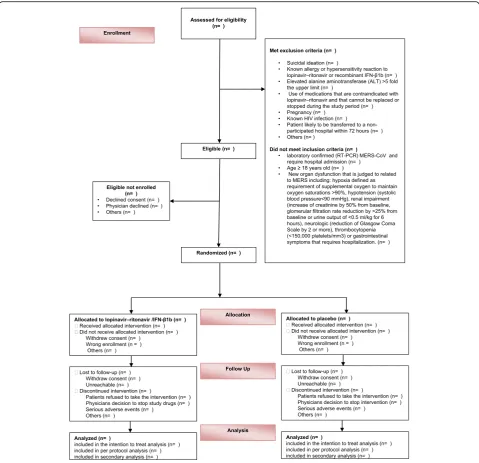
A CONSORT flow diagram of the trial progress will be constructed (Fig.1). The number of randomized patients to each group will be reported as well as the number of randomized patients who received the interventions. We will also report the number of screened patients (defined as all hospitalized patients with MERS) who met the eli-gibility criteria but were not enrolled and the reasons for non-enrollment.
The intention-to-treat population consists of all en-rolled patients whether or not they received the allo-cated intervention, and will be used for the primary analysis. A per-protocol analysis will be conducted for patients who received the allocated interventions (de-fined by any dose of the study intervention).
Data
Baseline characteristics
creatine kinase, lactate) and respiratory and vital parame-ters in addition to the location of the patient at time of randomization.
Intervention data
For each group we will report the time of hospital ad-mission to randomization and the time of randomization to the first dose received of the study drugs. We will re-port the received study intervention and its duration for each group, in addition to the missing or incomplete
doses and protocol violations (Additional file1: Table S2 and Table S8).
Co-interventions
We will compare any use of vasopressors, renal replace-ment therapy, neuromuscular blockade, mechanical ven-tilation, extracorporeal membrane oxygenation (ECMO), nitric oxide, prone ventilation, and tracheostomy. We will also compare the use of intravenous immunoglobu-lin, antiviral therapy, antibiotics, corticosteroids, and sta-tins (Additional file1: Table S2).
[image:3.595.58.538.87.550.2]Primary and secondary outcomes
The primary outcome is 90-day mortality (Additional file 1: Table S3). The primary outcome is defined as all-cause mortality after enrollment in the trial within 90 days, as either an inpatient or outpatient.
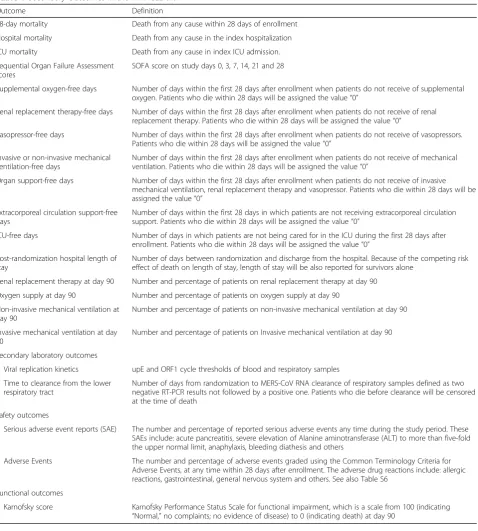
Secondary outcomes and subgroups are defined as presented in Table 1 and Additional file 1: Table S4, and S5).
In addition, we will compare the physiological parame-ters among patients treated in the treatment group and the control group.
Statistical analysis
[image:4.595.61.540.204.736.2]All analyses will be performed using SAS 9.4 with spe-cially written code for the analysis of the primary
Table 1Secondary Outcomes in the MIRACLE trial
Outcome Definition
28-day mortality Death from any cause within 28 days of enrollment
Hospital mortality Death from any cause in the index hospitalization
ICU mortality Death from any cause in index ICU admission.
Sequential Organ Failure Assessment scores
SOFA score on study days 0, 3, 7, 14, 21 and 28
Supplemental oxygen-free days Number of days within the first 28 days after enrollment when patients do not receive of supplemental oxygen. Patients who die within 28 days will be assigned the value“0”
Renal replacement therapy-free days Number of days within the first 28 days after enrollment when patients do not receive of renal replacement therapy. Patients who die within 28 days will be assigned the value“0”
Vasopressor-free days Number of days within the first 28 days after enrollment when patients do not receive of vasopressors. Patients who die within 28 days will be assigned the value“0”
Invasive or non-invasive mechanical ventilation-free days
Number of days within the first 28 days after enrollment when patients do not receive of mechanical ventilation. Patients who die within 28 days will be assigned the value“0”
Organ support-free days Number of days within the first 28 days after enrollment when patients do not receive of invasive mechanical ventilation, renal replacement therapy and vasopressor. Patients who die within 28 days will be assigned the value“0”
Extracorporeal circulation support-free days
Number of days within the first 28 days in which patients are not receiving extracorporeal circulation support. Patients who die within 28 days will be assigned the value“0”
ICU-free days Number of days in which patients are not being cared for in the ICU during the first 28 days after
enrollment. Patients who die within 28 days will be assigned the value“0”
Post-randomization hospital length of stay
Number of days between randomization and discharge from the hospital. Because of the competing risk effect of death on length of stay, length of stay will be also reported for survivors alone
Renal replacement therapy at day 90 Number and percentage of patients on renal replacement therapy at day 90
Oxygen supply at day 90 Number and percentage of patients on oxygen supply at day 90
Non-invasive mechanical ventilation at day 90
Number and percentage of patients on non-invasive mechanical ventilation at day 90
Invasive mechanical ventilation at day 90
Number and percentage of patients on Invasive mechanical ventilation at day 90
Secondary laboratory outcomes
Viral replication kinetics upE and ORF1 cycle thresholds of blood and respiratory samples
Time to clearance from the lower respiratory tract
Number of days from randomization to MERS-CoV RNA clearance of respiratory samples defined as two negative RT-PCR results not followed by a positive one. Patients who die before clearance will be censored at the time of death
Safety outcomes
Serious adverse event reports (SAE) The number and percentage of reported serious adverse events any time during the study period. These SAEs include: acute pancreatitis, severe elevation of Alanine aminotransferase (ALT) to more than five-fold the upper normal limit, anaphylaxis, bleeding diathesis and others
Adverse Events The number and percentage of adverse events graded using the Common Terminology Criteria for
Adverse Events, at any time within 28 days after enrollment. The adverse drug reactions include: allergic reactions, gastrointestinal, general nervous system and others. See also Table S6
Functional outcomes
Karnofsky score Karnofsky Performance Status Scale for functional impairment, which is a scale from 100 (indicating
outcome that accounts for the recursive design, as de-scribed in Chang [4].
Data and Safety Monitoring Board and interim analyses
A detailed interim analysis plan is reported in the MIR-ACLE protocol [3]. The trial is designed as a recursive, two-stage, group sequential randomized trial. The first interim analysis will be conducted when 34 subjects (17 per group) have completed 90 days of follow-up. This is about 17.5% of the total sample size needed for the clas-sical design (a classic two-group design requires a total of 194 subjects (97 subjects per group) to have an 80% power at a significance level of 5% using a one-sided Z test for difference in proportion to detect 20% absolute risk reduction in 90 days mortality among subjects re-ceiving treatment (20%) compared to a control group (40%)). A Data and Safety Monitoring Board (DSMB) will be convened to review the unblinded data (efficacy and safety) and advise on continuation or termination of the trial. The determination of the stopping boundaries in the first two-stage design was calculated using the conditional power method based on the summing stage-wise p values. At the first interim analysis, the DSMB will determine whether the trial should be terminated for futility or not using the following boundaries and their corresponding decisions (Table2).
Demographics and clinical characteristics
We will summarize and report the demographics and baseline clinical characteristics using descriptive statis-tics. As appropriate, the chi-square test or Fisher’s exact test will be used to compare the categorical variables, which will be reported as numbers and percentages. Stu-dent’sttest or the Mann–WhitneyUtest will be used as appropriate to compare the continuous variables, which will be reported as means and standard deviations or as medians and interquartile ranges.
Analysis of adverse events
All adverse events will be grouped using Common Ter-minology Criteria for Adverse Events (CTCAE) Version 4 of the National Institutes of Health (NIH) (Additional file1: Table S6). Adverse events will be grouped into ag-gregate groups and reported for the entire study period (Additional file 1: Table S7). All results will be
summarized in terms of frequency and percentage and will be compared across study arms using Fisher’s exact test. All results will be declared statistically significant with apvalue < 0.05.
Analysis of the primary outcome and continuous planning of the trial
LetKbe the number of stages of the current clinical trial needed to complete the trial and i∈{1, 2} be the index for the two-stage design in thekthstage. Letr1kiand r2ki be the proportions of 90 days mortality in the standard of care and treatment group respectively. Then the Z test statistic for the difference in proportion can be cal-culated as follows:
Zki¼δki
σki
ffiffiffiffiffiffi
nki
2 r
;
σki¼
ffiffiffiffiffiffiffiffiffiffiffiffiffiffiffiffiffiffiffiffiffiffiffiffiffiffiffiffiffiffiffiffiffiffiffiffiffiffiffiffiffiffiffiffiffiffiffiffiffiffiffiffiffiffiffi
r1kið1−r1kiÞ þr2ð1−r2kiÞ
½ =2
p
;
δki¼r1ki−r2ki;
wherenki is the sample size per group for theith two-stage design of thekth stage. In the interim analysis (i.e., at eachi= 1 of the kth two-stage), the primary outcome will be evaluated, and the trial sample size will be re-estimated for the subsequent stage based on the ob-served effect size using the following formula assuming a conditional power of 80% (Pc= 0.8) to decide if the trial should continue:
nk;2¼
ffiffiffi 2
p σk1
δδk1 Φ
−1 1−α
k;2þpk;1
−Φ−1ð1−PcÞ
2
:
Here αk, 2 is the precalculated rejection boundary for efficacy at the second stage of the two-stage design at thekthstage, and pk, 1is the raw table probability corre-sponding to theZkistatistic. At the first interim analysis, should the data suggest that another stage of the two-stage steps is required, we will recalculate the condi-tional error and new boundaries will be calculated for K= 2. Let βk+ 1, 1, αk+ 1, 1 be the rejection boundaries for futility and efficacy for the first (i= 1) of the two-stage step of thekth+ 1 stage. Then the conditional error is:
Table 2Stopping boundaries in the MIRACLE trial
Boundary Value Decision
Efficacy sopping boundary (α1) 0 No stopping for efficacy
Futility stopping boundary (β1) 0.2 Stop the trial for futility if less than stage-wiseP-value
Efficacy stopping boundary (α2) 0.2250 Stop trial for efficacy at the second stage or recalculate based on conditional power at first interim analysis
A pk;1
¼αkþ1;1þαkþ1;2 βkþ1;1−αkþ1;1
−1 2 β2
kþ1;1−α2kþ1;1
;k¼0;1;…K;
whereA(p0, 1) is the type I error, which is set to 0.05. The new αk+ 1, 2 boundary for the kth+ 1 stage for pre chosenβk+ 1, 1, αk+ 1, 1will be calculated as follows:
αkþ1;2¼
A p k;1þ1
2 β
2
kþ1;1−α
2
kþ1;1
−αkþ1;1
βkþ1;1−αkþ1;1 :
At the end of the trial, the treatment will be declared efficacious if the calculated stage-wise ordered p value pk, 2is less than αk, 2. The adjusted p value will be ob-tained using backward recursion as follows:
PK0−1;2¼
t for k¼1;
αk0;1þt βk0;1−αk0;1
−1
2 β 2
k0;1−α2k0;1
for k¼2;
(
Pi−1;2¼αi;1þ pi;1þpi;2
βi;1−αi;1
−1
2 β 2
i;1−α2i;1
for i¼1;…;K0−1 8 > > > < > > > :
whereK0is the total number of two-stage stages, andt is the sum of stage-wise raw p values. Finally, the ad-justed overall 95% one-sided confidence interval will be calculated by:
δc¼ max
1≤i≤K0−1 δi;1;δk0;2
;
where δi, 1 and δk0;2 are the stage-wise and the last
stage of the kth two-stage design confidence interval bound. The last stage confidence bound δk0;2 can be
found by solving the following equation numerically for δk0;2:
Φ δk0;2 ~ σ
ffiffiffiffiffiffiffiffiffi
nk0;1
2 r
−z1−pk0;1
þΦ δk0;2
~ σ
ffiffiffiffiffiffiffiffiffi
nk0;2
2 r
−z1−pk0;2
¼αk0;2;
wherenk0, 1andnk0, 2are the sample sizes for the first and second stage of the last kth two-stage design, and pk0, 1,pk0, 2are the stage-wise adjustedpvalues.
In order to stay consistent with the method that was used in calculating the boundaries for the trial, we will not account for stratification in the primary outcome analysis. In general, this approach is acceptable and it preserves both type I and type II errors as long as the weighted average of the effect size stays close to the hy-pothesized effect size [15]. Furthermore, as long as the sample size re-estimation at the interim analysis was based on the weighted average of the effect size, the overall power of the trial will be preserved.
Secondary analyses of the primary outcome, secondary outcomes, and subgroups
With the exception of the analysis of the primary out-come, all other analyses will be tested using regular
statistical methods and will be two-sided. A secondary ad-justed analysis will be conducted using multiple logistic regression analysis, in which death within 90 days will be modeled as the dependent variable, and a set of baseline variables that are strongly believed to affect the outcome of MERS will be included as independent variables. Those variables will include at minimum the following: age, community-acquired versus hospital-acquired infection, mechanical ventilation, center, and Sequential Organ Fail-ure Assessment score. Ninety-day median survival time will be summarized and reported using Kaplan–Meier curves and will be compared between the study groups using the log-rank test (Additional file1: Figure S1). Ana-lysis of secondary outcomes will be compared in the intention-to-treat cohort only. Subgroup analyses will be conducted if patient numbers permit (e.g., no fewer than five patients in subgroups of interest) in a priori defined subgroups (Additional file1: Table S5). Multivariable lo-gistic regression will be used to report the results of tests of interactions for these subgroups.
Handling of missing data
All missing data will be reviewed and characterized in terms of their pattern (e.g., missing completely at ran-dom, missing at ranran-dom, etc.). For missing completely at random, all analyses will be based on a list-wise deletion approach where only observations with complete values will be considered for analysis. For variables with values missing at random, multiple imputation techniques will be utilized to impute the missing values, as suggested by Rubin [16].
Adjustment multiplicity testing for the secondary analyses
To adjust for multiple testing, we will use the false dis-covery rate (FDR) as described by Benjamini and Hoch-berg [17]. In this procedure all hypothesis tests will be sorted in ascending order based on their calculated p value. All hypothesis tests below an index K will be rejected, whereKis calculated as follows:
K¼ max i:p ið Þ≤ i m:q
;
wherei=m,…,1,mis the total number of tested hy-potheses, andq= 0.05.
Additional details about the SAP are available in Additional file 2.
Discussion
care, in hospitalized patients with laboratory-confirmed MERS.
The first patient was enrolled in November 2016. At present, 14 sites are actively screening for eligible pa-tients. The recruitment rate in the MIRACLE trial has been slow mainly related to the decline in the number of MERS cases in Saudi Arabia. Due to the uncertainty of the efficacy level of the treatment and the recruitment rate, the trial is designed to be a recursive, two-stage, group sequential randomized trial [4].
Several methods could be utilized to build an adaptive trial. However, most of these methods would require one to specify a priori the time and type of adjustments that need to take place in the trial. For a disease such as MERS there are many factors that could limit the ability to specify a priori those elements; thus, the recursive two-stage design is a natural choice. This type of design provides enough flexibility to introduce different adjust-ments while learning from the observed data without in-flating the type I error.
Reporting of the SAP to the MIRACLE trial in advance of trial completion will enhance evaluation of the clinical data and support confidence in the final results and the conclusion. Prior specification of the statistical methods and outcomes analysis will facilitate unbiased analyses of these important clinical data.
Trial status
Recruitment started in November 2016 and is currently ongoing.
Supplementary information
Supplementary informationaccompanies this paper athttps://doi.org/10. 1186/s13063-019-3846-x.
Additional file 1: Table S1.Baseline characteristics of intention-to-treat (ITT) population.Table S2.Summary of interventions and
co-interventions.Table S3.Primary outcome: 90-day mortality.Table S4. Secondary outcomes.Table S5.Subgroup analyses.Table S6. Classifica-tion of adverse events in the MIRACLE trial (MERS-CoVInfection tReated withA Combination ofLopinavir/ritonavir and intErferon-β1b) using the NIH Common Terminology Criteria for Adverse Events (CTCAE), Version 4.0.Table S7.Summary of adverse events by severity.Table S8. Sum-mary of protocol violations.
Additional file 2.Statistical analysis plan document.
Abbreviations
APACHE II:Acute Physiology and Chronic Health Evaluation II; CONSORT: Consolidated Standards of Reporting Trials; CTCAE: Common Terminology Criteria for Adverse Events; DSMB: Data and Safety Monitoring Board; ECMO: Extracorporeal membrane oxygenation; MERS: Middle East respiratory syndrome; MERS-CoV: Middle East respiratory syndrome coronavirus; MIRACLE trial:MERS-CoVInfection tReated withA Combination ofLopinavir/ritonavir and intErferon-β1b; NIH: National Institutes of Health; SAP: Statistical analysis plan; SFDA: Saudi Food and Drug Authority; TEAE: Treatment-emergent adverse event
Acknowledgements
We would like to acknowledge the following Data Safety Monitoring Board (DSMB) Chair and members:
Greg S Martin, MD, MSc (Chair) Professor of Medicine
Executive Associate Division Director
Division of Pulmonary, Allergy, Critical Care and Sleep Medicine Research Director, Emory Critical Care Center
Emory University School of Medicine
Section Chief and Director, Medical and Coronary Intensive Care Grady Memorial Hospital
Atlanta, Georgia, USA
David A Schoenfeld, PhD (Member)
Professor of Medicine, Harvard Medical School Professor in the Department of Biostatistics Harvard School of Public Health
Boston, Massachusetts, USA
Sharon L Walmsley, MSc, MD, FRCPC (Member)
Senior Scientist, Toronto General Research Institute (TGRI) Toronto, Ontario, Canada
Shannon Carson, MD (Member) Professor of Medicine
Division Chief, Pulmonary Diseases and Critical Care Medicine University of North Carolina at Chapel Hill School of Medicine Chapel Hill, North Carolina, USA
Authors’contributions
YA, AA1, HB, SJ, SH, SK, MJ, AMD, JJ, RAF, FGH, and MAH conceived and designed the plan. YA, AMD, and JJ drafted the manuscript. YA, JJ, and MAH developed the analytical plan. YA, AA, AMA, HAJ, AA1, HB, SJ, SH, SK, MJ, AMD, ZAM, SG, SF, FH, AS, YM, GM, NMS, FEZ, AM, AB, AK, JJ, AH, MS, AM, RAF, FGH, AD, MA, WB, and MAH were involved in trial sites management, critical revision of the manuscript for important intellectual content, and approval of the final version to be published, and they agree to be accountable for all aspects of the work. All authors read and approved the final version of the manuscript.
Funding
The MIRACLE trial is funded by King Abdullah International Medical Research Center, Riyadh, Kingdom of Saudi Arabia. The study sponsor does not have any role in the study design, collection, management, analysis or interpretation of the data, or in writing the report.
Availability of data and materials
The datasets generated and/or analyzed during the current study are available from the corresponding author on reasonable request.
Ethics approval and consent to participate
The MIRACLE study is approved by the Scientific Committee and the Institutional Review Board at the National Guard Health Affairs, Riyadh, Saudi Arabia (RC15/142) and all participating sites and registered at the Saudi Food and Drug Authority (SFDA), Riyadh, Saudi Arabia. Patients who meet the eligibility criteria or substitute makers (for patients lacking decision-making capacity) of eligible patients will be approached to obtain informed consent for enrollment.
Consent for publication Not applicable.
Competing interests
The authors declare that they have no competing interests. YA and FGH are unpaid consultants on antivirals active for MERS for Gilead Sciences, SAB Biotherapeutics, and Regeneron.
Author details
1College of Medicine, King Saud Bin Abdulaziz University for Health Sciences,
King Abdullah International Medical Research Center, Riyadh, Saudi Arabia.
2
Intensive Care Department, Ministry of the National Guard - Health Affairs, ICU 1425, P.O. Box 22490, Riyadh 11426, Saudi Arabia.3Prince Mohammed
bin Abdulaziz Hospital, Riyadh, Saudi Arabia.4Infection Prevention and
Riyadh, Saudi Arabia.5Deputy Minister for Public Health, Ministry of Health,
Riyadh, Saudi Arabia.6Department of Medicine, Ministry of the National
Guard - Health Affairs, Riyadh, Saudi Arabia.7Department of Infection
Prevention and Control, Ministry of the National Guard - Health Affairs, Riyadh, Saudi Arabia.8Department of Pathology and Laboratory Medicine,
Ministry of the National Guard - Health Affairs, Riyadh, Saudi Arabia.9College
of Pharmacy, King Saud Bin Abdulaziz University for Health Sciences, King Abdullah International Medical Research Center, Riyadh, Saudi Arabia.
10Pharmaceutical Care Department, Ministry of the National Guard - Health
Affairs, Riyadh, Saudi Arabia.11King Saud Bin Abdulaziz University for Health
Sciences, King Abdullah International Medical Research Center, Research Office, Riyadh, Saudi Arabia.12Ministry of the National Guard - Health Affairs, Riyadh, Saudi Arabia.13Prince Mohammed bin Abdulaziz Hospital, Ministry of
Health & College of Medicine, Alfaisal University, Riyadh, Saudi Arabia.
14Hubert Department of Global Health, Rollins School of Public Health,
Emory University, Atlanta, Georgia, USA.15College of Medicine, King Saud Bin Abdulaziz University for Health Sciences, King Abdullah International Medical Research Center, Jeddah, Saudi Arabia.16Intensive Care Department, Ministry
of the National Guard - Health Affairs, Jeddah, Saudi Arabia.17Department of
Infection Prevention and Control, Ministry of the National Guard - Health Affairs, Jeddah, Saudi Arabia.18Military Medical Services, Ministry of Defense,
Prince Sultan Military Medical City, Riyadh, Saudi Arabia.19Department of
Intensive Care Services, Prince Sultan Military Medical City, Riyadh, Saudi Arabia.20Infectious Diseases Division, Prince Sultan Military Medical City, Riyadh, Saudi Arabia.21Department of Critical Care Medicine, King Fahad
Medical City, Riyadh, Saudi Arabia.22Department of Critical Care Medicine,
King Khalid University, Aseer Central Hospital, Abha, Saudi Arabia.
23
Department of Critical Care, King Fahad Hospital, Ohoud Hospital, Al-Madinah Al-Monawarah, Saudi Arabia.24Department Biostatistics and
Bioinformatics, King Saud Bin Abdulaziz University for Health Sciences, King Abdullah International Medical Research Center, Riyadh, Saudi Arabia.
25
Intensive Care Unit, King Saud Medical City, Riyadh, Saudi Arabia.
26Infectious Disease, King Saud Medical City, Riyadh, Saudi Arabia.27Intensive
Care Department, King Saud Medical City, Riyadh, Saudi Arabia.
28Department of Anesthesiology and Intensive Care, Tanta University
Hospitals, Tanta, Egypt.29Institute of Health Policy Management and Evaluation, University of Toronto, Toronto, Canada.30Department of Critical
Care Medicine and Department of Medicine, Sunnybrook Hospital, Bayview Avenue, Room D478, Toronto 2075, Canada.31International Severe Acute
Respiratory and Emerging Infection Consortium (ISARIC), Division of Infectious Diseases and International Health, Department of Medicine, University of Virginia School of Medicine, Charlottesville, Virginia, USA.
32Critical Care Medicine Department, King Abdullah Medical Complex,
Jeddah, Saudi Arabia.33Critical Care Medicine Department, Cairo University Hospital, Cairo, Egypt.34Internal Medicine Department, King Fahad General
Hospital, Ministry of Health, Jeddah, Saudi Arabia.
Received: 9 December 2018 Accepted: 24 October 2019
References
1. Arabi YM, Balkhy HH, Hayden FG, Bouchama A, Luke T, Baillie JK, Al-Omari A, Hajeer AH, Senga M, Denison MR, et al. Middle East respiratory syndrome. N Engl J Med. 2017;376:584–94.
2. Arabi Y, Shalhoub S, Mandourah Y, Al-Hameed F, Al-Omari A, Al Qasim E, Jose J, Alraddadi B, Almotairi A, Al Khatib K, Abdulmomen A, Qushmaq I, Sindi AA, Mady A, Solaiman O, Al-Raddadi R, Maghrabi K, Ragab A, Al Mekhlafi GA, Balkhy HH, Al Harthy A, Kharaba A, Gramish JA, Al-Aithan AM, Al-Dawood A, Merson L, Hayden FG, Fowler R, Saudi Critical Care Trials Group. Ribavirin and interferon therapy for critically ill patients with the Middle East respiratory syndrome: a multicenter observational study, Clin Infect Dis 2019; ciz544. doi:https://doi.org/10.1093/cid/ciz544. 3. Arabi YM, Alothman A, Balkhy HH, Al-Dawood A, AlJohani S, Al Harbi S,
Kojan S, Al Jeraisy M, Deeb AM, Assiri AM, et al. Treatment of Middle East respiratory syndrome with a combination of lopinavir-ritonavir and interferon-beta1b (MIRACLE trial): study protocol for a randomized controlled trial. Trials. 2018;19:81.
4. Chang M. Adaptive design theory and implementation using SAS and R. 2nd ed. Boca Raton: Chapman & Hall/CRC; 2014. p. 153–80.
5. Liu Q, Anderson KM, Pledger GW. Benefit–risk evaluation of multi-stage adaptive designs. Seq Anal. 2004;23:317–31.
6. US Food and Drug Administration (FDA). Draft guidance for industry on enrichment strategies for clinical trials to support approval of human drugs and biological products; availability. 2012.https://www.federalregister.gov/ documents/2012/12/17/2012-30274/draft-guidance-for-industry-on-enrichment-strategies-for-clinical-trials-to-support-approval-of. Accessed 26 June 2019.
7. Wassmer G, Eisebitt R, Coburger S. Flexible interim analyses in clinical trials using multistage adaptive test designs. Drug Inf J. 2001;35:1131–46. 8. Schafer H, Muller HH. Modification of the sample-size and the schedule of
interim analyses in survival trials based on data inspections. Stat Med. 2001; 20:3741–51.
9. Moher D, Hopewell S, Schulz KF, Montori V, Gotzsche PC, Devereaux PJ, Elbourne D, Egger M, Altman DG. CONSORT 2010 explanation and elaboration: updated guidelines for reporting parallel group randomised trials. BMJ. 2010;340:c869.
10. Schulz KF, Altman DG, Moher D, Group C. CONSORT 2010 statement: updated guidelines for reporting parallel group randomised trials. BMJ. 2010;340:c332.
11. International Conference on Harmonisation of Technical Requirements for Registration of Pharmaceuticals for Human Use: Good Clinical Practice (GCP) guideline.https://database.ich.org/sites/default/files/E6_R2_Addendum.pdf. 12. The International Council for Harmonisation of Technical Requirements for Pharmaceuticals for Human Use (ICH): statistical principles for clinical trials. https://database.ich.org/sites/default/files/E9_Guideline.pdf.
13. International Conference on Harmonisation of Technical Requirements for Registration of Pharmaceuticals for Human Use: E3 - structure and content of clinical study reports.https://database.ich.org/sites/default/files/E3_ Guideline.pdf.
14. Gamble C, Krishan A, Stocken D, Lewis S, Juszczak E, Dore C, Williamson PR, Altman DG, Montgomery A, Lim P, et al. Guidelines for the content of statistical analysis plans in clinical trials. JAMA. 2017;318:2337–43. 15. Srivastava DK, Rai SN, Pan J. Robustness of an odds-ratio test in a stratified
group sequential trial with a binary outcome measure. Biom J. 2007;49:351–64. 16. Rubin DB. Multiple imputation after 18+ years. J Am Stat Assoc. 1996;91:473–89. 17. Benjamini Y, Hochberg Y. Controlling the false discovery rate: a practical
and powerful approach to multiple testing. J R Stat Soc Ser B Methodol. 1995;57:289–300.
Publisher’s Note