ISSN: 1992-8645 www.jatit.org E-ISSN: 1817-3195
FROM CITESEER TO CITESEER
X: AUTHOR RANKINGS
BASED ON COAUTHORSHIP NETWORKS
DALIBOR FIALA
University of West Bohemia, Department of Computer Science and Engineering, Czech Republic
E-mail: [email protected]
ABSTRACT
CiteSeer was a digital library and a search engine gathering its mainly computer science research papers from the World Wide Web. After a few years of stagnation, it was definitely replaced with a new version called CiteSeerX in April 2010. As both CiteSeers provide(d) freely available metadata on the articles they index(ed), it is possible to analyze two different data sets to see the differences between CiteSeer and CiteSeerX. More specifically, we examined the article metadata from CiteSeer (downloaded in December 2005) and from CiteSeerX (harvested in March 2011) with a view of creating rankings of prestigious computer scientists. Since the free article metadata acquired from the Web site of CiteSeerX differ from those in CiteSeer in that they do not systematically include cited references, the only possibility of creating such rankings is to base them on the coauthorship networks in both CiteSeers. In this study, we produce these rankings using 12 different ranking methods including PageRank and its variants, compare them with the lists of ACM A. M. Turing Award and ACM SIGMOD E. F. Codd Innovations Award winners and conclude that the rankings generated from CiteSeerX data outperform those from CiteSeer.
Keywords: CiteSeer, CiteSeerX, Coauthorships, Citations, Researchers, PageRank
1. INTRODUCTION AND RELATED WORK
CiteSeer [1] was a digital library and a search engine specialized mainly in computer science literature that gathered its content by autonomously crawling the World Wide Web and downloading and parsing potentially relevant documents [2]. After some time of running in parallel with a new version, finally, in April 2010, the “old” CiteSeer officially ceased to exist and was replaced by the new CiteSeerX [3], which is, however, still in a beta version at the time of writing this paper (May 2013). In fact, the old URL redirects to the new one now. Anyway, in the last years of its existence, CiteSeer was no more updated. On the other hand, CiteSeerX has been continuously updated since its creation until now. Although there have been enough studies based on CiteSeer data, some of which will be mentioned in the related work section, research dealing with CiteSeerX has been somewhat rare so far, probably partly due to the relative novelty and presumed immaturity of CiteSeerX. Also, even though the nature of CiteSeer data invites bibliometric analyses, there have been few of them, perhaps as a result of the presence of errors in the data that have been created using automated text processing tools. In spite of this, some papers have reported a
successful usage of CiteSeer data for bibliometric purposes (see more on this in the following paragraphs).
This study tries to analyze the freely available article metadata of CiteSeer and CiteSeerX (obtainable from their respective Web sites) and to answer the following main research questions: a) What is the structure of these article metadata of CiteSeer and CiteSeerX and what are the basic characteristics of the coauthorship networks generated from them? b) Can the coauthorship networks of CiteSeer and CiteSeerX be used to rank computer scientists? c) And, if yes, which CiteSeer generates better rankings if they are compared to the lists of prestigious computer science award winners (ACM A. M. Turing Award and ACM SIGMOD E. F. Codd Innovations Award)?
ISSN: 1992-8645 www.jatit.org E-ISSN: 1817-3195
computation on entity-relation graphs. Hopcroft et al. [7] tracked evolving communities of computer science research papers by exploring the CiteSeer citation graph from 1998 and 2001. Joorabchi and Mahdi [8] used CiteSeer documents to evaluate the performance of their automatic classification of research papers according to a standard library classification scheme. Popescul et al. [9] employed CiteSeer data to train and test their new classifier that categorized research papers into publication venues. Šingliar and Hauskrecht [10] performed a component analysis of a partial CiteSeer citation graph. Zhou et al. [11] used thousands of CiteSeer documents in the construction of a real-world network to test their graph partitioning algorithm for the discovery of temporal communities of computer science researchers. Chen et al. [12] proposed a system based on the coauthorship network of CiteSeerX to recommend potential collaborators. He et al. [13] designed a recommender system suggesting cited references for a given article based on the many citation contexts available in CiteSeerX. Abstracts from CiteSeerX documents were employed in the construction of hierarchical topic-based communities of authors by Wu and Koh [14].
Fewer studies have been bibliometric. CiteSeer was used as one of the data sources providing citation data for the citation analysis of the works of a famous mathematician by Bar-Ilan [15]. Feitelson and Yovel [16] took advantage of CiteSeer’s citation counts of highly cited researchers in their predictive model of future citation-based ranks of researchers. Giles and Councill [17] investigated acknowledgements in the papers of the CiteSeer archive including its citation graph and determined the most acknowledged entities as well as their citation counts. Goodrum et al. [18] analyzed the most cited documents in the CiteSeer database and found out their publication type and age, among others. Zhao [19] explored the CiteSeer citation graph in the XML research field and identified highly productive and influential scientists. Zhao and Logan [20] carried out a similar study and concluded that citation analysis based on CiteSeer (at least in the XML domain) is as valid as that based on established data sources. And, finally, Zhao and Strotmann [21], again in the XML research field, conducted an author co-citation analysis of CiteSeer documents and compared the results with an analysis based on ISI Science Citation Index. Krumov et al. [22] constructed a coauthorship network from CiteSeerX data and examined the relation of coauthorship patterns to the impact of scientific publications.
Unlike our research, most of the above studies have not dealt with the CiteSeer citation or coauthorship graph as a whole – they have been mostly concerned with a part of it only. Furthermore, none of them has analyzed CiteSeer as well as CiteSeerX at the same time. In this context, this study is unique in that it examines the whole coauthorship graphs of both CiteSeers. It is an extension to our previous work, in which a citation analysis of the whole CiteSeer citation graph with a view of identifying prominent computer scientists was carried out [23] and a bibliometric analysis of all CiteSeer metadata aimed at finding the most productive and influential countries in computer science was conducted [24]. The usefulness of coauthorships in the assessment of researchers was shown by Yan and Ding [25] who determined the impact of authors in the informetrics research community by applying the PageRank algorithm to a coauthorship network. For the evaluation of the author rankings resulting from our analyses, we use the same technique (comparing the rankings with the lists of computer science award winners) as in other studies [23, 26-28].
2. DATA AND METHODS
ISSN: 1992-8645 www.jatit.org E-ISSN: 1817-3195
In total, there were 716768 “core” (i.e., with article full texts) publication records in CiteSeer and 1334000 “core” publication records in CiteSeerX. Thus, the number of records almost doubled between 2005 and 2011. As complete citations between publications are not available in the CiteSeerX metadata we had (unlike CiteSeer), the only possibility of constructing comparable author citation graphs from both CiteSeers is to base them on the coauthorship networks (similarly to Yan and Ding, 2011) that can be easily built from both metadata sets. From a coauthorship (or collaboration) network with publications and their respective authors, we can obtain a graph of
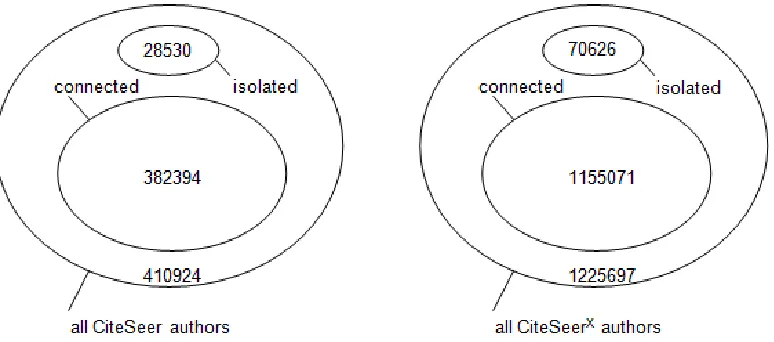
[image:3.612.116.503.283.454.2]authors, in which every two coauthors of a publication are connected with an undirected edge. To avoid parallel edges in the case of many publications being written by the same coauthors, the edge will be assigned a weight denoting the number of joint publications. Next, each undirected edge is replaced with two oppositely directed edges both retaining the original weight. As a result, a citation graph of authors based on the collaboration network has been created. The basic statistics of such author citation graphs generated from the article metadata of CiteSeer and CiteSeerX can be seen in figure 1.
Figure 1: Basic Statistics of the Coauthorship Graphs in Both CiteSeers
Without disambiguation or duplicates removal, we found a total of 1 663 044 author records in CiteSeer and 3837226 in CiteSeerX (not visible in figure 1). After transforming author names into upper case, we identified 410924 “distinct” authors in CiteSeer and 1225697 “distinct” authors in CiteSeerX. These are the actual numbers of nodes in the author citation graphs. We must underline that name unification and disambiguation is a very tedious and time-consuming task and is not the concern of this research. We examine the data from CiteSeer “as is”, without any pre- or postprocessing and this may have influence on the rather high per-author citation counts below. Prior to the elimination of parallel edges in the author citation graphs, there were 4764960 citations (formerly collaborations) between authors in CiteSeer (11.6 per author) and 16023138 in CiteSeerX (13.1 per author) excluding self-citations of all authors. After eliminating the
parallel edges, there were 2466446 and 9607486 edges left, which were assigned weights as described above. As for the authors, their number tripled between 2005 and 2011, but the percentage of isolated authors remained almost the same (7% and 6%, respectively) compared to the total number of authors. “Connected authors” are those who cite or are cited, which is equivalent here, because the citation graph is based on symmetric collaborations. Finally, we can conclude that the linkage density of the CiteSeer coauthorship graphs did not change between 2005 and 2011.
ISSN: 1992-8645 www.jatit.org E-ISSN: 1817-3195
in-degree (“unweighted”) or from more complicated (higher-order, recursive) methods such as HITS [30] or the notoriously known PageRank [31], which were originally conceived for the World Wide Web but later also applied to other network types such as author citation networks to identify influential actors. The “standard” PageRank (PR, by Brin and Page) can be modified so as to better reflect the features of bibliographic networks. For instance, the formerly unweighted edges can be assigned weights that denote the number of citations between two authors and thus give rise to a “weighted PageRank” (PR-W). The weighted PageRank formula can be further extended with some additional information such as the number of collaborations (PR-C), publications (PR-P), all coauthors (PR-AC), all distinct coauthors (ADC), all collaborations (PR-AColl), coauthors (PR-CA), or distinct coauthors (PR-DCA) that can all have influence on the weight of the directed edge between two authors. Thus, we get 12 ranking methods in total (Cites, InDeg, HITS, PR, PR-W, PR-C, PR-P, PR-AC, PR-ADC, PR-AColl, PR-CA, and PR-DCA), all of which will be used in our analysis. (For all the PageRank-like methods, we used a damping factor d of 0.9, a Spearman correlation-based convergence criterion and a maximum of 50 iterations.)
3. RESULTS AND DISCUSSION
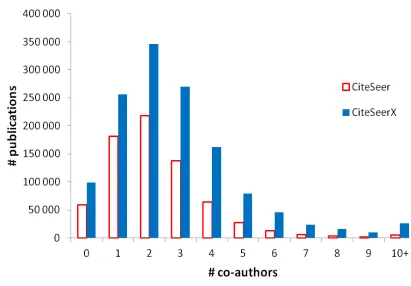
[image:4.612.99.510.424.710.2]We were interested in the changes that occurred in the CiteSeer data from 2005 to 2011. First, we had a look at the distribution of publications based on the number of their authors. Figure 2 shows such a histogram. There we can observe some similarities and discrepancies between the two CiteSeers. For instance, both digital libraries have a significant amount of publications with no authors and this amount remains relatively the same. The cause of this may be the inability of the underlying algorithms to correctly identify author names. From this point of view, the parsing quality does not seem to improve over the years. The most frequent number of authors per paper is two in both cases, but there is a difference in the second most frequent number – this is one author in CiteSeer but three authors in CiteSeerX. There may be several reasons for this phenomenon including the general increase in the average number of authors per paper in computer science between 2005 and 2011 or the concentration of CiteSeerX on a specific subfield of computer science with a higher number of authors. However, finding a precise explanation was not the aim of this study.
ISSN: 1992-8645 www.jatit.org E-ISSN: 1817-3195
ISSN: 1992-8645 www.jatit.org E-ISSN: 1817-3195
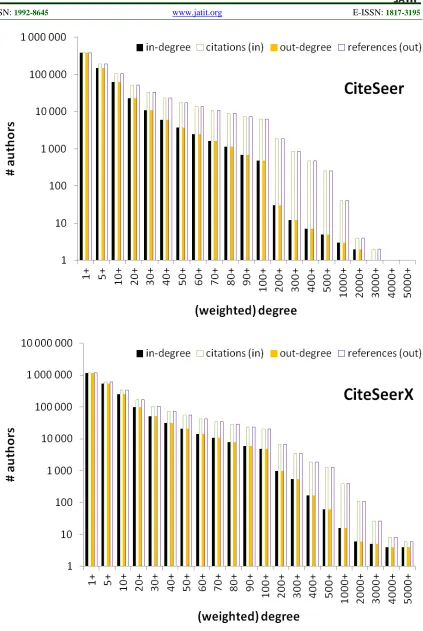
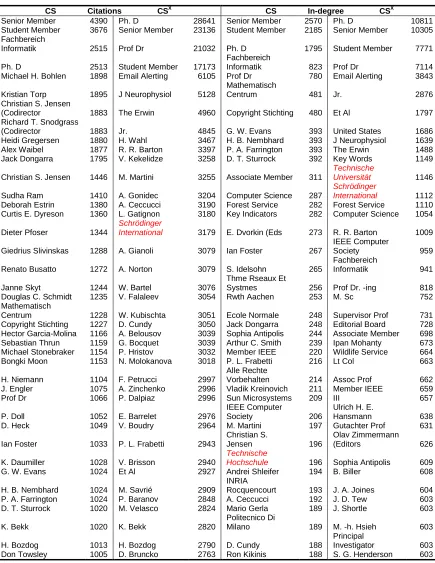
As far as the “density” of the graph of citations between publications is concerned, a great deal is revealed from the cumulative histogram charts in figure 3. The bars represent authors (i.e., graph nodes) with a specific magnitude of (weighted) in-degree or (weighted) out-degree. All the indicators are always larger in CiteSeerX due to the overall greater number of nodes and edges in the graph. We call the weighted in-degree “citations” and the weighted out-degree “references”. Evidently, for a weighted degree, the weights of in-coming (or out-going) edges are summed up. Since the directed graphs under study are based on symmetric collaborations, in-degrees and weighted in-degrees are equal and so are out-degrees and weighted out-out-degrees. The charts use a logarithmic Y-axis scale to better display bars in their tales. Thus, for instance, some 0.13% of authors have an in-degree of 100 or more in CiteSeer, whereas it is 0.41% in CiteSeerX. Also, CiteSeerX includes some authors that have more than 5000 citations, but CiteSeer does not. What authors are the most cited in both CiteSeers is shown in table 1.
Table 1 presents the top 40 authors by citations and in-degree in CiteSeer and CiteSeerX. (Names in italics cannot be printed in full due to space limitations.) As we can see, there is a lot of noise in the results due to errors in the metadata. As a consequence, the most cited “researchers” turn out to be “Senior Member”, “Student Member”, or “Ph. D” in both CiteSeers, which are the words frequently occurring close to proper names on papers’ title pages that were incorrectly parsed and classified as such. Nevertheless, some well known computer science researchers’ names (such as “Jack Dongarra” or “Ian Foster”) appear in the top 40 results from CiteSeer. In CiteSeerX, less known scientists are in the top results, e.g. “R. R. Barton”. An interesting extension to table 1 is table 2, in which the top 40 authors determined by three other methods (HITS, PageRank, and weighted PageRank) are presented. The HITS ranking differs the most from the others – it contains no noise and its researchers are mostly unknown. On the other hand, the PageRank and weighted PageRank rankings are noisy and include well known as well as little known computer science authors such as “Jack Dongarra”, “Ian Foster”, “Takeo Kanade”, “R. R. Barton”, or “Vladik Kreinovich”.
ISSN: 1992-8645 www.jatit.org E-ISSN: 1817-3195
Table 1: Top 40 Authors by Citations and In-degree in CiteSeer (CS) and CiteSeerX (CSX)
CS Citations CSX CS In-degree CSX
Senior Member 4390 Ph. D 28641 Senior Member 2570 Ph. D 10811 Student Member 3676 Senior Member 23136 Student Member 2185 Senior Member 10305 Fachbereich
Informatik 2515 Prof Dr 21032 Ph. D 1795 Student Member 7771
Ph. D 2513 Student Member 17173
Fachbereich
Informatik 823 Prof Dr 7114 Michael H. Bohlen 1898 Email Alerting 6105 Prof Dr 780 Email Alerting 3843
Kristian Torp 1895 J Neurophysiol 5128
Mathematisch
Centrum 481 Jr. 2876
Christian S. Jensen
(Codirector 1883 The Erwin 4960 Copyright Stichting 480 Et Al 1797 Richard T. Snodgrass
(Codirector 1883 Jr. 4845 G. W. Evans 393 United States 1686 Heidi Gregersen 1880 H. Wahl 3467 H. B. Nembhard 393 J Neurophysiol 1639 Alex Waibel 1877 R. R. Barton 3397 P. A. Farrington 393 The Erwin 1488 Jack Dongarra 1795 V. Kekelidze 3258 D. T. Sturrock 392 Key Words 1149
Christian S. Jensen 1446 M. Martini 3255 Associate Member 311
Technische
Universität 1146
Sudha Ram 1410 A. Gonidec 3204 Computer Science 287
Schrödinger
International 1112 Deborah Estrin 1380 A. Ceccucci 3190 Forest Service 282 Forest Service 1110 Curtis E. Dyreson 1360 L. Gatignon 3180 Key Indicators 282 Computer Science 1054
Dieter Pfoser 1344
Schrödinger
International 3179 E. Dvorkin (Eds 273 R. R. Barton 1009
Giedrius Slivinskas 1288 A. Gianoli 3079 Ian Foster 267
IEEE Computer
Society 959
Renato Busatto 1272 A. Norton 3079 S. Idelsohn 265
Fachbereich
Informatik 941
Janne Skyt 1244 W. Bartel 3076
Thme Rseaux Et
Systmes 256 Prof Dr. -ing 818 Douglas C. Schmidt 1235 V. Falaleev 3054 Rwth Aachen 253 M. Sc 752 Mathematisch
Centrum 1228 W. Kubischta 3051 Ecole Normale 248 Supervisor Prof 731 Copyright Stichting 1227 D. Cundy 3050 Jack Dongarra 248 Editorial Board 728 Hector Garcia-Molina 1166 A. Belousov 3039 Sophia Antipolis 244 Associate Member 698 Sebastian Thrun 1159 G. Bocquet 3039 Arthur C. Smith 239 Ipan Mohanty 673 Michael Stonebraker 1154 P. Hristov 3032 Member IEEE 220 Wildlife Service 664 Bongki Moon 1153 N. Molokanova 3018 P. L. Frabetti 216 Lt Col 663
H. Niemann 1104 F. Petrucci 2997
Alle Rechte
Vorbehalten 214 Assoc Prof 662 J. Engler 1075 A. Zinchenko 2996 Vladik Kreinovich 211 Member IEEE 659 Prof Dr 1066 P. Dalpiaz 2996 Sun Microsystems 209 III 657
P. Doll 1052 E. Barrelet 2976
IEEE Computer
Society 206
Ulrich H. E.
Hansmann 638 D. Heck 1049 V. Boudry 2964 M. Martini 197 Gutachter Prof 631
Ian Foster 1033 P. L. Frabetti 2943
Christian S.
Jensen 196
Olav Zimmermann
(Editors 626
K. Daumiller 1028 V. Brisson 2940
Technische
Hochschule 196 Sophia Antipolis 609 G. W. Evans 1024 Et Al 2927 Andrei Shleifer 194 B. Biller 608
H. B. Nembhard 1024 M. Savrié 2909 INRIA
Rocquencourt 193 J. A. Joines 604 P. A. Farrington 1024 P. Baranov 2848 A. Ceccucci 192 J. D. Tew 603 D. T. Sturrock 1020 M. Velasco 2824 Mario Gerla 189 J. Shortle 603
K. Bekk 1020 K. Bekk 2820
Politecnico Di
Milano 189 M. -h. Hsieh 603
H. Bozdog 1013 H. Bozdog 2790 D. Cundy 188
Principal
ISSN: 1992-8645 www.jatit.org E-ISSN: 1817-3195
Table 2: Top 40 Authors by HITS, PageRank, and Weighted PR in CiteSeer (CS) and CiteSeerX (CSX)
CS HITS CSX CS PageRank CSX CS PageRank (weighted) CSX
D. Cundy H Collaboration Senior Member Ph. D Senior Member Ph. D
H. Wahl A. Belousov Student Member Senior Member Student Member Senior Member A. Ceccucci V. Boudry Ph. D Student Member Ph. D Prof Dr
V. Kekelidze V. Brisson
Fachbereich
Informatik Prof Dr
Fachbereich
Informatik Student Member G. Bocquet D. Bruncko Prof Dr Email Alerting Prof Dr Email Alerting
A. Gianoli A. Babaev
Mathematisch
Centrum Jr.
Mathematisch
Centrum Jr.
P. L. Frabetti G. Buschhorn Copyright Stichting The Erwin
Copyright
Stichting The Erwin L. Gatignon W. Bartel Key Indicators United States Jack Dongarra J Neurophysiol N. Doble E. Barrelet G. W. Evans Et Al G. W. Evans United States
A. Gonidec P. Baranov H. B. Nembhard Key Words H. B. Nembhard
Schrödinger International
B. Gorini B. Delcourt P. A. Farrington
Schrödinger
International P. A. Farrington Et Al
G. Barr S. Egli D. T. Sturrock Computer Science D. T. Sturrock Forest Service
J. Duclos A. De Roeck Forest Service
Technische Universität Computer Science Technische Universität A. Lacourt G. Eckerlin Associate Member Forest Service Alex Waibel R. R. Barton
D. Schinzel V. Efremenko Computer Science J Neurophysiol Turku Centre
Fachbereich Informatik
M. Martini E. Elsen Arthur C. Smith
IEEE Computer
Society Vladik Kreinovich Key Words
A. Norton Ch. Berger Vladik Kreinovich
Fachbereich Informatik
Douglas C.
Schmidt Prof Dr. -ing B.
Panzer-Steindel F. Eisele E. Dvorkin (Eds R. R. Barton Forest Service Computer Science Yu.
Potrebenikov G. Cozzika S. Idelsohn Supervisor Prof Key Indicators Vladik Kreinovich A. Lai J. Cvach Member IEEE M. Sc Don Towsley Assoc Prof
W. Kubischta M. Fleischer Ecole Normale Prof Dr. -ing
Technische
Hochschule M. Sc
P. Grafstrom A. Fedotov
Thme Rseaux Et Systmes
Associate
Member Deborah Estrin Wildlife Service
P. Hristov L. Favart Rwth Aachen Member IEEE E. Dvorkin (Eds
IEEE Computer Society
A. Zinchenko J. Ferencei Key Words
Schrodinger
International Ian Foster J. A. Joines
H. Taureg
W.
Braunschweig Sophia Antipolis III Sebastian Thrun B. Biller G. Tatishvili G. Franke Jack Dongarra Assoc Prof S. Idelsohn J. D. Tew
D. Madigojine D. Clarke
Anthony M.
Santomero Vladik Kreinovich
Hector
Garcia-Molina J. Shortle F. Petrucci L. Goerlich M. Asce Open Access Mario Gerla M. -h. Hsieh
S. Palestini E. Gabathuler Ian Foster
Principal
Investigator Takeo Kanade S. G. Henderson
P. Dalpiaz B. Andrieu Turku Centre Lt Col Kang G. Shin
Schrodinger International M. Lenti M. Erdmann Takeo Kanade Sophia Antipolis Andrew B. Kahng Lt Col
I. Mikulec G. Flügge
IEEE Computer
Society Gutachter Prof Rwth Aachen Jack Dongarra
M. Savrie J. Formánek
Technische
Hochschule John Wiley Jason Cong Supérieure Lyon D. Marras R. Gerhards Mario Gerla David Calton Pu École Normale N. Molokanova J. Gayler Marie Curie Civil Justice Michael H. Bohlen Supervisor Prof
W. Funk J. Feltesse
INRIA
Rocquencourt E. Onate Manuela Veloso
Terrence J. Sejnowski
C. Cheshkov G. Bernardi
Scientiarum
Fennicae John David E. Goldberg Member IEEE
O. Vossnack J. Bürger
Politecnico Di
Milano J. A. Joines Daniel Thalmann Takeo Kanade R. Sacco S. Burke Sun Microsystems Wildlife Service Kristian Torp Civil Justice
V. Falaleev U. Bassler
Alle Rechte
ISSN: 1992-8645 www.jatit.org E-ISSN: 1817-3195
ISSN: 1992-8645 www.jatit.org E-ISSN: 1817-3195
ISSN: 1992-8645 www.jatit.org E-ISSN: 1817-3195
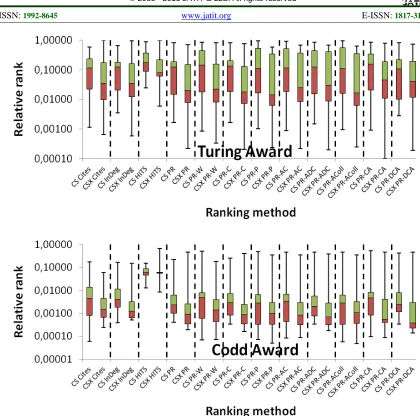
Figure 6: Boxplots of Relative Ranks Generated by Various Methods for Award Winners in Both CiteSeers
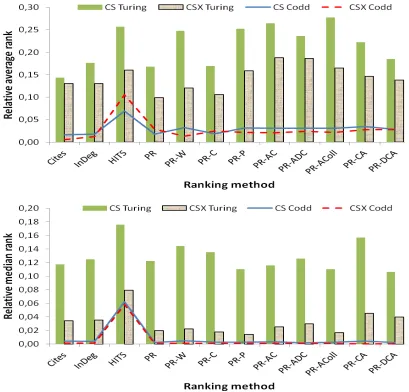
To answer the research question which of the two CiteSeers is better suited to evaluate computer science researchers, let us have a look at figure 6 and figure 7, in which charts comparing the ranks of Turing Award and Codd Award winners based on both CiteSeers are presented. figure 6 shows two boxplot charts (with the Y-axis on the logarithmic scale) depicting the relative ranks generated for the award winners by 12 methods in each CiteSeer. Thus, there are 24 different rankings for each of the awards. Relative ranks instead of absolute ranks are needed because the total number of researchers in CiteSeer and CiteSeerX differs as explained earlier. In general, the ranks based on CiteSeerX tend to be better (i.e., closer to 0) than those based on CiteSeer as we can see from the boxplots. We can also observe that the relative median rank of Turing Award winners in both CiteSeers roughly falls within top 10% and the
ISSN: 1992-8645 www.jatit.org E-ISSN: 1817-3195
are generally better than those in CiteSeer with the most notable exception being the relative average rank by HITS. As the basic characteristics of the coauthorship networks of both CiteSeers are similar (except for their size), the cause of the better ranks in CiteSeerX seems to be its broader coverage of the relevant computer science literature.
4. CONCLUSIONS AND FUTURE WORK
CiteSeer and its current (yet still beta) version CiteSeerX is a digital library and a search engine for computer science literature, whose article metadata have been successfully used for various purposes in the past. Some of the studies based on its data have been of bibliometric nature investigating its citation or coauthorship graphs. This paper belongs to such studies. Whereas
[image:12.612.103.512.319.711.2]CiteSeer has been discontinued and its most recent data come from December 2005, CiteSeerX has been continuously updated until now. This research is concerned with CiteSeerX data harvested from its Open Archives Initiative collection in March 2011. The number of articles covered by CiteSeerX almost doubled between 2005 and 2011 and, unfortunately, the structure of the metadata on these articles freely obtainable from the respective Web sites changed considerably. These modifications do not enable the 2011 data to be analyzed in the same way as the 2005 data. The greatest difference is the general lack of the information on cited references in the article metadata. This fact excludes the possibility of a direct analysis of the CiteSeerX citation graph acquired in this way. As a result, only its coauthorship network can be examined. The main contributions of this research are the following:
ISSN: 1992-8645 www.jatit.org E-ISSN: 1817-3195
• We compared the structure of the article metadata in CiteSeer and CiteSeerX freely available via their Web sites and constructed coauthorship (or author collaboration) networks from both data sets.
• We treated the coauthorship networks as citation graphs (according to the model of Yan and Ding [25]) and created rankings of researchers using 12 different ranking methods such as citation counts, HITS, PageRank, or its variations.
• We concentrated on the ranks achieved by the winners of the ACM A. M. Turing Award from the years 1991 – 2010 and by the winners of the ACM SIGMOD E. F. Codd Innovations Award from the years 1992 – 2011 and compared the rankings in both CiteSeers.
We thereby obtained the following main results: • The coauthorship graphs of both CiteSeers have
similar characteristics, apart from their sizes (see figure 1, figure 2, and figure 3).
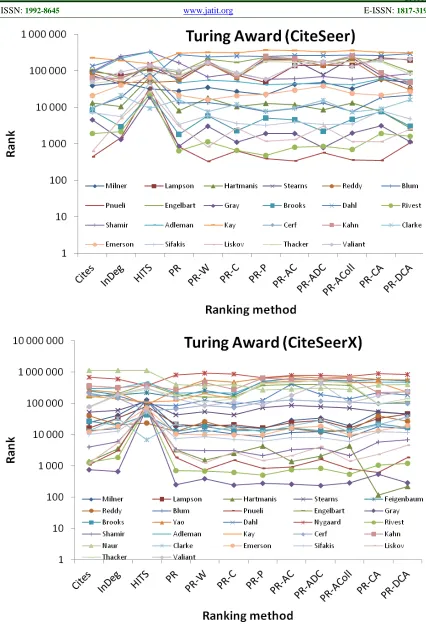
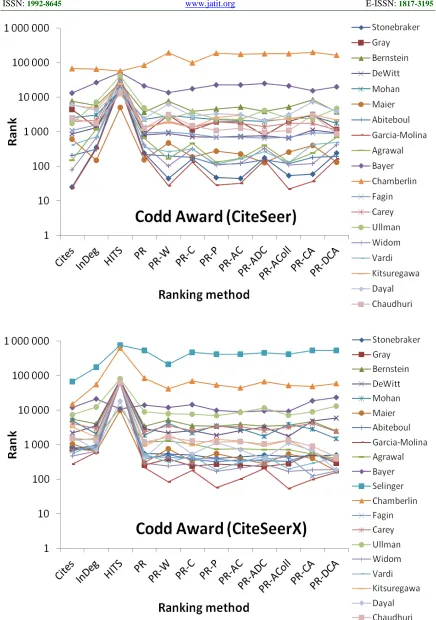
• The basic properties of the individual rankings based on coauthorship networks are the same as of those previously reported that were based on citation networks, which may indicate the usefulness of coauthorship networks for the ranking of researchers (see figure 4 and figure 5).
• The relative ranks of both Turing Award and Codd Award winners based on CiteSeerX are generally better than CiteSeer-based ranks presumably resulting from the broader coverage of the relevant computer science literature in CiteSeerX (see figure 6 and figure 7).
In the future, a natural continuation of this research would be the acquisition of the complete CiteSeerX citation graph and its thorough analysis. It would be interesting to see how different the researcher rankings are between CiteSeer and CiteSeerX (based on their citation graphs) and between CiteSeerX (based on the citation graph) and CiteSeerX (based on the coauthorship graph).
Acknowledgements. This work was supported by the European Regional Development Fund (ERDF), project “NTIS – New Technologies for Information Society”, European Centre of Excellence, CZ.1.05/1.1.00/02.0090.
REFERENCES:
[1] CiteSeer, http://citeseer.ist.psu.edu.
[2] S. Lawrence, C.L. Giles, and K. Bollacker, “Digital libraries and autonomous citation
indexing”, IEEE Computer, Vol. 32, No. 6, 1999, pp. 67-71.
[3] CiteSeerX, http://citeseerx.ist.psu.edu.
[4] Y. An, J. Janssen, and E.E. Milios, “Characterizing and mining the citation graph of the computer science literature”, Knowledge and Information Systems, Vol. 6, No. 6, 2004, pp. 664–678.
[5] S. Chakrabarti and A. Agarwal, “Learning parameters in entity relationship graphs from ranking preferences”, Lecture Notes in Computer Science, Vol. 4213, 2006, pp. 91– 102.
[6] S. Chakrabarti, A. Pathak, and M. Gupta, “Index design and query processing for graph conductance search”, VLDB Journal, Vol. 20, No. 3, 2011, pp. 445-470.
[7] J. Hopcroft, O. Khan, B. Kulis, and B. Selman, “Tracking evolving communities in large linked networks”, Proceedings of the National Academy of Sciences of the United States of America, Vol. 101, 2004, pp. 5249–5253. [8] A. Joorabchi and A.E. Mahdi, “An
unsupervised approach to automatic classification of scientific literature utilizing bibliographic metadata”, Journal of Information Science, Vol. 37, No. 5, 2011, pp. 499-514. [9] A. Popescul, L.H. Ungar, S. Lawrence, and
D.M. Pennock, “Statistical relational learning for document mining”, Proceedings of the Third IEEE International Conference on Data Mining, Melbourne (USA), 2003, pp. 275–282. [10] T. Šingliar and M. Hauskrecht, “Noisy-OR
component analysis and its application to link analysis”, Journal of Machine Learning Research, Vol. 7, 2006, pp. 2189–2213.
[11] D. Zhou, I. Councill, H. Zha, and C.L. Giles, “Discovering temporal communities from social network documents”, Proceedings of the Seventh IEEE International Conference on Data Mining, Omaha (USA), 2007, pp. 745–750. [12] H.-H. Chen, L. Gou, X. Zhang, and C.L. Giles,
“CollabSeer: A search engine for collaboration discovery”, Proceedings of the 11th Annual International ACM/IEEE Joint Conference on Digital Libraries, Ottawa (Canada), 2011, pp. 231-240.
ISSN: 1992-8645 www.jatit.org E-ISSN: 1817-3195
[14] C.-L. Wu and J.-L. Koh, “Hierarchical topic-based communities construction for authors in a literature database”, Lecture Notes in Computer Science, Vol. 6097, 2010, pp. 514–524.
[15] J. Bar-Ilan, “An ego-centric citation analysis of the works of Michael O. Rabin based on multiple citation indexes”, Information Processing and Management, Vol. 42, No. 6, 2006, pp. 1553–1566.
[16] D.G. Feitelson and U. Yovel, “Predictive ranking of computer scientists using CiteSeer data”, Journal of Documentation, Vol. 60, No. 1, 2004, pp. 44-61.
[17] C.L. Giles and I.G. Councill, “Who gets acknowledged: Measuring scientific contributions through automatic acknowledgment indexing”, Proceedings of the National Academy of Sciences of the United States of America, Vol. 101, No. 51, 2004, pp. 17599–17604.
[18] A.A. Goodrum, K.W. McCain, S. Lawrence, and C.L. Giles, “Scholarly publishing in the Internet age: A citation analysis of computer science literature”, Information Processing and Management, Vol. 37, No. 5, 2001, pp. 661– 675.
[19] D. Zhao, “Challenges of scholarly publications on the Web to the evaluation of science: A comparison of author visibility on the Web and in print journals”, Information Processing and Management, Vol. 41, No. 6, 2005, pp. 1403– 1418.
[20] D. Zhao and E. Logan, “Citation analysis using scientific publications on the Web as data source: A case study in the XML research area”, Scientometrics, Vol. 54, No. 3, 2002, pp. 449– 472.
[21] D. Zhao and A. Strotmann, “Can citation analysis of web publications better detect research fronts?”, Journal of the American Society for Information Science and Technology, Vol. 58, No. 9, 2007, pp. 1285– 1302.
[22] L. Krumov, C. Fretter, M. Müller-Hannemann, K. Weihe, and M.-T. Hütt, “Motifs in co-authorship networks and their relation to the impact of scientific publications”, European Physical Journal B, Vol. 84, No. 4, 2011, pp. 535-540.
[23] D. Fiala, “Mining citation information from CiteSeer data”, Scientometrics, Vol. 86, No. 3, 2011, pp. 553-562.
[24] D. Fiala, “Bibliometric analysis of CiteSeer data for countries”, Information Processing and Management, Vol. 48, No. 2, 2012, pp. 242-253.
[25] E. Yan and Y. Ding, “Discovering author impact: A PageRank perspective”, Information Processing and Management, Vol. 47, No. 1, 2011, pp. 125-134.
[26] A. Sidiropoulos and Y. Manolopoulos, “A citation-based system to assist prize awarding”, SIGMOD Record, Vol. 34, No. 4, 2005, pp. 54– 60.
[27] D. Fiala, F. Rousselot, and K. Ježek, “PageRank for bibliographic networks”, Scientometrics, Vol. 76, No. 1, 2008, pp. 135-158.
[28] D. Fiala, “Time-aware PageRank for bibliographic networks”, Journal of Informetrics, Vol. 6, No. 3, 2012, pp. 370-388. [29] CiteSeerX OAI, http://citeseerx.ist.psu.edu/oai2. [30] J. Kleinberg, “Authoritative sources in a
hyperlinked environment”, Journal of the ACM, Vol. 46, No. 5, 1999, pp. 604-632.