IMPLEMENTING ELECTRONIC DOCUMENTATION
MANAGEMENT SYSTEM
1
KHALID ALZUBI
1Assistant Prof., Department of MIS, Albalqa Applied University,Jordan
E-mail: [email protected]
ABSTRACT
This case study examines the possibility of implementing the Electronic Documentation System (EDMS) in Al-Balqa' Applied University as managing documents has become an important activity for organizing staff work. Studies show that people who work with information spend forty percent of their time finding, preparing, processing, and filing documents. Computerizing the process has made drastic changes to the efficiency of the services provided.. Accordingly, more institutions have now shifted to the implementation of an Electronic Document Management System (EDMS). This study provides a survey of the most important concepts of implementing an EDMS. The study is composed of several distinct groups of 120 employee selected randomly on four level. The tools of the study include questionnaire survey, and interview with the output gathered into an SPSS and Excel sheet for examination. After analyzing the overall case our findings show that the implementation need a strategic decision that must be made by the upper -chain management to effect a change in the work inside the Al-Balqa' Applied University that may include a reengineering process for some sector. Human Resources staff in the Al-Balqa' Applied University welcome the new technology as the information technology infrastructure in the Al-Balqa’ Applied University was felt to be in need of more development.
Keywords: Al-Balqa' Applied University, Document, EDMS, Implementation.
1. INTRODUCTION
This study shows the possibility of implementing an Electronic Document Management System (EDMS) in Al-Balqa’ Applied University. An Electronic Document Management System (EDMS) enables an organization to store and retrieve documents previously held on paper or some other physical medium, in an electronic form. The images have higher quality than photocopies and are usually legally admissible. Users of the system can subsequently retrieve documents quickly and easily on-screen, using a networked desktop computer (Crown Records Management,2014). They may also automatically save newly created electronic documents to the system. The documents are shared with colleagues over the existing computer network (Al-Nsour,2008).
2. PROBLEM
Most of the Al-Balqa’ Applied University work is not computerized, and the university considers it a necessity to move towards the E-Government , which makes the Electronic Documentation System a corner stone in developing all aspect of the workflow. Most of the employees and citizens in Al-Balqa’ Applied
University handle paper work, which consumes much time and money to keep and retrieve. Long bath of workflow makes the operation more complex and less flexible. Flexibility to handle new mission or developing new project is very low, because of the documentation routine and the low collaboration between the involved groups. Storage space and the ability to retrieve the kept document is very low. Filing the paper and storing it Has led to a waste of time and money.
3. OBJECTIVES
The main objective of this project is to establish the possibility of implementing Electronic Documentation Management System in a governmental service organization.
4. IMPORTANCE OF THE STUDY
Jordan, and has the largest share of services delivered to the Jordanian people. Electronic document management (EDM) technology has the potential to enhance the information management in constructing projects considerably, without radical changes to the current practice (Bjork,2003) .Most of the governmental work is still carried out manually with long bathes of operation, Al-Balqa’ Applied University has been involved to deliver high level of services to the people with minimal cost and time frame.. Storing documents and managing them comes as a challenge to the university services, and the Electronic Documentation Management System (EDMS) might be the best technology to overcome this problem and the best way to develop work in all sectors.
5. DEFINITION OF DOCUMENT
A document is a form of information. Traditionally, the concept of a document included, for example, reports, memos, letter, plans, invoices, or bills of materials. Public Record Office of Northern Ireland,(2009) had an experience where information was presented in paper format and it consisted mainly of text and graphics. Nowadays, the computer age has changed the traditional concept of a document as documents have widely turned into the electronic format and contain many different types of information such as word processing files, spreadsheets, graphics, video, audio, bit-mapped images, and compound documents incorporating multiple formats (Joseph and Marc.S,2013;Anon, 2001). In fact, the term document now seems to be too narrow in its traditional meaning, which is why many professionals have introduced the expression information product (Anon, 2001).
6. DEFINITION OF DOCUMENT MANAGEMENT
Document management is a term used to refer to the storage, retrieval, tracking, and administration of documents within an organization. Its primary origin was the use of manual file cabinets to store paper-based documents in alphabetized categories based on the document's contents. Gottesman, O. et al (2013) explained that the widespread use of computer technologies. Document management now also applies to electronic documents and paper-based documents converted to electronic form. Nowadays, instead of manual file cabinets, automated tools for document management are
required to provide users with services for accessing electronic documents, such as document repository, searching, change management, versioning, distribution, workflow, and the management of internal and external dependencies (Joseph and Marc.S,2013;Pitknen, 1999).
E. Bowton et al (2014) noted that document management reduces the time needed for producing documents that require complex handling. Complex handling may mean that the document has multiple authors, involves a review and approval process, has multiple versions, or its storage media (disk, CD, or tape) may change during its lifetime. Document management helps people to find the documents they are looking for without knowing the exact location of a document. It reduces the uncertainty about whether the documents are up-to-date. It also eliminates redundant data or files. An electronic document management systems releases personnel from handling papers to more important work. Many document management systems also provide good distribution features (Sutton, 2001).
7. THE CONCEPTS OF GOOD DOCUMENT MANAGEMENT
A document repository stores a document's content and any properties associated with it. Properties are values used to describe the document and they may also be referred to as metadata or attributes of a document. An electronic document repository usually has four parts: client applications, server application, a relational database and a file storage system. The relational database and the file system are managed by a server program (Crown Records Management ,2014; Image Advantage Solutions Inc,2014;Anon, 2001).The clients are divided into two categories: fat clients and thin clients. Fat clients are vendor specific programs for managing the repository and documents whereas thin clients refer to the use of Internet browsers (E. Bowton et al,2014;Bielawski, 1999).
An important issue when designing the document repository is scalability. Companies usually grow over time and produce more documents. At some point there will be a need to scale up the system to meet the increasing requirements (Joseph and Marc.S,2013)
7.1 Document Versioning
different organizations. Usually, versioning describes how the document changes with time, but it might describe some other function of the organization as well. There are different kinds of systems for identifying the versions (E. Bowton et al,2014;Anon, 2001).
7.2 Document Lifecycle
Documents go through a lifecycle in an organization. The document lifecycle is the linear progression and transition of states that a document occupies during the business process, from inception to retirement. First, the document is created, then it is changed, then it is archived, and finally it is not valid anymore (Anon,2001). The document has to satisfy different entry criteria in order to move from one state to another. The entry criteria can include keywords, dates or policies. Even though the traditional product lifecycle is well known, there are some unclear issues in defining the document lifecycle. One approach is that the version history describes a document's lifecycle.
7.3 Document Workflow
Workflow helps to automate the processing of policies and procedures in an organization. It defines who performs what and when. Although there are different workflow systems, they all try to satisfy the problem of automating the flow of information (E. Bowton et al,2014;Anon,2001). In document management the documents are usually routed through a workflow that includes review and approval.
7.4 Document Attributes
Attributes are properties that describe the document. Examples of attributes are name, title, subject, authors, status, and document type. Users can set and retrieve attribute values for individual documents and make database queries on the basis of the attributes (Peltonen,2000). In some document management systems the lifecycle state is defined as an attribute. Attributes are very important when creating a document. The system must be so arranged that the authors are forced to give values to the attributes. Otherwise, for example, searching the database is not useful, because the system cannot find all the matching documents (Ivica M. et al ,2010;Al-Nsour,2008).
8 . ELECTRONIC DOCUMENT
MANAGEMENT SYSTEMS BENEFITS
There are both hard and soft reasons for investing in an EDMS. The cost-benefit rationale is based on productivity improvements, cost-cutting, space saving and improved cash flow (Emelia et al ,2011). The strategic benefits, on the other hand, can include competitive advantage, improved customer service, better team working, compliance with regulatory and statutory laws, and better information access/flow.
8.1 Improved Information Storage And Retrieval A key benefit of document management is that users can have easy access on screen to scanned-in information, be it documentation, copies of letters, large-scale drawings or tiny notes. For them, an EDMS offers the possibility of enormous gains in time through far less time being spent on indexing, filing, searching for, and retrieving information
(Image Advantage Solutions
Inc,2014;Cimtech,2002).
For example, where information is found to be missing, either misfiled, or with another unidentified staff member, an EDM system will solve the problem by providing instant access, version control, and the audit trail of accesses.
8.2 Customer Service Improvements
Improved access to information will not only be of use to the staff concerned, but will also substantially improve customer service. When both internal and external customers request information or documentation, the relevant background documents can quickly be retrieved online and dealt with on the spot, instead of requiring background research and a return telephone call. The cost savings in terms of staff time can be significant (Ivica M. et al ,2010;Cimtech,2002). A comparable example is the recent evolution of telephone banking ‘call centers’. Call center staff retrieve full details on-screen and handle customer enquiries in seconds, rather than the minutes or even hours that would be needed to find this information from the vast storage rooms of paper files formerly in use. The resulting improvement to customer service can be significant.
8.3 Cost Savings
(Image Advantage Solutions Inc,2014; Gottesman,2013). The types of direct cost savings, that are typically found include the following: • Staff Time – the biggest factor, through efficiency gains;
• Space Costs – the costs of obtaining storage space and security;
• Storage Consumables – this includes reductions in the purchase of large volumes of furniture, cabinets and folders;
• Costs of Duplication - on-line documents are easily shared, avoiding duplications;
• Customer Service Costs - staff are able to handle customer queries in seconds by calling up documents on screen. This results in lower customer service costs in terms of reduced telephone charges, less time required for researching the history, etc.. (Image Advantage Solutions Inc,2014;Cimtech,2002).
9. IMPLEMENTATION OF EDMS
Managing documents has become an important activity for organizations and their employees. Studies show that people who work with information spend forty percent of their time finding, preparing, processing, and filing documents. Computers have drastically enhanced the process through automisation. But the amount of information involved doubles every four years (Sheffied Teaching Hospittals ,2013;Anon,1999). The use of computers creates new requirements for the management of documents, such as:
• Exchanging documents
• Finding a document without knowing its location or name
• Finding the most recent version of a document • Managing review and approval of documents that where created by means of different applications
These requirements provide motivation for an organization to start considering the implementation of an Electronic Document Management System (EDMS). Document management is a term used to refer to the storage, retrieval, tracking, and administration of documents within an organization (Anon,2001). The implementation process is often complicated and difficult because of the large variety of documents involved and the complexity of organization. This project tries to find a general guideline for such a process. It goes through the process of implementing a document management system. The scope of this project is limited to the planning stage (Image Advantage Solutions Inc,2014).
10. RELATED LITERATURE
National Center for State Courts (2005) conducted a feasibility study reflecting the state of technology and what was known about document management systems at the time it was done. Since then, much has changed, mainly resulting in improved speed, reliability, and capacity of the system at a lower cost Several studies explored the implementation of the Electronic Documentation management systems (EDMS) in many organizations. The aim of this study is to show the possibility of the implementation of the system in many cases with multiple condition, and to find out a kind of correlation between them and the case study introduced, which will help us in the method and procedures (Image Advantage Solutions Inc,2014).
One of the studies that considers the implementation of the Electronic Documentation management systems (EDMS) is "Types and Documents structuring: Building Project Information" (Tuncer, Stouffs, Sariyildiz, 2002) which show a methodology for integrating a number of design documents of different formats within a single information structure. When this integrated structure is highly related, it provides support for effective searching and browsing of this information.
EDMS employ many different hardware and software components (Cox, 2001) "An Introduction to Electronic Document Management System Technologies" taking a case study to show the digital imaging, document management, workflow, CD and optic al storage, computer output to laser disk (COLD), document input, groupware, electronic publishing and intranets, records management, and search and retrieval. The challenge lies in deciding which technologies offer the real benefits, then integrating them into a common strategy on an agency-wide level. That strategy may include specific policies and procedures in addition to the hardware and software.
as a tool for building the infrastructure required for e-government. A key component of e-government is “e-democracy,” which focused on the use of technology to enhance the engagement of citizens with democratic institutions. In particular, the use of technology can enhance public access to government-held information and promote transparency, accountability and open government (National Archives of Australia,2011).
In the municipal sector the Electronic Documentation management systems (EDMS) (Erway, 2001) "Electronic Document Management System" take a case study which show the city of San Clement which seeking proposals from qualified bidders to provide an Electronic Document Management System (EDMS) including software, imaging hardware, training, and implementation services for a city wide installation. This project is to be implemented in four phases (including the purchasing phase) over a two-year period. It is the city’s ultimate goal to implement an EDMS using its extensive network, enabling the city’s departments and public to have immediate access to critical documents. This study find the benefit of the implementation and the constrains that may come out from the real case in the city of San Clement.
The opportunity for integrating Electronic Documentation management systems (Weston,2001)” Integration with EDMS” came from a customer who was converting personnel action forms to automated workflow processes. Each process had a requirement for one or more supporting documents to be attached to the process. This requirement could normally be handled through the attachment control and, in this case, there were some complex security considerations for the documents. A better approach was to use an EDMS for building the folder-structured repository of the documents. Establishing complex document security schemes is one of the fundamental features of an EDMS. This would require less time to set up the repository. Then the workflow process would simply point to the documents in the EDMS and relegate all security and management of the documents to the EDMS .
11. METHOD AND PROCEDURES
The present study was primarily concerned with gathering data about the possibility of the implementation of the Electronic Documentation System (EDMS) in Al-Balqa' Applied University.
11.1 Community Of The Study
The community of the study was the Al-Balqa' Applied University staff totaling 9000 employee. With some staff that may not be related to the study like operational worker, supporting staff and drivers . Excluding those not directly involved , the population of the study is limited to 3500 employees .
11.2 Sample Of The Study
The sample of the study composed of several distinct groups. A total of 120 employees were selected randomly on four levels including senior management who may be interested in EDMS as a strategic purchase. IT managers who have responsibility for notifying other key staff at their institutions of emerging trends of the technology, records management staff that will be particularly interested in the potential of EDMS for better storage, management and retrieval of documents.
11.3 Tools Of The Study 11.3.1 Questioner Survey
The questioner used as a primary method for collecting the data from the selected sample, it contains 20 statement which focus on the following domain :
1.The Infrastructure that can accept the new technology,
2. Cost-benefit obtained from (EDMS),
3. Time saved as a result of implementation
4. The productivity that can be increased.
For each question the purpose I to evaluate the current situation and what should be the future goal closest to the employee opinion. The answers were gathered into an SPSS and Excel sheet for further examination. Charts for Operations were drawn based on the Excel sheets.
11.3.2 Interview
Interviewing the senior management and the IT manager could be the best method to collect the primary data; the open-end question gives more details about the subject.
12. ANALYSIS AND RESULTS 12.1 Questioner Results And Analysis
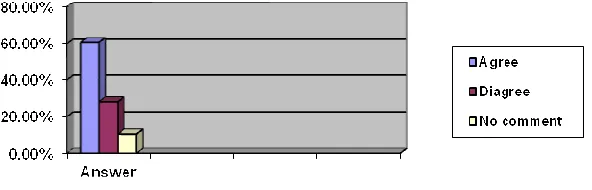
[image:6.595.83.294.246.311.2]After the questioner has been distributed to the sample introduced in the methodology section it was analyzed in the SPSS sheet, ;It is introduced in the following table that describes the questioner results which will be presented from three different perspectives: group that agree , disagree ,and with no comment, .Total figures are presented first.
Table 2: Distribution of the Answer Totally
Opinion Number Percent Agree 73 60.8 % Disagree 34 28.4 % No Comment 13 10.8 % Total 120 100 %
The table above shows the opinion based on the questionnaire that has been distributed , the agree percent that takes the biggest share 60.8 %, .This comes from the need for a new technology that gives a solution for the problem of the delay and confusion in the work. All work is done manually and the electronic system gives a big chance for a faster and easier way to do the job. As no electronic system implemented, the Electronic
Documentation management system (EDMS) comes as a step forward to the Electronic Government that the Jordanian government is planning to implement in the few coming years . This automation of the system comes as a necessary step to keep up with international advances in the field..
[image:6.595.160.456.440.535.2]As seen from the statistics The percentage of those who disagree is less than those who agree by the half reaching (28.4%) This comes from the implementation possibility in Al-Balqa’ Applied University that may not be accepted by the infrastructure and the human resources team that will use the new technology strategic decision is needed in which the high management decide to take the new technology and make what is needed to implement the Electronic Documentation management system (EDMS), .If done , the change will positively affect many sectors in Al-Balqa' Applied University like human resources, the technological infrastructure, financial and management, and aching in the other governmental sectors that share the work with the Al-Balqa’ Applied University. Figure 8 shows the answer distribution.
Figure 8: The Answer Distribution
(a) If we analyze the agree percent based on the Al-Balqa’ Applied University Infrastructure, cost-benefit, time that can be
[image:6.595.171.424.602.692.2]saved, and productivity, the following percent will be the outcome:
Table 3: Details of the Answer That Agrees
B. Axis 1) Number of an
Answer
Percent
2) Infrastructure 12 16 %
Cost-benefit 23 31 %
Time 25 34 %
Productivity 13 19 %
Total 73 100 %
(a) The cost-benefit (31%) and the time that can be saved (34%) has the highest percent which led to the agree opinion. This
Figure 9: The Agree Opinion Distribution.
The disagree percent is explained based on the high cost-benefit (30%) against the opinion that believes in the high expected cost and the low benefit, .Such disagreement also represents a misunderstanding of the new real benefit expected from the implementation of the new technology.
The infrastructure and the time (26%) has a high disagreement compared with productivity that will be obtained from the implementation. The overall disagreement is if it compared with the agree opinion. Table 3 show the distribution.
Table 4
:
Details of the Answer That DisagreesC. Axis 1) Number of an Answer Percent
2) Infrastructure 9 26 %
Cost-benefit 10 30 %
Time 9 26 %
Productivity 6 18 %
Total 34 100 %
Figure 10: The Disagree Opinion Distribution.
Figure 9 represents the distributions of the disagree opinion, in which the cost has the highest against productivity which has the lowest against, keeping the cost-benefit in the middle. The answer with No comment has the low percent (10.8%) , This
Table 5: Details Of The Answer With No Comment
D. Axis 1) Number of An Answer Percent
2) Infrastructure 3 24 %
Cost-benefit 5 38 %
Time 3 23 %
Productivity 2 15 %
Total 13 100 %
Figure 10 explains the distribution of the answer that has No comment for the new technology; it shows that the cost benefit has the
high unclear because most of the persons that filled in the questionnaire has no information about the cost-benefit analysis for new technology.
Figure 11: No Comment Opinion Distribution.
12.2 Interview Results And Analysis
The interview questions cover the most important subject that deals with the implementation process. The first question covers the infrastructure that can be used for implementation and the constrains that will face the implementation .All IT managers say that the infrastructure can accept the new technology and the there is no constrain for the implementation except the strategical decision that will be done by the high management in Al-Balqa’ Applied University.
The human resources team was the second domain in the interview. All managers claimed that Al-Balqa’ Applied University has good qualified staff who can accept the new technology and the implementation process will be smoother if the system is implemented in a specific area at first.
All managers see that the new technology will save the cost and the cost of the implementation will decrease the overall cost of the documentation if it is converted to an electronic system.
The time is very important in any implementation process as managers see that the time will be saved from the implementation of the
new technology .However, the time needed to the real implementation will be long because of the delay in the strategical decision concerned with the implementation process.
Increasing the productivity level from implementation is the only point that managers concentrate on it This means that there is better understanding for the need to the new technology and the implementation will be very successful.
13. RESULTS & RECOMMENDATIONS
After analyzing data, the overall case study and the related literature we find:
That implementation needs a stratigical decision that must be made by the high management. That implementation needs a change in the work at Al-Balqa’ Applied University that may include a reengineering process for some sectors.
That the human resources in the Al-Balqa’ Applied University can accept the new technology, but it needs more training and development.
[image:8.595.191.420.283.398.2]REFERENCES:
[1]. Al-Balqa’ Applied University (2005) Organizational structure. (on-line).Available: www.ammancity.gov.jo
[2] Al-Nsour,Marwan,(2008),” The Possibility of Implementing Electronic Documentation Management System (Case Study: Great Amman Municipality)”, International Journal of Internet Education, Egypt, issue number (2008/1)
[3] Anon, L.N.(2001) Implementing an Integrated Document Management Strategy on the
Web(on- line).Available:
http://www.techguide.com..
[4] Anttila, J.S.(2001) Dokumenttien Hallinta. IT Press, Helsinki 2001. 204 p. (on-line).Available: search.epent.com.
[5] Artto, K.N. (2001) Project Management Part. Helsinki University of Technology, Otatieto. (on-line).Available: www.ask.com.
[6] Bielawski, L.D (1999) Electronic Document Management Systems. Prentice Hall PTR, Upper Saddle River (NJ). (on-line).Available:www.snap.com.
[7] Bjork B-C (2003) Electronic document management in construction - research issues and results, ITcon Vol. 8, pg. 105-117, http://www.itcon.org/2003/9
[8] Brooks, F.P.(2000) The Mythical Man-Month.
Addison-Wesley- Longman,Reading(Mass.).322p.(on-line).Available: www.search.com.
[9] Buckiewicz, M.H. Khoshafian, S.L(2000) Introduction to Groupware, Workflow, and Workgroup Computing. Wiley Cop., New York 1998. 376 p. (on-line).Available: search.epent.com.
[10] Caputo, K.A. (2001) CMM Implementation Guide. Addison-Wesley-Longman, Reading (Mass.). (on-line).Available: www.ask.com. [11] Cimtech, S.C. (2002) Document
Management Guide and Directory (10th Ed.), University of Hertfordshire, 1999, pp. 69 - 72 .(on-line).Available: www.google.com. [12]Cox .K,R. (2001) An Introduction to
Electronic Documentation Management System. (on-line).Available: www.ask.com. [13] Crown Records Management,
(2014)."Records Management Perspectives: Developing an effective records management system",Developing an effective records management system,Issue 3, 2014, (on-line).Available:
http://www.crownrms.com/sites/default/files/r
ms-files/crm-perspectives-issue-3-2014.pdf. [14] Dhamija, R.F., Heller, R.S., & Hoffman,
L.N. (1999).Teaching E-Commerce. Communications of the ACM, Vol.42, No.9, 50- (on-line).Available: www.ask.com. [15]Drinkwater, L.D. (2000) Content
Management...Friend or Foe in the Document Management Arena. e-Doc Magazine 1 (2000) 3, p. 53-55. (on-line).Available: search.epent.com.
[16] E. Bowton, J. R. Field, S. Wang, J. S. Schildcrout, S. L. Van Driest, J. T. Delaney, J. Cowan, P. Weeke, J. D. Mosley, Q. S. Wells, J. H. Karnes, C. Shaffer, J. F. Peterson, J. C. Denny, D. M. Roden, J. M. Pulley, (2014)"Biobanks and Electronic Medical Records: Enabling Cost-Effective
Research. Sci. Transl.
Med. 6, 234cm3 (2014).
[17]Erway,W.J. (2001) Electronic Document Management System,
[18]Gottesman, O., Kuivaniemi, H., Tromp, G., Faucett, W. A., Li, R., Manolio, T. A., et al. (2013). The electronic medical records and genomics (eMERGE) network: past, present, and future. Genet. Med. 15, 761–771. doi: 10.1038/gim.2013.72 National Archives of Australia.,(2011) "Implementing EDRMS checklist". Commonwealth of Australia 2011. [19] Humphrey, W.K. (1997) Managing The
Software Process.
[20]Image Advantage Solutions Inc., (2014)"What You Must do Prior to Implementing an Electronic Records Management System"(on-line).Available:http://imageadvantage.com/mu st-prior-implementing-electronic-records-management-system/
[21] Ivica Marković, Srebrenko Pešić, Dragan Janković (2010). Using XAML in Representation of Dental Charts in Electronic Health Record. University of Niš, Faculty of Electronic Engineering, Serbia. Health care center Niš, Serbia.
[22] Joseph L. Kannry , Marc S. Williams, (2013)"Integration of genomics into the electronic health record: mapping terra incognita "American College of Medical Genetics and Genomics, Genetics in medicine Volume 15 Number 10 October 2013.
[24]National Center for State Courts,(2005).” Feasibility Review of the Electronic Management System for the Iowa Judicial
Branch”. Available at:
http://www.iowacourts.gov/wfdata/frame4458 -1127/File2.pdf
[25]Nostrand Reinhold, (on-line).Available: http://google.com.
[26]P.A. Emelia Akashah R. Syamsul Rizal Kamaruzaman Jusoff and E. Christon,(2011)"Electronic Document Management System",World Applied Sciences Journal 12 (Special Issue on Computer Applications & Knowledge Management): 55-58, 2011 ISSN 1818-4952. [27]Peltonen, H.J.(2000) Concepts and
Implementation for Product Data Management. Finnish Academies of Technology, Helsinki 2000. 188 p.(on-line).Available: www.yahoo.com.
[28] Pitknen,O.K.(1999)Teollisuuden Dokumenttienhallinta.Diplomit90 .1999 ِ◌. (on-line).Available: www.about.com
[29]Public Record Office of Northern Ireland,(2009)”General Guidelines for implementing an Electronic Document Management System”, Public Record Office of Northern Ireland.
[30]Robertson, J.L., Robertson, S.E.(2002) Mastering The Requirements Process. Addison-Wesley-Longman, Harlow. (on-line).Available: www.ask.com.
[31]Royce, W.D.(2000) Software Project Management: a Unified Framework. Addison-Wesley-Longman. Reading (MA) (on-line).Available: www.hotbot.com.
[32]Sheffied Teaching Hospittals,(2013)"Outline Business Case for a Trust-wide Electronic Document Management System"Outline Business Case for a Trust-wide Electronic Document Management System v0.2, Version No: v.0.2 Issue Date: 06.11.2013.
[33] Sutton, M. J. D.(2001) Document Management For The Enterprise: Principles, Techniques, and Applications. John Wiley & Sons, 2001. 369 p. (on-line).Available: www.about.com.