EXPRESS AVIATION NETWORK CONSTRUCTION
BASED ON HUB-SPOKE THEORY
1MINGKE HE, 2HONGJING CHENG, 3HAOXIONG YANG
1 Prof., Business School, Department of Management Science and Engineering, Beijing Technology and
Business University, Beijing, China
2 Department of Management Science and Engineering, Beijing Technology and Business University,
Beijing, China
3
Assoc. Prof., Department of Management Science and Engineering, Beijing Technology and Business University, Beijing, China
E-mail: [email protected], [email protected], [email protected],
ABSTRACT
Air freight network is one of the important means to improve the competitiveness of express enterprises. This paper establishes the model from two aspects, hub location decisions and hub number decisions, with the goal to achieve the lowest air freight network cost, based on the “hub-spoke” theory. Then, computes the cost of different number of hubs, and uses super-efficiency DEA model to decide the number of hubs. Finally, an example is illustrated and the results show that the model is reasonable and feasible. The “hub-spoke” network can help to improve efficiency of resource utilization and competitiveness of express enterprises.
Keywords: Express Company, Hub-Spoke Network, Genetic Algorithm, Super-efficiency DEA Model
1. INTRODUCTION
At present, a lot of express enterprises’ air freight is “point to point” and “ring” network model, which cause high empty loading rate and high transportation cost. However, “hub–spoke” aviation network first gathers different needs to the hub airport, and then transports express to the destination hub, and delivers them through regional transportation at last, so as to get transport economies of scale, thereby it can improve the loading rate and reduce transportation cost.
The rapid development of express company greatly increase the reliance on air transportation, “hub-spoke” aviation network also applies to express enterprise’s air freight network system structure. This paper put forward the method to construct “hub-spoke” air freight network for express company, through which can effectively reduce the air freight transportation costs and improve the competitive ability of express enterprise.
2. LITERATURE REVIEW
In 1987, O'Kelly first proposed the concept of “hub – spoke” network, and designed the secondary integer programming model for no capacity limit
network and introduces the basic contents and methods of “hub-spoke” logistics network design. F. Q. Dai study the comprehensive optimization model of the single hub airport site selection and route network planning. Although the literature of “hub-spoke” network increase gradually, but most of the documents are for aviation passenger transport network, and the study for air freight network system, especially for the establishment of the express company is very few. Based on the basis of literature review, this paper puts forward the method of express enterprise “hub-spoke” air freight network construction.
3. AVIATION NETWORK
CONSTRUCTION OF EXPRESS ENTERPRISE
In order to reduce the difficulty of management, operating costs, and route demand uncertainty, this paper chooses single configuration hub mode in “hub-spoke” network for the air freight network planning. The selection of the hub uses the least cost method, the determination of assigned relationship between hub and spoke use the gravity model method, and the choice of the number of hub uses super efficiency of data envelopment analysis (DEA) method.
3.1 Transportation cost calculation of different number of hubs
3.1.1 Basic assumptions
(1)Demand point only connects with one hub;
(2)Don't allow connection between spoke points;
(3)The final hub quantity is fixed;
(4)Transit times for a maximum of two in a transport;
(5)Unit transportation cost reduction factor between the Hub is constant;
(6)Hub and every route have no capacity limit.
3.1.2 Symbol Definition
i, j—variable representing the spoke city;
k, m—variable representing the hub city
Dij—representing distances from city i to city j;
Tij—representing time flying from city i to city j;
V—representing the flying speed of plane;
Wij—representing cargo quantity transported
from city i to city j;
Cij—representing the unit transportation cost
between node i,j;
p—representing the number of hub;
Zk—as a 0-1 variable, 1 represent as a hub, 0
represent not as a hub;
α—representing transportation cost reduction factor between hub k,m;
Rkm—the total flows between hubs.
3.1.3 Mathematical model establishment
(1)Objective function determination
Before constructing the mathematical model, the first step is to determine the objective function of the model, and the objective function of the model is the minimum total transportation cost. To determine the total transportation cost of network, the first step is to figure out the flow path of express in the network. According to the above analysis, this model selects single configuration hub model in the “hub-spoke” network, each demand point can only connect with one hub, then there are two kinds of path that express from one place to another location, that is, passing through one hub and passing through two hubs (see figure 1).
Figure1 Express Flow Path
① passing through two hubs: Spoke point first transfers through the hub to the destination hub, and then transfer to the final destination. This kind of means is used in the transportation between spoke points which belong to two different hubs;
② passing through one hub: Spoke point
transports to the destination through the
corresponding hub. This kind of means is used in transportation between spoke points which belong to the same hub.
Integrated above two kinds of express flow path, the total transportation cost of network mainly consists of two parts:
The unit transportation cost of passing through
two hub mode is:
C
ik+
C
jm ; The unittransportation cost of passing through one hub
mode is:
C
ik+
C
kj; UseW
ijto represent the goods quantity from city i to city j, it can be seen that transportation cost between demand point and hubS
C
can be expressed as:ij kj jm ik m k j i
S
C
C
C
W
C
=
∑
∑
∑
∑
(
+
+
)
⋅
Part two: Transportation cost between hub and hub.
Because of “hub-spoke” type network can gather flow of all demand point on a few hubs, the unit transportation cost on the trunk line in the network will be reduced directly. Use
α
to represent the unit cost reduction factor between hubs, it can be known the transportation cost between hub k and hub mC
H can be expressed as:km km m k
H
C
R
C
=
∑
∑
α
⋅
⋅
Adding the above two parts can work out the total transportation cost of network is:
km km m k ij kj jm ik m k j i T
R
C
W
C
C
C
C
⋅
⋅
+
⋅
+
+
=
∑
∑
∑
∑
∑
∑
α
)
(
(2)Hub number constraint
Use p to represent the number of hub,
K
Z
represents one point whether to be a hub, defined as a 0-1 variable, 1 represents a hub, 0 represents not as a hub, the resulting hub constraint for the air freight network is:p
Z
kk
=
∑
(3)Mathematical model
According to above analysis can establish mathematical model as follows:
km km m k ij kj jm ik m k j i T
R
C
W
C
C
C
C
⋅
⋅
+
⋅
+
+
=
∑
∑
∑
∑
∑
∑
α
)
(
min
(1)
s.t.: (2)
(3)
(4) (5)
In the objective function formula (1), the first term represents the airline transportation cost between hub and spoke, the second term represents the airline transportation cost between hubs, constraint conditions formula (2) represents the number of hub, constraint conditions formula (3) represents the total flow on the route between hub k
,m, constraint conditions formula (4) represents the relationship of flight time, distance and flight speed, constraint conditions formula (5) means the unit transportation cost is function to flight time.
Under the condition of given hub number, the key to the above problem is to determine the Zk
value, that is to determine the hub location, so as to determine the assigned relationship between demand point and hub. The solution complexity of the model established above is very high, and the enumeration method efficiency is low, in order to improve the speed of calculating, using genetic algorithm is a good choice.
3.2 The choosing of hub number
Data Envelopment Analysis (DEA) is a kind of nonparametric planning technology that can evaluate relative efficiency of a group of homogeneous decision unit. If using the traditional DEA model, it may achieve more than one efficient DMU. In this paper, we need to choose the number of hub, determine optimal number of the air freight network, so if using the traditional model simply, we can't choose the best number of hub. For the super-efficiency DEA model, in the evaluation of effective DMUs, the value may be greater than 1,
and there is no upper bound efficiency
theoretically, which means we need to sort the multiple CCR efficient DMUs, so as to select the optimal performance unit. Due to the efficiency value of effective decision making unit in the super-efficiency model may be greater than 1, it can evaluate and compare more effective decision making unit at the same time for further. Therefore, this paper will use super-efficiency DEA model to evaluate efficiency of choosing different number of hub, so as to choose the optimal number of hub.
The input-oriented form of super-efficiency evaluation model is as follows:
=
=
=
=
∑ ∑
∑
)
(
/
ij ij ij iji j ij
o
1 o
r r
1 min
. . :
, 1, 2
, 1, 2
0, 1, 2
n
j ij o io j j
n
j j o j j o
j s t
x x i m
y y r s
j n
θ
λ θ
λ
λ = ≠
= ≠
≤ = …
≥ = …
≥ = …
∑
∑
,
,
In the formula, m represents the input number, s represents the output number, and n represents the
number of DMU.
λ
j(j= 1,2,…n)represents the combination weight of n DMUs,∑
≠ =
n j j
ij jx o 1,
λ and
∑
≠ =n
o j j
j jy
, 1
r
λ
represents the input and output vector offictitious DMU according to the combination
weight,
x
io andy
ro represent the input and output vector of the DMUo for evaluation. The resultθ
o of the model is the efficiency of oth DMU, if thevalue of
θ
o is equal or greater than 1, it means the DMU is an effective unit; otherwise it is the invalid unit. Note that, for ineffective DMU, the super-efficiency value is equal to the traditional CCR efficiency value.4. AVIATION NETWORK
CONSTRUCTION EXAMPLES OF SF COMPANY
In order to validate the rationality and suitability, apply the theory to practical, we choose SF Company as the case for air freight network planning. The case analyses with 17 cities which SF Company open routes in domestic, the cities include: Beijing, Shanghai, Chongqing, Shenyang, Wuhan, Chengdu, Xi’an, Zhengzhou, Nanjing, Jinan, Hangzhou, Fuzhou, Changsha, Shenzhen, Guiyang, Kunming, and Urumqi.
4.1 Transportation cost calculation
According to the actual data, we use the presented air freight network design method, and the genetic algorithm to calculate transportation cost.
First of all, we should define related variable. Population quantity: pop-size = 30, crossover probability: Pc=0.9, mutation probability: Pm = 0.01, fitness function: f (up )=100-CT, the
maximum evolution algebra: T = 1000.
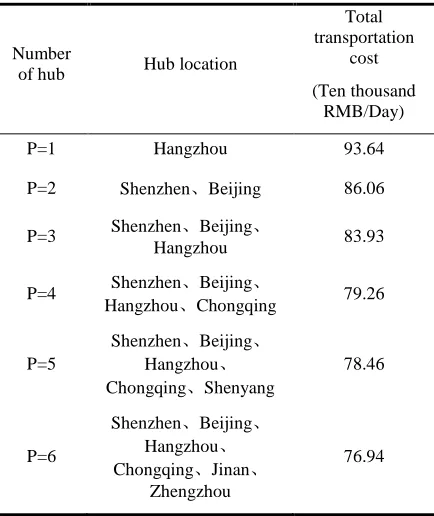
[image:4.612.310.527.172.430.2]Then, we calculate according to aviation freight volume a day of SF Company, summarize the transportation cost of multiple networks which were form by different number and location of hub, shown in table 1.
Table 1 Transportation Cost Calculation Results
Number
of hub Hub location
Total transportation
cost
(Ten thousand RMB/Day)
P=1 Hangzhou 93.64
P=2 Shenzhen、Beijing 86.06
P=3 Shenzhen、Beijing、
Hangzhou 83.93
P=4 Shenzhen、Beijing、
Hangzhou、Chongqing 79.26
P=5
Shenzhen、Beijing、 Hangzhou、
Chongqing、Shenyang
78.46
P=6
Shenzhen、Beijing、
Hangzhou、 Chongqing、Jinan、
Zhengzhou
76.94
It can be seen from table 1:
(1) If not consider the hub construction and operation cost, total transportation cost is the highest when the number of hub is 1. With the increasing of hub number, transportation costs of network decrease, but the decrease rate becomes smaller and smaller.
(2) In the actual operation, SF Company’s transportation volume is continually changing, when the volume change, we need to calculate according to the actual data using the above method.
4.2 The determination of hub number
There are many factors influence the number of air freight network, in order to make the computation simple, we can assume that other factors are the same, “input” mainly is the
investment of hub construction cost and
transportation cost, “output” mainly refers to express processing capacity.
situation, the SF Company could not build its own airport, so the company will rent warehouse or construct distribution center near the airport. It is understood that SF Company plan to build distribution center covers 200 mus, and the investment is 600 million RMB. Assume the depreciation life is 20 years, we can know that the
average cost of hire a hub airport is
82000RMB/day. Besides, we assume that the speed of an airplane is 850 km/h. The average transport time to express is the time that cost in aviation transportation, calculation formula is:
∑
∑
≠ ≤ ≤≤ ≤
≠ ≤ ≤≤ ≤
×
=
j i j i
ij j i j i
ij ij
W
T
W
T
, 17 1
, 17 1
, 17 1
, 17 1 average
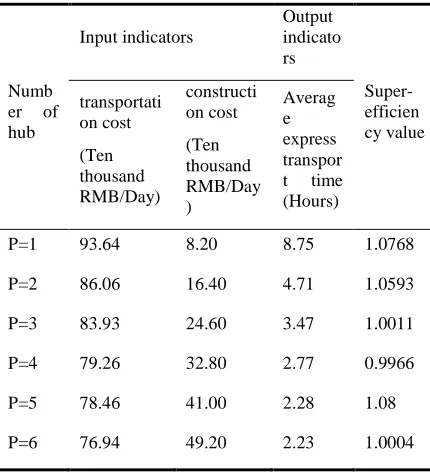
[image:5.612.86.301.460.696.2]Therefore, in the choice of the hub number, the input indicator is the construction cost and transportation cost, output indicator is the average transport time of express, and the indicators are calculate by day statistics. Note that the output indicator is average transportation time of express, is a contrary indicator, namely the smaller the data is, the efficiency of network system is higher, therefore in the calculation of the efficiency value, we adopt the reciprocal as output.
Table 2 Comparison Of Super-Efficiency Mean Of Different Number Of Hubs
Numb er of hub
Input indicators
Output indicato rs
Super-efficien cy value transportati
on cost
(Ten thousand RMB/Day)
constructi on cost
(Ten thousand RMB/Day )
Averag e express transpor t time (Hours)
P=1 93.64 8.20 8.75 1.0768
P=2 86.06 16.40 4.71 1.0593
P=3 83.93 24.60 3.47 1.0011
P=4 79.26 32.80 2.77 0.9966
P=5 78.46 41.00 2.28 1.08
P=6 76.94 49.20 2.23 1.0004
From Table 2, we can conclude that when the number of hub is 5, the efficiency is the highest. It means that in the 17 nodes network design, when
the number of hub is 5, it not only can greatly reduce the cost, but also can meet the needs of the national scope, thus, five hubs are more appropriate. Through the above analysis, SF Company’s air freight network finally chooses to build five hubs: Shenzhen, Beijing, Hangzhou, Chongqing, and Shenyang.
Because data availability is limited, this article through the relevant assumptions, choose the transportation cost and construction cost as the input indicators, and the express processing ability as output indicator. In actual operation, if other data is known, we should adjust the input indicator and output indicator according to actual condition, and calculate efficiency value through the super-efficiency DEA model, finally to determine the number of hub.
5. CONCLUSION
“Hub-spoke” mode is a necessary choice for express enterprise constructing air freight network. The use of “hub-spoke” network can increase flight density, improve the loading rate, reduce operational costs, and improve the competitive ability of express enterprises. This paper provides method for express enterprises building air freight network from two aspects: hub site selection and choice of hub number. Based on this, the method’s validity and suitability have been verified through the instance of SF Company.
The model and methods this paper put forward is based on the no capacity limit of the network, and the demand for express company is changing rapidly, in the later study, the capacity limit of network should take into consideration and after the change of demand, we should compete with the new data. In the choose of hub number, this paper take the air transportation cost and construction cost as the input indicator, and the average express transport time as the output indicator, if other data is available, the indicators can be changed in practice.
ACKNOWLEDGEMENTS:
REFRENCES:
[1] M.E. O’Kelly, and D.L. Bryan, “Hub Location with Flow Economies of Scale”, Transportation
Research Part B: Methodological, Vol. 32,
1998, pp. 605-616.
[2] F.J. Jin, C.J. Wang. “Chinese aviation network model building under the principle of Axis-radial”, Geographical Research, Vol. 24, No. 5, 2005, pp: 774-784.
[3] F.Q. Dai, R. Wang. “Single hub-airport site selection and flight route network planning comprehensive optimization”, China's civil aviation university journal, Vol. 25, No. 1, 2007, pp: 17-28.
[4] A. Charnes, W. W. Cooper, and E. Rhodes, “Measuring the efficiency of decision making
units”, European Journal of Operational
Research, 1978, pp: 429-444.