© 2018, IRJET | Impact Factor value: 6.171 | ISO 9001:2008 Certified Journal | Page 846
COST OPTIMIZATION USING GREEN BUILDING CONCEPT
Prasang Yadav
1, Shubhangi Kirnapure
2, Akshay Gulghane
31,2
U.G. Students, Civil Dept. G.H. Raisoni College of Engineering Nagpur, Maharashtra, India,
1,2Trainee Engineer, NRSC, ISRO, Dept. of Space, Govt. of India, Shadnagar, Hyderabad, Telangana, India
3
Professor, Civil Dept. G.H. Raisoni College of Engineering, Nagpur, Maharashtra, India
---***---Abstract -
Building has a big impact on environment, economy, and social development. Building operational phase and its life cycle is a significant factor in which it is responsible for the reduction in energy, water and material resources. The objective of this work is to develop a beneficial statement by approaching the Green Building construction throughout the world to save the consumption of energy, water and wastage of material with the help of using natural resources in Green Building.In this paper an analysis have been made on the basis of various materials used in green building and to implement what type of parameters are available to use natural resources on the daily basis to minimize the use of manmade sources to encourage the communities benefits.
Key Words:Green building, Sustainable energy, Natural Resources, Environment, Green materials.
1. INTRODUCTION
Building facility has been a human need for some activities platform such as social, economic and environmental. In the other hand, building construction has both positive and negative impacts that there are not only on construction phase but also on operational and maintenance phase. The building projects have cost associated with land, designing and planning, execution and operational, maintenance, which extend over its lifetime. Cost of operations and maintenance is intimately linked to the technology and materials chosen for construction. This is especially true for fully air-conditioned buildings that require continuous energy use over its life cycle. It is generally belief that the construction cost of a green building will be much more than conventional building, but some middle way is required to be found out how the cost of lifecycle is usually less than the cost of conventional building by analysing the real situation and condition in the construction and operational phase throughout the green building.
In Shadnagar, the NRSC campus being a green field, establishing energy intensive operational facility with equipment loads called for internal debate on the sustainability and energy efficiency of proposed building. NRSC took the green initiative and proposed to realize the Integrated Multi-mission Ground Segment for Earth Observation Satellites (IMGEOS) & National Database for Emergency Management (NDEM) facility infrastructure by green buildings norms, It is the first LEED India ‘PLATINUM’ rated green building among all ISRO centres and novel representative of ISRO’s Green initiative.
2. LITRATURE REVIEW
There are some paper focusing on the impact of building design on occupants’ comfort and satisfaction.
WATER EFFICIENT TECHNOLOGIES FOR GREEN BUILDING (Dr K N Sheth, 2017), Water efficiency means reducing usage of water and minimizing wastewater. All the fixtures such as taps, toilets, showerheads, urinals etc. are should be water efficient.
ENERGY EFFICIENT BUILDINGS (Shristi Khosla and S.K. Singh, 2014) the building sector alone represents about 35% energy consumption. Realizing the situation, the need of the day is to adopt sustainable green building design approach, which is the Ultimate solution to reduce the energy demand of the building.
SUSTAINABLE ENVIORNMENT: PRACTICES IN INDIAN SPACE RESEARCH ORGANIZATION-A CASE STUDY (Suja Abraham and T. Balaji et al., 2017) This paper illustrate the need of sustainable environment and various measures being implemented at ISRO, As benefits achieved more additional solar power plant, floating solar panels, harnessing wind energy, biogas plant are proposed to be implemented.
COST AND BENEFITS OF GREEN BUILDING (A Nalewail, V Venters, 2008) the relative cost of green construction is debated, and the discourse concludes with some cost-savings guidance.
3. THEORETICAL ASPECTS
3.1 Green Building
© 2018, IRJET | Impact Factor value: 6.171 | ISO 9001:2008 Certified Journal | Page 847
3.2 Scope
In these days when everyone is talking about green construction, there is need of way by which a common can afford a green home. So to optimize the cost of green building just to aware the generation about how it gives the benefits by various terms because the construction cost is just some percent more than normal ones, due to some extra materials. This is good investment as within some couple of years the costs are covered when one compare it with the long-term benefits, even in health terms, there is a huge benefit. It also reduces power and water tariffs and helps to save and preserve environment. The building's life also increases due to use of green technology.
3.3 Adopted Parameters
Material efficiency Energy Efficiency
Water Efficiency
Indoor air quality
Improved Health
Return on Investment
4. RESEARCH METHODOLOGY
This research was conducted by using quantitative approach through case study on green zone of shadnagar campus with some other references. Initially the survey was carried out which involved quantity estimation of materials and their techniques, decision of changes, market studies, benefits and cost analysis in order to investigate the life cycle phase of a green building.
To achieve the objectives of this study, a comprehensive literature review on green and sustainable building construction was first carried out. The aim of the literature review was to find out what are the essential differences between conventional and green construction projects in design, construction, and operating phases. In addition, the objective behind the review was to explore green building benefits applied in this project that can be able to give their best in terms of environmental, social, and healthier benefits to occupants.
5. ANALSYSIS AND RESULT
5.1 Case Study
According to our study we are comparing the materials of conventional and green building in order to achieve required beneficial aspects as given above, In addition this analysis involves this data to ensure feasible output.
Table -1: Material Replaced in Green Building
ITEM CONVENTIONAL
BUILDING GREEN BUILDING
Windows and Openings Aluminum Paneled Plain Glasses
Insulated Glass
Lighting Fixtures Tube Lights & CFLs Low Watt LED Tube Lights & Bulbs
Plumbing Fixtures Conventional Fixtures Special Green Fixtures
Flooring Vitrified & Glazed Tiles and
China Mosaic PVC Flooring, Glazed Tiles and China Mosaic
Doors Pine Wood Engineering Wood
Paints Plastic VOC Plastic Non VOC
Bricks Clay Bricks Flyash Bricks
Cement OPC PPC
Rain Water Harvesting Not Provided Provided
Solar Panels Not Provided Provided
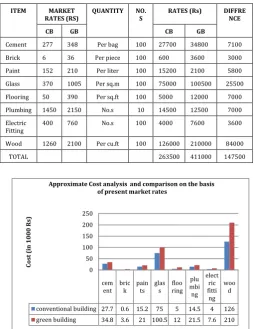
[image:2.595.303.558.401.731.2]According to our survey we have find out the Problem that, the cost of Green building construction is higher than conventional building because of material rates, The following table shows the comparative study.
Table -2: Approximate cost analysis and comparison of materials on the basis of present market rates between
conventional and green building
ITEM MARKET
RATES (RS) QUANTITY NO.S RATES (Rs) DIFFRENCE
CB GB CB GB
Cement 277 348 Per bag 100 27700 34800 7100
Brick 6 36 Per piece 100 600 3600 3000
Paint 152 210 Per liter 100 15200 2100 5800
Glass 370 1005 Per sq.m 100 75000 100500 25500
Flooring 50 390 Per sq.ft 100 5000 12000 7000
Plumbing 1450 2150 No.s 10 14500 12500 7000
Electric
Fitting 400 760 No.s 100 4000 7600 3600
Wood 1260 2100 Per cu.ft 100 126000 210000 84000
TOTAL 263500 411000 147500
cem ent
bric k
pain ts
glas s
floo ring
plu mbi ng
elect ric fitti ng
woo d
conventional building 27.7 0.6 15.2 75 5 14.5 4 126 green building 34.8 3.6 21 100.5 12 21.5 7.6 210
0 50 100 150 200 250
Co
st
(
in
1
0
0
0
R
s)
Approximate Cost analysis and comparison on the basis of present market rates
© 2018, IRJET | Impact Factor value: 6.171 | ISO 9001:2008 Certified Journal | Page 848
5.2 Solution
To go with green construction this research was continued with exploring the materials, water and energy benefits at operational phase of building to overcome the initial cost in order to get long term benefits by below measures.
5.2.1 Material Benefits Aerocon Blocks
Aerocon blocks are an innovative product in green building revolution. They are light weighted so easier to install and handle on the site having the size of 600x200x200mm & 600x200x100mm. It is made with recycled material of fly ash, which is waste from thermal power plant. Excluding with eco-friendly characteristics of these blocks they are also fire resistance, sound insulation, have strength and durability. They required time to complete a building with this blocks is 1/3 lesser than that of conventional building material. Aerocon blocks covers the same area as that 14 clay bricks do enabling a faster construction results in saving of labour, time and material. They also have excellent thermal properties helps in recurring energy costs of heating and cooling.
Insulated Glass
Nearly 15-20% of all building energy is lost via windows and doors, having energy efficient windows in building should be a priority. For that, the best suitable option is use Low-E-glasses. The main aim of glasses is to prevent heat on the side of glass where it originates. The coating reflects heat, which reduces the heat loss through the window. Onsite Double glazing is used with an U-value of 0.90 Btu/hr.ft2/°F which is more efficient and helps to achieve extra energy saving. This system has thermal analyst to ensure max. Heat of 1.8 w/sq.m and SHGC of 25, VLT 37%. It is made of two glass panes 6mm thickness toughened glass & heat strengthened glass with air gap of 12mm.
Paints
Paints with reduced level of VOC (Volatile Organic Compound) are more eco-friendly than conventional paints. Premium grade zero-VOC paints that also use VOC-free colorants are free of vinyl and other plasticizers and include no toxic biocides. Onsite 100% cool roof is provided with high solar reflectance paint i.e. albido paint having 45% reflectivity to make building more energy efficient and reduce energy requirement for cooling inside spaces.
Underdeck Thermal Insulation
Laying underdeck thermal insulation with 75 mm thick and U-value of 0.072 Btu/hr.ft2/°F, expanded polystyrene of density 18 kg/cum as per IS 4671 and providing 0.05 mm thick aluminium foil fixed to ceiling with metallic cleats of size 50x50x3-25 mm wide. The fundamental advantage of this system is to low consumption of energy that is spent on cooling inner atmosphere.
5.2.2 Energy Benefits
Passive Architectural Design:
Since the building blocks are situated in a circular manner, each building would get shading from the nearby building and all the exterior windows are well-shaded using sunshades over the windows. Therefore the heat gain through windows in east and west direction is very less. Hence this project is achieving 1.23% energy savings through better passive architectural design.
Solar Power Plant
Onsite Solar power generation through the SPP installed meeting 18% annual energy consumption whose PV array capacity is 300 kWp. The average solar power generation can release upto 4, 72,000 units on average, which helps to reduce the electricity consumption cost upto 41, 30,000 Rs per annum.
Day Light Pipe
Light pipes to bring daylight to deep interiors. This uses to full fill the capacity of 100 watt with covering area of 12 sq.m. It is one time investment installed to provide long-term
benefits by sun energy efficiency. i.e. Two no's of day light pipes are fitted which can save
(2x100x12)/1000= 21 Units Savings per day: 2.4x8.75= 21 Rs / day Monthly = 630 Rs, Yearly = 7560 Rs
LED Fixtures
In Green buildings, the only type of the lighting fixtures used is LED (Light Emitting Diode) Fixtures. These types of lightening fixture are somewhat costly but the life of LED fixtures will be more than 17 years. Same way the light of tube light and CFL is about 2 to 5 years. A significant feature of LEDs is that the light is directional, as oppose to conventional bulb, which spread the light more spherically.
1 LED fixture covers upto 4 Sq.m areas with having capacity of 36 watt but by the tube light, same area will be covers with 56 watt, which goes costly. 662 LEDs are installed in building.
1unit=1000kWh, assumed, 10 hrs duration of daily electricity consumption:
ITEM CAPACITY
(WATT) NO.S CONSUMPTION (UNIT/DAY) COST (PER UNIT) COST PER DAY (RS)
LED 36 662 238.32 7.20
(201-300) 1715.90
TUBELIGHT 56 662 370.72 8.75 (301-400)
3243.8
© 2018, IRJET | Impact Factor value: 6.171 | ISO 9001:2008 Certified Journal | Page 849
Air Conditioner
In Green buildings, the electricity consumption is only 9 Units to run 8 hours of A/C. Since the building is very cool, the thermostat mode will be activated which can save 2 hours of running A/C which means 3 units/day and 90 units/month is saved. While in the other side conventional building consumes upto 12 units to run 8 hours of A/C. Therefore, Total 260 TR of cassettes is fitted in onsite building.
For, 8 hrs of daily usage
ITEM TOTA
L TR UNIT CONSUMP TION (FOR 8 HR)
COST (PER UNIT)
CONSUMPTI
ON (
UNITS/DAY) COST PER DAY(R S)
GREEN
BUILDING Cassette 260 9 9.50(above 800)
2340 22230
CONVENTIN AL BUILDING
Cassett
e 260 12 9.50 (above 800)
3120 29640
Daily savings: 29640 -22230= 7410 Rs. Monthly = 2, 22,300Rs, Annually = 27, 04,650 Rs
Sensors
An occupancy sensor is an indoor motion-detecting device used to detect the presence of a person to automatically control lights. These sensors are typically used to save energy and another one, which is known as lux sensor is used as a measure of the intensity, as perceived by the human eye, of light that hits or passes through a surface.
5.2.3 Water benefits Plumbing Fixtures
Low-flow equipment includes special type of fixtures applied to plumbing appliances that moderate the flow of water. Low flow fixtures help to quickly reduce consumption and costs, yielding water savings and reduced utility bills.
Fixtures Flow
Low-flow faucet 2.5 gallons per minute or less
Low-flow sink aerator Reduce flow by 1.0 gallon/minute
Low-flow toilet Reduce flow to 1.3 gallons/flush (conventionally 3.5-7.0 gallons/flush)
Dual-flush toilet 0.8 or 1.6 gallons/flush
Water less urinals Reduces water usage up to 80%.
Benefits: Save money on water bills. Reduce water usage in buildings by 40% to 60%. Save resources including water, energy, and labour.
Rain Water Harvesting
Water efficiency achieved through wastewater recycling (100%) and rain water harvesting. Water body of 3 lakhs KL
(4 no’s) is made for retaining the rainwater in maximum quantity precipitated on campus for improvement of ground water. There is a technique, which is known as 3 course water proofing treatment having proper slope over the roof and connected through drain to rainwater harvesting pit and followed by water bodies which helps in improvement of ground water table.
Sewage treatment plant
Onsite STP of 30KLD installed for treating wastewater to tertiary treatment system for reuse in gardening and landscape.
5.2.4 Indoor Air Quality
A Court yard is provided at the centre of building that affects the health, comfort and performance of occupants. Buildings exist to protect people from the elements and to otherwise support human activity, building should not make people sick, cause them discomfort or otherwise inhibit their ability to perform other factors affecting occupants, such as light and noise and indoor environmental quality, with the help of passive architectural design by providing court yard at the centre of the building we can improve indoor environment of building by exposing occupants to natural air and reduces the lighting energy use by 50-80%.
[image:4.595.341.529.444.516.2]5.3 Total Savings
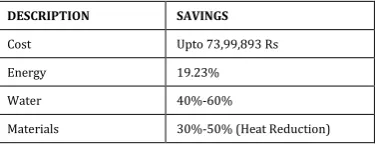
Table -3: Total saving by various measures
DESCRIPTION SAVINGS
Cost Upto 73,99,893 Rs
Energy 19.23%
Water 40%-60%
Materials 30%-50% (Heat Reduction)
6. CONCLUSION
© 2018, IRJET | Impact Factor value: 6.171 | ISO 9001:2008 Certified Journal | Page 850
REFERENCES
[1] O Das, P Bera, S Moulick, “Water Conservation Aspects of Green Building”, vol.04, Issue: 13, Dec-2015
[2] D Roychowdhury, R V Murthy, Jose P D, ‘’Facilitating Green Building Adoption-An Optimization Based Decision Support Tool,’’ IIMB-WP NO. 485, March-2015
[3] Dr K N Sheth, ‘’Water Efficient Technologies For Green Buildings.’’ Vol.1/April-2017
[4] Balramdas, P Meher, S Behera, B rath, S Dash, P Choudhary, ‘’Comparison Between Normal Buildings and Green Buildings-A case study approach,’’ Vol. 03, Issue:05, May-2016
[5] Luay N. Dwaikat, and kherun N. Ali, ‘’Green Buildings Actual life Cycle Cost Control: A Framework for Investigation,’’ Nov-2016
[6] Luay N. Dwaikat, and kherun N. Ali, ‘’ Measuring The Actual Energy Cost Performance of Green Building: A Test of the Earned Value Management Approach,’’ March-2016
[7] A V Kotkar, H Salunkhe,’’ A Review Paper On Green Building Reseach,’’ July-2017
[8] Shristi Khosla and S K Singh, ‘’Energy Efficient Buildings,’’ Vol. 5, 2014