Improving Embedding Capacity by using the
Z
4
-linearity of Preparata Codes
Houda JOUHARI
Laboratory of mathematics, informatics and applications University Mohammed V AgdalFaculty of Sciences BP 1014 Rabat Morocco
EL Mamoun SOUIDI
Laboratory of mathematics, informatics and applications University Mohammed V AgdalFaculty of Sciences BP 1014 Rabat Morocco
ABSTRACT
This paper presents a novel steganographic scheme based on non-linear Preparate codes that can achieve better performance for ap-plication in steganography than simple linear codes currently in use. The idea of this paper is to use theZ4-linearity of Preparata
non-linear codes for the construction of a new steganographic scheme and to show that quaternary covering functions can pro-vide embedding capacity higher than binary ones and can maintain good image quality as well.
Keywords:
Nonlinear codes, Codes over rings, Quaternary codes, Embed-ding efficiency, Preparata codes
1. INTRODUCTION
Internet is a popular communication channel nowadays. Trans-mitted data are easy to be copied or destroyed by unautho-rized persons. Therefore, how to transmit data secretly by in-ternet becomes an important topic. Encryption may provide a safe way, which transforms data into a ciphertext via cipher al-gorithms [1]. However, it makes the messages unreadable and suspicious enough to attract eavesdroppers attention. To over-come this problem, steganography offers different approaches to transmitting secret messages [2]. Steganography is a technique that imperceptibly hides secret data into cover media by alter-ing its most insignificant components for covert communication, such that an unauthorized user will not be aware of the existence of secret data [3].
The most common and well-known steganographic method is called least significant bit (LSB) substitution, which embeds se-cret data by replacingkLSBs of a pixel withksecret bits directly [4]. Many optimized LSB methods have been proposed to im-prove this work [5]. The human perceptibility has a property that it is sensitive to some changes in the pixels of the smooth areas, while it is not sensitive to changes in the edge areas. Not all pix-els in a cover image can tolerate equal amount of changes with-out causing noticeable distortion. Hence, to improve the quality of stego images, several adaptive methods have been proposed. An interesting steganographic method is known as matrix em-bedding, introduced by Crandall[6] and analyzed by Bierbrauer [7] and independently discovered by van Dijk [8] and Galand [9]. Matrix encoding requires the sender and the recipient to agree in advance on a parity check matrixH, and the secret message is then extracted by the recipient as the syndrome (with respect to
H) of the received cover object. This method was made popular
by Westfeld [10], who incorporated a specific implementation using Hamming codes in his F5algorithm, which can embedt
bits of message in2t−1cover symbols by changing at most,
one of them.
There are two parameters which help to evaluate the performance of a steganographic method over a cover message ofNsymbols: the embedding rateR= t
N, whichtis the amount of bits that
can be hidden in a cover message and the embedding efficiency
E= t
ρ, where the covering radiusρis the largest number of
pos-sible changes. In general, for the same embedding rate a method is better when the embedding efficiency is larger. We acknowl-edge, though, that the number of changes is not the only impor-tant factor influencing the security of the steganographic scheme but the choice of the cover object and the character of modifica-tions play an equally important role.
In this paper, a novel steganographic scheme based on theZ4 -linearity of Praparata codes is described. The experimental re-sults show that the proposed scheme can embed large amounts of information and can maintain good image quality as well. The remainder of this paper is organized as follows. In Section II we recall the relationship between information hiding and coding theory, and we give a brief introduction to codes defined overZ4 and more especially Preparata codes. In section III, the embed-ding and extracting algorithms of the proposed method is pre-sented. The experimental results will be in Section IV. Finally, conclusions are given in Section V.
2. CODING THEORY AND STEGANOGRAPHY
2.1 Notations
Throughout this paper, we will use some standard concepts and results from Coding Theory. LetFN2 denote the vector space of allN-bit row vectorsx= (x1,· · ·, xN). A binary[N, k]code
Cof block lengthNand dimensionkis ak-dimensional vector subspace ofFN2, where the sum of two vectors and a multipli-cation of a vector by scalar are defined using the usual binary arithmetics. The(N−k)×NmatrixHis called a parity check matrix ofCifxHT = 0for eachx∈C, whereHTdenotes the
transpose ofH. For anyx∈FN2, the vectors=xHT ∈F
N−k
2 is called the syndrome ofx. For each syndromes ∈ FN2, the setC(s) ={x ∈FN
2 |xHT = s}is called a coset. Note that
C(0) = C. Obviously, cosets associated with different syn-dromes are disjoint. Also, from elementary linear algebra, we know that every coset can be written asC(s) =x+C, where
x∈ C(s)arbitrary. Thus, there are2N−kdisjoint cosets, each
consisting of2kvectors. Any member of the cosetC(s)with the
de-noted aseL(s).
The Hamming weightωHof a vectorxis defined as the number
of ones inx(i.e.,ωH(x) =x1+· · ·+xN).
The distance between two vectorsxandyis defined as the Ham-ming weight of their differencedH(x, y) =ωH(x−y). For any
x∈C, we denote byB(x, ρ)the ball with centerxand radius
ρ,B(x, ρ) ={y∈F2N|dH(x, y)≤ρ}.
The covering radiusρof a codeCis defined as
ρ= max x∈FN
2
dH(x, C)
wheredH(x, C) = minc∈CdH(x, c)is the distance betweenx
and the codeC.
2.2 Syndrome Coding (Matrix Embedding)
We now briefly review a few relevant known facts about embed-ding schemes and covering codes that appeared in [9] and [11] and establish some more terminology. LetMbe the set of all messages. An embedding scheme onFN2 with a distortion bound
Tis a pair of embedding and extraction functionsEmbandExt:
Emb:FN2 ×M→F
N
2 and Ext:F
N
2 →M (1)
dH(x, Emb(x, M))≤T, ∀ M∈M,andx∈FN2 (2) such that for allM∈Mand allx∈FN2,Ext(Emb(x, M)) =
M. In other words, (1) means that we can embed any message fromMin any binaryN-tuple and (2) states that we can do it using at mostTchanges.
The matrix embedding theorem is taken from [12] and gives a recipe on how to use an[N, k]code to communicate(N −k) bits using at mostρchanges in a sequence ofNbits.
THEOREM 1. (Matrix embedding) LetCbe an[N, k]code with a parity check matrixHand covering radiusρ. The embed-ding scheme below can communicateN−kbitsM ∈FN2−kin
a sequence ofNbitsx∈FN2 using at mostρchanges
Emb(x, M) =x+eL(M−xHT) =y
Ext(y) =yHT
whereeL(M −xHT) is a coset leader of the cosetC(M −
xHT).
Indeed, since C has a covering radius ρ, we know that
dH(x, y) = ωH(eL(M − xHT)) ≤ ρ, which shows that
the embedding scheme has (a tight) distortion boundρ. To see thatExt(Emb(x, M)) = M, note thatExt(Emb(x, M)) =
yHT =xHT+e
L(M−xHT)HT=xHT+M−xHT=M.
The goal is to deliberately modifyxtoyin a way that:
Ext(y) =M
Steganography technique should generally have two important properties : good visual/statistical imperceptibility and a suffi-cient payload. The first is essential for the security of hidden communication and the second ensures that a large quantity of data can be conveyed. Two levels of protection can be done if the message is encrypted before hiding it [13].
2.3 Quaternary Codes
LetZ4 be the ring of integers modulo4andZn4 be the set of
n-tuples overZ4. By a quaternary codeCof lengthnwe shall mean a linear block code overZ4,i.e ., an additive subgroup of
Zn4.
DEFINITION 1. A Lee weigthωL:Z4→Zof an element in Z4is defined as
ωL(0) = 0, ωL(1) =ωL(3) = 1, ωL(2) = 2
and a Lee weight of a vectorc ∈ Zn4 is naturally :ωL(c) =
Pn
i=1ωL(ci). The Lee distance is defined as dL(x, y) =
ωL(x−y).
We define an inner product onZn4 byha, bi = a1b1+· · ·+
anbn(mod4)wherea = (a1,· · ·, an)andb = (b1,· · ·, bn),
and then the notions of dual code (C⊥), self-orthogonal code
(C ⊆ C⊥), and self-dual code (C=C⊥) are defined in the
stan-dard way. We say that two codes are equivalent if one can be obtained from the other by permuting the coordinates and (if nec-essary) changing the signs of certain coordinates. Codes differ-ing by only a permutation of coordinates are called permutation-equivalent.
Any quaternary code is permutation-equivalent to a codeCwith generator matrix of the form
G=
Ik1 A B 0 2Ik2 2C
where A and C areZ2-matrices and B is aZ4-matrix. The code is then an elementary abelian group of type4k12k2, containing 22kl+k2codewords. We shall indicate this by saying thatChas type4k12k2, or simply that|C|= 4k12k2.
IfChas generator matrixG, the dual codeC⊥
has generator ma-trix
H =
−BT−CTAT CT I n−k1−k2 2AT 2I
k2 0
and type4n−k1−k22k2
2.4 Gray Map
The vehicle by which binary codes are obtained from linear codes over Z4 is the Gray map φ : Z4 → F22 defined by
φ(0) = 00, φ(1) = 01, φ(2) = 11,andφ(3) = 10. Formally, we define three maps fromZ4toF2by:
c α(c) β(c) γ(c)
0 0 0 0
1 1 0 1
2 0 1 1
3 1 1 0
The Gray map is then extended componentwise to a map, also denotedφ, fromZn4 toF22n. The 2-adic expansion ofc∈Z4is
c=α(c) + 2β(c) (3) We construct binary codes fromZ4-linear codes using the Gray mapφ :Zn4 →F22ngiven by
φ(c) = (β(c), γ(c)), c∈Zn4.
LEMME 1. The Gray map φ : (Zn4, dL) → (Fn2, dH) is an isometry of metric spaces, that is, φ is a bijection and
dH(φ(x), φ(y)) =dL(x, y)for allx, y∈Zn4. Ifuandvare inZn4, then
φ(u) +φ(v) =φ(u+v+ 2(u∗v)) Therefore ifuandvare inZn4 , then
φ(u+v) =φ(u) +φ(v) +φ(2α(u)∗α(v)) whereu∗vis the componentwise product of the two vectorsu
andvinZn4.
Knowing that all the digital files are binary, we simply use the inverse gray map for working on the support quaternary.
2.5 Preparata Codes
that the Preparata code contains more codewords than any linear code with the same minimal distance [14].
We refer the reader to [15] for information concerning Galois rings and their use in the construction of codes overZ4. LetRbe a Galois ring of characteristic4 with4m elements.
The multiplicative group of units inRcontains a unique cyclic subgroup of order(2m−1). Letξbe a generator of this subgroup
and letT ={0,1, ξ,· · ·, ξ2m−2
}. Letµ:Z4 →F2denote the modulo2reduction map.
Our Preparata code is thus defined asP =φ(P), wherePis the quaternary codes with parity-check matrix given by:
H=
1 1 1 1 · · · 1 0 1 ξ ξ2 · · · ξ2m−2
where the entries in the second row are to be replaced by the correspondingm-tuples(b0j, b1j,· · ·, bm−1,j)T. ThenH is a
matrix ofm+ 1rows and2mcolumns over Z4.
Then for oddm ≥ 3the binary imageP =φ(P)ofP under the Gray map is a nonlinear code of lengthN = 2m+1, with
2N−2m−2codewords and minimal distance6.
3. THE PROPOSED STEGANOGRAPHIC SCHEME
Now taking a non-linear Preparata codes as example, it is shown that the performance of binary steganographic method can be im-proved by applying a non-linear codes on our information hiding method.
First a complete decoding algorithm for theZ4-linear Preparata code of length2mis presented.
3.1 Decoding the Quaternary Preparata Code in the
Z4Domain
There is a very simple decoding algorithm for the Preparata code
P, obtained by working in theZ4 domain. This is an optimal syndrome decoder: it corrects all error patterns of Lee weight at most2, detects all errors of Lee weight3, and detects some errors of Lee weight4. We use the parity check matrixHgiven in (section2.5), and assume m is odd and≥3.
Letv = (v0, v1,· · ·, vn−1) ∈Zn4 be the received vector. The syndromeHvThas two components, which we write as
t= n−1
X
j=1
vj+v0,
A+ 2B= n−1
X
j=1
vjξj
whereA,BinT.
It follows that the covering radius of P is at most4([16], The-orem 21 of ch. 6), i.e., the Lee distancedL(v,P)from a vector
v∈ Zn4 toP satisfiesdL(v,P) ≤ 4. Note thatt=±1if and
only ifdL(v,P) = 1or3.
Single errors of Lee weight1or2: Ift= 1andB = 0, or if
t=−1andA=B, we decide that there is a single error of Lee weight1in column(1, A). Ift = 1andB 6= 0, or ift=−1 andA6=B, thendL(v,P) = 3. Ift= 2andA= 0, we decide
that there is a single error of Lee weight2in column(1, B)T.
Double errors of Lee weight2: We begin by supposing thatt= 0 and
A+ 2B=X−Y
whereX, Y inT andX 6=Y. Note thatA6= 0sinceX−Y is invertible. We have
A=X+Y + 2X2m−1Y2m−1,
B≡Y +X2m−1Y2m−1(mod2).
Letx,y,a,b, respectively, be the images of X, Y, A, B in
GF(2m)after reduction mod2using the mapµ. Then
a=x+y, b=y+x2m−1y2m−1,
which we rewrite as
a=x+y, (b+y)2=xy.
The unique solution to these equations isy =b2/a,x =a+
b2/a. Note that whenb= 0orb=a, the double error involves the first column ofH. Next we suppose thatt= 2and that
A+ 2B=X+Y
whereX,Y ∈ T,X6=Y,A6= 0. Proceeding as above we find
a=x+y, b2=xy and soxandyare distinct roots of the equation
u2+au+b2= 0.
A necessary and sufficient condition for this equation to have distinct roots is that
tr(b2/a2) =tr(b/a) = 0 Finally we suppose thatt= 2and
A+ 2B=−X−Y
whereX,Y ∈ T,X6=Y,A6= 0. We now find that
a=x+y, (b+a)2=xy, and soxandyare distinct roots of the equation
u2+au+ (a2+b2) = 0.
A necessary and sufficient condition for this equation to have distinct roots is that
tr(a
2+b2
a2 ) =tr(1 +
b
a) = 1 +tr( b a) = 0.
3.2 Embedding Process
Our proposed data hiding method is based on Preparata codes
P=φ(P)of length2m+1, wheremis odd and≥3. The embedding process consists of the following steps:
Algorithm 1 The Proposed Embedding Process
Inputs Letx = (x1,· · ·, x2m+1)in F22m+1 be a block of cover data,
M= (M1,· · ·, M2m+2)inF22m+2the message to hide.
Outputs y = (y1,· · ·, y2m+1) in F2 m+1
2 , stego-data such that:dH(x, y)≤ρ.
(1) We computea=φ−1(x)andM=φ−1(M) (2) Compute the syndrome:S=M −aHT over
Z4 (3) IfS= 0, thene= 0
else we look for anesuch thateHT =Sandω
L(e)≤ ρ
by using the decoding algorithm (in section3.1) ; (4) Put: b= (a+e)mod4
(5) [Embedding modifications]yis the stego object
y=Emb(M, x) =φ(b) =x+φ(e) +φ(2α(a)∗α(e)) (6) if we are at the end of the cover object, Stop; otherwise, go
to1.
In fact, this embedding process works because :
3.3 Extracting Process
The message embedded is retrieved from the stego-data by ap-plying the proposed extracting function given as follows:
M =Ext(y) =φ(ϕ(y).HT)
Mis the secret information which the receiver extract from the cover.
In fact:
φ(ϕ(y).HT) = φ(b.HT) =φ((a+e).HT)
= φ(a.HT+e.HT) =φ(a.HT+M −a.HT) = φ(M) =φ(ϕ(M)) =M
3.4 Evaluation of image quality
For comparing stego-image with cover results requires a measure of image quality, commonly used measures are Mean-Squared Error, Peak Signal-to-Noise Ratio[17].
3.4.1 Mean-Squared Error. The mean-squared error (MSE) between two imagesI1(i, j)andI2(i, j)is
M SE=
Pm i=1
Pn
j=1(I1(i, j)−I2(i, j))2
m×n
mandnare the number of rows and columns in the input images, respectively.
3.4.2 Peak Signal-to-Noise Ratio. Peak Signal-to-Noise Ratio (PSNR) avoids this problem by scaling the MSE according to the image range:
P SN R= 10log10
I2
max
M SE
whereImaxis the intensity value of each pixel which is equal to 255for8bit gray-scale images, PSNR is measured in decibels (dB). PSNR is a good measure for comparing restoration results for the same image, but between image comparisons of PSNR are meaningless. Generally speaking, if the value of PSNR is more than30dB, then people have difficulty to notice the differ-ence between the cover image and the stego image.
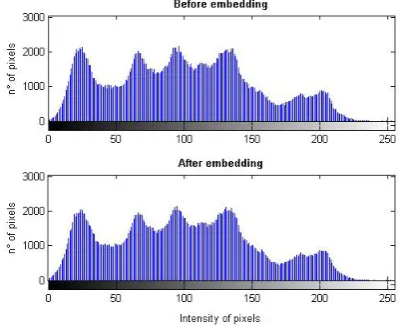
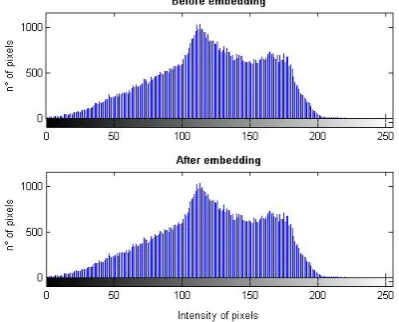
3.4.3 Histogram. The histogram is a function that counts the number of observations that fall into each of the disjoint cat-egories (known as bins). The height of the bins represents the number of values that fall within each range. An image histogram is a chart that shows the distribution of intensities in an indexed or intensity image.
4. EXPERIMENTAL RESULTS
For concreteness, we assume that the cover object used for com-munication is a gray-scale digital image whose pixels are inte-gers between0and255, then we assign8bits to each pixel value. Our steganographic scheme features two essential components. First, is the selection of places within the cover that might be modified and that used to hide the secret message. The second component is the steganographic protocol.
The best widely known steganography algorithm to embed secret information in Spatial and Transform domain of images is based on modifying the least significant bit layer of images, hence known as the LSB technique. This technique makes use of the fact that the least significant bits in an image could be thought of random noise and changes to them would not have any effect on the image.
For example form= 3, letP3be aZ4-linear Preparata code of length23 and (correcting capacity2), and witch has the
parity-check matrix described below:
H=
1 1 1 1 1 1 1 1 0 1 0 0 1 2 3 1 0 0 1 0 3 3 3 2 0 0 0 1 2 3 1 1
By applying the non-linear Preparata codeP3 =φ(P3), we can hide8bits in a sequence of16bits by changing at most4bits. Thus, for our method we embed the message (M1,· · ·, M8) in the LSBs24 pixel gray values (p
1,· · ·, p16)by at most 4 changes in the following manner
(M1,· · ·, M8) = (x1,· · ·, x16).HT wherexidenotes the LSB ofpi.
4.1 Design Details
The proposed scheme are implemented to visualize the data-hiding effect. In the following we describe the steps of our em-bedding algorithm implemented under Matlab:
(1) Read the host gray-scaling imageA, which is to be modified and to embed data.
(2) The host image is partitioned into groups of16pixels. (3) The size of the image and the number of bits to be embedded
in each group of16pixels together determine the capacity of embedding.
(4) If the message size fits to the estimated capacity, the em-bedding proceeds (go to step5), otherwise an error message showing the maximal possible length is displayed.
(5) The text message to be embedded is divided into segments of8bits that are embedded into a groups of16pixels along the embedding process.
(6) For each group of16pixels, do the following:
—Extract the cover-datax= (x1,· · ·, x16)of16bits from the group by concatenation the LSB of each pixel value; —Hide the secret messageM = (M1,· · ·, M8)of8bits
into the cover-data using the proposed method. (7) Store the resulting image as Stego Image (S).
In this present implementation Lena grayscale image of512×
512pixels and Baboon grayscale image of298×298pixels, has been taken as cover images as shown in Figures 1(a) and 2(a). For each image, we applied our method and we present a com-parative study in Figures 1 and 2 of the proposed method with the syndrome coding based on the extended Hamming codes [16]and [18] with the same length.
4.2 Embedding Capacity of the proposed scheme
In the proposed scheme the bit numbers of the secret messages that carried in sequence of length N bits by using the Z4 -linearity of Preparata codes is up to
log2
h N
0
+N
1
+· · ·+N
4
i
In our example, using extended Hamming code of the same length2m+1= 16to carry secret messages in512×512pixels of Lena grayscale image, its rate of the embedding capacity is
log2
h
16 0
+16 1
+16 2
i
16 =
7.0980
16 = 0.4436 The rate of the embedding capacity using the proposed method withm= 3is
log2
h
16 0
+· · ·+16 4
i
16 =
11.2975
(a) original host image
(b) After embedding 6920
bytes by the proposed scheme (PSNR=44,55)
(c) After embedding 3460
[image:5.595.315.522.89.333.2]bytes by the Hamming method (PSNR=44,55)
Fig. 1: Embedding effect on Lena image
Therefore, about131Kbits of secret messages can be embed-ded into the512×512image applying the proposed method compared to81Kbits applying the syndrome coding based on the extended Hamming code.
The proposed scheme has the following features:
—Applying the proposed method much amount of data could be embedded in the image. Therefore, a part of the image remains unused resulting in a distortion less image.
—The amount of data embedded using the proposed scheme leads indeed to a good results compared to the scheme based on extended Hamming code for embedding the secret data into a cover image, see Table 1.
—The effectiveness of the embedding process has been studied by calculating PSNR for the two digital images using the pro-posed method and the syndrome coding based on extended Hamming code as given in Table 2.
By comparing the histograms (See Figures 3, 4, 5 and 6) of the Lena image before and after the embedding, higher security per-formance was inferred applying our method. This improves the imperceptibility and enhances the embedding capacity.
(a) original host image
(b) After embedding 3460
bytes by the proposed scheme (PSNR=58,79)
(c) After embedding 2957
[image:5.595.118.222.95.334.2]bytes by the Hamming method (PSNR=58,79) Fig. 2: Embedding effect on Baboon image
Host Image Amount of embedded data applying (in bytes) The proposed scheme Extended Hamming code
Lena 16.384 10.240
[image:5.595.317.543.375.419.2]Baboon 5.550 3.468
Table 1. : Comparaison of amount of embedded data between the pro-posed method and the Extended Hamming syndrome coding
Host image PSNR (dB)
The proposed scheme Extended Hamming code
Lena 44,5580 44,5590
Baboon 58,7865 58,7048
Table 2. : Comparaison on PSNR values between the proposed method and the Extended Hamming syndrome coding method after embedding
3.460bytes
[image:5.595.314.545.469.515.2] [image:5.595.322.522.578.740.2]Fig. 4: Histogram of Lena for Extended Hamming method
Fig. 5: Histogram of Baboon for Our proposed method
Fig. 6: Histogram of Baboon for Extended Hamming method
5. CONCLUSION
In this paper, we have presented a novel and adaptive method to embed the secret data in the cover image with a good im-perceptibility and a high embedding capacity. The receiver does not need the original image to extract the information. Our test-ing results have shown that the proposed method based onZ4 -linearity of Preparata codes leads indeed to good results
com-pared to the syndrome coding method based on the Extended Hamming codes, and can maintain a good image quality which is seen in the PSNR value.
This paper has presented a novel steganography scheme capable of concealing a large amount of data in a binary image when compared to the Extended Hamming syndrome coding method.
6. REFERENCES
[1] H.J. Highland, Data encryption: a non-mathematical ap-proach, Comput. Secur. 16 (1997) 369386.
[2] F.A.P. Petitcolas, R.J. Anderson, M.G. Kuhn, Information hiding: a survey, Proc. IEEE Spec. Issue Prot. Multimedia Content 87 (7) (1999) 10621078.
[3] H. Wang, S. Wang, Cyber warfare: steganography vs. ste-ganalysis, Commun. ACM 47 (10) (2004) 7682.
[4] D.W. Bender, N.M. Gruhl, A. Lu, Techniques for data hid-ing, IBM Syst. J. 35 (1996) 313316.
[5] C.K. Chan, L.M. Chen, Hiding data in images by simple LSB substitution, Pattern Recognit. 37 (3) (2004) 469474. [6] R. Crandall, “Some notes on steganography”. Posted on steganography mailing list, 1998, http://os.inf.tu-dresden.de/ westfeld/crandall.pdf.
[7] J. Bierbauer and J. Fridrich, “Constructing good covering codes for applications in steganography”, in Transactions on Data Hiding and Multimedia Security III, Lecture Notes in Computer Science, Volume4920, Pages1-22,2008. [8] M. van Dijk and F. Willems, “Embedding information in
grayscale images”, in Proc.22nd Symp. Information and Communication Theory Benelux, Enschede, The Nether-lands, May15-16,2001, pp.147-154.
[9] F. Galand and G. KAbatiansky, “Information hiding by coverings”, in Proc. ITW, Paris, France,2003, pp.151-154. [10] A. Westfeld, : “F5: A steganographic algorithm: High ca-pacity despite better steganalysis”. In: Moskowitz, I.S. (ed) IH 2001. LNCS, vol.2137, pp.289-302. Springer, Heidel-berg(2001).
[11] D. Sch¨onfeld and A. Winkler : “Embedding with syndrome coding based on BCH codes:,” inProceedings of the 8th workshop on Multimedia and security, pp. 214–223, 2006. [12] J. Bierbrauer, “On Crandalls Prob-lem”. 1998 [Online]. Available: http://www.ws.binghamton.edu/fridrich/covcodes.pdf, Personal Communication.
[13] W. Stalling, “Cryptography and Network Security”. Engle-wood Cliffs, NJ: Prentice-Hall,1999.
[14] R. Hammons, P. V. Kumar, A. R. Calderbank, N. J. A Sloane, and P. Sol, “The Z4-linearity of Kerdock, Preparata, Goethals, and related codes,” IEEE Trans. In-form. Theory, vol.40, pp.301319, Mar.1994.
[15] B. R. MacDonald, Finite Rings with Identity. New York Marcel Dekker 1974.
[16] F. J. MacWilliams and N. I. A. Sloane, The Theory of Error-Correcting Codes. Amsterdam: North-Holland, 1977.
[image:6.595.63.263.502.663.2]