2017 International Conference on Electronic and Information Technology (ICEIT 2017) ISBN: 978-1-60595-526-1
Malicious Domain Detection Based on Machine Learning
Yi-da YAN
1,a, Zhen-yan LIU
1,b,*, Jun-wei ZHONG
1,c, Du CHENG
1,d,
Jing-feng XUE
1,eand Yong WANG
1,f1
Beijing Key Laboratory of Software Security Engineering Technology, School of Software, Beijing Institute of Technology, Beijing 100081, China
a
[email protected], [email protected], [email protected], d
[email protected], [email protected], [email protected]
*Corresponding author
Keywords: Malicious domain detection, Botnet, Fast-flux, Domain-flux, DGA.
Abstract. At present, malicious domain detection, especially malicious domain detection based on machine learning, is one of the research hotspot in network security field. In this paper, we first introduce the background knowledge of malicious domain detection and classify the malicious domain according to its malicious behavior. And then we focus on a survey on the detection research of C&C (Command and Control) domain in Fast-flux botnets and Domain-flux botnets which are the most popular and the most challenging. In the end, we also explore some potential future issues in malicious domain detection research.
Introduction
With the gradual improvement of the computer network, the network has more and more impact on people's daily life, so the network security problem is becoming increasingly important. The emergence of malicious domains has caused a series of harm. According to CERT's report on China's security situation in 2016 [1], about 97,000 Trojans and botnet has controlled 1699 million hosts of our country, the number of large-scale traffic attacks continued to increase throughout the year, up to 133 times per day. Botnets is one of the most serious threats on the Internet. In recent years, the number of site data and personal information leakage is increasing. All kinds of blackmail attack frequently, resulting in hundreds of millions of economic loss [2]. In November 2016, the hacker organization "Shadow Brokers" published a list of IP addresses and domains that had been controlled by the NSA, China has suffered the most attacks [1].
DNS converts the domain to IP address, provides the flexibility of communication, and also provides the availability of malicious services [5]. For example, domains can be used to manage botnet C&C servers, download websites where malicious code is located, and steal sensitive information via phishing websites [3]. By using DNS, attackers can change the IP address more flexibly to avoid detection. Fast-change in the domain and IP makes the traditional blacklist to prevent malicious domain has been unable to meet the demand. Similarly, people can detect malicious behaviors and malicious domain through DNS. In 2016, the Black Hat Conference specifically put forward the malicious domain detection by DNS. How to identify and detect malicious domain has gained global visibility.
which needs higher analysis cost. Passive analysis method is the most commonly used method. The application of machine learning method has made great achievements in malicious domain detection. In general, they use machine learning methods to extract features, and establish the classification model to detect.
This paper will be based on the role of DNS and principles, introduce the security detection methods of malicious domain. The paper is organized as follows: the first chapter expounds the significance of this subject; the second chapter is primarily targeted to understand the background of DNS and malicious domain, including the malicious domain purpose, working principle and classification; the third chapter introduces the botnet detection and malicious domain monitoring system; the last chapter summarizes the whole paper, analyzes the hotspots in recent years, and looks forward to the future.
Background Knowledge
This section will introduce the background knowledge of malicious domain, including the principles of DNS, domain resolution process, the classification of malicious domain.
DNS Principles and Resolving
DNS is the abbreviation of “Domain Name System", which provides domain resolution service for converting domains to their corresponding IP address. The namespace of the Domain Name System forms a hierarchical tree structure in which domains are separated by and each level of the domain is managed by different organizations. The top node is called the top-level domain (TLD), and the domain of the second layer node is called the second-level domain, and so on. Different top-level domains represent different types of websites.
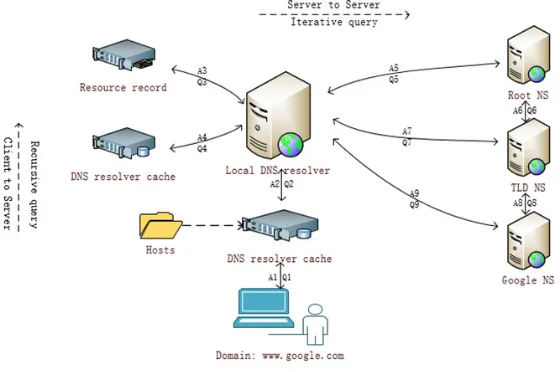
[image:2.612.167.447.476.662.2]DNS queries are resolved in two different ways, can be divided into recursive queries and iterative queries. From the client to the local DNS server is recursive query, and the query between DNS servers is iterative query, which is shown in Fig. 1.
Figure 1. DNS query process.
The DNS resolving process for www.google.com is as follows:
if there is a URL mapping relationship. If so, returned directly to complete the domain resolution.
2. If not, looks for the local DNS server.
3. If the domain to be queried is included in the resource record of local configuration zone, the resolution result is returned and the domain resolution is completed.
4. If the domain is not resolved by the local DNS zone server, but the server has cached this URL mapping, then call the IP address mapping to complete the domain resolution.
5. If the local DNS server local zone file and cache resolution are invalid, query the root server. The root server returns the server address of the .com domain to the local DNS server. If cannot be resolved, find the next server address and repeat the search, until you find the www.google.com host address.
Hackers have a variety of ways by using DNS to attack. The most common include four kinds. 1) Domain hijacking. Hackers control the domain management password and mailbox, the NS record of domain pointing to the attacker-controlled DNS server. The original web page was resolved through the modified DNS server to the page of the hacker. 2) Cache poisoning. Hackers use a variety of ways to control the DNS cache server, users who were originally ready to visit a website were unknowingly taken to other sites that hackers were pointing to. 3) DDoS attack. There are two ways. One for the DNS server itself, causing the DNS server crash or denial of services; another uses DNS server to attack other hosts on the Internet, causing the attacked host denial of services. 4) DNS spoofing. The attackers pretend to be the DNS server and set the IP address of the query as the IP address of the attacker.
Malicious Domain Classification
Malicious domain is characterized by domain camouflage, short life cycle, page content camouflage, frequent conversion of domains, frequent change of A record domain and so on. According to the different characteristics of malicious domain, based on a number of authoritative literature [3, 4, 5, 32, 33, 34], malicious domain can be divided into four classes: phishing, spamming, malicious hosting, botnet.
Phishing attackers use deceptive e-mail and forged websites for phishing scams. Attackers usually use the misplaced domain registration, attempt to disguise as an authoritative domain, and very similar to the legal domain, such as goo1e.com, baiidu.com, etc. Users may easily access the wrong website. Phishing sites steal the user's private information, such as credit card numbers, bank card accounts, ID numbers and so on, so as to achieve the purpose of fraud.
Spamming attackers send large amounts of malicious mail, which is the victim interested or concerned, but actually contains malicious domains or attachments containing Trojans or viruses. Once the user clicks the link, it jumps to the malicious website. Or spread the virus through attachments.
Malicious Hosting attempts to avoid blacklist detection by using multiple domains, servers, payloads, filenames, and URL paths. Malware uses complex hosting infrastructures such as server-side polymorphism and diverse domains, allowing an attacker to perform malicious activities, such as collecting stolen information, distributing malware, initiating social engineering attempts, and other malicious hosting services.
means of spreads, a large number of hosts infected by the bot virus. In the controller and the infected host formed a platform between a one-to-many control of the network. It may cause the basic information networks or critical information systems paralyze, result in a large number of confidential or personal privacy leaks. It can also be used for other criminal activities, such as Internet fraud. The use of botnets to launch DDoS attacks is one of the most important threats, attackers can send commands to all bots, command them to start accessing specific network targets continuously at a specific time, so as to achieve the purpose of DDoS.
With the development of Botnet, attackers use flexible domain and IP address to hide and change C&C server. The main features are the TTL time is short, domains change frequently and so on. Based on the changeable domain and domain generation algorithm, botnet can be divided into two types, Fast-flux [6], and Domain-flux. Fast-flux makes the domain pointing to multiple IP addresses at the same time, and as time goes by, the domain binding IP address collection is constantly changing. It mainly uses a large number of controlled host to provide transit services, hidden the controller. Others use Domain-flux technology to evade being blacklisted. Domain generation algorithm (DGA) is one of the most prominent domains in Domain-flux [3]. Each bot can use DGA to generate candidate C & C domain lists to locate their C & C servers. The infected machine then tries to resolve the domains by sending DNS queries until a successful answer is obtained from a malicious domain that is pre-reserved from the master.
Due to the large-scale, powerful damage of botnets, so how to detect it quickly and effectively, prevent the spread of botnets has become the focus of research in recent years. By reading a large number of literatures, we found that botnets in the malicious domain accounted for the most, so the next chapter will focus on specifically for botnets detection system and all malicious domain detection system.
Overview of Malicious Domain Detection Technology
This section will introduce botnet detection methods and malicious domain detection system. And introduce botnet detection from two aspects, Fast-flux and Domain-flux.
Botnet Detection Method
There are two main ways to detect botnets [17, 18, 21]. One is based on monitoring and analyzing network traffic. The other approach is based on analyzing DNS query/responses in the network. Bots need to locate the C&C server by resolving its domain. Domain-flux infected machines often query a large number of the non-existent domains to locate their C&C server.
Moreover, Alieyan K et al. [7] have subdivided the method of botnet detection based on DNS traffic.
Fast-Flux. Holz T et al. [8] designed a method based on DNS active detection, which calculates the flux fraction of each domain according to the number of A records and the number of NS records in the domain. The main drawback of this approach is that they rely on efficient DNS detection, and the monitored domain is limited to spam. In addition, active probing creates excessive network transmission and may be detected by attackers.
different types of domains. It also found previously unknown domains whose name servers showed Fast-flux behavior.
Stalmans E et al. [10] studied the use of spatial autocorrelation techniques, based on the geographical distribution of domain servers to detect fast-flux domains. Moran's I and Geary's C are used to generate classifiers, using multiple geographic coordinate systems to produce effective and accurate results.
Soltanaghaei E et al. [11] proposed a detection system based on monitoring passive DNS and analysis network traffic. The system used the history of the DNS flow as a white list, reduced the size of the data being analyzed. and eliminated the CDN domain which was the main cause of misclassification when looking for malicious Fast-flux domains. Finally, the SPRT method was used to cluster the flux rate of each domain in the continuous time window.
Choi H et al. [12] proposed a mechanism called botGAD, to monitor malicious group activity in DNS traffic. In order to detect swarm activity, botGAD measures similarity in different domains by constructing matrices based on features extracted from DNS traces. However, since the analysis is performed in both periodic and independent time windows, botnets can avoid detection by delaying communication and uploading them over multiple time windows.
Perdisci R et al. [13] introduced FluxBuster, a new passive DNS traffic analysis system for detecting and tracking malicious flux networks. FluxBuster monitored large amounts of DNS traffic traces generated by recursive DNS (RDNS) servers in hundreds of different networks that were scattered across geographically diverse locations. FluxBuster can detect malicious traffic services regardless of the malicious content of the ad.
Zhou C et al. [14] used the passive DNS method to record the information of domain access, and constructed the 18 feature sets from four aspects, using the real running data of Peking University campus network. Then based on the random forest algorithm to establish fast variable domain recognition model. Compared to FluxBuster, this method is better in recognition flux domain.
Domain-Flux. Yadav et al. [15] used linguistic feature to measure the information entropy of the two-letter group for all domains. They proposed a method of analyzing the passive DNS traffic. And proposed Kullback-Leibler divergence, Jaccard index, Levenshtein editing distance and other statistical methods to classify a group of domains are malicious or non-malicious.
Fu Y et al. [16] used hidden Markov models (HMMs) and probabilistic context-free grammars (PCFGs) to distinguish two DGA. The strategies are better at detecting DGA than BotDigger[17] and Pleiades[18].
to detect botnets efficiently. Zhang Y B et al. [23] proposed a detection method based on group behavior of botnet. For each detection period, collect a failure domain collection for cluster analysis.
Sharifnya R et al. [24] proposed a method of detecting automatically generated malicious domains in the network. The method includes identifying a plurality of DNS queries in network, where in the plurality of DNS queries share a common attribute, analyzing the plurality of alphanumeric elements using the CPU to determine a distribution metric for the domain set, and based on distribution measurement to generate early warning.
Sharifnya R et al. [25] proposed a negative reputation system called DFBotKiller, which took into account the history of suspicious group activity and the suspicious faults of DNS traffic to detect botnet. In order to identify random or algorithmic generated domains, three measures were used, namely Jensen-Shannon difference, Spearman rank correlation coefficient and Levenshtein distance.
The domain generated by the same algorithm has consistency in domain resolution, domain access and domain composition. Rely on this association, we can detect the new domain.
Sato K et al. [26] proposed a way to find unknown black domains. The method uses two symbiotic relationships of different domains to find an unknown black domain, that is, if a domain and a known black domain frequently accompanied, then the domain is also identified as the black domain. Guerid H et al. [27] proposed a botnet detection method that took into account users’ privacy and system performance. The method can identify zombie programs through behavior and identify the malicious services that control zombie programs using the traffic within the associated organization.
Schiavoni S et al. [28] used the Phoenix mechanism to detect domain generation algorithms. This method finds generation domains that represents a botnet by combining strings and IP-based features. At the same time, Phoenix is able to associate the unknown domains generated by DGAs with these groups, generate new perceptions of the evolution of each tracked botnet.
Li Q S [29] proposed a method based on the alive features of domains. The domain collection used by the Domain-flux botnet shows a time behavioral feature in terms of access. This detection method is validated by the mirror DNS traffic from an service provider.
Zhang S Y [30] proposed a method based on the algorithm of DNS map mining. The features of the DGA domain (9 features) are analyzed and extracted, using hierarchical clustering algorithm to cluster the failure domain of client request. Finally, a series of filtering rules are used to determine whether the domain is a legitimate domain or DGA domain.
Malicious Domain Detection System
online model, used the credibility of the engine to calculate credit scores, so as to judge the legality of the new domain.
Bilge L et al. [33] introduced the EXPOSURE system, which used large-scale passive DNS analysis to detect whether domains involved malicious activity. The experimental data includes a large real-world data set containing 100 billion DNS requests and real-time deployment of ISPs within two weeks. Four kinds of features are extracted, using J48 decision tree algorithm combined with ten-fold cross validation to construct a classification model. The experimental results show that the system can automatically identify unknown malicious domains, and it requires less training time and training data than Notos [32].
Antonakakis M et al. [34] also established a domain reputation system(Kopis) to detect malicious domain, which Notos, EXPOSURE is mainly to the host network domain request traffic or DNS server traffic monitoring, Kopis is mainly to the top-level domain name server, authorization server monitoring. Compared with the Notos and EXPOSURE, Kopis can monitor and analyze the domain requests from a global perspective.
Instead of focusing on local features, Khalil I et al. [35] proposed correlate and analyze domains across the globe. Moreover, the proposed scheme combined with traditional classification, makes the classifier output as a seed to detect other malicious domains. Different from the general classification such as Notos [32] and EXPOSURE [33], the technology can determine arbitrary given domain whether it may be malicious. Experiments with a public passive DNS database show that the proposed technique can achieve high TP rate (over 95%) and low FP rate (less than 0.5%).
Also based on the reputation score, Zhao G et al. [36] proposed a novel system to detect APT malware infection based on malicious DNS and traffic analysis. The collected data is divided into DNS traffic and network traffic. First used malicious DNS detection to get suspicious of IP, then used a network traffic analyzer (signature-based detectors and Abnormal detector) to detect, finally used the reputation of the engine to determine the domain whether it is infected with malicious.
Pandrangi R et al. [37] designed a system for identifying malicious domains based on Internet-wide DNS lookup patterns. Identify malicious domains by looking for variance in the server, look at the popularity growth of a domain after registration. Then cluster domains based on the similarity of servers.
Pomorova O et al. [38] combined passive DNS monitoring and active DNS detection to build an effective detection system, BotGRABBER. Based on the clustering of the features obtained from the payload of the DNS message and using the active detection analysis, the developed method can efficiently detect the domain use of IP mapping loop, domain flux, fast flux, and DNS tunneling evasion techniques.
Lu Y [39] designed and implemented a real-time monitoring system model. The model receives the network card data through the passive way, uses Map-Reduce to do the statistical analysis of the log data. It provides users with statistical services of historical data, enhances the real-time status of server monitoring.
Conclusions
In this paper, based on the study of DNS in malicious domain detection, we proposed that traditional detection methods such as content analysis and based on matching or manual determination are low efficiency, and have a high false negative rate which cannot meet the current needs. In particular, botnet development is rapid, large-scale and high-harm, so finding a real-time and effective detection method of botnet is a hot topic in recent years. Using network traffic, passive DNS information and other traces, combined with machine learning methods for analysis is very effective. This paper summarizes the detection methods of different kinds of malicious domains and compares the performance of malicious domain detection system using different machine learning algorithms. How to extract the features of different kinds of malicious domains according to the relationship between malicious domains is still need to research. Building a real-time, accurate detection and malicious domain finding system is still the next research target.
According to the security report released by CERT, in 2016, the security work has made some progress. The security of the DNS is in good condition and no significant security incidents occurred. Anti-attack capability has greatly increased. However, the security threat caused by the integration of the Internet and traditional industries is more complicated. The APT attack has become a normal problem in many countries, especially China. Based on the large data related to network security, the use of artificial intelligence technology such as machine learning can make a considerable contribution to unknown threat discovery, network behavior analysis and network security warning.
Acknowledgements
This work was financially supported by National Key R&D Program of China (2016YFB0801304)
References
[1] Information on http://www.cert.org.cn/
[2] Kerner S M. Proton Mail Learns That Paying Ransom Doesn't Stop Attacks [J]. Eweek, 2015.
[3] Stevanovic M, Pedersen J M, D'Alconzo A, et al. On the ground truth problem of malicious DNS traffic analysis [J]. Computers & Security, 2015, 55(C):142-158.
[4] Zhang Y, Liu T W, Sha H Z, Shi J Q. Malicious domain detection based on multiple-dimensional features [J]. Journal of Computer Applications, 2016, 36(4): 941-944.
[5] Pandrangi R, Feamster N G, Hao S. Systems and methods for identifying malicious domains using internet-wide DNS lookup patterns: US, US8713676[P]. 2014.
[6] Holz T, Gorecki C, Rieck K, et al. Measuring and Detecting Fast-Flux Service Networks[C]// Network and Distributed System Security Symposium, NDSS 2008, San Diego, California, Usa, February -, February. DBLP, 2008:487 - 492.
[8] Holz T, Gorecki C, Rieck K, et al. Measuring and Detecting Fast-Flux Service Networks[C]. Network and Distributed System Security Symposium, NDSS 2008, San Diego, California, Usa, February -, February. DBLP, 2008:487-492.
[9] Hu X, Knysz M, Kang G S. Measurement and analysis of global IP-usage patterns of fast-flux botnets [J]. 2011:2633-2641.
[10] Stalmans, Etienne, S. O. Hunter, and B. Irwin. Geo-spatial autocorrelation as a metric for the detection of Fast-Flux botnet domains. Information Security for South Africa, IEEE, 2012:1-7.
[11] Soltanaghaei E, Kharrazi M. Detection of Fast-Flux Botnets Through DNS Traffic Analysis [J]. Scientia Iranica, 2015.
[12] Choi H, Lee H. Identifying botnets by capturing group activities in DNS traffic [J]. Computer Networks, 2012, 56(1):20-33.
[13] R. Perdisci, I. Corona, and G. Giacinto, Early Detection of Malicious Flux Networks via Large-Scale Passive DNS Traffic Analysis, Dependable and Secure Computing, IEEE Transactions on, vol. 9, pp. 714-726, 2012.
[14]Zhou C, Kai C, Gong X, et al. Detection of Fast-Flux Domains Based on Passive DNS Analysis [J]. Acta Scientiarum Naturalium Universitatis Pekinensis, 2016.
[15]Yadav S, Reddy A K K, Reddy A L N, et al. Detecting Algorithmically Generated Domain-Flux Attacks With DNS Traffic Analysis [J]. IEEE/ACM Transactions on Networking, 2012, 20(5):1663-1677.
[16] Fu Y, Yu L, Hambolu O, et al. Stealthy Domain Generation Algorithms (DGAs) [J]. IEEE Transactions on Information Forensics & Security, 2017, PP (99):1-1.
[17] H. Zhang, M. Gharaibeh, S. Thanasoulas, C. Papadopoulos. BotDigger: Detecting DGA bots in a single network", Proc. IEEE Int. Workshop Traffic Monitor. Anal., pp. 16-21, Apr. 2016.
[18] Antonakakis M, Perdisci R, Nadji Y, et al. From throw-away traffic to bots: detecting the rise of DGA-based malware[C]. Usenix Conference on Security Symposium. 2012:24-24.
[19] Tu T D, Cheng G, Liang Y X. Detecting bot-infected machines based on analyzing the similar periodic DNS queries[C]. International Conference on Communications, Management and Telecommunications. IEEE, 2016:35-40.
[20] Antonakakis E, Perdisci R, Lee W, et al. Method and system for detecting malware: US, US8578497[P]. 2013.
[21] Antonakakis M, Perdisci R, Lee W, et al. Method and System for Detecting Dga-Based Malware: US, US20130191915 [P]. 2013.
[22] Pomorova O, Savenko O, Lysenko S, et al. A Technique for the Botnet Detection Based on DNS-Traffic Analysis[C]. International Conference on Computer Networks. Springer International Publishing, 2015:127-138.
[24] Sharifnya R, Abadi M. A novel reputation system to detect DGA-based botnets[C]. International Econference on Computer and Knowledge Engineering. IEEE, 2013:417-423.
[25] Sharifnya R, Abadi M. DF Bot Killer: Domain-flux botnet detection based on the history of group activities and failures in DNS traffic[J]. Digital Investigation, 2015, 12(12):15-26.
[26] Sato K, Ishibashi K, Toyono T, et al. Extending black domain name list by using co-occurrence relation between DNS queries[J]. LEICE Transactions on Communications, 2012, E95B(3):8-8.
[27] Guerid H, Mittig K, Serhrouchni A. Privacy preserving domain-flux botnet detection in a largescale network[C]. Fifth International Conference on Communication Systems and Networks. IEEE, 2013:1-9.
[28] Schiavoni S, Maggi F, Cavallaro L, et al. Phoenix: DGA-Based Botnet Tracking and Intelligence[C]. International Conference on Detection of Intrusions and Malware, and Vulnerability Assessment. Springer, Cham, 2014:192-211.
[29] Li Q S, Chen Z. Detection of Domain-flux botnet domain names, 2012, 33(08):2915-2919. [2017-08-11].DOI:10.16208/j.issn1000-7024.2012.08.056.
[30] Zhang S Y. Detecting Malware Domains on DNS Traffic [D]. Shanghai Jiao Tong University, 2014.
[31] Ma J, Saul L K, Savage S, et al. Beyond blacklists: learning to detect malicious web sites from suspicious URLs[C]. ACM SIGKDD International Conference on Knowledge Discovery and Data Mining, Paris, France, June 28 - July. DBLP, 2009:1245-1254.
[32] Antonakakis M, Perdisci R, Dagon D, et al. Building a Dynamic Reputation System for DNS[C]. Usenix Security Symposium, Washington, DC, USA, August 11-13, 2010, Proceedings. DBLP, 2010:273-290.
[33] Bilge L, Kirda E, Kruegel C, et al. Exposure: Finding Malicious Domains Using Passive DNS Analysis[C]. Network and Distributed System Security Symposium, NDSS 2011, San Diego, California, USA, February. DBLP, 2011.
[34] Antonakakis M, Perdisci R, Lee W, et al. Detecting malware domains at the upper DNS hierarchy[C]. Usenix Conference on Security. 2011:27-27.
[35] Khalil I, Yu T, Guan B. Discovering Malicious Domains through Passive DNS Data Graph Analysis[C]. ACM on Asia Conference on Computer and Communications Security. ACM, 2016:663-674.
[36] Zhao G, Xu K, Xu L, et al. Detecting APT Malware Infections Based on Malicious DNS and Traffic Analysis [J]. Access IEEE, 2015, 3:1132-1142.
[37] Pandrangi R, Feamster N G, Hao S. Systems and methods for identifying malicious domains using internet-wide DNS lookup patterns: US, US8713676[P]. 2014.
[39] Lu Y Z. Research and Design of DNS Monitoring System Based on Passive Package Analysis [D]. Beijing University of Posts and Telecommunications, 2013.