2017 3rd International Conference on Electronic Information Technology and Intellectualization (ICEITI 2017) ISBN: 978-1-60595-512-4
Watermarking Algorithm for PDF Document
Based on Comment Objects
Shiru Zhang, Xiaona Li and Gaoyuan Li
ABSTRACT
As PDF documents used extensively, security issues become increasingly more prominent. This paper presents an object-oriented PDF document page watermarking algorithm, in which a watermark signal is embedded as a legitimate PDF document page object. The object is not a pseudo-page to access the document reader, thus ensuring the regular PDF display function. The simulation results demonstrate the simpleness and robustness, security and invisibility, also with the capacity of watermarking algorithm guaranteed.
INTRODUCTION
With the popularity of the network, delivery of electronic document is becoming increasingly more efficiency. A number of documents are share and spread on the network in the form of electronic documents. Currently, PDF (Portable Document Format) is the main file format to transmit on the network. It is widespread used in electronic file transfer, exchange and distribution. And almost all of the popular electronic publications are in .pdf format[1].
The widespread use of PDF comes across some security issues which could be solved by digital watermarking. The core idea is to embed secret information about copyright into the digital products[2]. When a digital watermark, or a piece of multimedia confidential information is embedded into a multimedia, only a special watermark detector can be used to extract the watermark in the case of the human _______________________
perceptual system imperceptible [3]. In recent years, more and more researchers began to study the PDF document watermarking algorithm, but still in infancy.
In this paper, an object-oriented PDF document page watermarking algorithm is proposed. It masquerades watermark signal as legitimate PDF document page objects to achieve watermark embedding.
PDF STRUCTURE
The structure of PDF document contains two aspects; one is PDF file structures, called a physical structure. Another is the organized structure of PDF document content, known as the logical structure.
The physical structure consists of four parts: the file header, file body, cross-reference table, and the tail of a file. File header indicates the version number of the PDF specification complies. File body is the most essential part of the PDF document which is organized by a series of page objects. A record of the cross-reference table marks a page object entry that contains the page number of the object, offset and status, enabling random access to a page object. The tail of a file is an entrance to the entire PDF document declaring the address of the cross-reference table, and saving the encrypted information of the PDF document.
The logical structure of a PDF document can be viewed as a tree structure for all objects, the root of the tree is the Catalog. There are four roots of leaf nodes: pages tree, outlines hierarchy, articles threads, names destinations[4]. In addition, PDF document has eight basic objects: Boolean, Numeric, Stream, Dictionaries, String, Names, Arrays, and Null.
WATERMARKING ALGORITHM
Ideological Origin Algorithm
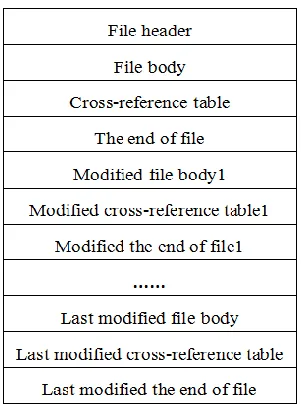
[image:3.612.229.380.304.508.2]When a document reader accesses to a PDF document, it will access the tail of a file first and then to find the cross-reference table and control the display of the entire document content in the end. When the content of the document is modified, the original object and the content of the page will not be changed, only a new page object is attached and the corresponding number is generated. And then the last updated page object will be automatically recognized by the document reader. Except the updated content of the document, the document address described in the updated new page objects will be changed, and the attachment for some additional new page that contains the object cross-reference table records is needed. The original cross-reference table is also not modified. This ensures that the reader can access the last updated page object, that means display the modified document. A physical structure of PDF document has been modified several times shown in Figure 1, including many file bodies, cross-reference table and the tail of a file.
Figure 1. PDF document physical structure repeatedly revised.
After a document is modified, abandoned page object can not be accessed by document reader, which is determined by the offset address from cross-reference table describing the page to be displayed. An algorithm was proposed by Sun Xingming and Liu Youji[7] which is consistent with this characteristic to implement hidden information.
will not affect the structure and content of the document. According to the definition of the physical structure of a PDF document, the sequence number of the page object always accumulates sequentially from “1”. That is just to set the page object number to "0", which generates a page number and content of the object can add by itself. Thus, the watermark signal will be disguised as a legitimate target pages, embedded in the physical structure of the document. The watermark signal is noted as w.
w= 0 0 obj\r\n <<ligaoyuan>>\r\n endobj
Where “ligaoyuan” is the watermark signal, the 0th page object is the key.
Watermark Embedding
Watermark signal embedding algorithm is shown in Figure 2:
The function of the document translator is to read the document in the form of binary data stream, and read sequentially from the tail of a file to header by moving the file pointer. The specific steps of the algorithm is as below:
Step 1: Document translator reads PDF a document test. pdf content stream in binary form and saves it to the document test1. pdf and test1.txt content stream;
Step 2: To determine whether the document has been read, that is, the file pointer return "EOL". If it is not finish, please return to step 1, if is finished, proceed to the next step;
Step 3: “w” will be read into test1.pdf and test1.txt;
Step 4: Close the document translator, and store it as test.pdf, test1.pdf and test1. txt respectively, where the test1.pdf is the watermarked PDF documents.
Figure 2. Watermarking algorithm Block Diagram.
use the Adobe PDF printer to convert it into a PDF document and save it as test .pdf, shown in Figure 3.
After the above steps, it can successfully embed a watermark into the tail of a file. And the watermarked document is shown in Figure 4.
Comparing Figure 3 and Figure 4, it can be seen that there is no difference between the watermarked PDF document and the original PDF document under the naked eyes, so it meets the invisibility of watermarks.
Figure 3. Test .pdf document content.
Watermark Extraction
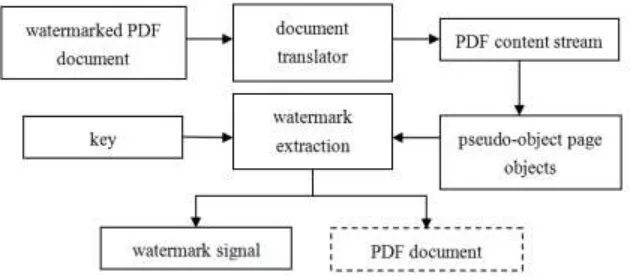
[image:6.612.153.468.194.334.2]In the section of “Watermark Embedding”, the editable watermark can be successfully embedded into the original PDF document, and can meet the invisibility. The extraction process of the watermark signal is an inverse embedded process. The block diagram of our watermark extraction algorithm is shown in Figure 5.
Figure 5. Watermark extraction algorithm Block Diagram.
When extracting the watermark, firstly, read watermarked PDF documents to get the document content streams via PDF document translator; then look for objects with camouflage page watermark signal to extract the watermark signal in the disguise page object. The specific steps are as follows:
Step 1: Document translator reads watermarked PDF document test1.pdf flow in the form of binary data stream and saved it to the document test2.pdf content stream;
Step 2: Flag detect whether the document contains pseudo-object page objects "0 0 obj", if there is, go on next step, otherwise go to step 5;
Step 3: Read the watermark signal of pseudo-object page, and writes it into test2.txt content stream;
Step 4: Determine whether the end of the watermark bit is read, if not, turn to the previous step, otherwise transfer it into the next step;
Step 5: To judge whether the document has been read, that is, the file pointer return "EOL"; if it is not finished, return to step 1, if it is finished, proceed to the next step;
Step6: Close the document translator, and save it to the three documents by the name test1.pdf, test2.pdf and test2.txt. Test2.txt is the stored watermark signal, test1.pdf and test2.pdf are the watermarked PDF documents.
Figure 6. Watermark signal.
PERFORMANCE ANALYSIS
In VC ++ 6.0 environment, this paper uses C language to read the document, embed watermark signals and make some extracting algorithm simulation experiments. In addition, utilizing the official PDF editing software Adobe Acrobat X Pro to attack document, and the attack types are: text delete, add text, text substitution, delete pages, crop pages and page rotation. The subjects were 50 Chinese-English paper related to the three key words of “video watermarking”, “document watermarking”, “pulse diagnosis”. The experimental results confirmed the reliability of the algorithm and the results of experimental statistics are shown in Table I.
TABLE I. THE ATTACK RESULTS OF 50 LAB DOCUMENT WATERMARKED.
Attack number 1 2 3 4 5 6
Number of articles
detected watermark 50 50 50 42 47 48
Where attack No. 1-6 represent six kinds of attacks. They are delete text, add text, replace text, delete pages, crop pages and page rotation, respectively. And we will evaluate the proposed watermarking algorithm from four aspects.
Robustness: By analyzing the data in Table 1, the proposed watermarking algorithm in this paper can completely resist the attack of text type, but it is kind of inadequate for page attack, because the watermark signal embeds into the document in the form of a pseudo-page objects. During the attack, word attack was confined within the pages of the object, and on the contrary, page attack is a kind of bulking page operations. It operates on page objects, so the pseudo-page objects will have a greater destructive power. However, the recognition rate of the watermark signal is still more than 90%; it can be seen that the algorithm has strong robustness.
Invisibility (Transparency): By observing Figure 2 and 4, we can conclude that the document will not display any significant changes after addition of the watermark. The display of the document will be not affected by the embedded watermark. The algorithm has invisibility.
Watermark capacity: We can see the watermark signal has editable characteristic. Thus, theoretically the capacity of the watermark signal is unlimited; a very large capacity can be embedded.
CONCLUSIONS
A watermarking algorithm for PDF document page objects is proposed in this paper. According to the property of an abandon page object after updating PDF document object, a watermark signal is disguised as a legitimate page object to embed into the document structure. Since the nature of pseudo-object page objects is the same as the abandoned one, it cannot be accessed by the document reader. Simulation results show that the security, robustness and invisibility of the algorithm can be guaranteed. Finally, the proposed algorithm has a great potential application due to the editable feature of the watermark, considerable watermarking capacity.
REFERENCES
1. Wang Wan, Han Yiqiu, Xu Fupei. 2001. PDF file format and PS file conversion study[J]. Computer science, 09:123-127. (In Chinese)
2. Yin Hao, Lin Chuang, Qiu Feng etc. 2005. Summary of digital watermarking technology[J]. Computer Research and Development, 2(7): 1093-1094(In Chinese)
3. Li Shanshan. 2012. Anti-attack hard copy text binary image digital watermarking algorithm study[D]. Xi'an University of Electronic Science and Technology. (In Chinese)
4. PDF Reference Manual Version 1.6[Z], Adobe Systems Incorporated http://www.Adobe
HYPERLINK. 2005.
5. He Xuansen, Zhu Tao, Yang Gaobo. 2015. A geometrical attack resistant image watermarking algorithm based on histogram modification[J]. Multidimensional Systems and Signal Processing, 26(1): 291-306.
6. Arab F, Abdullah S M, Hashim S Z M. 2015. A robust video watermarking technique for the tamper detection of surveillance systems[J]. Multimedia Tools and Applications. 75(18):10855-10885.
7. Liu Youji, Sun Xingming, Luo Gang, 2006, A new algorithm based on information hiding PDF