2016 International Conference on Electronic Information Technology and Intellectualization (ICEITI 2016) ISBN: 978-1-60595-364-9
CCD Aerial Camera Modulation Transfer
Function Test and Analysis
Haibin Zhu and Zhigang Xu
ABSTRACT
The modulation transfer function(MTF) is important measure of CCD camera imaging system performance index. In this paper, based on the MTF, on the basis of theoretical analysis based on the resolution of the target in the camera lens focal plane imaging position deviation between CCD camera and CCD pixels, modulation transfer function is analyzed, the influence of the mathematical model is established. And the CCD camera system at Nyquist frequency of the MTF was tested, the experimental results and the calculated results are basically consistent.
INTRODUCTION
Modulation transfer function (MTF) is objectively evaluate the optical system imaging quality standards, the fundamentally overcome the point of star, resolution, geometric aberration, and other traditional image quality inspection methods deficiencies[1-2].
CCD camera imaging system is mainly composed of optical lens, CCD and the related circuit. CCD camera is actually a pixel CCD to the scenery spatial sampling process. In modulation transfer function of CCD cameras to test, the method is
__________________________
generally used at home and abroad with the collimator sine target imaging to infinity, real work state of CCD camera to provide an infinity target. Then through the lens of a camera will be the imaging to the CCD to obtain numerical image transfer system. With image modulation by dividing the target modulation, can get MTF of a camera system.
Due to the offset of the stripes of the resolution of the board on the focal plane of the CCD camera imaging position and the pixel of the CCD will affect the CCD modulation transfer function. In this paper on the stripes of the resolution of the board on the focal plane of the CCD camera imaging position and CCD pixel offset of CCD modulation transfer function of ring was analyzed and the transfer function of CCD camera at the Nyquist frequency modulation were tested. The test results are consistent with the theory.
THE EFFECT OF MIGRATION ON THE MTF OF CCD CAMERA
Camera system modulation transfer function is a product of the lens and CCD modulation transfer function. When the resolution target measurement of CCD camera modulation transfer function, because it does not meet the requirements of MTF measurement cannot be lens and CCD modulation transfer function of the product as the camera system modulation transfer function. This can be rectangular wave is expanded into trigonometric series by Fourier series, series at all levels and the corresponding frequency lens modulation transfer function to the product as a rectangular wave in the lens focal plane as a function. Through like a wave function and the phase relationship between the trough and the pixel of the CCD, the paper draws the conclusion that the value function peaks and troughs place corresponding pixel of the CCD signal. Therefore, according to the definition of modulation transfer function, the CCD modulation transfer function is obtained. When the resolution target is uniformly illuminated, the light energy transmitted along the X direction is i (x) [3-4]:
) 1 ( ]}
) 5 ( 2 cos 5 1 ) 3 ( 2 cos 3 1 ) 2 [cos( 4 { )
( )
(x A0 A1f x A0 A1 fx f x f x
i
The target resolution camera lens imaging, the lens like on the energy distribution function i'(x) for:
) 2 ( ]} ) 5 ( 2 cos ) 5 ( 5 1 ) 3 ( 2 cos ) 3 ( 3 1 ) 2 cos( ) ( [ 4 { )
(x A0 A1 H f fx H f f x H f f x
i
target through the light energy function i(x), target in the lens like glazing surface energy distribution function i '(x):
cos(2 ) (3)
4 )
(x A0 A1 fx
i ) 4 ( ) 2 cos( ) ( 4 )
(x A0 A1 H f fx
i
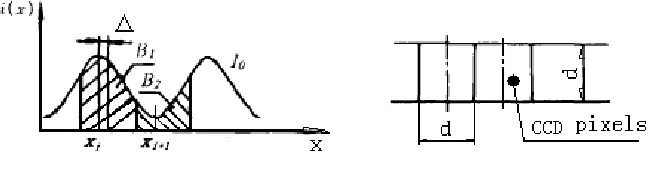
In the CCD camera imaging, CCD as photoelectric converter, was placed in the camera image plane imposed receiving like function i'(x). Design of CCD pixel width is d, pixel imaging is in the space domain integral energy like function I' (x). Like function i'(x) and pixel position as shown in Figure 1.
In Figure 1, xi xi + 1 for CCD two adjacent pixels corresponding to the lens like the light wave crest and trough the coordinates of the target function, the coordinates of the peaks and troughs of to wave the offset in the center of the corresponding pixels.
[image:3.612.133.461.377.462.2]
Figure 1. The schematic diagram of relation between target image function and CCD pixels.
CCD adjacent two pixels of i'(x) were obtained by integration energy B1, B2
expression: ) 5 ( ) ( sin ) ( 2 cos ) ( 4 ) 2 cos( ) ( 4 )
( 2 0 1
2 1 0 2
2
1 i x A A H f fx Ad Ad H f f x c fd
B i d x d x d x d x i i i i
) 6 ( ) ( sin ) ( 2 cos ) ( 4 ) 2 cos( ) ( 4 )( 2 0 1
3 2 1 0 2 3 2
2 i x A A H f fx Ad Ad H f f x d c fd
B i d x d x d x d x i i i i
) 7 ( 0 1 A A M ) 8 ( cos ) 2 ( 2 cos ) ( sin ) ( 8 2 sin ) 2 ( 2 sin ) ( sin ) ( 8 1 0 1 2 1 2 1 fd d x f fd c f H A A fd d x f fd c f H A B B B B M i i
According to the definition of modulation transfer function, the modulation transfer function of CCD camera system is obtained:
) 9 ( cos ) 2 ( 2 cos ) ( sin ) ( 8 2 sin ) 2 ( 2 sin ) ( sin ) ( 8 1 0 1
1 A AH f c fd f x d fd
fd d x f fd c f H A A A M M CTF i i o
Within the Nyquist frequency of CCD is linear, time invariant system; when the spatial frequency is higher than the Nyquist frequency conditions, violation of the sampling theorem and mixed stack effect, false existence CTF value. So in the analysis of CCD contrast modulation function, operation frequency is not higher than the Nyquist frequency[5]. At the Nyquist frequency are:
(10)2 1 2 , 1 , 0 d f n k kd
xi
The equation(10) into the equation (9) to:
) 11 ( cos 2 ) 2 1 ( 4 d d H
CTFN
TEST OF MODULATION TRANSFER FUNCTION OF CCD
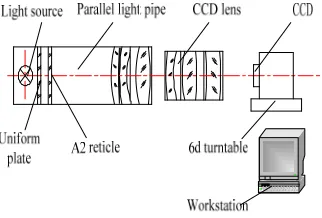
Due to the constraints of the manufacturing process, making light outgoing degree with sinusoidal variation of sinusoidal target very difficult. The resolution plate making is very mature technology, simple production, data acquisition is most bright stripes and dark stripes mean value, has the advantages of mean error effect. Therefore at the board resolution of CCD camera in the Nyquist frequency modulation transfer function for testing, the testing device as shown in Figure 2.
[image:5.612.216.377.275.384.2]The pixel size of CCD in the tested CCD camera is 9mm * 9mm, the spatial cutoff frequency of the camera system is, f=56lp/mm. The collimator focal length is 1.6m, the focal length of the lens is 600mm, the line width w rectangle target:
Figure 2. Schematic diagram of CTFN testing system of CCD camera.
m d
f f
w 9 24
6 . 0
6 . 1
2
1
maximum value CTFN at CTFN value for the camera system at the Nyquist frequency modulation transfer function. Control CCD step distance of 1 m, measured CCD camera in 5mm range of modulation transfer function value.
THE RESULTS OF THE EXPERIMENT
The CCD camera lens is 0.4 for the MTF, the relative aperture of 1:4, the focal length of the camera system for 600mm..
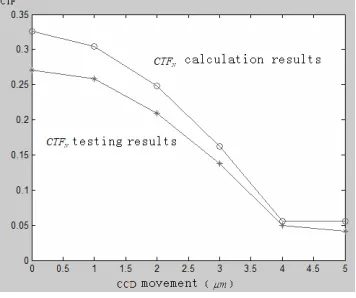
[image:6.612.100.260.376.530.2]In the Nyquist frequency of the CTF test, test images shown in Figure 3, test and theoretical calculation results, as shown in Figure 4, Table 1.
TABLE 1. EXPERIMENTAL DATA AND CALCULATED DATA.
[image:6.612.306.484.379.528.2]
Figure 3. CTFN testing image of CCD Figure 4. curve diagram of Experimental
camera in Nyquist frequency. testing data and calculated data.
By figure 4 shows: in addition to the magnitude of differences, consistent trend
curve and theoretical calculation results accord with the experimental results, the cosine change trend. Amplitude difference is due to the theoretical results are obtained for the ideal case in CCD, ignoring the collimator effect of modulation transfer function in practice. In addition to measuring the collimator factors, there are 4 resolution plate twenty-second sets of lines with CCD at Nyquist frequency for
CCD mobile
(µm) 0 1 2 3 4 5
CTFN test 0.2711 0.2584 0.2089 0.1378 0.050 0.041
different target line, non-uniformity of CCD pixel driving circuit, material, CCD pixel, signal acquisition circuit, and incomplete charge transfer and other factors will have a direct effect of on the measuring results of CTF[6], so the measurement results and theoretical calculation of a slight deviation.
CONCLUSIONS
Through the calculation and the experimental results can be seen at the Nyquist frequency, the differences between the rectangular coefficient 4/ target and target obtained by sinusoidal modulation transfer function of CCD camera. The CTFN is the nominal value and peak (or valley) as function of the product value of the corresponding pixel offset cosine center. The number of fringe resolution board in CCD images on the photosensitive surface of the plurality of usually contain. Under normal circumstances, the board resolution cannot guarantee the strict stripe width, between images and CCD pixel resolution in fringes formed in the CCD on the focal plane of the offset is multi value distribution. Based on the horizontal (or vertical) resolution board most bright stripes and dark stripes and the mean of the data acquisition, the effect on the average error, so as to improve the accuracy of measurement.
REFERENCES
1. Haoqun, Sha Dingguo, Zheng Naimei. Optical transfer function measuring instrument of knife edge and slit two kinds of measurement methods of comparative analysis. Optical Technology, 2001, 27 (1): 41-43.
2. Feltz J.C. Development of the modulation transfer function and contrast transfer function for discrete systems, particularly charge-coupled devices [J]. Opt. Eng., 1990, 29(8): 893-904.
3. Jiang Zhuying and so on, the optical system imaging quality evaluation and test. Beijing: Chinese Metrology Press, 1988.
4. Zhuang Songlin, Qian Zhenbang, the optical transfer function. Bryan, Mechanical Industry Press, 1981: 6-10.
5. Wan Chunming, Tong Shoufeng, analysis the testing principle of the modulation transfer function of CCD camera. Semiconductor Optoelectronics, 2001, 23 (1): 40- 43.