2016 International Conference on Wireless Communication and Network Engineering (WCNE 2016) ISBN: 978-1-60595-403-5
A Simplified FDDL Algorithm for Face Recognition
Xin LIU, Yun-jie ZHANG
*and Di-wei LI
Department of Mathematics, Dalian Maritime University, Dalian, 116026, China
*Corresponding author
Keywords: Sparse representation, Fisher discrimination, Dictionary learning.
Abstract. In this paper, a modified Fisher Discrimination Dictionary Learning method is introduced,
which is suitable for face recognition without and with disguise. In the proposed method the new optimization model is establish, so as to preserve intrinsic complementary penalty as well as able to simplify calculation of original algorithm. The effective and efficient of the proposed method is demonstrated experimentally by considering the YALE, ORL, and AR face database.
Introduction
Face Recognition (FR) has gradually become one of the most studied topics in computer vision and pattern recognition [1, 2]. With the development of compressed sensing [3], the face recognition model based on sparse representation (or sparse coding) has received extensive concern, and a number of related algorithms are presented [4]. One of the representative methods is Fisher Discrimination Dictionary Learning (FDDL) proposed by Yang et al. [5].
The main contribution of the FDDL algorithm lies in incorporating the supervised information (class label information) and the Fisher discrimination message into the objective function for learning a structured discriminative dictionary, which is used for face recognition. In FDDL model, the objective function contains three different sub-items concurrently: discriminative fidelity term, sparse regularization term and discriminative coefficient term. The discriminative fidelity term composes of collaborative penalty, discriminative penalty and complementary penalty.
However, it is a little complex to solve the original FDDL model. For this reason, Yang et al. [6] proposed a simplified FDDL method by integrating the discriminative fidelity term. But its performance is unstable for face recognition because complementary penalty is also ignored.
In this paper we suggest a new simplified FDDL model to improve the simplified method in [6]. The proposed model takes into account both the simplifying calculation and the complementary penalty. Empirical experiments on YALE, ORL and AR face database illustrate that the modified method is effective and efficient.
Brief Review of FDDL
Given sufficient c classes training face samples, and arranged the ni training samples from the class i
as columns of a matrix i
i
n m i n i i
i A A A
A [ 1, 2,, ]R where m is the dimension, then training sample matrix A = [A1, A2, …, Ac]Rmn where n = ni is the total number of training samples. Consequently,
the basic problem for face recognition is to correctly determine the class which a new query face sample yRmbelongs to.
In [5], Yang et al. proposed Fisher discrimination dictionary learning (FDDL) scheme for sparse representation. The FDDL employs the Fisher discrimination criterion to learn a structured dictionary, i.e. the dictionary atoms have correspondence to the class labels so that the reconstruction error associated with each class can be used for face recognition. The general model of FDDL is formulated as
n d
X f X
X D A r
J n
X D X
D argmin
{
( , , ) 1|| ||1 2 ( )}
, s.t. || ||1, ) , ( ) ,
where r(A, D, X) is the discriminative fidelity term; ||X||1 is the sparse regularization term; f(X) is a discrimination term imposed on the coefficient matrix X; and λ1 and λ2 are scalar parameters. Each atom dn of D is constrained to have a unit l2-norm to avoid that D has arbitrarily large l2-norm, resulting in trivial solutions of the coefficient matrix X.
Considering the importance of the label information for face recognition, FDDL respectively updates the dictionary and computes the sparse representation solution class by class. Thus, the general model of FDDL can be specified as
n d X f X X D A r
J c n
i i i
X D X
D argmin
1 ( , , ) 1|| ||1 2 ( ) , s.t. || ||21, ) , ( ) ,
(
{
}
. (2)where matrix [ 1, , , , ic]
j i i
i X X X
X denotes the sparse representation of Ai over the learned
dictionary D, j i
X denotes the coefficient of Ai over the sub-dictionary Dj corresponding to the j-th
class, and
c i j j j i j i i i i i i ii D X A DX A DX D X
A r 1 2 F 2 F 2
F || || || ||
|| || ) , , (
. (3)
2 F || || )) ( ( tr )) ( ( tr )
(X S X S X X
f W B
. (4) In discriminative fidelity term (3), the first penalty emphasizes that the whole dictionary D should be able to represent Ai collaboratively, and the last two penalty emphasizes that the learned dictionary
D, which is a concatenation of class-specific sub-dictionaries Di with i = 1, …, c, should be able to
represent Ai discriminatively. Meanwhile the third penalty also reflects the complementary
representation of Aiover the sub-dictionary Dj.
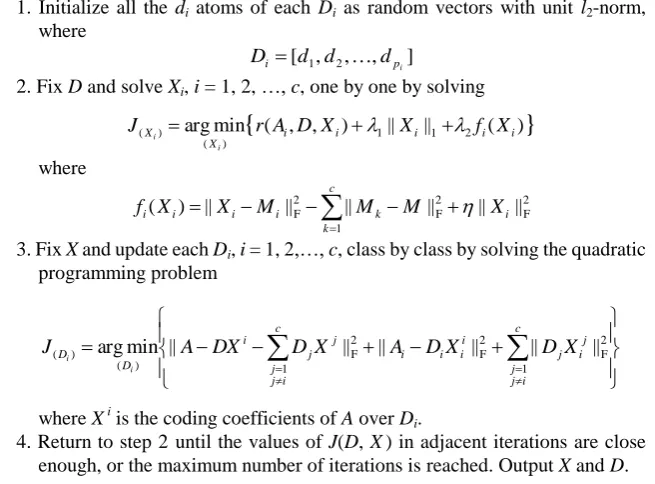
[image:2.595.132.460.466.708.2]The procedures of FDDL are summarized in Table 1.
Table 1. The FDDL Algorithm
1. Initialize all the di atoms of each Di as random vectors with unit l2-norm,
where
] , , ,
[ 1 2 pi
i d d d
D
2. Fix D and solve Xi, i = 1, 2, …, c, one by one by solving
}
{ ( , , ) || || ( )
min
arg 1 1 2
) ( )
( i i i i i
X
X r A D X X f X
J
i
i
where 2 F 1 2 F 2
F || || || ||
|| || ) ( i c k k i i i
i X X M M M X
f
3. Fix X and update each Di, i = 1, 2,…, c, class by class by solving the quadratic
programming problem
c i j j j i j i i i i c i j j j j i DD A DX D X A DX D X
J i i 1 2 F 2 F 2 F 1 ) ( )
( argmin || || || || || ||
where X iis the coding coefficients of A over Di.
4. Return to step 2 until the values of J(D, X) in adjacent iterations are close enough, or the maximum number of iterations is reached. Output X and D.
The Simplified FDDL Model
Fisher determination dictionary learning has shown to be effective in image classification. However, it is a little complex to solve the original FDDL model in (2). To address this issue, Yang et al. proposed a simplified method (SFDDL) in [6]: In discriminative fidelity term (3), considering that j
i
the representation of Ai over sub-dictionary Dj, should be very small for ji, the collaborative penalty
merges into discriminative penalty by explicitly assuming j
i
X = 0 for ji, and complementary penalty
is also ignored. Thus, the original FDDL model (2) can be reduced into a much simpler problem:
n d
X f X X
D A
J c ii ii n
i
i i i i X
D X
D argmin
1 || || 1|| ||1 ( ) , s.t. || ||2 1, 2 F )
, ( ) ,
(
{
}
. (5)where
2 F 3
2 F
2 || || || ||
)
(Xii Xii Mii Xii
f . (6) Obviously, the simplified model (5) reduces the number of variables, and then decreases computational complexity. However, the simplified model just reduces the within class variation to enhance the discrimination capability, not fully considers the role of complementary representation of
Ai over the sub-dictionary Dj. This thus results in an unstable performance for face recognition (see
Table 5 in [6]).
From the proof in [6], it is generally known that
2 F 2
F || ||
||
||AiDXi AiDiXii . (7) with the constraint that j
i
X = 0 for ji. Thus, when minimizing the complementary penalty, i.e.
jij i
jX
D ||2F ||
min . (8)
we might as well think that
2 F 2
F || ||
||
||AiDXi Ai DiXii . (9)
Consequently, apart from merging 2
F
|| ||AiDXi and
2 F
|| || i
i i i DX
A into a discriminative penalty, we
may also consider the role of complementary reconstruction in a way. Motivated by the above discussions, we propose a new simplified model (NSFDDL) as follow:
n d
X f X
X D A r
J c n
i i i
X D X
D argmin
1 s( , , ) 1|| ||1 2 ( ) , s.t. || ||21, ) , ( ) ,
(
{
}
. (10)where
c
i j j
j i j i
i i i i
i D X A D X D X
A r
1
2 F 2
F
s( , , ) || || || || . (11)
Compared with the SFDDL model (5), the NSFDDL model (10) does not explicitly assume that j
i
X
= 0 for ji. It regards collaborative penalty approximately as discriminative penalty, and retains the complementary penalty so as to enhance both the discriminative information in the reconstruction and sparse representations.
Optimization of NSFDDL Model
Similar to the optimization of FDDL, the objective function in NSFDDL model (10) can be divided into two sub-problems: updating X by fixing D, and updating D by fixing X. The procedures of NSFDDL are summarized in Table 2.
Since NSFDDL model (10) is the particular case of FDDL model, the two alternative optimizations in it are both convex, that is that the proposed NSFDDL algorithm converges.
1 2
2 || ||
|| ||
min arg
ˆ
{
y D . (12)
and the residuals ri corresponding to class i, which will then be used for the query sample
classification, is defined as
2 2 2
2 || ˆ ||
|| ˆ
|| i i i
i y D w m
r . (13) where and w are constants.
Table 2. The NSFDDL Algorithm
1. Initialize all the di atoms of each Di as random vectors with unit l2-norm,
where
] , , , [ 1 2
i p
i d d d
D
2. Fix D and solve Xi, i = 1, 2, …, c, one by one by solving
}
{ ( , , ) || || ( )
min
arg s 1 1 2
) ( )
( i i i i i
X
X r A D X X f X
J
i
i
with the method presented in [5].
3. Fix X and update each Di, i = 1, 2,…, c, class by class by solving the quadratic
programming problem
c
i j j
j i j i
i i i D
D A DX DX
J
i i
1
2 F 2
F )
( )
( argmin || || || ||
where j i
X is the coding coefficient of Aiover the sub-dictionary Dj.
4. Return to step 2 until the values of J(D, X) in adjacent iterations are close enough, or the maximum number of iterations is reached. Output X and D.
Face Recognition
To evaluate the performance of the proposed algorithm, we conduct a set of comparisons with FDDL and SFDDL. All algorithms were implemented in Matlab R2008b on a CPU 3.40GHz PC machine with 3.23G Memory. In order to reduce the experimental error, every experiment is repeated 15 times independently and the average recognition accuracy as the end results.
Experiments are performed on YALE, ORL and AR face database, respectively. For the convenience of comparison, all original images are resized into 165×120 pixels. The parameters of algorithms chosen by cross-validation are 1 = 0.005, 2 = 0.01, w = 0.0001.
The YALE database contains 165 face images of 15 individual, each with 11 images. The ORL database consists of 400 face images from 40 persons, 10 images per person. The AR database includes 2600 images from 100 humans, the 14 normal images per person (12 of the rest are disguised). Take the front half of images per person as training samples and the rest as testing. The comparison between three competing algorithms is shown in Table 3.
Table 3. Average Recognition Rate on Three Face Database.
Algorithms YALE database ORL database AR database
accuracy N accuracy N accuracy N
FDDL 0.988 5 0.930 5 0.935 7
SFDDL 0.988 5 0.915 5 0.911 7
NSFDDL 1.000 5 0.930 5 0.932 7
Where N is the number of training samples.
It can be observed from Table 3 that the effect of the NSFDDL is better than the SFDDL, and basically the same with FDDL. Again, the larger the face database, the stronger the ability of NSFDDL is compared with the SFDDL. This is because the function of complementary penalty in NSFDDL model is more powerful with the increase of the database capacity.
reduced, the performance of the NSFDDL is better than that of the SFDDL. However, the NSFDDL is unstable on some complex database such as AR, as shown in Table 6.
Table 4. Average Recognition Rate on the YALE. Table 5. Average Recognition Rate on the ORL.
Algorithms The number N of training samples Algorithms The number N of training samples
2 3 4 5 2 3 4 5
FDDL 0.859 0.933 0.971 0.988 FDDL 0.844 0.876 0.908 0.930
SFDDL 0.861 0.958 0.980 0.988 SFDDL 0.563 0.632 0.680 0.915
NSFDDL 0.874 0.941 0.980 1.000 NSFDDL 0.566 0.643 0.725 0.930
Table 6. Average Recognition Rate on the AR.
Algorithms The number N of training samples
2 3 4 5 6 7
FDDL 0.646 0.654 0.745 0.890 0.900 0.935 SFDDL 0.701 0.716 0.776 0.884 0.897 0.911 NSFDDL 0.678 0.713 0.740 0.885 0.899 0.932
Conclusion
Based on FDDL method, we present a new simplified model and corresponding optimization algorithm, which is suitable for face recognition. It aims to synchronously consider the computational complexity and the complementary penalty, so as to improve the recognition efficiency of existing algorithms. Both theoretical analysis and empirical experiments on benchmark face recognition database illustrate that the proposed mothod is effective and efficient.
Acknowledgements
This work has been supported by the Fundamental Research Funds for the Central Universities 3132016220.
References
[1] Wenyi Zhao, Rama Chellappa, Peter J. Phillips, Azriel Rosenfeld, Face Recognition: A Literature Survey, ACM Computing Surveys. 35(2003) 399-458.
[2] Cha Zhang, Zhengyou Zhang, A Survey of Recent Advances in Face Detection, Microsoft Research. Information on http://www.research.microsoft.com, 2010.
[3] David L. Donoho, Compressed sensing, IEEE Transactions on Information Theory. 52(2006) 1289-1306.
[4] Michael Elad, Sparse and Redundant Representations--From Theory to Applications in Signal and Image Processing, Springer Science+Business Media, New York, 2010.
[5] Meng Yang, Lei Zhang, Xiangchu Feng, David Zhang, Fisher Discrimination Dictionary Learning for Sparse Representation, Proceedings of the 2011 IEEE International Conference on Computer Vision. (2011) 543-550.