ONTOLOGICAL STAKEHOLDER VIEW: AN INNOVATIVE
PROPOSITION
1Jose-Luis Retolaza
Director at AURKILAN Business Ethics Research Institute. Spain. Senior Researcher at Applied Business Economics Institute [IEAE. UPV/EHU]
Email [email protected]
Leire San-Jose
(
Corresponding author)
Associate Professor at University of the Basque Country [UPV/EHU]. Bilbao-Spain. Visiting Research Fellow at University of Huddersfield. United Kingdom.
Email [email protected]
Maite Ruiz-Roqueñi
Associate Professor at University of the Basque Country [UPV/EHU]. Bilbao-Spain. Email [email protected]
1
ABSTRACT
This paper describes a theoretical way of understanding business enterprise, for what it is used the stakeholder theory as a theory of the firm. Thus, the purpose of this article is to show an innovative perspective called ontological perspective of stakeholders that relies on a phenomenological model where the subjective perspective of agents is the key, from a purely monetarist model to an economic, social and emotional value creation model, and thirdly from a deductive model of stakeholder interests to an inductive model. The main contributions are: add a new perspective to the different classifications made of stakeholder theory, avoid monetarist reductionism under the concept of value in a way that the manager takes into account all interconnected interests of stakeholders, and finally prioritize interests map instead of roles map without accepting the assumption that the role involves joint and no conflicting interests.
KEY WORDS: Innovation, Stakeholder Map, Stakeholder Approach, Business Ethics,
Stakeholder Theory, Management Model, Strategy.
JEL: D21 - Firm Behaviour: Theory.
M21 - Business Economics.
ONTOLOGICAL STAKEHOLDER VIEW: AN INNOVATIVE PROPOSITION
INTRODUCTION
Innovation has become a catchword within business studies and has stimulated a significant flow of research. Notwithstanding, and despite the broad conceptualisation of the concept expressed in the “Innovation White-Paper” (Davis, 2008) which has acted as one of the references for developments in this area and for support from institutional bodies, most actions within the sphere of innovation have focused on the fields of technology and production, leaving the organisational aspect relatively far behind. This has not been the case with research, where the first works already concentrated on the capacity of an organisation to respond and adapt to external and / or internal changes (Burns & Stalker, 1961; Hull & Hage, 1982). In the second phase stress was laid on the development of capacities to promote innovation in processes and products, regardless of any immediate need for change (Kanter, 1983). Hamel (2003) & Theilen (2002) works are centred on the need for organisations to proactively tackle future challenges through the incorporation of innovation in businesses themselves.
However, in this line many authors (Mintzberg, 1979, Mintzberg, et al., 1998; Hamel, 2003) have been relatively conservative to launch or support innovative changes into management of companies, steering clear of proposing such changes within the actual company concept. It is because they perceive the company as a capital-centred organisation, which structures its administration in line with capital property rights.
Property Rights Theory (Williamson, 1963; Alchian & Kessel, 1962; Alchian & Demsetz, 1972; Furubotn & Pejovich, 1972) within the context of strategic management (Coase, 1937). Stakeholder theory provides strong arguments against the traditional view of business which asserts that the sole goal of the corporation is to maximize profits, and therefore is critical about the mission of the company about the obtainment of more capital and on the legitimate right to manage the business only by capital owners. In other words, this conception of the firm found the capital as the key factor in value generation and as the only party to take on a company’s residual risk, furnishing only the shareholders with the legitimate right to participate in the governance of the company (San-Jose & Retolaza, 2012). The Stakeholder Theory, in its most broadly way (Mitchell et al., 1997, pp. 856–863) against the traditional view of business, questions this conception of the firm, standing as an innovative alternative paradigm. It is evident that value is produced by the whole set of stakeholders through processes (Asher et al., 2005), for instance, such as work, intellectual capital, knowledge management, or suppliers integration, therefore the participants in the creation of this value should logically also take part in managing it. The main argument against this formulation has tended to be that marginal risk on capital is undertaken exclusively by the shareholders; nonetheless, it is undertaken that all stakeholders assume residual risks in cases of inefficient management.
roles for maps of stakeholder interests. The reasoning is concerning that developed stakeholders map which key is the role are logical and easy to create, while impossible to be used in the strategic management of the company.
In this regard, our innovative proposition is of a dual nature: on the one hand, we understand the Stakeholder Theory in its ontological view as an innovation, which substantially modifies the company concept not only within internal ideas but also with external ones; and, on the other hand, we consider that there are three characteristics of the proposed model, which would make it possible to efficiently develop concrete management methodologies to enable a genuine applicability of the Stakeholder Theory to companies. Then, the theoretical contribution is significant regardless normative or merely instrumental perspective is chosen. Subsequently, this model will contribute to the applicability of the stakeholder theory to engage companies make more than a sustainability or corporate social responsibility report because their barriers in terms of transparency or knowledge of reporting between all stakeholders (Gupta, 2012). It will be possible to change the mind about how to apply the management to all stakeholders without fundament into capital-based organization; but taking into consideration the interest of them more than the roles.
REVIEW OF LITERATURE: THE STAKEHOLDER THEORY
The understanding of the Stakeholder Theory comes from the explanation with other linked theories of the firm. Then, Stakeholder Theory (Freeman, 1984) could be explained from different points of view; but the most important theories relate to this form to create value in a company into Business Management are three: Property Right Theory, Contract Theory and Agency Theory.
The Property Right Theory (Williamson, 1963; Alchian & Kessel, 1962; Alchian & Demsetz, 1972; Furubotn & Pejovich, 1972) considers generally that ownership of the company (where ownership is seen in terms of the organisation's capital) generates two exclusive rights, the right to obtain the profit generated by the company's business and the right to decision-making (Furubotn & Pejovich, 1972). The first right is based on an identification of the company with its capital, i.e., the owner of the capital is the owner of the company, and therefore, the only party that has rights over the company's profits (Segrestin & Hastchuel, 2011). The second right is based on the first one with the inclusion of the risk factor. Shareholders receive a variable yield depending on the company's performance, and that performance is affected by the way the company is managed (Berman et al., 1999; Sinha, 2006). The other participants in the company - workers, suppliers, customers and others-, will receive a profit or payment agreed upon in accordance with Contract Theory.
directly the company, but through managers to whom they delegate the running of the companies. This is where Agency Theory comes into play, postulating as it does that managers, simply run the company through the delegation of the owners; it may therefore be inferred that the agents' responsibility is to optimise the interests of the principals (Jensen, 2008).
All this review of literature leads us to conclude that because ownership is diffuse into the explanation of Stakeholder Theory, the property rights and moral agency of owners are increasingly irrelevant; what means that the way for further legitimating the claims of stakeholders against those of owners. Apart of legitimating the claims of stakeholders the discussion focused on the lack of applicability of this theory has started in the last years (Agle et al., 2008), because apart of the legitimate right of stakeholders it should necessary to explain how to apply the theory into practice, or at least establish theoretically how it will be possible. The problems to companies to practice it within part of strategy management of companies are previously analyzed (Agle et al., 2008) with doubtful results and lack of an open process to managing all of the stakeholders.
value, neither for distribution of incomes (Chesbrough et al. 2008). This idea leads to establish non-contractual commitments with all stakeholders with the aim to add value into the innovation process (Gould, 2012). Thus, that innovation is promoted as a process that goes all the way, from information over new technologies to social change that improves the management of the company taking into consideration all of the stakeholders (Gould, 2012).
STAKEHOLDER THEORY BASED ON INTERESTS: THE
CHARACTERISTICS OF THE PROPOSED ONTOLOGICAL STAKEHOLDER
VIEW
There is a general opposition between the rights of a firm's shareholders and the rights of the other stakeholders. The conflict arises between shareholders and other stakeholders over the appropriation of earnings (Freeman, 1984), which may be solved in two possible ways: instrumental and normative (Donaldson & Preston, 1995). In the instrumental solution the appropriation of earnings by the stakeholders results in an improvement in the receipt of income by shareholders. In the normative solution, the rights of all the stakeholders are inherent with the stakeholders themselves (i.e. they are inherent rights, acquired by the mere fact of being stakeholders), and must be respected regardless of the benefit or harm that may be caused to the shareholders.
the Aristotelian Academy in which Ontology is designated as the science that studies the nature of things, it seems appropriate to call to the view that we propose here Ontological Perspective View of Stakeholder Theory of the firm, because it explains properly what is the nature of the firm. This form to understand the firm has modified, not only the social nature of the company, but also the fundamental understanding of the relations between its components.
Considering that the Stakeholder Theory does not consist in an opposition between the stakeholders and shareholders, but in the opposition of two different conceptions of the company, one linked essentially to capital, and the other linked to the value of the intangible assets; this paper defend the existence of other form to explain the firm using the Ontological Stakeholder view.
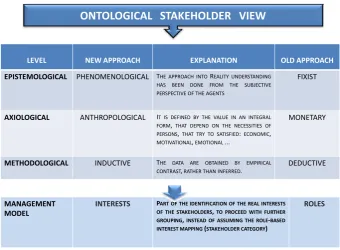
This ontological stakeholder view redefines the firm and highlights the “being” of the company as regards it reflect the concept of the mean of the firm. This view carries out a management model that introduce the interests themselves; them instead of a stakeholder-role based map it is show the interests-based map management model; at least theoretically that permit the applicability of the management for all the stakeholders; principally because of the reductionism of the interests of the stakeholders. This ontological stakeholder view takes into consideration three characteristics that are essential for developing (See Table 1):
1. From a shareholder-centred perspective or fixist approach to the epistemological level with basic is the phenomenon, in a business management focus “being” of the company.
3. From a deductive logic, based on the role of the stakeholders, to an inductive logic, that groups stakeholders on the basis of their specific interests.
LEVEL NEW APPROACH EXPLANATION OLD APPROACH
EPISTEMOLOGICAL PHENOMENOLOGICAL THE APPROACH INTOREALITY UNDERSTANDING HAS BEEN DONE FROM THE SUBJECTIVE PERSPECTIVE OF THE AGENTS
FIXIST
AXIOLOGICAL ANTHROPOLOGICAL IT IS DEFINED BY THE VALUE IN AN INTEGRAL
FORM,THAT DEPEND ON THE NECESSITIES OF PERSONS,THAT TRY TO SATISFIED:ECONOMIC,
MOTIVATIONAL,EMOTIONAL...
MONETARY
METHODOLOGICAL INDUCTIVE THE DATA ARE OBTAINED BY EMPIRICAL
CONTRAST,RATHER THAN INFERRED.
DEDUCTIVE
ONTOLOGICAL STAKEHOLDER VIEW
MANAGEMENT
MODEL
INTERESTS PART OF THE IDENTIFICATION OF THE REAL INTERESTS OF THE STAKEHOLDERS,TO PROCEED WITH FURTHER GROUPING,INSTEAD OF ASSUMING THE ROLE‐BASED INTEREST MAPPING(STAKEHOLDER CATEGORY)
[image:10.595.145.486.138.388.2]ROLES
Table 1. Ontological Stakeholder view: from old to new approach.
Bellow is explained the nexus from old to new approach, and in the next section into the Discussion is explain the reasons of the specific methodology that make possible the incorporation of all stakeholders interests to the objectives of companies.
1. Phenomenological approach of stakeholder theory into epistemological
level: the participation into companies.
governance. This participation can be seen as the Okham's Razor in the acceptance of stakeholders’ rights. As for the second issue, there are a number of interpretations, ranging from the most instrumental to the most altruistic extremes2, based on how a “stakeholder” is defined. In the most restricted version, there are different stakeholders as: pressure groups, groups of affected persons, or non-stakeholders. To sum up these groups it will be necessary to identify factors and processes that make it possible to advance towards the social pole, increasing the scope of stakeholder beneficiaries and, symmetrically, promoting their participation in governance (Retolaza & San-Jose, 2011). In this regard the study of mechanisms and processes for the integration of the different stakeholders in governance stands as an important challenge for the future that should consider not only the stakeholders in their natural and narrow way, but also the pressure groups, omitted stakeholders (non-stakeholders) and group of affected; although it will be very complex and difficult to perform.
2. Anthropological perspective of value: satisfaction of varied and personal
interests
From a classic perspective, value creation is identified with the generation of income; the monetarization of earnings limits the production of value, turning value into a limited good. The appropriation of a limited and desirable good leads to a conflict over the appropriation of earnings, which beings the agents involved — shareholders, workers, suppliers, customers, etc. — into conflict. The result of the distribution will depend on the established relations of power (Porter, 1985; Mintzberg, 1983), with the
2
expected consequence of the resolution of the conflict being a situation of optimal efficiency.
Accepting that real conflicts exist regarding appropriation of earnings in the company, stakeholder theory goes further, basing itself on two principles. The first principle states that the value produced is not equal to the earnings, but to the satisfaction of interests. The second principle refers to the interactive capacity of the stakeholders in the creation of value. This interaction among stakeholders will be positive and is based on a search for the other party's interests, generating an unlimited flow of value that is much greater than the monetary value of the contractual relationship between the parties.
In axiological level, in contrast to the monetary approach of value which identifies the value only with money is questioned, and the anthropological approach is extended with the aim to consider not only economic and financial issues, but also motivation, emotional and social points of value. Value is defined by the importance given to it by the receiver; normally relational norms exist in the reception of material goods, whereby it is possible to award these goods a monetary value. However, in the case of the reception of immaterial goods, there is no norm for transformation to monetary value, and as a result the value is that which the receiver attributes to it, independently of the value that may be attributed to it by other people and of the production value.
sufficient mean in relation to the surroundings, people dramatically reduce the value of these goods, and transfer that value to the satisfaction of other immaterial or spiritual needs such as factors related to safety, membership, recognition or self-fulfilment (Maslow, 1943). In this non-restrictive perspective, the potential for value generation is unlimited.
Complementarily, the generation of this type of value among various stakeholders may be additive rather than subtractive. The satisfaction of the stakeholders' interest around the anthropological consideration of the value concept leads to a new approach in which it is possible to transcend the conflict over appropriation; given that what is involved is an unlimited generation of value, there, can be a complementary non-conflicting appropriation.
3. Inductive perspective of interest: from grouping by roles to grouping by
common interests
This approach, from deductive to inductive, has centralized around the applicability problem of stakeholder theory (Agle et al., 2008). Different authors (Freeman et al., 2008; Agle et al., 2008) have tried to respond this problem without yielding the expected results. But, the problem of applicability is inherent to the form in which Stakeholder Theory itself has been developed; the justification of the initial approach has led to a deductive formulation of the theory. Given that classic business approaches have been shareholder-oriented, Stakeholder Theory extends the number of stakeholders, but does not alter the way their nature is interpreted. In other words, the stakeholders are actually defined by the role they perform in the company, with a-critical acceptance of the assumption that the role defines the interest, and that therefore, in general terms at least; those individuals who perform the same role in the company are going to have certain similar interests.
However, in the real world of the company, we find that among the different stakeholders there are different and even opposing interests; for example, one only has to look at the many intra-stakeholder conflicts that commonly arise in companies. Conflicts between shareholders over the strategy the company should adopt; conflicts between the workers, as manifested in their different stances when a strike is called; differences of interests, and even competitive relations, among suppliers, different interests among customers with regard to the price-quality binomial; and even conflicts at the heart of a community in the case of two opposing values, such as employment and pollution.
etc., does not resolve the problem, since in each of these sub-groups there again appears the same diversity of interests, requiring a new division and leading ultimately to an indefinite regression which in the case of large companies can come riskily close to infinity. Perhaps it might be possible to apply this approach in the case of small companies or companies in the process of being set up, given the small number of individuals involved (Retolaza et al., 2009), but in large corporations it is not viable.
Alternatively, we propose an inductive approach to the identification of stakeholders' interests that sees these interests not as being defined by their role, but as a grouping of real individual interests (stake-person). In this perspective, it would be necessary to focus on the particular interests of each person, so that they could subsequently be grouped into groups of real interests (stake-clusters). It is true that this approach assumes that the variability of people's private interests can be synthesised in a limited, and therefore manageable, set; however this approach appears to be accepted in marketing, which ultimately seeks to integrate the different private interests of clients possibly one of the groups with the most dispersed interests. The development of a methodology that will enable individual interests to be identified, grouped and subsequently incorporated into company management systems is an outstanding challenge in the application of Stakeholder Theory.
answerable to any specific stakeholder for its actions. In practice, if not in law, the agent becomes a principal; and its actions become uncontrollable.
Nonetheless, if the inductive model makes it possible to develop a methodology for identifying and grouping interests that will make it easier to create objectives for them and to include them in the targets of the annual management plan, then it would allow control over the agent's performance in satisfying these interests, regardless of whether the control is exercised only by the shareholders or by the stakeholders as a whole.
4. Management model from roles to interests: the application results
Regardless of the reasoning process, the stakeholder grouping according to their real interests and the role has a number of advantages in strategic management.
1. Facilitates the alignment of interests and objectives, reducing conflicts between different interest groups, and the transaction costs associated with them.
2. In companies with relative alignment of interests, the number of significant stakeholders will be significantly reduced, which makes it easier to try to satisfy them. In companies where the interests are not aligned, the result in number of interest groups will never be higher than that obtained with the classical methodology.
4. The increase in satisfaction of stakeholders entails, in most cases, an increase in its value contribution, which will result in increased value generation by the organization.
CONCLUSIONS, LIMITATIONS AND FUTURE RESEARCH LINES
This paper provides an in-depth description of the most important approaches that characterized the ontological stakeholder view. This view of the stakeholder perspective is founded by three main approaches: phenomenological, anthropological and inductive from epistemological, axiological and methodological level, respectively. Then, this theoretical paper supported by their approaches reinforce the roots of an innovative understanding of the theory of the firm that involve the stakeholders´ interests as a whole considerable into the management and strategy of companies to achieve the common good of all of them.
interested in the same issues, private and public clients have the same form to be satisfied or countryside and abroad suppliers have the same concerns.
This paper involves the developing a functional model of applicability into innovation, which can be used systematically to incorporate the satisfaction of stakeholders' interests as a company target into the usual management systems (strategy plan, balanced scorecard and annual management plan, for example). This being so, and taking into consideration the stakeholder theory as a theory of the firm; to apply this theory into companies it is necessary to purpose stakeholders´ interests instead the stakeholders´ role map as there has been doing the last years. Moreover, the ontological stakeholder view explained in this paper allows forming a new paradigm for understanding the company and its relations with people and society.
The main limitation of this work is that we have studied and developed the ontological stakeholder view from a theoretical view based on the theory of the firm. The robustness of this view is based on the possibility that it brings to obtain some empirical results and company development, that theoretically at least, will results into the improvement of companies' performance, not only financial ones, but also social; caused because of the application of this management model.
Moreover, the methodological tool within this management model that integrated the interest of stakeholders without being conditioned by the role assigned to each stakeholder has not already been developed; even though the balanced scorecard, with slight modifications (for example the inclusion of a higher perspective of “Stakeholder interests”) seems an optimal methodology for addressing this integration.
managers and directors the identification and management of stakeholder interests. It would also be desirable to the study of the relationship between the stakeholder orientation and organizational performance. Finally, a future possible research line will be the development of useful and practical management tools that incorporate the stakeholders' interests instead of roles within the ontological stakeholder view, such as the development of the Balanced Scorecard.
REFERENCES
Agle, B. R.; Donaldson, T.; Freeman, R.E.; Jensen, M.C.; Mitchell, R.K. & Wood, D. (2008). “Dialogue: Toward Superior Stakeholder Theory”, Business Ethics Quarterly 18(12): 153-190.
Alchian, A. & Demsetz, H. (1972). “Production, information costs, and economic organization”, American Economic Review 62: 777-795.
Alchian, A. & Kessel, R. A. (1962). Competition, monopoly, and the pursuit of money. In H. G. Lewis (ed.). Aspects of Labor Economics. Princeton: Princeton University Press, pp. 157-183.
Asher, C.C., J.M. Mahoney & Mahoney, J.T. (2005). “Towards a property rights foundation for a stakeholder theory of the firm”, Journal of Management and Governance 9: 5-32.
Berman, S. L., Wicks, A. C., Kotha, S. & Jones, T. M. (1999). “Does Stakeholder Orientation Matter? The Relationship between Stakeholder Management Models and Firm Financial Performance”, Academy of Management Journal 42(5): 488– 506.
Carney, M., Gedajlovic, E. & Sur, S. (2011). “Corporate governance and stakeholder conflict”, Journal of Management & Governance, 15(3): 483-507.
Chesbrough, H. (2003). Open Innovation: The New Imperative for Creating and Profiting from Technology. Boston, MA: Harvard Business School Press.
Chesbrough, H., Vanhaverbeke, W. & West, J. (2008). Open innovation: Researching a new Paradigm. New York: Oxford University Press.
Coase, R. M. (1937). “The Nature of the Firm”, Ecomica, New Series 4(1): 386-405. Davis, P. (2008): Innovation White-Paper. New York: Scanlon Leadership Network. Donaldson, T. & Preston, L. E. (1995). “The Stakeholder Theory of the Corporation:
Concepts, Evidence, and Implications”, Academy of management Review 20(1): 65-91.
Freeman, R.E. (1984). Strategic management: A Stakeholder Approach. Pitman: Boston, 2nd edition, 2010.
Freeman, R.E. (1994). “The politics of stakeholder theory: some future directions”,
Business Ethics Quarterly 4(4): 409-421.
Freeman, R.E.; Harrison, J.S. & Wicks, A. (2008). Managing for Stakeholders: Survival, Reputation, and Success. New Haven, [Conn.]: Yale University Press. Freeman, R.E.; Retolaza, J.L.; San-Jose, L. & Canales, F. (2012) La aplicabilidad de la
teoría de los stakeholders: el caso Etxanobe, Working Paper Instituto de Economía Aplicada a la Empresa, disponible en: www.ieae.es.
Friedman, M. (1962). Capitalism and Freedom. Chicago: University of Chicago Press. Furubotn, E. G. & Pejovich, S. (1972) “Property rights and economic theory: a survey
of recent literature”, Journal of Economic Literature 10:1137-1162.
Gould, R.W. (2012). “Open innovation and Stakeholder Engagement”, Journal of Technology, Management and Innovation 7(3): 1-11.
Gupta, A.D. (2012). “Corporate social responsibility and strategy: A bird’s eye view”,
Global Business Review 13(1), 153-165.
Hamel, G. (2003). Leading the Revolution: How to thrive in turbulent times by making innovation a way of life. Boston: Harvard Business School Press.
Herzberg, F. (1976). The managerial choice: to be efficient and to be human.
Homewood, Illinois: Dow-Jones Irwin.
Hull, F. & Hage, J. (1982). “Organizing for innovation: beyond Burns and Stalker’s organic type”, Sociology (November): 564-577.
Jensen, M. & Meckling, W. (1976). “Theory of the firm: Managerial behaviour, agency costs, and ownership structure”, Journal of Financial Economics 3: 305-360. Jensen, M. C. (2002). “Value Maximization, Stakeholder Theory, and the Corporate
Objective Function”, Business Ethics Quarterly 12(3): 235-256.
Jensen, M. C. (2008). “Non-Rational Behaviour, Value Conflicts, Stakeholder Theory, and Firm Behaviour”, Business Ethics Quarterly 18(2): 167-171.
Kanter, R.M. (1983). The Change Masters. New York: Simon & Schuster.
Kim, J. & Mahoney, J.T. (2005). “Property Rights Theory, Transaction Costs Theory, and Agency Theory: An organizational economics approach to strategy management”, Managerial and Decision Economics 26: 223-242.
Maslow, A. (1943). “A theory of human motivation”, Psychological Review 50: 370-396.
Mintzberg, H. (1979). The Structuring of Organization. Englewood Cliffs, N.J.: Prentice Hall.
Mintzberg, H. (1983). Power in and Around Organisations. Englwood Cliffs, NJ: Prentice Hall.
Mintzberg, H., Ahlstrand, B., & Lampel, J. (1998). Strategy Safari. The Free Press, New York. [Traducción al castellano: Safari a la Estrategia. Buenos Aires, 1999: Granica.]
Mitchell, R.K., Agle, B.R. & Wood, D. J. (1997). “Toward a theory of stakeholder identification and salience: Defining the principle of who and what really counts”, Academy of Management Review 22(4), 853-886.
Neron, P.Y. & Norman, W. (2008). “Citizenship, Inc.: Do we Really Want Businesses to Be Good Corporate Citizens?”, Business Ethics Quarterly 18(1): 1-26.
Pfeffer, J. (1994). Competitive advantage through people. Boston: Harvard Business School Press.
Porter, M. (1985). Competitive Advantage: Creating and Sustaining Superior Performance. Chicago: Free Press.
Retolaza, J.L. & San-Jose, L. (2011). “Social economy and stakeholder theory, an integrative framework for socialization of the capitalism”, CIRIEC-España, Revista de Economía Pública, Social y Cooperativa 73 (Special Issue): 193-211. Retolaza, J.L., Ruiz, M. & San-Jose, L. (2009). “CSR in business start-ups: an
application method for stakeholder engagement”, Corporate Social Responsibility and Environmental Management 16(6): 324-336.
Segrestin, B. & Hatchuel, A. (2011). “Beyond Agency Theory, a Post-Crisis View of Corporate Law”, British Journal of Management 22(3): 484-499.
Sinha, R. (2006). “Corporate Governance and Shareholder Value Analysis”, Global Business Review 7(1): pp. 1-16.
Williamson, O. E. (1963). “Managerial discretion and business behaviour”, American Economic Review 53: 1032-1057.
Wolfe, R.A. & Putler, D.S. (2002). “How Tight Are the Ties that Bind Stakeholder Groups?”, Organization Science 13(1): 64-80.
Acknowledgements