University of Huddersfield Repository
Taylor, Andrew and Varley, Rosemary
Embodiment in 3D virtual retail environments: Evolving the perceptions of collaborative art and design research as avatars
Original Citation
Taylor, Andrew and Varley, Rosemary (2008) Embodiment in 3D virtual retail environments: Evolving the perceptions of collaborative art and design research as avatars. In: ReLIVE 08: Researching Learning in Virtual Environments, 20th 21st November 2008, Open University, Milton Keynes, UK.
This version is available at http://eprints.hud.ac.uk/id/eprint/7452/
The University Repository is a digital collection of the research output of the University, available on Open Access. Copyright and Moral Rights for the items on this site are retained by the individual author and/or other copyright owners. Users may access full items free of charge; copies of full text items generally can be reproduced, displayed or performed and given to third parties in any format or medium for personal research or study, educational or notforprofit purposes without prior permission or charge, provided:
• The authors, title and full bibliographic details is credited in any copy; • A hyperlink and/or URL is included for the original metadata page; and • The content is not changed in any way.
For more information, including our policy and submission procedure, please contact the Repository Team at: [email protected].
Embodiment in 3D virtual retail environments: Evolving the
perceptions of collaborative art and design research as avatars.
Andrew Taylor and Rosemary Varley
Keywords: Second Life, collaboration, design, retail, education.
Abstract:
Being a fashion design lecturer and a fashion retail marketing lecturer, we were, until recently working on the same courses, in the same open plan office. Academically we had also been distinctly, yet independently aware of the debate surrounding the hyper un-realistic and non-sensory interface of online 2D shopping for clothes spanning the last decade. Until the advent of Web 2.0 interactivity, the customer’s inability to actualise, and communicate with both the product and the brand had been the main inhibitor to online shopping.
Following a paper presented to the subject area research forum about 3D fashion design research in Second Life. The authors met and chatted for the first time over coffee. We discussed the cultural and digital convergence happening within design and retail business. We acknowledged that in our polarised module delivery of design/retail content on the supply chain, we were missing out on the opportunity of teleporting into online 3D virtual worlds to do new research as a team.
Introduction
This paper reports on an exploratory research investigation that has grown out of a rare collaboration between a design academic and a retail marketing academic in the Design Business subject area, (Design Business was recently devolved in July 2008 and merged into a broader school profile of Fashion and textiles courses in the Department of Design) of the School of Art, Design & Architecture at the University of Huddersfield. The central focus of this paper is the
investigative study of fashion brands in the online 3D virtual environment Second Life for teaching and learning development. However, it is the evolving design and retail collaboration between the two academics that is emphasised as guiding this process throughout the paper.
The Design Business subject area had previously provided a suite of courses offering business orientated courses within the School: BA (Hons) Fashion & Textiles Buying/ Management/Retailing; BA (Hons) Fashion, Media and Promotion and BA (Hons) Advertising Media Design Management. Earlier research papers on 3D virtual environments (Taylor and Unver 2007, Unver and Taylor 2007) had been presented to the Design Business subject academic team resulting in a fruitful discussion of the potential value of using this environment for teaching and learning in Fashion & Textiles Buying, Management, Retail and Fashion Media and Promotion. The research collaboration began because we believed there was in particular, a real need to investigate the phenomenon of increasing retail presence of fashion brands in Second Life, both for teaching and learning input and design business pedagogic development.
The focus of this paper is an evaluation of using an avatar, as a virtual customer to experience shopping in mainstream fashion brands within the online 3D virtual environment Second Life. The recent proliferation of research on virtual fashion design and online retail presence compelled us to immerse our physical selves and investigate online shopping in Second Life, through the experience of being avatars. Adopting an experiential, exploratory and fun attitude to our research, we teleported into window shopping and browsing at the virtual 3D stores of fashion brands in Second Life during typical UK prime time Saturday afternoon shopping and buying hours.
A definition of a virtual body: the avatar as a collaborative tool
The word avatar has several meanings which require clarification; originally, it is an ancient Sanskrit word Avatara meaning "the descent of God" or simply
visual on-screen in-game persona which could also be customized in appearance. (Wikipedia, 2008)
As a potential tool for collaboration and communication, the avatar is an instrument of user-expression and individuality. The more it can reveal the intentions, emotions, and thoughts of a user, the more powerful it is. (Ventrella, 2005) Avatars are now widely accepted as the virtual extensions of ourselves, and this has resulted in a population boom of avatars. On attending the ‘Virtual Worlds conference 2007’ Breck, (2008) was apparently shocked to learn that there are more avatars in web space than there are people in the USA.
Avatars are widely available to acquire or purchase from numerous online brands and we, the consumer are avidly encouraged to create and populate virtual spaces with them. At the start of the collaborative strategies team blog, Coleman (2006) states that,
“Those 15-25 year olds that every online marketer seems to be targeting in the consumer space are a generation that grew up with computers. This generation is willing to spend real money on ring tones, wallpaper (almost a billion dollars in 2005) and now avatars.” (Coleman, 2006)
Humans living, working, playing and shopping in Second Life interact with each other through their fully three dimensional motional avatars, although in Second Life avatars are often referred to colloquially as “residents”. Residents or avatars can explore, meet other residents, socialize, participate in individual and group activities, create and trade items such as virtual property or services from one another. Experimentation with all aspects of fashion and identity are especially popular lifestyle choices in Second Life, as Harkin attests to in the Los Angeles Times (2007),
"Second Life allows you to be a celebrity in your own lunchtime …you can design the body you've always wanted, and indulge your fashionista fetish for very little money. You can be the most attractive, best-dressed version of yourself you can imagine."
Background
In the expanding, and increasingly competitive metaverse of online 3D virtual worlds Second Life is no longer the big name on the style conscious avatar’s virtual lips. Brave new and some not-so-new virtual worlds such as Activeworlds, There, Google’s Lively, Sony Playstation’s Home, Kaneva, China's HiPiHi,
‘Virtual retailing’ is a buzz-word of the moment in retail marketing. But what exactly is it describing? In basic introductory terms, KZero (2007) define virtual retailing as “using a digital virtual environment to facilitate and create a
purchase”. There is, however, clearly far more to the evolving virtual retail phenomenon than meets the eye, as we found out by immersing our real selves into a Saturday afternoon virtual shopping research strategy. We chose Second Life because ongoing online, and journal research led us to believe that fashion brands were developing new approaches to merchandising, and we felt much pedagogic value could be derived from documenting how physical human experiences are being simulated by the mainstream brand fashion retailers setting out their virtual stalls.
Physical or virtual: blurred boundaries between worlds
The alchemic mix of the anticipation, the magazine flicking, the window shopping beforehand, the journey into the city, on arrival the atmospherics within and around stores, interacting with other customers/ retail personnel, trying on and sampling products have always been the sartorial narcotic that fuels the
shopping addiction for the physical retail environment.
The communication and interaction between retailer and consumer in both virtual and physical worlds are changing and becoming more flexible; merging visual data through the promise of wider, faster bandwidths, Web 2.0 and soon 3.0, integrated 2D and 3D technologies and increased public fluency in programming language.
How you look and what you wear is űber-essential to every fashion conscious person and your avatar is no exception, in whatever choice of virtual worlds you immerse yourself into. Fashion brands are making the transition from the real world to simulated environment as consumer interest in dressing and styling their avatar becomes more frantic in online 3D virtual worlds. It is Second Life
however, that has the widest and most diverse range of fashion brands at the moment.
The presence of high profile brands is an indication that retailers consider
branded virtual space as a strategic option worth exploring, as the investment of resources to set up the land and buildings in Second Life is not inconsiderable. This development is interesting from a number of viewpoints, but the research question we found most compelling and relevant to the conference theme is the one concerning the direct relationship between the fashion company,
Methodology
The combined methodologies used during this study are descriptive observation (Robson, 2002) and exploratory experimental practice (Schön, 1987). Schön describes how the,
“Exploratory experiment is the probing, playful activity by which we get a feel for things. It succeeds when it leads to the discovery of something there.” (Schön, 1987)
The study of a new phenomenon in a new medium requires flexibility and creativity in research design, and so the research for this paper resulted in the compilation of narrative case study experiences from within virtual retail space as a avatar(s). This approach allowed the unexpected to be recorded and
eventualities to be pursued in a situation that was truly exploratory. For the purposes of this stage of the research we did not feel it was necessary to find and specifically interact with other visitors to the store we were visiting in Second Life; we were recording and observing the virtual experience as we encountered it. We therefore did not need to deal with the issues of validity and reliability of data being generated through carrying out research with avatars (World Advertising Research Centre WRAC, 2007). Likewise, at this initial stage no ethical issues were presented because our experiences were as ourselves, albeit as avatars.
New experiences: creating and testing a new avatar
Varley made a request to the University computing services team to enable download and installation of the Second Life software from www.secondlife.com. She created her avatar called Rosina Iwish and completed the basic tasks on Orientation island. The following Saturday afternoon both authors met in the University, sat in our separate offices, illustrated in Fig 1. and tried to use our separate PCs and struggled with the reality of the steep learning curve that stood in the way of our virtual shopping research. Immersion in the Second Life
environment requires the user to have an above standard graphics card on a PC and a skill level practice acquired through practice to navigate the interface and the avatar effectively. We had not anticipated the difficulties that we would encounter, both being relatively new to being inside virtual worlds. Limitations to be considered when approaching future research are:
• Above standard graphics card and fast processing speed on PC
• Limited gaming/virtual world skills put new avatars can be a disadvantage • Interface user know-how must be acquired through regular ‘in world’
activity.
• Sharing/networking of avatar location information through the inventory • Practice camera tools for viewing the avatars surroundings
Figure 1
Progress was very slow and we were limited in the time available. We made the decision to work together on one PC shown in Fig 1, using Taylor's Ay Taov avatar; Taylor operated the avatar and Varley recorded the sequences, steps, and processes of finding and accessing the stores, and documented our initial customer perceptions. Taylor used the Second Life camera in the user interface to take snapshots of the locations, events and products. We used online blogs, and Google searches to locate the Second Life universal resource locators (SLurl’s), which are Second Life location addresses on the web. Second Life does not obviously publish links to brands in the search function menu.
Combining searches on online brand specific websites and user blogs was the most useful resources for linking into Second Life retail locations.
Collaborative approach to shopping in Second Life
Having been used for half a century in the context of the store as physical space, the concept of image is an important one for evaluating the branded retail
environment by consumers (Varley 2005). We have applied the recommendation of McGoldrick, who in 2002 suggested that researchers may need to elaborate and sharpen their tools of image research for the digital store, and have based our assessment of the Second Life fashion stores around key store image
Second Life retail case studies
Yves Saint Laurent
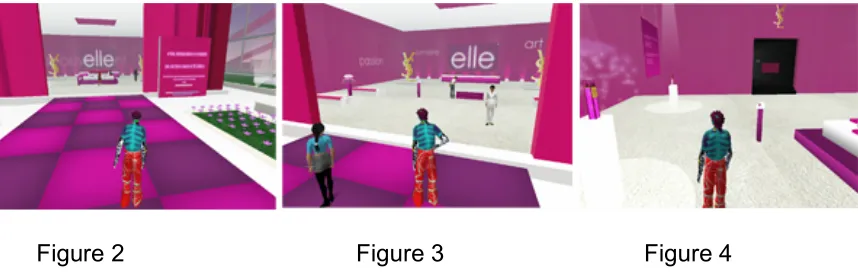
We had located the YSL Island SLURL from a Google search, and teleported directly from this page (now no longer available), into the ostentatious pink palatial grounds of the iconic fashion French house’s virtual launch of the new Elle perfume. A towering pink monolith, a simulation of the YSL Elle perfume bottle rose into the clouds in front of our tiny avatar. Ay Taov looked very small as he walked up the grand walkway lined with neat rows of daisies and entered the pink temple of Yves Saint Laurent. Shown in Fig.2.
Figure 2 Figure 3 Figure 4
The immediate impression inside was of a heavily branded, and overpowering bright fuchsia pink space illustrated in Fig 3. The main colour theme was different shades of fuchsia contrasted with grey and trimmed with white and gold. Placed in the entrance was a large gold YSL brand statue and in the centre of what we found to be the ‘ground floor’ a square structure was signposted as an elevator shown in the centre of Fig. 3. A discreet sign invited the customer to take a seat although we found it hard to climb onto the elevator; several attempts later, the avatar must be correctly seated on one of the pink cushions which activated a three level floor choice and we were transported in an instant to level 1.Fig.4
[image:8.612.92.521.237.373.2]Figure 5 Figure 6 Figure 7
We noticed two smartly dressed avatars. The male was behaving rather in a very erratic way and didn’t respond to our greeting (both can be aspects of typical behaviour in Second life and real life!) In Fig.5 the female avatar approached and greeted us in French. We had just met our first virtual shop assistant, and she asked Ay Taov if he had been in YSL before and if he would like to be shown around the gallery. Our avatar followed her into a long, dark tunnel that, once the avatars were inside, activated psychedelic disco effects and simulated sensation of being transported into a different part of the building. We followed the avatar into a spacious pink room with a series of large format photographic fashion ‘boudoir’ images displayed around the walls also shown in Fig.5. The YSL assistant explained this was an exhibition of the photographic artist Minah Pessoa. There was no other information available, so we attempted further interaction with the YSL assistant, but no further communication was offered. Perhaps this was because the avatar had ‘done their job’ by directing us to the gallery or perhaps explanations of brand promotion were reserved for the media and an approved audience. We returned to the research exploration of YSL, and jumped on the central elevator up to floor two, which arrived at another gallery housing a variety of untitled and unremarkable paintings and photographs.
Feeling slightly deflated, and just about to teleport out of the YSL space, when we noticed the most interesting artefact installed on floor 2 shown in Fig.6, which was a scaled down 3D model and exhibited hand drawn idea sketches of the YSL island and building development. The model of the building enabled us to share in the vision of developing YSL Island and how the brand spaces were designed. We flew into the centre of the room and landed on floor three which was empty and had no opportunity for interaction. The general impression of floor 3 seen in Fig.7, was of irrelevant and unnecessary use of unused space, with a few rows of pink seats, and a few 2D photographic Elle promotional posters.
Armani
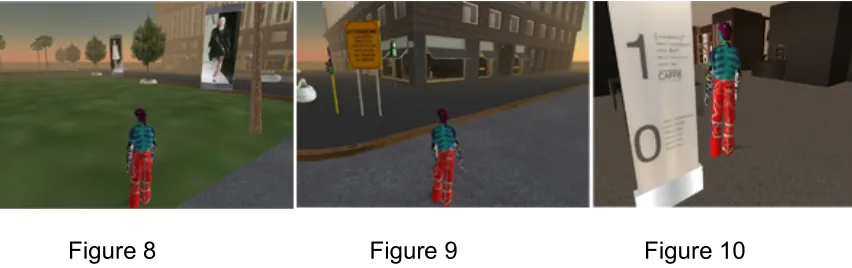
urban development, but on close inspection the store was made of a virtual marble or granite, with gold door handles and canopies on the windows, just as one might expect to see in Milan. As the avatar Ay Taov approached the store in Fig. 8, high resolution photographs of models wearing this season’s collection appeared on billboards along the sidewalk on the opposite side of the road.
Figure 8 Figure 9 Figure 10
The entrance to the store was relatively small and difficult to navigate, the light level inside was very low, so our general feeling was that it was difficult to find our way around. The store design was, in our opinion un-inspiring and like shopping in a maze, being constructed of straight lines, with too many walls and blocks. This feeling was exacerbated by a tight structure of square black pillars throughout, bare black partitioning walls and other box-like structures that appeared to have no purpose for merchandising in store. The product
presentation seen in Fig. 11-13. was limited and sparsely laid out on shelves and rails. On closer inspection of each garment detail, we found the image quality to be very low, and no obvious construction detail was added to the product images shown in Fig.12.
Figure 11 Figure 12 Figure 13
[image:10.612.95.522.477.613.2]that was difficult to view, listing the sub-brands available on the ground floor; however there was no other signage around the layout to indicate different areas might relate to different sub-brands. We did encounter one male shopper, shown in Fig.13 who looked like he was experiencing the same navigation problems with the Armani store layout, and asked if he would like to talk and declined by teleporting out of Armani.
After a number of attempts we managed to navigate the staircase to the first floor, where we found a bold logo for Armani Red emblazoned on the wall leading to the Armani Red boutique. Also, on this level we found a book department selling books about Armani, but not much else, and due to the frustrations experienced with the navigation around all the screens and columns that were in the virtual customer’s way, we were disinclined to continue the Armani shopping experience.
Reebok
Ay Taov was teleported onto ‘50 Cent Lane’. The approach to the Reebok building appeared to be designed to be urban, tough and cool, with quirky New York style buildings shown in Fig.14. The Reebok store is made in glass panels and has an entrance made from a concrete archway Fig.15. The entrance was clear and wide and easy to navigate; Ay Taov walked up wide shallow steps that led through the glass doors and was immediately met by a central product fixture of white Reebok trainers on shoe boxes and a sign informing customers to; “Get your blank shoes here” shown in Fig.16. Using avatar interactivity Ay Taov opened a notice of the price, (L$50) and a pair of customizable trainers could be purchased. The action of potentially purchasing the blank trainers automatically triggered a link directly to the Reebok website (www.rbk.com) where the real you can locate the nearest store and design and buy (real-life) personalised trainers. At this point we didn’t buy the trainers, but did experiment with the customisation process. In four corners of the Reebok space trainer customization and
visualisation booths allowed those who had purchased the blank trainers to select from a palette to add colour in sections of the shoe. The booths also allowed a 360 degree view of the design.
Exploring further into the store, in Fig.18, illustrates how we found the women’s sportswear section and encountered a ‘free goody bag’ of attachable
complimentary products. Floating hearts attracted the customer, inviting them to interact with this female-focused product promotion. If activated the free items were imported into the avatars inventory file to remind them of the experience. Ay Taov is now wearing the free ‘bling’-style heart shaped diamond earrings!
The Reebok store visual displays were very similar to other virtual stores,
showing an image of the product being worn by a model above the merchandise stacked on shelving. Fig. 18 shows a unique and interesting additional
interactive visualisation tool. The garment the model is wearing changes colour according to the product touched by the avatar. The point of sale posters, in Fig.19 included technical product detail and a recommended retail price in L$. Photographic lifestyle posters around the store supplemented the images specific to the limited number of women-only products on display.
Figure 17 Figure 18 Figure 19
Ay Taov walked up a flight of reasonably easy to navigate stairs (passing an interactive can of paint – that appeared to spray but didn’t mark our virtual clothing !). Level one had little to show, apart from a row of seats on a square structure reminiscent of YSL’s elevator (possibly one in the making for Reebok), and some fashion model photo promotional posters. Overall, the experience in Reebok was very interesting and relatively easy to navigate. The interaction was at a high level, but was quite restricted in terms of product variety.
Adidas
Ay Taov, the avatar had previously visited Adidas, and in an earlier research paper, (Taylor and Unver, E, 2007) Taylor had evaluated the store and customised and purchased a pair of ‘A3 microride’ trainers for the avatar;
however, unfortunately at the time of writing this research the store location was not available for teleportation.
called the A3 Microride illustrated in Fig.22 . The trainers are available in black and red, and white and silver and are shown displayed on black boxes in Fig.21. The trainer is the product with the highest quality 3D model from all the stores we evaluated. The A3 Microride product is embedded with a jump, bounce and land programming script, and the Adidas store provides a testing launch space where you can test the bounce and landing properties before making a purchase, although this is not easily signed and located in store. The shoes are a good, fun translation of a real-world product into the virtual realm, and at L$50 (about US$0.20), they’re easily affordable for any size of avatars!
Figure 20 Figure 21 Figure 22
Bershka
As exploratory shoppers we immediately felt happy on arriving on Bershka Island. Bershka’s interactive media specialists Mosi-Mosi have developed a southern European holiday paradise island within their virtual space. The
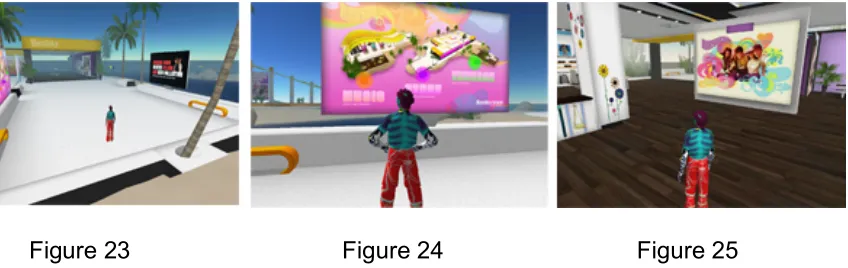
Bershka store is surrounded by palm trees, an inviting azure, Mediterranean Sea, that laps against secluded islands each with their own shady beach hut. In fig.24 a billboard explains the brand structure; three spaces; a party space, the Bershka store and relaxing space.
Figure 23 Figure 24 Figure 25
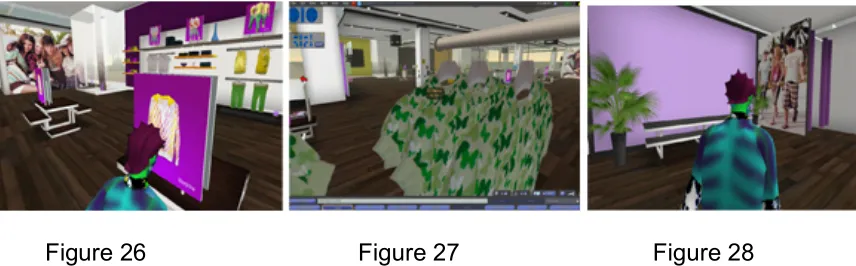
[image:13.612.99.523.508.642.2]Figure 26 Figure 27 Figure 28
The clothing on the rails is simulated using detailed texture mapped 2D images to suggest a 3D garment effect. In Fig. 26 a range of screen grabbed images of male and female avatars modelling a selection of the garments on the rails are displayed on the walls in each store section and impressive large format photo shoots of models are positioned around the store in Figs.25 -28 showing young human male/female models wearing the latest funkiest selections from the summer season ranges
As we browsed the store with our Ay Taov avatar, we checked different garments and found that everything could be easily bought by pointing the mouse to the garment. The avatar’s hand then shoots a beam in the direction of the item and an on screen window is activated that gives a price and the model name of the item. The price for a sweatshirt was L$25. We found the two changing rooms, Fig.28 with more large, magazine/billboard style model photo shoots. A pay desk with a cash machine and in-store promotional leaflets on the desk added to the surreal and perhaps unnecessary but intriguing attention to in-store detail.
Overall the store felt inviting and spacious, but, sadly empty as there were no other shoppers in Bershka during the time we were investigating. The visual impression was stunning and captivating making us feel happy, sociable and inclined to buy. On leaving the shop we investigated the relaxing spaces, which were designed with decking, sun shades, beach towels, beach huts, and mini islands affording the opportunity for some private space maybe to ‘de-stress’ the virtual shopper. Not far from Bershka we also found a ‘Sloogi’ booth designed also by Mosi-Mosi, offering navigational help, which we thought would be very useful for future research!!
American Apparel
[image:14.612.91.519.85.218.2]Figure 29 Figure 30 Figure 31
In Fig.29 the avatar was teleported into a dreamlike, almost surreal LA style oasis of palm-trees, flowers, waterfalls, rock and streams; and set off walking on a winding path through the sunny haze to the square glass fronted building with a huge American Apparel sign emblazoned on the store front shown in Fig.30. As Ay Taov approached the store, the area looked abandoned, and fallen-down palm-trees were scattered alongside the path. Ay Taov walked to the main entrance and in Fig. 31 looked through the padlocked glass doors into the empty store. The grey store interior had been stripped of all promotional images, apparel products and retail furnishings and appeared to have ripped wall-paper hanging from the interior walls. The green sign on the doors relays an apology to their virtual customers: “Sorry We’re Closed. Learn More Here. American
Apparel”. A web link on the sign connects the avatar to a page on their online web page: http://americanapparel.net/presscenter/secondlife/. The official statement from the online American Apparel press office (Americanapparel.net, 2007) reads:
“Last summer we opened up our Second Life American Apparel store with a grand opening party with tacos, a few cases of beer, and a piñata. We didn't know what to expect or if anybody would even show up. Needless to say, it's been quite a year. We've had thousands of visitors from all over the world and made a ton of new friends, seen some interesting things from furry folks to virtual terrorism, caused a bit of a clamor, and sold some virtual t-shirts and it's been great. But we feel like our time is up here. So we're closing our doors on Lerappa Island for now. This doesn't mean we're finished with the virtual world. Stay tuned to see what we do next.”
Discussion and Conclusions
By shopping and researching together as an avatar we became very aware of the challenges associated with navigating the virtual sites. Some were much easier to gain orientation and manoeuvre within that others and we suggest that the fashion brands must be exploring the relationship between their designed space and the medium of a virtual persona within their space. Mastering the programming that controls this navigation aspect will allow the fashion brands to improve the experience of browsing and exploring the retail environment. Ease of navigation was identified early as a success factor in 2D on-line retail outlets, with usability difficulties being a major source of frustration (Bowman et al, 2002, Dennis et al, 2004, Seock and Norton, 2007) therefore, the mastery of movement in the new 3D virtual environment must be a priority for the retailers, if they want customers to spend time in their virtual space.
We felt that the inclusion of changing rooms at Bershka shown in Fig.28
demonstrated consideration for the development of dressing and undressing in future virtual shops through improved 3D technologies. According to Rayman (2007), an exciting opportunity for the online world is the creation of avatars with the exact dimensions of ‘players’, enabling a customised try-on facility for either on-line or in-store shopping.
Our evaluation of Second Life as a desirable and popular retail location remains reserved, however we are confident that 3D virtual environments, and the avatar-persona will continue to evolve as valuable tools for on-line fashion design and retailing. In future projects fashion/textiles educators will ask students to build a 3D virtual customer according to their (students) own measurements, rather than giving the typical photocopied hand out size specification chart. This will facilitate an interactive, experiential and no doubt collaborative learning exchange.
Students can then virtually upload personalised clothes instantaneously and in the shared 3D environment discuss the properties of the products and the retail brand.
References
Americanapparel.net (2007), Press Center, viewed 11 Sept 2007, http://www.americanapparel.net/presscenter/secondlife/
Bowman, DA, Gabbard, JL and Hix, D (2002), ‘A Survey of Usability Evaluation in Virtual Environments: Classification and Comparison of Methods’, Presence, vol. 11, No.4, 404-24
Brek, J (2008) ‘More Avatars than there are people in the USA’, Smart Mobs –the next Social Revolution, Posted April 6th 2008, viewed September 24th 2008. http://www.smartmobs.com/2008/04/06/more-avatars-now-than-there-are-people-in-the-usa/
Coleman, D (2006); ‘Avatars and the future of team workspaces’. Collaborative Strategies Blog. Posted 03/29/06 viewed on 25th September 2008.
http://collaborate.com/cs_evl/collab.php/2006/03/29/avatars_and_the_future_of_t eam_workspace
Dennis, C, Fenach, T and Merrilees, B (2004), e-Retailing, Routledge, London
Harkin, F ( 2007); ‘Real World Intrudes on virtual Domain’, Los Angeles Times, Posted May 28th 2007, viewed on 24th September 2008.
http://articles.latimes.com/2007/may/28/business/ft-second28
Inditex.com (2007), http://www.inditex.com/en/who_we_are/concepts/bershka viewed 13 November 07
Kzero (2007) ‘Armani opens for (limited) business’, viewed 09 October 07, http://www.kzero.co.uk/blog/?p=1220#more-1220
Malmsten, E, Portanger, E and Drazin, C, (2001), Boo.hoo, Arrow, London,
McGoldrick, PJ, (2002), Retail Marketing (2nd Edition), McGrawHill, Basingstoke
Mitham, N (2007), ‘A Second Chance’, Cyber Drum, October, pp.12-13
Mintel, (2007), ‘Multi-channel Retailing’, Mintel International Group, London
Rayman, M (2007), ‘Immersive Retailing’, Viewpoint, issue 21 pp.133-143
Robson, C (2002), Real World Research (2nd Edition), Blackwell, Oxford
Seock Y, and Norton, M J T (2007), ‘Capturing college students on the web: analysis of clothing web site attributes’, Journal of Fashion Marketing and Management, Vol. 11 No. 4, pp.539-552
Song, K, Fiore A M, and Park, J (2007) ‘Telepresence and fantasy in online apparel shopping experience, Journal of Fashion Marketing and Management, Vol.11, No. 4 pp. 553-570
Springwise.com (2006); viewed on the 16th June 2006. (http://www.springwise.com/gaming/brave_new_retail_world/)
Style.com (2007) ‘You Only Live Twice’, viewed 01 October 07 http://www.style.com/trends/news/content_6035
Taylor and Unver, E, (2007), ‘Mutating the realities in Fashion Design: virtual clothing for 3D avatars’, in Extreme Fashion: Proceedings of the ninth annual IFFTI Conference, Toronto April 2007, CLTAD, London ISBN 978-0-9541439-7-8
Theretailbulletin.com (2006) ‘KPMG/SPSL Retail Think Tank: ‘Is internet retailing all its cracked up to be?’, viewed 9 November 06 http://www.theretailbulletin.com/news/
Theretailbulletin.com (2007), ‘An ecommerce platform is not just for Christmas’, viewed 13 November 07 http://www.theretailbulletin.com/news/
Unver E., and Taylor, (2007), ‘Creating 3D virtual spaces in art & design education’, ELIA European League of Institutes of the Arts Teachers' Academy conference papers, pp. 93-97 University of Brighton, UK, 2007,12-14th July. ISBN: 978-1-905593-07-1
Varley, R. (2006), Retail Product Management: Buying and Merchandising (2nd Edition), Routledge, London
Varley,R. (2005), ‘Store Image as the Key Differentiator’ in European Retail Digest, issue 46, pp.18-21
Ventrella, JJ (2005) ‘Avatars: Semi - Autonomous puppets Notes on the Art of Avatar Animation’, viewed 25 th September 2008
http://www.ventrella.com/Alife/avatar_animation.html
Wikipedia, (2008); ‘Definition of an avatar’, viewed 7 January 08 http://en.wikipedia.org/wiki/Avatar_(virtual_reality)
Authors
Andrew Taylor
Department of Design, School of Art, Design & Architecture.
The University of Huddersfield.Queensgate,Huddersfield.HD13DH. UK [email protected]
Andrew Taylor is a senior lecturer at the School of Art, Design & Architecture at the University of Huddersfield. Andrew's research is focused on the application of 3D technologies in fashion/textiles and in 3D multi user virtual environments for art and design education.
Rosemary Varley
School of Management and Science, London College of Fashion, 65, Davies Street, W1K5DA