THE USE OF EXCESSIVE FORCE IN RIOT CONTROL: LAW
ENFORCEMENT AND CRIMES AGAINST HUMANITY UNDER
THE ROME STATUTE.
SYLVIE NAMWASE
A thesis submitted in partial fulfilment of the requirements of the University of East London for the Degree of Doctor of Philosophy (PhD)
School of Business and Law.
ii Abstract
This thesis explores state-sanctioned violence used as part of law enforcement in riot control with a view to determine whether the definition of crimes against humanity under the Rome Statute effectively criminalises the use of force by state actors in riot control contexts. It analyses tensions arising from criminalising the use of lethal force against a ‘civilian population’ under the Rome Statute, while recognising the
responsibility of states to enforce law and order through force, including through lethal force. The study is qualitative and uses doctrinal analysis to identify definitional gaps and paradoxes within relevant laws. It uses positivist theory and the Hobbesian concept of sovereignty to illuminate how the fusion of power, law and violence perpetuate circularity around the standards regulating state use of force in riot control situations, and how this in turn hinders specificity of culpability under article 7 of the ICC Statute.
This study explores the effect of merging and applying without reflection, two prescriptive regimes; human rights and humanitarian law, within an international
criminal law framework under the ICC Statute which is proscriptive and punitive. It also analyses definitional circularity under relevant national laws which are viable
interpretive sources under the Rome Statute. The study concludes that article 7 is ineffective as a basis for criminalising excessive force in riot control contexts. The legal frameworks regulating use of force in these contexts, and those regulating crimes
iii Declaration
I declare that this thesis is my original work and that it has never been submitted for publication or for examination in any institution of higher learning.
iv
Table of Contents
Abstract ... ii
Declaration ... iii
List of Tables, Cases and Laws ... viii
Abbreviations ... xix
Acknowledgements ... xxi
Dedication ... xxii
CHAPTER ONE RIOT CONTROL AND CRIMES AGAINST HUMANITY 1.Introduction and Background to the study ... 1
2.Research questions ... 3
3. Context of the research ... 3
4. Significance and objective of the study ... 4
5. Analysis of definitional problems ... 5
Attack against a civilian population ... 5
The requirement of an “attack” as a state or organizational policy versus law enforcement ... 7
6. Existing scholarship ... 8
Civilian population... 11
‘Policy’ and ‘attack’ ... 13
Murder and ‘Other inhumane acts” ... 16
Attack, use of force and law enforcement ... 16
7. Research methodology ... 19
7.1 Limitations of methodology ... 20
7.2 Theory and Method ... 21
8. Thesis outline ... 22
9. Ethical issues ... 23
v CHAPTER TWO
LAW AND POLITICS: A REVIEW OF THEORY AND METHOD FOR THE USE OF FORCE IN RIOT CONTROL AS A CRIME AGAINST HUMANITY
1.Introduction ... 25
2. Contextualising Law, politics and method ... 27
3. The content and sources of law: Exploring natural law theories ... 30
3.1 The substance and source of law: comparing positivist and natural law approaches ... 30
4.Assessing Dworkin’s third theory of law ... 33
4.1Comparing Dworkin and Hart’s positivist theory of judicial interpretation ... 34
5.Critical legal theory ... 37
5. 1 Comparing critical legal theory to positivism ... 39
6. Exploring legal positivism: ... 40
6.1 Exploring modern positivism ... 41
6.2 Positive law and politics in Thomas Hobbes’ philosophy ... 42
6.3 The Hobbesian sovereign ... 45
6.4 The ‘force’ of law ... 46
6.5 Why the Hobbesian sovereign and not other sovereigns? ... 47
6.6 Rejecting an absolute sovereign ... 49
6.7 The Hobbesian sovereign, indeterminacy and legitimacy ... 50
6.8 Legal legitimacy ... 52
7. Conclusion ... 53
CHAPTER THREE THE HOBBESIAN SOVEREIGN, AMBIGUITY OF THE ICC STATUTE AND ITS INTERPRETIVE SOURCES OF LAW 1.Introduction ... 56
2. The principle of legality and ambiguity under the ICC Statute ... 57
2.1Antecedents of the principle of legality under international law ... 59
2.1.1 The International Military Tribunal of 1945 ... 59
2.1.2 The Ad Hoc International Criminal Tribunals (Rwanda and Yugoslavia) ... 61
2.2 Exploring a methodological approach to the principle of legality under the ICC Statute ... 64
2.2.1Antecedents of legality under the ICC Statute ... 64
2.2.2 ICC’s strict legality and the illusion of legal certainty ... 66
2.2.3 Grover’s ICC legality methodology ... 67
2.2.4 Grover’s mandatory legality guidelines ... 69
2.2.5 Critiquing Grover’s mandatory guidelines ... 70
vi
3.1 Crimes against humanity: antecedents of armed conflict and theoretical inadequacies ... 74
3.1.2 The theoretical ambiguity of ‘crimes against humanity’ ... 76
3.1.3 Crimes against humanity as victor’s justice ... 78
4. The ICC Statute and Elements of Crimes as a source for defining crimes against humanity in riot control contexts ... 80
4.1 The ambiguity of ‘murder’, ‘other inhumane acts’ and the policy requirement ... 81
4.1.1 The policy requirement dilemma ... 83
4.1.2 Murder and other inhumane acts ... 84
4.1.3 Legislative inaction and judicial innovation ... 87
4.1.4 ‘Attack’ and ‘civilian population’ ... 89
4.1.5 Elements of crimes and the circularity of defining ‘attack against the civilian population’ ... 89
4.1.6 The Decision pursuant to article 15 of the Rome Statute authorizing an investigation into the situation of Kenya (ICC-01/09, 31 March 2010). ... 92
4.1.7 ‘Attack against the civilian population’ ... 93
4.1.8 The Decision on the confirmation of charges in the case of Prosecutor v. Laurent Gbagbo (ICC-02/11-01/11, 12th June 2014). ... 95
4.2 Crimes against humanity and legality: applicable treaties, principles and rules of international law... 98
4.2.1 Applicable treaties ... 99
4.2.2 ‘Other situations of violence’ and the lack of an external boundary ... 101
4.2.3 The Hobbesian sovereign and the ambiguity of armed conflict and riot control boundaries ... 104
4.2.4 The absence of an internal boundary: proportionality of force in the protection of the right to life ... 108
4.2.5 McCann and others v. UK (Application no.18984/91 27 September 1995) ... 110
4.2.6 Montero Aranguren et al v. Venezuela (July 5 2006) ... 114
4.3 The indefiniteness of proportionality and the challenge for prosecution: drawing from IHL discourse ... 116
4.4 Persistent ambiguity under customary law ... 120
5. Conclusion ... 121
CHAPTER FOUR GENERAL PRINCIPLES FROM NATIONAL LAWS AND THE UN BASIC PRINCIPLES ON THE USE OF FORCE AND FIREARMS 1.Introduction ... 124
2.General Principles of law as sources of law under international law... 126
2.1 Problems with methodology and substance ... 128
2.1.1 Methodological disparities ... 128
2.1.2 Content and transposition of general principles of law ... 130
vii
3.1 The ICJ and PCIJ ... 133
3.2 International Criminal Tribunals ... 134
3.2.1 The vertical move: challenges with the substance of general principals of law under international criminal law ... 135
3.2.2 The horizontal move: challenges with methodology and representativeness ... 140
4. The International Criminal Court: General principles of law, the use of force in riot control and the ICC legality dilemma ... 142
4.1 Strict construction, effectiveness and legality ... 143
4.1.1 Strict construction and general principles as a source of law under the ICC Statute ... 144
4.1.2 Effective interpretation, analogy and strict construction ... 145
4.1.3 Methodological criticisms ... 148
5. National laws on the use of force in riot control ... 149
5.1 Methodological challenges ... 150
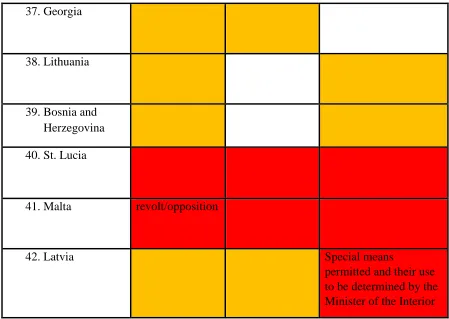
5.2 Method of categorizations: TABLES A, B and C... 151
5.3 Analysis of tabulated laws: ... 152
5.3.1 Fundamental disparities of standards ... 153
5.3.2 The vertical and horizontal moves: extracting general principles and the requirement of effective interpretation ... 155
5.3.3 The enduring circularity of law on the use of force in national application ... 158
a) Report of the Marikana Commission 2012 ... 158
b) 2012 Metropolitan Police Service (MPS) Report of the Strategic Review into the Disorder of the August 2011 London riots ... 160
c)Her Majesty’s Inspectorate of Constabulary (HMIC) Report into the London Riots of 2011. ... 161
5.4 Transposing use of force standards: analogy and strict construction: Attack, murder and inhumane acts... 163
5.4.1 The duality of law enforcement laws and criminal laws ... 164
5.4.2 Implications of duality for transposing standards on the use of force ... 165
6. UN Basic Principles on the Use of Force and Firearms as a source of law for the ICC ... 168
6.1 The enduring circularity of use of force standards under the UN Basic Principles ... 169
6.2 Amnesty International’s guiding principles to the interpretation of the Basic Principles on the use of Force and Firearms ... 172
7. Conclusion ... 175
CHAPTER FIVE CONCLUSION ... 178
Bibliography and references ... 183
viii List of Tables, Cases and Laws
Tables
Table B: Coded representation of disparity in standards of selected laws on lawful state response to riot control contexts
Table C: Summarised categorization of the ways in which selected laws differ on the three pillars of measuring force.
9 Cases
Attorney General for Northern Ireland’s Reference
No.1 of 1975, [1975] AC 105.
Beit Sourik Village Council v. The Government of Israel
PD 24 [2004], HCJ 2056/04.
Corfu Channel Case, Merits Judgement ICJ Reports, 9 April 1949.
Decision Pursuant to Article 15 of the Rome Statute authorizing an investigation into the situation of Kenya
(ICC-01/09), 31 March 2010.
Decision on the confirmation of charges in the case of Prosecutor v. Laurent Gbagbo
(ICC-02/11-01/11), 12June 2014.
France et al. v. Goring et al. Trial of the Major War Criminals before the
International Military Tribunal,
14 November 1945-1 October 1946.
Case Concerning The Factory at Chorzow, jurisdiction, Judgement
No. 8, PCIJ Series A, No.9. 26 July 1927.
Jaworzina Advisory Opinion No.8. PCIJ, Series B, 6 December 1923.
Judgment of the International Military Tribunal for the Trial of German Major War Criminals (With the dissenting opinion of the Soviet Member)
Nuremberg, 30September and 1October, 1946.
McCann and others v. UK (Application no.18984/91) 27 September
1995. .
Nachora and others v. Bulgaria (43577/98 and 43579/98) European
10
Prosecutor v. Akayesu (Case No. ICTR-96-4-T) Judgment, 2
September 1998.
Prosecutor v. Bagilishema (Case no. ICTR-95-1A-T), Judgment, 7
June 2001.
Prosecutor v. Blaskic (Case no. IT-95-14-T), Judgment, 3
March 2000.
Prosecutor v. Erdemovic (Case No. IT-96-22-A), App. Ch.,
Judgment, 7 October 1997.
Prosecutor v. Fatmir Limaj (Case No. IT-03-66-T) Judgement, 30 October 2005
Prosecutor v. Furundzija (Case No. IT-95-17/1-T), Judgment, 10
December 1998.
Prosecutor v. Kupreskicet al (Case No. IT-95-16-T), Judgment, 14
January 2000.
Prosecutor v. Tadic (Case No. IT-94-1-T), Opinion and
Judgement 7 May 1997.
Prosecutor v. Tadic, Decision on the Defence Motion on Jurisdiction
(ICTY-94-1), Trial Chamber, 10 August 1995.
Prosecutor v. Tadic a/k/a “DULE”, Decision on the Defence Motion for Interlocutory Appeal on Jurisdiction
(ICTY-IT-94-1-AR72), 2 October 1995.
Situation of the Democratic Republic of Congo, Judgement on Application for Extraordinary Review of the Pre-Trial Chamber I
(Appeal Case No.: ICC -01/04) 13 July 2006.
11
The case of Montero Aranguren et al (Detention Centre of Catia) v. Venezuela
Inter-American Court of Human Rights, July 5 2006, Series C No. 150.
The Public Committee Against Torture in Israel et al v. The Government of Israel et al
Supreme Court of Israel sitting as the High Court of Justice, (HCJ 769/02) Judgment, 11 December 2006.
xii Treaties
Agreement for the Prosecution and Punishment of Major War Criminals of the European Axis and Charter of the International Military Tribunal, London
8 August 1945.
Geneva Convention (I) for the Amelioration of the Condition of the Wounded and Sick in Armed Forces in the Field
12 August 1949.
Geneva Convention (II) for the Amelioration of the Condition of Wounded, Sick and Shipwrecked Members of Armed Forces at Sea
12 August 1949.
Geneva Convention (III) relative to the Treatment of Prisoners of War. Geneva
12 August 1949.
Geneva Convention (IV) relative to the Protection of Civilian Persons in Time of War
12 August 1949.
International Covenant on Civil and Political Rights
23 March 1976, UNGA Res. 2200.
International Criminal Court, Elements of Crimes
U.N. Doc. PCNICC/2000/1/Add.2 (2000).
Protocol II Additional to the Geneva Conventions of 12 August 1949, and relating to the Protection of Victims of Non-International Armed Conflicts
8 June 1977.
Rome Statute of the International Criminal Court
17 July 1998.
Statute of the International Criminal Tribunal for Yugoslavia
13 Statute of the International Criminal
Tribunal for Rwanda
8 November 1994, UN SC Res. 955.
Statutes of the International Committee of the Red Cross
2013.
Universal Declaration of Human Rights 10 December 1948, UNGA Res. 217.
xiv National Laws
Citation of laws as extracted from the database of the UN special rapporteuron extra judicial, summary or arbitrary executions, Christof Heyns, (August 2010-July 2016) at http://www.icla.up.ac.za/use-of-force/13-un/33-use-of-force
Argentina Minimum criteria for the development of protocols and the Police Forces Federal Security Forces in public Demonstrations
(Resolution no. 210/2011 of Ministry of Security) (Unofficial translation).
Argentina, Regulation No. 8 of Guns and Shooting
(ODI No. 25 of February 6, 2012) (Unofficial translation).
Armed Forces Act of Singapore GN No. S 288 of 1975. Azerbaijan Police Act No.727-IQ, 1999.
Bhutan Police Act 2009.
Bosnia and Herzegovina, Law of Brcko District, (excerpts)
No. 2 of 2000.
Bosnia and Herzegovina, Law on the internal Affairs of the Sarajevo Canton (excerpts)
Bosnia and Herzegovina, law on the internal Affairs of Tuzla. (excerpts) Bosnia and Herzegovina, law on the internal Affairs of Posavina. (excerpts) Code of Ethics for Officials of the Ministry of the Interior with on Police Functions, Bulgaria
2004.
Criminal Code of St. Lucia No. 9 of 2004.
Criminal Code of Canada 2013.
15 Law of the People’s Republic of China on Assemblies, Processions and
demonstrations
No. 20 of 1989.
Croatia law on Police 2000.
Fiji Public Order Act Cap. 20 As amended by the Public Order Amendment Decree No.1 of 2012. Finland Police Act 1995 as amended up to Act 560 of 2007. German Act on the use of Direct Force by
Federal Police Officers exercising Public Authority
1961.
India, Armed Forces (Special Powers) Act
No. 28 of 1958.
Indonesia Police Regulations No.8 of 2009. Islamic Republic of Afghanistan Police
Law
2005.
Law on the Establishment and Jurisdiction of the National Police, Rwanda
No. 9 of 2000.
Law on State Police, Albania No. 9749 of 2007.
Law on Police, Armenia 2004.
Law of Georgia on Police 2013.
Latvia Law on Police 1992 as amended, 1996.
Lithuania, law on Police 17 October 2000 No. VIII-2048 Vilnius, (As last amended on 11 May 2006 No. X-603).
Malaysia Police Act 344 of 1967 (incorporating all amendments up to 1 January 2006). Malaysia Public Order Preservation Act 296 of 1958 (incorporating all
16
Malta Public Meetings Ordinance Cap. 68 of 1931.
Malta Police Act Cap 164 of 1961.
National Police Service Act of Kenya No.11 of 2011. Organic Law of the National Police of
Timor Leste
No.8 of 2004.
Police Act, Nicaragua Law No. 288 of 1996.
Police Act, Uganda Cap. 303, 1994.
Police Powers and Responsibilities Act,
Australia
2000.
Public Order (protection of persons and property) Act, Australia
No. 26 of 1971.
Public Order Act, Brunei Cap. 148 of 1998. Public Order Act Kenya Cap. 56, 2009. Public Order and Security Act of
Zimbabwe
Cap. 11:17 of 2007.
Plan of Operations of the National Gendarmerie Director for Personnel, Argentina
(Unofficial translation), No. 01 of 2010
Pakistan Police Rules 1934.
Pakistan Police order 2002.
Pakistan Criminal Procedure Code 1898.
Protest Law, Egypt 107 of 2013
Philippines National Police Operational Procedures
2013
Russia Federal Law on Federal Security Service
1995
South African Police Service Standing Order
17 South Africa, Regulation of Gatherings
Act
No. 205 of 1993.
South Africa, National Municipal
Policing Standard for crowd management during
gatherings and demonstrations, GN 307 of 2008.
Sri Lanka Police Ordinance: Department Order
No. A/ 19.
The Nigeria Police Act Cap. P19.
The Police Act of Iceland No. 90 of 1996 as amended in 2000. The Taiwan Act Governing the use of
xix Abbreviations
ACPO Association of Chief Police Officers ASP Assembly of State Parties
DRC Democratic Republic of Congo
ECCC Extraordinary Chambers in the Courts of Cambodia FAR Forces Armées Rwandaises
HMIC Her Majesty’s Inspectorate of Constabulary
ICC International Criminal Court ICJ International Court of Justice
ICTY International Criminal Tribunal for Yugoslavia ICCPR International Covenant on Civil and Political Rights ICL International Criminal Law
ICRC International Committee of the Red Cross ICTR International Criminal Tribunal of Rwanda IHL International humanitarian law
IHRL International human rights law ILC International Law Commission
IMT International Military Tribunal at Nuremberg MPS Metropolitan Police Service
OHCHR Office of the High Commissioner for Human Rights OSVs Other Situations of Violence
PCIJ Permanent Court of International Justice RPF Rwandan Patriotic Front
xx
UDHR Universal Declaration of Human Rights UN United Nations
xxi Acknowledgements
I would like to thank both my supervisors, Prof Chandra Lekha Sriram and Prof John Strawson for their insightful views and professionalism which helped to shape the final output of this thesis. I would also like to thank Dr Edel Hughes, Prof Jérémie Gilbert and Prof M. Siraj Sait for their additional support during and after the annual monitoring review meetings.
I also wish to thank the family of Monica and Mark Kirya for their emotional and logistical support during my many difficult times in a foreign country. To my family: Daddy,
Maama, Aggie, Stella, Susan, Francis, Michael, Bernard and Fred, and to my friends: Berna, Rose, Mary, Agnes, Sheilla, Ayeko, Doreen, Adrian, Marvin, Dennis and all others, I wish to express my gratitude for the moral support.
xxii Dedication:
In memory of Ms Joan Kagezi who was the first lead Prosecutor of the International Crimes Division of the High Court in Uganda. Ms Kagezi was also a personal friend and mentor whose dedication to advancing accountability for atrocities in Uganda and at the
1
CHAPTER ONE
RIOT CONTROL AND CRIMES AGAINST HUMANITY.
1. Introduction and Background to the study
Mobilization by citizens against governments takes various forms, including peaceful demonstrations, which may graduate to riots, or to full blown armed violence. This
mobilization in the recent past has centred on a wide range of issues, from protests against the rising cost of living, protests against state backed development projects, rigged
presidential elections, the demand that dictatorial regimes be removed and protests relating to national identity issues. The composition, organisation, and structure of the
demonstrations have varied, so, too, has the incidence of fatalities and the extent of the damage caused. In Cote d’Ivoire, riots against disputed presidential election results culminated in the death of about 3,000 people (Van der Pol and Bax, 2011). In Uganda, riots over the rising prices of commodities left an unknown number of people dead from live bullets fired by anti-riot police, with an estimated 29 people arrested (Njoroge and Wanambwa, 2011). Libya’s 2011 riots in Benghazi left an estimated 200 unarmed people dead after ‘shoot to kill’ orders were allegedly issued (BBC, 2011a). In Egypt, by
November 2011, the death toll in riots against a new military regime had risen to 28 people (BBC, 2011b). In the Democratic Republic of Congo (DRC) an estimated 14 people died at the hands of state security forces in protests against ostensibly rigged presidential elections (BBC, 2011c). In Syria, the Office of the High Commissioner for Human Rights
2
reportedly killed over 400 people since November 2015. The alleged killings occurred amidst protests by the mostly Oromo land owners against the capital city’s expansion, a move that would see them displaced from their land (Human Rights Watch, 2016). Armed violence has also manifested at the horizontal level between opposition groups from among the population as was the case in Egypt between supporters and opponents of the Muslim brotherhood (The Times of Israel, 2013). In Kenya’ the 2007 post-election violence between opposing ethnic groups and against the state resulted in the death of over 1,000 people, some of whom were allegedly killed by the Kenya Police Force (Kenya Situation ICC-01/09, 2010). All these examples of situations in which the populace expressed frustration with the incumbent regime resulted in violent state-sanctioned repression.
The commonest form of government retaliation to violent protests has been the use of force which in numerous instances has been lethal. Given the nature of the violence and the extent of deaths in some of the countries, allegations of crimes against humanity have even been made (UN. Doc. A/HRC/S-17/2/Add.1 para 108, 1973, UN Doc. S/RES/1973, 2011). The situations in Kenya (Kenya Situation ICC-01/09, 2010), Libya and Cote d’Ivoire became the subject of inquiry by the International Criminal Court (ICC) for, among others, crimes against humanity. While referring the situation in Libya to the ICC, the Security Council indicated that the crimes committed may amount to crimes against humanity (UN. Doc. S/RES/1973).
However, it could be argued by states, as was the case for Libya, that the force used in riot control constituted law enforcement in line with national law and was not in breach of international law (BBC, 2011a). Egypt’s Interior Minister, Mohamed Ibrahim responded to accusations of excessive force against protestors in Rab’a and al-Nahda squares by stating that it was a justified state response to violence including gunfire from the crowd. He allegedly stated: “I am not saying everyone was firing, but it is more than enough if there are 20, 30, or 50 people firing live fire in a sit-in of that size.” (HRW 2014: 8-10). These responses have thus far not been met with concrete legal responses under the ICC Statute framework.
3
closest universal standard regulating use of force and explores them against the tensions between law enforcement in violent protests and crimes against humanity under the ICC Statute.
2. Research questions
The central question this study seeks to answer is whether article 7 of the ICC Statute effectively criminalises the use of excessive force in riot control contexts as crimes against humanity. It also uses the concept of the Hobbesian sovereign to analyse the legal
inadequacies and contradictions arising from the application of article 7 to riot control contexts.
The following sub-questions necessarily follow from the main question:
Whether the threshold requirements of an attack against a ‘civilian population’ for crimes against humanity adequately address the use of force by state actors in riots or similar violent situations not amounting to armed conflicts.
Whether the threshold requirement of a “State or organizational policy” provides an adequate standard for establishing liability for crimes against humanity in the context of law enforcement and use of force during riots
3. Context of the research
The study analyses laws regulating use of force in riot control contexts. It makes a specific focus on the justifications for the application of force and the justified means and methods of force. The analysis is juxtaposed against the legal framework of crimes against humanity under the Rome Statute.
4
major confrontations requiring control by regular or paramilitary police (Nigel 1991: 67). In any event, a riot is distinguishable from a demonstration, which is essentially peaceful and lawful (Gregory 1985: 53). In referring to riot control, this study contemplates any situations of violent protest against the state, or which have occasioned the use of force by the state forces in response to violent protests. As indicated above, these situations occur in a wide range of contexts including ethnic tensions, election protests, protests against state-backed development projects, protests concerning labour rights, among others. The study does not situate itself in any specific riot control context but rather adopts a perspective whose focus is on how the law regulates and justifies state forces’ forceful response to unlawful and violent situations in general. Thus ‘riot control’ in this study is used as a generic term to represent the wide spectrum of violent crowd protests against state forces from low threshold situations of violence to high threshold contexts bordering on internal armed conflict.
As such, the study has no specific geographical scope or temporal scope. It draws general examples from events where states have used force against violent protests and the actions resulted in claims of crimes against humanity such as the Kenya and Cote d’Ivoire
situations stated above.
4. Significance and objective of the study
While numerous authors have written about crimes against humanity, few, if any, have considered them in the context of the use of force by the police and security forces against violent protestors with a view to illuminating the definitional challenges arising there from. This thesis’ modest objective is to discuss these legal challenges in such a context, drawing on examples of decided cases and reports of commissions of inquiry where the foregoing questions have arisen. It explores whether and how these challenges fit in with or push the boundaries of existing laws, particularly international criminal law and international humanitarian law. The thesis approaches these questions using the Hobbesian sovereign as an agent for analysis. I argue in chapter two that the Hobbesian sovereign represents a fusion between law, power, force and politics which reinforces circularity around limitations on state conduct in riot control contexts. It illuminates the nature and
5
the ICC Statute to riot control contexts where the law on riot control remains largely state-centric. It enables a demonstration of how this circularity in turn affects interpretation under article 7.
5. Analysis of definitional problems
Article 7 (1) of the ICC Statute defines crimes against humanity as follows:
For the purpose of this Statute, ‘crime against humanity’ means any of the
following acts when committed as part of a widespread or systematic attack directed against any civilian population, with knowledge of the attack:
It then proceeds to list a series of acts including murder, extermination, torture and other inhumane acts. Article 7.2(a) proceeds to define an attack against a civilian population as follows:
For the purpose of paragraph 1:
(a) ‘Attack directed against any civilian population’ means a course of conduct involving the multiple commission of acts referred to in paragraph 1against any civilian population, pursuant to or in furtherance of a State or organizational policy to commit such attack;
This definition gives rise to a number of interpretation challenges as briefly explored below and as is further analysed in the ensuing chapters.
Attack against a civilian population
6
defined. However, the International Criminal Tribunal of Rwanda (ICTR, Prosecutor v. Akayesu: para 582) and the International Criminal tribunal for Yugoslavia (ICTY,
Prosecutor v. Tadic: para 638) have adopted the definition in common article 3 of the Geneva Conventions and have held that ‘civilian’ in the context of crimes against humanity includes persons taking no active part in hostilities or are no longer taking an active part in hostilities, including members of the armed forces who have surrendered or are hors de combat by reason of sickness or injury. It has been held also that the presence of some combatants among the civilian population does not deprive a population of its civilian character as long as the population is predominantly civilian (Prosecutor v. Kupreskicet al: para 549, Prosecutor v. Tadic paras 636-8).
The problem, as some scholars like Sadat (2002:154) and Cassese (2003:90) have argued, is that there is no need, in situations where rules of international humanitarian law do not apply, to distinguish between combatants and non-combatants, as the rationale behind the supplementary and more inclusive protection afforded by proscribing crimes against humanity during peace time would otherwise be lost.
I also add to the foregoing observations, that without clear guidelines on the use of force in the context described above, balancing law enforcement and criminal liability may be problematic for the state. To illustrate this point, in Syria and Libya former armed state officials joined citizens in demonstrations against the state and even reportedly used lethal weapons to the extent that some state officials called them terrorists (BBC, 2011a). In such cases, that is, before internal violence qualifies as armed conflict, a technical question arises whether the state would still be bound to regard such armed demonstrators as ‘civilians’. In particular, what attributes should the state use to establish whether the demonstrators are
7
whether article 7 of the ICC Statute effectively criminalises the use of force in riot control contexts.
The requirement of an ‘attack’ as a state or organizational policy versus law
enforcement
The other complication that arises in riot control contexts is the jurisdictional requirement of a state or organizational policy or plan for an ‘attack’ against the civilian population to qualify as a crime against humanity under the Rome Statute (Art 7.2). For this threshold requirement to be met, a state or organisation must actively promote or encourage the policy or plan, and such conduct can be inferred only from a deliberate failure by the government to take action against alleged crimes against humanity (Art 7.3).What amounts to a ‘deliberate failure’ is not defined.
While these requirements have been criticized (Sadat 2002: 157) as stringent and
detrimental to the successful investigation and prosecution crimes against humanity. I also submit that they are ambiguous and inadequate as they do not reflect the current realities of law enforcement and use of force in violent riot contexts. The Rome Statute provides a list of acts, including murder, which would amount to an ‘attack against the civilian
population’ (Art 7.1). It renders that list inclusive by referring to ‘other inhumane acts of a similar nature intentionally causing great human suffering’ (Art 7.1.k). However, for a provision creating a uniform standard of criminal liability at the international level, it offers no uniform guidance as to which conduct, otherwise lawful and part of national law
enforcement policies, would translate into ‘murder’ or an ‘inhumane’ act amounting to a crime against humanity.
The foregoing criticism is pertinent in the current discourse on law enforcement and the use of force against violent demonstrations, as different countries have different standards in their national laws, practice or rules of conduct for their law enforcement officials
8
for riot control would amount to a plan or policy to commit crimes against humanity under the ICC Statute.
It is based on these and subsequent arguments in the study that I maintain it is doubtful that when states negotiated the definition of crimes against humanity they considered that it would extend to internal situations where matters so directly connected with their very functions as sovereign states to maintain law and order in quelling riotous demonstrations, would be the subject of international scrutiny, let alone through criminal liability before an international criminal court. This state of affairs is further extrapolated in the review of literature below.
6. Existing scholarship
Since the Nuremberg trials to date, a comprehensive definition for crimes against humanity has been elusive. According to Bassiouni (1999: 60) the preambles of the First Hague Conventions of 1899 and 1907 bore the seeds of crimes against humanity in its reference to ‘laws of humanity’ also known as the Marten’s Clause. The expression in that context referred to customary law and state practice in armed conflict; Bassiouni (2011a, 45). Some scholars trace the first use of the term crimes against humanity to the phrase “crime of lese-humanity” which was used in a condemnation by Belgium of Germany’s destruction of its Louvain library in 1914 during the first world war (Kramer 2007: 24)Bassiouni has traced the use of the full expression ’crimes against humanity’ to 1915 in a joint declaration made by France, Great Britain and Russia condemning the Ottoman Empire for massacring the Armenian population in Turkey, although it was not articulated as a treaty crime at the time (2011: 45). The expression metamorphosed into the first positive international law
9
Charter definition of this crime has provided a template for subsequent treaty definitions for crimes against humanity, citing examples such as the Statute of the International Criminal Tribunal for Yugoslavia (ICTY), The Statute of the International Criminal Tribunal for Rwanda (ICTR), The Statute of the International Criminal Court (ICC) and the statutes of mixed tribunals including the Special Court for Sierra Leone (SCSL) and the Extraordinary Chambers in the Courts of Cambodia (ECCC). Furthermore, Bassiouni (2011a: 51) points out that several countries have since the Second World War, incorporated variations of crimes against humanity as interpreted under international law, in their domestic legislation.
However, several scholars agree that despite these developments, the evolution of crimes against humanity has been rather varied and to date, there is no universal definition for the crime. Bassiouni himself highlights (2011a: 51) that there are twelve international
definitions of crimes against humanity, while Sadat (2002, 148) points out that the disparate definitions paused one of the most difficult challenges during negotiations for the ICC Statute, the main bottlenecks being: the distinction between war crimes and crimes against humanity and separating international crimes punishable on the basis of individual criminal responsibility from acts amounting to state responsibility for human rights violations. In Cryer’s estimation, the Nuremberg and Tokyo Tribunal judgments did not resolve many definition issues, so much so that he points to this as the reason for Bassiouni’s proposal of a separate convention to harmonise the various definitions of crimes against humanity (2005:249).
10
effectiveness of the ICC in dealing with large scale internal atrocities that do not occur during armed conflict situations. Moreover, he also highlights that unlike its predecessors, Article 7 was not imposed as part of the World War II’s victor justice but rather was crafted through negotiations between over 160 states which explains its more detailed definition (1994: 43). Bassiouni (2011b: 202) adds that almost all the specific crimes enumerated under article 7 including murder, extermination, enslavement, torture and rape, to mention but a few, are crimes in all domestic jurisdictions, excluding a few like persecution, apartheid, and ‘other inhumane acts’, which although not criminalized under all domestic laws, are criminalized under international law. Robinson (1994: 57) concludes with confidence that Article 7 is a modern and clarified position that presents a firm basis for prosecuting crimes against humanity in the future.
11
Article 7 of the ICC statute was not drafted by the Diplomatic Conference’s Drafting Committee, but rather was a result as a series of diplomatic compromises hinged on consensus rather than legal techniques and requirements and that as such, it is no wonder that Article 7 along with other similar provisions of the Rome Statute is troublesome to sound legal drafting and Judgment.
Bassiouni’s observations put a dent in Robinson’s confidence in the soundness of article 7, as a firm basis for prosecuting crimes against humanity in the future. But perhaps this difference in attitudes might be reflective of the time in which both scholars were writing, with Bassiouni (2011) having the benefit of time for reflection and context analogy nine years after the entry into force of the Rome Statute compared to Robinson who wrote before the treaty even entered into force.
This state of affairs appears to be true upon a survey of the literature concerning some of the threshold requirements and elements of crimes against humanity. While several controversies abound, of particular interest to this study are the threshold requirements of an ‘attack against the civilian population’, the nature and scope of the policy requirement, and the mens rea and scope of certain specific crimes such as murder and ‘other inhumane acts’. An ensuing analysis of relevant law on the question of applying crimes against humanity to riot control contexts might add a dent to Robison’s confidence in the
soundness of Article 7 as a basis for prospective prosecutions of crimes against humanity as contexts of violence continue to evolve and present new definitional challenges for the ICC statutory framework.
Civilian population
12
and as such there is no logic to the ‘civilian-combatant’ distinction. In her own
consideration of this controversy, Sadat ( 2002: 154) points out that if Article 7 evolved to dispense with the required application of the Geneva Conventions, the presumption should be that no one in a ‘conflict’ is a ‘non civilian’ for purposes of Article 7. In further probing the ‘civilian’ requirement, Sadat (2002: 154) alludes to situations of massacres and
atrocities in contexts not deteriorating to the level of an armed conflict and which therefore do not trigger the application of war crimes provisions. She rejects the ‘civilian-combatant’ distinction in such scenarios, considering a situation where Government soldiers and their family members might be part of or are victims of such a massacre. Sadat in fact points out that for a provision that was meant to fill the gap left by international humanitarian law (IHL); by the retaining this ‘civilian –combatant’ distinction the Rome Statute is in regression. In an attempt to suggest a remedy, Ambos (2002: 25) proposes a definition for ‘civilian’ which encompasses both the IHL meaning and a broader conception of the word that is applicable during ‘peace time.’ He then seems to suggest (supra), while recognizing that IHL does not apply directly to crimes against humanity in peace time, that it might nonetheless offer some useful guidance in such an exercise. He gives an example of the
Prosecutor v. Blaskic case where he claims the court applied the broad Common Article 3 concept of a ‘civilian’ without distinguishing between situations of armed conflict and peace. Ambos also develops a curious concept which he refers to as the ‘specific situation’ context by which he claims that the Trial Chamber in Prosecutor v. Bagilishema clarified that the formal status of an individual does not limit the protection of their human rights for as long as they are not ‘active’ members of a ‘hostile’ armed force (2002: 25). He does not indulge further on this suggestion, leaving unexplored certain pertinent concepts such as ‘peace time’, and who a civilian would be in such a setting, or the scope of these concepts in scenarios of atrocities and massacre not amounting to armed conflict such as those alluded to above by Sadat. Neither does he address the fact that his ‘specific situation’ argument is still couched in an armed conflict and not a ‘peace time’ context. Interestingly, in a later publication, Ambos (2011: 287- 288) then states that recourse to the IHL
13
an extension of war crimes and not a crime in its own right (2011: 287-8). In all the foregoing discussions the main point of convergence appeared to be that maintaining the ‘civilian’ element as part of the threshold requirement meant that certain members of the state forces might be left unprotected in situations not amounting to armed conflict simply by virtue of their being part of the ‘armed forces’. While Sadat (2002: 154) makes this argument with reference to ‘members of the Government forces and their families’, Ambos (2002: 24) makes it with reference to “any individual” and later attempts to make it by reference to the police forces (2002: 25) although he still does so within the context of an armed conflict. In his 2011 analysis of the subject (2011: 287), Ambos cautions against the broad interpretation of the word ‘civilian’ in attempting to remedy this apparent anomaly for fear that it might violate the principle of legality. None of the scholars however analyse extensively their arguments under the ICC statute regime. But more specifically, none of them analyse their concerns from the context of riot control or situations of violence bordering on armed conflict where challenges with the qualification of conflict situations also means that the designation ‘civilian population’ presents a targeting challenge for law enforcement officials. This state of affairs regarding the threshold requirement for an attack against a ‘civilian population’ lends credence to Bassiouni’s warning (2011) about the troublesome nature of Article 7 of the Rome Statute and is further explored in chapter three of the study.
‘Policy’ and ‘attack’
Sub paragraph 2 (a) of Article 7 defines an ‘attack against the civilian population’ as:
a course of conduct involving the multiple commission of acts referred to in paragraph 1..against any civilian population pursuant to or in furtherance of a State
or organizational policy to commit such an attack… (emphasis added).
14
(1999:51) requires the proof of multiple acts and a policy to commit these acts before proceeding to the higher threshold where the option may be taken to prove whether the acts were either wide spread or systematic. Ambos (2011: 284) refers to it as the ‘widespread-systematic’ test, reiterating that Article 7 obscures the otherwise clear disjunctive ‘wide spread or systematic’ test by replacing ‘wide spread’ with ‘multiple commission of acts’ and ‘systematic’ with ‘a state or organizational policy’ and interconnects them in so far as the multiple commission of the acts in paragraph 1 must be based on a ‘policy’. Thus in Robinson’s assessment, (1999:51) should the prosecutor opt to prove the widespread element, the conjunctive requirement of a state or organizational policy will minimize concerns about isolated acts being characterized as crimes against humanity, while if the choice is for the systematic approach, the concerns over the scale of the crimes will be addressed from the requirement of a course of conduct and the multiple commission of the acts in Paragraph 1. Indeed according to Lee (1999: 97) during the negotiations on the Rome Statute, the inclusion of the ‘policy’ requirement was essential in order to reach a compromise on crimes against humanity, as it was a means through which unrelated and isolated in humane acts could be collectively described as an attack against the civilian population. Triffterer (1999: 13) also emphasizes that the requirement of a policy is essential to the elements of the crime.
From such an analysis, Ambos (2011: 285) concluded that ultimately, the policy
requirement is mandatory to prove crimes against humanity under article 7. According to him, the concept of crimes against humanity as a political crime confirms the mandatory requirement of a policy as the only thing that can turn isolated acts into crimes against humanity.
However, some scholars such as De Than and Shorts (2003: 92) argue that there seems to be no final agreement for the requirement of a policy under the Rome Statute, while Sadat (2002: 157) criticizes the policy requirement as stringent and a hindrance to the prosecution of crimes against humanity.
15
threshold requirement of a ‘systematic attack’, the exception being that the latter requires a higher degree of organization and substantial public resources (Robinson 1999: 50). Ambos (2011: 286) points out that the policy requirements differ for ‘a systematic attack’, where one typically needs to show some guidance by the accused as to intended victims of the attack, while a widespread attack that is not systematic will require proof of a policy of deliberate inaction or acquiescence on the part of the accused. In other words, almost all state or organizational actions involving the application of public resources such as police or military personnel and weapons would logically require the application of the
‘systematic attack test’ which might very well go to prove the policy requirement.
However, for all the foregoing unanimity, there is not a comprehensive definition of state policy in juxtaposition with the concept of law enforcement. This omission, in light of the subsequent review of the literature concerning the use of force in law enforcement and riot control, evokes the same concerns about the legislative and judicial soundness of Article 7 as expressed by Bassiouni (2011). It is thus interesting to note that it is Bassiouni himself who states in an earlier publication (1999: 249-250) that a state policy can be established from a range of actions whose scale and nature requires the use of government resources acting under ‘arbitrary’ power. He then proceeds to state that such a policy can be perpetuated by an absolutist government claiming the legitimacy of positive law and rejecting any discrepancy between law as an instrument of ideology and power. In this regard he criticizes states which he claims have justified their excesses on the claim of necessity for the preservation of public order (1999: 250).
16 Murder and ‘Other inhumane acts’
The foregoing dilemma is borne out by the lack of unanimity on the scope of culpability for ‘murder’ as a specific act and ‘other inhumane acts’ under article 7. In his analysis of this subject, Bassiouni (1999: 301) states that while the protection of life is a general principle, and all the major criminal justice systems include the offence of murder under their national laws, this does not automatically make murder an international crime. He traces (1999: 304) the formulations for murder as a crime against humanity under the London Charter and the Charters of the ICTY and ICTR and concludes that in his assessment, the definitions failed to fully address some major concepts of murder such as ‘lawful
justifications’ in otherwise unlawful killings. In analyzing the ICC statute, he states that this omission remains and that as such, the ICC leaves unaddressed, the very questions that were raised under the ICTY and ICTR statutes. Moreover, Politi and Nesi (2001: 82) also seem unsure about the exact scope of the offence of murder envisaged under Article 7 of the Rome Statute. They state that it is uncertain whether mental elements such as the ‘intent to cause great bodily harm resulting in death’, ‘reckless’ or ‘negligent killing’ are also envisaged by the ICC statute, and point out that there is disagreement among some scholars on the issue.
Similar concerns arise for the inclusion of ‘other inhumane acts’, which albeit allegedly reined in by the requirement that they must be of a similar character to the acts enumerated in paragraph 7(1) still raise concerns under the principle of legality, in the view of some legal scholars and in light of some positivist legal systems (Bassiouni 2011b: 411).
Attack, use of force and law enforcement
As earlier stated, the foregoing discussion raises pertinent questions regarding the
17
academic analysis on these subjects and where there is, the literature lacks any cross reference to crimes against humanity or to the ICC statute.
According to Watkin (2004: 10), IHL and IHRL share the right to life as a common ground and as such share the justified use of force to limit this right to life under their respective legal regimes. He further advances that since the state is required to maintain law and order, it may be required to use force, although such power must not be arbitrary (2004:9). Such power may be used for purposes such as self defense and defense of person and property, effecting an arrest, dispersing a riot, among others (2004:10). Watkin proceeds to point out that IHL has not evolved a comprehensive body of law for application in non-international armed conflicts and for that matter, situations could arise which might call for the closer interaction between IHL and IHRL. He points to some such scenarios including
emergencies where the military may be called upon to perform internal policing duties (2004:14) or where law enforcement forces are responding to a scenario bordering on an armed conflict (2004:25) which is reminiscent of Sadat’s allusion in discussing the threshold requirement of a ‘civilian’ under Article 7 of the ICC statute, or where there is presence or potential presence of firearms within a rioting crowd, calling into question the possible application of several methods of riot control (2004:33). Watkin further advances (2004, 26) that the exact nature of the distinction between such scenarios and armed conflict may not always be clear considering that Common article 3 of the Geneva Conventions does not offer a clear guidance on the conditions required before it can be invoked.
18
the lack of a definition for how the rules are to be applied in practice, the lack of a definition of proportionality and ‘imminent threat’, and the lack of specific guidelines on avoiding the need to use force’. It is also pertinent to point out that as guiding principles, they are not binding and as such their significance in the determination of criminal liability under the ICC statute is largely uncertain.
In addition to the criticisms pointed out by Osse, reports by Amnesty International (2003) and the Omega Research Foundation1 also reveal that there is no universal standard on what type of weapons are acceptable or would lead to disproportionate force when used under a crowd or riot control context, more so in the complex scenarios bordering on armed conflict highlighted above.
It follows therefore from this analysis that it is not clear from Article 7 of the Statute, whether certain state conduct that may be implemented pursuant to a state policy of law enforcement, might be equivalent to an ‘attack’ as a state policy of crimes against humanity.
Thus, from a review of the literature, the legitimate use of state force in riot control remains un explored and unarticulated under Article 7 of the Statute, given the indeterminate scope of murder and ‘other inhumane acts’, and the threshold requirement of a ‘civilian
population’ or the nature of a ‘State policy’ that would amount to crimes against humanity. The study will pursue the Foregoing discussion further, analyzing the outstanding issues in light of the stringent requirements of the principle of legality and the sources of
international law, while drawing upon some examples of violent protest situations
including post-election violence, and ethnic violence which attracted allegations of crimes against humanity before the ICC.
19 7. Research methodology
This study has used broadly doctrinal analysis. It has been done on an exploratory basis entailing across sectional analysis of laws and decisions of regional criminal tribunals and the international criminal court, relevant United Nations (UN) instruments, among others. While cognizant of the experimental, longitudinal, case study, and comparative research designs, the study opted for a design suited to its scope, the nature of data it sought to use and the time and resources available to it. A cross sectional and exploratory design enables the coverage of a wide range of relevant cases in order to provide as comprehensive an answer as possible to the research question. As the study did not involve the study of variables, the experimental and longitudinal approaches were not relevant to it. Additionally, given the time and resources available, the data for the study was to be collected simultaneously, which while not feasible for experimental and longitudinal designs, fit in well with the nature of the cross sectional and exploratory design.
Furthermore, the multifaceted and exploratory nature of evidence required for the research question under inquiry, rendered case study and comparative designs too limiting as these require a focused study of selected subject(s) with those subjects as the centre of interest. As indicated earlier, the study has been based on a general analysis of laws implicated in riot control and crimes against humanity and not specific case studies. It was anticipated that the answers to the research questions paused, the method adopted and the sources of such information could not be achieved through an isolated case(s).
20
(ICTR), The Special Tribunal for Lebanon (STL), The International Court of Justice (ICJ), among others.
Secondary sources were obtained from electronic and where necessary, hard copy reports of key organisations including Human Rights Watch, Amnesty International, and
International Committee of the Red Cross (ICRC), among others. Academic material including Journals, and books and e-books were accessed through physical and virtual library searches while media reports were drawn from online searches of mainstream international media houses including Aljazeera, BBC, CNN, as well as relevant local media houses. National laws on riot control were obtained from the database of the United
Nations Special Rapporteur on Extrajudicial Summary and Arbitrary Executions and where necessary, from national law databases.
7.1 Limitations of methodology
The main limitation with accessing national laws from online databases has been
21 7.2 Theory and Method
This study proceeds on the premise that law can provide an objective understanding of minimum boundaries of culpability and in this particular case, the boundaries of culpability for state conduct in riot control contexts, and explores where and how the law contains a definitional gap for these contexts. As has been stated above, the study adopts an approach of doctrinal analysis using positivist theory.
The question whether article 7 of the ICC Statute effectively criminalizes the use of force in riot control contexts is for the aims of this study posed as a doctrinal as opposed to
22
nature of complexities and contradictions arising from the legal vacuum created by article 7’s definitional inadequacies. This theoretical framework and method are further analysed in chapter two on law and politics.
8. Thesis outline
Chapter one contains the introduction, setting out the background to the study, the research question, the significance of the study, methodology its limitations and a review of the relevant literature.
Chapter two explores the theoretical framework and method through which the study answers the research question. It contains a brief review of other theories and methods, explaining why they are not suited for the study and justifying the selected theory and method.
Chapter three analyses the current international legal frame work regulating the use of force during violent mass uprisings. It considers in detail, the historical development of Crimes against humanity and its definition under the Statute of the International Criminal Tribunal for Yugoslavia (ICTY 1993, UN SC Res. 827), the Statute of the International Criminal Tribunal for Rwanda (ICTR 1994, UN SC Res. 955) and the Statute of the International Criminal Court (ICC Statute). The chapter also analyses the threshold requirements of ‘a State policy or plan’ and ‘an attack against the civilian population’ and analyses the tension this presents for the use of force against ‘armed civilians’ during peace time. It analyses these tensions against the strict legality requirement of the ICC Statute. It also explores the complexities arising from the hybridization of international human rights law and
international humanitarian law in the definition and application of crimes against humanity to riot control contexts.
23
Use of Force and Firearms for Law Enforcement Officers (UN Basic Principles on Firearms), which is the closest instrument to providing a universal standard on the use of force in riot control, but is not binding on states.
Chapter five contains a summary of findings from the study, conclusion and a general suggestion on further research into how the challenge might be managed for future applications.
9. Ethical issues
The study does not involve the use of human participants. As such, there was no requirement for securing ethical clearance to conduct interviews. There was also no need to secure private state documents as the relevant statutes were readily available from public sources and as such, the study did not require ethical clearance in this regard either.
10. Conclusion
24
25
CHAPTER TWO
LAW AND POLITICS: A REVIEW OF THEORY AND METHOD FOR THE USE OF FORCE IN RIOT CONTROL AS A CRIME AGAINST HUMANITY UNDER THE ICC STATUTE.
1. Introduction
This chapter’s central claim is that state parties to the ICC Statute have not engaged in consensus building and as such have not developed a shared understanding of the boundaries of liability under article 7 of the ICC Statute, for force used in riot control contexts as part of law enforcement activity. Moreover, other sources that would aid in clarifying these boundaries offer no remedy as they exist in the more prescriptive realms of human rights and humanitarian law which have no specific prohibitive standards on which to base a criminal prosecution under article 7. These observations render the article
ambiguous and ineffective in criminalizing state officials’ conduct in riot control contexts.
26
lawful and unlawful use of force to enable a prosecution for crimes against humanity under the ICC statute.
However, these contentions are not made with the assumption that it is possible to achieve absolute certainty in definition and are rather made with the awareness of the inherently indeterminate nature of law itself. As such the study proceeds on the more modest premise that at the very minimum, article 7 ought to have articulated the critical question of the aspects of state responsibility implicated under it, and countered the indeterminate nature of state discretion in riot control contexts. The omission of these indicators renders a vacuum in the article which then makes it ineffective as a basis for criminal prosecution. This is particularly critical given the unique nature of the challenge which the ICC poses to the internal concept of sovereignty. As has been observed by Corrias and Gordon (2015: 106-7) an international criminal tribunal, unlike a human rights court, is distinguishable because it applies principles of humanity and public conscience and has the power to deprive
individuals of liberty on the basis of law. This act is perceived to be the highest and most controversial power associated with political collectivity and which it might be added, is also a significant intrusion onto the sovereign’s internal mandate to make and implement law over its subjects. A similar observation is made by Robinson (2015: 332-3) who argues that the acute nature of the foregoing tensions within international criminal law is because this system, unlike the prescriptive human rights systems, seeks to create a vertical system of legal coercion on a horizontal plane among state actors who are more accustomed to a consensual regime. Given the apparent disparity of state approaches to internal security threats as will be further explored in chapter four, this scenario appears stark in light of the significant role that the sovereign state structure continues to wield over the ICC
framework. Whereas the ICC makes a significant advancement in piercing the veil of state sovereignty, it is still largely dependent on states’ support given its treaty based nature. Compared to other international institutions, the ICC’s more intrusive jurisdictional power leads it to the very site of conflicting internal forces between state and citizen, where it must contend with and challenge states’ tools of power, and make a judgment about them all within the foregoing complex architecture.
27
narrowly defined under article 22 of the ICC statute. It is highly positivist and state centric and offers in its current state no substantial guidelines on how the court as a mechanism for interpretation might legitimately proceed in this exercise without exceeding its
interpretative mandate.
This chapter develops the foregoing arguments in six parts. Part two foregrounds the discussion around law and politics and explains the method of analysis adopted by the study. Part three explains the option and unsuitability of the natural law framework of analysis, part four explores the option of Dworkin’s third theory of law, and part five explores critical legal theory, while part six will demonstrate the preference for modern positivist legal theory as the framework of analysis. This part will also address the concept of sovereignty and argue the Hobbesian sovereign as the most suitable agent through which to address the question under study. It will also briefly explore the concepts of legitimacy and indeterminacy in order to clarify the positivist premise of the study. It will then conclude in part seven with the main argument that the definition of crimes against humanity under article 7 of the ICC statute is ineffective in riot control contexts as it
implicates the powers of the state to use of force as law enforcement in riot control contexts and yet offers no guidelines as to the boundaries of liability for such use of force. It will maintain further that the interpretive sources that would aid in clarifying these boundaries offer no remedy for the interpretation gap under study. This is because they exist in the prescriptive realms of human rights and humanitarian law, which have no specific prohibitive standards on which to base a criminal prosecution under article 7. The overall conclusion is that the application of article 7 to riot control contexts is premature for an area of law which implicates state responsibility and for which there currently exists no shared understanding under international law on what conduct under state law enforcement processes would amount to criminal liability under article 7.
2. Contextualising Law, politics and method
28
using the language of law. Koskenniemi (2011: 2005) rejects the claim that law and in particular, international law is objective and devoid of political ideals or preferences. Robinson (2015) has contextualized this struggle between law and politics in a discussion of the dyads shaping the debate around the International Criminal Court’s (ICC) mandate. In it he points to some criticisms levelled against the court for being too utopian where it does not acknowledge state interests and for being too politicized where it takes into account state interests. Both Koskenniemi (2011) and Robinson(2015) seem to agree that an attempt to find a middle ground between the two struggles is impossible as the end result is precisely that which the arguments seek to avoid, namely the criticism that the law is political. This dilemma is articulated by Robinson (2015: 332-3) in the following terms:
It is not just that you cannot please everyone, but rather that the Court has a fundamentally contradictory assignment. It is understandably expected to be ideal
(normative, aloof, transcendental) and to be real (grounded, engaged, effective). The Court is expected to be 'in the world but not of it'. At every juncture, it can be credibly argued that it breached at least one of these expectations.
My point of departure from Robinson’s observation is that the problem of law for the question under study is not the inherently political nature of international law but the in-articulation at the international level of the critical line between state functions and criminal liability. This omission at the international level can be overcome with ‘language’ and consensus building which through positive law can demarcate predictable avenues of liability. The thesis proceeds on the understanding of law’s potential through definition, to provide some outer boundaries for the scope and substantive nature of crimes against humanity in riot control contexts. Combined with a more liberal understanding of the principle of legality, language can yield a ‘legitimate meaning’ that can avail some minimum predictability for state actors in riot control contexts.
29
will be further illustrated below, the study adopts an analytical approach using modern positivist theory. Positivist theories while cognisant of law’s indeterminacy depart from critical legal theory in their reference to ‘legitimacy procedures’ and ‘language
conferences’ for managing indeterminacy without claiming an absolute determinism.
Thus, in gauging ‘effectiveness’ the thesis does not pretend at an absolute determinacy but rather aims at an analytical approach to article 7 which recognizes the manageability of the fundamental questions of state responsibility implicated in the article’s equivocal and consequently ambiguous nature on three core issues: the demarcation between state
responsibility and criminal liability, the combination of human rights, humanitarian law and international criminal legal regimes without reflection and the inherently abstract nature of the question of proportionality in ascertaining lawful or unlawful force in riot control contexts.
The question whether article 7 of the ICC Statute effectively criminalizes the use of force in riot control contexts is for the aims of this study posed as a doctrinal as opposed to
empirical or applied research question. As Chynoweth points out, doctrinal analysis is concerned with the analysis of ‘black letter law’ with the guiding research question being, ‘what is the law’?, unlike empirical approaches which may seek to understand or predict human behavior in relation to law, or the applied research approaches which are concerned with systematic explanation of a given legal doctrine (2008:29, 30-31). The main objective of the study therefore is to discover, through analysis and legal argument, what the law is, and what are the gaps, paradoxes and ambiguities within it which limit article 7’s definitive scope for riot control contexts.