2018 International Conference on Modeling, Simulation and Optimization (MSO 2018) ISBN: 978-1-60595-542-1
An Approach for Bi-objective Optimization of Biochemical Systems
Gong-xian XU
1,2,*, Ying DU
1and Shun-xing WEI
11Department of Mathematics, Bohai University, Jinzhou, China
2Key Laboratory of Digital Publishing Big Data Mining Governance and Presentation Technology
Standard, Bohai University, Jinzhou, China *Corresponding author
Keywords: Bi-objective optimization, Linear programming, S-system model, Biochemical systems.
Abstract. In this work, a linear approach is presented to deal with the bi-objective optimization of biochemical systems. In this approach, an S-system form of the original nonlinear bi-objective problem is first attained. We then obtain a linear bi-objective problem by the logarithmic transformations. A NBI-based approach is presented to solve the obtained linear bi-objective problem. A case study is shown to the effectiveness of the presented linear approach.
Introduction
The optimization of biochemical systems is very important in the metabolic engineering. Many techniques have been presented to deal with the model-based optimization of biochemical systems [1-12]. For example, two geometrical programming strategies were presented to optimize the biochemical systems described by the so-called GMA equations [2, 4]. However, these two strategies possibly cannot yield the globally optimal solutions of biochemical systems [7]. A geometrical programming approach [7] and its improved version [9] have been proposed. Based on the Biochemical Systems Theory [13], a technique called IOM approach [5, 6] has been presented to deal with the optimization of biochemical systems. Two iterative versions of the IOM method were proposed to enhance the performance of the original IOM algorithm [3, 10]. A bi-level programming method has been proposed to maximize the yield rate of biochemical systems under the minimum process cost [8].
In this work, we present a linear approach to solve the bi-objective optimization problems of biochemical systems. An S-system form of the original nonlinear bi-objective problem is first obtained. A linear bi-objective problem is then attained by the logarithmic transformations. We present a NBI-based approach to solve the attained linear bi-objective problem. An example is finally shown to the effectiveness of the presented linear approach.
Bi-objective Optimization Problem
A biochemical system can be described by the following equations:
n i
Y X F t X
i
i ( , ), 1,2, ,
d d
(1)
where n
n R
X X X
X ( 1, 2,, )T ,Y (Y1,Y2,,Ym)TRm; the variables Xi are the metabolite
concentrations, and the variables Yk represent the enzyme activities.
In this paper, we consider the following bi-objective problem of biochemical systems:
) , (
max J1 X Y
) ( min J2 X
n i
Y X
Fi( , ) 0, 1,2, ,
0
0 1.2( )
) ( 8 .
0 Xi Xi Xi
m k
Y Y
Ykl k ku, 1,2,,
where J1(X,Y) is the first objective and denotes the production rate of a biochemical system, and )
(
2 X
J is the second objective and represents the sum of the metabolite concentrations Xi; (Xi)0
denote the considered basal steady-state; l 0
k
Y .
Solution Approach
In this section, we will propose a linear approach to solve problem (2). We first represent the biochemical system (1) as the following S-system form [10, 13]:
n i
Y X
Y X
V V Y X F t
X m
k h k n
j h j i
m k
g k n
j g j i
i i i
i ( , ) ij ik ij ik, 1,2, ,
d d
1 1
1 1
' '
In this expression, gij
Vi Xj
Xj Vi
,
i k k i
ik V Y Y V
g' ,
i j j i
ij V X X V
h , hik'
Vi Yk
Yk Vi
,
m k g k n
j g j i
i
ik ij
Y X
V 1 1 '
,
m
k h k n
j h j i
i
ik ij
Y X
V 1 1 '
.
In the same way, we can obtain the S-system forms
m kf k n
i f i
k
i Y
X Y
X
Jˆ1( , ) 1 1 1 1 1' and
n
i f i
i
X X
J
1 2
2( ) 2
ˆ of the objectives ( , )
1 X Y
J and J2(X), respectively.
Then we have the following reformulation of problem (2):
m
k f k n
i f i
k
i Y
X Y
X
Jˆ1( , ) 1 1 1 1 1'
max
n
i f i
i
X X
Jˆ2( ) 2 1 2
min
n i
Y X
Y
X m
k h k n
j h j i
m k
g k n
j g j i
ik ij
ik
ij 0, 1,2, ,
s.t.
1
1 '
1
1 ' (3)0
0 1.2( )
) ( 8 .
0 Xi Xi Xi
m k
Y Y
Ykl k ku, 1,2,,
Let xjln(Xj) and yk ln(Yk),
T 2
1, , , )
(x x xn
x , y(y1,y2,,ym)T, then problem (3) can
be rewritten as
m
k k k n
i fixi f y
y x
J~1( , ) ln( 1) 1 1 1 1'
min
n
i f ixi
x
J~2( ) ln( 2) 1 2
min
i ny h g x
h
g m i i
k ik ik k n
j ( ij ij) j ( ) ln , 1,2, ,
s.t. 1 ' '
1
(4)) ) ( 2 . 1 ln( )
) ( 8 . 0
ln( Xi 0 xi Xi 0
m k
Y y
Ykl) k ln( ku), 1,2, ,
ln(
This is a bi-objective linear problem. Next, we solve problem (4) based on the NBI method [14]. We first solve the single-objective problems
m
k k k n
i fixi f y
y x
J~1( , ) ln( 1) 1 1 1 1'
min
i ny h g x
h
g m i i
k ik ik k n
j ( ij ij) j ( ) ln , 1,2, ,
s.t. 1 ' '
1
(5)) ) ( 2 . 1 ln( )
) ( 8 . 0
m k
Y y
Ykl) k ln( ku), 1,2, ,
ln(
and
n
i f ixi
x
J~2( ) ln( 2) 1 2
min
i ny h g x
h
g m i i
k ik ik k n
j ( ij ij) j ( ) ln , 1,2, ,
s.t. 1 ' '
1
(6)) ) ( 2 . 1 ln( ) ) ( 8 . 0
ln( Xi 0 xi Xi 0
m k
Y y
Ykl) k ln( ku), 1,2, ,
ln(
Let * 1
~
J and J~2* be optimal objectives of problems (5) and (6), respectively, and z1* (xˆT,yˆT)T
and * T T T
2 (~x ,~y )
z be the corresponding solutions. We can turn problem (4) into the problem
) ~ ~ ( ) ~ ~ ( ) , ( min * 1 max 1 * 1 1
1 x y J J J J
J
) ~ ~ ( ) ~ ~ ( ) , ( min * 2 max 2 * 2 2
2 x y J J J J
J
i ny h g x
h
g m i i
k ik ik k n
j ( ij ij) j ( ) ln , 1,2, ,
s.t. 1 ' '
1
(7)) ) ( 2 . 1 ln( ) ) ( 8 . 0
ln( Xi 0 xi Xi 0
m k
Y y
Ykl) k ln( ku), 1,2, ,
ln(
where max 1
~
J and J~2max are J~1max max{J~1(z*1),J~1(z*2)} and J~2max max{J~2(z1*),J~2(z*2)}, respectively.
Now we can obtain the Pareto optimal solutions of problem (4) by solving a set of problems (8).
q max ) , ( ) , ( 1 1 ) ( ) ( ) ( ) ( ) ( ) ( ) ( ) ( s.t. 2 1 2 2 1 2 2 1 1 1 2 1 2 2 1 2 2 1 1 1 y x J y x J z J z J z J z J q z J z J z J z J * * * * p p * * * *
i ny h g x
h
g mk ik ik k i i
n
j ( ij ij) j 1( ) ln , 1,2, , '
'
1
) ) ( 2 . 1 ln( ) ) ( 8 . 0ln( Xi 0 xi Xi 0 (8) m
k Y y
Ykl) k ln( ku), 1,2, ,
ln(
1
2 1pp
2 , 1 , 0 i p i
For the given T
2 1, )
(p p (
t
p1,2,, ), the solutions of problem (8) will yield t Pareto points.
Computational Study
In this section, we will address the bi-objective optimization of a biochemical system [15] with the presented linear method in this work. This biochemical system is written as:
3 5 3 2 1 3 3 2 3 1875 . 0 25 . 6 2 1 1 6667 . 0 1667 . 4 d d X Y X X X X Y X t X
(9)
4 6 4 3 4 2 3 4 4 2 4 3333 . 0 516 . 3 5 . 1 1 5 . 3 1 5 . 1 1 7 1 6429 . 0 5 . 7 d d X Y X X X X X X Y X t X
The bi-objective optimization problem of the above biochemical system is represented as:
3 5 3 1 1875 . 0 25 . 6 ) , ( max X Y X Y X J 4 3 2 1 2( , )
min J X Y X X X X
0 3333 . 0 10 3 s.t. 1 2 1 1 X Y X Y 0 5 . 1 1 5 . 3 1 5 . 1 1 7 1 6429 . 0 5 . 7 2 1 1 6667 . 0 1667 . 4 3333 . 0 10 3 4 2 3 4 4 2 2 1 3 3 2 1 2 1 X X X X X Y X X X X Y X X Y X (10) 0 3333 . 0 516 . 3 5 . 1 1 5 . 3 1 5 . 1 1 7 1 6429 . 0 5 . 7 4 6 4 3 4 2 3 4 4 2 X Y X X X X X X Y X 4 , 3 , 2 , 1 , ) ( 2 . 1 ) ( 8 .
0 Xi 0 Xi Xi 0 i
6 , , 2 , 1 , ) ( 50 ) ( 1 .
0 Yk 0 Yk Yk 0 k
where T
0 (0.1428,0.2425,0.0393,0.4000)
)
[image:4.612.89.414.218.501.2](X ; (Y)0 (1,1,1,1,1,1)T.
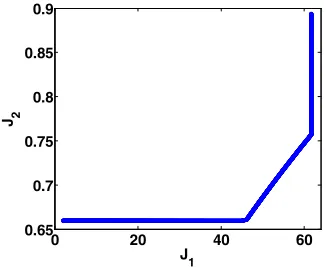
Figure 1 illustrates the Pareto front of bi-objective problem (10) using the presented method. There are 10001 points in Figure 1. We can see that all the points of the Pareto front are uniformly distributed.
0 20 40 60
[image:4.612.218.381.554.690.2]0.65 0.7 0.75 0.8 0.85 0.9 J1 J2
Summary
In this work, a linear approach has been presented to solve the bi-objective problem of optimizing a biochemical system. The presented approach is grounded on the S-system form of the nonlinear bi-objective problem. A NBI-based approach has been presented to solve the linear bi-objective problem obtained by the logarithmic transformations. An example has been illustrated to show the effectiveness of the presented linear approach.
Acknowledgement
This research was financially supported by the National Natural Science Foundation of China (No. 11101051), Liaoning Provincial Natural Science Foundation of China (No. 2015020038) and the Basic Research Fund of Liaoning Education Department (No. LF2017002).
References
[1] C. Pozo, G. Guillén-Gosálbez, A. Sorribas, L. Jiménez, Outer approximation-based algorithm for biotechnology studies in systems biology, Computers & Chemical Engineering 34 (2010) 1719-1730. [2] A. Marín-Sanguino, E.O. Voit, C. González-Alcón, N.V. Torres, Optimization of biotechnological systems through geometric programming, Theoretical Biology and Medical Modelling 4 (2007) 38.
[3] A. Marín-Sanguino, N.V. Torres, Optimization of tryptophan production in bacteria. Design of a strategy for genetic manipulation of the tryptophan operon for tryptophan flux maximization, Biotechnology Progress 16 (2000) 133-145.
[4] J. Vera, C. González-Alcón, A. Marín-Sanguino, N.V. Torres, Optimization of biochemical systems through mathematical programming: Methods and applications, Computers & Operations Research 37 (2010) 1427-1438.
[5] N.V. Torres, E.O. Voit, C. González-Alcón, Optimization of nonlinear biotechnological processes with linear programming: application to citric acid production by Aspergillus niger, Biotechnology
and Bioengineering 49 (1996) 247-258.
[6] E.O. Voit, Optimization of integrated biochemical systems, Biotechnology and Bioengineering 40 (1992) 572-582.
[7] G. Xu, Steady-state optimization of biochemical systems through geometric programming, European Journal of Operational Research 225 (2013) 12-20.
[8] G. Xu, Y. Li, Steady-state optimization of biochemical systems by bi-level programming, Computers & Chemical Engineering 106 (2017) 286-296.
[9] G. Xu, L. Wang, An improved geometric programming approach for optimization of biochemical systems, Journal of Applied Mathematics 2014 (2014) Article ID 719496.
[10] G. Xu, C. Shao, Z. Xiu, A modified iterative IOM approach for optimization of biochemical systems, Computers & Chemical Engineering 32 (2008) 1546-1568.
[11] G. Xu, Bi-objective optimization of biochemical systems by linear programming, Applied Mathematics and Computation 218 (2012) 7562-7572.
[12] G. Xu, C. Shao, W. Qian, Optimization and Control of Nonlinear Biochemical Processes, Science Press, Beijing, China, 2015.
[14] I. Das, J.E. Dennis, Normal boundary intersection: a new method for generating the Pareto surface in nonlinear multicriteria optimization problems, SIAM Journal on Optimization 8 (1998) 631-657.