University of Huddersfield Repository
Klaib, Ahmad and Osborne, Hugh
OE Matching Algorithm for Searching Biological Sequences
Original Citation
Klaib, Ahmad and Osborne, Hugh (2009) OE Matching Algorithm for Searching Biological
Sequences. In: International Conference on Bioinformatics, Computational Biology, Genomics and
Chemoinformatics (BCBGC09). ISRST, Orlando, Florida, pp. 3642. ISBN 9781606510094
This version is available at http://eprints.hud.ac.uk/id/eprint/9918/
The University Repository is a digital collection of the research output of the
University, available on Open Access. Copyright and Moral Rights for the items
on this site are retained by the individual author and/or other copyright owners.
Users may access full items free of charge; copies of full text items generally
can be reproduced, displayed or performed and given to third parties in any
format or medium for personal research or study, educational or notforprofit
purposes without prior permission or charge, provided:
•
The authors, title and full bibliographic details is credited in any copy;
•
A hyperlink and/or URL is included for the original metadata page; and
•
The content is not changed in any way.
For more information, including our policy and submission procedure, please
contact the Repository Team at: [email protected].
OE Matching Algorithm for Searching Biological Sequences
Ahmad Fadel Klaib and Hugh Osborne
Informatics Department, University of Huddersfield, Queensgate, Huddersfield, HD1 3DH, UK
E-mail: {a.klaib/ h.r.osborne} @hud.ac.uk
Abstract
String matching algorithms play a key role in many computer science problems, and in the implementation of computer software. This problem has received, and continues to receive a great deal of attention due to various applications in text manipulation, information retrieval, speech recognition, image and signal processing and computational biology. In this study, we propose a new algorithm called the Odd and Even algorithm (OE). OE combines an enhanced preprocessing phase from the Berry Ravindran algorithm with our proposed new searching phase procedure. This variety of searching order allows our proposed algorithm to reduce the number of comparison characters and enhances the searching response time. Experimental results show that OE algorithm offers a smaller number of comparisons and offers improved elapsed searching time when compared to other well-known algorithms for searching any length of alphabets and patterns. The proposed algorithm is applicable to searching protein sequence databases as well as any other string searching applications.
1. Introduction
Protein data can be found in many different forms such as sequences data, structure data, microarray data, and image data. Proteins are fundamental to the structure and the function of all living cells and viruses. Protein compounds are made of 20 different amino acids arranged in a linear chain. They are “complex organic compounds that consist of amino acids joined by peptide bonds" [1]. Computational biology and chemistry that use computational methods handle large amount of data. Protein sequence technologies have produced many extremely large sets of biological data which need faster techniques to process them.
The Swiss-Prot database is one of the main protein sequence databases containing descriptions of protein functions, domain structures, post-translational modifications and variants with a low level of redundancy and a high level of integration with other databases [2].
String-matching algorithms aim to find all occurrences of a given pattern P= p1p2…pm in a text T=t1t2…tn. They
work as follows: they first align the left ends of the pattern
and the text, then compare text characters with pattern characters and after a mismatch between the pattern and the text or a whole match between them they shift the pattern to the right. This procedure is repeated until the right end of the pattern reaches the right end of the text.
Most string-matching algorithms consist of a preprocessing phase and a searching phase to search for the pattern in the given text. The preprocessing phase analyses the characters in the pattern in order to use this information to determine the pattern shift in case of a mismatch or a whole match, with the aim of reducing the total number of character comparisons, while the searching phase defines the order of comparison of characters in each attempt between the pattern and the text. The main aim in algorithm development is to decrease the searching phase during each attempt and to increase the shifting value of the pattern.
String matching algorithms can be classified into seven categories according to the preprocessing function in the algorithm [3]. The first category, e.g. the Brute Force algorithm (BF) [4], shifts the pattern only one position at each attempt. The second category, which includes the Boyer-Moore algorithm (BM) [5]-[7] and the Fast Search algorithm (FS) [8], uses two preprocessing functions. The third category, a good example of which is the Boyer Moore Horspool algorithm (BMH) [9]-[11], uses one preprocessing function based on the rightmost character in the current window. The fourth category, e.g. the Quick Search algorithm (QS) [12], uses one preprocessing function based on the character next to the current window. The fifth category, such as the Berry–Ravindran algorithm (BR) [13], uses one preprocessing function based on the next two characters to the current window. The sixth category, e.g. the Karp-Rabin algorithm (KR) [14] and the Zhu Takaoka algorithm (ZT) [15], uses a preprocessing hashing function. The final category uses hybrid algorithms and includes the SSABS [16], TVSBS [17], ZTMBH [18], BRFS [19], BRBMH [20] and the BRQS [3] algorithms.
string-matching algorithms. Finally the conclusion is presented in section VI.
2. Related works
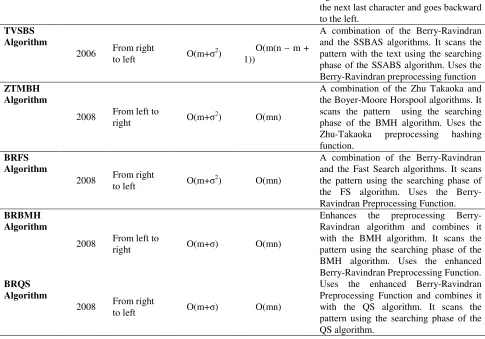
This section includes a survey of the main string-matching algorithms: the BR, KMP, BM, BMH, KP, ZT, QS, BR, FS, SSABS, TVSBS, ZTMBH, BRFS, BRBMH and the BRQS algorithms [21], [22]. Table 1 summarizes and compares these algorithms:
Algorithm Name
Year Comparison Order
Preprocessing Time
Searching Time Main
Characteristics
Brute Force
Algorithm Very Old
From left to
right N/A O(mn)
Shifts the pattern only a position each attempt. Not an optimal algorithm since it does not use the information that could be gained from the last comparison made
Knuth- Morris-Pratt
Algorithm 1974
From left to
right O(m)
O(mn)
Uses the notion of the border of the string. It increases performance, decreases delay, and decreases searching time compared to the Brute Force algorithm. It is efficient for large alphabets
Boyer-Moore
Algorithm 1977
From right
to left O(m+σ) O(mn)
Uses two preprocessing functions; the good-suffix shift and the bad-character shift. It is not very efficient for small alphabets
Horspool Algorithm
1980 From left to
right O(m+σ) O(mn)
Uses the Horspool bad-character preprocessing function based on the rightmost character in the current window. It is a simplification of the Boyer-Moore algorithm. It is faster than, and easier to implement than the Boyer-Moore algorithm
Karp-Rabin
Algorithm 1984
From left to
right O(m) O(mn)
Uses the Karp-Rabin preprocessing hashing function. It is very effective for multiple pattern matching in one-dimensional string matching
Zhu-Takaoka
Algorithm 1989
From right
to left O(m+σ
2) O(mn)
Uses the Zhu-Takaoka preprocessing hashing function. It is very effective for multiple pattern matching in two-dimensional string matching
Quick-Search
Algorithm 1990
From right
to left O(m+σ) O(mn)
Uses the Quick-Search bad-character preprocessing function based on the next character to the current window. It is especially fast for short patterns
Berry– Ravindran
Algorithm 1999
From left to
right O(m+σ
2) O(mn)
Uses the Berry-Ravindran preprocessing function based on the next two characters after the current window in order to increase the shifting value of the pattern
Fast Search Algorithm
2003 From right
to left O(m+σ
2) O(mn)
Uses the bad-character function only if the mismatching character is the last character of the pattern, otherwise the good-suffix function is to be used. It is efficient in very short patterns
SSABS
Algorithm 2004 From right
to left O(m+σ) O(m(n-m+1))
right most then the left most then it scans the next last character and goes backward to the left.
TVSBS Algorithm
2006 From right
to left O(m+σ
2) O(m(n – m +
1))
A combination of the Berry-Ravindran and the SSBAS algorithms. It scans the pattern with the text using the searching phase of the SSABS algorithm. Uses the Berry-Ravindran preprocessing function
ZTMBH Algorithm
2008 From left to
right O(m+σ
2) O(mn)
A combination of the Zhu Takaoka and the Boyer-Moore Horspool algorithms. It scans the pattern using the searching phase of the BMH algorithm. Uses the Zhu-Takaoka preprocessing hashing function.
BRFS Algorithm
2008 From right
to left O(m+σ
2) O(mn)
A combination of the Berry-Ravindran and the Fast Search algorithms. It scans the pattern using the searching phase of the FS algorithm. Uses the Berry-Ravindran Preprocessing Function.
BRBMH Algorithm
2008 From left to
right O(m+σ) O(mn)
Enhances the preprocessing Berry-Ravindran algorithm and combines it with the BMH algorithm. It scans the pattern using the searching phase of the BMH algorithm. Uses the enhanced Berry-Ravindran Preprocessing Function.
BRQS Algorithm
2008 From right
to left O(m+σ) O(mn)
[image:4.595.55.540.116.455.2]Uses the enhanced Berry-Ravindran Preprocessing Function and combines it with the QS algorithm. It scans the pattern using the searching phase of the QS algorithm.
Table 1: Summary of common string matching algorithms
3. Proposed algorithm
3.1. Preprocessing phase
In this phase, the proposed algorithm uses our enhanced brBc preprocessing function by counting the shifting values for each character in the pattern and storing them in the one-dimensional brBc array [20]. Fig. 1 shows the pseudo code for the pre-processing phase.
3.2. Searching phase
After implementing several algorithms, we found out that the best order in the searching phase is to compare the pattern and the text window characters from right to left.
Our proposed algorithm searches the pattern from right to left with new order. It starts with the last character of the text window and the pattern, and after a match, it moves backward to compare the odd index
positions of pattern and text window characters. If all these characters match, it will return and compare whole even index pattern and text window characters. In case of a mismatch or whole match during the comparison in odd or even positions it uses our enhanced brBc pre-processing function to shift the pattern. Fig. 2 shows the pseudo code for the searching process phase.
/*Pre-Processing Phase*/
FOR i=0 TO m-2
SET brBcShiftArray[i] TO m-i
END FOR
IF t[end]+1 = p[end] THEN
SET shiftvalue to 1
ELSE IF t[end]+2 = p[start] THEN
COMPUTE shiftvalue AS m+1
ELSE
COMPUTE shiftValue AS m+2
END IF
4. Working example
A sample file has been taken from the Swiss-Prot database which consists of 8740 proteins [23]. The following example illustrates our proposed algorithm:
Given:
Pattern(p)=“LAVKLATAIVLA”, length (m) =12
Text(n)=“KRFDSLYKQILAMGIFSIANQHIVLAV KLATAIVLATHTSPVVPVTTPGTKPDLNASFVSAN AE”, length(n)=64
4.1. Preprocessing phase
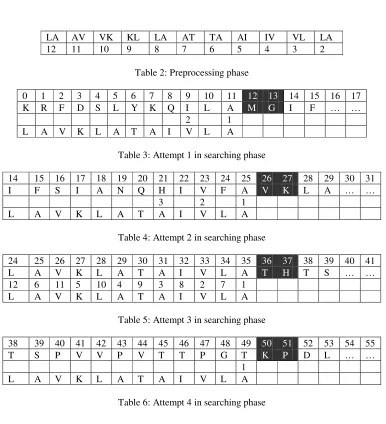
The shift values for the pattern characters are calculated according to Fig. 1. Table 2 shows the brBc one-dimensional array for the pattern characters.
4.2. Searching phase
The searching phase in this example is implemented according to Fig. 2. The following tables illustrate the searching phase for the given pattern (p) in the sample text (t).
4.2.1. Attempt 1: in this attempt, Table 3 shows that t0 –
t11 is the current text that is compared with the pattern p0
– p11. The t11 comparison with p11 has matched, so the
algorithm will move backward to the next odd index which compares t9 to p9 which causes a mismatch. The
pattern will be shifted to the right according to the pre-counted shifting value for the next two characters of the current window which are t12 and t13 (MG) and in this
attempt will shift by 14 positions.
4.2.2. Attempt 2: in this attempt, Table 4 shows that t14
– t25 is the current text which is compared with the p0 –
p11. The t25 comparison with p11 has matched, so the
algorithm will move backward to the next odd indices which are t23 and p9 which match. The next comparison
is between t21 and p7 which causes a mismatch. The
pattern will be shifted to the right according to the pre-counted shifting value for the next two characters of the current window which are t26 and t27 (VK) giving a shift
of 10 positions.
4.2.3. Attempt 3: in this attempt, Table 5 shows that t14
– t25 is the current text that is compared with the p0 – p11.
The first comparison between t35 and p11 produces a
match, so the algorithm will move backward to the next odd indexes which are t33 and p9 which produces a match
again. The next comparison is between t31 and p7 which
also produces a match. Then the same procedure is repeated until the all the odd indices match. It will then go back to the first even indexes (from the right) which they are t34 and p8. This produces a match also and it will
proceed to move back to compare further even indices. After a whole match between pattern and text it shifts the pattern to the right according to the pre-counted shifting value for the next two characters to the current window which are t36 and t37 (TH). In this attempt it will
be 14 positions.
4.2.4. Attempt 4: in this attempt, Table 6 shows that t38
– t49 is the current text that is compared with the p0 – p11.
The comparison of t49 with p11 causes a mismatch. The
pattern will be shifted to the right according to the pre-counted shifting value for the two characters next to the current window which are t50 and t51 (KP) and in this
attempt it will be 14 positions. But in this case the algorithm will cancel the pattern shifting since the length of the remaining text is 13 which is less than the pattern length.
/*Searching Phase*/
WHILE odd>=t[start] AND p[odd]=t[odd]
DECREMENT odd - 2
ENDWHILE
IF odd > t[start] THEN
WHILE even>=t[start] AND p[even]=t[even]
DECREMENT even – 2
ENDWHILE
ELSE
SET notMatch TO true
SET textPortion TO( t[end] +1) + ( t[end] +2)
CALL brBcShiftArray WITH textPortion
END IF
IF wholeMatch = true THEN
CALL brBcShiftArray WITH textPortion
END IF
END WHILE
/*Searching in the brBcShiftArray*/
FOR i=0 TO m
IF p[i] = textPortion THEN
SET shiftValue TO brBcShiftValue
END IF
END FOR
LA AV VK KL LA AT TA AI IV VL LA
12 11 10 9 8 7 6 5 4 3 2
Table 2: Preprocessing phase
0 1 2 3 4 5 6 7 8 9 10 11 12 13 14 15 16 17 K R F D S L Y K Q I L A M G I F … …
2 1
L A V K L A T A I V L A
Table 3: Attempt 1 in searching phase
14 15 16 17 18 19 20 21 22 23 24 25 26 27 28 29 30 31 I F S I A N Q H I V F A V K L A … …
3 2 1
L A V K L A T A I V L A
Table 4: Attempt 2 in searching phase
24 25 26 27 28 29 30 31 32 33 34 35 36 37 38 39 40 41 L A V K L A T A I V L A T H T S … … 12 6 11 5 10 4 9 3 8 2 7 1
L A V K L A T A I V L A
Table 5: Attempt 3 in searching phase
38 39 40 41 42 43 44 45 46 47 48 49 50 51 52 53 54 55 T S P V V P V T T P G T K P D L … …
[image:6.595.106.492.98.522.2]1 L A V K L A T A I V L A
Table 6: Attempt 4 in searching phase
5. Implementation
In this research, local machine (Dell Intel(R) Core™ 2 Duo Processors, CPU (1.80 GHz), 2 GB RAM and Windows Vista 32-bit Operating System) were used with Java SE 6 (JDK) software with update 10 including the Java Runtime Environment (JRE) and command-line development tools for producing applets and applications software.
6. Experimental results
To evaluate our new algorithm, we implemented it based on the code in Fig.1 and Fig.2. Additionally, we implemented six other algorithms; two of them are our previous algorithms using the enhanced brBc preprocessing phase; two developed in 2008 using the
original BR as the fastest algorithms to search the proteins; one of them using the rightmost character in the current window and the last one using only one character next to the current text window.
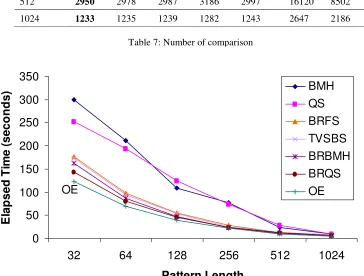
The performance of the algorithm proposed in this research is evaluated using the number of comparison between the pattern and the text and the elapsed time of searching.
Table I and Fig. I show that the number of comparisons and the elapsed searching time between the pattern and the text using our proposed algorithm is better in all cases than other algorithms.
6. Conclusion
In this paper, we have presented a new algorithm. The OE algorithm is a fast string matching algorithm. It combines our enhanced preprocessing phase from the Berry Ravindran algorithm with our new searching phase procedure. Experimental results show that our algorithm uses fewer comparisons to perform searches and has a shorter elapsed searching time. Our proposed algorithm is therefore suitable for searching the protein
sequences in the Swiss-Prot database as well as in any other string searching applications.
References
[1] V. Kurt, “Protein Structure Prediction using Decision Lists,” M.S thesis, Sch. Sci. Eng., Koç Univ., Istanbul, Turkey, 2005.
[2] A. Bairoch and R. Apweiler, “The SWISS-PROT protein sequence database and its supplement TrEMBL in 2000,“ Nucl. Acids Res, vol. 28, no. 1, pp. 45-48, Jan. 2000. [3] J. Mettetal. (2004, September 16). Brute Force
Algorithms: Motif Finding [Online]. Available: http://ocw.mit.edu/NR/rdonlyres/Mathematics/18-417Fall-2004/8BA 92AB3-A9CD-4719-A4AC-1AAFDB8AE5A0/0/lecture_03.pdf
Pattern
Length OE BRQS BRMH BRFS TVSBS QS BMH
32 95384 95498 95595 96356 95682 172936 161089
64 50973 51171 51202 52101 51258 133723 113597
128 26985 27099 27180 27388 27214 87426 59229
256 10012 10040 10058 11925 10075 45394 38005
512 2950 2978 2987 3186 2997 16120 8502
[image:7.595.98.462.217.493.2]1024 1233 1235 1239 1282 1243 2647 2186
Table 7: Number of comparison
OE
0
50
100
150
200
250
300
350
32
64
128
256
512
1024
Pattern Length
E
la
p
s
e
d
T
im
e
(
s
e
c
o
n
d
s
)
BMH
QS
BRFS
TVSBS
BRBMH
BRQS
OE
[4] A. F. Klaib and H. Osborne, “BRQS Matching Algorithm for searching Protein Sequence Databases,” unpublished. [5] G. Plaxton, (Fall 2005). String Matching: Boyer-Moore
Algorithm. [Online]. Available: http://www.cs.utexas.edu/users/plaxton/c/337/05f/slides/S tringMatching-4.pdf
[6] O. Danvy and H. K. Rohde, “Obtaining the Boyer-Moore String-Matching Algorithm by Partial Evaluation,” Information Processing Letters, vol. 99, pp. 158–162, 2006.
[7] R. S. Boyer, J. S. Moore, “A fast string searching algorithm,” Communications of ACM, vol. 20, no. 10, 1977, pp.762–772.
[8] D. Cantone, S. Faro, “Fast-search: A new efficient variant of the Boyer–Moore string matching algorithm”, Lecture Notes in Computer Science, vol. 2647, pp. 47–58, 2003. [9] M. Régnier and W. Szpankowski, “Complexity of
Sequential Pattern Matching Algorithms” Lecture Notes in Computer Science, vol. 1518, pp. 187-199, 2004. [10]T. RAITA, “Tuning the Boyer–Moore–Horspool String
Searching Algorithm,” Software-Practice and Experience, vol. 22, pp. 879-884, 1992.
[11]R. N. Horspool, “Practical fast searching in strings,” Software-Practice and Experience, vol. 10, no. 6, pp. 501-506, 1980.
[12]Sunday, "A very fast substring search algorithm," CommonACM, no. 33, pp. 132–142, 1990.
[13]Berry and Ravindran, "Fast string matching algorithm and experimental results,", Proceedings of the Prague Stringology Club, pp. 16–26, 2001.
[14]C. Charras, T. Lecroq, Handbook of exact string matching Algorithms. [Online]. Available: http://www-igm.univ-lv.fr/~lecroq/string/.
[15]R.F. Zhu, T. Takaoka, “On improving the average case of the Boyer-Moore string matching algorithm,” Journal of Information Processing, vol. 10, no. 3, pp. 173–177, 1987.
[16]S. S. Sheik, S. K. Aggarwal, A. Poddar, N. Balakrishnan and K. Sekar, “A fast pattern matching algorithm,” Journal of Chemical Information and Computer Sciences, no. 44, pp. 1251–1256, 2004.
[17]R. Thathoo, A. Virmani, S. S. Lakshmi, N. Balakrishnan and K. Sekar, “TVSBS: A fast exact pattern matching algorithm for biological sequences,” Current Science, vol. 91, no. 1, pp. 47–53, 2006.
[18]Y. Huang, X. Pan, Y. Gao, and G. Cai, "A Fast Pattern Matching Algorithm for Biological Sequences," IEEE, pp. 608 – 611, 2008.
[19]Y. Huang, L. Ping, X. Pan, and G. Cai, "A Fast Exact Pattern Matching Algorithm for Biological Sequences,"International Conference on BioMedical Engineering and Informatics, pp.8-12, 2008.
[20]A. F. Klaib and H. Osborne. “Searching Protein Sequence Database Using BRBMH Matching Algorithm,” International Journal of Computer Science and Network Security (IJCSNS), vol. 8, no. 12, pp. 410-414, 2008. [21]A. F. Klaib, Z. Zainol, N. H. Ahamed, R. Ahmad, and W.
Husain, “Application of Exact String Matching Algorithms towards SMILES Representation of Chemical Structures,” International Journal of Computer and
Information Science and Engineering, vol. 1, pp.235-239, 2007.
[22]A. F. Klaib, W. Husain and Z. Zainol, “Searching Similar Antimicrobial Structures Using Quick Search and Horspool Algorithms” International Journal: System and Information Sciences Notes, vol. 3, pp. 95-101, 2008. [23]Swiss Institute for Bioinformatics (SIB) and the European